_____________________________________________________________________________________________________
*Corresponding author: E-mail: [email protected]; ISSN: 2454-7352
Drip Irrigation in India: Prospects, Potential and
Challenges
Khusro Moin
1*and Azka Kamil
21Department of Geography, Kirori Mal College, University of Delhi, Delhi- 110007, India. 2
Department of Geography, Kamala Nehru College, University of Delhi, Delhi- 110049, India.
Authors’ contributions
This work was carried out in collaboration between both authors. Author KM designed the study, performed the statistical analysis, wrote the protocol and wrote the first draft of the manuscript. Author AK managed the analyses and the literature searches. Both authors read and approved the final manuscript.
Article Information
DOI: 10.9734/JGEESI/2018/44663 Editor(s): (1)Dr. Kaveh OstadAliAskari, Department of Civil Engineering, Isfahan (Khorasgan) Branch, Islamic Azad University,
Iran. Reviewers: (1) Mohamed Said Abdalla El Marazky, Agriculture Engineering Research Institute, Agriculture Research Center, Egypt. (2) Mustafa Ünlü, Cukurova University, Turkey. (3) Nusret Ozbay, Bingöl University, Turkey. Complete Peer review History: http://www.sciencedomain.org/reviewhistory/27064
Received 11 August 2018 Accepted 28 October 2018 Published 05 November 2018
ABSTRACT
The water crisis is assuming serious proportions in the world. If we look at the present scenario of water availability in India we observe that India with its per capita availability of less than 1600 m3 of water is a waterstressed country. The rising demand is likely to push it further to water scarce category if drastic measures of conservation and its efficient use is not promoted and adopted. The availability of water in India also shows variation in distribution from one region to another. Out of the total water consumption in the world about 70 percent is consumed by the agricultural sector. In India about 80 percent of the water goes to agricultural sector. It can be said that wasteful irrigation practices like flood and furrow irrigation are major culprits causing wastage of water leading to its crisis which is worsening day by day. The technology of drip irrigation comes with the solutions to save water and therefore its adoption in Indian context becomes indispensable. It is important for almost all the developing agrarian nations, which often face water scarcity due to hydro meteorological extremes like droughts, extreme events, etc., and are struggling hard to increase
crop productivity. Curtailment of waste and efficient use of water in the agricultural sector should be the priority of the nation if it seriously wants to tackle the issue. The major objective of this paper is to assess the potential, current status and identify challenges related to drip irrigation development in India.
Keywords: India; drip irrigation; prospects; potential; challenges.
1. INTRODUCTION
The burgeoning world population and ever increasing need of water is likely to cause water scarcity in the coming decades. India with a high population growth and millions of mouths to feed has immense pressure on agriculture. Even after seven decades of independence agriculture in India is primarily dependent on monsoons [1,2]. Farmers in India can play an active role in adopting efficient irrigation practices minimising the wastage of water to a great extent. A large proportion of farmers in India falls in the small and marginal category [3,4]. All this background gives a very critical picture of the future of agriculture in India unless some radical agricultural practices are introduced to raise the production. A look in the past few decades shows that the net sown area has increased from 118 million hectares in 195051 to about 140 million hectares in 2014. It has not shown any noticeable expansion since 1970. The green revolution in the late sixties has rescued us from food grain shortage and made us selfsufficient. This was possible through the use of HYV seeds, fertilizers and expansion of irrigation facilities through government’s initiatives. From about 16.9 percent of net irrigated area we have reached a figure of 40 percent. This progress is not without its cost. There have been serious consequences of indiscriminate withdrawal of water for irrigation [5,6]. The water table has gone down and expansion of irrigation in arid and semiarid areas has also caused the problem of salinity and water logging. In the light of limited land and scarce water resources the challenge of increasing agricultural production is immense. While research in the new varieties of seeds and their implications is going on across the world, new irrigation practices are also adopted to enhance water efficiency [7,8,9] Out of the total groundwater withdrawal about 75 to 80% goes to agricultural sector alone [9,10,11].
In the field of using innovation in irrigation practice drip method of irrigation was introduced in India in the early seventies in universities and research institutions. Its adoption gave encouraging results at these places. As a result
serious efforts began to be made towards its adoption in the eighties [12,13]. The practice has huge potential if our farmers adopt it in a big way. Adoption of drip method has borne fruits and countries like USA, Israel, Australia and Mexico have shown wider expansion of this practice. Israel is a country which has shown rapid progress in terms of its adoption, it also exports this technology and made it a profitable venture in commercial terms. They patented the first practical surface drip irrigation emitter [14,15]. The goal of adoption of drip irrigation in a big way in India is not as easy as it seems, it is full of constraints and challenges. The diverse physiography, size of population, economically weak farmers and types of crops grown limit its rapid spread and to a great extent acts as a hurdle in achieving a hundred percent utilization of its potential in the country. Proper assessment and identification of the potential a country holds and the major areas of challenges if addressed successfully would revolutionize the irrigation practice by saving wastage of over 50 percent of water every year along with increasing the output. This would go a long way towards the goal of ensuring food security and saving the scarce water resource [9,12,13,14,15,16,17].
food production of about 260 MT [18,19]. Increased frequency and intensity of climatic extremes due to the impacts of climate change is likely to adversely impact the availability and quality of water resource [18,20,21]. Many parts of the developing nations like India, experience seasonal water scarcity on a regular basis [19,20,21,22]. In order to mitigate regional and seasonal water scarcity and ensure food and nutrition security, and increase farmer income, it is necessary to conserve and store water through creation of all kinds of storage and adoption of new innovative practices [18,19].
India with17 percent of the world population has merely 4 percent of the world fresh water resources. It has a very low per capita water availability which puts it in the category of water stressed nation. The consumption of water to produce a unit of major food crop in India is 2 to 3 times more than Brazil and China. This indicates that it has very low water use efficiency in comparison with these countries. As mentioned earlier agricultural sector accounts for around 70 percent of the global freshwater withdrawals and the use of micro irrigation has potential to increase crop productivity while saving water. Therefore, its adoption in almost all the countries is one of the viable solutions that should be adopted immediately [19,23].
Several regions of India are facing severe water crisis. These comprise districts and subdistricts of southern and northern regions of Karnataka; Rayalseema region; Vidarbha and Marathwada; Rajasthan and Bundelkhand region. The water storage in reservoirs has depleted due to unsustainable irrigation practices further leading to acute scarcity of drinking water during drought years. Adoptions of water saving microirrigation technologies have proven extremely effective in not only reducing the wastage of water but also leading to higher crop yields. Studies revealed that microirrigation technologies have helped in bringing positive change in several areas of the country particularly in Deccan plateau region and western Rajasthan areas where no other methods of irrigation can work better [18,19,16].
Consecutive droughts occurring in 2012, 2015 and 2016 has led to the emergence of micro irrigation as a key policy priority in India for mitigating water scarcity. But, an indepth investigation into the criticalities across India’s varied farms and river basins, linked with water resource management reveals that micro irrigation program in India is coping with a risk of
failure, the study also raised the need for the identification of critical factors associated with microirrigation technologies [24]. The present paper investigates and compares the result of adoption of drip irrigation practices by agricultural universities and institutes. It also attempts to assess its impact on water conservation and crop production at the same time it seeks to identify the major challenges ahead that may obstruct its spread in the country on a wider scale.
2. MATERIALS AND METHODS
The present paper is mainly based on the secondary data sources collected from available interdisciplinary, historical and scientific literature. Therefore, the present paper investigates the result of adoption of drip irrigation practices by agricultural universities and analyses the benefits it may accord in terms of water conservation and increasing the production. Comparative analysis of drip and surface method of irrigation has been done with the help of data obtained from Haryana Agricultural University (Hissar, Haryana), Mahatma Phule Krishi Vidyapeeth (Rahuri, Maharashtra), Punjabrao Krishi Vidyapeeth (Akola). A temporal variation of progress in the drip irrigation technology has been represented through tables and figures. Further, data analysis has been done to assess the current status of drip irrigation in India; on the basis of data analysis challenges related to drip irrigation development have been identified.
3. RESULTS AND DISCUSSION
3.1 Comparative Analysis of Drip and Surface Method of Irrigation
3.1.1 Increased productivity of crops
study. A look into the report of INCID, 1994 [1] that has compiled the results of different agricultural research centres of the country would
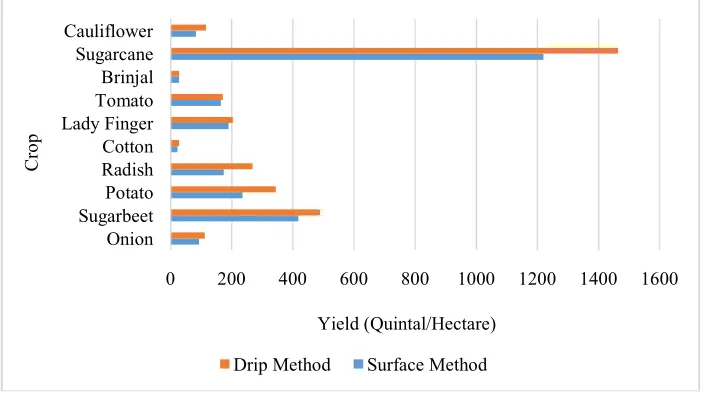
give the figures of actual changes in the level of productivity that has been brought about due to drip irrigation (Fig. 1, Table 1, Table 2, Table 3).
Fig. 1. Comparative study of drip and surface method of irrigation
Source: Based on Data Obtained from Haryana Agricultural University, Hissar, Haryana (INCID, 1994), Mahatma Phule Krishi Vidyapeeth, Rahuri, Maharashtra and Punjabrao Krishi Vidyapeeth, Akola
Table 1. Comparative advantage of drip irrigation method over surface method of irrigation (Onion, Sugarbeet, Potato, Radish)
Crop Water consumption (in mm)
Surface method Drip method
Onion 602 451
Sugarbeet 495 371
Potato 200 150
Radish
Source: Haryana Agricultural University, Hissar, Haryana (INCID, 1994)
Table 2. Comparative advantage of drip irrigation method over surface method of irrigation (Cotton, Ladyfinger, Tomato, Brinjal, Sugarcane)
Crop Water saving by drip over surface method of irrigation (%)
Increase in yield by drip over surface method of irrigation (%)
Cotton 53 26
Lady Finger 55 8
Tomato 27 5
Brinjal 55
Sugarcane 30 10
Source: Mahatma Phule Krishi Vidyapeeth, Rahuri, Maharashtra
Table 3. Comparative advantage of drip irrigation method over surface method of irrigation (Cauliflower, Tomato, Brinjal)
Crop Water saving by drip over surface method of irrigation (%)
Increase in yield by drip over surface method of irrigation (%)
Cauliflower 34 39
Tomato 31 29
Brinjal 61 62
Source: Punjabrao Krishi Vidyapeeth, Akola
0 200 400 600 800 1000 1200 1400 1600
Onion Sugarbeet Potato Radish Cotton Lady Finger Tomato Brinjal Sugarcane Cauliflower
Yield (Quintal/Hectare)
C
ro
p
Experimental studies on drip irrigation undertaken by CWC, 1991 shows a saving of about 27 to 59 percent of water on different crops. Along with that it shows a rise in productivity varying from 5 to 27 percent (Fig. 1, Table 1, Table 2, Table 3). Besides the above tables there have been other experimental results that bear out the fact that drip irrigation gives increased yields [1]. Results of few institutes discussed below show increased yield in varying degrees with the practice of drip irrigation. The University of Agricultural Sciences, Bangalore in their experiment with Pomegranate has shown an increase of 250 percent in yield. The Rajasthan Agricultural University, Udaipur in its result states that drip system has increased their yield by 65 percent and saved about 49 percent of water. Similarly Gujarat Agricultural University, Navsari reported 30 percent water saving on banana cultivation with 16 percent increase in yield. Potato has shown 54 percent water saving with 15 percent increase in yield. And in tomato there was 30 percent increase in yield with 47 percent saving of water. Dr. A. K. Randev (2015) has observed an increase in productivity of different crops in the range of 23 to 32 percent from 2002 to 2012. Research on water intensive crops like banana, grapes and sugarcane revealed an increase of 29, 19 and 23 percent in their production respectively with the practice of drip irrigation. All this and many more studies taking different crops for research have shown positive results in their output.
3.1.2 Higher efficiency of irrigation
The water which was earlier lost through seepage and evaporation during its conveyance from tube wells or canals to the field is
completely controlled. The supply of water which is exactly as per the requirement of the crop reduces wastage to negligible level. It is this water saving potential of this practice which makes it indispensable in the modern day agriculture. Some research results discussed below will prove its efficiency. The Rajasthan Agricultural University, Udaipur shows a saving of about 49 percent of water. Gujarat Agricultural University, Navsari reported 30 percent water saving on banana cultivation. Potato has shown 54 percent water saving and in tomato 47 percent of water was saved. Punjabrao Krishi Vidyapeeth in their study shows a saving of water varying between 30 to 60 percent. Similar study by Mahatma Phule Krishi Vidyapeeth, Rahuri shows a saving of 27 to 55 percent of water in different crops. Many other studies in addition to the ones which are discussed and shown in the tables above have reported a high saving on water of more than fifty percent with the use of drip method of irrigation. This water saved by using drip irrigation can be utilized for agriculture in water scarce regions and the wastage can be transformed into resource. The drip irrigation system has major advantages in terms of increased productivity and water use efficiency. Besides these two advantages there are many other associated benefits discussed below.
3.1.3 Benefit cost analysis
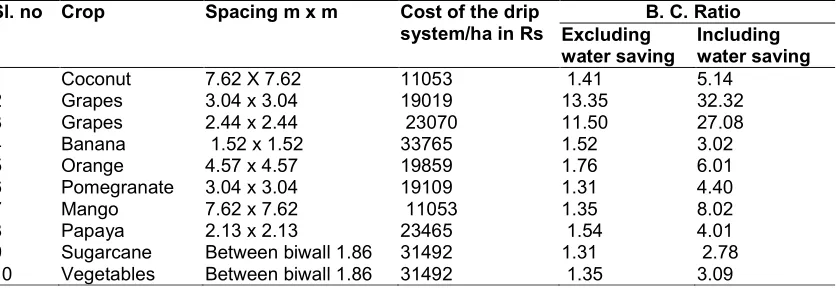
The changeover to drip system of irrigation will provide benefit to farmers as their returns would rise appreciably from the saving of water, increase in production and saving on power consumption (Table 4).
Table 4. Benefit-cost ratio factor of drip irrigation over conventional irrigation for various crops
Sl. no Crop Spacing m x m Cost of the drip system/ha in Rs
B. C. Ratio Excluding
water saving
Including water saving 1 Coconut 7.62 X 7.62 11053 1.41 5.14
2 Grapes 3.04 x 3.04 19019 13.35 32.32 3 Grapes 2.44 x 2.44 23070 11.50 27.08 4 Banana 1.52 x 1.52 33765 1.52 3.02 5 Orange 4.57 x 4.57 19859 1.76 6.01 6 Pomegranate 3.04 x 3.04 19109 1.31 4.40 7 Mango 7.62 x 7.62 11053 1.35 8.02 8 Papaya 2.13 x 2.13 23465 1.54 4.01 9 Sugarcane Between biwall 1.86 31492 1.31 2.78 10 Vegetables Between biwall 1.86 31492 1.35 3.09
It clearly indicates the benefit cost ratio estimated excluding water saving varies from 1.31 in sugarcane to 13.35 in grapes but if water savings are incorporated the average benefit cost ratio of the crops varies from 2.7 in sugarcane to 32.2 in grapes which is remarkable (Table 4). There were doubts about the methodology adopted for the calculation of the CostBenefit Ratio as these calculations were similar to the inputoutput ratio and also the assumptions were not clearly stated. Understanding the limitation of the work Narayanmoorthy [4] had carried out his own study and computed both the Net Present Worth (NPW) and the BenefitCost Ratio (BCR) by utilizing the discounted cash flow technique. NPW is the difference between the sum of the present value of benefits and that of costs for a given life period of the drip set. It collates the total benefits with the total costs covering items like capital and depreciation costs of the drip set. The BCR as computed by him without including the subsidy for banana and grapes was 2.28 and 1.76 respectively. Besides these other studies carried out at farm level by different researchers reveal the fact that by all means it is a winwin situation for farmers as adoption of drip method of irrigation is economically viable for every category of farmer.
3.2 Benefits of Drip Irrigation Technology
3.2.1 Restricts weed growth and insect infestation
Due to the precise and optimum supply of water directly to the roots it restricts the growth of unwanted plants (weeds) in the vicinity of the crop which makes the crop grow with vigour and keep its maintenance easy. It further cuts down the expenditure on labour as frequent weeding is not required at all thus bringing down the overall operational cost [1,3,12,15,19].
3.2.2 Suitable for different kinds of soils
This offers an added advantage of irrigating all kinds of soils which are otherwise very difficult to irrigate in the flooded method of irrigation. Soils which are very light with deep percolation of water can be irrigated at the same time very heavy soils that have very low infiltration rate can also be easily brought under irrigation [1,12,14,15,19].
3.2.3 Enhances fertilizer efficiency
Due to the adequate supply of water at the required points it reduces the loss of important
nutrients through leaching and surface runoff. It thus provides nutrients to the exact requirement of the plants without any wastage of fertilizer. This makes the fertilizer use more efficient without its wastage [1,3,12,15,18,19].
3.2.4 Use of saline water
Saline water can also be used for irrigation. If regular irrigation is done and flow is maintained it keeps the root zone free from any harmful accumulation of salts. The regular irrigation keeps the salt away from the soils by leaching it away to the periphery. Study by Kumar and Sivanappan (1983) has reported that drip irrigation offers an advantage of irrigating land with the saline water also. Aggarwal et.al. (1981) also noted this advantage in drip irrigation [15,18,19].
3.2.5 Suitable for all kinds of topography
This advantage of drip irrigation makes it very distinct as it can irrigate fields with high gradient and reach uneven terrain, rolling hills where other means of irrigation are irrelevant and impractical. This irrigation practice does not require making the field even which is very important if other forms of irrigation are practiced [1,15,18,19,25].
3.2.6 Soil erosion is reduced
As water is supplied slowly for a longer period of time to its root no surface runoff occurs, therefore, no soil erosion takes place. It checks the movement of fertilisers to the surface water and restricts pollution of water bodies also [15,25].
3.2.7 Low labour requirement
Besides providing a rise in productivity, saving of 40 – 70% of water and providing economic benefits to the farmer, it brings down the requirement of labour also. The labour requirement for weeding and spraying of pesticides for pest control is reduced in this irrigation practice because water is delivered exactly in the required amount and at the precise point leaving very little for other unwanted plants to grow and proliferate. This reduction in weeds also reduces insects and pests which otherwise under suitable conditions had multiplied in the vicinity of the crops [15,18,19,25].
3.3 Decadal Expansion of Drip Irrigation
maximum area under drip irrigation and results of research pursued by different universities in India all point to the fact that its adoption is advantageous and profitable than sticking to the old practice of irrigation , its benefit far outweigh the disadvantages. There is no doubt about the
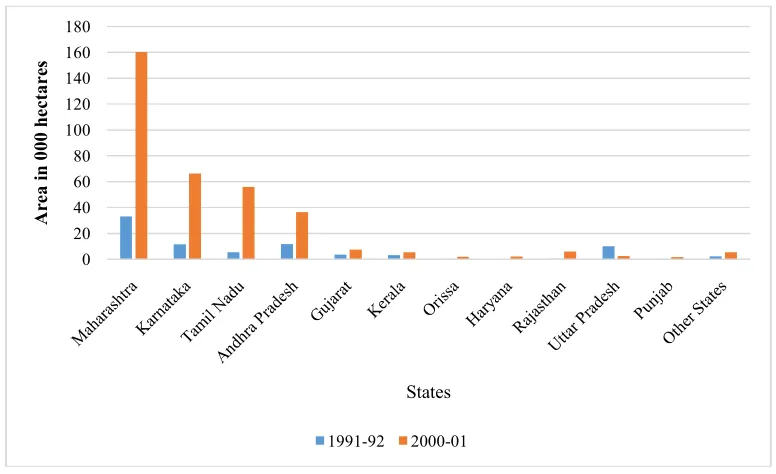
potential it holds for revolutionising the agricultural sector in future yet we have lagged behind in its adoption. The following section looks into its expansion over a period of time and also its concentration in specific states (Fig. 2 to Fig. 4).
Fig. 2. Expansion of area under drip irrigation between the 1991-92 and 2000-01
Source: Based on data obtained from AFC 1998 and GOI 2004 [5]
Fig. 3. State wise share of area under drip irrigation in % (1991-92)
Source: Based on data obtained from AFC 1998 and GOI 2004 [5]
0 20 40 60 80 100 120 140 160 180
A
re
a
i
n
0
0
0
h
e
c
ta
r
es
States
1991-92 2000-01
Maharashtra Karnataka Tamil Nadu Andhra Pradesh
Gujarat Kerala Orissa Haryana
Fig. 4. State wise share of area under drip irrigation in % (2000-01)
Source: Based on data obtained from AFC 1998 and GOI 2004 [5]
Area under Drip Method of Irrigation (DMI) has increased from 1,500 ha hectares in 1985 to 70 859 hectares in 1991– 92 [1]. From 70 thousand hectares in 1991 it went up to 367 thousand hectares in the year 200001 i.e. a fivefold increase in its area. The increase in one decade is remarkable which was possible because of government’s concerted bid, receptive attitude and enthusiastic effort on the part of the farmers particularly from the states of Maharashtra,
Karnataka, Tamil Nadu and Andhra Pradesh. These four states together covered more than 90% of the area of the country under drip irrigation in 200001. Figs. 5 and 6 shows the status of the year 2015 and percent of area under drip irrigation. It presents a very encouraging picture as the total area under drip irrigation has gone up to 3.3 million hectares which is nearly ten times the figure of 3.6 lakh hectares in the year 200001.
Fig. 5. State wise Area Covered under Drip Irrigation in India (2015-16)
Source: Based on data of Horticultural Statistics at a Glance 2015 [6]
Maharashtra Karnataka Tamil Nadu Andhra Pradesh
Gujarat Kerala Orissa Haryana
Rajasthan Uttar Pradesh Punjab Other States
0 100000 200000 300000 400000 500000 600000 700000 800000 900000 1000000
A
re
a
in
H
ec
ta
re
Fig. 6. State wise % share during 2015-16 (Area Covered under Drip Irrigation in India)
Source: Based on data of Horticultural Statistics at a Glance 2015 [6]
There has been a tremendous increase in the area under drip irrigation of Maharashtra, Karnataka and Tamil Nadu which have witnessed about fivefold increase yet their percentage share has come down on account of the rise in the percentage share of states like Gujarat, Andhra Pradesh, Rajasthan and Madhya Pradesh. States like Punjab, Haryana, and Rajasthan have shown remarkable improvement in the absolute area as well as percentage. Share of Gujarat has risen from mere 2.7 percent in 200001 to 12.8% in 2015. Its area has risen 55 times i.e. from mere 7600 hectares to 423771 hectares. Rajasthan has also shown an increase in percent from 1.6 to 5.4 which are remarkable by all accounts. Its area has increased from 6000 hectares in 200001 to 181,943 hectares in 2015 which is 30 times the earlier figure.
Along with these states Punjab and Haryana too have shown noticeable increase in their area under drip irrigation. The figures no doubt are impressive and the rate of increase is also remarkable yet it constitutes a mere 5% of the net irrigated area of the country which is very low. To attain a high positive change in water saving target and increase in yield it is important to bring more land under drip irrigation. This aim is not easy because there are certain genuine hurdles which need to be effectively tackled. Some of
the key problems that need a permanent solution have been discussed in the subsequent
parts.
3.4 Problems and Constraints in its Adoption in India
Preceding sections of the paper through documented evidence bear out the fact that drip irrigation is the need of the hour if we want to achieve the conflicting goals of feeding the rising population and saving our scarce water resources. As discussed earlier there is a mere 5 percent share of drip irrigation in the total net irrigated area of the country. The target to bring at least one third of irrigated area under drip irrigation is not easy to achieve as there are certain problems that need in depth deliberations and radical policy changes. There are some key issues that have relevance in present socio – economic set up of the country which has been discussed in the following section.
3.4.1 High Initial Investment and poor access to the subsidies
This is a major hurdle in the country which has hindered the adoption of drip irrigation in a big way. Installation of a new set up of drip irrigation requires a minimum investment of about Rs 25000 to 50000 which looking at the economic status of our farmers seems somewhat impossible. To overcome this obstacle the government of India has provided subsidy to different state governments targeting the small and marginal farmers. The Maharashtra state government has allocated a subsidy to the tune of 2282.35 lakhs during the period 19861993.
Andhra Pradesh Chhattisgarh Gujarat Haryana
Karnataka Kerala Madhya Pradesh Maharashtra
Odisha Punjab Rajasthan Tamil Nadu
Government of India had introduced 2.5 billion proportional schemes in the VIII plan on the use of plastics in agriculture, having components such as drip irrigation, drip demonstration, plastic machinery etc. The government of India sanctioned a centrally sponsored subsidy scheme in the year 198283 (sixth five year plan). Central government provided a subsidy of 50% to the farmer with a matching contribution from the state governments for installation of device [1]. Out of the total subsidy 75% was meant for small and marginal farmers. Same plan with little modification continued in the seventh plan as well.
As per the agricultural census 201011 about 48 % of net irrigated area constitute the small and marginal landholdings and 44% comes under semi medium and medium holdings while a mere 8% is large holdings. Since the government targets only the small and marginal farmers who could not afford these new systems even at the subsidised cost the Scheme did not get good results in the VII plan period (stated in the report of the working group for formulation of 8th plan, MoWR,1989)
In the eighth plan a budget of 1.88 million was allocated towards subsidy component. A subsidy for 50% of the cost of drip irrigation system was offered to farmers [1]. State government also took initiative and started their respective subsidy scheme for the farmers. Since the government provides subsidy of about 50% rest of the amount has to be generated by the farmer who can obtain this amount from the banks. NABARD has taken various initiatives to provide access of loans to farmers. These steps have shown some results yet there is a long way to go and government needs to plan more wisely by regularly assessing the impact of their Schemes and policies as many subsidy schemes fail to reach the farmers.
3.4.2 Shorter lifeline of pipes and tubes
The pipes and tubes which are exposed to the sun face extreme climates in Indian condition due to which they do not last very long. It cracks and breaks and requires regular and effective monitoring and maintenance. Emitters are often clogged if water is not clean and not properly filtered. This regular clogging and other associated expenditure raises costs of its operation which run against the possibility of its adoption as it puts an additional economic burden on the poor farmers. This is generally
viewed as a costly set up suitable for farmers with large landholdings.
3.4.3 Lack of awareness and training
A sizeable population of the farmers even in this present age of IT revolution is not acquainted with the benefits of adopting drip irrigation. Those who know about it find the system too difficult to manage and operate. There is a lack of trained hands also. The government should carry out a consistent campaign through media and educate farmers. An arrangement of training of farmers should be made in different district offices where they can be educated and trained for its use and management. There is a general lack of awareness among the farmers regarding its use and advantages.
3.4.4 Suitable for widely spaced crops
Drip irrigation is more suitable for widely spaced crops though this technology has been applied to more than 80 crops. Crops like mango, banana, coconut, grapes and pomegranate are the main crops which are irrigated by drip method of irrigation. Its use can be extended to other crops also but unwillingness on the part of farmers and increasing costs hinders their expansion.
3.5 Potential and Prospects of its Expansion
The expansion of drip irrigation with the help of government schemes, subsidies and its benefits to the farmers has gathered pace in the nineties and is continuously on the move ever since. India has an irrigated area of 65 million hectares which constitute about 40% of the net sown area. The drip irrigation holds immense potential in the country if adopted in a big way. Few organisations and individuals have attempted to calculate the actual potential the country holds for the expansion of drip irrigation and arrived at different figures. Task force on micro irrigation has given a figure of 27 million hectares of area which can be brought under drip irrigation (Tables 7 and 8).
Table 7. Drip irrigation potential area
Crops Area (Mha) Drip Sprinkler Total
Cereals 27.6 27.6
Pulses 7.6 7.6
Oil Seeds 3.8 1.1 4.9
Cotton 7.0 1.8 8.8
Vegetables 3.6 2.4 6.0
Spices and condiments 1.4 1.0 2.4
Flowers and Medicinal and aromatic plants 1.0 1.0
Sugarcane 4.3 4.3
Fruits 3.9 3.9
Coconut & Plantation Crops, Oil Palm 3.0 3.0
Total 27.0 42.5 69.5
Source: Task force on micro irrigation (TFMI, GOI 2004)
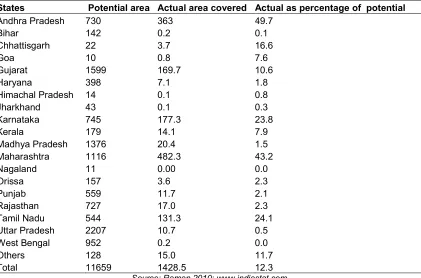
Table 8. Potential and Actual Area under Drip Irrigation (in 000 ha as on 2009)
States Potential area Actual area covered Actual as percentage of potential
Andhra Pradesh 730 363 49.7
Bihar 142 0.2 0.1
Chhattisgarh 22 3.7 16.6
Goa 10 0.8 7.6
Gujarat 1599 169.7 10.6
Haryana 398 7.1 1.8
Himachal Pradesh 14 0.1 0.8
Jharkhand 43 0.1 0.3
Karnataka 745 177.3 23.8
Kerala 179 14.1 7.9
Madhya Pradesh 1376 20.4 1.5
Maharashtra 1116 482.3 43.2
Nagaland 11 0.00 0.0
Orissa 157 3.6 2.3
Punjab 559 11.7 2.1
Rajasthan 727 17.0 2.3
Tamil Nadu 544 131.3 24.1
Uttar Pradesh 2207 10.7 0.5
West Bengal 952 0.2 0.0
Others 128 15.0 11.7
Total 11659 1428.5 12.3
Source: Raman 2010; www.indiastat.com
As regards the actual utilisation of the potential drip irrigation area Andhra Pradesh with 49% and Maharashtra with 43% of utilisation are the states with higher utilisation rate. Larger states like Uttar Pradesh with a potential of 2207 thousand hectares has only 0.5% of utilisation, Rajasthan 2.3%, Punjab 2.1%, Madhya Pradesh 1.5% of the actual utilisation of the potential. Most of the estimates of the potential have been calculated taking into account only the irrigated land, as a
result a large tract of land which is unirrigated because of water scarcity, uneven or difficult terrain and salinity or poor soil conditions have been kept outside the consideration of bringing them under irrigation through drip irrigation practice.
practice has the potential of reaching those areas which seemed impossible to irrigate in earlier practice of flood method of irrigation. Transforming this size of land which lay unused into a productive land with the help of drip irrigation would not only add to the pool of net
sown area but also go a long way in securing food to its rising population. As per the
government data on horticulture about 23.41 million hectares of land was under
horticulture in 201415 [6]. This includes fruits,
vegetables spices, flowers and plantation crops together. The figure of 23 million hectares
is not small by any measure and if efforts are made to bring almost all this land under drip irrigation we will have a substantial area of the country under this innovative irrigation
practice. The target of bringing all this area under drip irrigation is not a distant dream rather it is very real and practical because drip irrigation is a practice which is very suitable for cultivating vegetables, sugarcane, fruits and various other plantation crops.
The prospects of expansion of drip irrigation in India is immense as we have a large section of that area which has remained outside our consideration but which with the use of drip irrigation be transformed into a productive agricultural land. Adding up the Cultivable wasteland and Area under Horticulture we arrive at a figure of about 36 million hectares which is about half of the net irrigated area of the country. It is a common belief that drip irrigation is suitable for water scarce regions only which is untrue as it is equally beneficial to those regions which have an adequate water supply. By promoting drip irrigation in regions which are rich in water resource, it solves certain problems which these regions are going through. It checks the fast falling water table due to indiscriminate withdrawal of water for irrigation. This falling water table is a serious problem faced by states like Uttar Pradesh, Punjab, Haryana and Bihar. Punjab, which is a major foodgrain producing state of India, is facing serious problem of falling water table, waterlogging and salinity. The southwestern districts of the state face the problem of water logging and associated soil salinity. These include the districts of Muktsar, Fazilka, Bhatinda and Faridkot irrigated by the Sirhind canal. Lying in close proximity, are the areas experiencing groundwater overdraft and declining trend in ground water; these are Northern and Central districts [26]. Drip irrigation has the potential to address the problems of
falling water table, water logging and salinity. It checks the wasteful withdrawal of water. Through proper and precise distribution of water at the required points drip irrigation controls excessive seepage and the resultant water logging. All the studies have proved that drip irrigation is the best watersaving irrigation practice that ensures more than ninety percent efficiency. It irrigates the land without being harmful to the soil [27].
4. CONCLUSION
Due to the regular effort on the part of the government through various schemes to help farmers adopt this practice India has reached the figure of about 3.3 million hectares of land under drip irrigation in the year 2015. It is very encouraging to see that there has been a very rapid expansion of this method of irrigation; it is also equally true that we are very low in terms of the actual percentage (5 percent) of drip irrigated area to the net irrigated area of the country. There is also a lack of uniform distribution as only four to five states account for more than ninety percent of the total area under drip irrigation and rest others have very low to a negligible area even after decades of planning and execution. A major hurdle in the adoption of this practice is the high initial cost which discourages small and medium farmers from adopting this. Even though efforts have been made to provide subsidies to these farmers very specifically, they are reluctant to adopt it and a lot of them have no access to the subsidy schemes of the government. There is a need to broaden the base of beneficiary farmers by including large farmers in it through some sort of incentive schemes and also propagating the benefits of this practice through media, training workshops etc. The expansion of drip irrigation also needs some radical policy reforms that pave the way for swift spread and adoption of this practice. By various assessments it has been concluded that there is immense potential in the country to adopt and increase its areal coverage it is now upon the farmers and various stakeholders of the society to realise its importance and take lead in adopting this practice on a priority basis in the larger interest of the nation.
COMPETING INTERESTS
REFERENCES
1. INCID (Indian National Committee on Irrigation and Drainage). Drip Irrigation in India. Indian National Committee on Irrigation and Drainage, New Delhi; 1994.
2. Narayanamoorthy A. Drip irrigation: A viable option for future irrigation development. Productivity. 1997;38(3): 504511.
3. Narayanamoorthy A. Drip irrigation for sustainable agriculture. Productivity. 1999; 39(4):672680.
4. Narayanamoorthy A. Economics of drip irrigation in sugarcane cultivation: Case study of a farmer from Tamil Nadu. Indian Journal of Agricultural Economics. 2005;60(2):235248.
5. GOI (Government of India). Report of Task Force on Microirrigation, Ministry of Agriculture, Government of India, New Delhi; 2005.
6. Directorate of Economics and Statistics. Horticultural Statistics at a Glance 2015. Ministry of Agriculture, New Delhi; 2016. 7. Irrigation Research Management
Improvement Organisation, Central Water Commission, New DelhiDrip Irrigation System and Its Relevance in Better Water Use; 1991.
8. Raman S. Statewise microirrigation potential in India An assessment. Unpublished Paper. Natural Resources Management Institute, Mumbai; 2010. 9. Palanisami, Raman. Potential and
challenges in upscaling microirrigation in India. Iwmitata Water Policy Programme; 2012.
10. Directorate of Economics and Statistics. Agricultural Statistics at a Glance 2003, Ministry of Agriculture, New Delhi; 2004. 11. Directorate of Economics and Statistics.
Agricultural Statistics at a Glance 2014, Ministry of Agriculture, New Delhi; 2015.
12. Keller J, Blisner RD. Sprinkler and trickle irrigation. Chapman and Hall, New York, USA; 1990.
13. NCPA (National Committee on the Use of Plastics in Agriculture). Status, potential and approach for adoption of drip and sprinkler irrigation systems. National
Committee on the Use of Plastics in Agriculture, Pune, India; 1990.
14. NCPAH (National Committee on Plasticulture Applications in Horticulture). Status of Drip and Sprinkler Irrigation in India. National Committee on Plasticulture Applications in Horticulture. New Delhi: Government of India; 2005.
15. Sivanappan RK. Prospects of micro irrigation in India. Irrigation and Drainage Systems. 1994;8(1):4958.
16. Dhawan V. Water and agriculture in India. OAVGerman Agribusiness AllianceTERI; 2017.
17. Ministry of Agriculture & Farmers Welfare. Operational Guidelines of Per Drop More Crop (Micro Irrigation) Component of PMKSY. Department of Agriculture, Cooperation & Farmer Welfare, Division of Rainfed Farming System (RFS), Krishi Bhavan, New Delhi, India; 2017.
18. ICID (International Commission on Irrigation & Drainage). Proceedings of the First India Irrigation Forum. India Irrigation Forum, New Delhi, India; 2016.
19. IAI–FICCIGrant Thornton. Accelerating growth of Indian agriculture: Micro irrigation an efficient solution (Strategy paper Future prospects of micro irrigation in India); 2016.
20. Khetwani S, Singh RB. Groundwater dynamics in Marathwada Region: A spatio temporal analysis for sustainable groundwater resource management. International Journal of Conservation Science. 2018;9(3):537548.
21. Khetwani S, Singh RB. Assessment of hydrological drought in Marathwada Region: A spatiotemporal analysis. Journal of Geography, Environment and Earth Science International. 2018;17(1):1 10.
DOI: 10.9734/JGEESI/2018/43612
22. Singh RB, Khetwani S. Climate change, energy security and sustainable development. World Focus. 2017;38(6):5 11.
23. FAO (Food and Agriculture Organization). Water for sustainable food and agriculture. United Nations, Rome, Italy; 2017.
25. NABARD and ICRIER. Water productivity mapping of major Indian crops; 2018. 26. Planning Commission. Report of the high
level expert group on water logging in Punjab. Government of India; 2013.
27. Palanisami K, Kadiri M, Kakumanu KR, Raman S. Spread and economics of microirrigation in India: Evidence from Nine States. Economic & Political Weekly. 2011;46(2627):8186.
_________________________________________________________________________________ © 2018 Moin and Kamil; This is an Open Access article distributed under the terms of the Creative Commons Attribution License (http://creativecommons.org/licenses/by/4.0), which permits unrestricted use, distribution, and reproduction in any medium, provided the original work is properly cited.
Peer-review history:
![Fig. 4. State wise share of area under drip irrigation in % (2000-01) Source: Based on data obtained from AFC 1998 and GOI 2004 [5]](https://thumb-us.123doks.com/thumbv2/123dok_us/8377040.1677267/8.612.137.477.481.689/fig-state-wise-share-irrigation-source-based-obtained.webp)
![Fig. 6. State wise % share during 2015-16 (Area Covered under Drip Irrigation in India) Source: Based on data of Horticultural Statistics at a Glance 2015 [6]](https://thumb-us.123doks.com/thumbv2/123dok_us/8377040.1677267/9.612.135.479.92.298/state-covered-irrigation-india-source-horticultural-statistics-glance.webp)