~ 368 ~ WWJMRD 2017; 3(11): 368-372
www.wwjmrd.com International Journal Peer Reviewed Journal Refereed Journal Indexed Journal UGC Approved Journal Impact Factor MJIF: 4.25 e-ISSN: 2454-6615
Surinder Kaur
Student, MRSTU, Bathinda Punjab, India.
Abhilasha Jain
Assistant Professor, MRSTU, Bathinda Punjab, India.
Correspondence: Surinder Kaur
Student, MRSTU, Bathinda Punjab, India.
Energy Efficient Technique for Selecting Distributed
Weighted Clustering and Distributed Weighted Sensor
Node
Surinder Kaur, Abhilasha Jain
Abstract
WSN is wireless sensor network having energy as major resource. It makes ensure that life time of the network can grow. All the protocol primary issue is to control the network various issues, which leads to energy loss. This network consists of various wireless sensor nodes. Each sensor node collect the data and using hierarchy of the network sends to the base or sink node for further processing. In existing research work they have used V-Leach protocol. In which they select vice cluster head. When cluster head energy become zero vice cluster head become cluster head. In current research the energy saving technique is used. Based on the weight of the each sensor node to the cluster head, minimum weight sensor node will be selected. This sensor node will transfers the data to the cluster head then to the sink node. That means every node in the cluster head will not transfers the data to the cluster head. This is assumed that every node need not to transfer the data because nearby nodes will have same type of data. This technique has shown improvement in terms of average energy consumed by each node and Number of dead nodes count.
Keywords: WSN, Cluster, V Leach.
Introduction
Wireless Sensor Networks (WSN) is the innovation that comprises of expansive number of small sensor hubs disseminated in a specially appointed way. Sensors are by and large spread over a land range in profoundly thick way. These sensor hubs are of ease and low power which can perform different capacities.
Fig. 1: Sensor Network [3]
In WSN, the sensor nodes are deployed in a sensor field. The deployment of the sensor nodes can be random (i.e.dropped from the aircraft), regular (i.e. well planned or fixed) or mobile sensor nodes can be used. Sensor nodes coordinate among themselves to produce high-quality information about the physical environment. Each sensor node bases its decisions on its mission, the information it currently has, and its knowledge of its computing, communication, and energy resources. Each sensor nodes collect the data and route the data to the base station. All of the nodes are not necessarily communicating at any particular time and nodes can only communicate with a few nearby nodes. The network has a routing protocol to control the routing of data messages between nodes.
The routing protocol also attempts to get messages to the base station in an energy-efficient manner.
The base station is a master node. Data sensed by the network is routed back to a base station. The base station is a larger computer where data from the sensor network will be compiled and processed. The base station may communicate with the Remote Controller node via Internet or Satellite. Human operators controlling the sensor network send commands and receive responses through the base station.
Nowadays, agriculture needs tools and technology to improve the efficiency and quality of production and reduce the environmental impact on the crop. The wireless sensor network is primarily used in precision agriculture. The precision agriculture deals with the application the required quantity of water, fertilizer, pesticides etc at the required time in order to enhance improve quality and productivity, while ensuring zero damage to the environment. A wireless sensor nodes cluster together to form a network with each node having the capability to process. It consists of one or more microcontrollers, CPUs or DSP chips, may contain multiple types of memory (program, data and flash memories), have a RF transceiver (usually with a single Omni-directional antenna), have a power source (e.g., batteries and solar cells). The nodes are
arranged in an ad hoc fashion and communicate wirelessly. India primarily being an agricultural country faces many problems concerning agriculture such as crop productivity and quality resulting in shortcomings in quantity that can be exported and utilizing the agricultural lands for other sources such as building construction and tourist spot. The agriculture in India requires more attention to be paid to the farming activity and farmers, more research regarding latest agriculture tools and testing the quality of various innovative ideas. So, here we study the application of Precision Farming (PF) that aims to improve the revenue by utilizing more precise information recorded using technologies available for sensing and communicating.
Hierarchical sensor networks
Each sensor node usually belongs to only one cluster and
communicates directly to its cluster head, instead of the
base station. All cluster heads collect sensed data from
their respective clusters and form a network among them
in order to send the collected data to the base station.
Compared to flat architecture, hierarchicalmodel achieves
advantages in various design objectives like: Energy
conservation, Data aggregation, Load balancing and
Connectivity.
Fig. 2: Hierarchical sensor networks [3]
Literature Survey
1. M. Kumrawat et. al (2015): In wireless Ad-hoc network performance and security are the primarily concern of research and development. In this presented work wireless sensor network is considered for energy optimization and network scaling, therefore a number of techniques are explore and weighted clustering algorithm is prepared for solution optimization. The evaluation results and simulation demonstrates the performance of energy efficient Weighted Clustering Algorithm provides long network lifetime and enhanced energy optimization. 2. A. Singh et. al (2016) et al: In this paper, cluster head
and vice cluster head selection is discussed and a method of energy efficient routing is presented based on both particle swarm optimization technique and V-LEACH protocol. Performance comparison with existing leach protocol shows proposed protocol provides better performance to minimize energy dissipation in the transmission and increases the life time of the wireless sensor networks, also other comparative performance metrics like End to End delay, data transmitted and total energy consumed
shows proposed protocol provides better performance in comparison to existing leach protocol.
3. Anjali (2015) et al: Wireless sensors are small devices that have the functions of sensing, communicating, and information processing. The critical issue among Wireless Sensor Networks is energy efficient utilization of sensor nodes in order to enhance the network survivability. This paper proposes a protocol i.e. (Distance Adaptive Threshold
Sensitive Energy Efficient Sensor Network)
DAPTEEN based on Threshold-Sensitive Energy Efficient Sensor Network Protocol (TEEN) and Adaptive Periodic TEEN (APTEEN) hierarchical protocols for removing data redundancy and hence to enhance energy efficiency.
~ 370 ~
farmers towards proper cultivation. Here they propose a WSN protocol named APTEEN protocol that helps to increase network lifetime of the nodes by periodic
monitoring of the sensor nodes and communicating the necessary parameters to the farmers for taking action.
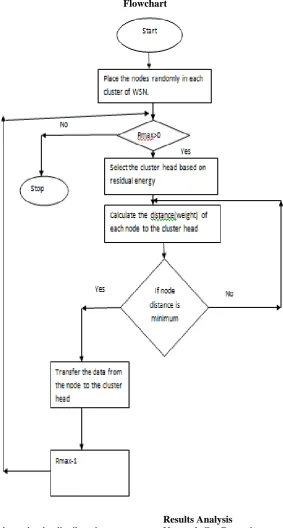
Flowchart
Algorithm
Step1 Build a network with randomly distributed sensor nodes.
Step2 Sub divide the network into smaller parts called as clusters.
Step3 Select cluster head and vice cluster head in each cluster based on residual energy and least distance from other nodes in same cluster.
Step4 Select the node which has least distance to the cluster head.
Step5 accepts the data from this node and reject the data from other nearby nodes in same cluster.
Step6 Collected data will be transmitted to the base station.
Stape7 Measure the Energy consumed and Dead nodes count.
Results Analysis Network Configuration
Table 1. Configuration Table
Parameters Values
Number of Nodes 200
Initial Energy 0.1
Rotations 25,50,100
Area 100m*100m
No of sink Nodes 1
Sink Position 150,50
Parameters Taken
1. Average Energy of Each Node: Average Energy of
2. Number of Dead Nodes: it is count of dead nodes left after the total communication, whose energy become zero after 100 iterations.
Energy Consumption for V-Leach
In Existing research the V-leach is identification of path based on distance is calculated. Also in a cluster each node sends the data to the cluster head and then to the base station. While communication each heterogeneous node has remaining energy. In current research less energy is consumed in communication. By electing one sensor node in one cluster who will transfers the data to the cluster head and then to the base station will save energy as residual energy. Because consumed energy is less.
Fig. 3: Average Energy consumption comparison of Existing and proposed.
Dead Nodes for V-Leach
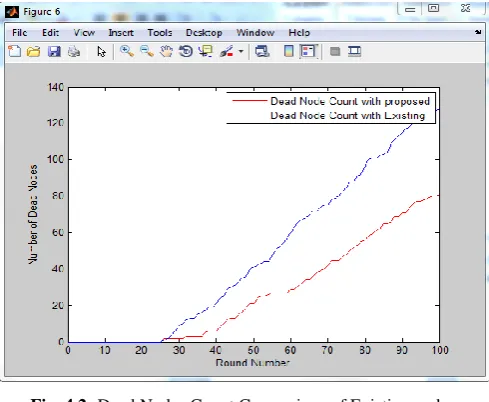
In V-Leach the dead node count starts from 18th round.
That mean selection a vice-cluster head will leads to more energy dissipation in both 25 and 50 rounds of communication.
Fig. 4.2: Dead Nodes Count Comparison of Existing and proposed
In this case the number of dead nodes count has improved.
Dead node starts to occur after 20th round. That means
total network will remain efficient for longer period of time.
Percentage Improvement
Table 2: Percentage Improvement
Parameters Existing Proposed Improvement (%)
Energy
Consumption 0.0874 0.0414 52%
Dead Nodes Count 47.94 27.0396 43%
Tabulation shows that the both parameters like energy consumption and the dead node count has improved compared to the existing technique. Energy consumption has improved to 52%. And the dead Nodes count has improved to 43%.
Conclusion
WSN is wireless sensor network. This network consists of various wireless sensor nodes. Each sensor node collect the data and using hierarchy of the network sends to the base or sink node for further processing. In existing research work they have used V-Leach protocol. In which they select vice cluster head. When cluster head energy become zero vice cluster head become cluster head. In current research the energy saving technique is used. Based on the weight of the each sensor node to the cluster head, minimum weight sensor node will be selected. This sensor node will transfers the data to the cluster head then to the sink node. That means every node in the cluster head will not transfers the data to the cluster head. This is assumed that every node need not to transfer the data because nearby nodes will have same type of data. This technique has shown improvement in terms of average energy consumed by each node and Number of dead nodes count. WSN is the network consists of heterogeneous members. This network consists of randomly distributed nodes. In future this network efficiency can be further checked based on another performance parameters like packet delivery ratio and throughput etc.
References
1. Mohini Kumrawat, Manoj Dhawan,” Optimizing
Energy Consumption in Wireless Sensor Network through Distributed Weighted Clustering Algorithm”, vol.3 pp.345-351, 2015.
2. Alka Singh, Shubhangi Rathkanthiwar and Sandeep
Kakde,” Energy Efficient Routing of WSN using
Particle Swarm Optimization and V-Leach
Protocol”,vol. 3 pp.789-795, 2016
3. Anjali1, Anshul Garg2 and Suhali3 “Distance
Adaptive Threshold Sensitive Energy Efficient Sensor Network (DAPTEEN) Protocol in WSN” 2015 conference (ISPCC).
4. Harneet Kour1 Ajay K Sharma,” Performance
Evaluation of HEED and H-HEED Protocol for Realistic Models in WSN” IEEE International Conference on Computer, Communication and Control (IC4-2015).
5. Xin Tan and S.S. Iyengar, “Localization in
Cooperative Wireless Sensor Networks: A Review,”
6. M. R. Ghafouri Fard, ”Angle of Arrival Localization
for Wireless Sensor Networks,”
7. Ravi chander Janapati, H.C. So, W.K. Ma, Y.T. Chan,
~ 372 ~
8. Kai Yik Tey, H. Lichtenegger, and J. Collins, Global
Positioning System: Theory and Practice, 3 rd ed. New York, NY: Springer-Verlag, 2014.
9. Chen Liang, H. Balakrishnan, E. Demine, and S.
Teller, “Anchor Free Distributed Localization in Sensor Networks,” Tech Report “Designing a positioning system for finding things and people indoors,”.
10.
Hanen Ahmadi, C. Lanzl, “Designing a positioningsystem for finding things and people indoors,”
Spectrum, IEEE, 35(9), 71-78, 2013.
11. Yao-Hung Wu, “A distributed location system for the
![Fig. 1: Sensor Network [3]](https://thumb-us.123doks.com/thumbv2/123dok_us/8370320.1674996/1.595.266.465.559.668/fig-sensor-network.webp)
![Fig. 2: Hierarchical sensor networks [3]](https://thumb-us.123doks.com/thumbv2/123dok_us/8370320.1674996/2.595.199.405.344.489/fig-hierarchical-sensor-networks.webp)