ISSN 2307-4523 (Print & Online)
© Global Society of Scientific Research and Researchers http://ijcjournal.org/
Survey on Window and Linux as Server Operating System
Shahid Hussain
a*, Faisal Bahadur
b, Faqir Gul
c, Arif Iqbal
d, Ghazala Ashraf
e,
Sumat Nazeer
fa,b,c,d,e,f Department of Information Technology, Hazara University, Mansehra , Pakistan
aEmail: [email protected]
bEmail: [email protected]
cEmail: [email protected]
d
Email: [email protected]
e
Email: [email protected]
fEmail: [email protected]
Abstract
Microsoft Windows and Linux are both increasing in terms of server operating system market share. Windows, which only a few years ago was not considered up to the business of supporting critical system requirements, is now the primary server operating system for many companies--and not just small organizations. Linux, which in the late 1990's was considered a hobbyist toy, now is the leading operating system in some applications such as web servers and is part of the intentional technology platform for major vendors such as IBM and Oracle. With both Windows and Linux improving in their proficiencies, we analyze the relative merits of each operating system. This research paper (survey on Window and Linux as server operating system) which provides detailed results of the survey and our analysis of the findings.
Keywords: Linux, window and server
1. Introduction
Linux and Windows are two operating systems that are continuously challenging from control of the computer market [1]. Proprietary software is basically software that companies use to make a profit while open source software is usually free software that distributes its source code to the public. Both operating systems have shown significant growth in the server world.
Microsoft released its first server OS in 1993 under the name Windows NT, just about the time that the Linux OS began developing on the internet. Since then Windows servers and Linux servers began growing by leaps and bounds. Many servers that were run by UNIX began converting to Linux, a style that would continue into the early twenty‐first century. Windows NT use began growing largely due to the fact that NT introduced the first 32‐bit implementation of the Windows API. An API includes the protocol, routines, and libraries needed for application building. By 2000, Windows and Linux each controlled roughly half of the overall server market. The Linux side contained such as NetWare, BSD, and Debian‐based Linu [2]x. However by 2008, Windows controlled 38.8 percent of the overall server market share compared to Linux’s 12.7 percent. However this data is based on total revenue of both servers and most Linux server software distributions are free and sales are rarely documented. As of 2009, five of the top ten most reliable servers ran Linux, three ran FreeBSD, and only two ran Windows. Some examples include Google, Yahoo, YouTube, and Facebook and key governmental agencies such as the US Army. Linux is by far the choice of operating system for many major websites. One of the few major website we could find that ran Windows was by no wonder windows.com. In many peoples’ minds Linux is the only opinion for quality web servers, but for others nothing is easier than the “point and click” charm of Windows. Ever since 1993, Linux and Windows have both attempted to gain control of the server market. There are many advantages and disadvantages to both operating systems in the server world. The paper is divided in following section. Section 2 explain research question, section 3 explain survey methodology, section 4 explain results and at the last conclusion.
2. Research question
• Which system is the best choice for a specific organization, or a specific application?
• What criteria should an IT manager use when he is considering these two os?
3. Survey Methodology
To answer these questions, we designed a simple two question survey. First we asked respondents to indicate how Linux compares to Microsoft Windows as a server operating system. ( our survey did not ask about any specific Linux distribution or version of Windows Server, such as Windows Server 2003 or Windows Vista.) We asked our respondents to consider eight major attributes:
• Ease of initial installation
• Ease of ongoing administration
• Security
• Reliability
• Flexibility
• Scalability
• Availability of skilled support staff
In evaluating each operating system, respondents to indicate which operating system is better for each of the eight attributes, as follows:
• Linux much better (score 1)
• Linux somewhat better (score 2)
• Linux and Windows are about the same (score 3)
• Windows somewhat better (score 4)
• Windows much better (score 5)
• No opinion (score 6)
In our analysis, we dropped responses for "no opinion" and then averaged the remaining responses for scores 1 through 5. We then calculated the average score, subtracted it from 3, and took the absolute value of the remainder. The result is that scores of zero mean that the two operating systems are about the same, and scores between 0 and 2 for each operating system reflect the intensity of the opinion in favor of that operating system.
Next, we asked respondents to indicate which of the following best characterizes their primary experience with each operating system:
• User
• IT manager
• System administrator, engineer, or programmer
• None
• The second question thus allowed us to open the survey to all willing participants, but to categorize responses in our analysis according to the experience of the respondents.
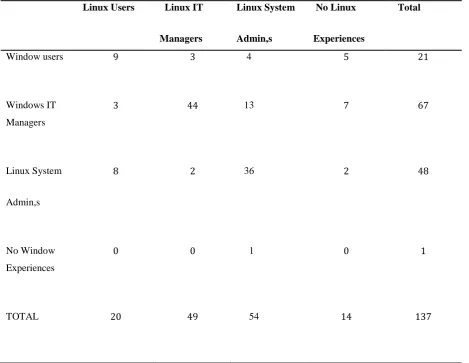
There were a total of 137 respondents to this survey, broken down by primary experience with each operating system as shown in Figure 1. In analyzing the results of this survey, we isolated the responses for three groups, as shown by the shaded cells in Figure 1.
The 44 IT managers that have experience in managing both Microsoft Windows and Linux. Because this group has experience in organizations running both operating systems, they should be most qualified to have an opinion about management aspects of Windows versus Linux.
The 36 system administrators, engineers, and programmers (referred to hereafter as, simply, system
administrators), with experience in technical support or programming using both operating systems. Because this group has experience administering both operating systems, they are the best group to ask about technical aspects of Windows versus Linux.
Table 1: Table of Microsoft Window Server VS Linux: Survey Demographics
Linux Users Linux IT
Managers
Linux System
Admin,s
No Linux
Experiences
Total
Window users 9 3 4 5 21
Windows IT Managers
3 44 13 7 67
Linux System
Admin,s
8 2 36 2 48
No Window Experiences
0 0 1 0 1
TOTAL 20 49 54 14 137
4. Results
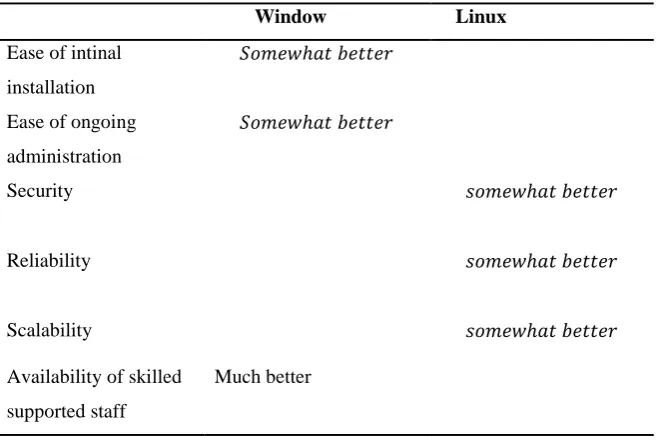
One way to evaluate the results of this survey is to look at the number of attributes where each system was rated better than the other, as shown in Table 1.
From this perspective, Linux is the winner, taking the lead in five out of eight categories. Individuals with equivalent experience on both operating systems said (on average) that Linux is "somewhat better" than Windows in terms of security, reliability, flexibility, scalability, and total cost of ownership. The same individuals--again, with equivalent responsibilities for both operating systems--said that Windows (on average) is "somewhat better" in terms of ease of initial installation, ease of on-going administration, and "much better" in terms of availability of skilled support staff.
These differences which provides the detailed responses for system administrators with experience on both operating systems, versus IT managers with responsibility for both operating systems, versus all survey respondents. The analysis on the relative merits of each operating system, and it provides guidelines for choosing between Linux and Windows based on these eight criteria.
Table 2: Table of Microsoft Window Server VS Linux: Summry of advanteges
Window Linux
Ease of intinal installation
𝑆𝑜𝑚𝑒𝑤ℎ𝑎𝑡 𝑏𝑒𝑡𝑡𝑒𝑟
Ease of ongoing administration
𝑆𝑜𝑚𝑒𝑤ℎ𝑎𝑡 𝑏𝑒𝑡𝑡𝑒𝑟
Security 𝑠𝑜𝑚𝑒𝑤ℎ𝑎𝑡 𝑏𝑒𝑡𝑡𝑒𝑟
Reliability 𝑠𝑜𝑚𝑒𝑤ℎ𝑎𝑡 𝑏𝑒𝑡𝑡𝑒𝑟
Scalability 𝑠𝑜𝑚𝑒𝑤ℎ𝑎𝑡 𝑏𝑒𝑡𝑡𝑒𝑟
Availability of skilled supported staff
Much better
There is no single operating system that is the right choice for every organization and every application. Many organizations find that the best approach is to run multiple operating systems. Linux and Windows are only two choices; there are many others; that said, for organizations that are deciding between Windows and Linux,
When evaluating Windows versus Linux as a server operating system, our survey provides insights on the relative advantages of each operating system for eight criteria. IT managers can use these insights to make informed decisions on the operating system that best meets the particular needs and priorities of their organizations.
5. Conclusion
References
[1] Cabrera, Joe. "Windows vs. Linux: A Comparative Study." (2009). Available :
http://www.freewebs.com/joemusicproductions/LinuxvWindows.pdf
[2] Chaudhary, Varun, Kuldeep Kaur, and Mikanshu Rani. "OPERATING SYSTEM SELECTION USING
AHP ON THE BASIS OF SECURITY, PERFORMANCE AND COST." International Journal of Computing
and Business Research (IJCBR) ISSN (Online) : 2229-6166 Volume 5 Issue 2 March 2014AVAILABLE
http://www.researchmanuscripts.com/March2014/3.pdf
[3] Hunt, C. (1999). Linux Network Servers 24seven. SYBEX Inc..Available
http://www.amazon.com/Linux-Network-Servers-24-Seven/dp/0782125069
[4] Zadok, Erez. Linux NFS and Automounter Administration (Craig Hunt Linux Library). Sybex, 2001.
Available ftp://ftp.sybex.com/2739/2739idx.pdf