ISSN 2307-4531
http://gssrr.org/index.php?journal=InternationalJournalOfComputer&page=index
Improving Performance of Ad Hoc On-demand Distance
Vector (AODV) Routing Protocol in Wireless Sensor
Network
Hnin Yu Swe
a*, Soe Soe Khaing
ba
Department of Information and Communication Technology, Yatanarpon Cyber City, Pyin Oo Lwin 05081,
Myanmar
b
Department of Information and Communication Technology, Yatanarpon Cyber City, Pyin Oo Lwin 05081,
Myanmar
a
Email:[email protected]
b
Email: [email protected]
Abstract
Ad hoc On-Demand Distance Vector (AODV)isa routing protocol for mobile ad hoc networks (MANETs) and other wireless ad hoc networks. This paper attempts to modify AODV to enhance network performances on wireless sensor network (WSN). The main idea of modified AODV is using multi metrics in route decision instead of single hop count metric. The modified AODV considers energy factor and node lifetime in route decision in order to maintain the connectivity of the network as long as possible. Simulation results conducted in network simulator (NS-2) prove that the effectiveness of modified AODV in terms of throughput, average end-to-end delay, routing overhead, dropped packet ratio and energy consumption and so on. There is significant decrease in average end to end delay, control overhead and dropped packet ratio by using modified AODV protocol under the varying traffic load.
Keywords: AODV; WSN; modified AODV; NS-2
--- * Corresponding author.
E-mail address: [email protected].
1.Introduction
Since the main task of the wireless sensor network is to transmit data from target area towards the sink node, the optimal method to forward data packets between each pair of source-sink is an important issue to be addressed in developing these networks. Due to the restricted feature of the wireless sensor networks [1], routing in this network is much more challenging compared to the traditional ad hoc network. First of all, according to the high density of sensor node, routing protocol should be able to support data transmission over distances, regardless of the network size. In addition, some nodes may fail during network operation due to energy depletion of the sensor nodes, hardware breakdown or environmental factors, but this issue should not interrupt the normal network operation. Furthermore, routing protocol in wireless sensor network should be able to satisfy the QoS (quality of service) requirements. Routing protocol in WSNs has been researched through numerous studies, nevertheless, several important research issues that should be further investigated. The conventional on demand routing algorithms[6], such as DSR, AODV, that are being unaware of nodes’ energy, establishes connections between nodes through the shortest path routes. These algorithms may result in a quick depletion of the battery power of the nodes along the most heavily used paths in the network. How to balance the Qos requirement and energy considerations is a big challenge. This paper focuses on improving the reliability of routes in order to achieve better performance of the AODV routing protocol in wireless sensor network. The rest of this paper is organized as followed. Section two includes the briefly description of AOD. In section three, we described modified AODV with energy metric. Performance evaluation and conclusion are described in section four and five.
2. Ad hoc On-Demand Distance Vector (AODV)
AODV [3] is reactive routing protocol, that is route is established only when the source node want to transmit data packet. The main processes of AODV are route discovery and route maintenance. In route discovery phrase, two control packets are used to discover route. They are broadcast route request (RREQ) packet and uncast route reply (RREP) packet. When the source node has a data packet to send to an intended node in the network, it starts route discovery process. Firstly, the source node checks whether it already has a route in its routing table. If the valid route exists in its routing table, it sends the packet to the destination on the specified route. Otherwise, it starts the route discovery procedure to find a route to that destination. The source node prepares the RREQ packet with source identifier (SrcID), destination identifier (DestID), source sequence number (SrcSeqNum), destination sequence number (DestSeqNum), the broadcast identifier (BcastID), and
time to live (TTL) field and broadcasts it to neighbors. DestSeqNum indicates the freshness of the route that is used to prevent route loop. When an intermediate node receives a route request RREQ, it either forwards it or prepares a route reply (RREP) if it has a valid route to the destination. The intermediate node sends a reply to the request if it is the destination, or if it has a valid route to the destination. Otherwise, it creates a reversed route entry by keeping routing parameters from RREQ packet such as hop count for both the source node and the node from which it receives the request. Then it increases the hop count value and updates the RREQ and then forwards this RREQ. During this route request phrase, the intermediate node updates their routing tables with a route that has least hop count for the reversed path of RREP. Finally, the destination node receives the first RREQ packet, it send the reply RREP packet to the source. If a route request RREQ is received multiple
times, which is indicated by the BcastID-SrcID pair, the duplicate copies are discarded.When a node receives a control message from a neighbor, it checks its routing table for an entry of the destination. If an entry does not exist, store the information of the route from which the received control packet in order to forward the data packet to this next node as the next hop toward the destination. If an entry exists, it compares the destination sequence number in the entry and in the message. The route is updated if either
•The sequence number in route table entry is lower than the one in the control message or
• The sequence numbers are equal, but the hop count of control packets is smaller than the existing hop count in the routing table or
•The sequence number is unknown.
3. Modified AODV
Two energy metrics, energy factor (EF) and node lifetime (Nlt) are integrated into AODV in an efficient way so that the ad hoc sensor network has a better performance and energy consumption of each node across the network is reduced. The control packets RREQ,RREP and routing table of AODV are modified by adding new parameters such as EF and Nlt. Energy Factor is the ration of how much of energy is consumed during packet transmission. To calculate Energy Factor (EF) that we consider, the following equation is used.
EF = ER ⁄ Ei (1)
where ER is residual or remaining energy and Ei is Initial energy of a node. Initial energy of a node can be varied depending on the user input. It is assigned when a node is initially created. ER is calculated as follow.
ER = Ec − (Et + Er) (2)
Ec is current energy of a node, Et and Er are transmission and reception energies and calculated as follow.
Et = (Pt× 8 ×packet_size) ⁄ Bandwidth (3)
Er = (Pr × 8 ×packet_size) ⁄ Bandwidth (4)
where, Pt and Pr are the transmission and reception power of a node. The node lifetime is also an important factor to be considered to choose the best optimal route. It is calculated based on nodes remaining energy and time. In this work, a very simple model is used to calculate node lifetime. The lifetime of the node is calculated by,
Nlt = (Ep − Ec) ⁄ (Tc − Tp) (5)
where, Ep is previous energy of a particular node and Ec is current energy of a particular node, Tc is current time and Tp is the previous time. Each node updates the routing table according to the following situation.
•The sequence number in route table entry is lower than the one in the control message or
• The sequence numbers are equal, but the hop count of control packets is smaller than the existing hop count in the routing table and energy factor (EF) and node life time Nlt in control message are greater than in the table, i.e., (hop count in message< hop count in table) & ( EF in message > EF table) & (Nlt in message > Nlt in table)or
•The sequence number is unknown.
4. Performance Evaluation of AODV and modified AODV
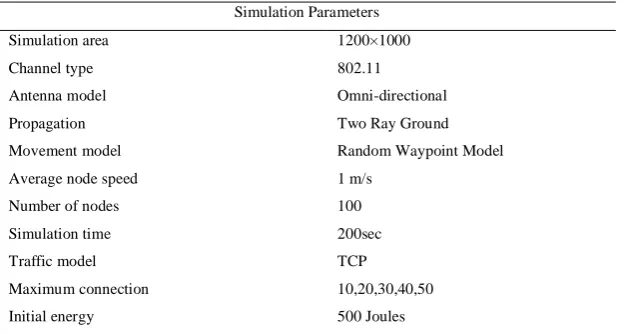
Table I. Simulation Parameters
Simulation Parameters
Simulation area 1200×1000
Channel type 802.11
Antenna model Omni-directional
Propagation Two Ray Ground
Movement model Random Waypoint Model
Average node speed 1 m/s
Number of nodes 100
Simulation time 200sec
Traffic model TCP
Maximum connection 10,20,30,40,50
Initial energy 500 Joules
Network simulator (NS-2) [10] is used to evaluate the performance differences of AODV and EN-AODV. Simulation is set up with 802.11 wireless channel and 802.11 Mac at the physical and data link layer. Nodes move randomly within the 1200× 1000 area with various speed for about 200 seconds.FTP (file transfer protocol) applications of TCP are generated with default TCP window size 32 and the packet size 512 bytes. The initial energy of nodes is set to 500 joules. The parameters for analysis are listed in Table. The performance of modified AODV is studied under varying condition of the traffic load.
4.1. Simulation Results: The effect of traffic load
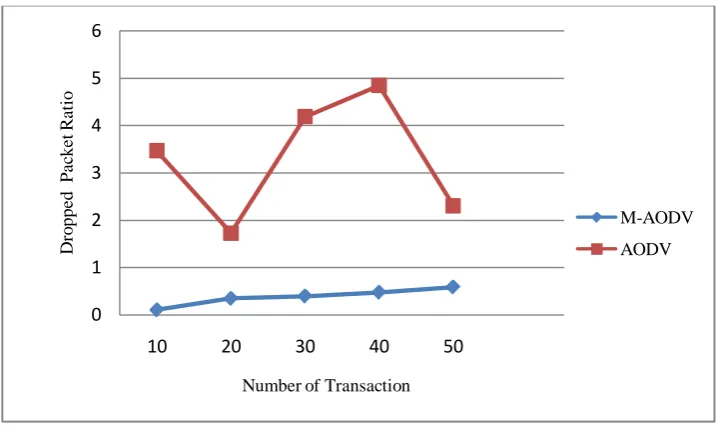
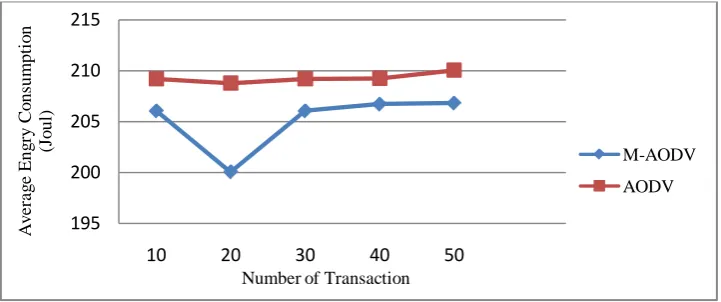
To study the effect of traffic load on the network performance, number of connections was varied as 10, 20, 30, 40 and 50 connections. The network was simulated with mobility scenario keeping 1 meter per second and the pause time 10 seconds and other related parameters as shown in table. Graphs in Fig 1-6 show the effect Traffic Load for modified AODV and AODV protocols with respect to various performance metrics.
(a) Throughput
In figure 1, both modified AODV and AODV generally work well in different traffic load. But modified AODV has higher throughput at 10, 30 and 40 connections and throughput of modified AODV slightly decreases at 20 and 50 transaction compared to AODV.
Fig 1: Max. Number of Connections Vs Throughput (bits/Sec)
(b) Dropped Packet Ratio
As the traffic load increases packets dropped will also increase because bandwidth requirement increases when the traffic load increases. Packet that the MAC layer is unable to deliver is dropped due to less link reliability between two nodes having higher distance. Modified AODV uses multi metrics in route selection instead of single hop metric, so it can drop fewer packets compared to AODV.
Figure 2: Max. Number of Connections Vs Dropped packet ratio
(c) Packet Delivery Fraction
Modified AODV and AODV build the routing information only when they are required to send data. This makes them more adaptive and results in better performance with respective to high packet delivery fraction. Modified AODV delivers more packets at every transaction and its value is stable compared to AODV.
0 500 1000 1500 2000
10 20 30 40 50
T
hr
o
ug
hput
(
bi
ts
/s
ec
)
Number of Transaction
M-AODV
AODV
0 1 2 3 4 5 6
10 20 30 40 50
D
ro
ppe
d
P
ac
ke
t R
at
io
Number of Transaction
M-AODV
AODV
Figure 3: Max. Number of Connections Vs Packet Delivery Ratio
(d)Routing Overhead
The frequency of route discovery is less in modified AODV because it can avoid route failure due to run out of node energy. As a result routing overhead in modified AODV is less compared to AODV. New route discovery is needed only when the paths fails due to lack of link availability.
Figure 4: Max. Number of Connections Vs Routing Overhead
(e) End-to-End Delay
As the traffic load increase the average end to end delay also increase as shown in figure 5. Modified AODV has less end to end delay compared to AODV due to less frequency of route discovery. It can avoid path failure during data transmission due to run out of energy.
96 96.5 97 97.5 98 98.5 99 99.5 100 100.5
10 20 30 40 50
P
ac
k
et
D
el
iv
er
y
F
ra
ct
io
n
Number of Transaction
M-AODV
AODV
0 20 40 60 80 100 120 140
10 20 30 40 50
R
ou
ti
n
g O
ve
rh
ea
d
Number of Transaction
M-AODV
AODV
Figure 5: Max. Number of Connections Vs End-to-End Delay (ms)
(f) Average Energy Consumption
The figure shows the average energy consumption of modified AODV is less than that of AODV.EN-AODV can reduce energy consumption without decreasing network performance by choosing optimal path with energy metric.
Figure 6: Max. Number of Connections Vs Average Energy Consumption (J)
5. Conclusion
Modified AODV aims to provide the route which has the higher energy factor from the source to the destination. Energy efficiency and the reliability of packet transmission can be improved by choosing the optimal path which has efficient energy resource. In Modified AODV, three parameters such as energy factor, node life time and hop count are considered in routing decision. Modified AODV has better average energy consumed and good result in Qos parameters than AODV. But throughput of modified AODV slightly decreases in some sanerio compared to AODV.
0 50 100 150 200 250
10 20 30 40 50
A v g E nd t o E nd D el ay (m il is ec o n d )
Number of Transaction
M-AODV AODV 195 200 205 210 215
10 20 30 40 50
A ve ra ge E n gr y C on su m p ti on (J ou l)
Number of Transaction
M-AODV
AODV
Acknowledgements
I would especially convey my thanks and credit to supervisor Dr. Soe Soe Khaing, Head of Faculty of Information and Communication Technology for her effective suggestion, willingness to share ideas and knowledge to attain her destination without any trouble. The author would like to heartfelt thanks to principal, Dr.Aung Win, Principal of University of Technology (Yatanarpon Cyber City) and all my teachers for their invaluable suggestion and helpful guidance during the preparation of this paper.
References
[1] Holger Karl and Andreas Willig, “ Protocols and Architectures for Wireless Sensor Networks,” Wiley 2005. ISBN: 0470095105.
[2] Ian F. Akyildiz, W.Su, Y. Sankarasubrammaniam, and E. Cayirci, “A Survey on Sensor Networks,” IEEE Communications Magazine, Vol.40, Issue 8, pp.102-114, Aug. 2002
[3] C. E. Perkins, E. M. Royer, and S. R. Das, “Ad-hoc On-demand Distance Vector (AODV) Routing,” IETF Internet Draft.
[4] David B. Johnson David A. Maltz Josh Broch “DSR: The Dynamic Source Routing Protocol for Multi-Hop” Wireless Ad Hoc Networks (http://www.monarch.cs.cmu.edu/)
[5] C. E. Perkins and P. Bhagwat, “Highly Dynamic Destination Sequenced Distance Vector Routing (DSDV) for Mobile Computers,” in Proceeding Of ACM SIGCOMM, Oct. 1994, pp. 234–244.
[6] D. Johnson, “Routing in Ad Hoc Networks of Mobile Hosts,” in Proc. IEEE Workshop on Mobile Computing Systems and Applications, Dec. 1995.
[7] E. M. Royer and C.-K. Toh, “A Review of Current Routing Protocols for Ad Hoc Mobile Wireless Networks,” IEEE Personal Communications, Apr. 1999.
[8] L.Layuan, L’Chunlin, Y.Peiyan, “Performance evaluation and simulations of routing protocols in ad hoc networks”, Elsevier, Communications 30, 2007, 18901898.
[9] B. Gupta, “Design, implementation and testing of routing protocols for mobile ad-hoc networks,” Master’s thesis, University of Illinois at Urbana-Champaign, 2002
[10] The Network Simulator –ns-2, Information Science Institute, USC Viterbi School of Engineering, http://www.isi.edu/nsnam/ns [accessed 25 May 2005]