Research Article
A Comparative Study on Frequent Link Disconnection
problems in VANETs
Muhammad Umair Hassan, Saad Karim*, Syed Kumail Shah, Sammar Abbas, Muhammad Yasin,
Muhammad Shahzaib and Muhammad Umair
Department of Information Technology, University of the Punjab, Jhelum Campus, jhelum, Pakistan {bcs.f13.23*, bcsf13.14*, bcs.f13.45, bcs.f13.22,
bcs.f13.20, bcs.f13.19, bcs.f13.16}@gmail.com
Abstract
Vehicular Ad-hoc network is an emerging technology, which takes vehicles as nodes and forms a wireless network. The topology of such network changes rapidly as the nodes are in continuous motion with different speeds, leading to some serious issues that must be handled correctly in order to make VANETs reliable. One of the main problems associated with VANETs is Frequent Link Disconnection. There have been many designed for VANETs but Rapid change in topology has made it really problematic to design a routing protocol for VANETs that is efficient and effective in all terms. In this paper, we compared the four major VANET routing protocols, GPGR, GPSR, GPCR & HarpiaGrid in terms of Frequent Link Breakage with respect to velocity of nodes and the number of nodes. The results have proved, HarpiaGrid and GPGR are the better routing protocols than other two. If overhead cost is ignored, HarpiaGrid gives the outstanding performance.
Keywords: Vehicular Ad-hoc Network, Mobile Ad-hoc Network, Grid-Based Predictive Geographical Routing, Greedy Perimeter
Coordinator Routing (GPCR), Greedy Perimeter Stateless Routing.
Received on 08 December 2017, accepted on 03 February 2018, published on 10 April 2018
Copyright © 2018 Muhammad Umair Hassan et al., licensed to EAI. This is an open access article distributed under the terms of the Creative Commons Attribution licence (http://creativecommons.org/licenses/by/3.0/), which permits unlimited use, distribution and reproduction in any medium so long as the original work is properly cited.
doi: 10.4108/eai.10-4-2018.154444
1. Introduction
In the past decade, there have been many innovations in vehicular Ad-Hoc Networks and more specifically in Vehicular Ad-Hoc. VANETs were commonly used in military vehicles but in recent years, automobile industry is showing interest in commercial implementation of Vehicular Ad-Hoc Networks. Commercial applications of VANETs mainly aims for safety applications. VANETs are a subset of MANETs and most of MANET protocols can be used in VANET. The research in this area is relatively new. Most of the VANET protocol are encountering many challenges and problems out of which frequent link disconnection is one of the most prominent one. So, we are comparatively studying the following protocols used in VANET: Grid-Based Predictive Geographical Routing; inter-vehicular communication occurs by using street maps, GPSR. Communication
occurs by using data packets, GPCR; messages are routed by using destination based greedy forwarding technique, HarpiaGrid protocol; creates a shortest transmission grid route by using map data, in a very short time, which are most commonly used protocols in VANET communication. A lot of work have been done over these protocols but the problem of frequent link disconnections arises during Inter-Vehicular communication. A comparison of these four protocols in terms of frequent link disconnection is the main focus of this paper. We have used Octave MATLAB for simulations. The rest of the article is organized as follow: related work is presented in section II, while section III describes the methodology and section IV describes conclusion of presented study.
2. Related work
2
minimum and increase throughput to maximum possible value. The aim of designing VANET algorithms is to design such algorithms, which can handle the dynamic and unpredictable nature of nodes. All the nodes should maintain their routes/paths but the routing strategies are scenario dependent. Two common scenarios are:
(1) Communication between Vehicle & Infrastructure. (V to I)
(2) Communication between two Vehicles. (V to V) Some popular routing protocols used in VANET are as following:
Grid-Based Predictive Geographical Routing (GPGR), GPSR, GPCR, HarpiaGrid, GPUR, GSR, GVGrid, CAR, (HARP) Hybrid Ad-hoc routing protocol [5].
Grid-Based Predictive Geographical Routing (GPGR) takes the information of the road from basic maps. So, the communication between vehicles would be done by following these maps. By using this method, the Inter Vehicular Communication is improved in terms of velocity, speed, position and direction and thus having a digital map for road information. As vehicles travelling on roads can get the knowledge of their location by using GPS so they could be located on road grid. Positions that are based on road grid comes closer to reality, which in an advantage of GPGR. Vehicles travelling on a road whose road grid is known, the position of the vehicle could be predicted correctly [3]. Routing protocol for IVC is much improved as the position, speed, velocity and direction of vehicle is concerned [1]. In GPSR the data packets are sent from source to destination, these packets are marked with the receiver’s location. Packets are then forwarded to neighbors of receiver node, as the location of neighbors are assumed to be known. If network topology doesn’t allow greedy forwarding, the topology graph is traversed, thus recovering GPSR. As GPSR uses the position data only, so here is the possibility of losing few nodes for packet forwarding, since we the nodes, are mobile as we are in VANETs [2]. While implementing GPSR the links should be highly stable because the nodes are updating their neighbors in real time. As the direction and velocity of nodes are
updated, it will automatically update the position coordinates of neighbors even if it doesn’t need to communicate. For the functioning of Greedy Perimeter Coordinator Routing (GPCR) static street map is not required. GPCR can be sub divided into further two components as following:
• Restricted Greedy forwarding procedure.
• Repair strategy for routing algorithm.
In GPCR, destination based greedy forwarding technique is used, and messages are routed by it to nodes at intersection. As we know that, GPCR does not use any map like GPSR so nodes which are at intersection are difficult to search. It uses Heuristic method for designation of coordinators by searching nodes at intersection. Responsibility of coordinators is to make routing decisions. For the determination of coordinators, two methods are used:
(1) Neighbor Table approach.
(2) Correlation coefficient approach.
In prior, messages containing location information and recently known location information of neighbors are transmitted. After receiving this beacon message, a node gets the required information of itself and its neighbors. Thus, by using that information, the particular node is considered to be in intersection range. In Correlation coefficient approach, algorithm is not dependent on basic map. Nodes utilize the information of itself and its neighbors to calculate the Correlation Coefficient (pxy). HarpiaGrid protocol creates a shortest transmission grid route by using map data, in a very short time. This protocol highly improves routing efficiency by restricting many non-essential transmissions. It uses backtracking methods to create advance grid forwarding paths. GPUR is commonly used protocol in VANETs but the drawback of using it is that it does not deal with road dead end problems. Same as GPCR, the selection of relay node in GPUR is also based on the road information. But the selection of relay node in GPUR will be from 2-hop nodes that are the neighbors of it. A periodic message is broadcasted to neighboring nodes to check the 2-hop presence. But these periodic messages become the reason of transmission delay. GPUR could not solve the problem of local maximum because the specification of roads is not considered. GSR uses a map to send packets from source to destination. By using position based addressing, it evaluates the shortest path between source and destination for data transmission [6]. The functionality of GVGrid protocol is similar to GSR. It uses network discovery to determine the path/route for data transmission. Data discovery provides the best stability which is based on position of vehicular nodes. Hybrid Ad-hoc Routing Protocol (HARP) was designed in 2001. HARP uses reactive approach and is a proactive protocol. It divides the network nodes into non- overlapping regions. It configures the shortest steady route from source to destination. HARP depends on constancy features, works with inter-zone and intra-zone. Interzone and Intra-zones are proactive and reactive protocols [7].
3. Methodology
Now we will compare following VANET routing protocols which are based on frequent link disconnection. 1. Grid-Based Predictive Geographical Routing
(GPGR).
2. Greedy Perimeter Coordinator Routing (GPCR). 3. Greedy Perimeter Stateless Routing.
4. HarpiaGrid routing protocol.
EAI Endorsed Transactions on
3.1 Grid-Based Predictive Geographical
Routing
GPGR gets the knowledge of road topology by road map. So, the data transmission packets will follow the road topology for routing. This method improves the routing protocol for Inter Vehicular Communication on the basis of the vehicle’s positioning and movement information.
GPGR uses underlaying formula to calculate its grid coordinates by using floor function.
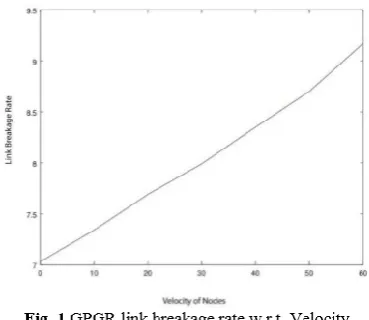
The link breakage rate w.r.t. velocity of nodes is mapped by considering the speed limit, allowed inside city (60km/h). The underlying graph constitutes the link breakage rate of GPGR in terms of velocity of nodes. When the velocity of nodes is higher, there is a greater chance of link breakage. Figure 1 reveals the GPGR’s link disconnection rate w.r.t. velocity of nodes. Greater the velocity of nodes, greater is the possibility of link breakage.
Figure 2 reveals the GPGR’s link disconnection rate w.r.t. number of nodes. Greater the number of nodes, lesser is the possibility of link breakage.
3.2 Greedy Perimeter Coordinator Routing
4
Figure 4 reveals the GPCR’s link disconnection rate w.r.t. number of nodes. Greater the number of nodes, lesser is the possibility of link breakage.
3.3 Greedy Perimeter Stateless Routing
To maintain the shortest path GPSR defines the following metric:
Speed factor is given as: f(s) = exp ( - ( x- si )2)/2a2
The underlying Figure 5, constitutes the link breakage rate of GPSR in terms of velocity of nodes. When the velocity of nodes is higher, there is a greater chance of link breakage.
Figure 6 reveals the GPSR’s link disconnection rate with respect to number of nodes. We can clearly see that when the graph is on the initial values, the link breakage is at its maximum. But as the number of nodes increases, the link breakage rate becomes less. So, we concluded from this result that the number of node/vehicles and their link breakage rate are inversely proportional to each other in VANET.
3.4 Harpia Grid Protocol
Harpia Grid is grid base routing protocol. It uses the data from maps to get the shortest route information. This method is much useful as overhead time is reduced. This protocol restricts a number of unessential transmissions by arranging the data packets in (grid) sequence instead of searching blindly. Like GSR and GvGrid, Harpia Grid is proactive protocol. In the proactive protocols, every node/vehicle must have the information of network topology and if the change in network topology is made, every node must be updated with the changes that are recently made. In proactive protocols, route information is already provided to nodes/vehicles. So, the overhead of maintenance of network topology is high. The underlying graph Figure 7 constitutes the link breakage rate of HarpiaGrid protocol in terms of velocity of nodes. When
EAI Endorsed Transactions on
the velocity of nodes is higher, there is a greater chance of link breakage.
Fig. 8 reveals the HarpiaGrid’s link disconnection rate w.r.t. number of nodes. Greater the number of nodes, lesser is the possibility of link breakage.
4. Conclusion
In this paper, we surveyed the four different routing protocols of VANET, mainly on the basis of frequent link disconnection rate. Although a number of VANET protocols have been discovered till now and researchers are working together in order to improve and update them. But the problem of frequent link breakage occurs in almost every protocol. We worked on GPGR, GPSR, GPCR and HarpiaGrid protocol to check which one gives the lowest disconnections.
The above figures (Fig. 9 and Fig. 10) show link disconnection rate on the basis of number of nodes. The larger the number of nodes, lower the link disconnection rates in all of the above routing protocols. The results have proved to be in favor of HarpiaGrid as it has the lowest link disconnection rate but being a proactive routing protocol, it costs too much overhead. The link disconnection rate of GPGR proved to be lower than that of GPSR and GPCR. The reason is that, in GPGR relay node is selected on grid sequence of streets and direction of motion of vehicles. While with the other three protocols, the link disconnection occurred more frequently because the stale nodes were selected as relay nodes and that were away from the range of transmission.
References
1. Q. Test, “Improving message reception in VANETs,” in Proceedings of the International Conference on Mobile Systems, Applications, and Services (MobiSys ’09), p. ACM Press, Krak ´ow, Poland, June 2009.
2. B. Karp and H. T. Kung. “GPSR: Greedy Perimeter Stateless Routing for Wireless Networks,” Proc. of ACM/IEEE
International Conference on Mobile Computing and Networking 2000, Aug. 2000.
3. M.-H. Chen, C.-R. Dow, S.-C. Chen, Y.-S. Lee, and S.-F. Hwang, “HarpiaGrid: a geography-aware grid-based routing protocol for vehicular Ad Hoc networks,” Journal of
Information Science and Engineering, vol. 26, no. 3, pp. 817– 832, 2010.
6
the 2nd ACM International Symposium on Mobile Ad-hoc Networking and Computing, 2001, pp. 247-250. 5. W. Sun, H. Yamaguchi, K. Yukimasa, and S. Kusumoto, “GVGrid: a QoS routing protocol for vehicular ad hoc networks,” in Proceedings of the 14th International Workshop on Quality of Service (IWQoS ’06), pp. 130–139, IEEE Press, New Haven, Conn, USA, June 2006.
6. Lochert, M. Mauve, H. Fler, and H. Hartenstein,
“Geographic routing in city scenarios,” SIGMOBILE Mobile Computing and Communications Review, vol. 9, no. 1, pp. 69– 72, 2005.
7. Z. Shafiq, S. A. Mahmud, G. M. Khan, A. Sayyed, and H. Al-Raweshidy, "Zone Routing Protocol: How does it perform the other way round?," in ICT Convergence (ICTC), 2012 International Conference on, 2012, pp. 71-77.
8. J. Nzouonta, N. Rajgure, G. Wang, and C. Borcea, “VANET routing on city roads using real-time vehicular traffic
information,” IEEE Transactions on Vehicular Technology, vol. 58, no. 7, pp. 3609– 3626, 2009.
9. J. Luo, X. Gu, T. Zhao, and W. Yan, “A mobile infrastructure based VANET routing protocol in the urban environment,” in ProceedingsoftheInternationalConferenceonCommunications and Mobile Computing (CMC ’10), pp. 432–437, Shenzhen, China, April 2010.
EAI Endorsed Transactions on