I
I
n
n
t
t
e
e
r
r
n
n
a
a
t
t
i
i
o
o
n
n
a
a
l
l
J
J
o
o
u
u
r
r
n
n
a
a
l
l
o
o
f
f
B
B
i
i
o
o
l
l
o
o
g
g
i
i
c
c
a
a
l
l
S
S
c
c
i
i
e
e
n
n
c
c
e
e
s
s
2016; 12(1): 1-17. doi: 10.7150/ijbs.13158 Research PaperA Mechanobiology-based Algorithm to Optimize the
Microstructure Geometry of Bone Tissue Scaffolds
Antonio Boccaccio, Antonio Emmanuele Uva, Michele Fiorentino, Luciano Lamberti, Giuseppe Monno
Dipartimento di Meccanica, Matematica e Management, Politecnico di Bari, 70126 Bari, Italy
Corresponding author: Dr. Antonio Boccaccio. Mailing Address: Dipartimento di Meccanica, Matematica e Management, Politecnico di Bari, Viale Japigia, 182, 70126, Bari, Italy. Contact Information: Tel: +39-0805962829; Fax: +39-0805962777; E-mail: [email protected]
© Ivyspring International Publisher. Reproduction is permitted for personal, noncommercial use, provided that the article is in whole, unmodified, and properly cited. See http://ivyspring.com/terms for terms and conditions.
Received: 2015.07.06; Accepted: 2015.09.23; Published: 2016.01.01
Abstract
Complexity of scaffold geometries and biological mechanisms involved in the bone generation process make the design of scaffolds a quite challenging task. The most common approaches uti-lized in bone tissue engineering require costly protocols and time-consuming experiments. In this study we present an algorithm that, combining parametric finite element models of scaffolds with numerical optimization methods and a computational mechano-regulation model, is able to predict the optimal scaffold microstructure. The scaffold geometrical parameters are perturbed until the best geometry that allows the largest amounts of bone to be generated, is reached. We study the effects of the following factors: (1) the shape of the pores; (2) their spatial distribution; (3) the number of pores per unit area. The optimal dimensions of the pores have been determined for different values of scaffold Young’s modulus and compression loading acting on the scaffold upper surface.
Pores with rectangular section were predicted to lead to the formation of larger amounts of bone compared to square section pores; similarly, elliptic pores were predicted to allow the generation of greater amounts of bone compared to circular pores. The number of pores per unit area ap-pears to have rather negligible effects on the bone regeneration process. Finally, the algorithm predicts that for increasing loads, increasing values of the scaffold Young’s modulus are preferable. The results shown in the article represent a proof-of-principle demonstration of the possibility to optimize the scaffold microstructure geometry based on mechanobiological criteria.
Key words: Numerical Optimization; Mechanobiology; Scaffold Microstructure; Mechano-regulation Algo-rithm.
Introduction
Bone defects of critical dimensions usually pre-sent harsher challenges to successful bone repair. In these conditions, surgery is usually required in order to re-establish the structural integrity of the fractured bone. Scaffold implantation hence becomes
manda-tory as it provides an ad-hoc structural/porous
framework for the bone defect healing process, i.e. an effective incubator allowing for cell attachment, pro-liferation and controlled differentiation into the tar-geted phenotype [1]. Scaffolds must favorite im-portant biological processes such as production of extra-cellular matrix, signaling and vascularization.
Mechanical loads acting on scaffolds must be properly transferred to the adjacent biological tissues.
Complexity of scaffold geometries and extreme variability of bone tissue properties make the design of scaffolds a quite challenging task. The most com-mon approach in bone tissue engineering is the ‘tri-al-and-error’ (T&E) approach: the existing design is modified based on the outcome of in vitro or in vivo experiments. Improvements in cell culture protocols and development of very efficient bioreactors have greatly improved T&E, as well as reliability of in vitro experiments [2]. However, T&E approach usually
requires costly protocols and time-consuming ex-periments [3]. Computational models allow to simu-late within a certain degree of accuracy how envi-ronment affects bone regeneration and hence, to fully understand the mechanisms behind tissue differenti-ation [4-7]. Mechanical factors are known to play a key role in the bone regeneration process [2] and a number of studies have used computational models to investigate the role of biophysical stimuli in regulat-ing tissue differentiation in scaffolds for bone tissue engineering [8-16].
The geometry of porous scaffolds has recently been shown to significantly influence the cellular re-sponse and the rate of bone tissue regeneration [17]. Rumpler et al. [18] showed that curvatures with radii much larger than the cells could interact with the cells and influence their behavior. The type of curvature, i.e. concave vs. convex, is also found to be important in some studies showing that the tissue growth pro-cess prefers concave surfaces to convex ones [19-23]. Furthermore, a number of studies have shown that the pore shape could significantly affect the tissue regeneration process in scaffolds [20, 24-26].
Studying the effects of the scaffold microstruc-ture on the bone regeneration process is a very diffi-cult task. In order to identify all the specific geomet-rical features that could influence bone tissue regen-eration it is necessary the systematic study of different classes of pore shapes but, no such studies are cur-rently available in the literature [17]. In such a context, the availability of in vitro, in vivo and in silico data is of crucial importance. The effects of the large number of mechanisms involved in the bone regeneration process could be separated when in vitro, in vivo and in silico data are simultaneously available. Different types of mechanisms in fact, could be turned on or off in computer or in in vitro models to study whether a given experimental response depends or not on a specific mechanism.
Numerical optimization techniques have been utilized to determine the optimal design of scaffolds for bone tissue engineering [27]. Rainer et al. [28] in-troduced an innovative strategy for the fabrication of highly optimized structures, based on the a priori finite element analysis (FEA) of the physiological load set at the implant site. Dias et al. [29] and Coelho et al. [30], based on design optimization schemes previ-ously developed [31-32], proposed a topology opti-mization algorithm as a technique to design scaffolds that meet specific requirements for mass transport and mechanical load bearing. Wieding et al. [33] proposed a numerical study to optimize the geomet-rical parameters of open-porous titanium scaffolds to match the elastic properties of human cortical bone with respect to an adequate pore size. Guyot et al. [26]
developed a computational framework based on the level set methodology to predict curvature-dependent growth of the cell/extracellular matrix domain within tissue engineering constructs. However, to date, no studies are reported in the literature that determine the optimal scaffold geometry by maximizing (or minimizing) an objective function based on mecha-no-regulation criteria.
The objective of this study is to optimize the mi-crostructure geometry of scaffolds through the com-bined implementation of finite element models, a numerical optimization routine and a mecha-no-regulation algorithm. The scaffold geometrical parameters are continuously perturbed and then the finite element model is re-meshed in each iteration cycle until the biophysical stimulus acting on the tis-sue filling the scaffold becomes the most favorable one thus maximizing the amount of generated bone. In particular, in this paper the effects of the following factors have been investigated: (1) the shape of the pores; (2) their spatial distribution; (3) the number of pores per unit area. The optimal dimensions of the pores have been determined for different values of scaffold Young’s modulus and compression loading acting on the scaffold upper surface.
Materials and Methods
Scaffold parametric models
Parametric three-dimensional biphasic po-ro-elastic finite element (FE) models of open-porous scaffolds were developed to investigate their struc-tural response under different values of compression loading. The general purpose finite element software ABAQUS® Version 6.12 (Dassault Systèmes, France)
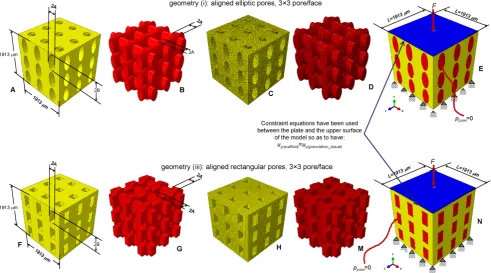
was utilized. Following Byrne et al. [8], cubic finite element models of regular structured bone scaffolds were built with volume VTOT = L × L × L = 1.913 ×
1.913 × 1.913 ≅ 7 mm3 (Figures 1 and 2). Modelling
(iv) are not shown as they can be obtained from ge-ometries (i) and (iii), respectively, by simply imposing the constraint (A = B).
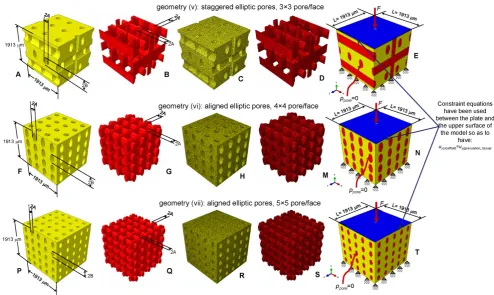
All the scaffold models, according to Byrne et al. [8], were hypothesized to undergo to compression loading. The bottom surface nodes were clamped while, a force to generate an apparent pressure (de-fined as the ratio between the load F and the total surface area A = L × L, Figure 1E,1N, Figure 2E, 2N, 2T) of 0.001, 0.005, 0.01, 0.05, 0.1, 0.5, 1.0, 2.0, 3.0, 4.0 and 5.0 MPa was applied on the nodes of the upper surface via a rigid plate (shown in blue in Figure 1E, 1N, Figure 2E, 2N, 2T). The load was ramped over a time period of 1 s which can be considered the time in which a scaffold can be loaded in in vivo conditions (e.g. the time necessary to assume the erect position, etc). The same time period was utilized in a previous study [34]. In order to apply the same vertical dis-placement to the nodes of the scaffold and those of the regenerate, constraint equations have been utilized that tie the rigid plate to the model upper surface. According to Byrne et al.[8], the pore pressure ppore on
the outer surfaces of the granulation tissue was set equal to zero thus simulating the free exudation of fluid.
In the parametric study, scaffolds were hypoth-esized to possess three different Young’s modulus
values E: 500 (low), 1000 (intermediate) and 1500 (high) MPa which are consistent with those utilized by Byrne et al. [8]. The material properties used for the granulation tissue are the same as used in previous models [35-37]: Young’s modulus 0.2 MPa; Permea-bility 1×10-14 m4/N/s; Poisson’s ratio 0.167; Porosity
0.8; Bulk modulus grain 2300 MPa; Bulk modulus fluid 2300 MPa. 4-node linear coupled pore pressure elements (C3D4P) and 8-node trilinear displacement and pore pressure elements (C3D8P) available in ABAQUS were utilized to model scaffolds including elliptic or circular (i.e. geometries: (i), (ii), (v), (vi) and (vii); Figures 1C, 1D and Figures 2C, 2D, 2H, 2M, 2R, 2S) and rectangular or square (i.e. geometries: (iii) and (iv); (Figures 1H, 1M) pores, respectively. Poro-elastic finite element analyses were performed in the study accounting for geometric nonlinearity. Mesh was properly refined so as to reach a good compromise between the convergence of nonlinear analyses and the computational time. In particular, for geometries (i) to (v) the approximate element size was 40 µm and the curvature of the pores was controlled with a maximum deviation factor of 0.1. For geometries (vi) and (vii) an approximate element size of 35 µm and a maximum deviation factor of 0.1 were set.
Figure 2. CAD model (A-B, F-G, P-Q) and finite element mesh (C-D, H-M, R-S) of the scaffold (A, C, F, H, P, R) and of the granulation tissue (B, D, G, M, Q, S) in the case of: (A-E) elliptic staggered pores, 3×3 pore/face; (F-N) elliptic (aligned) pores, 4×4 pore/face; elliptic (aligned) pores 5×5 pore/face (P-T). (E, N, T) Boundary and loading conditions acting on the model. A force to generate an apparent pressure is applied vertically via a rigid plate. The pore pressure ppore on the outer surfaces of the granulation tissue was set
to zero to simulate the free exudation of fluid.
Mechano-regulation model
Tissue regeneration process begins once mesen-chymal stem cells (MSCs) invade the scaffold thus proliferating and differentiating. Neglecting the tran-sient phase of the spreading of the MSCs throughout the scaffold pores we assume that complete cell cov-erage in the scaffold has already taken place. After dispersal, cells are hypothesized to differentiate de-pending on the values of a biophysical stimulus S that is assumed to be a function of the octahedral shear strain and interstitial fluid flow in the extracellular environment of the cells.
Following Prendergast et al. [38], if γ is the octa-hedral shear strain and v the relative fluid/solid ve-locity, the stimulus S is defined as:
…(1)
a and b being empirical constants [39], where a=3.75% and b=3µms-1. Based on the value of S, in each element
filling the scaffold pores the following cell phenotypes and the corresponding new tissue types will be pre-dicted to form:
…(2)
where nmature, nresorb and m represent boundaries of the
mechano-regulation diagram for tissue differentiation [40]. Their values (nresorb=0.01, nmature=0.53, m=3) are
taken to be the same as those utilized in previous studies [35-36, 40-41].
Algorithm
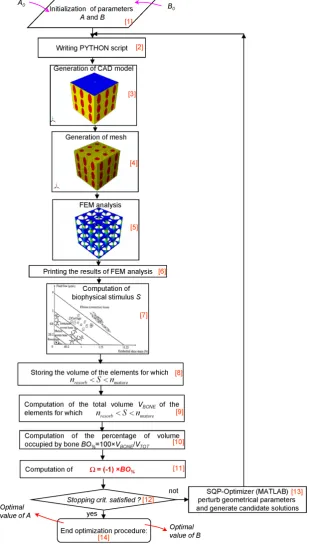
An ad hoc algorithm, a graphical summary of
which is depicted in Figure 3, was written in Matlab® (v. R2011b) environment that combines a numerical optimization routine with the finite element models and the computational mechano-regulation model described above. The aim of the algorithm was to compute the optimal dimensions A and B (Figures 1 and 2) that allow the amounts of bone developed within the scaffold, during the early stages of the bone regeneration process, to be maximized. In other words, the algorithm determines the best dimensions of parameters A and B based on the hypothesis that b
v a S =γ +
the only tissue occupying the scaffold pores is granu-lation tissue and that the mesenchymal stem cells are homogeneously dispersed throughout the scaffold domain.
The algorithm first requires the initialization of parameters A and B (Block [1]). The bounds were set very broad in order to increase the design freedom of the optimization process. The lower bounds Amin and
Bmin were set equal to 5 µm, -that is a very small
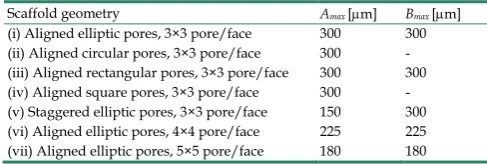
di-mension rather far from the typical range of pore size for bone tissue scaffolds-, while the upper ones, cho-sen on the basis of (a) the hypothesized side dimen-sion L of the scaffold (Figures 1 and 2), (b) the pores spatial distribution and (c) the number of pores per unit area, are listed in Table 1. For example, in the case of geometry (i) (aligned elliptic pores, 3×3 pore/face) the maximum diameter of the single pore will be 600
µm and hence the sum of the diameters of all the
pores disposed along a row or a column, will be 600 × 3 = 1800 µm that is slightly smaller than the dimen-sion of the side (1913 µm) of the cubic model. The same consideration holds true in the case of geome-tries (ii), (iii) and (iv). Regarding geometry (vi) (or (vii)), the maximum diameter of the single pore will be 450 µm (or 360 µm) and the sum of the diameters of all the pores disposed along a row or a column, will be 450 × 4 = 1800 µm (or 360 × 5 = 1800 µm). It is worthy to note that for geometry (v) (staggered elliptic pores, 3×3 pore/face), following the hypothesis that chang-ing the values of A and B, the connectivity of the scaffold must remain constant, Amax cannot be greater
than 150 µm (and not 300 µm). In fact, exceeding this threshold limit would lead to additional intersections between the pores which imply the change of the original connectivity.
Table 1. Upper bounds set for dimensions A and B in the
algo-rithm
Scaffold geometry Amax [µm] Bmax [µm] (i) Aligned elliptic pores, 3×3 pore/face 300 300 (ii) Aligned circular pores, 3×3 pore/face 300 - (iii) Aligned rectangular pores, 3×3 pore/face 300 300 (iv) Aligned square pores, 3×3 pore/face 300 - (v) Staggered elliptic pores, 3×3 pore/face 150 300 (vi) Aligned elliptic pores, 4×4 pore/face 225 225 (vii) Aligned elliptic pores, 5×5 pore/face 180 180
The initial values given to A and B are defined in a PYTHON script (Block [2]) that is run in ABAQUS. The CAD model (with the same dimensions written in the PYTHON script) (Block [3]) and the finite element mesh (Block [4]) are automatically generated. After applying on the model the boundary and loading conditions above described, a finite element analysis
is performed (Block [5]). Then, for each element oc-cupying the scaffold pores (i.e. the elements high-lighted in red, see Figures 1 and 2), strain and fluid flow values are printed (Block [6]) and, according to equation (1), the biophysical stimulus S is computed (Block [7]). The computation of S is done at the end of the ramp loading. Based on the magnitude of S and the boundaries of the mechano-regulation diagram for tissue differentiation (the diagram is schematically shown in Figure 3, Block [7]), for each element of the scaffold pores, the cell phenotypes and the corre-sponding new tissue types are predicted. For the el-ements for which:
…(3)
i.e. for the elements where mature bone is predicted to form, the volume is stored in memory. Then, the al-gorithm computes the percentage of the total scaffold volume BO% occupied by bone (Block [10]) as:
…(4)
where VBONE is the volume obtained by summing up
the volume of all the elements for which inequality (3) is satisfied, and VTOT the total volume of the scaffold
computed as VTOT = L × L × L= 1.913 × 1.913 × 1.913 ≅ 7
mm3.
The algorithm formulates, hence, an optimiza-tion problem including the geometrical parameters A and B as design variables where the objective is to minimize the functional Ω. This optimization problem is stated as follows (Block [11]):
…(5)
being Amin, Bmin and Amax, Bmax the lower and the upper
bounds, respectively, described above. In other words, the algorithm aims to minimize Ω and then to maximize BO%, i.e. the amounts of bone developed
within the scaffold during the early stages of the bone regeneration process. In the case of the geometries with circular (i.e. geometry (ii)) or square (i.e. geome-try (iv)) pores, problem (5) includes also the constraint equation (A = B). The inverse problem stated in Eq. (5) is solved with the Sequential Quadratic Programming (SQP) method, a globally convergent gradient-based optimization algorithm available in Matlab®, where the gradients are computed by means of the finite difference approach. The number of iterations per-formed in the optimization process can be defined by means of stopping criteria. These criteria include several tolerances that can be set by the user. Once one of the stopping criteria is satisfied (Block [12]), the
mature resorb S n n < <
optimization process terminates and the optimal val-ues of A and B are hence given in output (Block [14]). In the case where none of the stopping criteria is meet, the optimization algorithm perturbs geometrical pa-rameters A and B, writes a new PYTHON script thus commencing a new iteration. Iterations will be per-formed until one of the stopping criteria is satisfied (Block [13]). The solution of the optimization problem, i.e. the values of A and B for which Ω reaches its minimum value, will be between two limit cases:
pores too small a) and pores too large b). In the first case, for most of the elements occupying the scaffold pores, inequality (3) will be satisfied but VBONE will be
small, as the volume of pores (that can be occupied by bone) is small. In the second case, the volume of the pores (and then, potentially, VBONE) is large but, due to
the high values of the biophysical stimulus (caused by the high values of strain) for a very limited number of elements, inequality (3) will be satisfied.
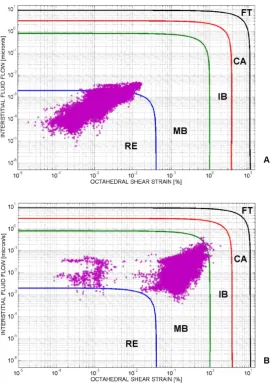
Figure 4. Mechano-regulation diagram for tissue differentiation. For each element of the tissue occupying the scaffold, the computed interstitial fluid flow v is diagrammed in function of the octahedral shear strain γ. Based on the region where the couple (γ, v) falls, the biophysical stimulus acting on the generic element will be: ‘Fibrous tissue’ (FT) or ‘Cartilage’ (CA) or Immature Bone’ (IB) or ‘Mature Bone’ (MB) or, finally, ‘Resorption’ (RE). The cloud of points (γ, v) computed before the optimization process is principally localized in the region ‘Resorption’ (A). After implementing the algorithm, the cloud of points moves towards the region ‘Mature Bone’ (B). A very small number of elements is outside the ‘Mature Bone formation’ (MB) region. In order to better visualize the distribution of the cloud of points in the diagram, the logarithmic scale was utilized on both the axes.
Figure 4, shows the mechano-regulation diagram for tissue differentiation and clarifies how the algo-rithm works (in particular, the diagram refers to the case of geometry (i), aligned elliptic pores, 3×3 pore/face, pressure 0.005 MPa and E 1500 MPa, Fig-ure 1(A-E)). For each element of the tissue occupying the scaffold pores, the computed interstitial fluid flow v is diagrammed in function of the octahedral shear strain γ. Based on the region where the couple (γ, v) falls, the biophysical stimulus S acting on the element will be: ‘Fibrous tissue formation’ (FT) or ‘Cartilage formation’ (CA) or ‘Immature Bone formation’ (IB) or ‘Mature Bone formation’ (MB) or, finally, ‘Resorption’ (RE). The cloud of points (γ, v) computed before the optimization process is principally distributed in the region ‘Resorption’ (Figure 4A). After implementing the algorithm, the cloud of points moves towards the region ‘Mature Bone’ (Figure 4B). A very small
num-ber of elements is outside the ‘Mature Bone formation’ (MB) region.
All simulations have been performed on a HP Z620- Intel® Xeon® Processor E5-2620 - 16Gb RAM. Determination of the optimal values of A and B took 10 to 15 hours for each analysis. Considering that: seven geometries have been investigated; for each geometry, three values of scaffold Young’s modulus E and eleven levels of pressure have been hypothesized, it follows that 7 × 11 × 3 = 231 analyses were per-formed for a total of about 3000 hours of computation.
Results
Aligned elliptic pores, 3×3 pore/face
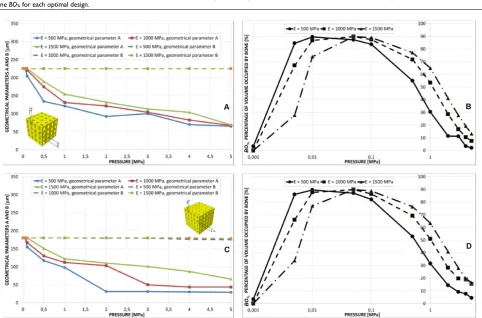
particu-lar, the greater the scaffold Young’s modulus the small is the difference between the optimal values of A and B (Figure 5(A-B)). For increasing values of pressure, A decreases while B remains almost con-stant and equal to the maximum value Bmax in the case
of E equal to 1000 and 1500 MPa and decreases in the case of E equal to 500 MPa (Figure 5B). Large per-centages of volume occupied by bone BO% were
pre-dicted to form for very low pressure values (ranging in the interval 0.01-0.1 MPa, Figure 5C). (Note: in or-der to better visualize the change of BO% with the
pressure, the logarithmic scale was utilized on the axis of abscissae. This was done for this and all the dia-grams throughout the article illustrating BO% in
func-tion of the pressure). For pressures smaller than 0.01 MPa, increasing values of BO% were predicted for
decreasing values of the scaffold Young’s modulus. For pressures greater than 0.1 MPa, conversely, in-creasing values of BO% were predicted for increasing
values of E (Figure 5C).
It is important to note that the values of BO%
reported in Figure 5C as well in all the other graphs showing BO% in function of the pressure are relative
to the optimal design. In other words, for a fixed level of pressure and scaffold Young’s modulus, the opti-mization algorithm after perturbing the values of A and B, finds a very large number of BO%. The
per-centage illustrated in Figure 5C (and in all the graphs showing BO%) refers to the optimal values of A and B,
i.e. is the maximum value of BO% among the others
that have been computed.
Aligned circular pores, 3×3 pore/face
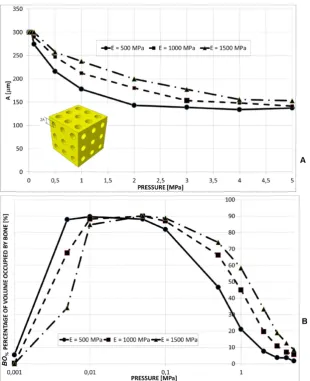
A wide radius of the circular pores was pre-dicted only for pressure values smaller than 0.1 MPa (Figure 6A). Greater values of the scaffold Young’s modulus were predicted to lead to larger values of the radius A. Also in this case, for very small pressures (< 0.01 MPa), the percentage of volume occupied by bone increases for decreasing levels of E. On the con-trary, for pressures greater than 0.1 MPa, increasing values of BO% were predicted for increasing values of
the scaffold Young’s modulus (Figure 6B). Aligned rectangular pores, 3×3 pore/face
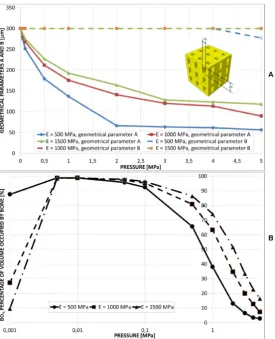
For all the pressure values investigated in the study the optimal dimension of B was predicted to remain almost constant and equal to Bmax (Figure 7A).
The values of A, instead, were predicted to signifi-cantly decrease for increasing levels of pressure. For a fixed value of pressure, the parameter A increases for increasing values of E. The trend of BO% appears
sim-ilar to that found in the case of elliptic and circular pores.
Figure 6. (A) Optimal values of the radius A of the aligned circular pores, 3×3 pore/face, predicted by the optimization algorithm for different pressures and scaffold Young’s moduli. (B) Percentage of scaffold volume occupied by bone BO% for each optimal design.
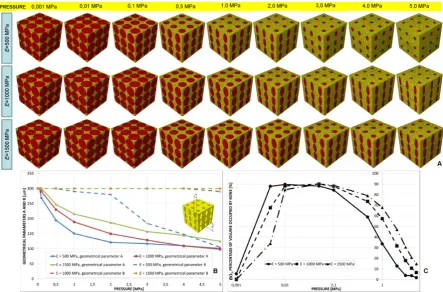
Aligned square pores, 3×3 pore/face
A large value of the side dimension A of the square pore was predicted for very low pressures (Figure 8(A-B)). For pressure values greater than 2-3
MPa, dimension A tends to assume an asymptotic
trend and its value increases for increasing values of the scaffold Young’s modulus (Figure 8B). The per-centage of volume occupied by bone BO% assumes a
trend similar to that shown in the previous cases (Figure 8C).
Staggered elliptic pores, 3×3 pore/face
A constant value of B was predicted for all the hypothesized levels of pressure. Dimension A, in-stead, for a pressure greater than 0.5 MPa, was pre-dicted to decrease (Figure 9(A-B)). For very small values of pressure the percentage of volume occupied by bone is null (Figure 9C) thus indicating that the tissue occupying the scaffold is subject to resorption. Furthermore, the highest values of BO% (about 60 %)
are significantly smaller than those predicted for the other geometries.
Aligned elliptic pores, 4×4 and 5×5 pore/face The value of B predicted by the algorithm was almost constant for the all the values of pressure. Pa-rameter A was instead predicted to decrease for in-creasing levels of pressure (Figure 10A, 10C and Fig-ure 11). The trend of BO% in function of pressure is
similar to that shown in the case of aligned elliptic pores, 3×3 pore/face (Figures 10B, 10D).
Analysis of the effect of the shape of the pores, their spatial distribution and the number of pores per unit area
In order to evaluate the effects (1) to (3), BO% was
Figure 7. (A) Parameters A and B predicted by the optimization algorithm diagrammed in function of the pressure in the case of aligned rectangular pores, 3×3 pore/face. (B) Percentage of scaffold volume BO% occupied by bone for each optimal design.
Figure 8. (A) Geometrical configurations predicted by the optimization algorithm for different values of pressure and scaffold Young’s modulus in the case of aligned square pores, 3×3 pore/face. (B) Values of A predicted by the optimization algorithm in function of the pressure. (C) Percentage of scaffold volume occupied by bone BO% for each
Figure 9. (A) Geometrical configurations predicted by the optimization algorithm for different values of pressure and scaffold Young’s modulus in the case of elliptic staggered pores, 3×3 pore/face. (B) Parameters A and B predicted by the optimization algorithm diagrammed in function of the pressure. (C) Percentage of scaffold volume occupied by bone BO% for each optimal design.
Figure 11. Geometrical configurations predicted by the optimization algorithm for different values of pressure in the case of aligned elliptic pores, 4×4 pore/face (A) and aligned elliptic pores, 5×5 pore/face (B). All the configurations shown in the figure refer to the case of scaffold Young’s modulus 1000 MPa.
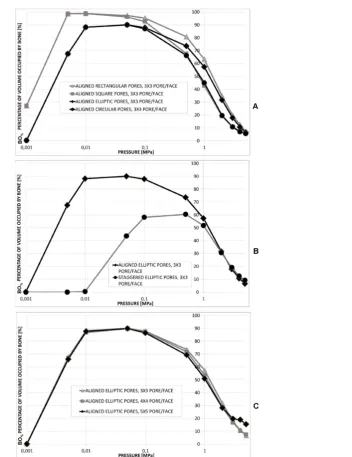
Figure 12. Percentage of scaffold volume occupied by bone BO% for each optimal design in the case of different pore shapes (A); different pore positioning (B); different numbers
Realizing scaffolds with elliptic pores was pre-dicted to lead to higher values of BO% than the case of
circular pores (Figure 12A). However, for very low pressures, values of BO% computed for the two shapes
are the same. Analogously, scaffolds with rectangular pores were predicted to produce higher levels of BO%
with respect to the case of square pores. Also in this case, for very low values of pressure, the two curves showing BO% in function of pressure are overlapped
(Figure 12A). For pressures lower than 1 MPa, scaf-folds with rectangular pores were predicted to allow the generation of greater amounts of bone than scaf-folds with elliptic pores. For pressures higher than 2 MPa, similar values of BO% were predicted for elliptic
and rectangular pores as well as for circular and square pores (Figure 12A).
For pressure values lower than 1 MPa, scaffolds with aligned elliptic pores (3×3 pore/face) allow larger amounts of bone to be generated than those with staggered elliptic pores (3×3 pore/face) (Figure 12B). For pressures higher than 2 MPa, instead, scaf-folds with staggered pores were predicted to lead to the formation of slightly larger amounts of bone than the case of aligned pores (Figure 12B).
For very low pressures (< 0.1 MPa) the curves of BO% computed for different numbers of pores per face
are overlapped (Figure 12C). In the interval 0.1 - 2.0 MPa, the model with (aligned elliptic) 3×3 pore/face was predicted to have higher levels of BO% than that
with 4×4 and 5×5 pore/face. Interestingly, beyond 3 MPa, the trend changes and the geometry with 5×5 pore/face appears to be the most performant as it allows the greatest amounts of bone to be generated.
Discussion
This study presented the first mechanobiolo-gy-based optimization algorithm ever developed in the literature to determine the optimal microstructure geometry of bone tissue scaffolds.
The pore shape seems to have important effects on
the amounts of bone predicted to form within the scaffold (Figures 5-8, Figure 12A). In general, “ori-ented” pores (i.e. pores whit A ≠ B) allow greatest amounts of bone to be generated. For example, rec-tangular pores lead to larger values of BO% compared
to square pores; similarly, elliptic pores were pre-dicted to produce higher levels of BO% compared to
circular pores (Figure 12A). This can be justified with the argument that in the case of “oriented” pores, two design variables have to be optimized (i.e. A and B) and then greater BO% values can be obtained than the
case where just one design variable (e.g. square or circular pores, where A = B) can be optimized. The higher the load, the greater is the “orientation” (i.e. the difference between A and B) of the pores (Figure
5A, Figure 7A, Figure 9A, Figure 10A, 10C, Figure 11). However, for very high loads and for a scaffold Young’s modulus of 500 MPa, the elliptic pores tend to assume a circular shape (Figure 5A).
For very low values of pressure, the rectangular pores tend to assume the square shape (Figure 7A, Figure 8(A-B)), as well as the elliptic pores, the circu-lar one (Figure 5(A-B), Figure 6A). For low pressures, in fact, low values of the biophysical stimulus S are computed and hence the optimization algorithm, in order to increase S, tends to increase the dimensions of A and B. At the limit, A is fixed equal to Amax and B
to Bmax, where Amax = Bmax.
For very low pressures, square pores allow larger amounts of bone to be generated within the scaffold, than the circular ones (Figure 12A). The cir-cular shape of the pore cross section is in fact in-scribed in the square one and then the volume (that can be considered as the protrusion of different pore cross sections) that can be occupied by bone in the case of square pores will certainly be greater than the circular counterpart. For higher pressures, BO% values
predicted for the rectangular pores are close to those computed for the elliptic ones, as well as BO% values
computed for the square pores are close to those computed for the circular ones (Figure 12A).
Regarding the effect of the pore distribution, it appears that for very low pressure values, scaffolds with aligned pores allow much larger amounts of bone to be generated than scaffolds with staggered pores (Figure 5, Figure 9 and Figure 12B). This is principally due to the geometrical limitation that must be imposed to Amax (in fact, for elliptic staggered
pores, Amax cannot exceed 150 µm, see Table 1) to keep
constant (during the optimization process) the scaf-fold connectivity. For high pressure values, instead,
the volume percentage occupied by bone BO% for
scaffolds with staggered pores is slightly higher than that predicted for scaffolds with aligned pores (Figure 12B).
The effect of the number of pores per unit area ap-pears to be less relevant. In the interval 0.1 - 2.0 MPa, the model with (aligned elliptic) 3×3 pore/face was predicted to exhibit the highest values of BO%.
Be-yond 3 MPa, instead, the geometry with 5×5 pore/face appears to favorite the formation of the greatest amounts of bone (Figures 10, Figure 11 and Figure 12C).
modulus is listed, i.e. the value of E for which the highest amounts of bone are predicted to form.
Due to the differences in body weight, size, and cross sectional area of bone, the stress values in each human bone can significantly change from a subject to another. This explains why a very broad interval (from 0.001 to 5 MPa) of loads have been tested in the study. However, if one can control the load level, based on the levels of BO% predicted in the study,
some pore dimensions should be preferred to others. For instance, in the case of geometry (ii) aligned cir-cular pores, 3×3 pore/face, for a scaffold Young’s modulus of 1500 MPa, loads close to 0.05 MPa should be applied to maximize bone formation (Figure 6B). Analogously, for the same geometry and for a scaffold Young’s modulus of 500 MPa, the load of 0.005 MPa should be preferred (Figure 6B). Generally speaking, scaffolds should be tailored for the specific anatomic site where they will be implanted. In a low loading environment, scaffolds with large dimension pores can be utilized (Figure 5B, Figure 6A, Figure 7A, Fig-ure 8B, FigFig-ure 10A, 10C); scaffolds with smaller and “oriented” pores should be instead utilized in a high loading environment (Figures 5B, Figure 7A, Figure 10A, 10C).
The model utilized in the study presents a number of limitations. The proposed algorithm aims to minimize the functional Ω that depends on the
bi-ophysical stimulus S and then on the
mecha-no-regulation hypothesis first proposed by Prender-gast et al. [38] and on the same model parameters as has been used in numerous other predictions of tissue repair [9, 35, 42-43]. These mechanobiological models must be continually tested in order to provide further corroboration for the hypotheses on which they are based [14, 44-45]. Other factors known to partially regulate bone regeneration, such as angiogenesis [46-47] and growth factors [48], were not included in the model. The model neglects the temporal variable and predicts the best microstructure based on the hypothesis that only the granulation tissue occupies the scaffold pores and that mesenchymal stem cells are homogeneously distributed throughout the scaf-fold domain. A more complete, but much more
ex-pensive in terms of computational times, model would simulate: (a) the MSCs spreading and diffusion through the scaffold domain, (b) the tissue differenti-ation and (c) the bone regenerdifferenti-ation processes in func-tion of time and would determine the best scaffold geometry based not only on the mechanobiological predictions at the instant t = 0 s but on the entire temporal interval investigated. Any scaffold dissolu-tion processes have also been neglected [8]. Prelimi-nary analyses revealed that, based on the computa-tional time necessary to perform a single finite ele-ment analysis and on the number of analyses that should be run to simulate the evolution in time of the regeneration process (that includes also the scaffold dissolution) and to determine the best scaffold geom-etry, a computational time at least 60-90 times longer (than the time taken to perform the analyses pre-sented in the paper) is required. Increases in compu-tational power will ultimately allow better 4D models to be developed to more accurately simulate the tissue differentiation and the bone regeneration processes occurring in scaffolds. The ideal scaffold geometry is based on the presence of both macro-pores that have been extensively analysed in the present study and of micro-pores that are involved in cell adhesion and differentiation the analysis of which is missing [49]. Given the complexity of the problem and the large number of physical, chemical, biological and me-chanical phenomena that are involved, a possible strategy to find the relationships between these two dimension scales consists in implementing multiscale algorithms. A micro-scale model can be utilized to study the cellular adhesion and differentiation, a macro-scale model, instead, can be utilized to deter-mine the “average” loading and boundary conditions acting on the single cell. Homogenization rules can be utilized to transfer information from the micro- to the macro-scale model, localization rules can, instead, be utilized to transfer data from the macro- to the mi-cro-scale model. A similar approach has been utilized in a previous study [9]. The implementation of mul-tiscale algorithms to investigate this field represents the objective of extensive future studies.
Table 2. Best values of the scaffold Young’s modulus (expressed in MPa) for different scaffold geometries and compression loads
Figure 13. Patterns of bony tissue (3D view and frontal view) predicted by the optimization algorithm in the case of (A) square pores, pressure 1 MPa, scaffold Young’s modulus 1000 MPa and (B) circular pores, pressure 1 MPa, scaffold Young’s modulus 1000 MPa. The gray elements represent the volumes within the scaffold where bone formation is predicted to occur. The patterns of bone tissue are rea-sonably consistent with those of new tissue formed in three-dimensional matrix channels observed in an in vitro study [18]. Bone forms from the pore walls and tends to develop towards the center of the pore. In the case of square pores, the new bone does not follow the original sharp edge but tends to distribute on a rounded surface. (C) Detailed view of the pattern of bony tissue predicted to form in an elliptic pore (the case shown refers to geometry (i), E=1500 MPa, pressure 5 MPa). The greatest amounts of bone form in the regions where the curvature of the pore is higher. This is consistent with experimental findings [18-20, 50].
In spite of these limitations, the patterns of bony tissue predicted by the optimization algorithm in the case of aligned square pores (geometry (iv)) and aligned circular pores (geometry (ii)) (pressure 1 MPa, scaffold Young’s modulus 1000 MPa) are reasonably consistent with those of new tissue formed in three-dimensional matrix channels observed in an in vitro study [18]. In Figure 13 the gray elements rep-resent the volumes within the scaffold where the al-gorithm predicts bone formation. Bone forms from the pore walls and tends to develop towards the center of the pore. In the case of square pores, the new bone does not follow the original sharp edge but tends to distribute on a rounded surface (Figure 13). The typ-ical pattern of bony tissue predicted by the algorithm in the case of elliptic pores is also consistent with
ex-perimental studies where it has been observed that the rate of tissue generation is proportional to the curvature of the surface [18-20, 50]. Interestingly, in the regions of the pore with the highest curvature the greatest amounts of bone are predicted to form. For instance, Figure 3C shows a detailed view of the typ-ical pattern of bone formed in an elliptic pore, geom-etry (i), aligned elliptic pores 3×3 pore/face, pressure 5 MPa, E 1500 MPa.
It was shown that a minimum pore size of around ≈ 100 μm is required for successful progres-sion of the bone regeneration process [51]. This threshold dimension is respected in all the scaffold models analyzed in the study (Figures 5-11) with the sole exception of the scaffold with aligned elliptic pores, 5×5 pore/face, E 500 MPa, where dimensions of A slightly smaller were predicted (Figure 10C). However, the values of the ratio between the load and E, for which the pore size was predicted to be smaller than 100 µm, are rather high [8] and hence reasonably far from being representative of the “physiological loading conditions” acting on a real scaffold for bone tissue engineering. It was shown that the change in the mechanical properties of the scaffold leads to an altered rate of bone tissue regeneration [52]. This is consistent with the results of the numerical model. Different amounts of bone in fact, were predicted to be generated for different values of the scaffold Young’s modulus (Figure 5C, 6B, 7B, 8C, 9C, 10B, 10D).
Conclusions
A mechanobiology-based algorithm was devel-oped capable of predicting the best scaffold micro-structure, i.e. the optimal dimensions A and B of the pores that allow the amounts of bone generated within the scaffold, to be maximized. The effects of the following factors have been investigated: (1) the shape of the pores; (2) their spatial distribution; (3) the number of pores per unit area. The optimal dimen-sions of the pores have been determined for different values of scaffold Young’s modulus and compression loading. The main results of the study are listed be-low.
1) “Oriented” pores (i.e. pores whit A ≠ B) allow greatest amounts of bone to be generated than the “not oriented” (i.e. pores whit A = B) ones. For exam-ple, rectangular pores lead to larger volumes of bone compared to square pores; similarly, elliptic pores were predicted to produce greater amounts of bone compared to circular pores.
occupied by bone for scaffolds with staggered pores is slightly higher than that predicted for scaffolds with aligned pores.
3) The number of pores per unit area appears to have negligible effects on the amounts of bone that can be generated in the scaffold.
4) For increasing loads, increasing values of the scaffold Young’s modulus are preferable.
5) In a low loading environment, scaffolds with large dimension pores can be utilized; scaffolds with smaller and “oriented” pores should be instead uti-lized in a high loading environment.
These results represent a proof-of-principle demonstration of the possibility to optimize the scaf-fold microstructure based on mechanobiological cri-teria.
Competing Interests
The authors have declared that no competing interest exists.
References
Bianco P, Robey PG. Stem cells in tissue engineering. Nature. 2001; 414: 118-21 1.
Lacroix D, Planell JA, Prendergast PJ. Computer-aided design and finite 2.
element modelling of biomaterial scaffolds for bone tissue engineering. Philos T Roy Soc A. 2009; 367: 1993-2009
Sanz-Herrera JA, García-Aznar JM, Doblaré M. A mathematical approach to 3.
bone tissue engineering. Philos T Roy Soc A. 2009; 367: 2055-78
van der Meulen MCH, Huiskes R. Why mechanobiology? A survey article. J 4.
Biomech. 2002; 35: 401-14
Sun W, Lal P. Recent development on computer aided tissue engineering—a 5.
review. Comput Meth Prog Bio. 2002; 67: 85-103
Sun W, Darling A, Starly B, Nam J. Computer aided tissue engineering: over-6.
view, scope and challenges. Biotechnol Appl Bioc. 2004; 39: 29-47
Sun W, Starly B, Darling A, Gomez C. Computer aided tissue engineering: 7.
biomimetic modelling and design of tissue engineering. Biotechnol Appl Bioc. 2004; 39: 49-58
Byrne DP, Lacroix D, Planell JA, Kelly DJ, Prendergast PJ. Simulation of tissue 8.
differentiation in a scaffold as a function of porosity, Young’s modulus and dissolution rate: application of mechanobiological models in tissue engineer-ing. Biomaterials. 2007; 28: 5544-54
Boccaccio A, Ballini A, Pappalettere C, Tullo D, Cantore S, Desiate A. Finite 9.
Element Method (FEM), Mechanobiology and Biomimetic Scaffolds in Bone Tissue Engineering. Int J Biol Sci. 2011; 7: 112-32
Sandino C, Planell JA, Lacroix D. A finite element study of mechanical stimuli 10.
in scaffolds for bone tissue engineering. J Biomech. 2008; 41: 1005-14 Olivares A, Marsal E, Planell JA, Lacroix D. Finite element study of scaffold 11.
architecture design and culture conditions for tissue engineering. Biomateri-als.2009; 30: 6142-9
Milan JL, Planell JA, Lacroix D. Computational modelling of the mechanical 12.
environment of osteogenesis within a polylactic acid-calcium phosphate glass scaffold. Biomaterials. 2009; 30: 4219-26
Milan JL, Planell JA, Lacroix D. Simulation of bone tissue formation within a 13.
porous scaffold under dynamic compression. Biomech Model Mechanobiol. 2010; 9: 583-96
Khayyeri H, Checa S, Tägil M, Prendergast PJ. Corroboration of mechanobi-14.
ological simulations of tissue differentiation in an in vivo bone chamber using a lattice-modeling approach. J Orthop Res. 2009; 27:1659-66
Hendrikson WJ, van Blitterswijk CA, Verdonschot N, Moroni L, Rouwkema J. 15.
Modeling Mechanical Signals on the Surface of mCT and CAD Based Rapid Prototype Scaffold Models to Predict (Early Stage) Tissue Development. Bio-technol Bioeng. 2014; 111: 1864-75
Velasco MA, Narváez-Tovar CA, Garzón-Alvarado DA. Design, Materials, 16.
and Mechanobiology of Biodegradable Scaffolds for Bone Tissue Engineer-ing. Biomed Res Int. 2015, Article ID 729076, 21 pages
Zadpoor AA. Bone tissue regeneration: the role of scaffold geometry. Biomater 17.
Sci. 2015; 3: 231-45
Rumpler M, Woesz A, Dunlop JW, van Dongen JT, Fratzl P. The effect of 18.
geometry on three-dimensional tissue growth. J R Soc Interface. 2008; 5: 1173-80
Bidan CM, Kommareddy KP, Rumpler M, Kollmannsberger P, Bréchet YJ, 19.
Fratzl P, Dunlop JW. How linear tension converts to curvature: geometric control of bone tissue growth. PLoS One. 2012; 7: e36336
Bidan CM, Wang FM, Dunlop JW. A three-dimensional model for tissue 20.
deposition on complex surfaces. Comput Methods Biomech Biomed Eng. 2013; 16: 1056-70
Gamsjäger E, Bidan C, Fischer F, Fratzl P, Dunlop JW. Modelling the role of 21.
surface stress on the kinetics of tissue growth in confined geometries. Acta Biomater. 2013; 9: 5531-43
Bidan CM, Kommareddy KP, Rumpler M, Kollmannsberger P, Fratzl P, 22.
Dunlop JW. Geometry as a factor for tissue growth: towards shape optimiza-tion of tissue engineering scaffolds. Adv Healthcare Mater. 2013; 2: 186-94 Bianchi M, Urquia Edreira ER, Wolke JG, Birgani ZT, Habibovic P, Jansen JA, 23.
Tampieri A, Marcacci M, Leeuwenburgh SC, van den Beucken JJ. Substrate geometry directs the in vitro mineralization of calcium phosphate ceramics. Acta Biomater. 2014; 10: 661-69
Van Bael S, Chai YC, Truscello S, Moesen M, Kerckhofs G, Van Oosterwyck H, 24.
Kruth JP, Schrooten J. The effect of pore geometry on the in vitro biological behavior of human periosteum-derived cells seeded on selective laser-melted Ti6Al4 V bone scaffolds. Acta Biomater. 2012, 8:2824-34
Feng YF, Wang L, Li X, Ma ZS, Zhang Y, Zhang ZY, Lei W. Influence of Ar-25.
chitecture of β-Tricalcium Phosphate Scaffolds on Biological Performance in Repairing Segmental Bone Defects. PLoS One. 2012; 7: e49955
Guyot Y, Papantoniou I, Chai YC, Van Bael S, Schrooten J, Geris L. A compu-26.
tational model for cell/ECM growth on 3D surfaces using the level set meth-od: a bone tissue engineering case study. Biomech Model Mechanobiol. 2014; 13:1361-71
Giannitelli SM, Accoto D, Trombetta M, Rainer A. Current trends in the design 27.
of scaffolds for computer-aided tissue engineering. Acta Biomater. 2014; 10: 580-94
Rainer A, Giannitelli SM, Accoto D, De Porcellinis S, Guglielmelli E, Trom-28.
betta M. Load-Adaptive Scaffold Architecturing: A Bioinspired Approach to the Design of Porous Additively Manufactured Scaffolds with Optimized Mechanical Properties. Ann Biomed Eng. 2012; 40: 966-75
Dias MR, Guedes JM, Flanagan CL, Hollister SJ, Fernandes PR. Optimization 29.
of scaffold design for bone tissue engineering: A computational and experi-mental study. Med Eng Phys. 2014; 36: 448-57
Coelho PG, Hollister SJ, Flanagan CL, Fernandes PR. Bioresorbable scaffolds 30.
for bone tissue engineering: optimal design, fabrication, mechanical testing and scale-size effects analysis. Med Eng Phys. 2015; 37: 287-96
Lin CY, Kikuchi N, Hollister SJ. A novel method for biomaterial scaffold 31.
internal architecture design to match bone elastic properties with desired po-rosity. J Biomech. 2004; 37: 623-36
Almeida Hde A, Bártolo PJ. Virtual topological optimisation of scaffolds for 32.
rapid prototyping. Med Eng Phys. 2010; 32: 775-82
Wieding J, Wolf A, Bader R. Numerical optimization of open-porous bone 33.
scaffold structures to match the elastic properties of human cortical bone. J Mech Behav Biomed Mater. 2014; 37: 56-68
Boccaccio A, Kelly DJ, Pappalettere C. A Mechano-Regulation Model of 34.
Fracture Repair in Vertebral Bodies. J Orthop Res. 2011; 29: 433-43
Boccaccio A, Pappalettere C, Kelly DJ. The influence of expansion rates on 35.
mandibular distraction osteogenesis: a computational analysis. Ann Biomed Eng. 2007; 35: 1940-60
Boccaccio A, Prendergast PJ, Pappalettere C, Kelly DJ. Tissue differentiation 36.
and bone regeneration in an osteotomized mandible: a computational analysis of the latency period. Med Biol Eng Comput. 2008; 46: 283-98
Boccaccio A, Lamberti L, Pappalettere C. Effects of aging on the latency period 37.
in mandibular distraction osteogenesis: a computational mechano-biological analysis. J Mech Med Biol. 2008; 8: 203-25
Prendergast PJ, Huiskes R, Søballe K. Biophisical stimuli on cells during tissue 38.
differentiation at implant interfaces. J Biomec. 1997; 30: 539-48
Huiskes R, van Driel WD, Prendergast PJ, Søballe K.A biomechanical regu-39.
latory model of periprosthetic tissue differentiation. J Mater Sci Mater Med.
1997; 8: 785-8
Lacroix D, Prendergast PJ. A mechano-regulation model for tissue differentia-40.
tion during fracture healing: analysis of gap size and loading. J Biomech. 2002; 35: 1163-71
Boccaccio A, Kelly DJ, Pappalettere C. A model of tissue differentiation and 41.
bone remodelling in fractured vertebrae treated with minimally invasive percutaneous fixation. Med Biol Eng Comput. 2012; 50: 947-59
Kelly DJ, Prendergast PJ. Mechano-regulation of stem cell differentiation and 42.
tissue regeneration in osteochondral defects. J Biomech. 2005; 38: 1413-1422 Andreykiv A, Prendergast PJ, van Keulen F. Swieszkowski W, Rozing PM. 43.
Bone ingrowth simulation for a concept glenoid component design. J Biomech. 2005; 38: 1023-33
Isaksson H, Donkellar CC, Huiskes R, Ito K. Corroboration of mechanoregu-44.
latory algorithms for tissue differentiation during fracture healing: Compari-son with in vivo results. J Orthop Res. 2006; 24: 898-907
Isaksson H. Recent advances in mechanobiological modeling of bone regen-45.
eration. Mech Res Commun. 2012; 42: 22-31
Geris L, Gerisch A, Sloten JV, Weiner R, Oosterwyck HV. Angiogenesis in 46.
bone fracture healing: a bioregulatory model. J Theor Biol. 2008; 251: 137-58 Sandino C, Checa S, Prendergast PJ. Lacroix D. Simulation of angiogenesis and 47.
cell differentiation in a CaP scaffold subjected to compressive strains using a lattice modeling approach. Biomaterials. 2010; 31: 2446-52
Bailón-Plaza A, Van Der Meulen MCH. A mathematical framework to study 48.
Bose S, Roy M, Bandyopadhyay A. Recent advances in bone tissue engineering 49.
scaffolds. Trends biotechnol. 2012; 30: 546-54
Knychala J, Bouropoulos N, Catt C, Katsamenis O, Please C, Sengers B. Pore 50.
geometry regulates early stage human bone marrow cell tissue formation and organisation. Ann Biomed Eng. 2013; 41: 917-30
Karageorgiou V, Kaplan D. Porosity of 3D biomaterial scaffolds and osteo-51.
genesis. Biomaterials. 2005; 26: 5474-91
Yavari SA, van der Stok J, Ahmadi S, Wauthlé R, Schrooten J, Weinans H, 52.