CSUSB ScholarWorks
CSUSB ScholarWorks
Electronic Theses, Projects, and Dissertations Office of Graduate Studies
9-2015
Geometric Constructions from an Algebraic Perspective
Geometric Constructions from an Algebraic Perspective
Betzabe Bojorquez
California State University-San Bernardino
Follow this and additional works at: https://scholarworks.lib.csusb.edu/etd
Part of the Algebra Commons, Other Mathematics Commons, and the Other Physical Sciences and Mathematics Commons
Recommended Citation Recommended Citation
Bojorquez, Betzabe, "Geometric Constructions from an Algebraic Perspective" (2015). Electronic Theses, Projects, and Dissertations. 237.
https://scholarworks.lib.csusb.edu/etd/237
A Thesis Presented to the
Faculty of
California State University, San Bernardino
In Partial Fulfillment of the Requirements for the Degree
Master of Arts in Mathematics
by
A Thesis Presented to the
Faculty of
California State University, San Bernardino
by
Betzabe Bojorquez September 2015
Approved by:
Giovanna Llosent, Committee Chair Date
John Sarli, Committee Member
Corey Dunn, Committee Member
Charles Stanton, Chair, Corey Dunn
Abstract
Acknowledgements
Table of Contents
Abstract iii
Acknowledgements iv
List of Figures vi
1 Introduction 1
2 Basic Constructions 2
2.1 Examples of Constructible Real Numbers . . . 7
2.2 Constructible Angles . . . 8
3 Algebraic Description of the Field of Constructible Real Numbers C 11 3.1 Construction of Regular Polygons . . . 17
3.2 Classical Problems . . . 23
3.2.1 Squaring the Circle . . . 24
3.2.2 Duplicating the Cube . . . 24
3.2.3 Eisenstein’s Criterion . . . 24
3.2.4 The Problem of Trisecting an Angle . . . 25
4 Constructions with Marked Ruler and Compass 26
5 Conclusion 32
List of Figures
2.1 Construction of a Midpoint . . . 2
2.2 Construction of an Angle Bisector . . . 3
2.3 Addition and Subtraction Closure . . . 5
2.4 Multiplication Closure . . . 6
2.5 Square Root Construction . . . 7
3.1 Construction of Sine and Cosine . . . 17
3.2 Construction of 5-gon Side 1 . . . 22
4.1 Construction with a Marked Ruler . . . 27
4.2 Secants from a Common Point . . . 27
4.3 Menelaus Theorem . . . 28
4.4 Construction of Cube Root . . . 28
4.5 Cube Root of Two . . . 30
Chapter 1
Introduction
Chapter 2
Basic Constructions
Let us now begin with some examples of geometric constructions that are very basic. We are only allowed to use straightedge and compass.
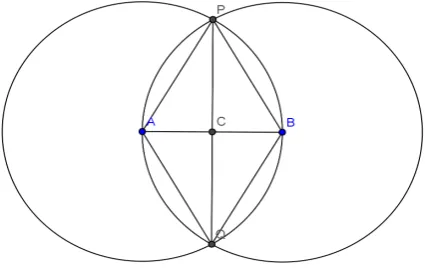
Example 1. Midpoint Construction GivenAB, we can construct its midpoint C.
Figure 2.1: Construction of a Midpoint
First construct AB. Now construct a circle with centerA and radius AB and circle with center B with radius AB. The two circles will intersect at two points, label themQ and
P. Draw QP with straight edge. QP ∩ AB=C which is the midpoint of AB.
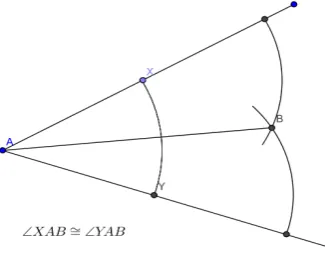
Example 2. Bisecting an Angle Draw ∠A. Construct a circle with center A that
Figure 2.2: Construction of an Angle Bisector
intersects both sides of∠A. Label the intersectionsX andY. Construct circle with center
X radius AX. Construct circle with center Y and radius AY. Mark the intersection of circle X and circleY, point B. Draw AB which is the bisector of ∠XAY.
Proof. AX=XB=BY=AY are all congruent because they are radii of congruent circles.
⇒ 4AXB ∼=4AY B ⇒ ∠XAB ∼=∠Y AB ⇒ AB is the bisector of∠XAY.
We can construct many other figures using a compass and straightedge. To construct the figures there are basic steps that are defined as axiomatic basic constructions.
Definition 3. Basic operations in the plane used in straightedge and compass construc-tions:
1. Draw a line through two given points.
2. Draw a circle with a given center and radius equal to the distance between two other given points.
Every construction begins with given points, lines and circles and will be completed with a sequence of the above steps.
Now we begin to relate the construction of real numbers to algebra so we begin by constructing our unit measurement OX which has length 1. Although we are restricted to those simple 5 constructions, as we combine them in finite steps we will show that we are able to construct the rationals and also many of the irrational numbers. Also we can construct many of the geometric figures we all know well. We can construct angles of certain magnitudes and many regular polygons.
Definition 4. A real numberαisconstructibleby straightedge and compass if a segment of length|α|can be obtained starting with our unit segment by a straightedge and compass construction.
Definition 5. A set X has closure under an operation if performance of that operation on members of the set always produces a member of the same set; in this case we say the set is closed under this operation.
Definition 6. A nonempty setF is a f ieldif it has the following properties: If a, b, and c ∈ F then
1. a+b ∈F
2. a+b=b+a
3. (a+b)+c=a+(b+c)
4. There is an element 0 ∈ F such that a+0=a ∀ a ∈ F
5. There exist an element -a ∈F such that a + (-a)=0
6. a·b ∈F
7. a·b=b·a
8. (a·b)·c = a·(b·c)
9. a·(b+c) = a·b+a·c and (b+c)·a = b·a+c·a
11. There exist a and b, b6=0,such that, a· 1b=1
Let C be the set of constructible real numbers. We now show that C is closed under the field operations of R. This helps us make the connection between geometric
constructions and Field Theory.
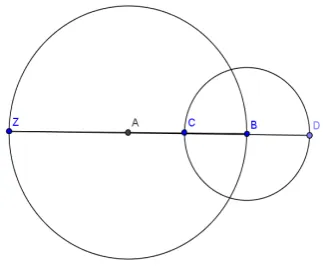
Proposition 7. C is closed under addition and subtraction. If γ andδ are constructible real numbers with 0 ≤ δ ≤γ, then so are γ+δ and γ-δ.
Proof. We construct a circle with radiusγand label a radiusAB. Then construct a circle with center B and radiusδ. The intersection of circleB and circle Agive us the desired lengths AD=γ+δ and AC=γ-δ see Figure 3.C is closed under addition and subtraction.
Figure 2.3: Addition and Subtraction Closure
Corollary 7.1. Let C be the set of constructible real numbers. Then Z ⊆C.
Proof. Since 1∈C then,Z ∈C therefore,Z⊆C.
Proposition 8. C is closed under multiplication and division.
If α and β are constructible real numbers, then so is α ·β and αβ.
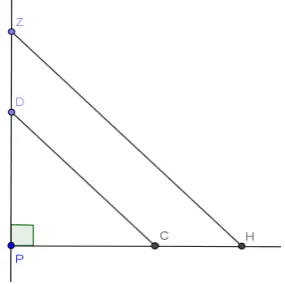
Figure 2.4: Multiplication Closure
DC. Construct a line parallel toDC through pointZ and label the intersection withP C
, point H. By the Angle Angle postulate of Similar Triangles we have that 4P DC is similar to4P ZH. Corresponding sides of similar triangles are proportional therefore DPZP = P HP C. Let PC = 1, PH=β ⇒ α
δ= 1
β. So we haveδ=α·β. This proves that the product
of two constructible numbers is constructible. Closure of division is similarly proven.
Definition 9. LetF be a field. The polynomial ring, F[X], inxover the fieldF is defined as the set of expressions, called polynomials in x, of the form
p = p0 + p1x + p2 x2 + · · · + pm−1 xm−1 + pm xm, where p0, p1,, pm, the
coefficients of p, are elements of F.
Definition 10. Let F be a field, Let F(α) ={p(α)|p(x)∈F[x]}. If α /∈F, then F is a proper subset of F(α).
Proposition 11. The set C of constructible real numbers is a field.
Proof. LetC be the set of constructible numbers and let α,β,λ∈C.
1. Previously we showed that if α and β ∈ C, then α +β,α-β, also α · β, and αβ, β
6
=0, ∈ C.
4. -α ∈C,α + (-α)=0. 5. (α ·β)·λ=α ·(β ·λ).
6. 1 ∈C such thatα ·1=1·α=α.
7. There exist a and b, b6=0,such that, a· 1 b=1 .
Therefore C is a field.
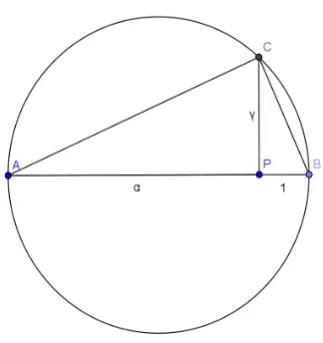
Figure 2.5: Square Root Construction
Proposition 12. Let α be a constructible real number, α ≥0, the √α is constructible.
Proof. Construct AB = AP +P B, let AP =α and P B = 1. Construct circle X with diameter AB. ConstructCP ⊥AB withC on circle X.
Let CP = γ ⇒ γ is constructible. 4AP C is similar to 4CP B ⇒ P BP C = P AP C ⇒ γ2 = α
⇒ γ =√α ⇒ √α is constructible.
2.1
Examples of Constructible Real Numbers
Example 13. Fourth Root of Three Construct circle P with diameter AB=4.
Construct the perpendicular bisector to the radius AP.
Label the midpoint M. Label the intersection of circle P and the perpendicular bisector of the radius, point C.
We know that any triangle inscribed in a semi-circle is a right triangle therefore 4ABC
is a right triangle with CM an altitude from point C. This makes CM the geometric mean between AM and M B. The radius of Circle P is 2 therefore AM=1 and BM=3. Since CM is the geometric mean between 1 and 3, then CM =√3. Now we construct segment ST=1+√3.
We construct circle Q with diameter CM=ST=1+√3 . Draw point R on radius SQ so that SR=1 which leaves RT=CM=√3. Draw the perpendicular line through R toST and we have the same properties as the first right triangle inscribed in circle P.⇒The altitude from the right angle is the geometric mean in the right triangle of circle Q and therefore is the √43.
Generalizing this construction above we can repeat the process and construct any root of the form 2n.
Example 14. Isp3 +√45 constructible?
The √45 is constructible by repeating the process of the square root twice. This makes 3 + √45 the sum of constructible numbers therefore constructible. The square root of any constructible number is constructible therefore p3 +√4
5 is constructible.
Example 15. Are 3 - √82
5 and 3
1 +√85 constructible?
They are both constructible because they are sums, differences, and quotients of con-structible numbers which are all closed operations under C.
Example 16. Is (√2+3√3) constructible?
Clearly we can construct the √2 and 3√3 and the sum of constructible numbers are constructible.
2.2
Constructible Angles
Pythagorean Identity
sin2α+cos2α=1
Sum of Angles Identity
sin(α±β)=sinαcosβ±sinβcosα
cos(α±β)=cosαcosβ∓sinαsinβ Double Angle Identities
cos 2α =cos2α-sin2α
sin 2α =2sinαcosα Half Angle Identity
cos(α2)=
q 1+cosα
2
sin(α2)=
q 1−cosα
2
Example 17. For any angle φ, the real number cosφ is constructible if and only if the real number sinφis constructible.
Proof. (⇒) Let φbe any angle and the cosφbe a constructible real number. By the Trigonometric Pythagorean Identity:
sin2φ + cos2φ=1 sin2φ=1-cos2φ
sinφ=p1−cos2φ.
As previously mentioned p1−cos2φ is a constructible number therefore sinφ is
con-structible.
(⇐) Similarly using the same identity and solving for cosφ, we get that cosφ=p1−sin2φis a constructible number.
is equilateral therefore we can construct an angle of magnitude 60◦.
Also, we can construct a right angle with the construction of the perpendicular lines.
Chapter 3
Algebraic Description of the Field
of Constructible Real Numbers
C
We will describe our field C of constructible real numbers by using some field theory.
Choosing our origin O =(0,0) and our unit segment pointX = (1,0) on thex−axis we have the following:
Definition 20. Square Root Tower
Let F be a subfield of R. Then a square root tower over F is a sequence of
fields K0,K1, ... ,Kn such that F = K0 ⊆K1 ⊆...⊆Kn ⊆R and Ki+1 = Ki(√ρ) for
some ρ∈Ki with
√
ρ /∈ Ki ∀ j satisfying 1≤j≤i. Kn is the top of the tower. Definition 21. The Polynomial Ring Extension
For every ringR, the polynomial ringR[x]is a ring extension ofR. IfS is a ring extension of R, and a is an element in S, the set R[a] equals all f(a) such that f(x) is in R[x], is the smallest subring of S containing R anda, and is a ring extension of R.
Proposition 22. Let F be a subfield ofRand letf(x)=x2+ax+b∈F[x] be a quadratic
polynomial with coefficients in F. If f(x) has a zero inR, then both zerosα1 andα2 belong
to R and eitherα1, α2 ∈ F orα1, α2 ∈ F(
√
γ) ⊆ R.
Proof. Using the quadratic formula to find the zeros off(x),α1=−a+
√
a2−4b
2 andα2=
−a−√a2−4b
2
Let γ =a2-4b≥0 thenα1=−a+
√
γ
2 and α2=
−a−√γ
2 are real and belong toF[
√
Theorem 23. The Rational Root Theorem states a constraint on rational solutions (or roots) of a polynomial equation.
If we have an equation an xn+an−1 xn−1+· · ·+a0 = 0 with integer coefficients then
ra-tional solution x, when written as a fraction x = pq in lowest terms (i.e., the greatest common divisor of p and q is 1), satisfies p is an integer factor of the constant term a0,
and q is an integer factor of the leading coefficient an.
Theorem 24. Let α be a real number. Then α is constructible if and only if α belongs to the top of some square root tower over Q.
Proof. (⇐)Let C be the set of constructible real numbers. C is an extension field of Q.
C is a subfield ofRbecause we have shown earlier that the constructible setC is closed
under addition, subtraction, multiplication, and division.
Let F =K0 ⊆K1 ⊆...⊆Kn⊆Rbe a square root tower, and letα be in the top of the
square root tower. We show how αis constructible by inducting on the size of the tower. If n= 0 thenK0=Q ⇒α is rational.
Since we proved earlier that addition, subtraction, multiplication, and division of integers are constructible ⇒ Any rational number is constructible.
Now we assume Ki ⊆C. By definition of a square root tower, Ki+1 =Ki(
√
ρ) for some ρ∈Ki with
√
ρ /∈ Ki ∀ j satisfying 1≤j≤i.
⇒ √ρ ∈C since we can construct √ρ by proposition 12.
With √ρ ∈ C ⇒ Ki(√ρ) ∈ C because C is closed under addition and multiplication.
⇒Kn is constructible by induction. ⇒ α is constructible.
(⇒) Letα∈C, beginning withO at theoriginand markingX on thex−axis
to be our unit segment we can construct a line segment of length|α|from theorigin. We now need to show thatαbelongs to the top of the square root tower. In fact we can show through any straight edge and compass construction starting from our unit segment there is a square root tower over Q in which in the course of the construction the following
belong to the top of the tower:
1. The coordinate (x, y) of any point marked.
2. The coefficients m,bof the equation of any line drawn y=mx+b.
3. The coefficientsκ,λ,µof the equation of any circle drawnx2 +κ x+y2 +λ y+µ
The basic operations we defined as our possible constructions drawn with a compass and straight edge previously will be our 5 cases; that is:
1. Draw a line through 2 given points.
2. Draw a circle with center at a given point and radius equal to the distance between 2 other given points.
3. Mark the points of intersection of a straight line and a circle. 4. Mark the point of intersection of two straight lines.
5. Mark the intersection of 2 circles.
We begin with the trivial case (1) of two points with distance between them equal to 1 unit, (our unit segment) so the origin (0,0) and (0,1) which belong to the top of the trivial tower Q = K0 ⊆ R. Suppose we perform m operations and that all the
coordinates and coefficients above belong to the top of some tower K0 ⊆K1 ⊆ · · · ⊆ Kn
and perform one more operation considering all basic operations we have the following cases:
(Case 1)
The line through (x1,y1) and (x2,y2) which we already marked. Therefore x1,y1,x2,y2 ∈ Kn.
If we pick any point (x,y) on our line we can compute the slope between (x,y), and the two marked points (x1,y1) and (x2,y2) and the slopes must be equal. We get the following
equations:
y−y1 x−x1
=y2−y1
x2−x1
⇒ (y-y1)(x2-x1)=(y2-y1)(x-x1) y(x2-x1)-y1(x2-x1)= x(y2-y1)-x1(y2-y1)
y=x(y2−y1)
x2−x1
-x1(y2−y1) x2 -x1+
y1(x2−x1) x2−x1
Since Kn is closed under addition, subtraction, multiplication, and division we rewrite
our equation asy =mx+b
where m=(y2−y1)
x2−x1
,
b=x1(y2−y1)
x2−x1 +
y1(x2−x1)
(Case 2)
For the next construction we want to draw a circle with center (x0,y0) that is already marked and its radius is equal to the distance between two other points that are also already marked (x1,y1) and (x2,y2). Allxi,yi ∈Kn , 0≤i≤2 (top of the tower).
Taking any point on the circle (x,y) we find the distance (length of radius) be-tween the center and this point and it is equal to the distance bebe-tween (x1,y1) and (x2,y2)
We now have the equation:
p
(x−x0)2+ (y−y0)2 =p
(x2−x1)2+ (y2−y1)2
(x−x0)2+(y−y0)2=(x2−x1)2+(y2−y1)2
x2-2x0x+y2-2y0y+(x0)2+(y0)2-(x2−x1)2-(y2−y1)2=0. We can set κ=−2x0 ,λ=−2y0, and
µ=(x0)2+(y0)2-(x2−x1)2-(y2−y1)2
and now we have the equation of a circle
x2+κx+y2+λy+µwith all its coefficients in Kn.
(Case 3)
For this case where two lines intersect, we have lines y=m1x+b1and y=m2x+b2that have already been marked, m1,m2,b1,b2 ∈ Kn.
We now solve the system of equations: y=m1x+b1
y=m2x+b2
and the solution to this system is the point of intersection.
Setting both equations equal to each other we have the following equation
m1x+b1=m2x+b2.
We now solve for x:
x= b2−b1
m1−m2
∈ Kn.
Substituting x into the original system we can solve fory and we have that
y= b2−b1
m1−m2 ·m1+b1 ∈ Kn.
(Case 4)
Now we look at the intersection between a circle and a line.
We begin with the line y=mx+b and the circlex2+κx+y2+λy+µ=0 already marked. To solve this system of equations
y =mx+b
x2+κx+y2+λy+µ=0
we substitute y=mx+b and get
x2+κx+(mx+b)2+λ(mx+b)+µ=0 (1+m2)x2+(κ+2mb+λm)x+b2+λb+µ=0
using the quadratic formula we have
x=−(κ+ 2mb+λm)±
p
(κ+ 2mb+λm)2−4(1 +m2)(b2+λb+µ)
2(1 +m2)
let ρ=(κ+ 2mb+λm)2-4(1+m2)(b2+λb+µ)
and β=(κ+2mb+λ m) and are contained in Kn,
then, x=-β ± √ρ.
We have the case where either the circle intersects at one point or two points. Either way, x ∈Kn(√ρ) and y=mx+b∈ Kn(√ρ).
So now Kn+1 becomes the new top of our square root tower, where Kn+1=Kn(
√
ρ). (Case 5)
x2+κ1x+y2+λ1y+µ1=0
x2+κ2x+y2+λ2y+µ2=0
setting both equations equal to each other we get:
x2+κ1x+4y2+λ1y+µ1=x2+κ24x+y2+λ2y+µ2 κ1x+λ1 y+µ1=κ2x+λ24y+µ2
(κ1-κ2)x+(λ1-λ2)y=µ2-µ1
y=(κ1−κ2)x
λ1−λ2
+µ2−µ1
λ1−λ2
Let γ=κ1−κ2
λ1−λ2
and
δ=µ2−µ1
λ1−λ2
y=γx+δ which reduces to the previous case.
The following definitions partnered with the previous theorem will help show which regular polygons are constructible and which need more than a compass and straightedge.
Definition 25. A number is said to be algebraic if it is a root of a finite , non-zero polynomial in one variable with rational coefficients.
Definition 26. A number is said to be transcendental if it is not a root of a non-zero polynomial equation with rational coefficients.
Corollary 26.1. Let α be a real number. Ifα is constructible, then [Q(α):Q] is a power
of 2.
Proof. Let α be a real constructible number. We know α ∈ Kn which is the top of a square root tower and Ki+1=Ki(√α) for some ρ ∈Ki.
⇒ [Ki+1: Ki]=2, [Kn:Q(α)][Q(α):Q]=[Kn:Q]=[Kn:Kn−1]· · ·[K2:K1][K1:Q]=2n
Exercise 27. Is 3+√65 constructible?
P(x)=x6-18x5+135x4-540x3+1215x2-1458x+724 is irreducible over Q by The Rational
Root Theorem because ±1, ±2, ±4,±181,±362,±724 are not zeros and are the only pos-sible rational zeros of p(x). Let α=3+√6
5. ⇒ α is a zero of p(x), [Q((3 + 6
√
5) :Q]=6,
not a power of 2 therefore α is not constructible by Corollary 25.1.
Corollary 27.1. Transcendental real numbers are not constructible.
Proof. Ifα is constructible then Q(α) is of finite degree overQand hence algebraic over Q, and is not transcendental.
3.1
Construction of Regular Polygons
Proposition 28. An angle of magnitudeφcan be constructed with compass and straight-edge if and only if sinφ and cosφ are constructible real numbers.
Proof. (⇒) Let sinφand cosφbe constructible real numbers. Then there exist an angle
φ such that in a right triangle the ratio of the side opposite of φ and the hypotenuse is equal to sinφ.
(⇐) Let∠ABC=φbe constructible. Construct a perpendicular line from point A to the side BC of ∠ABC, name the point of intersection D.AD,AB, and BDare all constructible. ⇒ sinφ= ADAB and cosφ= BDAB which are both constructible.
Proposition 29. A regular n-gon for n≥3 is constructible using only compass and straightedge if and only if cos360n is a constructible real number.
Proof. (⇒) In any regular polygon, the measure of one exterior angle is 360n and the interior angle of the regular polygon is supplementary to the exterior angle so its measure is 180-360n . If these angles are constructible then so is cos(180 − 360n ) = -cos360n by Proposition 27.
(⇐) Starting with a unit segment OX, we draw a circleO with radius 1. Since cos360n is constructible, then the angle of magnitude 360n is constructible too. If an angle of magnitudeφ=360n is constructible then such an angle∠PXQ can be constructed having
X as its vertex and the extension ofOX as a side. LetXP intersect the unit circle atA. Then XAis one side of the required n-gon. Repeat the process with OAin place ofOX
to construct the next side and continue this process until the entire n-gon is constructed.
Below are more examples of constructible angles and the algebraic reasons of their constructibility. Also with constructible angles we can use Algebra to show the regular polygons that are constructible.
Example 30. Equilateral Triangle
We constructed an equilateral triangle ealier with compass and straightedge in figure 2.1 but we can also use the fact that cos60=12. Since it is equal to a real constructible number,12, then 60 degrees is constructible and we can say a regular 3-gon, triangle can be constructed by applying proposition 29.
Example 31. Thesin90 = 1, so of course its constructible, therefore90◦ is constructible and a regular quadrilateral (Square) is constructible.
Next we use Algebra to prove the following polygons are not constructible.
Definition 32. An nth root of unity, where n is a positive integer, is a numberz=cosα+isinα
satisfying the equation zn = 1.
As we transition from the geometric aspect of constructibility and focus more on the Abstract Algebra, we need to relate degrees to radian measure.
An angle can be measured in degrees as well as radians. When we measure an angle with radian measure, we are actually measuring the distance traveled on the circle’s circumference (the arc). So an angle θ measured in radians is the arc length divided by the radius. A circle has 360◦ or 2πrr radians which is simply 2π radians. Thus far, all of the measures of angles have been in degrees but we need to use radian measure to discuss the angles that are not constructible.
Proposition 34. (De Moivre’s Formula)
(cosx+isinx)n =cosnx+isinnx, for all real x and integers n. Setting x = 2πn gives a primitiventh root of unity:
(cos2πn +isin2πn)n =cos 2π +isin 2π = 1, but for k = 1, 2,. . .,n−1,
(cos2πn +isin2πn)k=cosπn2k + isinπn2k 6= 1
Theorem 35. The real number cos2π5 is constructible therefore a regular pentagon is constructible.
Proof. cos2π5 +isin2π5 is a fifth root of unity hence a root of the equationx5=1. We can factor this equation:
x5-1=(x−1)(x4+x3+x2+x+ 1).
Clearly cos2π5 +isin2π5 6= 1 so it is not a root of (x−1) so it must be a root ofx4+x3+x2+x+1. We have that (cos2π5 +isin2π5 )4= cos2π5 - isin2π5
Let z=cos2π5 +isin2π5 .
z+z4=2cos2π5 Let α=2cos2π5
⇒ α2=(z+z4)2
⇒ α2+α=(z+z4)2+z+z4
⇒ α2+α=z4+z3+z2+z+2=1
⇒ α2+α=1
⇒ α2+α-1 =0
Now we have thatα is a zero of the quadraticx2+x-1=0 and when we solve it using the quadratic formula we get
x=−1+
√
5
2 andx=
−1−√5 2
α > 0 thereforeα=2cos2π5 =−1+
√
5 2
⇒ cos2π5 =−1+
√
5 4
⇒ cos2π5 is constructible. ⇒ A regular pentagon is constructible by proposition 28. Euclid discovered that a polygon of n sides can only be constructed with compass and straight edge if n=2k, 2k·3, 2k·5, or 2k ·3·5. Two thousand years later, C.F.Gauss proved that a 17-gon was also constructible with compass and straightedge. So then, the real question arises, exactly which polygons are constructible? This is later answered by Galois theory which is out of the realm of this research paper.
Example 36. Show algebraically that an angle of magnitude φ is constructible if and only if an angle of magnitude φ
2 is constructible.
Proof. (⇒)Let an angle of magnitude φ
2 be constructible. If
φ
2 is constructible then the
sinφ2 is constructible. By the half angle formula sinφ2=±
q 1−cosφ
2 ⇒cosφis constructible
⇒ an angle of magnitudeφis constructible.
(⇐)If an angle of magnitudeφis constructible then cosφconstructible.
q 1+cosφ
2
is constructible. But
q 1+cosφ
2 =cos φ
2 ⇒ cos φ
2 is constructible. ⇒ φ
2 is constructible.
Example 37. Let θ=40◦, θ is not constructible.
Proof. From trigonometric identities we have cos3θ=4cos3 θ-3cosθ. Since cos120=-12 the numberα=cos40 satisfies the equation 4α3-3α=-21 hence is a zero of polynomialp(x)=8x3 -6x+1 which is irreducible over Qby the rational root theorem since ± 18,±
1 4, ±
1 2,±1
are not zeros ofp(x) and are the only possible rational zeros.
⇒ [Q(α) :Q]=3, not a power of 2. α is not constructible by corollary 26.1.
⇒ 40◦ is not constructible.
Example 38. Is30◦ constructible? Thesin30=12 therefore30◦ is constructible by corol-lary 25.1.
Example 39. sin 90=1 therefore90◦ is constructible.⇒ 902 =45◦ is constructible.
Example 40. Is42◦ constructible?
By Theorem 35 cos(2π5 ) is constructible. We know that 2π=360◦ therefore 2π5 =72◦ is constructible by proposition 29. Also 30◦ is constructible therefore we have that
72◦−30◦ = 42◦ is constructible.
Example 41. Let θ=10◦. Isθ constructible? From trigonometric identities we have
sin 3θ=−4 sin3 θ+3sinθ. Since sin 30=12 the number α=sin10 satisfies the equation -4α3+3α=12 hence is a zero of polynomialp(x)=8x3-6x+1 which is irreducible overQ by
the rational root theorem because ± 1 8, ±
1 4, ±
1
2, ±1 are not zeros of p(x) and are the
only possible rational zeros.
⇒ [Q(α) :Q]=3, which is not a power of 2. α is not constructible by corollary 25.1
⇒ 10◦ is not constructible by proposition 29.
Example 42. The angle of magnitude 72◦ is constructible. If we bisect 72◦ we have an angle of magnitude 36◦. If we bisect an angle of 36◦ we have an angle of18◦. An angle of measure 18◦ is constructible.
In the following exercises we will determine if the regular polygon with n sides is constructible.
Example 43. An octagon has 8 sides. So for n=8 the cos(3608 )=cos45= √
2
2 therefore by
Example 44. A polygon with 9 sides is not constructible.
Thecos(3609 ) is not a real constructible number because in example 37 we proved that40◦
is not constructible and by proposition 29 cos 40 is not constructible.
Example 45. A regular decagon has 10 sides. cos(36010)=cos36. The angle of magnitude
36◦ is constructible because 72◦ by example 36. Now we can saycos36 is constructible by propostion 29.
Example 46. A regular polygon with 20 sides is constructible because cos18 is con-structible since the angle of magnitude 18◦ is constructible by example 42.
Example 47. A regular polygon with 30 sides is constructible. cos36030=cos12. We know
72◦ and 60◦ are magnitudes of constructible angles. Their difference is constructible ⇒
12◦ is constructible ⇒ cos12 is constructible ⇒ a polygon with 30 sides is constructible by proposition 29.
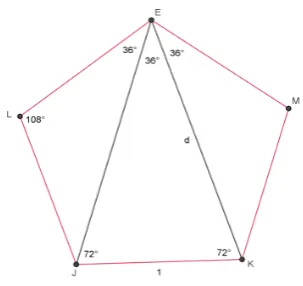
Example 48. Show that in a regular 5-gon with sides of length 1 any diagonal has length
α=1+ √
5 2 .
Figure 3.2: Construction of 5-gon Side 1
Proof. By the law of sines we have:
sin 36 1 =
sin 72
d where d is the diagonal of a regular pentagon.
d=sin72sin 36 d=12(1+√5)
constructible. Let α=2cos(2π7 )
Let x3+x2-2x-1=(x-α)(ax2+bx+c)
Distributing the right side we have: ax3+(b-aα)x2+(c-bα)x-cα
⇒ a=1 b-α=1 c-bα=-2 -cα=-1
⇒ b=α+1 c=α1
Therefore
x3+x2-2x-1 =(x-2cos2π7 )(x2+(2cos2π7 +1)x+ 1
2 cos27π and 2cos( 2π
7 ) is a zero of
p(x)=x3+x2-2x-1. [Q(α) :Q]=3 because p(x) is irreducible over Q by the rational root
theorem, and α is not constructible. We recall that 2π7 in radians is the same as 3607 degrees. By corollary 25.1, 3607 is not constructible. By proposition 29 a heptagon is not constructible.
3.2
Classical Problems
There are many constructible geometric figures that cannot be done with only straightedge and compass. We encounter a few below that are considered classical prob-lems. The Greeks made many attempts at three specific problems, the ‘‘squaring of the circle ”, ‘‘doubling of the cube”, and the ‘‘trisection of an arbitrary angle”.
3.2.1 Squaring the Circle
Given a circle in the plane, construct a square of the same area. This cannot be done with only a compass and straightedge.
Proof. The area of a circle isπr2. The area of a square with side s is s2. Setting these two areas equal to each other we haveπr2=s2. If we divide both sides byr2 we have that
π=(sr)2. This would imply that √π = sr. If sr is constructible then√π is constructible. This is a contradiction because π is not constructible.
3.2.2 Duplicating the Cube
The doubling of the cube is also known as the Delian problem. The people of Delos were plagued by Apollo and so asked an oracle to help them get rid of the plague. The oracle advised them to double the size of the altar to Apollo which was a cube. The Delians asked Plato for help and he told them they needed to study geometry. Plato asked Eudoxus, Menaechmus and Archytas to solve this problem but they did not get Plato’s approval for their solutions were wrong. This problem was also worked on by many others, the Egyptians, the Indians, and the Greeks to no avail. In 1837 Pierre Wantzel proved it impossible to solve with constructions that only use straight edge and compass. He found that the problem required the construction of the cube root of two which is impossible to construct with only compass and straight edge.[Bog15]
3.2.3 Eisenstein’s Criterion
Eisenstein’s Criterion gives a sufficient condition for a polynomial with integer coefficients to be irreducible over the rationals. Meaning the polynomial will be unfac-torable into the product of nonconstant polynomials with rational coefficients. Given the polynomial f(x)=anxn +an−1xn−1+· · ·+a1x+a0, where all ai are integers, for all i
between 0 and nand there exist a prime psuch that the if following hold: 1. p divides all ai,i≤n
2. p2 does not divide a0
then f(x) is irreducible.
Proof. If the given cube has side s, then the volume of the cube is s3. The cube with double the volume would have volume 2s3. The edge of the duplicated cube would be √3
2a. Taking the side of the given cube as our unit, we would have to construct a segment of length √3
2. But√3
2 is a zero ofx3-2 which is irreducible overQby Eisenstein’s
Criterion with p=2 and therefore [Q(3
√
2) :Q]=3, not a power of 2. Therefore 3
√
2 is not constructible with only compass and straight edge.
3.2.4 The Problem of Trisecting an Angle
The two classical problems above are by far much more popular in the math world. Trisecting an arbitrary angle is the least studied. Perhaps because there is no interesting story about the gods asking for a solution. So the problem arises plainly. Another reason might be because of how different it is from the other two problems. We cannot square a circle or double a cube, but there are specific angles that can be trisected. For instance we can trisect 90◦, but the problem is that of trisecting an arbitrary angle. There is no general sequence of steps that would always end with trisecting an arbitrary angle.
Example 51. Let us look at the angle60◦, it cannot be trisected. Proof. We can construct an angle of 60◦.
Now we use trigonometric identity of the sum angle formula. cos3θ=4cos3 θ −3cosθ
cos60=12 Let α=cos20
4cos320− 3cos20=12
4α3-3α=12 so now we have that α is a zero of p(x)=8x3-6x-1. p(x) is irreducible over the rationals by the Rational Root Theorem because ± 1
8,± 1 4,±
1
2,±1 are not zeros of p(x) therefore [Q(α):Q]=3, not a power of 2. α is not constructible therefore 20◦ is not
Chapter 4
Constructions with Marked Ruler
and Compass
The ancient civilizations firmly believed in the gods and their demands. The gods demanded precise solutions of mathematical problems. The ancient mathematicians insisted on doing mathematics with precision so that the problems of their world would be vanished by the gods. The people believed that the god Apollo was cruel for giving them the impossible problem of doubling the cube.[Bog15]
With a marked ruler and compass the constructions are not impossible. As we see in the following examples we can construct figures and solve problems that were impossible without the ruler.
Definition 52. A construction with a marked ruler and compass allows (in addition to the operations defined in Definition 11.1.8) the following operation: (6)Given two points A and B, lines L and M, and a point P, to construct points C on line L and point D on line M such that point P lies on the line through point C and point D and the length of CD equals the length of AB.
A real numberαis constructible using a marked ruler and compass if a segment
|α|is constructible.
Figure 4.1: Construction with a Marked Ruler
Proof.
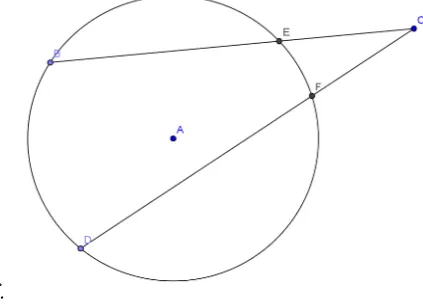
Figure 4.2: Secants from a Common Point
We draw the triangles BFC and DEC. By the Angle-Angle theorem of similar triangles 4BCF ∼ 4DCE. Therefore BCDC = CFEC ⇒ (BC)(EC)=(DC)(CF)
Theorem 54. (Menelaus’ Theorem) Given any line that intersects the three sides of a triangle (one side extended), six segments are cut off on the sides. The product of three non-adjacent segments is equal to the product of the other three.
Let AF C be any triangle and let a line L cut the sides of their extensions at points D,B,E then ADAB ·BF
EF · EC DC=1.
theorem.png
Figure 4.3: Menelaus Theorem
Proposition 55. Letα be a real number that is constructible with a compass and marked ruler, then the real number √3α is constructible with the marked ruler and compass.
This propositon also helps solve the problem of duplicating the cube.
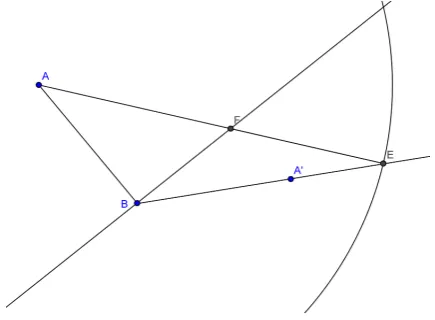
Figure 4.4: Construction of Cube Root
Proof. LetAB =CD = 1 ∠ABC = 90◦ and ∠CBD = 30◦ AC=x BC=√x2−1 AD= x
+ 1. Using Law of Sines and substituting all the given information we can say:
sin∠BDC BC =
sin√∠BDC x2−1 =
sin 30 1
sin∠ADB AB =
sin∠ABD AD
sin∠ADB
1 =
sin 120 x+1
∠ADBand∠BDCare the same angle so we can set the two equations equal to each other. sinBDC=
√
x2−1
2
sinADB=
√
3 2(x+1)
√
x2−1
2 =
√
3 2(x+1)
4(x2+ 2x+ 1)(x2−1)=12 4x4+ 8x3−8x−16=0
x4+ 2x3−2x−4=0 (x3−2)(x+ 2)=0 x=√3
2 and x=-2 but we letx=AC so it must be √3
2.
Corollary 55.1. The problem of the duplication of the cube can be solved using the marked ruler and compass.
Proof. This problem amounts to the construction of√3αwhich can be done with a marked
ruler and compass by proposition 55.
Example 56. Show that 2 cos(θ3) is a zero of y3−3y−2 cosθ
Proof. Let h(y)=y3−3y−2 cosθ Substituting 2 cos(θ
3) into our functionh(y) we have h(2 cos(θ3)) = (2 cos(θ3)3−3(2 cos(θ3)−2 cos(θ).
After simplifying the right hand side of the equation we have 8cos3(θ3) - 6cos(θ3) - 2cosθ. 2 cos(θ3) is a zero ofy3−3y−2 cosθ
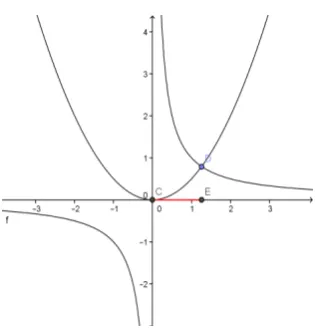
Example 57. Another example of how to construct √32 as the intersection of a parabola with the hyperbola xy=1.
Figure 4.5: Cube Root of Two If we solve the system:
y=1x y=12x2
Substituting y=x1 into y=12x2
we have the equation:
1 x=
1 2x
2
Solving for x we get 1=12x2·x
2=x3 x=√3
2
The intersection of the parabola with the hyperbola is the point (√3
2,√312) and we have
line segment CE is the length √32.
compass and a ruler.
Proof. Archimedes’ Trisection
Draw the unit circle with central ∠DOC=θ and radius OD and OC. Extend OC and with the distance of 1 marked on a ruler, keeping it in contact with D, slide it until it reaches a position where if B and A are the points of intersection with the circle and the extension ofOC, respectively, then AB=1. Let∠OAB=α. Show thatα=θ3.
Figure 4.6: Archimedes Trisection of an Angle
4 BOD and 4 ABO are both isosceles triangle with base angles equal to 2α
and α, respectively.
Using the sum of interior angles of a triangle and angle addition postulate we have the following equation:
180−4α=180−α−θ. Subtracting 180 from both sides of the equation we have:
−4α=−α−θ. Combining like terms we have the equation:
−3α=−θ. Finally, dividing by 3 on both sides of the equation we have the desired result:
Chapter 5
Conclusion
As the ancient civilizations discovered some impossible problems, we then extend our construction with the compass and straight edge to include a marked ruler. We begin with our marked points, lines, circles, and construct most of the basic geometric figures. We can now construct segments of lengths with cube roots if we use a marked ruler. Similar to the constructions of roots of the form 2k we can repeat cube root construction and construct roots of the form 3k. The problems of doubling the cube and trisecting an angle were both solved by using a marked ruler. The impossibility of solving these two problems was proven by using algebra thousands of years after they were posed. Lindemann proved the impossibility of squaring the circle. He also went so far as to show thatπ is transcendental. One problem that is still unsolved is the construction of regular n-gons. Sure, Gauss showed that a regular 17-gon is constructible. He also went on to show that a regular polygon with n sides is constructible if and only ifn=2m·p1·p2· · ·pk
wherepi are Fermat’s Primes. This is just a partial answer to the question of constructible regular polygons. Also, can we construct other roots of numbers that are not in the form 2k or 3j? This question can also be answered by further research in Galios Theory and