IJSRSET1732189 | 16 April 2017 | Accepted : 19 April 2017 | March-April-2017 [(2)2: 721-729]
© 2017 IJSRSET | Volume 3 | Issue 2 | Print ISSN: 2395-1990 | Online ISSN : 2394-4099 Themed Section: Engineering and Technology
721
Complex Adaptive Systems and Technology Innovation
Diffusion in Urban Water Management in Ghana:
A Co Theoretical Analysis
Isaac Asare Bediako*
ab, Xicang Zhao
a, Henry Asante Antwi
a, Kofi Baah Boamah
aa
Jiangsu University, 301, Xuefu Rd. Zhenjiang, P. R. China,
bKoforidua Technical University, P. O. Box KF 981, Koforidua, Ghana
ABSTRACT
A key vision of the Government of Ghana is to rationalize urban water sector to promote and improve the delivery of water services in terms of sustainability, economy, efficiency, effectiveness and satisfaction. This need to rejuvenate urban water management in developing countries such as Ghana through effective innovation strategies has renewed academic interest in traditional models of innovation diffusion. Our study sought to investigate the influence of complex adaptive system in adopting technology innovation in urban water delivery system. We augmented Rogers‘ innovation diffusion configuration with three complex adaptive system parameters to overcome the linearity assumption of the former. 195 questionnaires were administered to purposively sampled participants who work in different areas of Ghana‘s urban water supply system. We observed that incorporating complex adaptive system network parameters improved innovation diffusion by 10 percentage points (reduces the prediction error from 17% to 13%). Our study supports the school of thought that innovation diffusion is not a linear process. The complexity requires the adoption of complex adaptive systems to accentuate its acceptance in an organization. Keywords: Innovation Diffusion, Adoption, Complex Adaptive System, Linearity, Urban
I.
INTRODUCTION
A key vision of the Government of Ghana is to rationalize urban water sector to promote and improve the delivery of water services in terms of economy, efficiency, effectiveness and satisfaction (Schäfer, et al, 2009). The long-term goals of the policy are generally directed at providing the entire urban centers in the country with potable water by the year 2020. Emphasis of this policy is on diffusion of technology that will ensure among other things the payment of adequate tariffs by consumers to ensure full cost recovery, to provide adequate revenue for infrastructure investment, operations and maintenance and replacement of the infrastructure systems (Berry, et al, 2015). In Ghana, the Urban Water sector in Ghana comprises about 87 cities and towns where the national water utility- the Ghana Water Company Limited (GWCL) owns and manages water supply. The sector is under the dual authority of the Ministry of Water Resources, Works and Housing
(MWRWH) and of the Ministry of Local Government, Rural Development and Environment (MLGRDE) (Amisigo, et al, 2015). According to one estimate, the expansion and rehabilitation of urban infrastructure requires investments in innovation in excess of US$1.3 billion over an unspecified period. Indeed Cobbina, et al (2015) explains that Ghana annual urban water innovation investment needs in water supply is estimated at US$150 million per year. However, the actual annual investments in urban water supply innovation in 2015 through the Water Sector Restructuring Secretariat are around US$40 million per year (Cobbina, et al, 2015).
documented the need to relook at innovation policies, programs and approaches in order to promote effective innovation (Pahl-Wostl, 2007).
Nearly half a century ago, Rogers rolled out his ―magnum opus‖ in which he proposed an innovation diffusion model grounded on known sociological theories and systems. Rogers located his research in the context of how corn farmers in United State adopted technology. From this, he proposed a monograph of technology adoption lifecycle that draws on a synthesis of Tarde's S-shaped diffusion curve and the role of opinion leaders and George Simmel's group affiliations study (Rammel, et al, 2007). Following that five stages of innovation adoption that entails how individuals gain knowledge, are persuaded, implement and confirm innovation are explained. The five categories of stages in the lifecycle include innovators, early adopters, early majority, late majority, and laggards (Rogers, 2008). Rogers also demonstrated the importance of relative advantage for a new product or technology as well as its overall compatibility; relative ease to comprehend and adapt; observable and tangible status; and the ability to perform in a product trial (Rivera and Rogers 2006). Despite the many criticisms against the work of Rogers, it has invariably remained the single source of most technology and innovation diffusion theories. As observed by Pahl-Wostl, et al (2007), it is the cannibalization of the Rogers initial exploit that has formed the backbone of most of the known models to explain innovation adoption behavior especially in the field of technology adoption and use (Pahl-Wostl, 2008). This study attempts to apply innovation diffusion and complex adaptive systems to the case of urban water management in a co-theoretical study owing to the dearth of studies in this area. We extend the frontiers of existing literature by empanelling an ensemble of more sophisticated analytical model based on the radial basis function artificial neural networks.
II.
RELATED WORKS
The extant literature is littered with several empirical works that have attempted to validate the original innovation diffusion theory proposed by the Rogers by looking at the truism of the lifecycle proposed, the importance of the conditions revealed and the general applicability of the parameters and variables identified in different organizational, cultural and industry context with conflicting outcomes. Folke (2006) has also
examined the concept of relative advantage or the perceived efficiencies gained by the innovation relative to current tools or procedures and its relevance to innovation diffusion while Armitage,et al (2009) look at compatibility with the pre-existing system and how it directly influences technology adoption. In a study, Van der Brugge & Rotmans (2006) validated other concepts of Rogers work by noting that the difficulty to learn, its trialability or testability, its potential for reinvention or using the tool for initially unintended purposes have a positive and significant effect on the innovation adoption life cycle. Similar studies by Scott et al (2015) also validated the observed effects. It is noted in the study that these qualities interact and are judged as a whole. Thus, an innovation might be extremely complex, reducing its likelihood to be adopted and diffused, but it might be very compatible with a large advantage relative to current tools. Even with this high learning curve, potential adopters might adopt the innovation anyway. Chertow & Ehrenfeld (2012) surveyed several literatures on the adoption of innovation process and outlined numerous studies that have also identified other characteristics of innovations even though they are not as common as the ones that Rogers lists above. For example the work of Bettini, et al (2015) show that the fuzziness of the boundaries of the innovation can impact its adoption. Specifically, innovations with a small core and large periphery are easier to adopt. On another hand Dodgson & Gann (2011) explain that innovations that are less risky are easier to adopt as the potential loss from failed integration is lower. Herman et al (2015) also argues that innovations that are disruptive to routine tasks, even when they bring a large relative advantage, might not be adopted because of added instability. Likewise, innovations that make tasks easier are likely to be adopted. Closely related to relative complexity, knowledge requirements are the ability barrier to use presented by the difficulty to use the innovation. Even when there are high knowledge requirements, support from prior adopters or other sources can increase the chances for adoption (Galán, et al, 2009).
Baskerville and Prie-Heje 2001; cf. Dosi 1988). The authors argue that accepting the linear model that suggests a straightforward trajectory from invention, to requirements specification based on user needs, and to market commercialization are untenable since human behavior and attitude does not follow a linear path. This stimulated further academic and theoretical interest and search for a more fitting understanding of innovation diffusion leading to the proliferation of several other theories and scholarly interest in diffusion. The contribution of Giovanni Dosi (1988) was the closest challenge to the existing theory proposed by Rogers even though it was without a long history. Specifically Dosi (1988) examined innovation and diffusion by adapting Thomas Kuhn's (1996) notion of the scientific paradigm. The author criticized the linear 'technology push-market pull' approach and argued that there was rather an ―interplay between continuity and rupture‖ in technological change (1982) and the interplay of the material technology with expertise and practice. Twenty years later Rogers himself revised his innovation diffusion configuration by breaking away from the linear orientation of his original project. He rather introduced a complex adaption system theory to develop a hybrid model or framework to explain diffusion of innovations (Rogers et al.2005; see also Rogers 1976). In this model the essence of the complex adaption system is to capture the importance of emergent behavior and characteristics of complex systems that produce order out of disorder and a 'fitter' system suggesting a similar pattern of emergence figures in the diffusion of innovations. Rogers (2005) argues that complexity in the context of diffusion enables researchers to draw on a ―new toolbox‖ to map irregularities in diffusion and the multiplicity of factors that shape the process (Rogers et al.2005:13-14). Moreover the concise distillation of Rogers theory in the separate works of Van den Bulte and Joshi (2007) and Baskerville and Pries-Heje (2001) may indicate the extent to which new transparency researchers are benefitting from the intricate value in the original work of Rogers'. In contemporary public business management, one of the closest application of this hybrid concept of technology acceptance or innovation diffusion and complex adaptive system is in the Australian healthcare sector it is deployed to evaluate the rapid adoption of technology by general practitioners (Zechman, 2011).
The alternative view of the innovation diffusion from the complex adaptive system (CAS) perspective is that relationships in a change context must be observed from the whole change and not the parts to the change as have become the custom. This is akin to the behavior of the clusters or colonies of animals such as birds, ants, fishes and particles all of whom act together in unison without much leadership (Braden, et al, 2009). The entirety of their system of operations cannot be easily understood by looking at them as individual animals except by looking at them as a whole since they are bound by an umbilical cord of simple rules which are followed unconsciously by each member generate amazingly complex structures and change (Loorbach, 2010). An emergent change situation that generates innovative outcomes, can be likened to a flock of birds that is self regulatory and each bird models their behavior according to the choices of the nearest neighbor in order to maintain a balance. There is no leader, no overall plan, and no ‗collective intention‘. No individual bird necessarily understands the concept of the ‗flock‘ of which it is part. This is how innovation looks like when it is first introduced. Innovation like changes in technologies, leaves people upset, devastated and increasingly unprepared (Li, et al, 2015). People get frustrated by the need to leave pre-conceived ideas and promote new ―fields of activity‖ that they do not understand, believe in or willing to sacrifice for. Innovation pushes people to cooperate and network with people they may not like. Innovation situations, people are compelled to update skills, use different resources, tap into deep reservoir of knowledge experiences, tolerate diversity, engage and explore beyond limits, work overtime, and many other radical activities some of which may not make immediate sense if perceived from the individual level. Thus innovation requires exploring of new skills, gaining new experiences and probing established rules to value them but also to challenge and push them (Folke, et al, 2005).
entirely local level, are sufficient to produce globally coherent patterns that look as if someone, or at any rate something, is directing them. So, it is the relationships that exist between each bird, and the simple rules that apply, that create a complex, yet beautiful system (Bolton & Foxon, 2015). The central thesis is that complex systems consist of elements following simple rules, unaware of the complexity they are producing, and making no reference to any centralized blueprint yet complex systems they produce. In addition to these rules that the individual in the system follow is the concept of attractors, external forces that can drive the individual elements of the system some of which include central incentive, support structure and need incentive (Loorbach, 2010). The combination of these often tacit rules and attractors allows the creation of a harmonious system independent of the motivations of the individual component. Successful innovation is fueled by adding the advantage of stimulus incentives and future financial penalties for non-adoption. In the Australian case for example, the practice incentive program (PIP), was implemented and general practices were offered money if they voluntarily uptake of computers without coercion. The second important factor is the need for a support structure (Silvestre, 2015). Beyond incentives, innovation requires an effective support structure. This involves the collection of elements somehow united to support the innovation load with stability. These include the human resources, materials, management, suppliers etc. These support structures that form the basis of innovation can stimulate or restrict the success and ability to change with customer needs and economic trends. To remain flexible, the company must build support systems that can change as needed (Zechman, 2011). Technology may be expensive to update, but easily managed by human beings. People, on the other hand, often do not bend as easily but often resist necessary changes. The third issue is the need recognition and incentive. The organization must recognize that the innovation must be supplied in order for a certain condition to be maintained or a desired state to be achieved. As noted by Schäfer, et al (2009) it is the efficiency and effectiveness that innovation diffusion viewed with the eye of complex adaptive networks can bring that it has been suggested for consideration and use in the management of urban water management in Ghana and other developing countries fraught with several problems of innovation breakdown. In the extant literature the application of similar models to water
management is not new albeit different context and analytical configurations. For example, Pahl-Wostl et al (2007) examines change management toward adaptive water management through social learning. They argued that within the undergoing paradigm shift toward a more integrated and participatory management style, there was the need to fully take into account the complexity of the systems to be managed and to give more attention to uncertainties. In their view, this can only be achieved through the adoption of adaptive management approaches that can more generally be defined as systematic strategies for improving management policies and practices by learning from the outcomes of previous management actions. In that regard, Pahl-Wostl et al (2007) described how the principles of adaptive water management might improve the conceptual and methodological base for sustainable and integrated water management in an uncertain and complex world. The authors specifically addressed the question relating to the types of uncertainty that need to be taken into account in water management, how adaptive management account for uncertainty, the characteristics of the adaptive management regimes, the role of social learning in managing change. They observed that major transformation processes were needed because, in many cases, the structural requirements, e.g., adaptive institutions and a flexible technical infrastructure, for adaptive management are not available (Pahl-Wostl et al, 2007).
As these processes involve interactions among the built, human, and natural environments, Giacomoni and Zechman (2011) develop a novel modeling technique to capture the interactions among diverse systems and their impacts on the emergent sustainability of water resources. Giacomoni and Zechman (2011) present a Complex Adaptive Systems (CAS) approach, which simulates the interactions among population growth, construction of houses, land use change, domestic water use practices, and hydrologic processes, through the integration of a set of complex modeling paradigms, including agent based models and cellular automata with hydrologic models. A sustainability index is computed as the product of reliability, resilience and vulnerability of the system and is used to assess different management scenarios and adaptive strategies (Partzsch, 2009). The CAS framework is demonstrated for assessing the performance of adaptive land and water use strategies in the development of more sustainable water management strategies. In their study Kanta and Zechman (2013) explained that the availability of water resources in many urbanizing areas is the emergent property of the adaptive interactions among consumers, policy, and the hydrologic cycle. As water availability becomes more stressed, public officials often implement restrictions on water use, such as bans on outdoor watering.
Consumers are influenced by policy and the choices of other consumers to select water-conservation technologies and practices, which aggregate as the demand on available water resources. Policy and behavior choices affect the availability of water for future use as reservoirs are depleted or filled (Ghaffour, et al, 2013). Based on this they posited urban water supply as a complex adaptive system (CAS) by coupling a stochastic consumer demand model and a water supply model within an agent-based modeling (ABM) framework.
Despite the successful application of the complex adaptive system to different aspects of innovation management in water management, a co-theoretical analysis of the innovation diffusion configuration and CAS parameters is still lacking in the extant literature especially in the case of Africa thereby provoking this research. Thus the study seeks to evaluate the extent to which complex adaptive parameters can be incorporated into the innovation diffusion and to determine the degree to which they influence innovation diffusion in
Ghana‘s water management. After explaining the source of data, we outline a mix of analytical tools employed to carry out this research.
III. METHODS AND MATERIAL
1. Sample Data
Data for the study was procured through a self-administered questionnaire to180 respondents selected from the top and middle level management of the Ghana Water Company, water resource commission, public utility regulatory commission and the Ministry of Water Resources, Works and Housing. These were selected based on their direct involvement in innovation diffusion at different levels in the Ghana urban water --distribution system. In addition 10 consultants to the Ghana Water Company Ltd and 5 employees of the Acqua Vittons Rand Company (former management consortium to the water services providers) were included. The latter was added because they have been involved in management different aspects of innovation in the urban water delivery process in Ghana. Thus in all a total of 195 respondents were consulted to answer designed questions over a six month period. We adopted items of innovation diffusion from Roger‘s traditional model to explain innovation diffusion as our key measurement of adoption in the urban water management in Ghana. These include relative Advantage (the degree to which the technology is perceived to be better than the practice it aims to supersede), compatibility- the degree to which the technology is compatible with existing values, past experiences and needs of potential adopters, Complexity – simplicity of use of technology, trialability – the experimenting with small parts of an innovation before taking the final leap and observability –visibility of results to others. Further we modified our construct by including three complex adaptive system attributes (central incentive, need incentive and support structure). To determine the overall score of the respondents on a particular parameter, the five questions each were asked for each parameter. This implied a total of 40 questions for the eight parameters. Additional questions relating to the demography- years of experience working in the company, gender, level of operation, etc were added to complete the questionnaire. Prior to data collection, the questionnaire was piloted among ten respondents which were not part of the final respondents to fine tune the wording.
We performed a two staged statistical analysis to obtain the results. Firstly, we performed factor analysis to investigate the dimensions of support structure, need incentive, central incentive, relative advantage, compatibility, complexity, trialability and Observability. Next we designed a radial basis function neural network model to examine the effect of the above factors on the rate of innovation diffusion (intention to use technology). The basic assumptions such as the constant variance and normality were thoroughly verified so as not to influence the outcome. Secondly the Kaiser– Meyer-Olkin measure of sampling adequacy (KMO-MSA) and Bartlett‘s Test of Sphericity was used to determine the appropriateness of the data for factor analysis. the recorded KMO value was in excess of 0.60 and the Bartlett‘s Test of Sphericity was significant. The varimax rotation and principal components analysis were performed for factor analysis. Based on the results all the variables with factor loadings below 0.5 were eliminated before conducting the Cronbach‘s alpha reliability analysis. We set and ensured that all measure of sampling adequacy exceeded the Cronbach‘s alpha reliability value threshold level of 0.60 and the Bartlett‘s Test of Sphericity were large and significant. We eliminated 5 items of the initial 40 items from the respective parameters as they had a factor loading lower than 0.50. To examine the effect of the eight factors on innovation diffusion proxied by the intention to use technology in urban water management, a feed forward artificial neural network was developed. According to Ansong et al (2014) it is possible for neural networks to have many different layers, units per layer, network inputs, and network outputs. Our final model contained eight input layers, 3 hidden layers and 1 output layers. Each network-input-to-unit and unit-to-unit connection is modified by a weight. In addition, each unit has an extra input that is assumed to have a constant value of one. The weight that modifies this extra input is called the bias. All data propagate along the connections in the direction from the network inputs to the network outputs, hence the term feed-forward. When the network is run, each hidden layer unit performs the calculation in Error! Reference source not found. on its inputs and transfers the result (Oc) to the next layer of units. The activation function of our model artificial neural networks can be expressed mathematically as follows:
x Hidden
c P
p cp cp Hidden
c h i w b whereh x e
O
1 1 ) (
1 , ,
……… (1.1)
Oc is the output of the current hidden layer unit c, P is either the number of units in the previous hidden layer or number of network inputs, ic,p is an input to unit c from either the previous hidden layer unit p or network input p, wc,p is the weight modifying the connection from either unit p to unit c or from input p to unit c, and bc is the bias. In Error! Reference source not found., hHidden(x) is the sigmoid activation function of the unit and is charted in Figure Error! No text of specified style in document.. Other types of activation functions exist, but the sigmoid was implemented for this research. To avoid saturating the activation function, which makes training the network difficult, the training data must be scaled appropriately. Similarly, before training, the weights and biases are initialized to appropriately scaled values.
Figure Error! No text of specified style in document.. Sigmoid activation function. Chart limits are x=7 and
y=-0.1, 1.1.
Each output layer unit performs the calculation in Error! Reference source not found. on its inputs and transfers the result (Oc) to a network output.
x x h where b
w i h
O P c Output
p cp cp Output
c
1 , , ( ) (1.2)
IV. RESULTS AND DISCUSSION
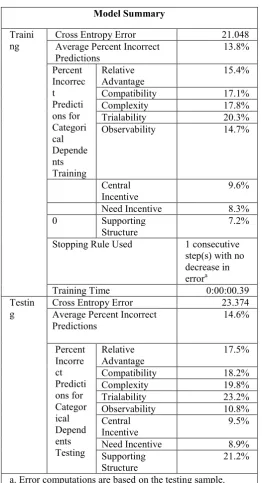
Model Summary
Traini ng
Cross Entropy Error 21.048
Average Percent Incorrect Predictions
13.8%
Percent Incorrec t Predicti ons for Categori cal Depende nts Training
Relative
Advantage 15.4%
Compatibility 17.1%
Complexity 17.8%
Trialability 20.3%
Observability 14.7%
Central
Incentive 9.6%
Need Incentive 8.3%
0 Supporting
Structure 7.2%
Stopping Rule Used 1 consecutive
step(s) with no decrease in
errora
Training Time 0:00:00.39
Testin
g Cross Entropy Error Average Percent Incorrect 23.374
Predictions 14.6%
Percent Incorre ct Predicti ons for Categor ical Depend ents Testing
Relative
Advantage 17.5%
Compatibility 18.2%
Complexity 19.8%
Trialability 23.2%
Observability 10.8%
Central
Incentive 9.5%
Need Incentive 8.9%
Supporting
Structure 21.2%
a. Error computations are based on the testing sample.
Table 1: Model summary results of parameters.
Table 1 above shows the output of results for the test of influence of the eight parameters on innovation diffusion proxied by technology acceptance and use in the Ghana urban water supply system. The data is divided into the training set and the testing set. The training set is the nominal measure of the relationship between the various factors and innovation diffusion. The analysis shows that the overall prediction accuracy of the eight factors on innovation diffusion is about 86% (prediction inaccuracy is 13.8%). The individual prediction inaccuracies again provide ample evidence of
the importance of emergent behaviors in innovation diffusion. For example Rogers‘s initial diffusion configuration returned prediction inaccuracies of relative advantage (15.4%) compatibility (17.1%), complexity (17.8%), trialability (20.3%) and observability (14.7%). This gives an overall prediction accuracy of 82.3% (prediction inaccuracy of 17.7%). On the other hand the prediction inaccuracy of the complex adaptive system configurations outperforms each of Rogers‘s parameters as far as contribution or hindrance to innovation diffusion in urban water management systems is concerned. For example the prediction accuracy of the effect of central incentive in urban water management innovation is nearly 90% (prediction inaccuracy is 9.6%). In the same regard, the effect of need Incentive is nearly 91% (prediction inaccuracy is 8.1%) while the effect of supporting structure is 93% (prediction error is 7.2%). The inflation adjusted testing model follow similar patterns. Overall the training values returned a prediction accuracy of 86% (prediction error of 13.8%) which is far lower than using only the traditional
linear configuration
proposed by Rogers.
V.
CONCLUSION
case for example, the practice incentive program (PIP), was implemented and general adopters were offered money if they voluntarily uptake computers without coercion. The second important factor is the need for a support structure (Giacomoni and Zechman, 2011). Beyond incentives, innovation requires an effective support structure. This involves the collection of elements somehow united to support the innovation load with stability. These include the human resources, materials, management, suppliers etc. These support structures that form the basis of innovation can stimulate or restrict the success and ability to change with customer needs and economic trends. To remain flexible, the company must build support systems that can change as needed (Pahl-Wostl et al, 2007). Technology may be expensive to update, but easily managed. People, on the other hand, often do not bend as easily and often resist necessary changes. The third issue is the need recognition and incentive. The organization must recognize that the innovation must be supplied in order for a certain condition to be maintained or a desired state to be achieved.
VI. REFERENCES
[1]. Amisigo, B. A., McCluskey, A., & Swanson, R. (2015). Modeling impact of climate change on water resources and agriculture demand in the Volta Basin and other basin systems in Ghana. Sustainability, 7(6), 6957-6975.
[2]. Armitage, D. R., Plummer, R., Berkes, F., Arthur, R. I., Charles, A. T., Davidson-Hunt, I. J., ... & McConney, P. (2009). Adaptive co‐management for social–ecological complexity. Frontiers in Ecology and the Environment, 7(2), 95-102. [3]. Berry, J., Fischer, G., & Guiteras, R. P. (2015).
Eliciting and utilizing willingness to pay: Evidence from field trials in Northern Ghana. [4]. Bettini, Y., Brown, R. R., & de Haan, F. J. (2015).
Exploring institutional adaptive capacity in practice: examining water governance adaptation in Australia. Ecol Soc, 20(1), 47-66.
[5]. Bolton, R., & Foxon, T. J. (2015). Infrastructure transformation as a socio-technical process— Implications for the governance of energy distribution networks in the UK. Technological Forecasting and Social Change, 90, 538-550.
[6]. Braden, J. B., Brown, D. G., Dozier, J., Gober, P., Hughes, S. M., Maidment, D. R., ... & Werner, C. M. (2009). Social science in a water observing system. Water Resources Research, 45(11). [7]. Chertow, M., & Ehrenfeld, J. (2012). Organizing
Self‐Organizing Systems. Journal of Industrial Ecology, 16(1), 13-27.
[8]. Cobbina, S. J., Duwiejuah, A. B., Quansah, R., Obiri, S., & Bakobie, N. (2015). Comparative assessment of heavy metals in drinking water sources in two small-scale mining communities in northern Ghana. International journal of environmental research and public health, 12(9), 10620-10634.
[9]. Dodgson, M., & Gann, D. (2011). Technological innovation and complex systems in cities. Journal of Urban Technology, 18(3), 101-113.
[10]. Folke, C. (2006). Resilience: The emergence of a perspective for social–ecological systems analyses. Global environmental change, 16(3), 253-267.
[11]. Folke, C., Hahn, T., Olsson, P., & Norberg, J. (2005). Adaptive governance of social-ecological systems. Annu. Rev. Environ. Resour., 30, 441-473.
[12]. Galán, J. M., López‐Paredes, A., & Del Olmo, R. (2009). An agent‐based model for domestic water management in Valladolid metropolitan area. Water resources research, 45(5).
[13]. Ghaffour, N., Missimer, T. M., & Amy, G. L. (2013). Technical review and evaluation of the economics of water desalination: current and future challenges for better water supply sustainability. Desalination, 309, 197-207.
[14]. Giacomoni, M. H., & Zechman, E. M. (2011). Assessing sustainability of integrated urban water resources systems through a complex adaptive systems approach. In World Environmental and Water Resources Congress 2011: Bearing Knowledge for Sustainability (pp. 2844-2851). [15].
[16]. Herman, J. D., Reed, P. M., Zeff, H. B., & Characklis, G. W. (2015). How should robustness be defined for water systems planning under change?. Journal of Water Resources Planning and Management, 141(10), 04015012.
[17]. Juma, C. (2015). The new harvest: agricultural innovation in Africa. Oxford University Press. [18]. Li, Y. L., Zhang, Q., Werner, A. D., & Yao, J.
lake-catchment-river system using artificial neural networks: Poyang Lake (China). Hydrology Research, 46(6), 912-928.
[19]. Loorbach, D. (2010). Transition management for sustainable development: a prescriptive,
complexity‐based governance framework.
Governance, 23(1), 161-183.
[20]. Pahl-Wostl, C. (2007). Transitions towards adaptive management of water facing climate and global change. Water resources management, 21(1), 49-62.
[21]. Pahl-Wostl, C. (2008). Requirements for adaptive water management. In Adaptive and integrated water management (pp. 1-22). Springer Berlin Heidelberg.
[22]. Pahl-Wostl, C., Sendzimir, J., Jeffrey, P., Aerts, J., Berkamp, G., & Cross, K. (2007). Managing change toward adaptive water management through social learning. Ecology and Society, 12(2).
[23]. Partzsch, L. (2009). Smart regulation for water innovation–the case of decentralized rainwater technology. Journal of Cleaner Production, 17(11), 985-991.
[24]. Rammel, C., Stagl, S., & Wilfing, H. (2007). Managing complex adaptive systems—a co-evolutionary perspective on natural resource management. Ecological economics, 63(1), 9-21. [25]. Schafer, A. I., Rossiter, H. M. A., Owusu, P. A.,
Richards, B. S., & Awuah, E. (2009). Physico-chemical water quality in Ghana: Prospects for
water supply technology implementation.
Desalination, 248(1-3), 193-203.
[26]. Scott, C. A., Kurian, M., & Wescoat Jr, J. L. (2015). The water-energy-food nexus: Enhancing adaptive capacity to complex global challenges. In Governing the nexus (pp. 15-38). Springer International Publishing.
[27]. Silvestre, B. S. (2015). Sustainable supply chain
management in emerging economies:
Environmental turbulence, institutional voids and sustainability trajectories. International Journal of Production Economics, 167, 156-169.
[28]. Van der Brugge, R., & Rotmans, J. (2006). Towards transition management of European water resources. In Integrated Assessment of Water Resources and Global Change (pp. 249-267). Springer Netherlands.
[29]. Zechman, E. M. (2011). Agent‐Based Modeling to Simulate Contamination Events and Evaluate