IJSRSET1733103 | 05 June 2017 | Accepted : 13 June 2017 | May-June -2017 [(2)3: 417-421]
© 2017 IJSRSET | Volume 3 | Issue 3 | Print ISSN: 2395-1990 | Online ISSN : 2394-4099 Themed Section: Engineering and Technology
417
Artificial Intelligence Revolution and India’s AI Development:
Challenges and Scope
Harjit Singh
Neighbourhood Campus Dehla Seehan, Punjabi University, Patiala, Punjab, India
ABSTRACT
Artificial Intelligence is the ability to think, to understand, to recognize patterns, to memorize, to make choice from alternatives and to learn from experience. Artificial Intelligence is to make replica of human brain’s capabilities so that the computers start doing all those activities that the human is doing and in much less time. The recent developments in AI affected politics, journalism, games and public life. In politics the use of AI helped to better use of resources, energy and time in the election campaign to reach the target audience. The high computing power is used to analyze public opinion and the nature of voters across all regions perfectly. There is a concern that political use of AI is increasing negative aspects in modern politics by promoting wrong criticism of opposition, spreading falsehoods, raise social anxiety and encourage racial intolerance. In journalism, bots are performing very well in converting raw data into narrative text with much speed and efficiency. In the recent US presidential elections, AI is used in journalism up to the mark. In games, AlphaGo an AI based machine developed by Google DeepMind, created a history in the recent months by defeating the world champion of Chinese ancient board game “Go”. The life of people is directly or indirectly affected by AI. The smart phones now provide intelligent keyboards which are able to anticipate the next words while typing some text that reduces the burden of typing all the text. Use of machine intelligence to capture user interests and online behavior is very common now on the web. Information is extracted from the data to make an intelligent guess to display advertisements of products that are of interest to the user. Similar to other products of globalization, AI in India is also a side product of globalization, which is becoming widely available without much political consideration. India is lagging behind in the developments of AI as compared to other nations like US and China. The quite emergence of AI applications in India is not noticed by its policymakers in Government. To take full benefits of AI revolution there must be policies for AI innovation and adaptation in Government and public sectors. India must establish regional innovation centers in association with universities and private start-ups for manufacturing robotics and developing automation.
Keywords: Narrow AI and Broad AI, AI revolution, AI and Politics, AI and Journalism, AI and Games, AI and People, Negative concern of AI, Challenges and Scope of AI in India.
I.
INTRODUCTION
The ability of an artificial entity such as a computer machine that makes it so intelligent to solve complex problems that is otherwise possible only by human brain is called artificial intelligence. It is the ability to think, to understand, to recognize patterns, to memorize, to make choice from alternatives and to learn from experience. Artificial Intelligence is to make replica of human brain’s capabilities so that the computers start doing all those activities that the human is doing and in much less time. Artificial Intelligence is the capability
of a machine to perform those activities that are otherwise expected from a human brain. It includes knowledge acquisition, judgment, relationship understanding and produce thoughts. According to the philosophy of Artificial Intelligence, it can be categorized as Narrow AI and Broad AI:
A. Narrow AI
example is solving Tower of Hanoi problem. The problem is to move some different sized disks arranged in ascending order of size from one pole to another using temporary pole in such a way that only one disk can be moved at a time and a bigger disk cannot be placed on a smaller disk. The problem is so difficult for human that as the number of disks are increased, it becomes impossible for a human to solve the problem. But when proper program (using recursive logic) is fed into the computer, it can solve the problem in seconds and can specify all the moves from each pole to each other pole. It proves and amazing strength of programmed intelligence. Another example is chess playing with computer. Not all the moves are programmed step by step, but the programs are made in such a way that they extend their capabilities beyond what is programmed. So, Narrow AI is the capability of a machine to perform activities similar to a human but for a specific domain. In that context for which intelligence is developed, it can perform very intelligently but outside that context it is nothing.
B. Broad AI
Concept is based on the fact that machines could have human level intelligence and they can perfectly perform their activities like human beings. The possibility to design and develop machines in such a way that they can think, they can have reasoning ability and they can do each and every thing that human can do. It means they may be able to program themselves and others. But as expected by the program of AI, current research is far from these expectations and also it is a debate that whether it is possible.
II.
AI IN RECENT EVENTS
C. AI and Politics
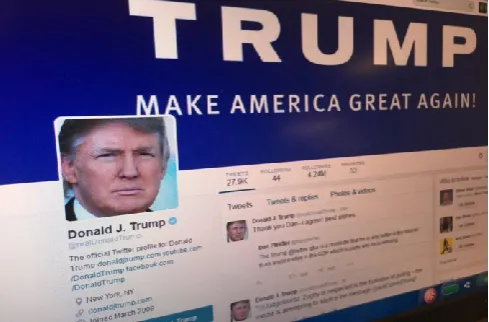
The most recent contribution of AI in politics is disclosed in Presidential elections in US. These elections are highly affected by recent developments in AI. The revolution in AI has changed the way election campaigns are performed in US. The use of AI helped to better use of resources, energy and time in the election campaign to reach the target audience. The high computing power is used to analyze public opinion and the nature of voters across all regions perfectly. During 2008 and 2012 US elections, these AI techniques were nicely used by Barack Obama’s election campaigns.
Figure 1: TWITTER/@REALDONALDTRUMP
Sanjiv Rai, a Mumbai based innovator has developed an AI system named MoglA in 2004. The system is intelligent enough for right prediction of future events and gave right prediction in the last three US presidential elections. It had predicted that Tuesday’s presidential elections in US, Donald Trump will be the winner. Even the nominees of Democratic and Republican parties were predicted by the system successfully as Hillary Clinton and Donald Trump as two candidates. MoglA analyzed millions of interactions from Twitter, Facebook, Youtube and Google that were related to Donald Trump and Hillary Clinton. MoglA learns from the environment similar to Mowgli of the popular “The Jungle Book”. Its name is also based on Mowgli.
In Indian Prime Minister Elections of 2014, Narendra Modi also deployed some of the AI technologies for election campaign, but it was just an initiative.
D. AI and Journalism
Figure 2: Image from www.shutterstock.com
E. AI and Games
AlphaGo is an AI based machine developed by Google DeepMind. It created a history in the recent months by defeating the world champion of Chinese ancient board game “Go”. The world champion of board game, Lee Sedol of South Korea was challenged by Google DeepMind to five board game series in which AlphaGo defeated the champion by four to one. AlphaGo proved that machines can be made intelligent enough to defeat human brain. They can learn from the environment and can predict more accurately than a human brain can. They can make decisions more quickly and accurately than what is expected from human mind.
Figure 3: Chinese Ancient Board Game “Go”
F. AI and People
Recent AI developments affected life of people directly or indirectly. The smart phones now provide intelligent keyboards which are able to anticipate the next words while typing some text that reduces the burden of typing all the text. Desktop computers and tablets now provide voice activated assistants to help. The tablets and other devices are now intelligent enough to follow voice commands to perform the tasks for users. Use of machine intelligence to capture user interests and online behavior is very common now on the web. Whenever
user visits a web site, in the background some intelligent algorithms execute to capture data about user’s interests and online behavior. The browsing history is analyzed by those systems and information is extracted from the data to make an intelligent guess to display advertisements of products that are of interest to the user. The above examples show that at every step of our daily routine, we face some form of machine intelligence which is now becoming crucial for business as well as for our lives.
Figure 4: Advertisements on ShopClues page
Not only the people utilizing that AI benefits, but also they are contributing to some extent to the advancements in AI. The online services such as Netflix, Amazon, Shopclues etc. use intelligent systems to learn from online behavior of consumers to make their products and services according to the demands.
III.
NEGATIVE CONCERN OF AI USE IN
POLITICS
The advancements in Big Data processing and Machine intelligence resulted in many advantages to election campaigns may be at country level or local level. But at the same time there is a concern that political use of AI is increasing negative aspects in modern politics by promoting wrong criticism of opposition, spreading falsehoods, raise social anxiety and encourage racial intolerance. But if we think deeply, these negative aspects were also connected with earlier way of campaign such as television, radio, newspapers etc. What has changed is just the speed and reach to the target.
IV.
CHALLENGES AND SCOPE OF AI IN INDIA
India is lagging behind in the developments of AI as compared to other nations like US and China. Similar to other products of globalization, AI in India is also a side product of globalization which is becoming widely available without much political consideration. The necessary AI infrastructure for a revolution of AI in India is almost neglected by Indian policymakers. Infrastructure to store huge amount of data is provided by servers that are mostly located outside India.
Although, policymakers do not give much importance to these things but global companies like Microsoft and Amazon recently planning to invest in cloud infrastructures in India. Above that there is a lack of the culture of innovation necessary for AI development in India.
In India, till now AI developments are focused to consumer products and services only. The developments are driven by private sector and are being used for business policies and growth. The quite emergence of AI applications in India is not noticed by its policymakers in Government. To take full benefits of AI revolution there must be policies for AI innovation and adaptation in Government and public sectors. It must not be bound to private sectors only.
India must establish regional innovation centers in association with universities and private start-ups for manufacturing robotics and developing automation. Incentives must be offered to manufacturers to motivate them. It must promote infrastructure for cloud computing capacity inside India.
To promote culture of innovation, the National Education Policy mush establish alternative models of education which are more suitable for the future of AI in India. To make the programmes such as Skill India and Digital India a perfect success, the recent innovations and future of AI perspective must not be ignored.
Even current developments of AI are not being used in government sectors to take their benefits. Current advancements of AI may be adopted by government sector to take its benefits such as preventing misuse of subsidy or loan, detecting income tax fraud etc.
V.
CONCLUSION
This paper discusses recent advancements in AI at global level and their impact on global as well as local levels. In politics, AI is experimented by Barack Obama, Narendera Modi, Hillery Clinton and Donald Trump and they found it very useful technology. The use of AI helped to better use of resources, energy and time in the election campaign to reach the target audience. The high computing power is used to analyze public opinion and the nature of voters across all regions perfectly. In the recent US presidential elections, AI is used in journalism up to the mark. AlphaGo an AI based machine developed by Google DeepMind, created a history in the recent months by defeating the world champion of Chinese ancient board game “Go”. Use of machine intelligence to capture user interests and online behavior is very common now on the web. Information is extracted from the data to make an intelligent guess to display advertisements of products that are of interest to the user.
India is lagging behind in the developments of AI as compared to other nations like US and China. The necessary AI infrastructure for a revolution of AI in India is almost neglected by Indian policymakers. Current advancements of AI must be adopted by government sector to take its benefits. India must establish regional innovation centers in association with universities and private start-ups for manufacturing robotics and developing automation.
VI.REFERENCES
[1] C. Raja Mohan, “Raja Mandala: Artificial intelligence, real politics”, http://indianexpress.com/article/opinion/columns/u s-elections-campaign-artificial-intelligence-mogia-hillary-clinton-donald-trump-politics-3944453/, November 2016
[2] https://deepmind.com/research/alphago/
[3] https://www.sciencedaily.com/news/computers_ma th/artificial_intelligence/Richard Mallah, "The Top A.I. Breakthroughs of 2015”, http://futureoflife.org/2015/12/29/the-top-a-i-breakthroughs-of-2015/", December 29, 2015 [4] Stuart Frankel and Kristian Hammond, “5
Predictions for Artificial Intelligence in 2016”,
[5] Daniel B. Neill, “Using Artificial Intelligence to Improve Hospital Inpatient Care”.
[6] Daniel E.O. Leary Artificial Intelligence and Expert System in Accounting Databases: Survey and Extensions”, Expert Systems with Applications, vol-3, 1991.
[7] Oscar Firschein, Martin A. Fischler, L.Stephen Coles, Jay M. Tenenbaum, “FORECASTING AND ASSESSING THE IMPACT OF ARTIFICIAL INTELLIGENCE ON SOCIETY”, unpublished.
[8] S.N. Deepa, B. Aruna Devi, “A survey on artificial intelligence approaches for medical image classification”, Indian Journal of Science and Technology, Vol. 4 No. 11 (Nov 2011).
[9] N Ramesh, C Kambhampati, JRT Monson, PJ Drew, “Artificial intelligence in medicine”, 2004. [10] Charles Weddle, Graduate Student, Florida State
University “Artificial Intelligence and Computer Games”, unpublished.
[11] C. Sampada,, et al, "Adaptive Neuro-Fuzzy Intrusion Detection Systems", Proceedings: International Conference on Information Technology: Coding and Computing (ITCC’04),2004.
[12] Vassilis S Kodogiannis and John N Lygouras (2008) Neuro-fuzzy classification system for wireless capsule endoscopic images. J. World Acad. Sci.Engg. & Technol., 45, 620-628.
[13] Zadeh L, “Fuzzy sets Inf Control”, 1965
[14] Fatai Adesina Anifowose, Safiriyu Ibiyemi Eludiora, “Application of Artificial Intelligence in Network Intrusion Detection”, World Applied Programming, Vol (2), No (3), March 2012. [15] F. D. Laramee, Genetic Algorithms: Evolving the
Perfect Troll, AI Game Programming Wisdom, Charles River Media, Inc., Hingham, MA, 2002 [16] Holland JH, “Adaptation in Natural and Artificial
Systems”, 1975.
[17] J. Matthews, Basic A* Path finding Made Simple, AI Game Programming Wisdom, Charles River Media, Inc., Hingham, MA, 2002.