© 2016 IJSRSET | Volume 2 | Issue 3 | Print ISSN : 2395-1990 | Online ISSN : 2394-4099 Themed Section: Engineering and Technology
Assessing How the Packaging of Immunization Services
Influence Uptake of the Immunization Services in Selected
Health Facilities of Kajiado North Sub-County Kenya
Toweett John Kipngetich
*, Dr Wanja Mwaura Tenambergen, Maureen Atieno Adoyo
Department of Health Systems Management, Kenya Methodist University, P.O. Box 45240-00100 Nairobi, Kenya
ABSTRACT
Background: Immunization as a preventive measure to diseases is vital to organizational performance. Among the six pillars of the health system, this research focused on service delivery. A desk review indicated that there was low immunization coverage in the County. The objectives of the study was to determine how the cultural values, packaging of immunization and health promotion supports the uptake of immunization services
Methods: A cross-sectional study utilizing a guided questionnaire, targeting 280 mothers and an interview guide targeting 9 health workers were used. Data analysis was done using SPSS version 21 using descriptive statistics. Qualitative analysis was done by thematic content analysis and framework analysis.
Results: Majority of the respondents (mothers) were young with a mean age of 26 years. 233 (83%) agreed that immunization program is well explained to them when they visit health facilities. More than half 183(65.4%) of mothers got the information about immunization through continuous health education routinely offered in health facilities, whereas a significantly low 39 (13.9%) mothers got the immunization information through community health promotion. The correlation of health education with awareness indicated a (P-value = 0.406**) A p-value of 0.209** indicates that frequent visits to the health facilities did not influence the awareness of mothers on the immunization services offered in health facilities.
Conclusion: The researcher concluded that there is a relationship between immunization uptake and immunization health promotion activities and recommended that the County Government of Kajiado should introduce outreach services and intensify health promotion activities
Keywords: Service Delivery, immunization uptake, immunization services packaging Coverage, Kajiado north sub-county
I.
INTRODUCTION
In 1974, the World Health Organization (WHO) established the Expanded Programme on Immunization (EPI) to ensure all children had access to routinely recommended vaccines. Initially, those vaccines were limited to bacille Calmette-Guérin vaccine (BCG), diphtheria-tetanus-pertussis vaccine (DTP), oral poliovirus vaccine, and measles-containing vaccine (MCV). Global coverage with the third dose of DTP (DTP3) increased from <5% in 1974 to 79% by 2005. However, one fifth of the world's children, especially those in low-income countries, still were not fully
vaccinated during the first year of life with the four traditional EPI vaccines. Every attempt must be made to immunize children on time as per the national Expanded Programme on Immunization [EPI] schedule. Any delay in completing the schedule exposes that child and all others in the community who are not fully immunized to precisely those risks of mortality and morbidity from the target diseases that immunization is designed to avoid. [1, 16]
preventable diseases is immense. Globally speaking, 2.5 million children die every year from easily prevented infectious diseases. In fact, in the year 2000, measles resulted in 777,000 deaths and 2 million disabilities.
Among the six pillars of the health system, this research focused on service delivery. The Kenya bureau of statistics (2008–2009), through the Kenya demographic and health survey (KDHS) stated that the national neonatal mortality rate (per 1,000 births) was 31 in 2008 and 50 in 2009 for the entire Kajiado County. The data pointed out that the County is the least improved health service demanding population with a percentage rating of 30.9% for immunization nationally putting the county at position 47 out of the 47 counties. This indicated that there was low immunization coverage in the County. [2].
Kajiado north sub – County remains one of the areas of focus due to its low immunization coverage. According to Nigeria for instance, an under-5 mortality rate of 201/1000 (immunization coverage of 13%) was recorded. It remains one of the polio hot zones along with the India, Pakistan and Afghanistan and also one of the 11 countries that accounted for 66% of the world’s measles death [3]. Literacy level contributes to informed decision at every level of health care intervention. Central bureau of statistics reported that seventy percent of illiterate persons in Kenya are female. [4].
The World Health Report (2000) defined overall health system outcomes or goals as: improving health and health equity, in ways that are responsive, financially fair, and make the best, or most efficient, use of available resources.[5,13].
Health systems advocates for interrelated parts in a health system working together toward successful service delivery. Packaging of immunization services towards realization of high immunization coverage forms one of these parts. According to [6,16], Understanding and working with complexity requires a paradigm shift from linear, reductionist approaches to dynamic and holistic approaches that appreciate the multifaceted and interconnected relationships among health system components, as well as the views, interests and power of its different actors and stake-holders. In addition, it is evident that education level and socioeconomic status are related, as is gender, when examining health inequalities in minority groups that
live in developed countries with access to a national health service [7, 14].
Just as immunization is free in kenya, coverage is still low in the sub-county. This is attested to by the coverage in India. In India for instance, immunization services are offered free in public health facilities, but the immunization rate remains low. According to the National Family Health survey, only 44 percent of children aged 1-2 years old have received the basic package of immunizations. That rate drops to 22 percent in rural Rajasthan [8].
At the time of the study, the authors were unaware of any published reports on the influence of immunization uptake by immunization service packaging in Kajiado North Sub-County, Kenya. The study was therefore carried out to document the status of the influence of immunization service packaging in public and faith based health facilities in Kajiado north Sub-County, Kenya. Knowledge of this situation was necessary to guide the County on appropriate investment on interventions to maximize resources available for greater health benefit.
II.
METHODS AND MATERIAL
Study area: The study was conducted in sampled health facilities in Kajiado north sub-county, in Kajiado County. There had been no documentation on the influence of immunization uptake in the sub- County.
Study design and procedure:
under one year of age attending MCH clinic and those found in the market centers fulfilling the requirements.
Data collection:
Structured questionnaires were used to collect data from mothers meeting the established criteria. It focused on socio-demographic characteristics, economic status, awareness of immunization services, mode in which they received information about immunization services and the frequency of visiting the health facilities for immunization services. The health workers interview guide was organized to capture data on cost, availability, acceptability, distance and how these factors influenced mothers’ immunization services uptake.
Data management and analysis:
At the end of each interview the filled questionnaire was cross checked for completeness and any missing entries corrected. Data collected was coded, processed and cleaned of current inconsistencies and outliers. Data was analyzed by the use of SPSS (Statistical Package for the Social Sciences) version 20 as per the specific research questions and subjected to descriptive analysis using frequencies and percentage. Descriptive and inferential statistics were generated and relationships were determined using Pearson correlation and levels of significance deduced. Qualitative analysis was done by thematic content and framework analysis.
Ethical consideration:
Permission to conduct research was sought from the County Director of Health. The researcher provided full information about what the research entailed and ensured participants were competent to give consent. The questionnaires were administered with duly obtaining consent of the participant. Participants’ privacy was maintained by ensuring that they were not exposed to public when filling questionnaires. Anonymity of respondents was assured by concealing their identity and research data was kept confidential for research purposes only. The study was conducted by full adherence of the Scientific and Ethics Review Committee of Kenya Methodist University.
III.
RESULTS AND DISCUSSION
A concerted effort by all stakeholders at all levels is necessary to involve both, planners and researchers. It
also recognizes that important decisions that determine health system performance at all levels are made by specific people (individuals and groups in the public and private sectors) highlighting the importance of collective duties toward the advancement of health, and of identifying responsibility and ensuring accountability for health system outcome. In this study a p-value of 0.209** with a significance at the 0.01 level (2 tailed) indicates that there is no influence in the awareness by mothers of the immunization services offered in health facilities as a result of the frequency of the visits to the health facilities. The level of education of mothers was relatively low with 73 (26.1 %) saying they attained basic primary education. A correlation of awareness of immunization services with level of education indicated a p-value of -0.259** for those mothers who attained the basic education, which is less than the level of significance of 0.01 therefore confirming that the level of education influences uptake of immunization services.
(a) Cost of accessing immunization
The study sought to find out the cost of accessing immunization among the respondents. The element of cost is not issues because the immunization services are offered free of charge and therefore this aspect may not in any away be contributory to low access to immunization services. The mothers across a number of markets visited during the study expressed appreciation on the free immunization services and only pointed out that the road networks to the health facilities were wanting. This is evidenced by the information given by one key informant who said.
“…From time immemorial the immunization services have never been offered at a cost in public and faith based hospitals. However, a small fee is charged in private hospitals to gather for other services which go alongside immunization services…”
(Key Informant, BF 001)
(b) Availability of Immunization Services
they learnt of immunization services through health promotion activities. Another 18.1% felt that health education during clinic visits need to be frequent. All the immunization services were offered for 8 hours each day between 8.00 am to 5.00 pm and the clinic remained opened with one staff represented each time. This is evidenced by the information provided by one key informant who said:
“…Due to staff shortage the organization of immunization services are structured in a way that there is always one staff to provide services particularly during lunch break and at any one time in the cause of each working day…” (Key Informant, BF 002)
(c) Acceptability
The acceptability was supported by several sentiments from health workers who confidently stated that the organization of immunization services attracts mothers to seek the services despite the current devolution challenges. They cited growth in numbers accessing out-patient health services as good example. This is evidenced by the information provided by one key informant who said
”… The health information office recently gave a quarterly service delivery performance report indicating that there is a noted rise in patient attendance to the health facilities attributed to the consistency in availability of drugs…”
(Key Informant, BF 003) (d) Distance
The distances between households and health facilities ranged from a hundred meters (100m) to twenty kilometers (20 km). Approximately 48(17.1%) of mothers visit facilities that are outside the 5 kilometer distance prescribed for in the Kenya health policy (2014-2030), Therefore, distance only influenced 48 (17.1%) of the mothers interviewed in taking up immunization services. This is evidenced by the information given by one key informant who said.
“… Kajiado County is vast and has a smaller population as compared to the area the communities cover. The Maasai community is the majority
inhabitants and pastoralists. It’s against this background that they migrate in search of pastures for their animals and therefore most likely that some will miss on their children’s clinic days…”
(Key Informant, BF 002)
Discussion
This study was undertaken to determine the influence of immunization Packaging to immunization uptake in Kajiado north sub-County. Overall, there was an average packaging based on observations and focused group discussion with the health workers. These packaging was similar as as compared to India where researchers reported that according to the National Family Health survey, only 44 percent of children aged 1-2 years old have received the basic package of immunizations [8].
To improve service delivery staffing and packaging of services is key. Due to staff shortage the organization of immunization services are structured in a way that there is always one staff to provide services particularly during lunch break and at any one time in the cause of each working day. According to the findings from a cross-sectional descriptive study by University of Nebraska Medical Center in 1995, it illustrated the importance of human resources management to the health care system. It stated that hospital administrative staff recognized a variety of new challenges that were necessitating organizational change [9,12].
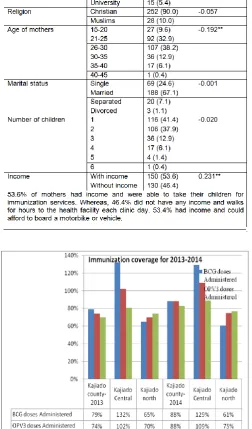
Although availability of immunization services was sufficient, the proportion of coverage of children eligible for immunization is still below the national target of (90%). 125 respondents said they traveled by foot to seek immunization services. This concurs with the coverage as established in desk review in the Health Sector report which indicated a variation in uptake with a downward trend recorded in 2013 in two of the three facilities sampled [10].
These findings are consistent with a study in India which stated that immunization services are offered free in public health facilities, but the immunization rate remains low adding that, according to the National Family Health survey, only 44 percent of children aged 1-2 years old have received the basic package of immunizations [11].
A large proportion of 65.4% of mothers who actually received information about immunization services through continous health education. Equally suggested by health workers and mothers alike was the staff shortage. They said the acute shortage of health workers in some facilities have continued to increase the patient/ client waiting time from 30 minutes prescribed in the service charter to an average of 45 minutes. This concurs with [7], which stated that, the supply of services is only one factor in the decision making process. Just as important are the physical and financial accessibility of services, knowledge of what providers offer, education about how to best utilize self- and practitioner-provided services and cultural norms of treatment.
Health is a devolved function in the current health governance structure. The Health Sector report stated that, despite the downward trend of all health services just after devolution of health services, there is evidence that the health sector indicators are improving. Immunization coverage has shown the lowest performing counties upward trends [9].
University of Nebraska Medical Center in (1995), stated that, the hospital administrative staff recognized a variety of new challenges that were necessitating organizational change. To address staffing; they integrated a series of organization-wide staffing strategies that would anticipate and meet changing workforce requirements pertaining to staff. This concurs with the transcribed sentiments by key informant health worker, BF 003 that, despite the challenges of devolution, the health management has taken action to address the supply of drugs and flow of patients seeking health services has increased.
IV.
CONCLUSION
Although packaging of immunization services is acceptable based on cost and the distance coverage is
not bad but access is still low. This is attributed to the vast land occupied by the majority of the population inhabiting Kajiado County. The majority are Maasai whose way of live is nomadic. Health is a devolved function in the current health governance structure in Kenya. The respondents expressed increased attention during clinic days due to close supervision of staff and frequent supply of vaccines and other drugs.
They further indicated that availability of drugs has encouraged them to keep their children clinic schedules as they visit the facilities to seek other forms of medical care. Despite the fact that immunization services are available and that 65.4% of respondents received continous health education from health facilities. It is prudent to note that health workers shortage is a problem known in Kajiado north sub- County as contributing to increased patient waiting time. Waiting time determines future demand for services in the same health facility.
What is already known on this topic?
Immunization services are offered with no cost attached to it. Staff shortage is a problem across all counties in the republic of Kenya known to increase the patient waiting time due to overworked staff.
What this study adds
There is need to form outreach teams to trace defaulters of immunization schedules as well as assess the level of outreach in the community. Socio-economic empowerment is an important factor in achieving immunization coverage as well as enabling the community to access vital health information for their good health.
There is need to package simplified information about the benefits of immunization services shared in health education sessions and during community health promotion. If 26% of mothers under the age of 30years only attained basic education, there is a likelihood that low immunization coverage is partly due to education profile of young mothers.
Acknowledgments
study in the County. I thank Dr. Marione Mukira for her support and moderation throughout the data collection process. I am particularly indebted to the support provided by all health workers and mothers in Kajiado North sub-county who took time to participate in the research, without their support this research could not have been successful. I also thank Mr Musa Oluoch and Mr Ben Osuga for their fruitful technical guidance.
Competing Interests
The authors declare no competing interests
Authors’ contributions
JKT & AMA developed the concept and designed the study. AMA & WMT supervised literature review, data collection, data analysis, and final conceptualization of the study report. JKT conducted literature review, collected, analyzed, and interpreted data. JKT drafted the manuscript. All authors participated in the critical review of the final version of the manuscript and contributed significantly to its contents and to the management of the manuscript preparation.
Tables and figures
Table 1: Socio-demographic Characteristics of the Mothers
Table 2 : Correlation of immunization services packaging variables
Figure 1 : Kajiado north sub-county immunization coverage for 2013-2014
V.
REFERENCES
[1] Center for disease control (CDC) (2011). Global
Routine Vaccination Coverage; weekly,
November 2, 2012 / 61(43);883-885
[2] Kenya National Bureau of Statistics (KNBS) and ICF Macro. 2010. Kenya Demographic and Health Survey (2008-009) The information on the population and health situation in Kenya. Calverton, Maryland: KNBS and ICF Macro.
[3] D Adeyinka, O Oladimeji, F Adeyinka, C
Aimakhu. Uptake Of Childhood Immunization Among Mothers Of Under-Five In Southwestern Nigeria. The Internet Journal of Epidemiology. 2008 Volume 7 Number
[4] Central Bureau of Statistics (2002). The information on the population and health situation in Kenya. KNBS and ICF Macro.
[5] The World Health Organization report (2000). Health Systems: Improving Performance. Geneva. 2000.
[6] Sheikh et-al (2011), Building the Field of Health Policy and Systems Research, Social Science Matters. Framing the questions, PLoS Med 8:
e1001073;10.1371/journal. pmed.1001073.
Published. August 23, 2011.
[7] Anderson, J. G. (1973). Health services
utilization: Framework and review. Health Services Research, 8(3), 184-99
[8] The World Health Organization (1974). Report on establishment of the Expanded Programme on Immunization (EPI) Geneva: World Health Organization.
[9] Health Sector report (2014/2015). Annual
performance review report. Ministry of health: publication
[10] Banerjee, Abhijit Vinayak, Esther Duflo, Rachel Glennerster, and Dhruva Kothari. (2010). "Improving Immunisation Coverage in Rural
India: Clustered Randomised Controlled
E(Andersen J.G, 1973)valuation of Immunisation Campaigns with and without Incentives." BMJ 340-222
[11] Jenny L. Jones et-al (2005), The impact of organizational culture on the intention to remain in public child welfare:A case study of Tennesse. Tennessee: publication.inc
[12] Kajiado County (2014). Department of health services. Kajiado county health sector strategic
and investment plan (2013-2017). Reversing trends and accelerating the attainment of health goals. Ministry of health: publication
[13] Ensor, T., & Cooper, S. (2004). Overcoming barriers to health service access: influencing the demand side. Health Policy & Planning, 19(2), 69-79.
[14] Hershey, J. C., Luft, H. S., & Gianaris, J. M. (1975). Making sense out of utilization data: Medical Care, 13 (10); 838-54.
[15] Kothari,(2004). Mugenda wa Mugenda (1999) International Journal of Education and Research Vol. 2 No. 4 April
[16] Ministry of public health of Yemen (2005), Guidelines for Safe Immunization Practices and Monitoring Immunization Programs at the Facility and District Levels in Yemen (First Edition- pg 19. March 2005)