Boyl a n , B ri gi t t e , F ol ey, Mi k e a n d M cT e r n a n , N i g el ( 2 0 1 1 ) An inv e s ti g a ti o n of h o w I ni ti al Te a c h e r E d u c a ti o n s u p p o r t s t h e d e v elo p m e n t of p r i m a r y t r ai n e e s ' u n d e r s t a n d i n g a n d t e a c h i n g of P h ilo s o p h y fo r C hil d r e n a n d c o n c e p t c a r t o o n s . Te a c h e r E d u c a ti o n Adv a n c e m e n t N e t w o r k Jo u r n al (TEA N), 2 ( 1).
Do w n l o a d e d fr o m : h t t p ://i n si g h t . c u m b r i a . a c . u k /i d/ e p ri n t/ 1 3 4 8 /
U s a g e o f a n y i t e m s f r o m t h e U n i v e r s i t y o f C u m b r i a’ s i n s t i t u t i o n a l r e p o s i t o r y ‘I n s i g h t ’ m u s t c o n f o r m t o t h e f o l l o w i n g f a i r u s a g e g u i d e l i n e s .
Any it e m a n d it s a s s o ci a t e d m e t a d a t a h el d i n t h e U niv e r si ty of C u m b r i a ’s in s ti t u ti o n al r e p o si t o r y I n si g h t ( u nl e s s s t a t e d o t h e r wi s e o n t h e m e t a d a t a r e c o r d ) m a y b e c o pi e d , di s pl ay e d o r p e rf o r m e d , a n d s t o r e d i n li n e wi t h t h e JIS C f ai r d e a li n g g ui d eli n e s ( av ail a bl e h e r e) fo r e d u c a t i o n al a n d n o t-fo r-p r ofi t a c tiviti e s
p r o v i d e d t h a t
• t h e a u t h o r s , ti tl e a n d full bi blio g r a p h i c d e t ail s of t h e it e m a r e ci t e d cl e a rly w h e n a n y p a r t
of t h e w o r k is r ef e r r e d t o v e r b a lly o r i n t h e w ri t t e n fo r m
• a h y p e rli n k/ U RL t o t h e o ri gi n al I n si g h t r e c o r d of t h a t it e m is i n cl u d e d i n a n y ci t a ti o n s of t h e w o r k
• t h e c o n t e n t is n o t c h a n g e d i n a n y w a y
• all fil e s r e q ui r e d fo r u s a g e of t h e it e m a r e k e p t t o g e t h e r wi t h t h e m a i n it e m fil e.
Yo u m a y n o t
• s ell a n y p a r t of a n it e m
• r e f e r t o a n y p a r t of a n it e m wi t h o u t ci t a ti o n
• a m e n d a n y it e m o r c o n t e x t u ali s e it i n a w a y t h a t will i m p u g n t h e c r e a t o r ’s r e p u t a t i o n
• r e m ov e o r a l t e r t h e c o py ri g h t s t a t e m e n t o n a n it e m .
T h e full p oli cy c a n b e fo u n d h e r e.
Citation:
Foley, M., Boylan, B. & McTernan, N. (2011) ‘An investigation of how Initial Teacher Education supports An investigation of how Initial Teacher Education supports the development of primary trainees’ understanding and teaching of Philosophy for children and
concept cartoons.
Authors: Michael Foley, Brigitte Boylan, Nigel.McTernan
University of Cumbria.
London East Consortium.
Tower Hamlets PDC
English Street
London
E3 4TA.
An investigation of how Initial Teacher Education supports the development of primary trainees’ understanding and teaching of Philosophy for Children and
concept cartoons.
Authors: Authors: Michael Foley, Brigitte Boylan, Nigel.McTernan
Abstract
The research examines the impact of the university taught sessions in broadening the primary Graduate Teacher Programme trainees’ conceptual base in line with The Office
for Standards in Education (OFSTED) recommendations. In particular the investigation
analyses how Initial Teacher Education supported the Graduate Teachers Programme trainees’ understanding and teaching of Philosophy for Children (P4C) and concept
cartoons as creative strategies. Philosophy for Children and concept cartoons are
viewed as creative teaching strategies in the sense that they enable pupils to develop
higher order thinking skills, question assumptions, encourage structured classroom talk
and open up possibility thinking.
Using questionnaires, non-directive group sessions, lesson observations and course
research assignments, evidence was gathered as to the use of the creative teaching
strategies by the trainees in their classroom practice. Thirty nine percent of trainees
implemented P4C and fifty seven percent used concept cartoons in their teaching. The
results indicate that the university-based teaching programme had an impact but some
trainees did not use the strategies because they felt constrained by internal school
pressures and external constraints.
To improve the usage of the strategies we intend to strengthen the link with the
rationale behind what constitutes effective learning by providing concrete ways in which
Citation: 3
Key Words: Concept cartoons; Philosophy for Children; Creative teaching strategies;
Background
This paper is concerned with an exploration of two ‘creative teaching strategies’
in the context of a London primary Graduate Teacher Programme (GTP). The
GTP is an employment based route into teaching in which the trainees1 spend
four days a week in schools and one day a week at university engaged in a core
taught programme. Approximately 14% of the annual 75,000 newly qualified
teachers in England come through the GTP route (General Teaching Council,
2010). The Office for Standards in Education (Ofsted) notes that the GTP is successful in ‘recruiting good teachers with a high level of professionalism and self motivation’ (Ofsted, 2007). 'The Ofsted report on GTP national provision,
reviewing the period 2003-2006, points out that an important aspect of the GTP
course is the breadth of experience gained from the trainee's immersion in school
life. According to our internal Self Evaluation Document from 2009 we discovered
that the retention rate of GTP trainees from this primary provider after six years in
teaching is 94% which suggests that the breadth of experience we offer is
successful. However, the Ofsted report goes on to state that 'GTP trainees'
repertoire of teaching strategies is narrow and often remains an area for development’ (Ofsted, 2007).
As the provider for a small cohort of twenty six primary GTP trainees, the authors
of this paper were particularly interested in the impact of university taught
sessions in developing the trainees’ conceptual base. The team was also keen to see how these sessions might broaden trainees’ teaching strategies. In particular we wished to investigate how ITE supported the development of primary trainees’
understanding and teaching of P4C and concept cartoons. The former is a
strategy to develop children’s thinking and encourage dialogic talkingand the
1
Citation: 5 latter strategy is concerned with presenting children with cartoons in order to encourage debate and reconsider their preconceptions. Such ‘creative teaching strategies’, the delivery team hypothesised, could put pupils at the centre of
learning as problem solvers and communicators rather than as passive recipients
of knowledge (Keogh, Naylor and Downing, 2003). As tutors on the GTP delivery
team we focused on P4C and concept cartoons as possible mechanisms for
broadening teaching strategies and moving trainees away from a transmission
type approach to teaching. We envisaged that P4C and concept cartoons would develop trainees’ teaching for creativity.
What is creativity?
Craft and Jeffrey (2008) have suggested that there have been three major factors
in a more recent trend towards creativity in primary education: firstly a democratic
view in which creativity is seen as both necessary and inherent in humans;
secondly an explicit connection made by the government between creativity in
the classroom and need for creativity in the broader economy; thirdly, the
generation of more creative learners and more cultural cohesion through the use of Creative Partnerships. Creativity is seen as an ‘elusive concept’ (Craft, 2001,
p.12) and has been defined in numerous ways to such an extent that there is now, arguably, ‘cultural saturation’ (Craft, 2000, p.14). Ofsted points out that the
term is widely used with a variety of different interpretations ranging from innate
abilities to a set of skills that can be supported (Ofsted, 2010). All Our Futures (NACCCE, 1999) defines creativity as ‘an imaginative activity fashioned so as to produce outcomes that are both original and of value’ (NACCCE, 1999, p.29). Craft believes that ‘creativity is an essential life skill which needs to be fostered by the education system’ (Craft, 1999, p.137) and in later work dubs creativity as ‘possibility thinking’ and also containing the core elements of being imaginative,
posing questions and incorporating play (Craft, 2000, p.6). Claxton, Craft and
Gardner (2008) make the point that when discussing creativity, attention needs to
collective perspective the value of creativity in education may be debatable. Teachers’ understanding of creativity tends to vary with a commonly held view
that creativity is similar to problem solving. Yet others believe that creativity is
associated with lateral or intuitive thinking or the fresh outlook of young children (HMIE, 2006). A report by the Scottish HMIE noted that, ‘creativity is possible in
all subjects and curricular areas although student teachers and class mentors report a variable awareness of the role of creativity in learning through ITE’
(HMIE, 2006). Robinson sees creativity as a ‘dynamic process which draws from many areas of a person’s experience and intelligence’ (Robinson, 2001, p12).
There can be little doubt that such a range of views on the nature of creativity
comes from the mix of underlying perspectives that inform the practice of
creativity in education. Given the difficulty of defining the concept of creativity, as
a delivery team we aimed to encourage our trainees to see teaching for creativity
as a collaborative enterprise where children learn best if they take responsibility
for their own learning, by being actively engaged in the process. Our intention
was to make concrete the notion of creativity by encouraging the trainees to use
such strategies as P4C and concept cartoons as mechanisms to extend pupil
thinking and understanding. We thought that such an approach fitted well with Black and Wiliam’s idea (1998, p.16) that what teachers need is ‘a variety of living examples of implementation’.
Creative Partnerships: A strategy to develop creativity in schools
In order to investigate the benefits to children of developing creativity in schools
we looked at the Creative Partnership scheme. The Creative Partnership
scheme was established in 2002 by the then Government to fund creative
professionals to work in partnership with teachers and pupils. Among the
Citation: 7
become a core principle and be incorporated into Every Child Matters policy2
(Great Britain. Parliament. House of Commons, 2003).
The House of Commons Education and Skills committee reported that Ofsted’s
review of Creative Partnerships in 2006 was broadly supportive of the scheme,
commenting that most creative partnerships were effective and the programme
helped the development of personal and creative skills (Great Britain. Parliament.
House of Commons, 2006). In July 2010 Creative Culture and Education (CCE)
stated that PricewaterhouseCoopers auditors had examined data on Creative
Partnerships. The auditors concluded that for every £1 invested the partnership
delivered benefits of £15.30 to the economy. The same survey showed that
pupils involved with Creative Partnerships achieve on average GCSE grades 2.5 ‘better than their peers in similar schools’ (CCE, 2010).
Two specific teaching strategies
As the GTP delivery team, we decided to broaden the range of teaching
strategies taught on the course, in line with Ofsted (2007, p.15)
recommendations. To accomplish this task we felt that fostering two particular
approaches, P4C and the use of concept cartoons, were more likely to develop
teaching to promote creativity, in the sense of promoting more open ended tasks
and more open questions in which the teacher and the pupils would be involved
in a co-construction approach to learning (Watkins, Carnell and Lodge, 2007).
Both approaches carry risks such as the danger of pupils going off task, the
possibility of curriculum coverage being compromised, a possible lack of
2
The aim of the Every Child Matters programme is to give all children the support they need to:
be healthy
stay safe
enjoy and achieve
make a positive contribution
inclusivity and the role of the teacher changing to be more of a facilitator rather
than a transmitter of knowledge. In this sense we viewed both methods as
relatively creative approaches to teaching since P4C and concept cartoons questioned ‘the taken for granted’, are more likely to develop higher order thinking skills, and expose pupils to other children’s ideas. In short, we felt that using such strategies was more likely to develop pupils’ critical consciousness and open up ‘possibility thinking’ (Craft, 2000, p.6) and as a result develop a
more creative approach to teaching and thus widen the GTP repertoire of
teaching strategies, as recommended by Ofsted (2007). We were aware from
the outset however that the focus on creativity raises specific challenges such as
ensuring a reasonable balance between having a structure and at the same time
allowing freedom in learning, curriculum and pedagogy. In addition, as Craft
(2008) suggests there is also a tension between the more managed approach of
the older generation of teachers and the more evolutionary approach of a social
networking generation.
Philosophy for Children
P4C was initially developed by Professor Matthew Lipman (Lipman, 2003) and
his associates at Montclair University in the late 1960s. The delivery team saw
P4C as a method for developing a classroom community of enquiry. P4C also helped develop active listening, reflection and the ability to change one’s views in
response to other opinions. Other benefits included the encouragement of pupil
dialogue and developing higher order thinking skills. The Society for Advancing
Philosophical Enquiry and Reflection in Education handbook (SAPERE) suggests that there are two clear aims of P4C: one is to ‘develop understanding and good
judgment through critical examination of meaning of words, facts of the matter, personal feelings, views and values’; another clear aim is to build a sense of
community through paying proper respect to differences of interpretation, beliefs,
Citation: 9 various practical strategies which can be used to carry out these aims in the
classroom by developing communities of enquiry i.e. the pedagogy of P4C.
We were aware that P4C has been criticised for being a watered down version of
academic philosophy (Hand, 2008) and that other critics such as Suissa (2009)
argue that P4C focuses too narrowly on truth, failing to address the question of
meaning in life. Fox (2003) argues that children are doers, not thinkers, and will
have limited patience and perseverance with a classroom activity that demands
long periods of inaction. However, as a delivery team we thought that learning
could be defined as an activity of making meaning and so teachers need to
provide opportunities for children to talk within a structured context in order to
extend thinking and understanding. P4C we felt was one practical strategy which
allowed the learners to be active and teachers to publicly present themselves as
learners.
Concept Cartoons
Concept cartoons are cartoon style drawings about everyday events with which
children would be familiar. Naylor and Keogh (1999) developed the cartoons as a
science and mathematics assessment and teaching tool particularly for dealing
with common misconceptions and as a starting point for investigations. The cartoons take pupils’ ideas into account and present children with a number of
set alternatives as a way of beginning discussion. The minimal use of language
and the use of visuals lend themselves to inclusivity. Students are encouraged to
debate the offered alternatives and to give reasons for their choices in order to
access their thinking processes and possible misconceptions. The discussion around the cartoons stimulates pupils to listen to each other’s ideas and
reconsider their own preconceptions. As with P4C, the delivery team view was
that concept cartoons provided a very practical mechanism for the trainees to
move away from a reception type delivery and instead encourage children to
The research
We began the research in the autumn term 2009 when all the trainees were
involved in a primary school visit to see some exemplary P4C practice in terms of
teaching for creativity. In addition, trainees spent one of their training sessions
discussing P4C and being involved in P4C activities so that trainees could appreciate and understand the impact of P4C on children’s learning. With
concept cartoons, the trainees spent a session discussing and using the cartoons
as learning aids and also attended a session led by Brenda Keogh, joint author of
concept cartoons. Subsequently, the GTP delivery team led similar activities with the trainees’ mentors in order to raise awareness of the course content and the
potential impact these strategies have on pupil learning. In terms of the
university-based programme the delivery team modelled both processes for the
trainees. We decided that the key research question was to investigate the impact of university-based teaching of P4C and concept cartoons on trainees’ practice and the educational impact of these two strategies on children’s learning.
We used qualitative research methods, questionnaires and non-directive
interviews to collect our data.
Research methodology
At the end of the academic year 2009/10 we devised two simple questionnaires
as a practical method to collect data in a standardised format. Each
questionnaire asked seven questions. Three questions were closed and the
remaining four were open in order to allow an opportunity for trainees to expand
their responses. The questions were designed to ascertain whether the trainees
had used either P4C or concept cartoons in their teaching. We also asked
whether they had been formally observed using the strategies to check on the
veracity of their response and also to gain another view on the success, or
otherwise of the strategies. Other questions asked for the trainees to assess
Citation: 11 the benefits and limitations of the strategies in terms of pupils learning and on
their own role as a teacher/facilitator. The trainees were also asked whether they
would use the strategies in the first year of teaching. In addition, we were
interested to find out why they had not used the strategies so we could ascertain
the constraining factors in order to support future planning.
The return rate for the questionnaires was 88%, which represents 23 out of 26
trainees. Three of the trainees were absent from the session in which the
questionnaire was administered. From the outset we considered the ethical
principles involved in the research. To this end we gained informed verbal
consent from the participants. We made it clear that no one would be identified
or presented in an identifiable form. We also guaranteed anonymity in the sense
that the delivery team would not be able to tell which responses came from which
trainee. In addition, we assured confidentiality for all participants (Sapsford and
Jupp, 1996, pp.318-319).
The data collected from the questionnaires was detailed and provided the delivery team with interesting insights into the trainees’ thinking about the two
teaching strategies; P4C and concept cartoons. The small size of our sample
limits the generalisations that can be made from our research. However, certain
aspects stand out in the responses: firstly the constraints of the workplace
environment on the ability of the trainees to experiment; and secondly, the
willingness of the class teacher/mentor to allow the trainees to try out the
strategies. Such reluctance is understandable given the tension between
creativity and the emphasis on assessment and also finding the balance between
structure and freedom in learning, curriculum and pedagogy.
Using the information gleaned from the questionnaires we carried out
‘non-directive’ group discussion with two groups of eight trainees. In this way we were
context. The group interviews took forty five minutes during which time the delivery team took notes on the trainees’ responses. The first group had used
either P4C and/or concept cartoons in their teaching. With this group the focus of
the discussion centered on the benefits of the teaching strategies and the
difficulties encountered. For a more balanced view, we conducted a group
discussion with a second group who had not used either strategy in their
teaching. The discussion centered on the main reasons why the trainees had not
utilised either P4C or concept cartoons as teaching strategies. The
questionnaires and the interviews were administered over a two week period in
June 2010.
We also used evidence from trainees’ evaluations of their own teaching, in which
they had taught P4C or concept cartoons. This evidence was particularly useful
when considering the strategies impact on pupil learning, in the view of the
trainee. Evidence from four GTP course research assignments on P4C and
concept cartoons provided additional data. The use of multiple methodological
practices to gather evidence was a deliberate strategy to add depth and rigour to
the enquiry (Flick, 2002, p.229).
Research findings
The question arose as to whether the teaching of P4C and concept cartoons had
any impact on the GTP trainees. Prior to the start of the programme, an audit of
partner schools showed that of the 24 schools within the cohort, two schools
were using concept cartoons and only one school had embedded P4C within its
practice. However, as noted above both strategies were taught on the course
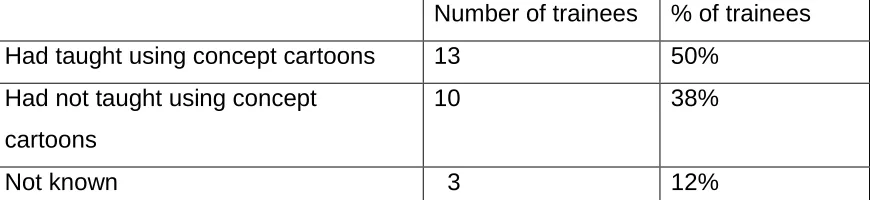
and the partner school using P4C was visited by all students. The results of the
questionnaires completed by students at the end of the academic year are
Citation: 13
Number of trainees % of trainees
Had taught using concept cartoons 13 50%
Had not taught using concept
cartoons
10 38%
Not known 3 12%
Table 1. Concept cartoons
Number of trainees % of trainees
Had taught p4c 9 35%
Had not taught p4C 14 54%
Not known 3 12%
Table 2. Philosophy for children (P4C)
As a general observation, if the strategies had not been taught by the delivery
team then it is highly unlikely that trainees would have had the opportunity to use
such creative strategies as they would have been unaware of their existence.
One trainee produced a research project on pupils’ writing skills in Science in
which concept cartoons featured prominently. As a major part of the research
she focused on developing a dialogic approach to teaching Science. To develop the children’s analytical writing, she decided to use Alexander’s notion of
teaching talk, learning talk and interactive talk (Alexander, 2006). As part of her
teaching talk she introduced a pre-teaching key vocabulary. As part of learning
talk and interactive talk she introduced concept cartoons. The cartoons provided
a focus, a context and a purpose for the discussion. Through the vehicle of the
cartoons she encouraged the children to explain why they picked a specific
solution suggested by the cartoon characters and also why they rejected other
She argued that the neutral nature of the cartoon characters allowed the pupils to
take more risks, since the characters were seen as non judgmental. The concept
cartoons also appeared to encourage the children to use and develop their
thinking skills rather than just writing descriptively, as they had done previously.
The trainee sampled pupils and assessed them against the Assessment Focuses
(AF) within the Assessing Pupil Progress (APP) system (Great Britain,
Department for Children, Schools and Families, 2010). The sample of children
initially scored low on AF1, thinking skills and AF4, drawing conclusions, at the
beginning of the Science module. On the other hand they scored well on AF3,
presenting data, a more descriptive skill. After encouraging a dialogic approach
over the period of the Science module by focusing on teacher talk, learning talk
and interactive talk the students improved on AF1 (thinking skills) and AF3
(drawing conclusions). Using APP assessment she concluded that concept
cartoons helped to develop higher order thinking skills in the children and moved
pupils away from a more passive approach to thinking and learning.
This trainee was also observed teaching and the lesson outcome was judged to
be outstanding according to Ofsted derived consortium grading criteria. Within a group discussion of the trainee’s research, the trainee stated that the lesson she had learnt as a teacher was ‘the need to step back and empower her students through the use of a dialogic approach’. In her questionnaire response the trainee elaborated on this point by stating that ‘children were able to probe
deeper into the understanding of the topic and become more independent of the teachers’ (Debernadis, 2010). The general consensus from the concept cartoon
questionnaires were that the cartoons provide a starting point for thinking and
had the advantage of being inclusive. One respondent stated that the cartoons were useful in ‘elucidating widely held misconceptions with multiplication and division as well as in science.’
The fact that 50% of trainees had used concept cartoons as opposed to 35% of
Citation: 15 examples of cartoons are readily available. The cartoons were seen as
particularly useful in addressing misconceptions in Science by giving pupils a
structure around which they could hinge their discussion and provoke their
thinking. Although one respondent pointed out that the cartoons might limit children’s thinking to believing that the solutions offered in the cartoons were the
only ones available to answering the problem. Another respondent stated that ’the children thought the views expressed were options to pick from rather than possible misconceptions’. Trainees in the group discussion also commented that
the cartoons gave the pupils a starting point for discussion with their peers, were
very versatile and could easily be adapted for different year groups. One trainee teacher commented that ‘concept cartoons give you a starting point and allow you to assess what children know.’
P4C on the other hand was generally seen as a riskier approach. When using
P4C it was far easier for the pupils to go off task, resources were less readily
available and the trainees had limited experience in carrying out this strategy. In
addition, trainees thought that P4C was more suitable for children in KS2 rather
than KS1. In questionnaire responses and in the group discussion, trainees
commented on the need for more training. The trainees who had not used P4C
cited reasons such as the lack of time, lack of confidence, the lack of school
support for such initiatives and having no designated time on the school
curriculum. One trainee remarked: ‘In my school the daily structure is very much about delivering the core subjects and ensuring NC contents are covered.’
Another trainee wrote: ’I wasn’t 100% confident teaching it as I felt very nervous
and unsure. The lesson was overly long; everything took a lot longer than expected.’ Such reservations are in line with the view put forward by Ofsted 2003) that some teacher’s lack of subject knowledge, as distinct from
pedagogical knowledge, may make them less likely to develop student
In the group discussion one trainee commented that doing ‘P4C was a daring step’. The trainee went on to say that P4C helped her gain a new insight into children’s thinking. Another respondent commented that ’the children really enjoyed being in control of what they discussed’ and a third trainee stated that ‘P4C developed children’s speaking and listening skills-questioning, justification,
curiosity, reasoning. Children also had the chance to think collectively through talk and broaden and challenge each other’s views’.
Conclusions
The research examined the impact of the university taught sessions in broadening the trainees’ conceptual base and also the impact which the
strategies of P4C and concept cartoons had on children’s learning. Our rationale
for using the two strategies was based on enabling the trainees to engage
children in high quality talk and also giving children ownership of their own
learning. The trainees who had used P4C and concept cartoons have fed back
that pupils were more engaged in their learning, have richer ideas, deeper
understanding of concepts and demonstrate more possibility thinking. In terms of
P4C and concept cartoons the trainees stated in their questionnaire responses
that both strategies had limited school impact because of constraining factors
such as curriculum coverage pressures and prescribed curriculum content. The trainees’ views on such external constraining factors are consistent with the
findings of MacBeath (2008, p.2) that teachers feel overtaxed by too many
initiatives and overloaded with a prescriptive curriculum and as a result have little
time for discussion.
As a delivery team we are now aware that trainees’ potential for using creative
strategies such as P4C and concept cartoons will be partly determined by
workplace constraints such as the age group of their pupils and the willingness of
their class teacher or mentor to allow experimentation as part of their learning on
Citation: 17 decided to encourage the use of creative strategies by strengthening the link
regarding the rationale as to what constitutes effective learning and encouraging
the trainees to make their own views about learning more explicit (Berry, 2009, p.
307). We will extend the context in which concept cartoons are used beyond
Science to subjects such as Mathematics and Personal and Social Education. Such an approach fits with Black and Wiliam’s assertion that teachers are
unlikely to implement ‘attractive sounding ideas’ as general principles, ‘what they need is a variety of living examples of implementation’ (Black and Wiliam’s (1998,
p.15).
Recommendations and Next Steps
Berry (2009, p. 305-318) suggests that teacher educators require more
knowledge than practising teachers but have little formal training for their role as
teacher trainers. The development of professional self understanding therefore is
part of an ongoing process which can be promoted through self awareness. As
the delivery team of the GTP course we need to regularly question whether our
teaching methods are effective and we see this research project as part of this process of self development. In an attempt to broaden our trainees’ teaching
strategies in line with Ofsted recommendations we have tried to encourage the use of P4C and concept cartoons as creative approaches. The word ‘Creative’ is
used here in the sense that these two strategies encourage structured high
quality talk and pupil participation at a time when the key strategies in Literacy
and Numeracy limit pupil autonomy.
As a result of the research findings we have become more aware of the need to
take account of the school based constraints in our teaching sessions. To
counteract these constraints we see the need to incorporate the mentors into the
teaching and learning benefits of using such strategies as P4C and concept
cartoons. In addition, we have devised a pro forma, as part of our evaluative
the teaching programme each half term. This research on creative strategies has also played an important role in the delivery team’s ongoing professional self
development by improving our self awareness through reflective practice.
References
Alexander, R. (2006) Towards Dialogic Teaching: Rethinking Classroom Talk 3rd
edn. (Thirsk, Dialogos).
Berry, A. (2009) ‘Professional self-understanding as expertise in teaching about teaching, Teachers and Teaching; theory and practice’, 15 (2) pp. 305-318.
Black, P and Wiliam, D. (1998) Inside the black box. Raising standards through classroom assessment, (London, King’s College).
Claxton, G., Craft, A. and Gardner, H. (2008) Concluding thoughts: good thinking
- education for wise creativity. (Thousand Oaks, CA: Corwin Press).
Craft, A., Gardner, H. and Claxton, G.(2008) Creativity, Wisdom and Trusteeship:
exploring the role of education. (Thousand Oaks, CA: Corwin Press).
Craft, A. (1999) Can you teach creativity? Nottingham: Education Now Books.;
Craft, A (2000) Creativity across the primary curriculum: framing and developing
practice. (London, Routledge).
Craft, A. (2001) An analysis of research and literature on Creativity Education.
[Online]. Available at: http://www.euvonal.hu/images/creativity_report.pdf
(Accessed: 1st March 2011).
Craft, A. (2008) Creativity in the school. [Online]. Available at:
http://www.beyondcurrenthorizons.org.uk/wp-content/uploads/ch3_final_craft_creativityinschool_20081218.pdf (Accessed: 3rd
March 2011).
Craft, A. and Jeffrey, B. (2008) ‘Creativity and performativity in teaching and learning: tensions, dilemmas, constraints, accommodations and synthesis’.
Citation: 19 Creative Culture and Education (2010) The costs and benefits of creative
partnerships. Available at:
http://www.creativitycultureeducation.org/research-impact/exploreresearch/pwc-report,57,RAR.html (Accessed 30 September 2010).
Great Britain. Department of Education (2007) Creative Partnerships and the
Curriculum [Online]. Available at::
http://www.parliament.the-stationery-office.co.uk/pa/cm200607/cmselect/cmeduski/1034/1034.pdf (Accessed
21.March 2011).
Debernardis, N. (2010) Using Dialogic Teaching to Develop Quality in Writing
Scientific Conclusions. Unpublished GTP Assignment
Flick, U. (2002) An introduction to qualitative research London: Sage Ltd. Fox, R. (2003) ‘Can children philosophise? The case for caution.. The Philosopher’s Magazine, 24 pp.35-37.
General Teaching Council for England (2010) Annual Digest of Statistics
2009-10: Profile of registered teachers in England. Statistical Digest, August. Available
at:: http://www.gtce.org.uk/publications/stats_digest0910 (Accessed: 30
September 2010).
Great Britain, Department for Children, Schools and Families. (2010) Assessing Pupils’ Progress. A teachers’ handbook. [Online]. Available at:
http://nationalstrategies.standards.dcsf.gov.uk/files/downloads/pdf/271f4e96db82
37e60d44da971bc6c37b.pdf (Accessed 24 March 2011).
Great Britain. Education and Skills Committee. (2007) Creative partnerships and
the curriculum Eleventh Report of Session 2006- 2007. (London, The Stationery
Office).
Great Britain, Parliament. House of Commons. (2003) Every Child Matters
(2003). [Online]. Available at:
http://www.education.gov.uk/consultations/downloadableDocs/EveryChildMatters
.pdf (Accessed 21.March 2011).
Hand, Michael. (2008) ‘Can Children be Taught Philosophy’;Journal of
http://onlinelibrary.wiley.com/doi/10.1111/j.1467-9752.2011.00788.x/pdf
(Accessed 24 March 2011).
HMIE (2006) Emerging Good Practice in Promoting Creativity. Available at:
http://www.hmie.gov.uk/documents/publication/hmieegpipc.html (Accessed 24
March 2011)
Keogh, B. et al (2003) Formative Assessment Using Concept Cartoons: Initial Keogh, B., Naylor, S. and Downing, B. (2003) ‘Children’s interactions in the classroom; argumentation in primary science’ European Science Education
Research Association Conference, Noordwijkerhout, Netherlands 19-23 August.
Conceptcartoons.com. Available at:
http://www.conceptcartoons.com/resources/esera-paper.pdf (Accessed 24 March
2011).
Lipman, M. (2003) Thinking in Education.2nd edn.(Cambridge, University Press).
McBeath (2008) ‘Pressure and Professionalism: The Impact of Recent and
Present Government Policies on the working lives of teachers’. 21st
International
Congress for School Effectiveness and Improvement. Auckland, New Zealand
6-9 January. The Cambridge Network. Available at::
http://www.leadershipforlearning.org.uk/hcdimages/LFL/MacBeathGalton_icsei08
.pdf (Accessed 24 March 2011).
NACCCE (1999) All Our Futures: Creativity, Culture and Education. National
Advisory Committee on Creative and Cultural Education. May. Available at:
http://www.cypni.org.uk/downloads/alloutfutures.pdf.
Naylor, S. and Keogh, B. (1999). ‘Constructivism in classroom: Theory into practice’, Journal of Science Teacher Education 10 (2), pp.93-106.
Ofsted (2003) Expecting the Unexpected.Developing creativity in primary and
secondary schools, August. Available at:
http://www.google.co.uk/search?hl=en&q=Expecting++the+Unexpected.Developi
ng+creativity+in+primary+and+secondary+school&meta= (Accessed: 24 March
Citation: 21 Ofsted (2007) An employment based route into teaching 2003-2006. Ofsted
Report, January. Available at:
http://www.ofsted.gov.uk/Ofsted-
home/Publications-and-research/Browse-all-
by/Education/Leadership/Management/An-employment-based-route-into-teaching-2003-06/(language)/eng-GB (Accessed: 1 October 2010).
Ofsted (2010) Learning: creative approaches that raise standards. Ofsted Report,
January. Available at:
http://www.ofsted.gov.uk/Ofsted-home/Publications-and-
research/Browse-all-by/Documents-by-type/Thematic-reports/Learning-creative-approaches-that-raise-standards (Accessed: 1 October 2010).
Robinson, P. (2001) Out Of Our Minds. Learning To Be Creative. (Minnesota,
Capstone).
SAPERE (2007) SAPERE Level 1 Handbook. (Oxford, SAPERE).
Sapsford, R. and Jupp, V. (1996) Data Collection and Analysis. (London, Sage
Ltd).
Suissa, Judith (2009) Philosophy in the Secondary School- a Deweyan
Perspective. In: Philosophy in Schools. Continuum, London, pp. 132-144. ISBN
978-1-44110265-2
Watkins, C., Carnell, E., Lodge, C. (2007) Effective Learning in Classrooms