http://www.sciencepublishinggroup.com/j/ijics doi: 10.11648/j.ijics.20180302.16
ISSN: 2575-1700 (Print); ISSN: 2575-1719 (Online)
Research on Scheduling Strategy of AFDX End System
Based on Time/Event Trigger
Ziran Shen
*, Leilei Yin, Yi Li, Yuanyuan Xu
The 28th Research Institute of China Electronics Technology Group Corporation, Nanjing, China
Email address:
*
Corresponding author
To cite this article:
Ziran Shen, Leilei Yin, Yi Li, Yuanyuan Xu. Research on Scheduling Strategy of AFDX End System Based on Time/Event Trigger.
International Journal of Information and Communication Sciences. Vol. 3, No. 2, 2018, pp. 66-74. doi: 10.11648/j.ijics.20180302.16
Received: August 23, 2018; Accepted: September 25, 2018; Published: October 18, 2018
Abstract:
To meet different time delay requirements of different data, three scheduling strategies based on event, time and event-time are studied in this paper. The network calculus method is used to derive the maximum delay upper bound of virtual link based on three scheduling strategies, the relationship between the maximum delay upper, virtual link parameters, time scheduleparameters and the frame length is compared, the difference between the alternate scheduling strategy and the Time-Triggered or event-triggered scheduling is studied. The AFDX (Avionics Full-Duplex Switched Ethernet) virtual network model is established toverifythetheory based on OPNET, thedeterminist of theTime-Triggered link, the maximum delay of the event-triggered link and the efficiency of the end system transmission are compared under different scheduling strategies. Also, the applicable occasions of different scheduling strategies are studied. The results show that the event and time alternate scheduling strategy not only ensures the certainty of Time-Triggered link transmission, but also reduces the event triggering. The maximum delay upper bound of the link effectively improves the data processing capability and transmission efficiency, ensures the stability and certainty of the periodic signal transmission, and is suitable for the aviation bus system with different kinds of data with different delay requirements.Keywords:
Time-Triggered, Event-Triggered, Scheduling Strategy, Determinism, Maximum Delay Upper Bound1. Introduction
The terminal system in the AFDX network communication system is the interface connecting the avionics subsystem with the AFDX bus, and undertakes the task of safe and reliable data exchange. As an important part and key part of AFDX network data transmission, the performance of the terminal system directly affects the communication performance of the entire AFDX network. Domestic and foreign scholars have carried out a lot of research work on the AFDX backbone network to the multi-node system scheduling strategy of the airborne distributed control system connected to the network [1-5]. At present, the commonly used scheduling algorithms have different service rules, control purposes and Complexity, the commonly used communication scheduling mechanism is based on event triggering or time triggering [6-10]. When forwarding the same priority data under the large airborne network structure, the data delay limit on each virtual link
may be too large due to different paths, the onboard network load is not balanced.
performance, and the end system scheduling strategy proposed in this paper is applicable to different network environments for data transmission.
2. Event-Triggered Scheduling Strategy
The combined scheduling strategy of short frame and weight polling combines the combined scheduling policy with weighted polling on the basis of short frame priority, combined with the advantage of short frame priority scheduling algorithm, by polling long frame data with weight to sacrifice the general The bandwidth of the task data stream ensures timely transmission of more important task data, improves the bandwidth utilization of the AFDX end system of the airborne network, and reduces the maximum delay upper bound of the short frame virtual link, especially suitable for data transmission with more short-frame data streams.
2.1. Event-Triggered Scheduling Policy Structure
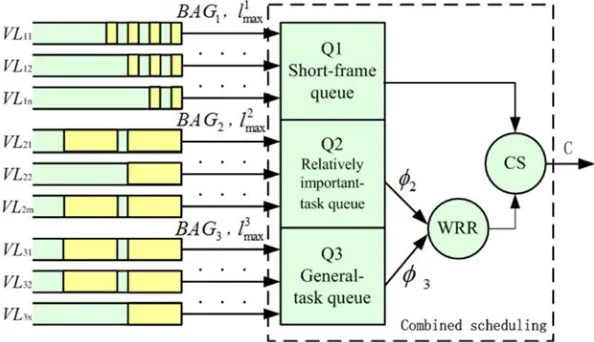
The structure of combined scheduling is shown in Figure 1. According to the information exchange between different units of the system network, we can divide the network data stream into shortframe data stream and long frame data stream by the length of the frame. Moreover, the short-frame has the highest priority to schedule and process the short-frame packet. At the same time, we will distribute the long frame data stream into the relatively important tasks and general tasks by the data types and into different proportions of transmission bandwidth, which make sure that different types of data streams have different weights to satisfy its real-time requirement. In order to ensure short-frame data transmission, short-frame queue was priority to schedule. Weight ratio of Long frame queue play a more important role, which provides the bandwidth required for general task data packet transmission and realizes the timely transmission of the relativelyimportant task of data.
Figure 1. The combined scheduling strategy structure.
2.2. Virtual Link Delay Upper Bound
In this combined scheduler, the service curve meets ( )t C t*
β
= . The short-frame data stream is integrated into the Q1 queue with highest priority, and the combination scheduling has priority to process the short frame data stream, that is, the short-frame has the highest priority to schedule and process the short-frame packet, but it will be blocked at more once with the being processed data packets. The data flow in theQ2/Q3queue can be processed just when the data stream ofthe high priority queue has been processed. The first delay corresponding to the situation is the frame is being blocked withthe high priority queue. Based on the service curve and the arrival curve in the network calculation method, the delayed upper boundDiexpression of the queueQi under the combined scheduling algorithm is solved.
2 3 1
max max max
1 1
2
1 3 2 max 2
max 3 max 3 max
1 1
max 2
2 1 2
max 2 max
3 1 1 max 2 3
1 2 3 max 3
max 2 max 3 max
1 1 max 2 3 ( ) 8 ( ) ( ) 8 8 ( ) ( ) ( ) ( ) 8 n i n n i m i i m m n i i m i m m n i m i i m m
max l l l
D
C
l
l l l
l D l l C BAG l l
l l l
l D φ φ φ φ φ φ φ φ = = = = = = = = = + = × × + × × + × = × × − × × × + × × + × = ×
∑
∑
∑
∑
∑
∑
∑
∑
, 1 3max 3 max
3 1 1 max 2 8 ( ) ( ) n n i i m i m m l l C BAG l φ φ = = × − × ×
∑
∑
∑
2
Q , Q3 queue. l1maxi is the maximum frame length of theithVL in Q1 queue, BAG1i is the bandwidth allocation interval of theithVL in Q1 queue. n is the number of virtual link aggregation for the high priority queue.
It can be seen from the above formula that the delay upper bound of the virtual link is related to the physical link bandwidth, the maximum frame length of the virtual link and the polling weight ratio.
3. Time-Triggered Scheduling Strategy
The TTP protocol based on the time triggered, using TDMA (time-division multiple access) technology, a cluster
cycle is divided into a number of TDMA round, distribution of different time slots in each round to send a message to all nodes, and finally form a unified message schedule [4-7]. At the same time, only one node to transmit the message. The network that communicates based on the Time-Triggered mode advances in real time along the timetable established based on the global time. The communication of all nodes does not conflict with each other, avoiding the unpredictability, message congestion and delay of the event triggering mode. Jitter problem. The time slot, message length and cluster period of each node can be adjusted according to the actual application during cluster design, so as to obtain the maximum bandwidth utilization.
Figure 2. Theallocation of node slot.
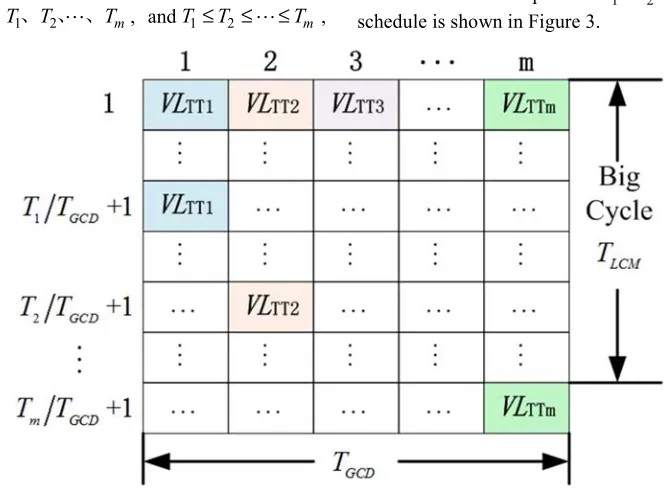
Assume that the AFDX end system has m time triggered virtual linksVLTT1、VLTT2、⋯、VLTTm, the data transmission cycle of which areT1、T2、⋯、Tm, and
1 2 ⋯ m T ≤T ≤ ≤T ,
GCD
T andTLCMrepresent the greatest common divisor and least common multiple of T1、T2、⋯ andTm , the time
schedule is shown in Figure 3.
Figure 3. Time schedule.
When a Time-Triggered scheduling policy is adopted, the data frames of each virtual link are sent strictly according to the time scheduled by the scheduling schedule, and the delay
shaping. Considering the case of delay processing in the worst case, the transmission time of a virtual link is just passed, and the data frame arrives, waiting for the next time allocated to the link, based on the Time-Triggered virtual chain. The maximum delay upper bound of the path is the time slot period assigned to the link. Consider the maximum length and bandwidth of data frames in the AFDX network.
Each time slot needs to be greater than 123.04.
µ
sIf the data transmission period of each link is greater than or equal to the time slot, the upper bound of the maximum delay of the virtual link based on time triggering must be greater than 123.04.µ
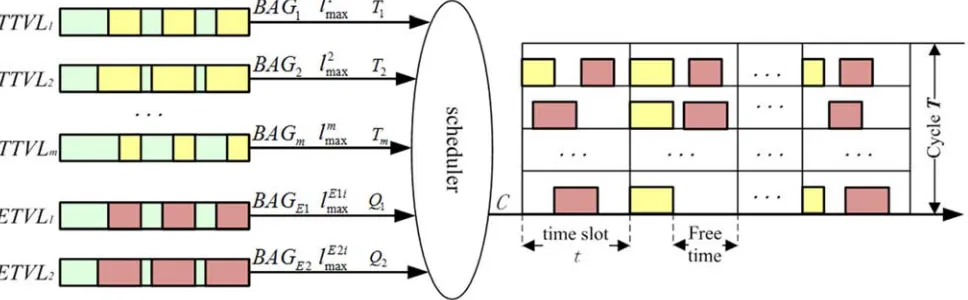
s.Figure 4. Alternate scheduling structure.
4. Event and Time Alternate Scheduling
Strategy
The structure of alternate scheduling is shown in Figure 4. The end system data stream is divided into time triggered virtual link (TTVL) and event triggered virtual link (ETVL) according to the demand of delay time. Time triggered virtual link (periodic data) require the stability of delay, but the delay time of event triggered virtual link (burst data and non real-time data) is as small as possible. According to this alternate scheduling method based on time triggered and event triggered, the TTVL is transmitted in the predetermined time schedule, and the event triggered virtual link is transmitted in the free time outside the regulation TTVL time. For the event triggered virtual link, according to the different requirements of instantaneity, the burst data has higher priority and should bescheduledtotakeprecedenceover.
The time triggered virtual links are scheduled according to the time schedule, and the event triggered virtual links are scheduled in the free time of the time schedule. So in the big cycle TLCMof the time schedule, the scheduling time assigned to the event triggered link is:
max
1
(
)
m i
LCM ETVL LCM
i i
l
T
t
T
C
T
=
=
−
∑
×
In which, m is the number of the time triggered links, Ti is the data transmission cycle of the ith time triggered link, so the total service curve of the event triggered links is:
max 1
( )
( )
m i
LCM LCM
i i
ETVL
LCM
l T
T
C T
t C t
T
β =
− ×
= × ×
∑
For the event triggered virtual link, the burst data streams highly requiring real time are placed in queue Q1 with the
highest priority and prioritized, but will be blocked with the queue Q2that is being processed at most once and the time triggered packet once, so the service curve of queue Q1
meet the rate delay model, that is,
max
2
max max
1 1
1
( )
max( )
( ) ( )
m i
m LCM
Q i
LCM
i
i i
Q
LCM
l T
T
l l
C T
t C t
T C
β = =
− × +
= × × −
∑
For the nonperiodic data link lowly requiring real time, the delay in the worst case is considered. Queue Q2 will be blocked with the time triggered packet once after waiting the transmission of the queue Q1, so the service curve of queue
2 Q is:
max
1
max max
1 1
2
( )
max( )
( ) ( )
m i
m LCM
Q i
LCM
i
i i
Q
LCM
l T
T
l l
C T
t C t
T C
β = =
− × +
= × × −
∑
1 max
2 max
1 max max
1 max 1
1 1 max 1 max 1 2 max 1 max 2 2
( ) max( )
( ) ( ) ( )
( )
( ) m
( ) ( ) ( ≠ = = ≠ = = ≠ − × + = × − × − − − × × − × + = × − × −
∑
∑
∑
∑
∑
∑
m i Q w m LCM Q iLCM Q w
i w j
i i
Q j m i
LCM w j Q w LCM
LCM i i LCM m i LCM Q
LCM Q w
i i
Q j
LCM w j Q w
l T l
T l l
C T l
t C t
T BAG C l T
T C T C T l T T l
C T l
t C t
T BAG
β
β
2 max max 1 max 1 ax( ) ) ( ) ≠ = = − − × ×∑
∑
Q w m i w j i m i LCM LCM i i LCM l lC l T
T
C T
C
T Based on the service curve and the arrival curve in the
network calculation method, we will calculate the delay upper bound DQiof Qiqueue under the alternate scheduling algorithm: 2 max max max 1 1 1 max 1 max( ) ( ) n m i Q i i i
Q m i
LCM LCM
i i
LCM
l l l
D C l T T C T C T = = = + = + − × ×
∑
∑
1 max max max 1 1 2 max 1 max( ) ( ) n m i Q i i iQ m i
LCM LCM
i i
LCM
l l l
D C l T T C T C T = = = + = + − × ×
∑
∑
The upper expression shows the delay upper bound DQi has some connection with the physical link bandwidth, the transmission cycle of TTVL and the maximum frame-length.
The queue Qiis composed of multiple virtual links, the delay upper bound DQijas follows:
1
2 max
1 max max
max 1
1
max max
1
1 max 1
1
max(
)
(
)
(
)
Q w m Q i Q j w j iQ j m i m i
LCM LCM
LCM Q w LCM
i i
i i
LCM w j Q w LCM
l
l
l
l
D
C
l
T
l
T
T
T
C
T
l
C
T
C
C
T
BAG
T
≠ = = = ≠
+
=
+
+
−
×
−
×
×
−
×
∑
∑
∑
∑
2 1 max1 max max
max 1
2
max max
2
1 max 1
2
max(
)
(
)
(
)
Q w m Q i Q j w j iQ j m i m i
LCM LCM
LCM Q w LCM
i i
i i
LCM w j Q w LCM
l
l
l
l
D
C
l
T
l
T
T
T
C
T
l
C
T
C
C
T
BAG
T
≠ = = = ≠
+
=
+
+
−
×
−
×
×
−
×
∑
∑
∑
∑
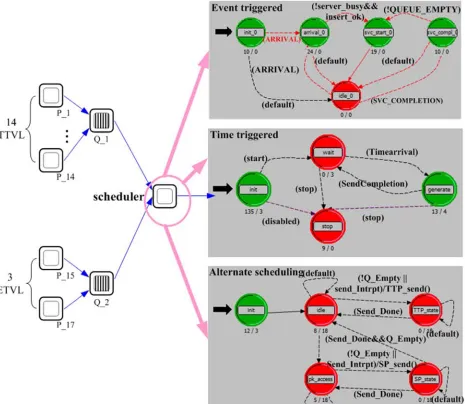
Figure 5. AFDX end system simulation model.
5. Test Verification of Terminal System
Scheduling Policy
5.1. Simulation Analysis
AFDX network simulation model is established. As shown in Figure 5, the deterministicity of the Time-Triggered link and the delay of the event-triggered virtual link under the three algorithms of event triggering, time triggering and event-time alternate scheduling are simulated time.
5.2. Deterministic Analysis of Time-Triggered Scheduling Virtual Link
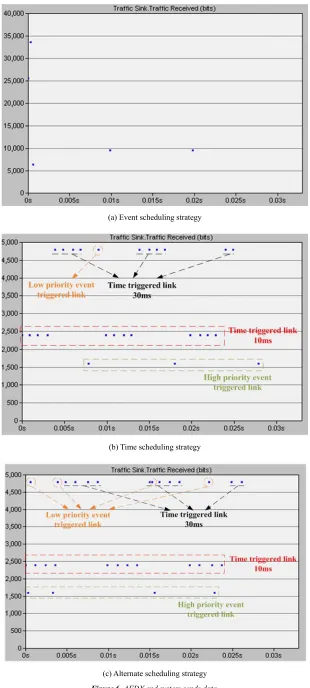
According to the model simulation shown in Figure 5, the three systems of event triggering, time triggering and alternate scheduling are shown, and the data transmitted by the end system are shown in Figure 6(a), (b) and (c), respectively.
We can see from Figure 6, the data sending together will
(a) Event scheduling strategy
(b) Time scheduling strategy
(c) Alternate scheduling strategy
5.3. Delay Analysis of Event-Triggered Scheduling Virtual Link
The article analyzes the delay time of the event triggered virtual link in this three scheduling strategy too, the simulation result is shown in Figure 7.
Figure 7. Delay time for triggering virtual link events under different scheduling policies.
It can be seen from Figure 7:
(i) Under all scheduling strategies, the simulation results of the virtual link delay time are smaller than the maximum delay upper bound calculation result, which is consistent with the actual situation.
(ii) Compared with the event scheduling policy, the delay
time of the event-triggered link is significantly increased. This is because the event-triggered link can only be sent in the specified time slot under the Time-Triggered scheduling. The event-triggered link cannot be timely. For transmission, the delay time is equal to the difference between the planned transmission time in the scheduling schedule and the time after traffic shaping.
(iii)Compared with the event scheduling policy, the delay time of the event-triggered link is significantly reduced. After the Time-Triggered virtual link is sent according to the specified time, the event is triggered by the idle time transmission event, which improves the data frame congestion.
(iv)Compared with the Time-Triggered scheduling policy, the alternate scheduling policy uses the free time in the scheduling timetable to schedule the event to trigger the link, which effectively reduces the waiting time of the event-triggered link, and the virtual link delay time is significantly reduced.
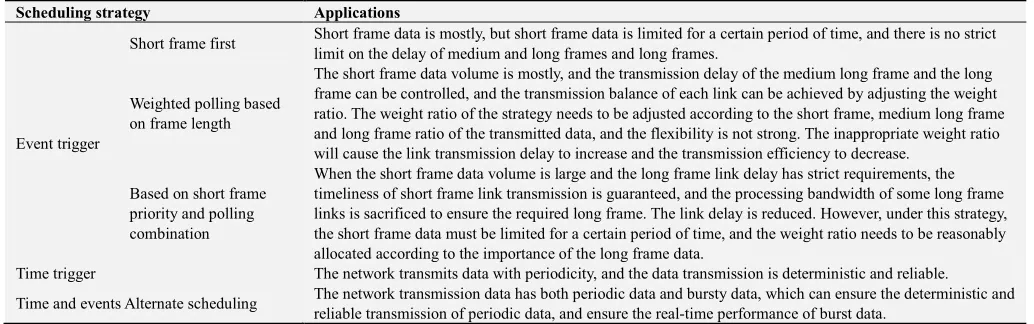
Through the above analysis, the short frame priority, the frame length based weighted polling, the short frame priority and the polling combination based on three event triggering and time triggering and the time and event alternate scheduling strategy are given, and the applicable occasions of the above scheduling strategy are given, for example. Table 1 shows.
Table 1. Event, time and time and event alternate scheduling strategy applicable occasions.
Scheduling strategy Applications
Event trigger
Short frame first Short frame data is mostly, but short frame data is limited for a certain period of time, and there is no strict limit on the delay of medium and long frames and long frames.
Weighted polling based on frame length
The short frame data volume is mostly, and the transmission delay of the medium long frame and the long frame can be controlled, and the transmission balance of each link can be achieved by adjusting the weight ratio. The weight ratio of the strategy needs to be adjusted according to the short frame, medium long frame and long frame ratio of the transmitted data, and the flexibility is not strong. The inappropriate weight ratio will cause the link transmission delay to increase and the transmission efficiency to decrease.
Based on short frame priority and polling combination
When the short frame data volume is large and the long frame link delay has strict requirements, the timeliness of short frame link transmission is guaranteed, and the processing bandwidth of some long frame links is sacrificed to ensure the required long frame. The link delay is reduced. However, under this strategy, the short frame data must be limited for a certain period of time, and the weight ratio needs to be reasonably allocated according to the importance of the long frame data.
Time trigger The network transmits data with periodicity, and the data transmission is deterministic and reliable.
Time and events Alternate scheduling The network transmission data has both periodic data and bursty data, which can ensure the deterministic and reliable transmission of periodic data, and ensure the real-time performance of burst data.
6. Conclusion
This paper compares the AFDX end system scheduling strategy triggered by the event, time and time/event proposed by our research group. The short frame priority scheduling is taken as the research object, and the advantages of the frame length based weighted round robin scheduling strategy are analyzed. Applicable occasions, and further improve the combined scheduling algorithm to improve the bandwidth utilization of the airborne network AFDX end system and reduce the maximum delay upper bound of the short frame
strategies, the delay time of the event-triggered link is effectively reduced, andthe system bandwidth utilization is improved, which is suitable for network transmission data. In the case of periodic data and bursty data, the deterministic and reliable transmission of periodic data can be guaranteed, and the real-time performance of burst data can be guaranteed.
References
[1] Wu Huan, GeHongJuan, Ni JianLi, Xu Yuanyuan. AFDX end system transmission strategy based on shortest frame first scheduling. Aeronautical Computing Technique, vol. 42, no. 6, (2012), pp. 125-128.
[2] XuYuanyuan, GeHongjuan, Wu Huan, Ni Jianli. Research of Virtual combinatorial scheduling strategy in AFDX end system. Journal of Information & Computational Science, vol. 12, no. 1, (2015), pp. 255-262.
[3] XuYuanyuan, GeHongjuan, Chen Si, Liu Shiyu. The application of TTP protocol in aircraft electrical system [C]. IEEE Transportation Electrification Conference and Expo Asia-Pacific 2014, 2014.
[4] YuanYuanXu, HongJuan GE, Shuang WU, etc. Short-frame Prior Scheduling with WRR Transmission Strategy in AFDX Terminal System [J]. TELKOMNIKA Telecommunication, Computing, Electronics and Control, 14(3A), 2016:98-107.
[5] Yuanyuan XU, Hongjuan GE, Jingzhong YANG. Research on the scheduling method of AFDX terminal system based on time triggered and event triggered [J]. Journal of Intelligent Information Systems, Vol. 48, June 2017, Issue 3.
[6] FENG Bingqing, REN Yan. Research on the Scheduling Method of Time-Triggered AFDX Network [J]. Modern Computer. 2017, 01:5-9.
[7] He Xiangdong, Bai Yang, Tian Yuan, Jia Shiwei. Design and Implementation of AFDX Switch Priority Scheduling Technology [J]. Information & Communications. 2018, 7:76-78.
[8] YANG Jingzhong, GE Hongjuan, WU Shuang, XU Yuanyuan. Short-frame prior scheduling with weighted round robin transmissionstrategy in AFDX terminal system [J]. Journal of Beijing University of Aeronautics and Astronautics. 2016, 42(10): 2258-2264.
[9] ZHAO Luxi, LI Qiao, LIN Wanqing, XIONG Huagang. Stochastic network calculus for analysis of latency on TTEthernet network [J]. Acta Aeronautica et Astronautica Sinica. 2016, 37(6):1953-1962.