RESEARCH ARTICLE
GC-MS ANALYSIS AND
IN SILICO
DOCKING ANALYSIS OF EXTRACTS OF
ACACIA TORTA CRAIB
*,1
Latha, R.,
2Mujeera Fathima and
3Ganesan, S.
1
Department of Botany, Sri Meenakshi Govt Arts College for Women (A) Madurai-2, India
2
Department of Plant Biology and Plant Biotechnology Govt. Arts College (Men) Nandanam, Chennai -35, India
12/12 C Thiru chunai, Karungalakudi, Melur Taluk, Madurai 625101, India
ARTICLE INFO
ABSTRACT
Acacia torta Craib. has many medicinal values and its drug like ability against skin infections caused by bacteria was done. Initially, the ethanolic extract of the plant was subjected to GC-MS analysis to identify the compounds present in the sample. Then, lead compounds were screened to be used for docking with iGEMDOCK. Docking was done for the lead compounds against the human penicillin binding protein to check their effectiveness in inhibiting the receptor. Ethanolic extract from powdered leaves and bark of the plant was prepared. GC-MS analysis showed there were 20 compounds present in the sample from which a total of 5 compounds were subjected to docking. Fitness scores of the ligands 1-Pentene, 1, 3-diphenyl-1-(trimethylsilyloxy;) Benzoic acid, 4-methyl-2-trimethylsilyloxy-, trimethylsilyl ester; 1, 3-Dioxolane, 2-(6-heptynyl) - and 2-heptyl 1, 3 Dioxolane with about -65 kcal/mol were more appreciable than tetramethylsilane having binding score -25kcal/mol. The ligands with appreciable fitness score can further be taken into preclinical studies to be used against pathogens involved in skin infection.
Copyright©2017,Latha et al. This is an open access article distributed under the Creative Commons Attribution License, which permits unrestricted use,
distribution, and reproduction in any medium, provided the original work is properly cited.
INTRODUCTION
Acacia torta Craib. is a perennial shrub known by its common name twisted acacia is distributed in major parts of India and the regional name of the plant is indu. The plant is known for its most of the medicinal uses. For example cough and dysentery is treated with the decoction of its stem bark
(Ganesan and kesavan, 2003; Karthikeyan et al., 2015). Gas
Chromatography and Mass Spectrometry (GC-MS) analysis method can be used to analyze the compounds present in a plant. It is generally based on separation of compounds based on their volatility and then detecting the individual compounds present in the sample based on the molecular weight
(Karthikeyan et al., 2015). The applications of GC-MS
analysis contributes major role in drug identification and also in other purposes such as forensic, security, monitoring the environment etc. Thus GC-MS is used to identify the
compounds present in extract of Acacia torta Craib (Bai et al.,
2014). Docking is a method used to analyze and predict the
binding of the query molecule with one or more number of molecules in three dimensions resulting in the formation of stable complex. The function of protein is greatly dependent on the molecules which interact with them.
*Corresponding author:Latha, R.
Department of Botany, Sri Meenakshi Govt Arts College for Women (A) Madurai-2, India.
A protein can be highly expressive or can be inhibited strongly
when there is a stable complex formation (Gupta et al., 2016).
Docking is more useful especially in drug discovery for the pharma companies as it helps to screen the drugs against a particular disease or pathological conditions. Docking done for
screening of lead compounds in combination with other in
silico methods helps greatly in reducing the time taken by in vitro approaches. There are many docking tools that are developed and being developed based on genetic algorithm
and their own algorithm (Karavadi and Suresh, 2014). The
efficiency of docking is measured with their docking scores that will be produced in terms of binding affinity and many other factors. iGEMDOCK, a structure based virtual screening docking tool which has graphic interfaces to prepare binding site and the library of the screening compounds. Then each compound is docked into protein subsequently generating various interaction profiles such as Vander Waals, hydrogen-bonding, and electrostatic profiles. Then it generates all the possible interactions and ranks them based on the fitness score (Sarojini and Krishnan, 2014).
MATERIALS AND METHODS
Preparation of plant material
The plant Acacia torta craib was collected from sivaganga Dt., Tamilnadu and its stem, leaves are subjected to shade drying.
ISSN: 0976-3376
Asian Journal of Science and Technology Vol. 08, Issue, 07, pp.5119-5123, July,2017Available Online at http://www.journalajst.com
ASIAN JOURNAL OF
SCIENCE AND TECHNOLOGY
Article History:
Received 18th April, 2017
Received in revised form 27th May, 2017
Accepted 04th June 2017 Published online 24th July, 2017
Key words:
Integrated farming system, IFS Model,
Livelihood Security.
Key words:
Acacia torta Craib.,
Once they are dried they are powdered and stored for further
analytical purposes (Hsu et al., 2011).
Preparation of plant extract
The powdered plant extract was set up for cold extraction with 80% ethanol employing hot percolation using Soxhelt apparatus. Then the extract was subjected to distillation to remove solvent and then the extract was used in GC-MS
analysis (Karthikeyan et al., 2015; Bai et al., 2014).
Gas Chromatography and Mass Spectrometry Analysis
The plant extract was subjected to GC-MS analysis in order to identify active compounds present in the sample. Fatty Acids Methyl Acetate (FAME) library was used to identify the
compounds from the mass spectra of the sample (Sarvalingam
et al., 2011). The unknown compounds of mass spectrum were
compared with the reference spectrum in the FAME library. By comparison, the name of the compound, molecular weight and molecular formula for the matching hits were identified
(Saha et al., 2016).
Molecular Docking studies
To study the interactions of the ligands with the human penicillin binding protein, molecular docking was carried out with iGEMDOCK which helps to estimate the protein-ligand interaction in terms of fitness. Fitness is the total energy of the predicted docking pose in the binding site (Sarojini and Krishnan, 2014).
Preparation of Receptor
The 3D structure of the human penicillin binding protein was retrieved from Protein Data Bank (PDB) (http://www.rcsb.org/
pdb/explore/explore.do?structureId=2zc3) (Vanitha et al.,
2011).The preparation of receptor was done with the help of
Discovery Studio Visualizer tool which involved the removal of bound ligands and water molecules present in the downloaded structure. Once these changes are done the
receptor turns into a stable active structure (Yamada et al.,
2008; Kumar et al., 2014).
Preparation of Ligand
The ligands, also the active components in the plant extract were retrieved from PubChem
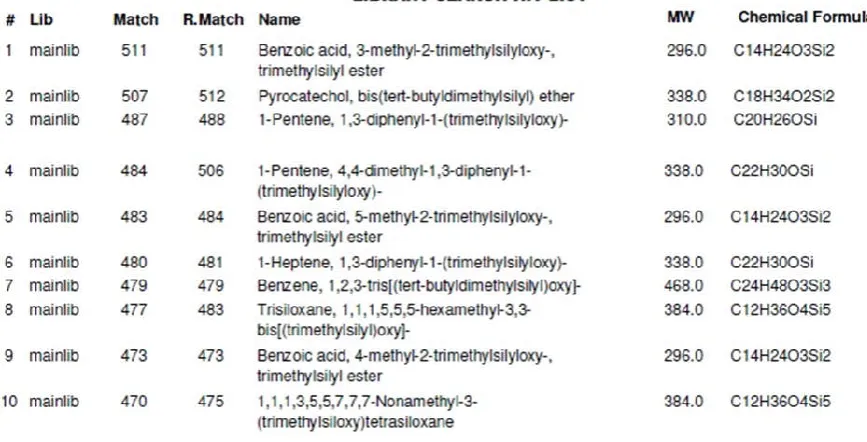
Fig. 1a. List of compounds identified from GC-MS analysis of ethanolic extract of Acacia torta Craib.
(https://pubchem.ncbi.nlm.nih. gov) in 2D format. With the help of Discovery Studio Visualizer tool .sdf format ligand
files were converted to .pdb files (Miguet et al., 2009).
Docking with iGEMDOCK
The receptor, human penicillin binding protein was added to the iGEMDOCK using the ‘Prepare Binding Site’ option and
ligands using the ‘Prepare Compounds’ option in
Docking/Screening module. The algorithm chosen for docking was Standard Docking which involved a population size of 300 over 80 generations with 10 output modes of the
interaction of the ligand (Sarojini and Krishnan, 2014; Kumar
et al., 2014). Docking was initiated using the ‘Start Docking’
option in the same module. Once Docking is completed the best docking pose was subjected to analysis with the help of Docked Poses/Post-Screening Analysis module. In this module, fitness was calculated for the best docking pose in terms of energy values of the bonds involved in binding of
receptor and ligand (Sasikala and Meena, 2016).
RESULTS AND DISCUSSION
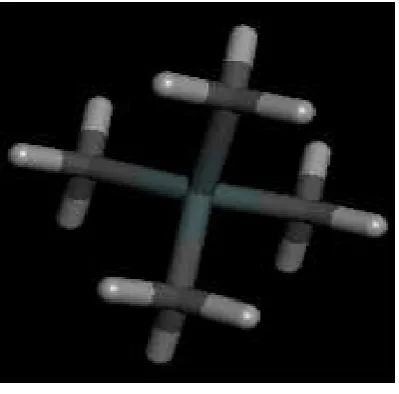
The compounds present in the extract were identified with the help of the peaks and their retention time from the chromatogram produced from the GC-MS analysis. A total of 20 compounds were identified from the analysis as they were matching with the FAME library used in the GC-MS analysis and are given in Fig 1a and 1b. The following ligands were retrieved from the small molecule databases and the unbounded structures are seen in Fig 2 – 6. Similarly, the receptor human penicillin binding protein was retrieved under the ID 2ZC3 and Fig 7 shows the structure of the receptor after the ligands and water molecules were removed. The downloaded structure was in complex with biapenem, a
carbapenem antibiotic against Streptococcus pneumoniae
Fig. 2. Heptyl-1,3-dioxolane
Fig. 3. Tetramethylsilane
Fig. 4. 1-Pentene, 1, 3-diphenyl-1-(trimethylsilyloxy)
Fig. 5. Benzoic acid, 4-methyl-2-trimethylsilyloxy-, trimethylsilyl ester
Table 1. Fitness scores for various ligands against the penicillin binding protein 2ZC3
Ligand Fitness VDW HBond Elec AverConPair
2-heptyl 1, 3 Dioxolane -61.9449 -55.9449 -6 0 29.25
Tetramethylsilane -25.0733 -25.0733 0 0 28
1-Pentene, 1,3-diphenyl-1-(trimethylsilyloxy) -79.4206 -79.4206 0 0 22.9545
Benzoic acid, 4-methyl-2-trimethylsilyloxy-,trimethylsilyl ester -66.7366 -65.1887 -1.54793 0 22.3158
1,3-Dioxolane, 2-(6-heptynyl)- -64.1737 -54.984 -9.18975 0 28.0833
Fig. 6. 1,3-Dioxolane, 2-(6-heptynyl)
Fig. 7. 2ZC3 (Penicillin Binding Protein 2x)
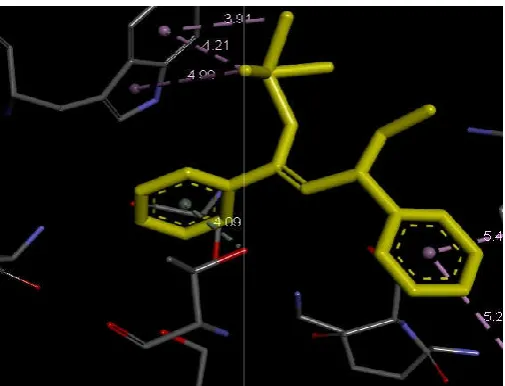
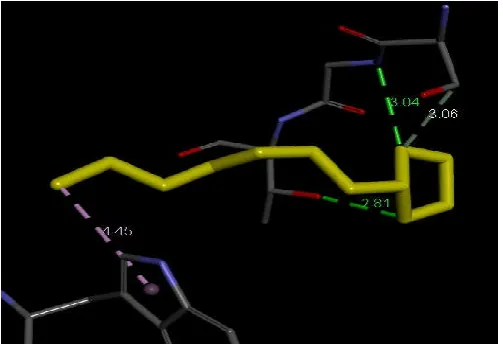
The docking was carried out with iGEMDOCK and docked poses of the lead compounds from the GC-MS analysis can be seen in Fig from 8 to 12. Fitness of the docked
individual ligands is given in the Table 1. Among the five ligands 1-Pentene, 1,3-diphenyl-1-(trimethylsilyloxy) showed the highest fitness energy of -79.4206(kcal/mol)
Benzoic acid, 4-methyl-2-trimethylsilyloxy
ester with –66.7366(kcal/mol), 1,3-Dioxolane, 2 with -64.1737(kcal/mol). Second least being 2
Dioxolane with -61.9449(kcal/mol) and the last being Tetramethylsilane. The following binding energy contributed to fitness of ligands with receptor were Vander Waal’s force and Hydrogen bonding and electrostatic interactions does not contribute to any fitness between the ligand and receptor. The average connection pair was good for 2-heptyl 1, 3 Dioxolane had the best average connection pair of 29.25 (kcal/mol)
DISCUSSION
A total of five lead compounds from GC-MS analysis were checked for their inhibiting property against the penicillin binding protein using iGEMDOCK and these compounds may be reported for the first time in this study. The fitness scores of docking results indicate that the following ligands
1,3-diphenyl-1-(trimethylsilyloxy); Benzoic acid, 4 trimethylsilyloxy-,trimethylsilyl ester;
1,3-heptynyl)- and 2-heptyl 1, 3 Dioxolane are effective in their binding with the penicillin binding protein present in the
Streptococcus pneumoniae (PBP 2X) which was also used by
(Kumar et al., 2014; Sasikala and Meena, 2016
lead compound tetramethylsilane has poor binding with the
heptynyl)
Fig. 7. 2ZC3 (Penicillin Binding Protein 2x)
The docking was carried out with iGEMDOCK and docked MS analysis can be seen in Fig from 8 to 12. Fitness of the docked pose for the individual ligands is given in the Table 1. Among the five (trimethylsilyloxy) showed (kcal/mol) followed by trimethylsilyloxy-,trimethylsilyl Dioxolane, 2-(6-heptynyl)- 64.1737(kcal/mol). Second least being 2-heptyl 1, 3 61.9449(kcal/mol) and the last being silane. The following binding energy contributed to fitness of ligands with receptor were Vander Waal’s force and Hydrogen bonding and electrostatic interactions does not contribute to any fitness between the ligand and receptor. The heptyl 1, 3 Dioxolane had the best average connection pair of 29.25 (kcal/mol)
MS analysis were checked for their inhibiting property against the penicillin CK and these compounds may The fitness scores of docking results indicate that the following ligands 1-Pentene, (trimethylsilyloxy); Benzoic acid,
4-methyl-2--Dioxolane, 2-(6-heptyl 1, 3 Dioxolane are effective in their binding with the penicillin binding protein present in the (PBP 2X) which was also used by
, 2016). The other lead compound tetramethylsilane has poor binding with the
receptor; hence, it cannot be taken next stage for example, in vitro validation using animal cell line. The fitness scores of the potential ligands were more than that of the fitness sco the 3, 5, 6-Trichloro-2-pyridinol
protein reported in (Sasikala
comparable to those antibiotics reported in
2008).
Fig. 8. Interaction of 2-heptyl 1, 3 Dioxolane with binding protein
Fig. 9. Interaction of Tetramethylsilane with Penicillin binding protein
Fig. 10. Interaction of
1-(trimethylsilyloxy) with Penicillin binding protein
receptor; hence, it cannot be taken next stage for example, in vitro validation using animal cell line. The fitness scores of the potential ligands were more than that of the fitness scores for pyridinol docked against the model
and Meena, 2016) and can be
comparable to those antibiotics reported in (Yamada et al.,
heptyl 1, 3 Dioxolane with Penicillin binding protein
Fig. 9. Interaction of Tetramethylsilane with Penicillin binding protein
Fig. 11. Interaction of Benzoic acid, 4-methyl-2-trimethylsilyloxy-, trimethylsilyl ester with Penicillin binding protein
Fig. 12. Interaction of 1,3-Dioxolane, 2-(6-heptynyl)- with Penicillin binding protein
Conclusion
The ethanolic extract of Acacia torta Craib. was subjected to
GC-MS analysis to identify the lead compounds in the sample. A total of 20 compounds were found in the extract from which 5 were selected as lead compounds and subjected to docking studies with penicillin binding protein 2x and 4 compounds were found to be more effective. Further, these compounds can then be validated using either in vitro studies using cell lines and in vivo validation using animal testing followed into preclinical trials for these ligands to be used as a drug in skin infections.
REFERENCES
Bai, S., Seasotiya, L., Malik, A., Bharti, P. and Dalal, S. 2014.
GC-MS analysis of chloroform extract of Acacia nilotica
L. leaves, Journal of Pharmacognosy and
Phytochemistry, 2(6).
Dhaya Rani Varkey, Danie Kingsley J. and Jayanthi Abraham 2015. Antimicrobial Activity and In-silico analysis of 3, 5,
6-trichloro-2-pyridinol, Res. J. Pharm., Biol. Chem. Sci.,
6(4):272-284.
Ganesan, S. and Kesavan, L. 2003. Ethnomedicinal plants used by the ethnic group of valaiyans of vellimalaihills
(Reserved Forest, Tamilnadu, India J Econ. Taxon. Bot.,
27:754-760
Gupta, Ashish Kumar, BHAT, J.L. 2016. GC-MS analysis of
methanol extract of Acacia nilotica (L.) Leaves,
International Journal of Pharmaceutical Chemistry, 6(2):50-53.
Hsu, K.C., Chen, Y.F., Lin, S.R. and Yang, J.M. 2011. iGEMDOCK: a graphical environment of enhancing GEMDOCK using pharmacological interactions and
post-screening analysis, BMC bioinformatics, 12(1):p.S33.
Karavadi, B. and Suresh, M.X. 2014. Molecular Docking
Studies on Penicillin-Binding Protein 3 of Streptococcus
Pneumoniae-Hungary 19A-6 Strain, Int J Pharm Bio Sci.,
5(2):331-339.
Karthikeyan, Baskaran and Sebastian Rajasekaran, 2015. Documentation of Traditional Knowledge about Uses of Medicinal Plants Found in Pachaimalai Hills Trichy District, Tamilnadu, 4(2):777-793.
Kumar, KM., Anitha, P., Sivasakthi, V. et al. 2014. In silico
study on Penicillin derivatives and Cephalosporins for
upper respiratory tract bacterial pathogens, 3
Biotech, 4(3):241-251.
Miguet, L., Zervosen, A., Gerards, T. et al. 2009. Discovery of
new inhibitors of resistant Streptococcus pneumoniae penicillin binding protein (PBP) 2x by structure-based
virtual screening, Journal of Medicinal Chemistry,
52(19):5926-5936.
Saha, M.R., Dey, P., Begum, S., De, B. et al. 2016. Effect of
Acacia catechu (Lf) Willd. on oxidative stress with
possible implications in alleviating selected cognitive disorders. PloS one 11(3):p.e0150574.
Sarojini, K. and Krishnan, H. 2014. Molecular Docking Studies of some Sulfonamide Derivatives as Pbp-2x
Inhibitors as Antibacterial Agents, Rom. J. Biopys.,
24(3):175-184.
Sarvalingam, A., Rajendran, A. and Aravindhan, V. 2011. Curative climbers of Maruthamalai hills in the southern
Western Ghats of Tamil Nadu, India, Int J Med Arom
Plants, 1(3):326-332.
Sasikala, R.P. and Meena, K.S. 2016. In Silico Molecular Docking Studies of Multi-Potential Compounds Isolated from Premna Serratifolia L., Innovare Journal of Life
Sciences, 4(3):1-7
Vanitha, V., Umadevi, K.J. and Vijayalakshmi, K. 2011. Determination of bioactive components of Annona
squamosa L leaf by GC-MS analysis, Int J Pharm Sci Drug
Res., 3(4):309-312.
Yamada, M., Watanabe, T., Baba, N. et al. 2008. Crystal
structures of biapenem and tebipenem complexed with
penicillin-binding proteins 2X and 1A from Streptococcus
pneumonia, Antimicrobial agents and chemotherapy,
52(6):2053-2060.