Teresa Gil Carvalho and Robert Ménard*
Unité de Biologie et Génétique du Paludisme, Institut Pasteur, 25 Rue du Dr Roux, 75724 Paris Cedex 15, France
Abstract
Genome manipulation, the primary tool for assigning function to sequence, will be essential for understanding
Plasmodium biology and malaria pathogenesis in molecular terms. The fi rst success in transfecting
Plasmodium was reported almost ten years ago. Gene-targeting studies have since fl ourished, as Plasmodium
is haploid and integrates DNA only by homologous recombination. These studies have shed new light on the function of many proteins, including vaccine candidates and drug resistance factors. However, many essential proteins, including those involved in parasite invasion of erythrocytes, cannot be characterized in the absence of conditional mutagenesis. Proteins also cannot be identifi ed on a functional basis as random DNA integration has not been achieved. We overview here the ways in which the Plasmodium genome can be manipulated. We also point to the tools that should be established if our goal is to address parasite infectivity in a systematic way and to conduct refi ned structure-function analysis of selected products.
Introduction
It is safe to predict that the wealth of information revealed by the sequence of the Plasmodium falciparum genome will benefi t many areas of malaria research (Waters and Janse, 2004). New drug targets will be identifi ed by capitalizing on the comprehensive view of parasite metabolism, as was already done to demonstrate the anti-malarial activities of fosmidomycin and triclosan (Jomaa
et al., 1999; Surolia and Surolia, 2001). Another much anticipated impact of the genome sequence is on vaccine development, via the formulation of new ‘vaccinomic’ approaches (Hoffman et al., 1998; 2002). Comparative genomics will soon be possible as the genome sequence of more Plasmodium species and other Apicomplexa is completed, and will provide insights into the evolution of these protozoan parasites and adaptation to their hosts.
To what extent will the sequence help us to understand Plasmodium biology? Encompassing 14 chromosomes, the ~25-megabase Plasmodium genome is predicted to encode ~5,000 genes. Apicomplexa are part of one of the most ancient eukaryotic lineages, phylogenetically distant from the model organisms already sequenced. They have unique structural features and have evolved distinct solutions to basic problems; for example they divide by multiple fi ssion, locomote by gliding and induce the formation of new membrane
compartments in the host cell. Not surprisingly, the proportion of Plasmodium products that have homologs in other organisms is the lowest among sequenced genomes. Annotation of P. falciparum chromosome 2 (Gardner et al., 1998) and 3 (Bowman et al., 1999) left about two-thirds of the predicted genes without function, either having no detectable homolog or a Plasmodium/ Apicomplexa-specifi c homolog for which we have no functional information. Function was tentatively assigned to only a third of the predicted genes, but most of these signifi cant matches remain only partially informative. They may reveal the biochemical activity of the product, inherent to the protein and irrespective of cellular context, for example a kinase or a phosphatase activity. They may also indicate the presence of a domain of known function, but in an otherwise unique molecular context. Obviously, homology searches lead to physiological function only for proteins that are involved in one of the core biological processes common to all eukaryotes.
In studying Plasmodium biology, the major questions concern the molecular basis of the features that defi ne Apicomplexa protozoa, the traits that are specifi c to
Plasmodium, and the parameters that infl uence disease such as transmission and virulence. Thus the central challenge is to be able to identify the parasite products that are critical to biological processes of interest. For this, we need molecular genetic tools for manipulating and questioning the genome in a variety of ways.
Plasmodium Transfection: A Brief Account of the First Milestones
Plasmodium was the last protozoan of medical importance to become amenable to molecular genetics. Transfecting Plasmodium was not an easy task, as the parasite spends most of its life located intracellularly within a vacuole, its nucleus being separated from the environment by four membranes. Also, Plasmodium
DNA is particularly A/T-rich and unstable in Escherichia coli, which complicates preparation of transforming constructs. The fi rst success in transfecting Plasmodium
was reported in 1993, when D. Wirth and collaborators obtained transient gene expression after electroporation of extracellular gametes and zygotes in P. gallinaceum, an avian Plasmodium species (Goonewardene et al., 1993). The decisive breakthroughs came in 1995, when the groups of T. Wellems working on P. falciparum and of C. Janse and A. Waters working on P. berghei, a species that infects rodents, could transfect erythrocytic stages of the parasite. Transfection was transient in P. falciparum
(Wu et al., 1995), and stable in P. berghei by means of a pyrimethamine-resistance gene (van Dijk et al, 1995). Using a similar selection system, three studies published the next year described integrative transfection, in P. falciparum (Wu et al., 1996; Crabb and Cowman, 1996) and P. berghei (van Dijk et al., 1996), which indicated a large if not complete dominance of homologous integration in both species. These seminal studies were *For cor re spond ence. Email [email protected].
© Horizon Scientifi c Press. Offprints from www.cimb.org
then rapidly followed by reports on the inactivation of genes of interest (Ménard et al., 1997; Crabb et al., 1997a; Sultan et al., 1997).
Although transfection has since been described in other Plasmodium species, P. falciparum and P. berghei
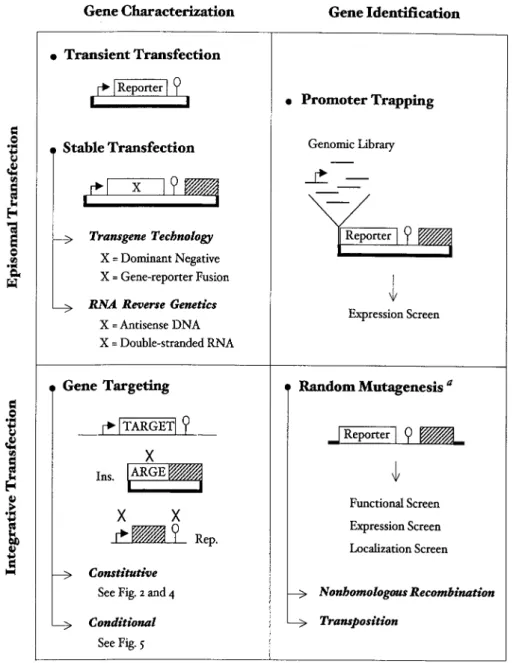
have been the subject of all functional studies. A variety of molecular genetic approaches can now be taken in the two species. Theoretically, episomal or integrative transfection can each be used for either characterizing or identifying genes, as outlined in Figure 1. To propose a complete view of the Plasmodium genetic toolbox, we will consider these four situations successively.
Gene Characterization Using Episomal Transfection Transient Transfection
Since its fi rst use in 1993, transient transfection has been largely used to study gene expression in Plasmodium. Transient transfection plasmids only need to contain a reporter gene fl anked by the sequences under study (Figure 1), and reporter genes encoding chloramphenicol acetyltransferase, fi refl y luciferase or green fl uorescent protein (GFP) have been used to analyze the untranslated regions of many genes. The goal of most of these studies was to defi ne by deletion mapping the minimal 5′ and 3′
Figure 1. A theoretical view of molecular genetic techniques. The selectable marker and its expression sequences are symbolized by a grey box, the bacterial plasmid by thick lines, the gene promoter by an arrow, and the 3′ untranslated sequences necessary for gene expression by an open circle. Ins,
insertion plasmid; Rep, replacement plasmid. See text for details.
regions that retained the capacity to effi ciently drive gene expression (Wu et al., 1995; Crabb and Cowman, 1996; Crabb et al., 1997b; Horrocks and Kilbey, 1996; Dechering
et al., 1997). This information has been particularly valuable for constructing expression or resistance cassettes of minimum size. More recent transient transfection studies have initiated characterization of the DNA elements involved in gene expression (Horrocks and Lanzer, 1999) and stage-specifi c expression (Dechering
et al., 1999), or of the mechanisms that ensure expression of a single member of the var gene family (Deitsch et al., 1999; 2001). Another study used transient transfection to demonstrate that readthrough of an internal stop codon was occurring in a Pf60 gene (Bischoff et al., 2000).
Still, little is known of how gene transcription is controlled in Plasmodium. Plasmodium promoters superfi cially resemble classical eukaryotic promoters transcribed by RNA polymerase II, consisting of a core promoter region controlled by upstream enhancer elements. However, they are functionally distinct from other eukaryotic promoters, as they do not function in mammalian COS cells and their sequences share no homology with any known transcription factor-binding site of eukaryotes (Horrocks et al., 1998). In addition, promoters of SV40 or other viruses, which are ubiquitously active in higher eukaryotes, fail to drive reporter expression in P. falciparum (Horrocks et al., 1998). What adds stage-specifi city to gene expression in Plasmodium is also mysterious, although upstream elements may be involved (Dechering et al., 1999). Unraveling the transcriptional machinery in Plasmodium
will be important, as it may reveal new schemes of gene expression and lead to the development of new tools for timely expression of transgenes or mutations.
Stable Transfection
Multiple selectable markers are now available for stable episomal transfection in both P. falciparum and P. berghei. The most commonly used markers remain the original Plasmodium or Toxoplasma DHFR-TSToxoplasma DHFR-TS variants Toxoplasma DHFR-TS variants that confer resistance to pyrimethamine, present in a variety of resistance cassettes (Wu et al., 1996; Waters
et al., 1997; Crabb et al., 1997b). In both Plasmodium
species, transfectants can also be selected via resistance to the antifolate drug WR99210 encoded by a human
DHFR gene (Fidock and Wellems, 1997; de
DHFR gene (Fidock and Wellems, 1997; de Koning-DHFR
Ward et al., 2000a). Derivative markers now exist that confer both drug resistance and fl uorescence via a GFP fusion (Sultan et al., 1999b; Kadekoppala et al., 2000). Other selectable markers that act independently from the folate pathway have been developed for stable episomal transfection in P. falciparum (Ben Mamoun et al., 1999; de Koning-Ward et al., 2001).
The fate of stably maintained plasmids is different in P. bergheiP. berghei and P. berghei and P. falciparum. In P. berghei, plasmids replicate as unrearranged monomeric units, with an average copy number of 15 per nucleus (van Dijk et al., 1997). These plasmids appear to be fairly stable, even in the absence of drug pressure. In P. falciparum, however, the situation is more complex. Plasmids rapidly form large concatemers (Kadekoppala et al., 2001), which probably emerge from inter plasmid homologous recombination.
The structure and properties of these concatemers also appear to change with time (O’Donnell et al., 2001). Initially small and unevenly segregated to the daughter merozoites, they become larger structures that after a few months are stably replicated even in the absence of selective pressure. Recently, a 1.4-kb sequence composed of 21-bp degenerate repeats, Rep20, has been shown to improve plasmid maintenance and to allow effi cient segregation of plasmids in P. falciparum
(O’Donnell et al., 2002).
Transgene Expression
Gene function can be approached using transgene expression in several ways (Figure 1). (i) Over-expressing dominant-negative forms of a protein can generate a defective phenotype and thus inform on protein function. This strategy is so far limited to a few well-known protein families, and has the drawback of possible unspecifi c effects. (ii) GFP fusions of a protein can be produced to analyze its secretory pathway, as in the case of the insightful studies on the apicoplast-targeted and KAHRP proteins (Waller et al., 2000; Wickham et al., 2001). (iii) Modifi ed versions of a gene can be expressed in a corresponding null mutant, although a serious limitation of episomes for addressing subtle structure-function relationships is the gene dosage effect due to the high number of replicating units.
Whenever possible, the transgene should be expressed from the natural expression regions of the target gene to minimize artifacts due to temporal misexpression of the product (Kocken et al., 1998). In the future, tools for controlled gene expression should greatly help to refi ne episomal approaches, particularly for studies on the erythrocytic stages of the parasite. Transgene technology may nonetheless be limited by episome instability when studying mosquito stages of the parasite, on which drug pressure cannot easily be applied.
RNA Reverse Genetics
Another tool for probing gene function using episomes is antisense technology. Target gene expression can be suppressed by the annealing of antisense molecules to complementary transcripts, by a poorly understood mechanism that may affect transcript stability, processing, transport and/or translation. Both approaches of electroporating single-stranded antisense oligodeoxynucleotides (Barker et al., 1996; 1998) and stably over-expressing antisense transcripts (Gardiner et al., 2000) have been used with success in Plasmodium to disrupt endogenous mRNA function. Stage-specifi c or inducible expression of antisense RNAs may thus represent an alternative to gene manipulation for investigating protein function. It remains that the inhibitory activity of a given antisense molecule is diffi cult to predict, and that antisense approaches face the possible limitations of questionable specifi city and incomplete effi cacy.
interfering’ RNAs (21-23 nucleotide fragments), which guide the cleavage of homologous mRNA by the silencing complex RISC (Hammond et al., 2001; Sharp, 2001). This evolutionarily conserved pathway, which may be part of a basic surveillance system that degrades transposon or viral messages, has already been harnessed as a reverse genetics tool. Injecting or expressing double-stranded RNAs causes the silencing of the corresponding gene in many systems tested, from protozoa to multicellular organisms. Degradation of target mRNA is specifi c and effi cient, even with low concentrations of double-stranded RNA and regardless of the sequence chosen in the target gene. The silencing effect is particularly stable, which obviates the need for the extensive chemical modifi cations that are necessary for enhancing the half-life of antisense oligodeoxynucleotides.
The single RNAi study undertaken in Plasmodium
is encouraging, showing a partial but apparently specifi c reduction of target mRNA levels (McRobert and McConkey, 2002). One limiting factor might be the low transfection frequencies in Plasmodium. Selection of interfered parasites would necessitate expressing double-stranded RNA from a selectable episome. A variety of constructs have already been devised for inducing stable
interference in other systems. For example transcription can occur through inverted DNA repeats, giving rise to hairpin single-stranded RNA mimicking double-stranded RNA (Tavernarakis et al., 2000; Shi et al., 2000; Chuang and Meyerowitz, 2000), or from two opposing promoters, each giving rise to one strand of the double-stranded RNA (Wang et al., 2000). Controllable and stage-specifi c expression of interfering constructs may thus become a handy tool for probing gene function in Plasmodium.
Gene Characterization Using Integrative Transfection Gene Targeting: Current Status
Gene targeting by homologous recombination is arguably the most informative approach to protein in vivo function. It is more reliable and predictable than antisense or dominant-negative approaches, and permits a detailed analysis of protein structure-function relationships. The
Plasmodium genome is haploid, contains mostly single-copy genes and integrates exogenous DNA by ~100% homologous recombination. Thus, for most genes a single recombination event is suffi cient for generating a modifi ed parasite clone. In fact, despite the relative youth of transfection technology in Plasmodium, and its relative
Figure 2. Gene-targeting strategies used in Plasmodium. Gene targeting relies on homologous recombination between a genomic sequence (TARGET gene) and its homolog in the targeting construct (shown on the left). The latter can carry a single region of homology (insertion type) or two regions fl anking the marker (replacement type). Insertion plasmids insert via a single crossover (SCO) between the pair of homologs (plasmid retained), while replacement fragments replace the target sequence via a double crossover (DCO) between pairs of homologs (plasmid lost). In P. berghei, these events are favored by linearizing the transformed DNA. In P. falciparum, linear DNA does not promote recombination, and circular replacement plasmids insert preferentially via a SCO between one pair of homologous sequences. Symbols are as in Figure 1; downstream 3′ untranslated sequences are symbolized by a closed circle.
aThe insertion plasmid must contain an internal fragment of the gene to generate two truncated gene duplicates in the fi nal locus. bThe replacement plasmid should be designed to delete part or all of the target coding sequence.
cThe SCO shown involves the 5′ regions of homology (TA). In this or the reverse case (a SCO between the 3′ regions of homology, ET), a full-length target
gene copy is created.
dFor the gene modifi cation (t) to be recovered in the fi rst, expressed and full-length duplicate, the SCO must occur upstream from the modifi cation. eThe 3′ sequence necessary for gene expression is truncated.
ineffi ciency (stable transfection frequencies have been evaluated at ~10-6 in both P. falciparum and P. berghei), numerous gene-targeting studies have already been performed. They have revealed important insights into such diverse processes as drug resistance, cell invasion by the various invasive stages of the parasite, sexual differentiation, or cytoadherence of infected erythrocytes. Although usually genes have been inactivated, several genes have been modifi ed and in one case expression levels have been diminished. Figure 2 illustrates the strategies that have been used and Figure 3 shows the
Plasmodium loci that have been targeted, as of february 2002. Previous reviews have described construct design and selection protocols (Waters et al., 1997; Ménard and Janse, 1997; Tomas et al., 1998; de Koning-Ward et al., 2000b; Ménard and Nussenzweig, 2000).
Homologous recombination provides a versatile system for manipulating the Plasmodium genome. On the one hand, double crossovers can span and delete tens of kilobases, and be used to introduce large deletions at chromosome ends (Pace et al., 2000). On the other hand, as few as ~300 bp of homology (and possibly less) are suffi cient for crossover formation and plasmid
insertion is associated with short gene conversion tracts (Nunes et al., 1999). Therefore, point mutations can be introduced using small insertion plasmids. Also, strict homology between the targeting and target sequences is not required for productive recombination. For example, transfection in P. berghei with targeting vectors containing sequences from the C-rRNA gene resulted in disruption of the C- as well as the D-rRNA gene, which differ in ~5% of their sequence (van Spaendonk et al., 2001). This implies that a targeting vector may occasionally integrate by homologous recombination elsewhere than at the expected locus, especially when recombination occurs between highly A/T-biased 3′ or 5′ untranslated
sequences. Finally, the multiplicity of selectable markers permits complementation experiments, which provide defi nitive proof for the involvement of a protein in a defective phenotype (Sultan et al., 1999a; 2001; Thathy
et al., 2002). The tools are thus available to perform DNA reverse genetics in Plasmodium according to the molecular Koch postulates of S. Falkow (1988).
There are important differences between gene-targeting procedures and their outcomes in P. falciparum
and P. berghei. The targets of electroporation are
intraerythrocytic forms of the parasite (rings to schizonts) or extracellular merozoites, and selection occurs in vitro or in rodents, respectively. Crucially, linear DNA is the preferred substrate for homologous recombination in P. berghei, but not in P. falciparum. Linear DNA is presumably degraded in P. falciparum when it crosses the four membranes to the parasite nucleus, and this has two important consequences. One is that the time required for selecting integrants is longer in P. falciparum (3-4 months versus 2 weeks in P. berghei), because circular plasmids preferentially replicate episomally than integrate into the genome. Another consequence is that double crossover events can hardly be selected in P. falciparum, because circular replacement plasmids preferentially integrate via single crossovers (see Figure 2).
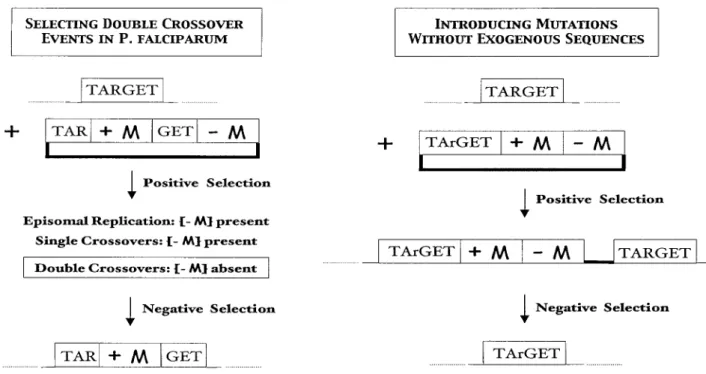
One way to recover the rare double crossovers that may occur when transfecting circular replacement plasmids is to use a negative marker to counterselect the other transfection products (Figure 4). Two negative selectable markers, cytosine deaminase and thymidine kinase, have already been developed in P. falciparum
(Duraisingh et al., 2002). They will also serve for conducting more reliable protein structure-function analysis in both Plasmodium species. Indeed, so far all subtle gene modifi cations have been introduced in the presence of a selectable marker, which as a new transcription unit may affect gene expression in the targeted or unlinked loci in unpredictable ways. Figure 4 shows the classical ‘hit and run’ procedure employed to
circumvent this drawback and to introduce mutations in a fi nal locus devoid of exogenous sequence, based on the sequential use of positive and negative selection.
Limitations of Gene Targeting in Plasmodium
Despite these exciting achievements, there are still numerous genes whose function cannot be properly investigated. This is the case of genes involved in parasite replication in erythrocytes (on which selection is based), including those important for merozoite invasion of erythrocytes, the most scrutinized step of the parasite life cycle and a primary vaccine target. Loss-of-function mutants in these genes die or are overgrown by non-targeted parasites. Therefore, with currently available tools, the best possible evidence that a gene is important for invasion of erythrocytes is when it can be targeted with a nondisruptive construct but not with a disruptive construct (Cowman et al., 2000). This was reported for
MSP-1 and AMA-1, along with direct evidence for their role in merozoite invasion via gain-of-function mutants created by trans-species exchange between human and rodent homologs (O’Donnell et al., 2000; Triglia et al., 2000). Nonetheless, failure to select loss-of-function mutants may be a misleading criterium for identifying important genes among uncharacterized sequences, given the poor targeting frequencies in Plasmodium. In addition, since impaired mutants cannot be selected, the defective phenotype and actual protein function cannot be studied.
Other genes that cannot be at present fully characterized are those encoding multifunctional proteins. Knocking-out these genes only reveals the earliest non-redundant role of their product. One example is CS, known to be involved in sporozoite adhesion to the mosquito salivary glands and to mammalian hepatocytes, but which is fi rst essential for sporozoite formation in the oocyst (Ménard et al., 1997; Thathy et al., 2002). Thus the role of sporozoite surface-associated CS, the leading vaccine candidate against pre-erythrocytic stages of the parasite, cannot be dissected genetically. It is clear that unrestricted functional analysis of the genome requires the tools for activating or silencing genes at will.
Missing Tools: A Brief Overview of Conditional Mutagenesis
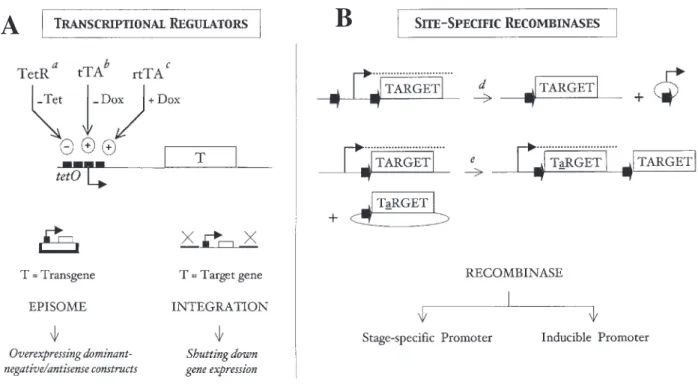
Two types of tools have been widely used for conditional gene expression in eukaryotes: transcriptional regulators and site-specifi c recombinases. Their basic mechanisms of action and some of the possible applications for studying Plasmodium essential genes are illustrated in Figure 5.
The most popular transcriptional regulatory systems are derived from the tetracycline resistance operon of bacterial Tn1010 (Gossen and Bujard, 1992; Baron 10 (Gossen and Bujard, 1992; Baron et al., 1999; Urlinger et al., 2000). They have been developed into increasingly effi cient tools for controlling gene expression in model organisms from yeast to rodents, and have been used with success in various protozoan parasites (Wirtz and Clayton, 1995; Hamann et al., 1997; Wirtz et al., 1999; Meissner et al., 2001; Yan et al., 2002). They consist of (i) a regulator (repressor or activator), (ii) operator sequences, which must be positioned around the transcriptional start site, and (iii) an effector (tetracycline or derivative) for modulating the regulator-operator interaction and turning ‘on’ or ‘off’ gene expression. When a tetracycline-responsive copy of a gene is borne by an episome, it can only be used for timely over-expression of dominant-negative, antisense or interfering constructs. A more direct approach is to insert the controllable copy in place of the endogenous gene by homologous recombination. This enables to shut down gene expression in all recombinants at a chosen
A
B
Figure 5. Tools for conditional gene expression. A) A promoter can be made drug-responsive by inserting 2 to 7 copies of 19-bp tetO (tetracycline operator) sequences around the transcriptional initiation site of the promoter, which are recognized by a regulator: TetR, tTA or rtTA. Left, a drug-responsive transgene can be borne by an episome and used to express dominant-negative constructs. Right, a controllable copy of a target gene can also be used to replace its chromosomal copy by double crossover. Ideally, the desired state (overexpression or tight repression) should be obtained by adding rather than removing the effector, because the former situation is associated with more rapid kinetics of expression switch.
aTetR (tetracycline repressor) is limited by a narrow range of control. TetR dissociates from tetO upon tetracycline binding, leading to gene transcription. btTA (tetracycline-controlled transactivator) is best suited for rapid repression of gene expression and knock-out approaches. In the absence of doxycycline, the gene is expressed; upon doxycycline addition, the gene is rapidly repressed.
crtTA (reverse tetracycline-controlled transactivator) is best suited for rapid expression of a transgene and dominant-negative approaches. In the absence of doxycycline, rtTA does not bind to tetO and the transgene is not expressed; upon doxycycline addition, it is rapidly expressed.
B) Cre (Flp) catalyses a recombination reaction between two identical 34-bp recognition sites called loxP (FRTFRTFRT). When the two sites are located on the ). When the two sites are located on the
same molecule (chromosome), recombination will excise (invert) intervening DNA if the sites are in the same (opposite) orientation. Shown here is the deletion of the target gene promoter. When one site is on the linear chromosome and the other on a circular plasmid, recombinase inserts the plasmid at the chromosomal site. Shown here is plasmid integration leading to gene modifi cation. Timely expression of the recombinase may rely on stage-specifi c or inducible promoters, or other approaches.
dintrachromosomal deletion/excision is reversible but is energetically favoured over intermolecular integration.
time, and to directly assess the consequences of the gradual loss of the product. Inducible promoters come with the clear advantages of reversibility, in allowing to generate truly conditional ‘on’ and ‘off’ states in one clone, and fl exibility, in enabling to create intermediary or temporary states that may be as informative on protein function as a constitutively ‘off’ state. In some situations, however, their effi ciency will ultimately depend on whether complete repression can be obtained, as well as on the kinetics of repression after effector addition/removal. Studies on essential products of parasite erythrocytic stages would greatly benefi t from these tools, particularly the transactivators suited to conditional gene silencing (see Figure 5 legend). The situation seems ideal for P. falciparum, which replicates in erythrocytes in vitro where effector levels can be more easily controlled.
A second way to inactivate a gene in a temporally restricted manner is offered by site-specifi c recombinases. Two site-specifi c recombinases of the λ integrase
family have been used for this purpose in a variety of eukaryotes: Cre of bacteriophage P1 and Flp of yeast (Sauer, 1998; Porter, 1998). These enzymes catalyse a reciprocal conservative recombination between two identical 34-bp target sequences and, depending on their position and orientation, recombination will insert, invert, or delete DNA (see the Figure 5 legend). Therefore, these systems offer the primary advantage of enabling not only to inactivate but also to modify or swap genes, and thus to investigate protein structure-function relationships. Recombination occurs regardless of DNA topology and host environment, and the Cre/loxP system has been shown to function in the apicomplexan Toxoplasma gondii
(Brecht et al., 1999). Although it should be easy to design modifi cations and insert the LoxP or FRT site(s) into the
Plasmodium genome by homologous recombination, the challenge is to express the recombinase conditionally. A fi rst possibility would be to use natural stage-specifi c promoters. If these prove not to be leaky before being activated, they would then be useful for truly conditionally inducing gene rearrangements at a defi ned stage of the parasite life. They would allow studies on essential genes not only in that particular stage, but also in erythrocytic stages after complete cycling of the parasite. A gene important for merozoite invasion could for example be deleted in a mosquito stage of the parasite, and after transmission to the mammalian host its function could be assessed in merozoite formation in the liver and in subsequent merozoite invasion of erythrocytes. Directly applying recombinase systems to parasite erythrocytic stages would require expressing the recombinase from an inducible promoter or using one of the recombinase variants that can be activated by an exogenous factor (Metzger and Chambon, 2001). It may become possible to use, as was recently performed with mammalian cells (Jo et al., 2001), a cell-permeable recombinase that could be directly added to cells/parasites bearing a manipulated (‘fl oxed’ or ‘fl rted’) gene. As increasingly sophisticated site-specifi c recombination systems are being developed, their usefulness in Plasmodium should be evaluated as they would offer virtually unlimited ways of analyzing the function of Plasmodium essential genes.
Gene Identifi cation
Plasmodium has been transfected almost exclusively for testing promoter activity or gene function, and reverse genetic techniques are now well established. On the other hand, attempts to identify genes and develop forward genetic screens have been scarce.
Using Episomal Transfection (Promoter Trapping)
In bacteria, episomal transfection has been widely used to identify genes that are induced in response to defi ned conditions. The basic method consists in fusing a genomic library to a promoterless reporter gene whose product confers a selectable or easily screenable phenotype, for example antibiotic resistance (Figure 1). A simple variant, called differential fl uorescence induction, uses green fl uorescent protein as the reporter and relies on fl uorescence-activated cell sorting (FACS) to isolate bacteria with active transcriptional fusions (Valdivia and Falkow, 1997). In Plasmodium, a similar promoter-trap strategy could in theory be used for isolating promoters that are active during any step of the parasite life. A
Plasmodium genomic library of 1-kb average insert size could be scanned in a few minutes by FACS, and active promoters rescued from fl uorescent parasites. However, the tens of thousands of clones necessary to cover the genome still represent many individual transfections, given the low transfection frequencies. Also, although it is clear that stage-specifi c promoters can be active when carried by episomes (Sultan et al., 1999a; 2001), little is known of their regulation throughout the cycle. In P. falciparum, episomes apparently do not properly assemble chromatin (Horrocks et al., 1998), a requirement for the correct developmental expression of many eukaryotic genes. Another problem is that distinct transfected plasmids may assemble into concatemers (Kadekoppala et al., 2001). Therefore episomal transfection is not presently a suitable approach for identifying Plasmodium genes based on their expression profi le.
Using Integrative Transfection (Insertional Mutagenesis)
of eukaryotic genomes, transposes effi ciently (~10-4; Gueiros-Filho and Beverley, 1997).
Unfortunately, such methods are not in sight in
Plasmodium. Nonhomologous recombination does not occur using currently used vectors, or with frequencies incompatible with gene discovery. Transposition was reported only once, using the mariner element, but with apparently low effi ciency (Ben Mamoun et al., 2000). Even if tools for random DNA insertion into the
Plasmodium genome can be established, their utility for gene discovery would also necessitate increasing frequencies of transfection.
What are the Prospects for Functional Genomics in Plasmodium?
In the absence of appropriate molecular genetic tools, genomic techniques will be crucial for classifying genes according to their pattern of expression (Figure 6). High-redundancy methods can be useful for providing transcriptome snapshots, such as massive cDNA sequencing projects (Carlton et al., 2001) and serial analysis of gene expression (Munasinghe et al., 2000; Patankar et al., 2001). Several genome-wide techniques that compare relative levels of mRNAs in two conditions are also being applied to Plasmodium, including DNA microarray hybridization (Hayward et al., 2000; Ben Mamoun et al., 2001), subtractive suppressive hybridization (Dessens et al., 2000), and differential display (Lau et al., 2000; Cui et al., 2001). So far these techniques have been used mainly for analyzing expression profi les in erythrocytic stages of the parasite, the only stages that yield the necessary amounts of mRNA. To facilitate similar studies with mosquito or liver stages, tools are being developed that should help to purify the small available numbers of parasites by FACS (Natarajan et al., 2001) or laser capture microdissection (Sacci et al., 2002). All these technologies will permit to down scale the genome to its expressed portion during a process of interest and to identify stage-specifi c genes. More focused screens (e.g. involving drug-treated or mutant parasites, or parasites in exex or ex or in vivo conditions) may narrow down to smaller subsets of co-expressed genes and provide sharper leads to investigators. But it is likely that in most cases these global mRNA techniques will leave us with large numbers of differentially expressed genes. As for the entire genome, sequencing will hardly
by itself constitute a rationale for further analysis, although sequence may occasionally suggest function. The challenge remains to translate the fl ow of expression data into biological activities.
Function could be addressed by a systematic, gene-by-gene approach. One possibility would be to systematically delete expressed genes by homologous (double crossover) recombination, and generate null mutants. However, the transition from gene sequence to parasite mutant takes at least 12 weeks in the relatively handy P. bergheiP. berghei system, making such large-scale P. berghei system, making such large-scale functional studies impractical in most laboratories. If it proves reliable in Plasmodium, RNAi technology would be a more rapid method for testing the function of many genes. Systematic functional studies using RNAi have been performed against the products encoded by entire chromosomes in Caenorhabditis elegansCaenorhabditis elegans (Fraser Caenorhabditis elegans (Fraser
et al., 2000; Gönczy et al., 2000) or the components of complete pathways in Drosophila (Clemens et al., 2000) (reviewed in Kuwabara and Coulson, 2000; Barstead, 2001). RNAi would be an effi cient way to mine the
Plasmodium genome for potential drug targets, or to screen for important genes that may deserve further analysis by homologous recombination.
Yet for most laboratories, a direct screen for genes of interest or essential genes would be a more appealing prospect than the gene-by-gene approach. New opportunities for generating random mutants in Plasmodium may arise from the construction of (differentially) expressed gene libraries, which reduces the initial pool of genes and allows their mutagenesis in other organisms. Cloned genes could for example be mutagenized in E. coliE. coli and mutated alleles subsequently E. coli and mutated alleles subsequently introduced into Plasmodium for replacement of their chromosomal copy by homologous recombination. Such ‘shuttle mutagenesis’ has been used in yeast, after Tn3
or Tn77 mutagenesis in 7 mutagenesis in E. coliE. coli (Kumar and Snyder, 2001). E. coli (Kumar and Snyder, 2001). There is now a wide choice of mutagenizing agents, including multifunctional transposons which use the same insertion event to determine (i) when the gene is expressed (via reporter fusion), (ii) where the product is localized in the cell (via formation of epitope-tagged products), and (iii) the consequence of the absence of the product (via gene inactivation) (Ross-Macdonald
et al., 1997; 1999). To avoid having to screen mutants individually, molecular barcodes have been developed for bacterial pathogenesis studies (Hensel et al., 1995) and yeast functional genomics (Shoemaker et al., 1996; Winzeler et al., 1999). These short sequences serve as clone identifi ers and allow large numbers of mutants to be pooled and analyzed simultaneously by comparative hybridization on fi lters or high-density arrays. In bacteria for example, these tags associated with classical transposition (signature-tagged transposition method, STM) have served to isolate mutants that were unable to survive in the host (Hensel et al., 1995). Establishing such tools in Plasmodium would permit to envisage focused approaches to virtually any aspect of parasite biology.
Animal models of malaria should be particularly valuable for functional genomic studies and tackling basic aspects of parasite biology. Rodent Plasmodium species, including P. bergheiP. berghei and P. berghei and P. yoeliiP. yoelii (Mota P. yoelii (Mota et al., 2001), are
practical because they can be studied routinely and safely in the laboratory, and in vivo throughout their life cycle. Double crossover recombination is readily obtained with linear DNA, allowing in principle shuttle strategies. An additional attractive feature of rodent systems is that the three actors (parasite, mosquito and vertebrate host) can be genetically manipulated, and the sequence of their genome is, or will soon be known. P. knowlesiP. knowlesi and P. knowlesi and P. cynomologi, which infect primates and are closely related to the human parasite P. vivax, can also be manipulated by double crossover recombination (van der Wel, 1997; Kocken et al., 1999; 2002). However, their use for large-scale studies is prohibited by ethical and practical reasons. P. falciparum remains the mandatory target for studying specifi c virulence traits, such as cytoadherence of infected erythrocytes. This system offers the advantage of an erythrocytic cycle that can be studied in vitro and synchronized, but is limited by the diffi culty to produce mosquito stages of the parasite and the time consuming molecular genetic procedures. A precise understanding of malaria pathogenesis will necessitate that each system contributes its part.
Conclusion
The landscape of malaria research has changed dramatically in the last decade. The sequence of the genome of several Plasmodium species is now known, genomic techniques have been developed, and the parasite can be transfected. The molecular genetics toolbox, however, is far from complete. On the one hand, understanding the function of a given gene (reverse genetics) is straightforward, and we should soon have the tools for manipulating any gene. On the other hand, identifi cation of genes based on their function (forward genetics) is still problematic. The powerful genomic techniques will continue to categorize the genome into subsets of interest, and may suggest function of groups of genes, but only constitute a fi rst step. Molecular genetic methods must be adapted to translate the wealth of sequence and expression data into biological functions, and to link them to investigator-driven research addressing specifi c questions that can only be answered by a reductionist approach.
These are exciting times for the malaria research community. The blending of these new technologies will lead to an increasingly sophisticated view of parasite biology, and uncover the molecular details behind the unique features of this ancient eukaryote. More importantly, they hold great promise to help reducing the burden of malaria in allowing a systematic hunt for drug targets and a rational choice of vaccine candidates, and will certainly lead us to other intervention strategies that are now unforseeable.
Acknowledgements
We thank, Patricia Baldacci, Freddy Frischknecht, Hiroshi Sakamoto, and Sabine Thiberge for their review of the manuscript and many helpful comments.
References
Baldi, D.L., Andrews, K.T., Waller, R.F., Roos, D.S., Howard, R.F., Crabb, B.S., and Cowman, A.F. 2000. RAP1 controls rhoptry targeting of RAP2 in the malaria parasite Plasmodium falciparum. EMBO J. 19: 2435-2443.
Integration of an insertion plasmid at RAP1 (rhoptry associated protein 1) generates a parasite clone that produces a RAP1 truncate. In these parasites, the components of the rhoptry low molecular weight complex (RAP1-3) fail to associate, indicating that the complex is not important for parasite invasion of red blood cells.
Barker, R.H.Jr., Metelev, V., Coakley, A., and Zamecnik, P. 1998. Plasmodium falciparum: effect of chemical structure on effi cacy and specifi city of antisense oligonucleotides against malaria in vitro. Exp. Parasitol. 88: 51-59.
Barker, R.H.Jr., Metelev, V., Rapaport, E., and Zamecnik, P. 1996. Inhibition of P. falciparum malaria using antisense oligodeoxynucleotides. Proc. Natl. Acad. Sci. USA. 93: 514-518.
Baron, U., Schnappinger, D., Helbl, V., Gossen, M., Hillen, W., and Bujard, H. 1999. Generation of conditional mutants in higher eukaryotes by switching between the expression of two genes. Proc. Natl. Acad. Sci. USA. 96: 1013-1018.
Barstead, R. 2001. Genome-wide RNAi. Current Opin. Chem. Biol. 5: 63-66.
Ben Mamoun, C., Gluzman, I.Y., Beverley, S.M., and Goldberg, D.E. 2000. Transposition of the Drosophila
element marinermariner within the human malaria parasite mariner within the human malaria parasite
Plasmodium falciparum. Mol. Biochem. Parasitol. 110: 405-407.
The Drosophila transposable element marinermariner is a mariner is a member of the Tc1 family of transposons, which are ubiquitous elements of eukaryotic genomes capable of mobilization independently of host factors. The transposon was introduced in P. falciparum by stable episomal transfection; few insertions in the parasite genome occurred, a number of which were in the same gene (protein kinase A).
Ben Mamoun, C., Gluzman, I.Y., Goyard, S., Beverley, S.M., and Goldberg, D.E. 1999. A set of independent selectable markers for transfection of the human malaria parasite Plasmodium falciparum. Proc. Natl. Acad. Sci. USA. 96: 8716-8720.
Describes episomal transfection in P. falciparum using
BSD (blasticidin S deaminase) of Aspergillus terreus, which confers resistance to blasticidin, and NEO
(neomycin phosphotransferase II) of transposon Tn5, which confers resistance to geneticin/G418.
Ben Mamoun, C., Gluzman, I.Y., Hott, C., MacMillan, S.K., Amarakone, A.S., Anderson, D.L., Carlton, J.M.-R., Dame, J.B., Chakrabarti, D., Martin, R.K., Brownstein, B.H., and Goldberg, D.E. 2001. Co-ordinated programme of gene expression during asexual intraerythrocytic development of the human malaria parasite Plasmodium falciparum revealed by microarray analysis. Mol. Microbiol. 39: 26-36.
tags of known sequence (representing ~15% of the estimated number of parasite genes), and hybridized with Cy5-labelled cDNA from 5 intraerythrocytic stages of the parasite: rings, early and late trophozoites, and early and late schizonts. These stages express distinct sets of genes that can be clustered into functional groups: genes involved in protein synthesis, glucose metabolism and energy production, erythrocyte invasion.
Bischoff, E., Guillotte, M., Mercereau-Puijalon, O., and Bonnefoy, S. 2000. A member of the Plasmodium falciparum Pf60 multigene family codes for a nuclear protein expressed by readthrough of an internal stop codon. Mol. Microbiol. 35: 1005-1016.
Transient transfection is used to demonstrate that translation occurs through an internal ochre codon in the 6.1 member of the Pf60 gene family, as a luciferase reporter inserted downstream from the internal stop codon can be expressed.
Bowman, S., et al. 1999. The complete nucleotide sequence of chromosome 3 of Plasmodium falciparum.
Nature. 400: 532-538.
Brecht, S., Erdhart, H., Soete, M., and Soldati, D. 1999. Genome engineering of Toxoplasma gondii using the site-specifi c recombinase Cre. Gene. 234: 239-247. Carlton, J.M.R., et al. 2001. Profi ling the malaria genome:
a gene survey of three species of malaria parasite with comparison to other apicomplexan species. Mol. Biochem. Parasitol. 118: 201-210.
A comparative analysis of six datasets: 5482 P. berghei
GSSs [genome survey sequences, obtained after mung bean treatment of genomic DNA], 5582 P. berghei
ESTs [expressed sequenced tags, obtained from cDNA libraries], 10 874 GSSs in two P. vivax lines, and 2438
P. falciparum ESTs or GSSs present in GenBank. Approximately 1000 putative new Plasmodium genes are identifi ed. Their functional categorization using InterPro (a database of protein domains and signatures) is presented.
Chiang, S.L., Mekalanos, J.J., and Holden, D.W. 1999. In vivo genetic analysis of bacterial virulence. Annu. Rev. Microbiol. 53: 129-154.
Chuang, C.-F., and Meyerowitz, E.M. 2000. Specifi c and heritable genetic interference by double-stranded RNA in Arabidopsis thaliana. Proc. Natl. Acad. Sci. USA. 97: 4985-4990.
Clemens, J.C., Worby, C.A., Simonson-Leff, N., Muda, M., Maehama, T., Hemmings, B.A., and Dixon, J.E. 2000. Use of double-stranded RNA interference in Drosophila
cell lines to dissect signal transduction pathways. Proc. Natl. Acad. Sci. USA. 97: 6499-6503.
Cowman, A.F., Baldi, D.L., Healer, J., Mills, K.E., O’Donnell, R.A., Reed, M.B., Triglia, T., Wickham, M.E., and Crabb, B.S. 2000. Functional analysis of proteins involved in Plasmodium falciparum merozoite invasion of red blood cells. FEBS Letters. 476: 84-88.
A review that presents conclusions of gene disruption experiments at loci potentially involved in merozoite invasion of red blood cells: MSP1-5, RAP1-2, RhopH3,
Ag512, EBA175, AMA1, S-antigen, and ABRA. They suggest that in the P. falciparum D10 line, all these genes except EBA175 and RAP are essential for invasion of red blood cells in vitro.
Crabb, B.S., and Cowman, A.F. 1996. Characterization of promoters and stable transfection by homologous and nonhomologous recombination in Plasmodium falciparum. Proc. Natl. Acad. Sci. USA. 93: 7289-7294. A second report of stable transfection and plasmid integration via homologous recombination in P. falciparum using a Toxoplasma gondii DHFR-TS pyrimethamine-resistance gene. The evidence for non homologous recombination is based on a single clone. Crabb, B.S., Cooke, B.M., Reeder, J.C., Waller, R.F.,
Caruana, S.R., Davern, K.M., Wickham, M.E., Brown, G.V., Coppel, R.L., and Cowman, A.F. 1997a. Targeted gene disruption shows that knobs enable malaria-infected red cells to cytoadhere under physiological shear stress. Cell. 89: 287-296.
The KAHRPKAHRP gene in KAHRP gene in P. falciparum is inactivated by insertion of a replacement plasmid via a single crossover. KAHRP(-) mutants do not correctly localize PfEMP1 and form knobs on the surface of infected erythrocytes, which do not adhere to CD36 under physiological fl ow conditions.
Crabb, B.S., Triglia, T., Waterkeyn, J.G., and Cowman, A.F. 1997b. Stable transgene expression in Plasmodium falciparum. Mol. Biochem. Parasitol. 90: 131-144. Cui, L., Rzomp, K.A., Fan, Q., Martin, S.K., and Williams,
J. 2001. Plasmodium falciparum: differential display analysis of gene expression during gametocytogenesis. Exp. Parasitol. 99: 244-254.
Dechering, K.J., Kaan, A.M., Mbacham, W., Wirth, D.F., Eling, W., Konings, R.N.H., and Stunnenberg, H.G. 1999. Isolation and functional characterization of two distinct sexual-stage-specifi c promoters of the human malaria parasite Plasmodium falciparum. Mol. Cell. Biol. 19: 967-978.
Pfs16 and
Pfs16 and
Pfs16 Pfs25Pfs25 are activated at the onset Pfs25 are activated at the onset of gametocytogenesis (in erythrocytes) and gametogenesis (in mosquitoes) respectively. Their promoters are characterized by transient transfection in P. falciparum (blood stages) and P. gallinaceum
(mosquito stages). An AAGGAATA sequence is identifi ed that is present only in the Pfs25 promoter region, binds a mosquito stage-specifi c transcription factor (PAF-1), and is important for Pfs25Pfs25 transcription.Pfs25 transcription. Dechering, K.J., Thompson, J., Dodemont, H.J., Eling, W.,
and Konings, R.N. 1997. Developmentally regulated expression of pfs16, a marker for sexual differentiation of the human malaria parasite Plasmodium falciparum. Mol. Biochem. Parasitol. 89: 235-244.
Deitsch, K.W., Calderwood, M.S., and Wellems, T.E. 2001. Cooperative silencing elements in varvar genes. var genes. Nature. 412: 875-876.
Deitsch, K.W., del Pinal, A., and Wellems, T.E. 1999. Intra-cluster recombination and var transcription switches in the antigenic variation of Plasmodium falciparum. Mol. Biochem. Parasitol. 101: 107-116.
de Koning-Ward, T.F., Fidock, D.A., Thathy, V., Ménard, R., van Spaendonk, R.M.L., Waters, A.P., and Janse, C.J. 2000a. The selectable marker human dihydrofolate reductase enables sequential genetic manipulations of the Plasmodium berghei genome. Mol. Biochem. Parasitol. 106: 199-212.
Describes the selection of plasmid integration events using a WR99210-resistant form of human DHFR in a genome already manipulated using the pyrimethamine-resistant form of P. bergheiP. berghei DHFR-TS. P. berghei DHFR-TS.
de Koning-Ward, T.F., Janse, C.J., and Waters, A.P. 2000b. The development of genetic tools for dissecting the biology of malaria parasites. Annu. Rev. Microbiol. 54: 157-185.
de Koning-Ward, T.F., Waters, A.P., and Crabb, B.S. 2001. Puromycin-N-acetyltransferase as a selectable marker for use in Plasmodium falciparum. Mol. Biochem. Parasitol. 117: 155-160.
Dessens, J.T., Beetsma, A.L., Dimopoulos, G., Wengelnik, K., Crisanti, A., Kafatos, F.C., and Sinden, R.E. 1999. CTRP is essential for mosquito infection by malaria ookinetes. EMBO J. 18: 6221-6227.
Ookinetes of P. berghei in which the CTRP gene is disrupted after a double crossover event are not motile, fail to invade the mosquito midgut epithelium and do not develop into oocysts.
Dessens, J.T., Margos, G., Rodriguez, M.C., and Sinden, R.E. 2000. Identifi cation of differentially regulated genes of Plasmodium by suppression subtractive hybridization. Parasitol. Today. 16: 354-356.
Duraisingh, M.T., Triglia, T., and Cowman, A.F. 2002. Negative selection of Plasmodium falciparum
reveals targeted gene deletion by double crossover recombination. Int. J. Parasitol. 32: 81-89.
Falkow, S. 1988. Molecular Koch’s postulates applied to microbial pathogenicity. Rev. Infect. Dis. 10 Suppl. 2: S274-276.
Fidock, D.A., and Wellems, T.E. 1997. Transformation with human dihydrofolate reductase renders malaria parasites insensitive to WR99210 but does not affect the intrinsic activity of proguanil. Proc. Natl. Acad. Sci. USA. 94: 10931-10936.
P. falciparum transfected episomally with a human, methotrexate-resistant DHFR variant becomes resistant to the anti-folate compounds WR99210 and cycloguanil, but not the cycloguanil precursor proguanil, suggesting that the latter acts independently of DHFR. Fidock, D.A., Nomura, T., Cooper, R.A., Su, X.-z., Talley,
A.K., and Wellems, T.E. 2000a. Allelic modifi cations of the cg2 and cg1 genes do not alter the chloroquine response of drug-resistant Plasmodium falciparum. Mol. Biochem. Parasitol. 110: 1-10.
Fidock, D.A., Nomura, T., Talley, A.K., Cooper, R.A., Dzekunov, S.M., Ferdig, M.T., Ursos, L.M.B., Sidhu, A., Naudé, B., Deitsch, K.W., Su, X.-z., Wootton, J.C., Roepe, P.D., and Wellems, T.E. 2000b. Mutations in the P. falciparum digestive vacuole transmembrane protein PfCRT and evidence for their role in chloroquine resistance. Mol. Cell. 6: 861-871.
Fraser, A.G., Kamath, R.S., Zipperlen, P., Martinez-Campos, M., Sohrmann, M., and Ahringer, J. 2000. Functional genomic analysis of C. elegans
chromosome I by systematic RNA interference. Nature. 408: 325-330.
Gardiner, D.L., Holt, D.C., Thomas, E.A., Kemp, D.J., and Trenholme, K.R. 2000. Inhibition of Plasmodium falciparum clag9 gene function by antisense RNA. Mol. Biochem. Parasitol. 110: 33-41.
An internal fragment of clag9 is cloned in an antisense direction under the control of the strong calmodulin
promoter. Stable expression of the episome strongly decreases production of clag9 protein and reproduces the phenotype obtained after clag9 disruption (decreased adherence of infected eythrocytes to CD36+ melanoma cells).
Gardner, M.J., et al. 1998. Chromosome 2 sequence of the human malaria parasite Plasmodium falciparum. Science. 282: 1126-1132.
Gueiros-Filho, F.J., and Beverley, S.M. 1997. Trans-kingdom transposition of the Drosophila element
mariner within the protozoan Leishmania. Science. 276: 1716-1719.
Gönczy, P., et al. 2000. Functional genomic analysis of cell division in C. elegans using RNAi of genes on chromosome III. Nature. 408: 331-336.
Goonewardene, R., Daily, J., Kaslow, D., Sullivan, T.J., Duffy, P., Carter, R., Mendis, K., and Wirth, D. 1993. Transfection of the malaria parasite and expression of fi refl y luciferase. Proc. Natl. Acad. Sci. USA. 90: 5234-5236.
The fi rst demonstration that Plasmodium can be transfected. P. gallinaceum gametes and zygotes (extracellular) are electroporated with a plasmid that contains the fi refl y luciferase gene inserted into the
Pgs28 gene and fl anking DNA. After 24 hr, luciferase
Pgs28 gene and fl anking DNA. After 24 hr, luciferase Pgs28
activity is transiently expressed in electroporated parasites.
Gossen, M., and Bujard, H. 1992. Tight control of gene expression in mammalian cells by tetracycline-responsive promoters. Proc. Natl. Acad. Sci. USA. 89: 5547-5551.
Hamann, L., Buss, H., and Tannich, E. 1997. Tetracycline-controlled gene expression in Entamoeba histolytica.
Mol. Biochem. Parasitol. 84: 83-91.
Hammond, S.M., Caudy, A.A., and Hannon, G.J. 2001. Post-transcriptional gene silencing by double-stranded RNA. Nature Rev. Genet. 2: 110-119.
Hayward, R.E., DeRisi, J.L., Alfadhli, S., Kaslow, D.C., Brown, P.O., and Rathod, P.K. 2000. Shotgun DNA microarrays and stage-specifi c gene expression in
Plasmodium falciparum malaria. Mol. Microbiol. 35: 6-14.
PCR-amplifi ed inserts (3648 inserts of 1.5-kb average size, thought to represent ~40% of the parasite genes) from a P. falciparum mung bean nuclease genomic library (ORF- or exon-enriched) were printed on glass slides. These ‘shotgun’ microarrays were hybridized with a mixture of Cy3 or Cy5-labelled cDNA from the erythrocytic trophozoite and gametocyte stages, respectively. The 85 arrayed genes showing the highest differential fl uorescence (red/green or green/red) were sequenced, and new genes were identifi ed.
of bacterial virulence genes by negative selection. Science. 269: 400-403.
Hoffman, S.L., Rogers, W.O., Carucci, D.J., and Venter, J.C. 1998. From genomics to vaccines: malaria as a model system. Nature Med. 4: 1351-1353.
Hoffman, S.L., Subramanian, G.M., Collins, F.H., and Venter, J.C. 2002. Plasmodium, human and Anopheles
genomics and malaria. Nature. 415: 702-709.
Horrocks, P., and Kilbey, B.J. 1996. Physical and functional mapping of the transcriptional start sites of Plasmodium falciparum proliferating cell nuclear antigen. Mol. Biochem. Parasitol. 82: 207-215.
Horrocks, P., and Lanzer, M. 1999. Mutational analysis identifi es a fi ve base pair cis-acting sequence essential for GBP130GBP130 promoter activity in GBP130 promoter activity in Plasmodium falciparum. Mol. Biochem. Parasitol. 99: 77-87.
This work progressively narrows down a 5 bp-sequence, located within a 73 bp-enhancer element, which is crucial for effi cient activity of the GBP130
promoter and specifi cally binds nuclear factors.
Horrocks, P., Dechering, K., and Lanzer, M. 1998. Control of gene expression in Plasmodium falciparum. Mol. Biochem. Parasitol. 95: 171-181.
Jo, D., Nashabi, A., Doxsee, C., Lin, Q., Unutmaz, D., Chen, J., and Ruley, H.E. 2001. Epigenetic regulation of gene structure and function with a cell-permeable Cre recombinase. Nat. Biotech. 19: 929-933.
Jomaa, H. et al. 1999. Inhibitors of the nonmevalonate pathway of isoprenoid biosynthesis as antimalarial drugs. Science. 285: 1573-1576.
Kadekoppala, M., Cheresh, P., Catron, D., Ji, D., Deitsch, K., Wellems, T.E., Seifert, H.S., and Haldar, K. 2001. Rapid recombination among transfected plasmids, chimeric episome formation and transtrans gene expression trans gene expression in Plasmodium falciparum. Mol. Biochem. Parasitol. 112: 211-218.
Co-transfection with a plasmid that expresses GFP fl uoresence and another that confers pyrimethamine resistance allows drug selection of a population where a third of the parasites stably fl uoresce. These fl uorescent parasites contain drug-selectable, chimeric concatemers of both plasmids, and can only be obtained when both plasmids share a large region of homology of Plasmodium DNA (5’ hrp3 UTR sequences).
Kadekoppala, M., Kline, K., Akompong, T., and Haldar, K. 2000. Stable expression of new chimeric fl uorescent reporter in the human malaria parasite Plasmodium falciparum. Infect. Immun. 68: 2328-2332.
A DHFR-GFPmut2 fusion, which confers methotrexate-resistance and fl uorescence, is used in P. falciparum
episomal and integrative transfection.
Kaneko, O., Fidock, D.A., Schwartz, O.M., and Miller, L.H. 2000. Disruption of the C-terminal region of EBA-175 in the Dd2/Nm clone of Plasmodium falciparum does not affect erythrocyte invasion. Mol. Biochem. Parasitol. 110: 135-146.
EBA-175 (Erythrocyte-binding antigen) is localized in the merozoite micronemes and binds the red blood cell surface molecule glycophorin A in a sialic acid-dependent manner. Its encoding gene is targeted in the
P. falciparum Dd2/Nm clone, whose merozoites invade erythrocytes mainly via a sialic acid-independent
pathway. Parasites expressing a EBA-175 truncate lacking the cytoplasmic domain can be selected, implying that EBA-175 is not involved in the sialic acid-independent pathway of merozoite invasion.
Kappe, S., Bruderer, T., Gantt, S., Fujioka, H., Nussenzweig, V., and Ménard, R. 1999. Conservation of a gliding motility and cell invasion machinery in Apicomplexan parasites. J. Cell. Biol. 147: 937-943. An ends-in strategy is used to demonstrate the role of the cytoplasmic tail of TRAP in sporozoite gliding motility and cell invasion. Exchanging the tail of TRAP by that of Toxoplasma gondii MIC2 does not affect sporozoite gliding or invasion, suggesting a functional conservation of the motor system that drives these processes in Apicomplexa. Mutations in the TRAP tail lead to a novel form of motility, termed pendulum motility.
Kocken, C.H.M., Ozwara, H., van der Wel, A., Beetsma, A.L., Mwenda, J.M., and Thomas, A.W. 2002.
Plasmodium knowlesi provides a rapid in vitro and in vivo transfection system that enables double-crossover gene knockout studies. Infect. Immun. 70: 655-660. Kocken, C.H.M., van der Wel, A.M., and Thomas, A.W.
1999. Plasmodium cynomolgi: transfection of blood-stage parasites using heterologous DNA constructs. Exp. Parasitol. 93: 58-60.
Kocken, C.H.M., van der Wel, A.M., Dubbeld, M.A., Narum, D.L., van de Rijke, F.M., van Gemert, G.J., van der Linde, X., Bannister, L.H., Janse, C., Waters, A.P., and Thomas, A.W. 1998. Precise timing of expression of a Plasmodium falciparum-derived transgene in
Plasmodium berghei is a critical determinant of
Plasmodium berghei is a critical determinant of Plasmodium berghei
subsequent subcellular localization. J. Biol. Chem. 273: 15119-15124.
Kumar, A., and Snyder, M. 2001. Emerging technologies in yeast genomics. Nature Rev. Genet. 2: 302-312. Kuwabara, P.E., and Coulson, A. 2000. RNAi – Prospects
for a general technique for determining gene function. Parasitol. Today. 16: 347-349.
Lau, A.O.T., Sacci Jr, J.B., and Azad, A.F. 2000. Retrieving parasite specifi c liver stage gene products in Plasmodium yoelii infected livers using differential display. Mol. Biochem. Parasitol. 111: 143-151.
Lobo, C.-A., Fujioka, H., Aikawa, M., and Kumar, N. 1999. Disruption of the Pfg27 locus by homologous recombination leads to loss of the sexual phenotype in
P. falciparum. Mol. Cell. 3: 793-798.
Pfg27 encoding a protein specifi cally produced at
Pfg27 encoding a protein specifi cally produced at Pfg27
the onset of gametocytogenesis is targeted by single crossover integration of a replacement plasmid. Two mutants, in which full-length Pfg27 lacks its promoter or terminator sequences, have reduced or no Pfg27Pfg27 transcription and display fewer or no typical Pfg27 transcription and display fewer or no typical gametocytes, respectively.
Matuschewski, K., Nunes, A., Nussenzweig, V., and Ménard, R. 2002. Plasmodium sporozoite invasion into insect and mammalian cells is directed by the same dual binding system. EMBO J. 21: 1597-1606.