CSUSB ScholarWorks
CSUSB ScholarWorks
Theses Digitization Project John M. Pfau Library
2006
Modeling queueing systems
Modeling queueing systems
Angela Zoi Leontas
Follow this and additional works at: https://scholarworks.lib.csusb.edu/etd-project
Part of the Mathematics Commons
Recommended Citation Recommended Citation
Leontas, Angela Zoi, "Modeling queueing systems" (2006). Theses Digitization Project. 3101.
https://scholarworks.lib.csusb.edu/etd-project/3101
A Thesis
Presented to the
Faculty of
California State University,
San Bernardino
In Partial Fulfillment
of the Requirements for the Degree
Master of Arts
hi
Mathematics
by
Angela Zoi Leontas
A Thesis
Presented to the
Faculty of
California State University,
San Bernardino
by
Angela Zoi Leontas
June 2006
Approved by:
Peter Williams, Chair, Department of Mathematics
Date 1 '
J. T. Hallett
ABSTRACT
The main objective of this project is to introduce the theory of queueing systems
and to demonstrate its applicability to real life problems. In the first chapter, we discuss the
Markovian property and measures of effectiveness for queueing systems with exponential
interarrival and service times. This information is used to optimize the performance of
the given system. The second chapter of this project is concerned with queueing systems
with exponential interarrival times, Erlang service times, and a single server. The system
performance measures for this queueing system are derived. An appropriate example model
is constructed and investigated. Chapter three discusses different goodness-of-fit tests that
can be used to determine whether the exponential distribution is appropriate for a given set
of data. Advantages and disadvantages of using different goodness-of-fit tests are discussed
and relevant examples are given. Simulation is a method of analyzing queueing systems
which is an alternative to the analytical approach. In the fourth chapter, a single server
queueing system with exponential interarrival times and Erlang service times is simulated
ACKNOWLEDGEMENTS
I would like to thank the Lord Jesus Christ who is my source of inspiration and
life. He has blessed me by placing many special people in my life to share my journey
with me.
I would like to express my sincere appreciation to my advisor, Dr. Nadejda
Dyakevich, for giving so much of her time, energy, and dedication to the successful com
pletion of this thesis. Her knowledge, insight, and countless readings of earlier drafts
have improved this work greatly. Also, I would like to thank Dr. Rolland Trapp and Dr.
Charles Stanton for their support and guidance in this project and throughout my studies
at California State University, San Bernardino.
I am grateful to my family for all their love and support in reaching my goals.
I offer my deepest appreciation and gratitude to my parents, who sacrificed all their life
in order to provide their children with advantages they never had. Many thanks to my
Table of Contents
Abstract iii
Acknowledgements iv
1 Introduction 1
1.1
Overview...
1
1.2
Birth-Death Processes...
3
1.3
Optimization for the M / M / s System 62 The Erlang Distribution 12
2.1
The M/Ek/1 Model13
2.2
An Example for M/Ek/117
3 Model Selection 21
3.1
Chi-Square Goodness of Fit Test23
3.2
The Kolmogorov-Smirnov Test25
3.3
The Anderson-Darling Test 273.4
Concluding Remarks...
28
4 Simulation 30
4.1
Description of the Simulation31
4.2
The M / Ek/1 Example Revisited33
A Kolmogorov-Smirnov Test Example 36
B Anderson-Darling Test Example 38
C Flow Chart and VBA Code 40
D Simulation Results 49
Chapter 1
Introduction
1.1
Overview
The study of the characteristics of waiting lines, or queues, has many important
applii::ations. One of the first problems studied in the field of queueing theory was telephone
traffic congestion by A. K. Erlang in 1909. Erlang's research sparked interest among
many other mathematicians who extended his work. Up to the 1950's, telephony was
the principal application of this theory. Today, queueing theory is a useful tool in other
important applications such as air traffic control, machine repair, scheduling problems, and
time-sharing.
Terminology and Kendall-Lee Notation
To describe a queueing system, we must specify the arrival and service processes.
The arrival process of most queueing systems is independent of the number of customers
present and may be described by the probability distribution that governs the time between
successive arrivals, called the interarrival time. We will assume that at most one arrival
may occur at any given instant and that the arrival process does not depend on the number
of customers present in the queueing system.
The service process of many systems is also independent of the number of cus
tomers present, and we may specify the service time distribution which describes a cus
tomer's service time. We will assume that the servers do not work any slower or faster
In this work, we will use the following standard abbreviations for the probability
distributions to describe interarrival and service times:
M = Times are independent, identically distributed random
|
variables having an exponential distribution. ;
Ek = Times are independent, identically distributed random ;
variables having an Erlang distribution with shape parameter A;.
There is a standard notation created by Kendall (1951) for describing many queueing
systems. This notation is used for models in which all arriving customers wait in a single
queue until one of s parallel servers becomes available. There are six characteristics of; the
notation written in the form 1/2/3/4/5/6. The first characteristic describes the nature of
the arrival process. The second describes the nature of the service times. '
The third characteristic is the number, s, of parallel servers. The fourth
cjiar-acteristic describes the queue discipline. In this work, the order in which customers! are
served is first come, first served (FCF5).
The fifth characteristic is the maximum number of customers allowed in the sys
tem,
including customers in line and customers being served. If there is no maximum', we
denote this by oo. The sixth characteristic is the size of the population from which cus
tomers are drawn. We denote this by oo unless the number of potential customers is of the
same order of magnitude as the number of parallel servers. Often, for 1/2/s/FCFS/oo/oo,
the shorthand notation of 1/2/s is used.
System Perform£ince Parameters
Certain characteristics of a queueing system are of particular interest to optimize
its performance. The most important characteristics are as follows:
TTj =
steady-state probability that j
customers are in the system
L = expected number of customers in the system
Lq =
expected number of customers in queue
Ws — expected time a customer spends in service
A = average number of customers per unit time (arrival rate)
/I =
average number of service completions per unit time (service rate)
p = A/s^ = traffic intensity.
1.2 Birth-Death Processes
We assume that no more than one arrival may occur at any given instant of tirpe.
Define U as the time of arrival of the ith customer. Let Ti =
ti+i —U
be theith interarriyal
time. We
will assume the Ti's are independent, continuous random variables described by
the random variable A.
The
most appropriate distribution for A
is the exponential distribution since
inter-arrival times are not usually very long. The density function of an exponential distributipn
with parameter A is
a{t) =
where A is the arrival rate, measured in units of arrivals per hour. Also, 1/A is defined
as the mean interarrival time.
We know from [Ros02] that the mean and variance of an exponential random
variable are given by
varA = To • ^ ■■ A ■ ' ■'
In this chapter, we assume that service times are exponential. Let p be the service rake
in units of customers per hour. Then,
l/p
is the mean service time,
Another reason that the exponeritial distribution is often used for interarrivpl
times is because of its Markovian property. This property implies that the probability
distribution of the time until the next arrival does not depend on how long it has been
since the last arrival. Throughout this work, we assume that all interarrival times are
Lemma 1.1 (Markovian Property). If A has an exponential distribution, then for all
nonnegative values oft and h
P(A
>
t
+
hI
A~t)
=
P(A>
h). The proof of the following theorem can be found in [GH85].Theorem 1.2. Consider an arrival process {N(t), t ~
0},
where N(t) is the number ofarrivals up tot,
N(0)
= 0,
and satisfies the following assumptions:(i) P( an arrival occurs between time t and t
+
~t)=
>..~t+
o(~t), where >.. is a constantindependent of N(t) and limo(~t)/t
=
0;(ii) P(more than one arrival between t and t
+
~t)=
o(~t);(iii) the number of arrivals in non-overlapping time intervals are statistically independent.
Then, interarrival times are exponential with parameter >.. if the number of arrivals that
occur in an interval of length t follows a Poisson distribution with parameter >..t.
Define the number of people present in a queueing system at time
t
to be the stateof the queueing system at time
t.
The probability of j people present in a queueing systemat time t given i people initially present is denoted by I{j (t). For many queueing systems,
I{j
(t)
will approach a limit 7rj for large t. This limit is independent of the number of peopleinitially in the system. We call 7rj the steady-state probability of state j, or alternatively the equilibrium probability of state j. We will think of 7rj as the probability that at any given time in the distant future, j customers will be present in the system. The 7rj may
also be interpreted as the fraction of time that j customers are present in the queueing
system for some time in the distant future.
A birth-death process satisfies the following three laws:
(i) A birth occurs between time t and t
+
~t with probability Aj~t+
o(~t), where Aj is called the birth rate in state j. Hence a birth increases the state of the system from j to j+
l. A birth is equivalent to an arrival to the system.(ii)
A death occurs between time t and t+
~t with probability µj~t+
o(~t), where µj iscalled the death rate in state j. Thus a death decreases the system's state from j to j - l.
A death will" be thought of as a service completion. To ensure a non-negative state, we
require µo
=
0.The birth-death model is not appropriate when either the interarrival or service
times are not exponential.
Steady-State Probabilities for Birth-Death Processes
We will outline the steps of the derivation of the steady-state probabilities. See
[Win94] for more details.
We relate ~ j (t
+
D..t)
to Pij (t) for smallD..t
by~j (t
+
D..t)
~ Pij (t)+
D..t
(>-j-1Pi,j-l (t)+
µj+lPi,j+l (t) - ~j (t) µj - ~j (t) Aj)+
o (b..t). We divide both sides byD..t,
and take the limit asD..t
-too. For all i and j2:
1, we have~/(t)
=
Aj-1~,j-1 (t)+
µj+lPi,Hl (t) - ~j (t) µj - Pij (t) Aj,and for j
=
0,~,o'(t)
=
µ1Pi,1 (t) - >.o~,o (t).We will use this infinite system of differential equations to obtain the steady-state proba
bilities defined by
1rj ;= lim Pij
(t).
t-+oo
To find the steady-state, we set Pi/(t)
=
0 and acquire1rj-1Aj-1
+
1rj+iµj+l=
1rj (>.j+
µj) (j2:
1)1r1µ1
=
1ro>.o.From the above equations, it follows that
1ro>.o
1r1
-µ1
1ro (>.o>-1) 1r2
µ1µ2
Let
Then,
In the next section, we apply the theory of birth-death processes to determine
the steady-state probabilities for the M / M / s queueing system and use them to derive
measures of effectiveness for the system.
1.3 Optimization for the
M / M /
s
System
Analysis of queueing systems may be used to answer one of the most important
questions for the system: How can we minimize costs for a particular queueing model?
Also, what is the optimal number of servers to minimize the sum of service costs and delay
costs? These questions are of much interest to employers and thus to the modeler as well.
We will explore these questions along with the relevant theory of the M / M / s model ( recall
that s is the number of servers). If j customers are present in the system and j ~ s, then all j customers are in service and s-j servers are idle. However, if j
>
s, thens customersare in service and j - s are waiting in the queue. If a person arrives and a server is idle,
he enters service immediately; otherwise, he joins the queue of customers awaiting service.
To model this system as a birth-death process, we remember that the birth rate in state j
is the arrival rate
>.;
i.e. Aj =>.
for j2:
0. If j servers are busy, service completions occur at a rate of jµ. Thus, if j customers are present, min(j,
s) servers will be busy, and so,µj = min (j,
s)
µ. Therefore, the M / M /s
model may be described as a birth-death process with parametersAj
>.
for j2:
0µj jµ forj=0,1, ... ,s
µj - sµ for j
>
s. (1.2) Defineas the traffic intensity.
).
p= sµ
To ensure the stability of the system, p must be less than one.
That is, the arrival rate must be less than the maximum service rate, which is achieved
when all s servers are busy. Otherwise, the queue will tend to grow indefinitely in time
and the system will "blow up" [WA04].
For j
=
1, 2, ... , s, we have'Trj
-
7r0Cj1roAoA1 • • · Aj-1
=
µ1µ2 · · "µj
1ro.\i si
-j! (µi) si
(sp)i 1ro
=
.,
J·
For j
2:
s, we have'Trj
=
7r0Cj1ro.\o.\1 · · · Aj-1
-µ1µ2". • µj
1ro.\i si
-
s! (si-sµi) si
(sp)i 1ro
=
(1.3)
s! (si-s) ·
Note that the steady-state probabilities must add to 1 since at any given time, the system
is in some state. Thus,
00
L'Trj
=
1, j=0and so
00
1 - L'Trj j=0
s-1 oo
L'Trj
+
L'Trj j=0 j=s_
~
(sp)i 1ro+
~
(sp)~ 1ro~ j! ~ s! (sJ-s)
J=0 3=s
s-1 ( / 8 00
l
- 7ro
[
Ls~
+
:,LI
j=0 J j=s
s-1 (
)j
s ( l s-1 )l
= '·
7ro~~
+
~
-
-
~
pi
[ ~
JI
s! 1-p ~which implies
1 _ 1ro [~(sp)i
+
s
8
( - 1 _ 1-p
8) ] ~ j! s! 1 - p 1 - p J=Os-1
(sp)j
(sp)8
l
7ro [
I:-.-,
+ '
(1 - ) .j=O J. s. p
Therefore,
1
7l"Q
= - - - - -
(1.4)s~ (sp(j -1E!L_
~ j. +sT(I=py
J=O
From equation (1.3), we see that the steady-state probability that all servers are busy (i.e.
j ~ s) is given by
=
~(sp)i 1ro
P(j
~s)
~s!
(si-s)
J=Ss 00
=
s70I:pi
s. .J=S
·:7°
(t,1-t1)
8 8
_ S 7ro
(-1- 1
_
~
P )s! 1-p 1-p
(sp)8
7ro=
(1.5)s!(l-p)
Now denote the expected number of customers waiting in the queue as Lq, If j customers
are present and j ::; s, none of the customers need to wait in the queue. However, if j
>
s, there will be j - s customers waiting in the queue. Thus,00
j=s
~
.
(sp)i
7f'Of='s
(J -
s)
s!(si-s)
_xs7r0 ~ .
_xj-s
-
µss!
~
(J - s) si-sµi
J=S
_xs7rO
Loo (.
)
j-s- - - J-S p .
Changing indices, we obtain
\8 00
/\ 7l"QL
n Lq - - - npµss!
n=l
A8
7rop
~
(~pn)
µ8 s! dp L..t n=l
(sp) 8
7rop - s! (1-
p)
2 •Hence, from (1.5), we acquire
Lq
=
p(j
~ s) p. (1.6)1-p
Little's Formula
For -any queueing system in which a steady-state distribution exists, the following
relations hold [Win94]:
L -\W
Note that L ~ Lq
+
Ls and W = Wq+
W8 • Substituting (1.6) into Lq = AWq and solvingfor Wq:
=
Lq,\
p
(j
~ s)sµ(l-p)
p
(j
~ s)(1.7) sµ- ,\ .
Determining W8 and L8 along with applying Little's Formula, we may obtain L and W as
follows: Since W8
=
1/µ, we get,\
Ls=-. µ
Thus,
L Lq+,\
µ
_ P(j ~ s)p
+~.
Then, since L
=
AW,W
=
p (j~
s)+
~-sµ - A µ
Example 1. 1. An employer wishes to determine the number of servers that should work on Tuesdays. He approximates a delay cost of $0. 05 for every minute a customer waits in
line. On the average, three customers arrive per minute and it takes a server two minutes
to complete the service. Each server is paid $12.00 per hour. Interarrival times and
service times were found to be exponential. How many servers should the employer have
working on Tuesdays to minimize the sum of service costs and delay costs?
We have
A - 3 customers per minute, and
µ - 0.5 customers per minute.
Since p
=
A/
sµ
must be less than one,3
1 0.5s
<
implies
s
>
6 servers.Thus, the employer must have at least seven servers to ensure the stability of the system.
Then, for s
=
7, 8, ... we will compute:Total expected cost Expected service cost Expected delay cost
Minute Minute
+
MinuteNote that each server is paid 12/60
=
$0.20 per minute. Hence, Expected_ service cost=
$0.20s.Mmute
Also,
Expected delay cost Expected customers) Expected delay cost)
( (
Minute Minute Customer
- 3
(0.05Wq)
Then for s
=
7, p ~ 0.86, from (1.4) we get 7fo ~ 0.0015. Thus, using (1.5), P(j
~ 7) ~0.62. From (1.7), Wq ~ 1.24 minutes. Hence, for s
=
7,Expected delay cost ~ $O.l 9, Minute
and so
Total expected cost ~ $1. _ 59 Minute
Computing the service cost per minute for s
=
8 servers in a similar manner, we obtain$1.60. Therefore, the total expected cost per minute for eight servers cannot possibly be
lower than that of seven servers since the service cost alone for eight servers is more than
Chapter 2
The Erlang Distribution
When the interarrival times do not fit an exponential distribution function, they
can often be modeled by an Erlang distribution [Win94]. Let T be a continuous random
variable with Erlang density function
R(Rt)k-1e-Rt
f(t)
=
(k - 1)! 'where R
>
0 is the rate parameter, k is the shape parameter ( a positive integer), andt
2:
0. The mean and variance areE(T)
=
~
and
k
var(T)
=
R2 ,respectively [Win94]. If k
=
1, then f(t)=
Re-Rt (for t2:
0), which is an exponential distribution with parameter R. Thus, the exponential distribution is a special case of theErlang distribution. More specifically, it is an Erlang type 1. If the interarrival times do
not seem to fit an exponential distribution, we often consider an Erlang distribution with
rate parameter k>.., shape parameter k, and mean 1/
>..
This can provide greater flexibility by being better able to represent the real world [GH85].The sum of k independent, identically distributed exponential random variables
with mean l/kµ is an Erlang type k distribution [Win94]. The Erlang distribution can
be used to describe queueing models where the service may be a series of k identical phases
Note that all phases are independent and identical. Also, only one customer at
a time can be in the service process. That is, a customer enters service in phase k, then phase k - 1, and so on. After phase 1 is completed, the customer leaves the system. A
customer must complete all phases of service before the next one may enter phase k of
service.
2.1 The
M / Ek/1
Model
Recall that M / Ek/1 stands for a queueing system with exponential interarrival
times and Erlang-k service times, where k is the number of phases of service. Even if the
queueing system does not have phases of service, it is convenient to analyze it in this way
since each phase may be considered an exponential random variable which allows us to use
the Markovian property.
Let
Pn,i(t)
be the probability ofn
customers in the queueing system with thecustomer in service being in phase i, where i
=
1, 2, ... , k. The first phase of service is phase k, the- second is phase k - 1, and so on; the last phase of service is phase 1. A customer leaving phase 1 leaves the system all together.We can write the following set of difference equations:
Pn,i(t
+
At)=
Pn,i(t)(l - >.At - kµAt)
+
Pn,i+1(t)kµAt
+Pn-1,i(t)>.At
(n ~ 2; 1:Si :S k -
1). Pn,k(t
+
At) -Pn,k(t)(l -
>.At -kµAt)
+
Pn+1,1(t)kµAt
+Pn-1,k(t)>.At
(n ~ 2)PI,i(t
+
At) - P1,i(t)(l - >.At -kµAt)
+P1,i+1(t)kµAt
(n=
1; 1:Si :S k -
1)P1,k(t
+
At) - P1,k(t)(l - >.At -kµAt)
+
P2,1(t)kµAt
+po(t)>.At
where the probability that an arrival (service eompletion of phase j)
occurs between time
t and time t
+
At
is equal to AAt
+
o(At)
(fe/uAt 4^ o(At)). Note that At
is a,n incremental
element and o(At) becomes negligible when compared to At as At
0, i.e.
At-^D At ;
Therefore, airo(At) terms were ignored in the above difference equations [GH85].
Let us first consider the case when n > 1. There are several ways for the system
to get to state n,
j
(n customers in system with the customer in service being in phase jf,
n > 1 and j = 1,2,..., fc). The system might have been in state n,j at t and had no net
change during At (that is, no arrivals and no departures of phase y). Or the systern nlay
have found itself in state (n -^ 1)
,y and had an arrival, or in state n,
(j
+
1) and hac[ a
service completiort of phase j + 1- If j = k, another possibility is that the system was
state (n
+
l),
l and had a depairture of phase 1
(and thus exiting the system).
The difference equation for n f= 0 may be interpreted as follows: We consider
how the system may get to state 0
(zero customers in the system) at time t At. The
system might have been in state 0
at t and had no arrivals during At, or the system might
have found itself in state 1 and had a service completion (therefore exiting the system)!
The corresponding differential-difference equations are found by taking pn,i(t)\ to
the left hand side, dividing through by At, and taking the limit as At —>• 0. Using (he
definition of the derivative, we obtain
dpn,i(t)
m
= -(A
+
kp,)pn,i(tl +kppn,i+l{t)
+
Apn-l,i(t)
2;1 <i < jfc -1)
-r{X+ k:jj)pnj,(t) 4- fc/ipn+l,l(t) 4- Apn-l,fc(t)
= --(A4-fcM)pi,i(t)4fcm,i+i(^)
< i < k — 1)
= -{\
+
kp)pi^k{t)
+
kpp2,iit) +
Xpo{t)
dt(n > 2;1 < i < k-l)
dpn,k
(t)
dt
{n > 2) dpi,i{t)
dt
(1 < i < k — 1)
dpi,kit)
dt dpd{t)
= -Xpoit)
+
kppi,iit).
I
so the steady-state difference equations are
0 - -(>. + kµ)Pn,i + kµpn,i+l + APn-1,i (n ~ 2; 1::;
i::;
k - 1)0 -(>. + kµ)Pn,k + kµPn+l,1 + APn-1,k (n ~ 2)
0 -(>.
+
kµ)p1,i+
kµp1,i+1 (1 ::;i::;
k - 1) 0 - -(>. + kµ)p1,k + kµp2,1 + >.po0 - ->.po+ kµp1,1- (2.1)
Let the random variable Tq represent the time spent in the queue, where E[Tq]
=
Wq, We remember that the expected time to complete each of k phases of service is 1/kµ
and thus the total expected time for a full service completion is 1/µ. Thus, the expected time a customer spends waiting in line is equal to the expected time for Nq customers in
line plus the remaining service time of the customer in phase
I.
E[Tq]
=
E[Nq]-1+
E[I]-k 1µ µ
1 2 k
-p11 +-p12+ .. · +-Plk kµ ' kµ ' kµ '
k+l k+2 k+k
+--p21 +--p22+ .. ·+--P2k
kµ ' kµ ' kµ '
2k + 1 2k + 2 2k + k
+ kµ P3,1 + ~P3,2 + · · · + kµ P3,k
+ .. ·+Po
k(l-1)+1 k(l-1)+2 k(l-l)+k
kµ Pl,1 + kµ Pl,2 + ' ' . + kµ Pl,k
k(2-1)+1 k(2-1)+2 k(2-l)+k
+ kµ P2,1 + kµ P2,2 + · · · + kµ P2,k
k(3-1)+1 k(3-1)+2 k(3-l)+k
+ kµ P3,1 + kµ P3,2 + · · · + kµ P3,k
+ .. ·+po
00
k [k (n - 1)
+
i]
(2.2)- ~tr
kµ Pn,i+
Po,where Nq is the random number for the number of customers in the queue and I is the
random number representing the phase of service in which the customer being served is
in.
We wish to derive the expected time a customer waits in the queue Wq using (2.1).
fourth by zk, and the fifth by z0 gives
-(>.
+
kµ)zk(n-l)+iPn,i+
kµzk(n-l)+iPn,i+l+
>.zk(n-l)+iPn-1,i where(n
>
2; 1 ::; i ::; k - 1)0
=
-(>.+
kµ)zknPn,k+
kµzknPn+l,1+
>.zknPn-1,k (n2:
2)
0 -(>.
+
kµ)ip1,i+
kµip1,i+1 (1 ::;i::;
k - 1)0
-
-(>.+
kµ )zkPl,k+
kµzkp2,1+
>.zkpo0
-
->.z0po+
kµz0p1,1, (2.3}0
-Let
G(z)
=
ZPl,1+
z2p1,2+,,. +
ZkPl,k+zk+
1P2,1+
zk+2P2,2+ · ·, +
Z2kP2,k+ · · · +
Po=
k- L:L>k(n-l)+iPn,i
+
PO·n=li=l
Expanding each equation in (2.3) and summing up all terms, we have:
O=i(G(z)-po)-(1+
k~)G(z)+po+ k~zkG(z).Let r
=
>./kµ. Then,0
= -
1 (G(z) - Po) - (1+
r) G(z) +Po+ >.rzkG(z). zIt follows that
G
Po(l -
z)(z)
=
1-z (1-r)+
rzk+l' where>. Po= 1- -.
µ
Thus,
'() -[1-z(l+r)+rzk+l]-(1-z)[-(l+r)+(k+l)rzk]
G z
=
[1-z(l+r)+rzk+l]
2From (2.2), we conclude
~G'(l)
kµ
1 (k+l)i
kµ 2
(1 -
i)
(k
+
1)>,
2kµ(µ->.)"Since the total wait time is a sum of the expected wait time in queue and the expected
wait time in service, we have:
w
=
Wq+Ws1
w:
q+
µ(k
+
1) >.+
2k (µ - >.) 2kµ (µ - >.)Using this together with Little's Formula, we also obtain
Lq
=
>.Wq(k+l)>.2
2kµ (µ - >.)
and
L >.W
_ >.( (k+l)>.
1)
2kµ (µ - >.)
+
µ
>. ((k
+
1) >.+
2k (µ - >.)) .2kµ (µ - >.)
2.2 An Example for
M/
Ek/1
We wish to determine whether the marketing department should rent a slow or
fast copy machine. The department estimates each employee's time to be worth $15.00
per hour. The slow copier rents for $4.00 per hour, and it takes an employee an average
of 10 minutes with a variance of 19 minutes to complete copying. The faster copier rents
for $8.00 per hour, and it takes an employee an average of 6 minutes with a variance
machine. The interarrival times were found to be exponential. Which machine should
the department rent to minimize the total expected cost per hour?
Let us first analyze the slow copier. Note that
>.
=
4 employees per hour and1
- 10 minutes per employee
µ
=
16
hours per employee,so
1
1 .µ emp oyees per mmute 10
6 employees per hour.
Let us check that the copy times satisfy
var T
<
[E (T)]2 •Since 19
<
102, an Erlang distribution can be fitted to the copy times [Win94]. Let us determine k.1 var T
-
kµ21 19
=
k
Uo)2
k ~ 5.26.Thus, k
=
5 or k=
6. For k=
5, var T=
20, and for k=
6, var T=
16.67. Hence,we choose k = 5 since the observed variance is closest to that achieved with k = 5.
Therefore, the copying times fit an Erlang distribution with rate parameter kµ
=
½
and shape parameter k=
5. We have an M / E5/l model. We must also check system stability [Win94], i.e.>.
p =
- <
1µ
thus the queueing system is stable.
Now we carry out the calculations (using hours as the time unit) to determine the
total expected cost per hour for the slow copy machine as follows:
Total Expected Cost Expected Service Cost Expected Delay Cost
- - - = - - - + - - - ,
Hour Hour Hourwhere
Expected Delay Cost
=
(Expected Employees) (Expected Delay Cost) .Hour Hour Employee
Thus,
Total Expected Cost
=
4+
4 (lSW.).Hour q
Note that the expected delay cost per hour is the employee's wage per hour. Calculate
Wq as follows:
(k+l),\
2kµ (µ - ,\)
6 (4)
60 (2) 1
5
hours.Hence, for the slow machine
Total Expected Cost _ 4+ 60
Hour ,5
=
$16.00.Thus, the slow copier has an expected cost of $16.00 per hour.
Similarly, we may analyze the fast copy machine. We have
,\ =
4 employees per hour1
=
6 minutes per employeeµ
1
=
hours per employee 101 1 .
µ
=
6
emp oyees per mmuteSince var T
<
[E (T)]2, or 9<
62 , an Erlang distribution may be fitted to the copy times.We also verify that p
=
A/µ= 4/10<
1, so the system is stable. To find k: 1var T
=
kµ2
1 9
k
(¼)2
k-
4.Similar to the case for the slow copy machine,
Total Expected Cost Expected Service Cost Expected Delay Cost
Hour Hour
+
Hour=
8+4(15Wq).Calculate Wq as follows:
(k
+
1) A Wq =2kµ(µ-A)
5 (4)
-80 (6)
1
= hours. 24
Thus, for the fast copy machine,
Total Expected Cost 60
Hour 8
+
24$10.50.
Therefore, the fast copier has an expected cost of $10.50 per hour.
Since the total expected cost per hour is $16.00 for the slow machine versus $10.50
for the fast copier, the marketing department should rent the fast copy machine to minimize
the total cost per hour.
Note that we may also determine the expected number of customers in queue
(Lq)
for the slow and fast copy machines using the steady-state formula that we derived. The
slow copier gives
Lq
=
4/5 employees, and the fast copier givesLq
=
1/6 employees. OfChapter
3
Model Selection
Finding the appropriate probability distribution that describes a set of data is
imperative for a model to produce meaningful results. For the queueing systems that we
are interested in, determining whether the actual data are consistent with the assumption of
exponential interarrival times and service times is essential. Goodness of fit tests are often
used ~o test a set of data for fitting a probability distribution. The most common tests are
the chi-square goodness of fit test, Kolmogorov-Smirnov test, and Anderson-Darling test.
In this chapter, we will demonstrate how to use these three tests to choose appropriate
probability distributions for the given data set.
All of these tests compare the data to a theoretical distribution ( with the popu
lation mean m replaced by sample mean m). Given
m,
we wish to conduct a hypothesis test to determine whether ti, t2, ... ,tn represent a random sample from a random variablewith a given density function
f(t).
That is, we want to test the following hypotheses:H0 : t1, t2, ... , tn is a random sample from a random
variable with a given density function
f(t),
Ha
t1, t2, ...,
tn is not a random sample from a randomvariable with a given density function
f(t).
Let us consider queueing models in which we want to fit to an exponential distribution.
Suppose the interarrival times of a queueing system have been observed to be t 1 , t 2 , ... , tn,
of the arrival rate
>.
from the observed data. A common method is using the maximumlikelihood estimate [KPW04].
Definition 3.1. The likelihood function is
n
L(0)
=
IT
P(Tj=
tjI
0)j=l
and the maximum likelihood estimate of 0 is the value that maximizes the likelihood
function.
This estimate is found by setting the objective function L(0) and then determin
ing the parameter value that optimizes the function. We will show that the maximum
likelihood estimate of the arrival rate
>.
is given byand the mean of interarrival times
1/
>.
=
0 can be estimated byn I)i ~ -t i=l
0 = i = - - .
n
By the definition of the likelihood function,
n
L(0) =
IT
P(Tj = tjI
0)J=l
n
=
ITf(tjI
0) j=l=
f:r0-
1e-t
j=l
-f:!i
- 0-ne i=l o.
Note that when calculating the likelihood function for a single point, we interpret
Instead of maximizing L (0), we will maximize l (0)
=
ln L (0). This can be donesince both L (0) and l (0) have their maximum point at the same value. Then,
n
I:ti
l(0) - -nln0 - i=l
0
i=l
3.1
Chi-Square Goodness of Fit Test
The first step in a chi-square goodness of fit test is to break up the set of in
terarrival times into k adjacent intervals
[ao, a1), [a1,
a2), ... ,[ak-1,
ak), where ak=
oo. Assuming thatf(t)
governs interarriv1;1,l times, we determine the number of expected interarrival times, denoted by ej, that are in interval j. To do this, compute the expected
probability Pi of the data that would fall in the jth interval, where
Pi=
L
p(xi)aj-I9j$a3
and
p
is the mass function of the fitted distribution. Hence ej=
npj is the expected number of the data that will fall in the jth interval. Denote the number of observed datain the jth interval
[aj-1,
aj) by Oj- The chi-square test statistic is0(o· -
e·)2x2
=
L..J J Jj=l ej
A small test statistic value demonstrates a good fit. This occurs when the observed
interarrival times are near the expected interarrival times.
Given a value of the desired Type I error (rejecting H0 when it is true) a, the
critical value_ is X%-r-l,l-o:' where r is the number of parameters that must be estimated
for the interarrival time distribution. Note that r
=
1 for the exponential distribution.Accuracy of a test is an important factor in modeling. The requirements for
accuracy of the · chi-square test are not concrete, but there are a few guidelines that are
often followed: The intervals should be chosen such that Pl
=
p2= ... =
Pki this is called the equiprobable approach. This is satisfied for 3 ~ k ~ 30 intervals and ej ~ 5 for all j[Win94], [LK00]. The lack of rigid rules for interval selection for the chi-square goodness
of fit test is one of its major drawbacks.
However, for the equiprobable approach for interval selection, the chi-square test
is said to be unbiased since it is more likely to reject a false null hypothesis than a true one.
If many ej 's are small and not equal, a highly biased yet valid test is possible. According
to [LK00], the equiprobable approach along with the conditions that ej ~ 5 for all j and
k ~ 3 guarantees a valid and unbiased test.
Example 3.1. The interarrival times (in minutes) observed at a bank are as follows (in
ascending order): 0.1, 0.2, 0.2, 0.3, 0.3, 0.5, 0.6, 0.6, 0. 7, 0.8, 0.9, 1.2, 1.5, 1.6, 1.8,
2.2, 2.3, 3.0, 3.5, 3.8, 3.9, 5.3, 6.1, 9.4, 11.0. Use the chi-square goodness of fit test
with a
=
0.05 to determine if it is reasonableto
conclude that the observations follow anexponential distribution.
There are 25 observations with a mean arrival rate
5
j;
=
~=
0.405 arrivals per minute. 2I:ti
i=l
Now test whether the data are consistent with an exponential random variable, say A, with
density f(t)
=
O.4O5e-o.4ost. Choose k=
5 intervals to ensure that the probability that anobservation from A falls into each of the five categories is Pj
=
0.20 for 1 ~ j ~ 5. Thusej
=
25(0.20)=
5 for each interval. Then set the interval boundaries. We must firstcalculate the cumulative distribution function, F(t), for
A:
F(t)
=
P(A ~t)
tJ
0.405e-0.40Sxdx0
F(a2)
=
P(A::S
a2)=
0.40F(a3)
=
P(A::S
a3)=
0.60F(a4)
= P(A::S a4)
= 0.80.From F(t)
=
1 - e-o.4o5t, we can use natural logarithms to solve fort
as follows:F(t)
=
l _ e-o.4o5tln e-0.405t
=
ln(l - F(t))ln(l - F(t))
t
-0.405
ln(l -
F(aj))
£ ll . -0.405 or a J.It follows that
a1
=
0.55, a2=
1.26, a3=
2.27, anda4
=
3.98.The number of observations in each interval is
01
=
6, 02=
6, 03=
4, 04=
5, and 05=
4.Thus,
(6-5)2 (6-5)2 (4-5)2 (5-5)2 (4-5)2
x2 -
5+
5+
5+
5+
5=
0.20+
0.20+
0.20+
0+
0.20 0.80.The critical value is
xl
0.95=
7.81, and sincex
2=
0.80::S
7.81, we cannot reject the null hypothesis. Hence, with 95% certainty, the null hypothesis is not rejected and theexponential dfstribution with
>.
=
0.405 arrivals per minute is a plausible model for theinterarrival times. □
3.2 The Kolmogorov-Smirnov Test
The Kolmogorov-Smirnov (K-S) test is another method that can be used to assess
whether the observations T1, T2, ... , Tn are an independent sample from the exponential
distribution function. This test has advantages and disadvantages. To perform the test,
the data does not need to be grouped, and hence the problem of interval specification is
eliminated. Although the original K-S test requires all parameters to be known (i.e. the
parameters should not be estimated from the sample data), applying it for discrete or for
any continuous distribution with estimated parameters yields a conservative test. That is,
the actual probability
ci
of rejecting the null hypothesis when it is true is at least as smallas the stated probability a [LK00].
For the K-S statistic, define the empirical distribution function Fn(t) as the right
continuous step function where Fn (T(i))
=
i/n for i=
1, 2, ... , n. Also, the distributionfunction F(t) is assumed to be continuous over the range of data. A natural assessment of
goodness of fit is a measure of closeness of the empirical and fitted distribution functions.
In the case when all parameters are known, the test statistic is the largest vertical distance,
Dn, of Fn(t) and F(t) for all t, where Dn is defined by [KPW04]
Dn
=
sup IFn(t) - F(t)l -tHowever, since in our case not all parameters are known (we estimate the mean from the
observations), we will use the adjusted test statistic
0.2) ( c 0.5) ( Dn - -;;;- v n
+
0.26+
..jn .
Once more, we do not reject H0 if this test statistic is small. A commonly used critical
value for this situation is c1-a
=
1.094 for a= 0.05 [LK00].Example 3.2. Use the K-8 test with a
=
0.05 on the previous example to determine if itis reasonable
to
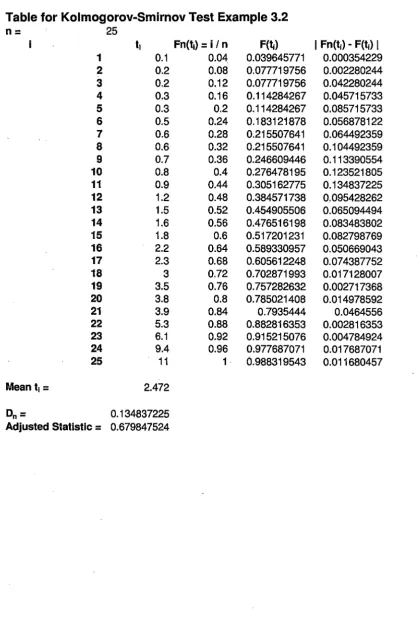
conclude that the observations follow an exponential distribution.We first set up a table to compute Fn(t), F(t), and IFn(t) - F(t)I for each t. Then
we determine Dn from the table (see Appendix A). Since the critical value is
co.
95=
1.094and
0.2) (· /M 0.5 )
D25 -
25
V 25+
0.26+
J25
~ 0.6798 :::; 1.094,(
again we cannot reject the null hypothesis. Hence, using the K-S test with 95% certainty,
the null hypothesis is not rejected and the exponential distribution is a plausible model for
3.3. The Anderson-Darling Test
The Anderson-Darling (A-D) test is a similar test to the K-S test, however it
detects discrepancies in the tails. This is an important characteristic since many distribu
tions mostly differ in their tails [LK00]. Denote the A-D test statistic for the case when
all parameters are known by
00
A;,= n
J
[Fn(t) -F(t)]
2 'lj;(t)J(t) dt,-00
where the weight function
1
'lj;(t)
=
F(t)[1 - F(t)]
Then A~ is the weighted average of the squared differences between the empirical and
model distribution functions. The weights are largest for F(t) close to 0 and 1 (the left
and right tails, respectively). Let Zi = F(T(i)) for i = 1, 2, ... , n. Then the test statistic
for carrying out actual computations can be written as
-{f:(2i-
l)[lnZi+
ln(l - Zn+1-i)]}A2 _ n - i=l _ ~
n
The values for Fn(t) and F(t) are calculated the same way as for the K-S test.
Since
A;,
is a weighted distance, we want to reject the null hypothesis ifA;,
is too large. Once again, an adjusted test statistic is available that takes into account that themean was estimated from the data. Thus, reject H0 if
( 1
+
0~6)A;,>
1.326 for a=
0.05 [LK00].Example 3.3. Use the A-D test with a
=
0,05· on the previous example to· determine if itis reasonable to conclude that the observations follow an exponential distribution.
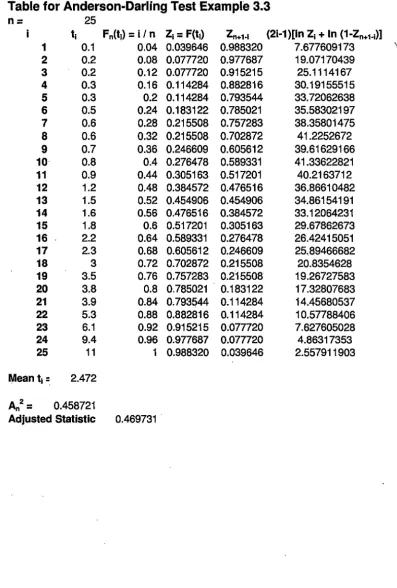
We set up a table to compute Fn(t), Zi, and Zn+l-i for each t (see Appendix B).
Then compute
A;,~
0.4587. Since the critical value is do.95=
1.326 and( 0.6)
1+
2 ~ 0.4697 ~ 1.326,25
A25again we cannot reject the null hypothesis. Thus, using the A-D test with 95% certainty,
the null hypothesis is not rejected and the exponential distribution is a plausible model for
3.4 Concluding Remarks
We first note that any model is only an approximation of reality, however the
model may still be useful. While selecting a distribution model, it is very important to
follow the principle of parsimony. The principle states that unless there is strong evidence
to use a more complex model, it is preferred to choose a simpler model. Most hypothesis
tests use this principle as well. Unless there is strong evidence to do so, do not reject
the null hypothesis ( and thus claim a more complex model of the population needs to be
found). Finally, it is wise to keep focused on the problem that is to be solved rather than
spend abundant energy searching for the perfect model. The reasoning behind this is that
if a complex model is very close to the observations, there is no guarantee that the model
matches the population from which the data were sampled [KPW04].
There are two main approaches to model selection; they are the judgment-based
and score-based approaches [KPW04]. The judgment-based approach allows for a decision
to be based on the success of particular models in similar situations or on how well the
data compare to the empirical distribution using a graph.
The score-based approach assigns each model a score and the model with the best
score is chosen. Common scores include the lowest value of the Kolmogorov-Smirnov test
statistic, the lowest value of the Anderson-Darling test statistic, the lowest value of the
chi-square goodness of fit test statistic, the highest p-value for the chi-square test, and the
highest value of the likelihood function at its maximum. Overall, the analyst's judgment
is required at the very least in deciding which algorithm to choose.
Each hypothesis test has its advantages and disadvantages. The chi-square good
ness of fit test is commonly used since it may be applied to any hypothesized distribution.
Also, the critical value of the test is easily adjusted depending on the number of param
eters estimated from the data. A valid chi-square test using the equiprobable approach
for interval selection always produces an unbiased test. A test is said to be unbiased if it
is more likely to reject a false null hypothesis than when it is true. However, the major
drawback of this test is the lack of rigid rules for interval selection. In some cases, different
choices of intervals can lead to different conclusions [LK00].
For the Kolmogorov-Smirnov test, the data does not need to be grouped, which
test statistic when parameters are estimated from the data. The critical values are not
readily available for discrete data and must be computed from difficult formulas. Lastly,
the K-S test statistic gives the same weight to the difference
IFn(t) - F(t)
I
for all values oft,
but many distributions differ primarily in their tails [LK00].The Anderson-Darling test has an advantage since its test statistic is a weighted
average where the weights are largest in the tails, unlike the K-S test statistic. Similar
to the K-S test, the A-D test statistic must be adjusted for the case when parameters are
estimated from the data. The critical values for this test also must be computed from
Chapter 4
Simulation
Simulation is a common method of analyzing queueing systems as an alternative
method to the analytical approach. Perhaps the biggest advantage of simulation is its flex
ibility in the sense that it is possible to create a program for an individual queueing system
without needing as many simplifying assumptions as the analytical method. Queueing
systems with non-exponential service times, a limited capacity waiting room, and many
other situations which are extremely difficult to analyze directly can be explored using
simulation. Simulation should be used when an analytical solution may not be found or
it does not have acceptable approximations [GH85].
Another advantage of simulation is that the user sees the action through time.
Creating simulation models to see the effects of changing system parameters is much more
cost efficient than to change the system in real life. There are three basic phases of
simulation: data generation, bookkeeping, and output analysis. In queueing systems,
the first phase generates the interarrival and service times with appropriately selected
probability distributions. The biggest problem in queueing simulation is bookkeeping.
Bookkeeping involves keeping track of arrivals, departures, busy and idle servers, queue
length, clock time, and status of the server. In other words, timing and bookkeeping is a
challenge [WA04]. The outputs are then analyzed to determine which parameters of the
queueing system should be changed to optimize system performance.
The model that we will consider is a single server queueing system. Customers
arrive at random times to the system. If a customer arrives and the server is busy, the
simulate the system for a user-defined length of time, called the close time. At this time,
no new arrivals are allowed to enter the system, but customers already present are served.
The simulation terminates when the last customer leaves. This model assumes that the
times between arrivals are exponentially distributed and the service times are Erlang type
k. The purpose of the simulation is to coHect statistics on the system behavior in order to optimize its performance.
4.1 Description of the Simulation
Visual Basic for Applications (VBA) was used to simulate the queueing system
discussed in this chapter. The VBA code takes care of all the timing and statistical
bookkeeping as the simulation runs [Alb00]. The program code may be found in Appendix
C. The key idea of the simulation is one of scheduling events. At any given time, there is
a list of scheduled events of two types. The first type is an arrival. Each time a customer
arrives to the system, the next arrival is scheduled at some random time in the future. The
second type of event is a service completion ( or departure). Each time a customer goes
into service (possibly after waiting in the queue), a departure is scheduled for a random
time in the future.
Generating Exponential and Erlang Type k Service Times
We first want to generate arrival times from the exponential distribution with
parameter .X. We recall that the probability distribution is given by
F(x)
=
1 - e->.t(t
~ 0).We use VBA's random number generator to produce a uniform-(0,1) random number r.
Solving the equation
r
=
l - e->.tfor
t
is referred to as the analytical inversion process of generating random variables fromNote that it does not matter whether we use 1-r or r since both are uniform-(0,1) random
numbers. Thus, we may write
and by taking natural logarithms of both sides, we obtain
lnr
t
=
-T·
This is the formula used in our VBA program to generate random exponential interarrival
times.
To generate Erlang random variables, we may use the fact that an Erlang type k
random variable, x, is the sum of k independent, identically distributed exponential random
variables with mean l/kµ [Win94]. Thus, using VBA's random number generator to
produce uniform-(0,1) random numbers r1, r2, ... ,rk, we have
x
=
t
(-l~ri)
i=l µ
k ln
II
rii=l
kµ ,
which is the formula used to generate random Erlang type k service times.
We will now explain the major steps of the program after the user enters the
following inputs: the customer arrival rate, the mean service time per customer, the number
of phases of service, and the closing time.
Step 1:
The program begins by initializing the system. Set the clock time to zero, set the status
of the server to idle, and schedule the first arrival. Go to step 2.
Step 2:
Determine whether the next event will be an arrival or a departure as follows. Find the
minimum of the scheduled event times. If the next event time is that of an arrival, reset
the current clock time to the time of the arrival and go to step 3. If it is a departure,
reset the current clock time to the time of the departure and go to step 4. In either case,
increase the wait times of everyone in the queue by the elapsed time between the previous
Step 3:
Check to see if the server is busy. If yes, put this arrival at the end of the queue, keeping
track of the arrival time (for later statistics). If the server is idle, place this customer into
service and schedule his departure. Schedule the time of the next arrival. If this time is
after the closing time, do not allow the next arrival and do not schedule any future arrivals.
Go to step 5.
Step 4:
Ifthere is at least one customer in the queue, send the customer from the front of the queue
to the server and record his wait time for later statistics. Move all other customers up one
space in the queue and schedule a departure. If there is no queue, set the server's status to
idle; do not schedule a departure event. Increase the number of served customers by one.
Go to step 5.
Step 5:
If the clock time is greater than the close time and the server is idle, calculate the outputs
and terminate tl:ie program. Otherwise, go to step 2.
The flow chart may be found in Appendix C.
4.2 The M/Ek/1 Example Revisited
Rec.all that in Chapter 2 we considered an example where we used analytical
methods to determine summary measures for the M/Ek/1 model. Here, we want to
compare the theoretical values of the expected wait time in queue (Wq) and the expected
number of customers in queue
(Lq)
found in Example 2.2 with the corresponding valuesusing a simulation model.
From Example 2.2, we have for the slow copy machine
>. -
4 employees per hour, 1µ
=
16
hours per employee, andTheoretical values for the expected wait time and the expected number in queue were
1
Wq
5
hours Lq - 45
employees.For the fast machine we have
1
µ
=
1
-
hours per employee10
k
=
4 phases of serviceWq 1 hours 24
Lq 1
6
employees.We use the VBA program to simulate the use of each copy machine.
Inputs and Outputs
There are four inputs for each copier: the employee arrival rate ,\ the mean service
time per employee 1 /µ, the number of phases of service k, and the closing time. At the end of the simulation, we want to display the summary measures, which include: average
time and maximum time in queue, average number and maximum number of employees in
the queue, and the fraction of time that the server is busy. Also, the simulation program
outputs the number of employees processed and the probability distribution of number in
queue.
From [Ros02], we determined to perform one hundred runs for the slow and fast
machines. Each run simulates an eight hour period. Also, by [Win94], we expect the
average of the simulation values to be close to the steady-state values found in Chapter 2.
Slow Copy Machine
We calculated the average wait time and the number in queue to be 0.20055 hours
and 0.80102 employees, respectively. Both averages are very close to the steady-state values
Fast Copy Machine
We calculated the average wait time and the number in queue to be 0.04158
hours and 0.16644 employees, respectively. Again, both averages are very close to the
steady-state values of 0.041667 hours and 0.166667 employees, respectively.
In summary, simulation allows the user to obtain a realistic analysis of the queue
ing system. This method is commonly used when a queueing model is extremely difficult
or impossible to analyze analytically due to the complexity of the queueing system. Simu
lations allows us to create hypothetical situations without costly real-time experimentation
nor possible loss of clientele due to long lines and long wait times.
Appendix A
Kolmogorov-Smirnov Test
Table for Kolmogorov-Smirnov Test Example 3.2
n= 25
ti Fn(t1) = i / n F(t1)
I
Fn(t1) - F(t1)I
1 0.1 0.04, 0.039645771 0.000354229
2 0.2 0.08 0.077719756 0.002280244
3 0.2 0.12 0.077719756 0.042280244
4 0.3 0.16 0.114284267 0.045715733
5 0.3 0.2 0.114284267 0.085715733
6 0.5 0.24 0.183121878 0.056878122
7 0.6 0.28 0.215507641 0.064492359
8 0.6 0.32 0.215507641 0.104492359
9 0.7 0.36 0.246609446 0.113390554
10 0.8 0.4 0.276478195 0.123521805
11 0.9 0.44 0.305162775 0.134837225
12 1.2 0.48 0.384571738 0.095428262
13 1.5 0.52 0.454905506 0.065094494
14 1.6 0.56 0.476516198 0.083483802
15 1.8 0.6 0.517201231 0.082798769
16 2.2 0.64 0.589330957 0.050669043
17 2.3 0.68 0.605612248 0.074387752
18 3 0.72 0. 702871993 0.017128007
19 3.5 0.76 0.757282632 0.002717368
20 3.8 0.8 0.785021408 0.014978592
21 3.9 0.84 0.7935444 0.0464556
22 5.3 0.88 0.882816353 0.002816353
23 6.1 0.92 0.915215076 0.004784924
24 9.4 0.96 0.977687071 0.017687071
25 11 1 0.988319543 0.011680457
Mean t1
=
2.472Dn= 0.134837225
Appendix B
Table for Anderson-Darling Test Example 3.3
n= 25
t1 Fn(t1) = i / n Z1 = F(t1) Zn+1·1 (2i-1 )[In Z1+ In (1 ·Zn+1-1)] 1 0.1 0.04 0.039646 0.988320 7.677609173
'
2 0.2 0.08 0.077720 0.977687 19.071704393 0.2 0.12 0.077720 0.915215 25.1114167 4 0.3 0.16 0.114284 0.882816 30.19155515 5 0.3 0.2 0.114284 0.793544 33. 72062638
6 0.5 0.24 0.183122 0.785021 35.58302197
7 0.6 0.28 0.215508 0.757283 38.35801475
8 0.6 0.32 0.215508 0.702872 41.2252672 9 0.7 0.36 0.246609 0.605612 39.61629166 10· 0.8 0.4 0.276478 0.589331 41.33622821 11 0.9 0.44 0.305163 0.517201 40.2163712 12 1.2 0.48 0.384572 0.476516 36.86610482 13 1.5 0.52 0.454906 0.454906 34.86154191 14 1.6 0.56 0.476516 0.384572 33.12064231 15 1.8 0.6 0.517201 0.305163 29.67862673 16 2.2 0.64 0.589331 0.276478 26.42415051 17 2.3 0.68 0.605612 0.246609 25.89466682 18 3 0.72 0:102812 0.215508 20.8354628 19 3.5 0.76 0.757283 0.215508 19.26727583 20 3.8 0.8 0.785021 0.183122 17.32807683 21 3.9 0.84 0.793544 0.114284 14.45680537 22 5.3 0.88 0.882816 0.114284 10.57788406 23 6.1 0.92 0.915215 0.077720 7.627605028 24 9.4 0.96 0.977687 0.077720 4.86317353 25 11 1 0.988320 0.039646 2.557911903
Mean t1=. 2.472
An2=
0.458721Appendix C
YES, process NO, process an arrival a departure
Generate new random numbers
lnlUallze counters and status Indicators
Set clock time = Set clock time= time time of next arrival of next departure
YES
Is the server busy?
Increase the number In queue by 1
NO
Generate Erlang service time (Sn
Generate exponential lnterarrtval time (IT)
YES
Set server status to Idle
Continue
NO
Decrease the number In queue by 1
Generate Erlang service time (Sn
et time of next departure = clock time+ ST
Set time of next arrival = clock time+ IT
Continue
Code for the Simulation Program
Option Explicit
' Declare system parameters.
' · MeanlATime - mean interarrival time (reciprocal of arrival rate) ' MeanServeTime - mean service time
' MaxAllowedlnQ - maximum number of customers allowed in the queue ' CloseTime - clock time when no future arrivals are accepted
' K -used to generate Erlang number with shape parameter K ' MeanServeTimeDivByK - MeanServeTime/K
' ProdKRand - product of K random numbers between 0 and 1
Dim MeanlA Time As Single, MeanServeTime As Single, _
CloseTime As Single, K As Integer, MeanServeTimeDivByK As Single, ProdKRand As Single
' Declare system status indicators.
NumlnQ - number of customers currently in the queue ServerBusy - the status of the server, 0 for idle, 1 for busy ClockTime - current clock time, where the inital clock time is 0 TimeOtLastEvent - clock time of previous event
EventScheduled(i) - True or False, depending on whether an event of type i is scheduled or not, for i=0,l, where i=0 corresponds to arrivals and i=l corresponds to service completions TimeOfNextEvent(i) - the scheduled clock time of the next event of type i ( only defined when
EventScheduled(i) is True)
Dim NumlnQ As Integer, ServerBusy As Integer, ClockTime A