Downloaded from: http://insight.cumbria.ac.uk/id/eprint/2015/
Usage of any items from the University of Cumbria’s institutional repository ‘Insight’ must conform to the following fair usage guidelines.
Any item and its associated metadata held in the University of Cumbria’s institutional repository Insight (unless stated otherwise on the metadata record) may be copied, displayed or performed, and stored in line with the JISC fair dealing guidelines (available here) for educational and notforprofit activities
provided that
• the authors, title and full bibliographic details of the item are cited clearly when any part of the work is referred to verbally or in the written form
• a hyperlink/URL to the original Insight record of that item is included in any citations of the work
• the content is not changed in any way
• all files required for usage of the item are kept together with the main item file.
You may not
• sell any part of an item
• refer to any part of an item without citation
• amend any item or contextualise it in a way that will impugn the creator’s reputation
• remove or alter the copyright statement on an item.
The full policy can be found here.
For Peer Review Only
IMPACTS OF AGGLOMERATION ON CALL CENTRE OPERATIONS: EVIDENCE FROM NORTH WEST ENGLAND1
.
Frank Peck and Ignazio Cabras
University of Central Lancashire
Paternoster Row Carlisle Carlisle CA3 8TB
United Kingdom
T: 01772 895241
First received: August 2006
Accepted: October 2007
ABSTRACT
Call centres have until fairly recently provided a significant source of employment growth in
the peripheral regions of the UK. Despite the potential for locational dispersal throughout the
urban hierarchy, however, call centres tend to be highly concentrated in larger urban centres
and variations in wage costs between local labour markets appear to have little influence over
location patterns. This paper explores the consequences of high levels of agglomeration for
recruitment and retention of labour within call centres in the North West Region of England.
Using survey data, various measures of labour market stress are shown to be positively
correlated with urban size. The results tend to confirm that businesses are prepared to
absorb the costs of concentration in order to avoid the perceived risks of labour shortages in
smaller dispersed urban centres.
Key words:
Contact Centres, Agglomeration, Location factors, Local Labour Market,
Service industries, North West England,
R11 - Regional Economic Activity: Growth, Development, and Changes < R1 - General Regional Economics < R - Urban, Rural, and Regional Economics, R12 - Size and Spatial Distributions of Regional Economic Activity < R1 - General Regional Economics < R - Urban, Rural, and Regional Economics
For Peer Review Only
L’impact de l’agglomération sur les activités des centres d’appel
dans le nord-ouest de l’Angleterre.
Peck & Cabras
Jusqu’ici, les centres d’appel ont constitué un bassin d’emploi non-négligeable à la
périphérie du Royaume-Uni. Cependant, malgré le potentiel de redistribution
géographique à tous les niveaux de la hiérachie urbaine, les centres d’appel ont
tendance à s’agglomérer dans les plus grandes zones urbaines, et il semble que la
variation de la masse salariale des marchés du travail locaux influe très peu sur la
distribution des emplacements. Cet article cherche à étudier les conséquences des taux
d’agglomération élevés quant à l’embauche et au maintien de l’emploi dans les
centres d’appel situés dans la région Nord-Ouest, en Angleterre. A partir des données
provenant des enquêtes, on montre que les mesures différentes de l’effort subi par le
marché du travail sont en corrélation étroite avec la taille urbaine. Les résultats ont
tendance à confirmer que les entreprises sont prêtes à absorber les frais
d’agglomération pour éviter les risques perçues par pénurie d’emploi dans les plus
petits centres urbains dispersés.
Centres de contact / Agglomération / Facteurs de localisation / Marché du travail local
/ Industries des services / Nord-ouest de l’Angleterre
Classement JEL: R11; R12
Auswirkungen der Agglomeration auf den Betrieb von Call Centern:
Belege aus Nordwestengland
Frank Peck and Ignazio Cabras
ABSTRACT
In den peripheren Regionen Großbritanniens trugen Call Center bis vor
relativ kurzer Zeit signifikant zum wachsenden Beschäftigungsniveau
bei. Trotz des Potenzials für eine Standortstreuung innerhalb der
gesamten urbanen Hierarchie neigen die Call Center jedoch dazu, sich
in größeren urbanen Zentren hochgradig zu konzentrieren; die
unterschiedlichen Gehaltskosten der verschiedenen lokalen
Arbeitsmärkte scheinen die Standortmuster nur geringfügig zu
beeinflussen. In diesem Beitrag werden die Konsequenzen einer
hochgradigen Agglomeration für die Anwerbung und Beibehaltung von
Arbeitskräften in Call Centern im Nordwesten Englands untersucht.
Anhand von Umfragedaten wird gezeigt, dass verschiedene Faktoren
der Arbeitsmarktbelastung positiv mit der Stadtgröße korrelieren. Die
3For Peer Review Only
Ergebnisse scheinen zu bestätigen, dass Unternehmen bereit sind, die
Kosten einer Konzentration zu absorbieren, um die vermeintlichen
Risiken eines Arbeitskräftemangels in kleineren, verstreuten
Stadtzentren zu vermeiden.
Key words:
Call Center
Agglomeration
Standortfaktoren
Lokaler Arbeitsmarkt
Dienstleistungsbranchen
Nordwestengland
R11, R12
Efectos de la aglomeración en las operaciones de los centros de llamadas:
ejemplo del noroeste de Inglaterra
Frank Peck and Ignazio Cabras
ABSTRACT
Los centros de llamadas han aportado hasta hace poco una fuente
importante de crecimiento de empleo en las regiones periféricas del Reino
Unido. Pese a la posible dispersión de ubicación en toda la jerarquía urbana,
los centros de llamadas tienden a concentrarse en gran medida en grandes
centros urbanos; asimismo las variaciones en los costes de salarios entre los
mercados laborales locales parecen tener poca influencia en los modelos de
ubicación. En este artículo analizamos las consecuencias de los altos niveles
de aglomeración para la captación y retención de mano de obra en los
centros de llamadas en la región noroeste de Inglaterra. Con ayuda de datos
recabados en estudios, mostramos de qué modo los diferentes factores de la
presión para
el mercado laboral están positivamente relacionados con el
tamaño urbano. Los resultados tienden a confirmar que los negocios están
dispuestos a absorber los costes de concentración a fin de evitar los riesgos
percibidos de la falta de personal en los centros urbanos más pequeños y
dispersos.
Key words:
Centros de contacto
Aglomeración
Factores de ubicación
Mercado laboral local
Industrias de servicios
Noroeste de Inglaterra
R11, R12
For Peer Review Only
IMPACTS OF AGGLOMERATION ON CALL CENTRE OPERATIONS: EVIDENCE FROM NORTH WEST ENGLAND
.
INTRODUCTION
The increased use of call centre technologies and forms of organisation has been one of the
more significant aspects of change affecting the service sector within regional economies
over the past ten years. In the UK, the impacts of these changes on the development of cities
and regions has been widely researched including studies of locational determinants and their
impacts on employment (BRISTOW, MUNDAY and GRIPAIOS 2000; BISHOP, GRIPAIOS
and BRISTOW 2003, RICHARDSON, BELT and MARSHALL, 2000; RICHARDSON and
BELT, 2001). Early expansion of call centres focussed primarily on finance and insurance
industries (MARSHALL and RICHARDSON, 1996), but the approach was soon adopted
widely across many sectors including prominently in travel and transport, computer services,
distribution, hotels, telecommunications retailing and utilities. These previous studies have
also noted that the key motivation for these changes has been to improve efficiency and
reduce the costs of interaction with customers and clients by displacing traditional
face-to-face interactions. While accepting that call centres have created jobs in peripheral regions,
previous research has also observed some of the negative effects on the quality of
employment and raised concerns about the sustainability of call centre employment in
competition with low labour cost offshore locations.
Research on UK peripheral regions confirms that call centres have until fairly recently
provided a significant source of employment growth at least over the past ten years
(BRISTOW, MUNDAY and GRIPAIOS 2000; BISHOP GRIPAIOS and BRISTOW 2003,
DEPARTMENT OF TRADE AND INDUSTRY 2004). Despite the potential for locational
dispersal throughout the urban hierarchy, however, studies have shown that call centres tend
to be highly concentrated in larger urban centres. Furthermore, analyses of location have
shown that despite the significance of labour costs for these activities, wage costs appear to
For Peer Review Only
have little influence over location patterns at the scale of the UK regions (BISHOP, GRIPAIOS
and BRISTOW 2003). This lack of association between location and labour costs is explored
further in this paper which examines the labour market difficulties experienced by call centre
managers operating in different urban environments across the North West Region of
England.
LOCATIONAL DETERMINANTS OF CONTACT CENTRES
Discussion of the location patterns of call centres has previously been placed within the
context of the impacts of information and communication technologies (ICTs) on processes of
uneven development. Studies of call centres conducted during the 1990s in particular were
stimulated in part by the possibility of increased levels of decentralisation and the evolution of
a new spatial division of labour within the service sector (RICHARDSON and MARSHALL
1996, 1999). It is suggested that once appropriate telecommunications infrastructure is
available, call centres become to some extent spatially mobile and businesses are able to
exploit spatial variations in other factors of production more effectively. Reduced cost of
communications over long distances has enabled businesses to locate call centre functions at
considerable distances from consumers and remote from other corporate functions which has
led to greater flexibility in locational decision-making. The adoption of call centre organisation
is commonly motivated by a desire to increase efficiency and reduce the costs associated
with the customer interface in service organisations. Contact centres therefore offer
opportunities to reduce overall costs through, for instance, the closure of local branch
networks or the relocation of customer contact activities away from high cost locations leading
to new forms of inter-regional and increasingly international divisions of labour
(RICHARDSON, BELT and MARSHALL, 2000).
The findings of these earlier studies tend to suggest that while these activities have the
potential to operate from smaller centres of population and more remote areas, issues related
to labour supply have tended to reassert the importance of agglomeration at sub-national
scale within the UK. While technology can make contact centres potentially mobile, location
For Peer Review Only
is heavily constrained by other factors associated with the pre-existing spatial division of
labour leading to perpetuation of existing concentrations of service activities (BRISTOW,
MUNDAY and GRIPAIOS, 2000). This conclusion has been confirmed more recent by
BISHOP et al (2003) who examined the key spatial variables that influence location patterns
within the UK. This investigation included size of population, population density, economic
activity rates, levels of earnings and the percentage of employment in finance, business
services and telecommunications (as a measure of possible constraints on location imposed
by linkage effects). Their findings show strong associations between location patterns and
measures of urban size including population density. However, levels of earnings appear to
have no significant relationship with location patterns.
BISHOP el al (2003) consider two arguments that might explain the lack of association
between measures of labour cost and the spatial distribution of contact centres. First, they
suggest that labour cost differentials at the intra-regional scale in the UK are insufficient to
induce locational change, particularly in comparison to the cost benefits of relocation at the
international scale. Secondly, they suggest that other factors in the study have a more
powerful influence on location at this spatial scale compared to labour costs. These include
the influence of the inherited spatial division of labour within corporations and the economies
that may be obtained from close location with linked activities within the same business or
related businesses. There may also be benefits that arise from shares sites and properties
within existing facilities and in some instances the knowledge embedded in a workforce or in
a local labour market that may not easily be reproduced elsewhere.
These findings are supported by earlier studies which showed that labour cost was not the
only consideration in decisions to establish contact centres in peripheral regions. In
North-East England, for instance, interviews conducted with contact centre managers suggested
that cost of labour was not the only consideration, but rather the availability of a ‘sufficient
pool of quality labour at a lower cost than other regions’ (RICHARDSON et al 2000, p.362). A
recent report on UK contact centres by OMIS (2005) also indicates that staff accessibility is a
key consideration in current contact centre location decisions. This suggests that the size of
For Peer Review Only
the labour pool is important particularly for larger contact centres, which will tend to draw
them towards larger agglomerations in spite of the risks that this may entail for high labour
turnover and retention problems. The reference to ‘pool of quality labour’ also implies that
some contact centre operators are prepared to forgo any labour costs advantages in small
centres of population because of a belief that smaller labour pools will not guarantee a
continued flow of suitable applicants; they are prepared to pay the cost of concentration (in
terms of higher wages and labour turnover) in order to reduce the risk of labour shortage.
While the influence of labour availability may lead to agglomeration, there is also the
possibility that linkage effects influence this outcome. There is, however, less conclusive
evidence concerning the influence of linkage effects on the location of contact centres. It can
be noted however, that while many contact centres are freestanding and located at a distance
from other parts of the same firm, there are also cases where customer contact functions are
co-located with other functions. The importance of these functional linkages may well vary
depending on the nature of products and services. In a recent analysis of service-based
growth in the North East of France, for instance, SCHULZ et al (2004) argue that even service
industries that specialise in distance selling can benefit from spatial proximity on the supply
side and that proximity to a pool of workers with relevant accumulated knowledge and
providers of linked services can generate competitive advantages to offset against relatively
high wage levels.
If one assumes that labour availability and linkage effects are powerful influences on
locational behaviour, it may not be so surprising that firms operating contact centres do not
immediately respond to spatial wage differentials. While relocation at an international scale
may be considered as an option in some situations, in the short to medium term the key issue
for contact centres may not be relocation to reduce wage costs, but minimising labour market
problems at their present location through the development of appropriate management
strategies and ongoing innovation in technology. This question provides the focus for the
empirical work in this article. Rather than seeking to identify spatial variables that might
correlate with location patterns, our approach treats ‘characteristics of location’ as one of
For Peer Review Only
several sets of factors that might contribute towards the experience of contact centres in
meeting their labour requirements. In other words, our aim is to show how recruitment and
retention difficulties vary between contact centres and to examine the relative importance of
business and location characteristics in influencing these difficulties using a case study of the
North West Region of England.
THE CONTACT CENTRE ‘INDUSTRY’ IN NORTHWEST ENGLAND
The North West Region of England provides highly relevant illustration of the significance of
agglomeration on the contact centre industry. Various sources of data tend to confirm the
high level of concentration of contact centre activities within the two major centres of
economic activity in Merseyside and Greater Manchester. One source is provided by the
study by BISHOP et al (2003) who developed a database of over 1,800 contact centres
across the UK. The spatial pattern shows concentrations in the South-East of England but
there are significant outliers in the North West, Scotland and the North East (p.2758). The
striking feature of the distribution of contact centre employment, however, concerns high
levels of concentration in the major conurbations. The main centres measured by levels of
employment are in Tyneside, Greater Glasgow, West Yorkshire, London, Greater Manchester
and the West Midlands.
Early studies of call centres were hampered by a lack of reliable data on this activity across
the UK. This situation has improved slightly in that the Standard Industrial Classification (SIC)
has recently been modified to include reflect the significance of call centres. However, even
this category fails to detect contact centre activities that are embedded within large
organisations and often co-located with other functions. In an attempt to overcome this
problem, the Department for Trade and Industry (2004) commissioned the development of a
database building on information supplied by the UK Call and Contact Centre Association
supplemented by systematic sample telephone enquiries and cross checking of information
from other available publicly-available sources. This data (compiled by ContactBabel)
generally confirms the significance of contact centres for UK employment and estimates the
For Peer Review Only
number of ‘seats’ at around half a million and provided employment for over 800,000 workers
across the UK during 2003-4 (Table 1). Significant growth in number of contact centres and
levels of employment were also confirmed particularly during the 1990s (annual growth over
ten percent), although this data shows continued growth since 2000 though at lower levels.
This analysis also suggests that there may be continued growth at least up to 2007.
TABLE 1
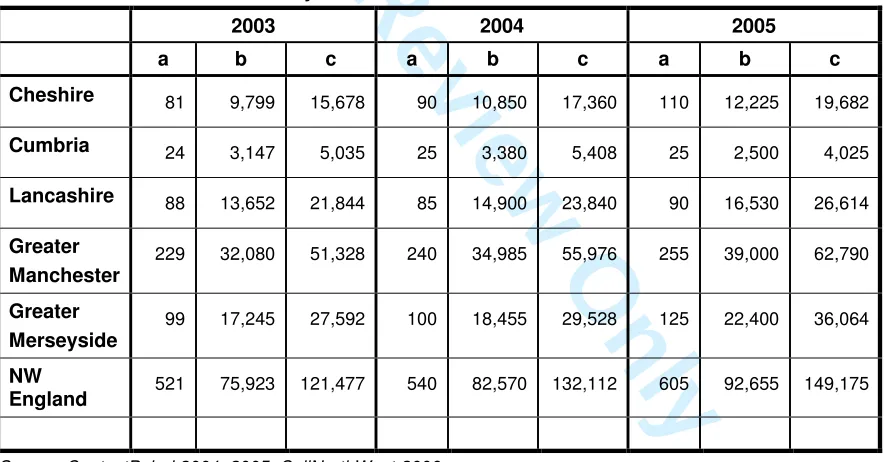
Significantly for the present study, this data shows that the NW Region is host to at least 540
contact centres operating with over 80,000 agent seats and providing over 132,000 jobs in
2003-4. The data also confirms the concentration of these contact centres within the major
conurbations of Greater Manchester, Merseyside and Central Lancashire where more than
fourth fifths of these businesses are located. ContactBabel data also appears to show strong
growth in employment in contact businesses during 2003-2004 (PECK and CABRAS, 2005).
Growth has occurred in both agent ‘seats’ and also in levels of employment even in the larger
conurbations in which one might anticipate higher levels of labour cost (Table 2).
Interestingly, the highest growth occurred in Cheshire, where contact centres and agent
positions both register a growth of over ten percent. Detailed examination of the location
patterns shows that these contact centres are predominantly located in urban settlements in
the north of the county where there is likely to be good access to labour from both
Manchester and Merseyside.
TABLE 2
One of the useful attributes of the ContactBabel dataset is that it enables disaggregation of
data across different product-markets. Previous research has indicated that expansion of
contact centres focused initially on the finance and insurance sector (MARSHALL AND
RICHARDSON, 1996; DATAMONITOR 1996, 2002; HENLEY CENTRE 1996) but these
technologies and forms of management were subsequently adopted much more widely
(RICHARDSON et al 2000). ContactBabel data (reported in Department for Trade and
For Peer Review Only
Industry 2004) suggests that across the UK as a whole 15 percent of all contact centre
employees are associated with financial services, 14 percent with retailing and distribution,
and 12 percent with motoring, transport and travel.
In order to investigate variations in the labour market experiences of contact centres in the
region, a questionnaire was designed to gather quantitative information on various measures
of ‘labour market stress’ experienced by managers. Four related measures of stress were
identified as follows; (a) the level of attrition in new recruits (percentage of new recruits who
leave within six months), (b) the levels of absenteeism, (c) the expressed degree of difficulty
in finding new recruits and (d) managers’ assessment of the quality of new recruits.
Questionnaires were posted or distributed via CallNorthWest networks to 361 businesses and
65 responses were obtained, a response rate of 18 percent2. As well as the various
measures of ‘labour market stress’, the questionnaire also gathered data on employment size,
market structure and labour characteristics of businesses and also managers’ evaluation of
their present location. Finally, the dataset was completed by adding a number of variables
designed to enable analysis of location. These included prominently various measures of
urban size (population, population density, total employment at the scale of unitary or district
authority). In the analysis, interest focused on the relative significance of business attributes
and locational characteristics as predictors of the level of labour market stress experienced by
contact centres.
CHARACTERISTIC OF SURVEYED CONTACT CENTRE BUSINESSES
The sectoral composition of the respondent establishments shown in Table 3 broadly reflects
the product-market specialisms that have been noted in previous studies of contact centres
(CONTACTBABEL, 2005). The three largest categories are the public sector (15), specialist
outsourcing businesses (12) and finance (10). The remainder are diverse covering different
service industries as well as manufacturing. Nearly a half of all respondents employ less that
50 workers but the larger contact centres tend to be over-represented in the finance sector
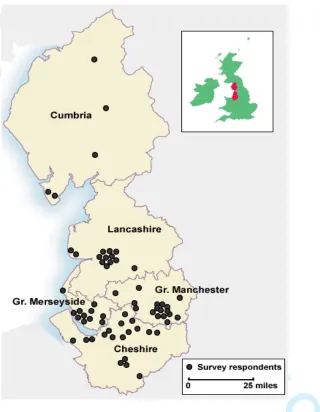
and in motoring organisations. The spatial distribution of respondent call centres illustrates
For Peer Review Only
the tendency for concentration in urban cores, but there is some dispersion in all five
sub-regions (Figure 1).
(TABLE 3; FIGURE 1)
The questionnaire provided data on the employment structure in surveyed contact centres.
Figure 2a indicates that around three quarters of contact centres have more female than male
employees. These data are consistent with patterns reported by RICHARDSON and
MARSHALL (1996) and by RICHARDSON et al (2000) in their study of the North East of
England, although they also suggest that this dependence on female workers ‘would decline
as more young men entered in the industry’ (p. 361). Even so, the evidence shows that
female workers are still predominant in many businesses and that ‘women’s labour power is
clearly central to the call centre industry’ (BELT et al, 2002).
Again Richardson, commenting a report from MITIAL (1998), suggested that contact centre
businesses were moving away from recruiting a predominantly part-time workforce to save
cost and promote flexibility” (p.362). Although we have no time series to measure change,
our survey findings show that a substantial number of contact centres employ very few
part-time workers, while others occupy different positions on the scale including a small minority
that operate almost entirely on part-time labour (figure 2b).
(FIGURE 2a; FIGURE 2b)
Managers were also asked to indicate the most important skills required from new recruits to
their operations. These skills were grouped into two broad categories that attempted to
distinguish between ‘routine’ skills (identified as communication skills, customer service skills,
telephone handling, and call control) and ‘higher level’ skills associated with handling
customer enquiries (questioning skills, listening skills, multilingual skills, management skills,
IT skills, and numeracy). The results appear to show that the majority of surveyed employers
are less concerned for these higher level skills; less than 20 percent of respondents
highlighted these as important to their recruitment operations. These findings appear to
For Peer Review Only
contradict those reported in a recent study conducted by the Learning Skills Council (LSC,
2003) which suggested that a skills mismatch exists in the contact centre industry. The
authors argue that a high percentage of employers experience a significant shortage of
‘high-calibre’ applicants and that there is a need for improved induction and training inputs provided
directly by the businesses. Much depends, however, on detailed definitions of terms such as
‘high level’ and ‘high calibre’. Also, a recent report for CallNorthWest (CABRAS, 2006) has
stressed the fact that the definition of ‘high’ and ‘low’ skill and the training inputs associated
with these will vary considerably for contact centres in different product-markets.
LABOUR MARKET CONDITIONS IN CONTACT CENTRE BUSINESSES
The data analysis focuses in particular on various measures of ‘labour market difficulty’ and
the factors that might cause this to vary between contact centres. Three key variables were
identified to try to capture different aspects of the labour market problems faced by
companies. Businesses tend to vary in the ways in which they customarily measure ‘rates of
attrition’ which can often lead to false comparisons. In order to standardise this, respondents
were asked to indicate in the past 12 months, what percentage of new employees have
resigned their post within six months of their appointment. Managers were also asked to
indicate (using likart scales) the level of difficulty experienced in recruiting new agents, the
degree of difficulty experienced due to absenteeism and their level of satisfaction with the
quality of new recruits. The distributions of responses to these questions are shown in figure
3. Most contact centres (65%) lose less than 10 percent of their new recruits within 6 months
but a significant minority have rates of attrition above this, including seven businesses that
currently lose over 20 percent of their new recruits (Fig 3a). Many managers also claim to be
experiencing high levels of absenteeism that impacts on performance (52%; Fig 3b).
Difficulty in finding new recruits (19%, Fig. 3c) is also a significant feature for some
respondents while some are also less than satisfied with the quality of new recruits (30%, Fig
3d). As might be expected, these various measures are also highly correlated with one
another (see Table 4), which suggests strongly that a significant number of contact centres
exhibit multiple forms of labour market difficulty.
For Peer Review Only
(FIGURE 3; TABLE 4)
DETERMINANTS OF LABOUR MARKET STRESS - BUSINESS CHARACTERISTICS
The close correlation between measures of labour market difficulty suggests that there may
be common characteristics of contact centres that experience greater problems in
recruitment. One may hypothesise that labour market difficulties may be correlated with a
number of variables. Larger contact centres, for instance, will have proportionally greater
demand for labour which may heighten recruitment difficulties compared to smaller contact
centres in similar sized labour markets. More tentatively, larger contact centres may also
appear more impersonal and less likely to generate staff loyalty, though it is also possible that
larger employers may develop more effective management processes to counteract this.
Contact centres that are in expanding markets may experience greater difficulties in recruiting
and retaining staff. Problems in recruitment and retention may also be linked to variations in
contractual terms for workers (part time as opposed to full time; use of fixed contracts), the
degree of knowledge and sophistication required in handing calls in different sectors and the
mix of in-bound to out-bound calls. These characteristics may influence retention in
particular, due to their influence on job interest and possibly on the level of autonomy given to
operators in handling enquiries.
The results demonstrate quite clearly that the size of contact centre is by far the best predictor
of attrition rates. Table 5 shows that the statistical relationship between rates of attrition and
size measured by numbers of agent positions is highly significant. Of the remaining variables,
none even approaches being linked to variation in attrition. This result seemed so clear cut
that tests were made on the sensitivity of these finding by repeating the analysis with different
size bands. Even when the largest contact centres are excluded from the analysis, this result
is still confirmed. The remaining negative findings are also, in themselves, quite interesting.
There is no association, for instance, between patterns of growth/decline and rates of attrition
as one might have expected due to the presumed impact of growth on demand for labour.
For Peer Review Only
Rates of attrition also seem to be uncorrelated with variations in part-time work, use of fixed
term contracts and the mix of inbound to outbound calls.
(TABLE 5)
Of the remaining measures of labour market stress, there were significant correlations
between levels of business growth and absenteeism, though the result shows a negative
correlation which suggests that, in general, absenteeism tends to be relatively low in contact
centres experiencing higher growth. One explanation for this result might be that high growth
increases levels of job security and may even create promotion opportunities for some staff,
thereby influencing staff morale and a more positive attitude to work. A slightly weaker
correlation also suggests that there are higher absentee rates in contact centres with high
proportions of part-time work. Results also indicate that managers’ evaluation of the level of
recruitment difficulty was significantly higher in contact centres experiencing rapid growth as
expected. Interestingly, however, the result for employment type suggests that managers in
contact centres with high proportions of part time posts have less recruitment difficulty
(though as noted above, more difficulty with absenteeism). Lastly, managers’ views on the
quality of new recruits do not seem to vary systematically with any of the observed
characteristics of contact centres.
Contact centres are also analysed by market sector. In order to carry out statistical
comparison, respondents were grouped into four categories as shown in Table 6. While there
are no statistically significant differences between these groups overall, the results do show
that contact centres in financial services within the survey have proportionally more
businesses with high rates of attrition (61 percent with rates above 20%). The counts are
small in these categories, but contact centres in finance tend to be the larger ones and this is
consistent with the strong correlation between attrition and size of contact centre noted
above.
(TABLE 6)
For Peer Review Only
DETERMINANTS OF LABOUR MARKET STRESS: LOCATIONAL CHARACTERISTICS
While the analysis appears to show that levels of labour market difficulty are correlated with
size and growth characteristics of businesses, the methodology also involves examination of
the association with location. Using sub-regions as categories, Table 7 shows that there are
differences in the responses of managers in different areas. In particular, levels of difficulty
are generally higher in the larger urban cores (Manchester and Liverpool) compared to other
areas. In order to refine this analysis, measures of labour market difficulty are tested against
urban size as measured by total employment and population by local authority district/ unitary
authority. The results confirm that managers’ recruitment difficulties as well as rates of pay
for agents and supervisors are positively correlated with employment size (Table 8). These
findings are consistent with the hypothesis that agglomeration tends in induce greater
difficulty in recruitment and wage pressures. Admittedly, the correlations between total jobs in
local authority areas and rates of attrition and levels of absenteeism are much weaker, but the
coefficients are positive in both cases. Also, the association between urban size and
managers’ assessments of the quality of recruits generates a negative correlation. Viewing
this evidence as a whole, there does appear to be a fairly consistent difference in these
various measures of labour market experience and urban size.
(TABLE 7; TABLE 8)
These results raise the question whether these systematic variations between large and small
labour markets simply reflect the fact that large contact centres tend to be in the larger labour
markets. To explore this further, the analysis in table eight was repeated on subsets of the
data in different size bands. The results were broadly unchanged. In particular, there were
still positive associations between urban size and recruitment difficulties as well as agent pay
within different size categories. This would seem to suggest that there is a systematic
difference in labour market experience by urban size and that these statistical differences are
not simply a consequence of variations in business size structure across the urban hierarchy.
For Peer Review Only
Given these findings, it is relevant to ask whether these apparent agglomeration
diseconomies have generated pressures for relocation either within the region towards the
lower cost / low attrition locations in the north-west region or elsewhere. Only thirteen
respondents (20%) indicated that some consideration had been given to relocation within the
past 12 months. Of these, the majority (8) involved possible moves within the NW region;
another two had examined locations in the Midlands and only three overseas. The replies
concerning moves within the region also did not appear to involve any systematic
decentralisation away from the urban cores. Businesses that had considered relocation can
be found in all sub-regions and not just in the large urban centres. At least four businesses
had considered new premises within Greater Manchester while only two had looked at
movement into Lancashire and none had considered sites in Cumbria. The fact that the
majority of potential movers seem to be considering locations in close proximity to their
present location seems to suggest that it is not labour market push factors that are inducing
this, but rather may have more to do with growth and premises considerations. Figure 4,
indeed, shows that most potential movers are currently occupying premises that have been
converted to their use.
(FIGURE 4) CONCLUSIONS
The evidence presented in this paper tends to confirm findings from other recent research
concerning the locational preferences of businesses that operate contact centres within the
UK. Location patterns within NW England show a strong preference for larger metropolitan
areas “either within city centres or at the near peripheries of cities” (BRISTOW et al 2000,
p.530). Confirmation of this pattern suggests that, at least at sub-national scale, the
availability of ICT infrastructure has not led to the spread of contact centres throughout the
urban hierarchy and that labour availability, in particular, continues to constrain location to a
choice between locations within (or accessible to) the most densely populated areas
(BISHOP et al 2003).
For Peer Review Only
The more significant finding from this research, however, concerns the impact of these
locational preferences on the operations of contact centres. Our results show that the
continued preference for metropolitan areas within the NW Region is marked by high levels of
labour market difficulty as measured in particular by labour turnover and recruitment
problems. Measures of urban size in general have been shown to be much more strongly
correlated with recruitment difficulties compared to most business characteristics. The
exception relates to size of business which is strongly correlated with rate of attrition.
However, many of the larger contact centres are more dependent on large labour catchments
and may have less flexibility in terms of location at the sub-regional scale in the UK in order to
ensure continued supply of labour. These results provide evidence to suggest that
businesses that operate contact centres are prepared to absorb the costs of concentration (in
terms of higher wages and high labour turnover) in order to reduce the risk of labour shortage.
In spite of high levels of attrition in many cases, relatively few contact centre managers
reported plans to relocate on the basis of labour availability or cost. There is further
investigation required into these location patterns and the agglomerative forces that appear to
be holding customer contact activities in relatively high labour cost locations. The significance
of customised premises may be a subject of useful enquiry in investigating intra-urban
relocation patterns and the development of contact centres within urban peripheries.
However, interest should also surround the linkage effects upon contact centres that might tie
them to particular agglomerations in order to access workers with knowledge in particular
market segments, as implied in the work of SCHULZ et al (2004) and LIEFOOGHE (2005).
Contact centre operations will obviously vary in levels of skill requirements and the extent of
product knowledge. In some operations, prior knowledge may be of little significance and in
these circumstances training inputs may be minimal and locational choice may be fairly
broad, including options for offshoring to low cost labour locations. In contrast, other contact
centre operations may require greater levels of product knowledge and the types of enquiries
may place greater demands on operators to respond flexibly to information and implement
decisions.
For Peer Review Only
Relatively little attention has been given to the possible variations in locational requirements
between contact centres involving different types of product-markets and the institutional and
functional linkages that might exist between contact centres and other operations within the
same firm and also linked firms. This raises the possibility of future research on the process
by which outsourcing of business services occurs and the role of dedicated contact centres
within local service clusters (BENNEWORTH 2002; DANIELS 2004; KARLSSON 2004).
There is the question whether companies with a long-standing presence in a region may be
less inclined to relocate call centre functions abroad. These institutional differences may also
affect the potential for alternative employment and redeployment in instances where
offshoring does occur. The growth of contact centres in the public sector is also a relatively
new aspect of contact centre development. It is likely, for instance, that the processes
involved in setting up contact centres for public services may be influenced to a greater extent
by regional development benefits in providing employment in relatively remote industrial
towns and cities within peripheral economies.
REFERENCES
BELT V., RICHARDSON R., and WEBSTER J. (2002) Women, social skills and interactive
service work in telephone call centres, New Technology, Work and Employment17 (1), 20-34
BENNEWORTH P. (2002) Creating new industries and service clusters on Tyneside Local
Economy 17(4), 313-327
BISHOP P., GRIPAIOS P., and BRISTOW G. (2003) Determinants of call centre location:
some evidence for UK urban areas Urban Studies40(13), 2751-2768
BRISTOW G., MUNDAY M., AND GRIPAIOS, P. (2000) Call centre growth and location:
corporate strategy and the spatial division of labour Environmental and Planning A32(3), 519-538
For Peer Review Only
CABRAS I. (2006) Contact centres and Incapacity Benefit Claimants: new possibilities for
occupational development, Research Report to CallNorthWest, University of Central
Lancashire, Preston
CONTACTBABEL (2005) Call Centre in the North West- Baseline Research Report to
CallNorthWest, University of Central Lancashire, Preston
DANIELS P. W. (2004) Reflections on the Old Economy, New Economy and Services,
Growth and Change, 35(2), 115-138
DATAMONITOR (1996), Call Centres in Europe 1996-2001, Datamonitor, London
DATAMONITOR (2002), Call Centres Industry Profile: United Kingdom, Datamonitor, London
DEPARTMENT OF TRADE AND INDUSTRY (2004) The UK Contact Centre Industry: A
Study. Report by CM Insight, ContactBabel, and The Call and Contact Centre Association
(CCA) on behalf of the UK Department of Trade and Industry, London.
HENLEY CENTRE (1996), Teleculture Futures: Harnessing Telecommunications to meet
Customer Needs for the 21st Century, Henley Centre, London
KARLSSON C (1999) Spatial industrial dynamics in Sweden: urban growth industries, Growth
and Change, 30(2), 184-212
LEARNING AND SKILLS COUNCIL (2003) National Employers Skills Survey 2003, London.
LIEFOOGHE C. (2005) Services: the future of industry. From coalmining and textile industries
to environmental services and distant selling in the Nord-Pas-de-Calais region –France,
Regions 259, 13-16
For Peer Review Only
MARSHALL J.N. and RICHARDSON R. (1996) The impact of ‘telemediated’ services on
corporate structures: the example of ‘branchless’ retail banking in Britain Environment and
Planning A28, 1843-1858.
MITIAL (1998) Call Centre Location Study. Mitial Industrial Market Research, Wrexham.
NATIONAL STATISTICS (2005) Annual Population Survey, Official Labour Market Statistics,
London
OMIS (2005) Best Locations for Contact Centres 2004-2005 - 3rd Edition UK Survey. OMIS
Research, Banbury.
PECK F. and CABRAS I. (2005) 'Regional Economic Policy and the Contact Centre Industry
in the North West Region'. 28th National Conference of the Institute for Small Business &
Entrepreneurship, Blackpool, 1-3 November 2005
RICHARDSON R. and BELT V. (2001) Saved by the bell? Call centres and economic
development in less favoured regions, Economics and Industrial Democracy22, 67-98.
RICHARDSON R., BELT. V. and MARSHALL N. (2000) Taking calls to Newcastle: the
regional implications of the growth in call centres, Regional Studies, 34(4), 357-369 RICHARDSON R. and MARSHALL J. N. (1996) The growth of telephone call centres in
peripheral areas of Britain: evidence from Tyne and Wear, Area28(3), 308-17.
RICHARDSON R. and MARSHALL J. N. (1999) Teleservices, Call Centre and Urban and
Regional Development, The Service Industries Journal, 19(1), 96-116.
For Peer Review Only
SCHULZ C., DÖRRENBÄCHER P., LIEFOOGHE C. (2004) Far away, so close? Regional
clustering of mail order firms and related business services in the Lille metropolitan Area of
France, University of Birmingham, School of Geography, Earth and Environmental Sciences,
Working Papers in Services, Space, Society, No. 14
For Peer Review Only
Table 1. Contact centres and agent positions in UK
Contact Centres in UK Agent Positions 1995 2,515 n/a 143.9 n/a
1996 2,740 9% 169.8 18%
1997 3,070 12% 203.8 20%
1998 3,470 13% 264.9 30%
1999 3,990 15% 331.2 25%
2000 4,470 12% 387.5 17%
2001 4,825 8% 430.1 11%
2002 5,065 5% 460.2 7%
2003 5,320 5% 494.3 7%
2004 5,535 4% 538.7 9%
2005 5,700 3% 581.8 8%
2006 5,845 3% 616.7 6%
2007 5,980 2% 647.6 5%
Source: collation of analysis and data from Gartner Dataquest, Datamonitor and ContactBabel and reported by DTI (2004)
Table 2: Contact centres industry in the NW between 2003 and 2005
2003 2004 2005 a b c a b c a b c Cheshire 81 9,799 15,678 90 10,850 17,360 110 12,225 19,682 Cumbria 24 3,147 5,035 25 3,380 5,408 25 2,500 4,025 Lancashire 88 13,652 21,844 85 14,900 23,840 90 16,530 26,614 Greater
Manchester
229 32,080 51,328 240 34,985 55,976 255 39,000 62,790
Greater Merseyside
99 17,245 27,592 100 18,455 29,528 125 22,400 36,064
NW
England 521 75,923 121,477 540 82,570 132,112 605 92,655 149,175
Source: ContactBabel 2004, 2005; CallNorthWest 2006. a: Number of contact centres
b: Agent positions
c: Total number of staff employed in contact centres.
For Peer Review Only
Table 3. Sectoral and size distribution of respondent contact centres Sector
10-50 51-150 151-250 251-500 >500 a b Total Finance 3 4 1 1 1 16% 15% 10 Public Sector 6 6 2 0 1 7% 23% 15
Outsourcing Services 7 4 1 0 0 15% 18% 12
Printing/Publishing 2 2 0 1 0 3% 8% 5
IT 1 1 2 0 0 8% 6% 4
Motoring/Finance 0 0 1 1 0 2% 3% 2 Other services1 5 1 2 0 0 17% 13% 8 Manufacturing 5 0 0 0 0 12% 8% 5
Entertainment 2 0 0 0 0 4% 3% 2
Retail/Distribution 1 1 0 0 0 15% 3% 2
Total 31 19 9 3 2 65
Source: Survey data, ContactBabel 2005
a: Percentage in NW Region.
b: Percentage of survey respondents.
1 Including Transport and travel, food and drink, education
For Peer Review Only
Table 4: Relationships between measures of labour market difficulty
Absenteeism Recruitment
difficulties Quality of new recruits Six month attrition Pearson
Correlation .354(**) .357(**) -.320 (*) Spearman‘s
Rho
.394(**) .396(**) -.328(**)
n. of obs. 65 64 63
Absenteeism Pearson
Correlation .140 -.288(*)
Spearman‘s
Rho .139 -.280(*)
n. of obs. 64 63
Recruitment
difficulties Pearson Correlation -.613 (**)
Spearman‘s Rho
-.588(**)
n. of obs. 62
** Correlation is significant at the 0.01 level (2-tailed). Source: Survey Data
* Correlation is significant at the 0.05 level (2-tailed).
For Peer Review Only
Table 5: Association between labour market stress and contact centre characteristics
Business
Expect. Contract Part-time Fixed-term Contract Inbound Calls Size CC Age Six months
Attrition Pearson Correlation -.089 .036 -.038 .030 .502(**) -.045
Spearman‘s
Rho -.002 .108 -0.66 .020 .494(**) .062
n. of obs. 65 63 59 64 64 65
Absenteeism Pearson
Correlation -.246(*) .211 .001 .034 .113 .221
Spearman‘s
Rho -.243(*) .264(*) .022 .065 .152 .172
n. of obs. 65 63 59 64 64 65
Recruitment
Difficulties Pearson Correlation .257(*) -.285(*) .189 -.168 .173 .094
Spearman‘s
Rho .287(*) -.247(*) .096 -.171 .217 .059
n. of obs. 64 62 58 63 64 64
Quality of
new recruits Pearson Correlation -.032 .066 -.038 .215 -.190 -.114
Spearman‘s
Rho -.083 .057 -0.42 .302 -.194 -.060
n. of obs. 63 63 59 63 62 63
** Correlation is significant at the 0.01 level (2-tailed). Source: Survey Data
* Correlation is significant at the 0.05 level (2-tailed).
For Peer Review Only
Table 6. Six months attrition levels in contact centres by economic sector Six months attrition
<20% >20% Total
11 4 15
Public Sector
73.3% 26.7% 100%
5 8 13
Finance
38.5% 61.5% 100%
12 5 17
Telemarketing/Outsourcing Services
70.6% 29.4 100%
14 6 20
Other Services
70.0% 30.0% 100%
42 23 65
Total
68.3% 21.7% 100%
For Peer Review Only
Table 7: Variations in levels of recruitment difficulty by sub-region Recruitment difficulties
No
Difficulties Difficulties Medium Difficulties High Total
1 9 7 17
Greater Manchester
5.9% 52.9% 41.2% 100.0%
8 9 1 18
Cheshire and Warrington
44.4% 50.0% 5.6% 100.0%
3 5 3 11
Liverpool
27.3% 45.5% 27.3% 100.0%
7 5 1 13
Lancashire
53.8% 38.5% 7.7% 100.0%
5 0 0 5
Cumbria
100.0% .0% .0% 100.0%
24 28 12 6
Total
37.5% 43.8% 18.8% 100.0%
Source: Survey data 3
For Peer Review Only
Table 8. Association between labour market characteristics and urban size
Total Jobs Population
Pearson Correlation .231 .121
Spearman’s Rho .227 .081
Six month attrition
n. obs. 65 65
Pearson Correlation .333(**) .312(*) Spearman’s Rho .364(**) .301(*) Recruitment difficulties
n. obs. 64 64
Pearson Correlation .180 .244(*)
Spearman’s Rho .243 .293(*)
Absenteeism
n. obs. 65 65
Pearson Correlation -.078 -.107
Spearman’s Rho -.163 -.194
Quality of new recruits
n. obs. 63 63
Pearson Correlation .313(*) .164
Spearman’s Rho .311(*) .092
Agent salary level
n. obs. 65 65
Pearson Correlation .266(*) .182
Spearman’s Rho .388(**) .124
Supervisor salary level
n. obs. 63 63
** Correlation is significant at the 0.01 level (2-tailed). Source: Survey Data
* Correlation is significant at the 0.05 level (2-tailed).
For Peer Review Only
Figure 1: Distribution of call centre survey respondents
For Peer Review Only
Figure 2. Employment structure of respondent call centres
For Peer Review Only
Figure 3: Measures of labour market stress for call centre respondents
For Peer Review Only
Figure 4: Relocation considerations by type of premises
For Peer Review Only
1 Research reported in this paper was supported financially by CallNorthWest (CNW), an initiative funded by the
North-West Development Agency. CNW is hosted by the University of Central Lancashire in Preston and provides support for contact centre managers through provision of education and training, recruitment and retention services and general business support. The authors are grateful for support, advice and access to information on the contact centre industry in the NW region. An earlier version of the paper was presented to the Regional Studies Association International Conference “Shaping EU Regional Policy: Economic, social and political pressures” Leuven, Belgium, 8th-9th June 2006. Valuable feedback was received from three anonymous referees and the Regional Studies
editorial team.
2 The method for survey work depended on just one mailing due to conditions imposed by CallNorthWest on
confidentiality of company data. This restricted the ability to chase non-respondents to boost the rate of return. The response rate of 18 percent reflects these constraints.