233 | P a g e
CULTURE BASED PRODUCT DESIGN
RoshanRohit
1, Prof.MihirPandey
2, UpendraTripathi
31,2,3
Department of Mechanical Engineering, J.N.C.T. Engineering College, Rewa, (India)
ABSTRACT
This research discusses how products utilize culture codes in order to establish their cultural characteristics
and achieve product differentiation. From relevant theories and literature, we have determined the items for
analysis, analyzed the cultural model space of products, the locations of the usage of culture codes in products,
and discussed their internal aspect, middle (behavioral) aspect, and external (appearance) aspect based on
where a product is located This research project examines the construction of cultural based model,
architectural model and models evolved from various historic and linguistic analysis of product design for
India. The project discusses about various zones of India based on cultural, architecture, customs, traditions,
rituals etc in a region and to translate these factor for designing of a product. There is little in-depth research
that can assist designers to use culture as a catalyst for designing innovative product within Botswana’s context.
The designer of this product has utilized the above-mentioned affect codes, identification codes, style codes, and
transmission codes to create an entirely new image of alcoholic products.
Key words: culture codes, product design, Socio-cultural factors, culture-orientated product design,
Botswana
I. INTRODUCTION
There is a lack of in-depth research and appropriate methods to assist designers on how culture can be consciously integrated in product design Such a framework is required and needs to go beyond the consideration of the surface manifestations of culture that have been widely accepted in design methodologies and it must address how the core components of culture can be embedded in designing products. This challenges designers to gain a deeper understanding of users’ culture but embodying of cultural factors in new products development
is not a straight forward subject and it is still an under researched area .
Culture is the foundation on which designers unleash their creativity, and a design that lacks culture is just like a tree without its roots. The word “culture”has a rather broad meaning in contemporary science.
234 | P a g e
Fig.1-Product Model
Culture is not just about individuals; it can include attitude in terms of creativity, education, or living (Cheng-NengKuan ,1998). Culture includes all types of explicit or implicit behaviors, and it is learned or passed on through the use of signs (Kroeber, A.L.). Culture is a set of codes that are shared by people to guide individual behaviors or to achieve group acceptance. Culture allows people to share a set of codes and allows people who use different codes to form different groups (Chen&Starosta, 1998).
“Codes” have the implications of “deciphering”and“interpretation”(Yu-Fu Yang, 1998). “Codes”refer to the “rules”in the coding system (Hung-Bo Li, 2003) and are composed of signs and common practice(John Fiske). “Communication”does not only rely on a single sign but also its combination rules and how it is interpreted by
people in a certain group. As all communication tools are placed in a single cultural system, we call these tools the “code system”. McDermott (1997) believes that future designs need to return to the humanistic and aesthetic perspectives, and technology cannot be used to lead design as it is just a supplementary tool. Future designs would be an integration of art, culture, and science in order to solve the problems of society and readjust our lifestyle. In the 21st century, where there is a focus on digital technologies, it is more important to have designs
that are based on “humanity” and expressed through “culture”; this leads to the so-called “cultural creativity design”(Lin et al.,2005).
235 | P a g e
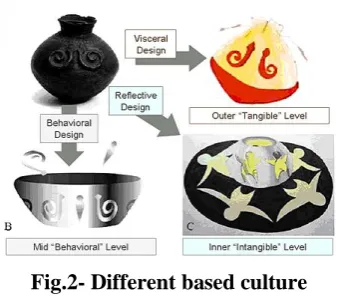
Fig.2- Different based culture
“Culture codes”are the result of analyzing culture through a generalized semiology. The results include all the
rules and features of all forms of expression other than language. The culture codes in design especially focus on the meaning and stories behind signs
In this study, we mainly discuss how to utilize culture codes to establish cultural characteristics and achieve product differentiation Association are the focus of our study. Viewing themselves as the “culture promoters of Shin-Yi Township,”Shin-Yi Hsiang Farmers’Association is actively involved in the development of plum products. They have also utilized many local cultural elements in product design, achieving great popularity among consumers. Consumption is no longer just an economic behavior but a differentiated form of code consumption. How to use culture codes to express one’s features has
become an important topic.
II. CULTURAL MODEL AND ORIENTATION OF PRODUCTS:
“Cultural identification”is aimed at creating cultural qualities in a product to achieve differentiation, and the
point is to understand and utilize a culture that is relevant to the product and to give the product an appropriate cultural presentation so it will have certain meanings among its users. The development of “product culture model”proposed by Ming-Chyuan Ho et al. contains three axes: time, space, and cultural differences. Considering market characteristics, product orientation can either be “creating new culture ”or“ conforming to existing culture”which lead to 12 different kinds of product culture patterns
236 | P a g e
The establishment of this product’s cultural pattern helps clarifying the meaning of the product; this not only satisfies the commercialized and socialized product demand but also helps designers find the appropriate cultural strategies and models for their products. Moreover, we can understand a product’s cultural background through its maker, designer, and user
III. THE CHARACTERISTICS OF THE DESIGN OF CULTURAL PRODUCTS:-
The framework of cultural product design proposed by Leong (2003) is shown as the inverted triangle in this that contains external, middle, and inner cultural spaces. Based on this framework,.added the design factorsthat should be considered in product design, which is “the design attribute of cultural products”. In other words, they include (1) external or shape-related aspects –including color, texture, and shape; (2) middle or behavioral aspects –including functions, usage, and convenience; (3) inner or psychological aspects: including special meanings,
These elements are described in fig 4 (A) (B)
Fig 4 (A) The design attribute of cultural products
237 | P a g e
IV. CONCEPT OF PRODUCT SEMANTICS
Looking at the theories proposed by semiologists such as Pierce and Saussure, the “codes” are defined by the former as a media-induced transmission that starts from nothing, and all the perspectives and results arejust a way for codes to be interpreted. The latter defined codes in terms of “signifiers” and “signified,”and pointed out that it is not just a physical manifestation but also a psychological experience or impression that turn codes into meaningful entities. Nevertheless, both of them have stated that the function of codes is to express meanings. Moreover, based on Pierce’s research, Morris proposed that the function of codes are rooted in “surface features,”“evaluation,”and“conditions/orders”; he divided codes into the three aspects of patterns, semantics, and usage.codes are generated from certain images, words, and rules. By looking at the evolution of images, they can be divided into: the items that images represent (patterns), how images are interpreted (semantics), and how images are used (usage). The relationships between these components are expressed
Fig.5 The interaction among patterns, semantics and usage.
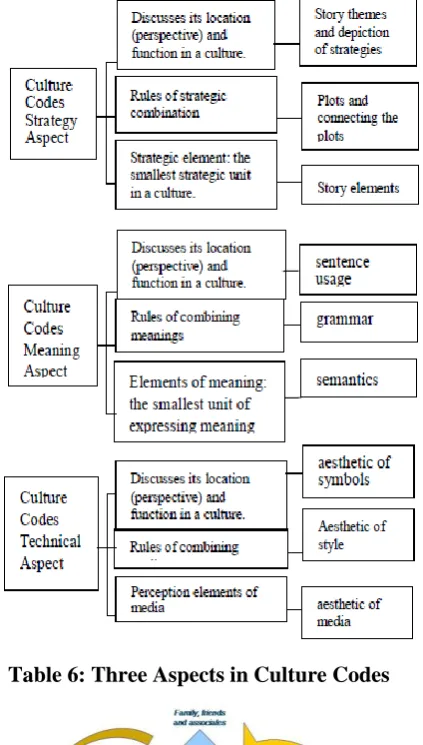
V. ASPECTS IN CULTURE CODES
238 | P a g e
Table 6: Three Aspects in Culture Codes
Fig 6 : Three Aspects in Culture Codes
VI. CODES
239 | P a g e
determines the characteristics of signs. He also divided codes into functional codes, affect codes, and transmission codes to correspond with It is of great importance to understand existing cultural values of the organization before any effective adaption or customization of quality practices is possible (Naor et al. 2008; Zu et al. 2010). Further, parallels have been drawn between organizational culture and operations management where Nahm et al. (2004) claim that people’s beliefs indirectly influences existing practices and therefore also
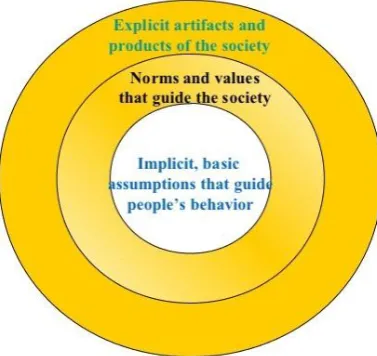
manufacturing performance These are easily observable, but as an outsider you will only understand how
organization behaves but you rarely can understand the underlying logic of why it behaves the way it does, and therefore it is hard to analyze an organizational culture only based on this level. On the second level of organizational culture, there are the cultural values of the organization. Values are communicative and people of anorganization are aware of these, such as company philosophy, norms and justifications. On the third level of organizational culture, one can find the basic assumptions. These assumptions are lying so deep that the involved people cannot imagine what the alternative would be. It can therefore be hard to observe and ask straight questions about these assumptions, since people might not even understand the question. Liker and Hoseus (2008) discuss that it is not necessary for people to think in exactly the same way, but it is important that there are shared core values and that everyone agrees about how to carry out work.
Fig.7-cultured codes in diff.model
VII. ANALYSIS OF CULTURE CODES
This study is aimed at discussing how products utilize culture codes in order to establish their cultural characteristics and achieve productdifferentiation. The findings are compiled based on theories discussed earlier: 1. Product culture models have the three axes of time, space, and cultural variations that form 12 spaces, which determine the locations where culture codes are used in products. Each space can be further divided in order for us to analyze whether a product is a new culture produced by a user, corporate culture, or a designer
240 | P a g e
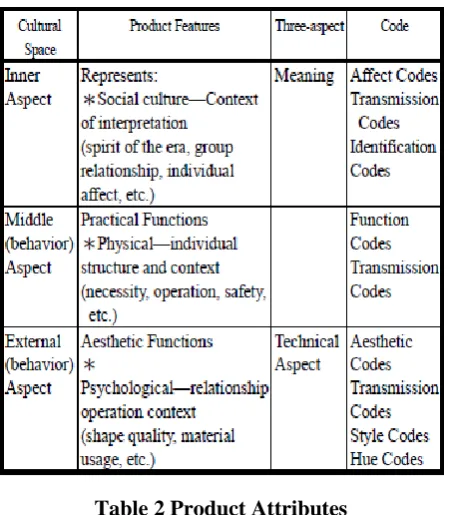
making reference to the “three aspects of culture codes”in Table 1 and “codes in different domains”in Table 2, we can make the following initial summary:
Table 2 Product Attributes
Within the organization there will exist different subcultures. An organizational culture is the articulated culture for the whole company, and even though it is meant to be equal all over the business it most likely differs between different departments and units (Liker & Hoseus 2008). Schein (1984) argues that if an organization has a structure with functional, divisional or geographical subgroups, the organization will exist of multiple cultures.
VIII. STRUCTURE OF THE UNIT AND ITS QUALITY MANAGEMENT
241 | P a g e
Fig.8-Simplified structure of the unit
During the last years, there has been a venture to implement Lean production at Hilti including the plant and unit under study. The initial projects were focused on logistical flow and the introduction of Kanban cards. Quality management was not considered within the scope of Lean at that time. A new course of action, which is called Lean@Hilti, has recentlybeen initiated. It is controlled by a centralized business unit which works
explicitly
to
develop the core values and strategy for implementation and execution. The practical implementation is however performed together with Lean experts at each plant. The four steps in this practical implementation are 1) disturbance-free, 2) flow, 3) rhythm and 4) pull, which can be seen in the Hilti Lean house displayed in Figure 8. The Lean expert in P1 is in charge of the actual Lean projects that are carried out at the plant and is the one who plan and lead the execution of the four steps. According to the Lean expert it is important to have stable processes when implementing Lean and therefore quality management can be seen as a tool of Leanand242 | P a g e
One way of working with continuous improvement at the plant is by using so called CIP (Continuous Improvement Project), which is part of the Lean@Hilti initiative. They are used to gradually improve the work within the unit. There are different ways of performing a CIP, the one most widely used at the unit is the Speedy Quality Circle (SQC), see Figure 9. The CIPs let all employees be part of the development, and the scope of the projects are of various sizes. When a problem has been detected, an action group is formed, which then works together to solve the issue. The detected problems in the plant can be brought up by both operators and coaches. Since the CIP is part of the centralized Lean initiative, they are all arranged according to a Hilti standard, with defined project steps. Notice boards in the production show the status of these CIP’s, illustrating the progress of
the projects.
243 | P a g e
IX. CONCLUSION
The aim of this study was basically to tie up the links between culture and objects. This was tried to be done through investigating the culture that is shaping the objects; and also looking at the clusters of artifacts that could be said to be forming a material culture to be read to reveal the hints of the invisible background forces represented by these objection evidence.
REFERENCE
[1]. Adorno, Theodor and Max Horkheimer. 1989. “The Culture Industry:Enlightenment as Mass Deception.” Dialectic Of Enlightenment. London: Verso.
[2]. “Culture Industry Reconsidered.” in The Culture Industry: Selected Essays on Mass Culture.London: Routledge.
[3]. Crocombe, R. (1983). The south pacific: An introduction. Auckland:Longman Paul. Fincham, R and Rhodes, P S (1994) The individual work and organisation:behavioural studies for business and management Oxford University Press, Oxford
[4]. Healy, R. G. (1994). Tourist merchandise as a means of generating local benefitsfrom ecotourism, Journal of Sustainable Tourism, 2(3), 137-151.
[5]. Hofstede, G (2001) Culture’s consequences: comparing values, behaviors,institutions, and organizations across nations Sage Publications, Thousand Oaks
[6]. Maggie Asplet& Malcolm Cooper (2000). Cultural designs in New Zealand souvenirclothing: the question of authenticity, Tourism Management 21, 307-312.
[7]. Mariano Ramirez Jr. & Robert Zehner (2009). Cultural patterns in product design ideas: comparisons between Australian and Iranian student concepts, DesignStudies 30(4), 438-460
[8]. Press, M and Cooper, R (2003) The design experience: the role of design anddesigners in the twenty-first century Ashgate, Aldershot