INTERNATIONAL RESEARCH JOURNAL OF PHARMACY
www.irjponline.com
ISSN 2230 – 8407
Research Article
INTENTIONS AND PERCEPTIONS OF IRAQI PHARMACY STUDENTS TOWARD
POSTGRADUATE EDUCATION
Fadia Thamir Ahmed *, Sara Asaad Kadhim, Fatima Zuhair Ali
College of Pharmacy, University of Baghdad, Baghdad, Iraq
*Corresponding Author Email: [email protected]Article Received on: 25/08/18 Approved for publication: 24/09/18
DOI: 10.7897/2230-8407.099195
ABSTRACT
Background: An evolving need for highly qualified pharmacists is encountered recently in pharmacy practice; as a result, an increasing number of pharmacists considered a postgraduate study to improve their careers. Objectives: to identify the pharmacy students’ intentions and perceptions toward postgraduate study and the factors influencing their decision. Methods: A questionnaire was answered by final year pharmacy students’ in the College of Pharmacy/ University of Baghdad. Numbers and percent used to measure the frequency of responses and a 5-point Likert scale were used to assess factors influencing students’ preferences. Results: out of 182 students, about 84.1% intended to join the residency program in Iraq, a small percentage wanted to pursue postgraduate study directly post-graduation (4.95% in Iraq vs. 2.75% abroad). After the residency program, most students intended to pursue postgraduate studies in Iraq (62.1%) vs. (9.9%) abroad; a considerable percent (28%) decided not to pursue further study. Funding was mostly influencing students’ intentions to study. University grades were a determinant in choosing higher education over residency program. The 3 most preferable areas of specialization were clinical pharmacy, pharmacology and quality control of drugs, in order to get a better job opportunity. Conclusions: pharmacy students had the intentions to pursue postgraduate studies in Iraq but after completing their residency program. Getting married is the main obstacle against studying abroad. Unaffordable cost was the most influencing factor against studying directly after graduation. The most effective motive for pursuing postgraduate study was to get better job opportunities.
Keywords: postgraduate study, intentions, pharmacy students.
INTRODUCTION
Pharmacy plus other medical professions are the main fundaments in the health care system all over the world. Its primary responsibility is to deliver safe, effective and proper use of medicines1.
In the recent age of pharmacy practice, there is an evolving need for highly qualified pharmacists and, as a result, an increasing number of pharmacists may consider postgraduate study as a way to improve their careers2. In spite of this fact, in many countries,
only a small percentage of graduated pharmacists decide to start their postgraduate study directly after their graduation3-6. Many
studies have discussed the postgraduate studies for pharmacy graduates. From them, a survey performed in 2011 in the United Kingdom found that only about 2% of pharmacy graduates of the 2010 academic year started a full-time postgraduate study4.
Another study revealed that about (92.7%) of students at 14 British schools of pharmacy intended to pursue their first-year practical training immediately after their graduation since it is a prerequisite to be registered as a pharmacist in Britain5.
In addition, another study surveyed pharmacy graduates from different universities in Australia (who completed their pre-registration training in 2004 and were registered by 2005), which was performed by the Graduate Careers Council of Australia, found that only 3.6% of graduates were starting a full-time study, and 8.4% were starting part-time study6.
The decreased number of pharmacy graduates intending to pursue further study in these countries is attributed to the fact that postgraduate qualification is not a requirement to practice as a pharmacist; thus, taking a postgraduate degree may not be
beneficial when applying for jobs within the pharmacy profession7,8.
Depending on various factors, Pharmacy students are making their future choices in professional career. Most importantly their socio-economic status and the type of health care systems all over the world9. Also, pharmacy students’ undergraduate curriculum
and their experiences in the final year of their graduate study can be an impact on their decisions10.
Furthermore, the pharmacy graduate’s decision not to begin postgraduate study may also be attributed to their exhaustion after years of graduate education7,8.
Considering that at the undergraduate level, it is a multi-norm decision making issue and it is a critical and concerned situation in a student’s professional life11.
Many factors should be considered to increase the likelihood of pharmacy students pursuing graduate school, among them is increasing salaries, decreasing the time necessary to complete graduate study, and encouragement by faculty and staff members12.
This has led to an unplanned increase in the total number of pharmacies graduates each year from few hundreds to more than 2000 graduates between 2003 and 2018.In addition, many Iraqis go abroad to study in foreign countries and come back home with a pharmacy degree. As a result, the number of pharmacists registered in the Syndicate of Iraqi Pharmacists has increased from about 7000 to more than 20000 from 2003 to 2018. Iraq is one of the countries in which the number of registered pharmacists is higher than that recommended by the World Health Organization (WHO) (a pharmacist to population ratio of 1:2000).
This obvious increase in pharmacy graduates has led to increasing competition in work environment that eventually encourage more graduates to consider pursuing higher studies in order to get better job opportunities.But the decision of undertaking further studies is not taken directly after graduation but at least two years after. This is mainly because, in Iraq, governmental employment as residency program (which should be immediately after graduation) will be lost if the graduates choose to pursue higher studies. So that leaves only the private sector as a job opportunity for pharmacists who start their postgraduate studies directly after graduation.
Against this background, it is an important decision for pharmacy students to choose a career path in the academic pharmacy profession. The aim of this study is to identify the pharmacy students’ interests in the postgraduate study by investigating their perception of career choice, their intentions after graduation and the factors that influence their decision.
MATERIALS AND METHODS Study design
A pilot study included a questionnaire according to literature13. It
was designed to inquest students’ career and further study intentions after graduation, the area of postgraduate study they prefer, the place where to pursue postgraduate study either in their home country or abroad, the relationship their future career plans intentions and the factors that affect their decisions13. Also,
demographic data were also gathered, including gender, age, year of study and marital status. The questionnaire consisted of multiple-choice and Likert-scale items.
The questionnaire was distributed (in English) to the final (5th)
year pharmacy students in the College of Pharmacy/University of Baghdad for the academic year 2017/2018 between February and April/2018. The student that completed and returned the questionnaire was considered as a participant. Students who did not complete or return the questionnaire were considered as non-respondents.
Ethics
All the students included in this study are of age (older than 18), and they express voluntary consent to participation when they returned the questionnaire. There were no personal identifiers during the administration and collection of the questionnaire to preclude any personal identification.
Statistics
The Statistical Package for the Social Sciences version 20 (SPSS v. 20) software was used to save and analyze the data. A 5-point Likert scale ranging from very low importance (1) to very high importance (5) was used to assess factors that influenced students’ postgraduate intentions, students’ preference of academic over residency program, students’ preference regarding the place to pursue postgraduate study and students’ preference regarding postgraduate study area, also used to assess the potential impact of studying in Iraq or abroad. Numbers and percents were used to measure the frequency of responses (categorical data).
RESULTS
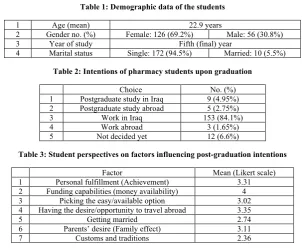
A total of 182 students completed the questionnaire (out of 200) with overall response rate 91%. Most respondents (126, 69.2%) were females and the majority of them (176, 96.7%) aged between 22 and 24 years with a mean age of 22.9 years. Only a small percent of them were married (5.5%) (Table 1).
When looking at the results regarding the intentions of pharmacy students directly after graduation, the majority of the students (84.1%) reported that they intend to stay in Iraq and begin work directly after graduation (governmental employment in the Iraqi Ministry of Health residency program); while a small percentage planned to travel abroad for work (1.65%). Only a few students wanted to start postgraduate study directly after graduation (4.95% in Iraq and 2.75% abroad), and the remaining (6.6%) were not decided yet (Table 2).
When investigating the factors that influence students’ postgraduate intentions, it was found that funding capability is in the first place (mean: 4), followed by having the desire/opportunity to travel abroad (mean: 3.35) as the most influential factors, then comes personal fulfillment, parents’ desire, picking easy and available option, getting married, and finally, customs and traditions (mean: 3.31, 3.11, 3.02, 2.74 and 2.36 respectively). The order of the factors influencing students’ decisions ordered according to the mean value of response according to Likert scale (Table 3).
While the factors that influence their choices to pursue postgraduate studies or to join Ministry of Health residency program (governmental employment), were (ranked according to mean value of Likert scale) student’s university grades (mean: 3.44), better job opportunities (mean: 3.3), picking the easy/available option (mean: 3.22) and finally scientific issues (mean: 3) (Table 4).
Table 1: Demographic data of the students
1 Age (mean) 22.9 years
2 Gender no. (%) Female: 126 (69.2%) Male: 56 (30.8%) 3 Year of study Fifth (final) year
4 Marital status Single: 172 (94.5%) Married: 10 (5.5%)
Table 2: Intentions of pharmacy students upon graduation
Choice No. (%)
1 Postgraduate study in Iraq 9 (4.95%) 2 Postgraduate study abroad 5 (2.75%)
3 Work in Iraq 153 (84.1%)
4 Work abroad 3 (1.65%)
5 Not decided yet 12 (6.6%)
Table 3: Student perspectives on factors influencing post-graduation intentions
Factor Mean (Likert scale) 1 Personal fulfillment (Achievement) 3.31 2 Funding capabilities (money availability) 4 3 Picking the easy/available option 3.02 4 Having the desire/opportunity to travel abroad 3.35
5 Getting married 2.74
6 Parents’ desire (Family effect) 3.11
7 Customs and traditions 2.36
Table 4: Factors influencing students’ decisions to choose between academic programs and residency program
Factor Mean (Likert scale)
1 Scientific issues 3
2 Better job opportunities 3.3 3 Student’s university grades 3.44 4 Picking the easy/available option 3.22
Table 5: Intentions of pharmacy students regarding the place to pursue postgraduate study after completing the residency program
Choice No. (%)
1 Postgraduate study in Iraq 113 (62.1%) 2 Postgraduate study abroad 18 (9.9%) 3 Did not want to pursue further study 51(28%)
Table 6: Factors influencing students’ decisions regarding where to pursue postgraduate study
Factor Mean (Likert scale) 1 Funding capabilities 3.74
2 Getting married 3.75
3 Customs and traditions 2.24
4 Parents’ desire 2.74
Table 7: The potential impact of getting a postgraduate degree in Iraq or abroad on future career
Factor Mean (Likert scale) 1 Improved theoretical knowledge 2.55 2 Improved practical experience 3.31
3 Better income 3.5
Table 8: Students’ preferred areas of postgraduate specialization
postgraduate specialization No. (%) 1 Biochemistry and laboratory diagnosis 6 (3.3%) 2 Pharmaceutics and pharmaceutical industry 11 (6%)
3 Clinical pharmacy 56 (30.8%)
4 Pharmacognosy and medicinal herbs 16 (8.8%)
5 Biotechnology 9 (4.9%)
6 Pharmacology and toxicology 48 (26.4%) 7 Quality control of drugs 24 (13.2%) 8 Analytical and food chemistry 10 (5.5%)
Table 9: Factors influencing students’ decisions regarding areas of postgraduate study
Factor Mean (Likert scale)
1 Scientific issues 3.48
2 Better job opportunities 3.99
3 University grades 3.57
4 Picking the easy/available option 3.11
Most students stated that getting a postgraduate degree either in Iraq or abroad would have a good impact on their career in the future; this includes (ordered according to the mean value of response, Likert scale) better income(mean:3.5), improved practical experience (mean:3.31) and improved theoretical knowledge (mean:2.55) (Table 7).
The results concerning the pharmaceutical fields of postgraduate study that the students preferred showed that the first 3 most-preferred areas of study were the clinical pharmacy (30.8%), pharmacology and toxicology (26.4%) and quality control of drugs (13.2%). The remaining areas were preferred by fewer percentages (less than 10%) of the students (Table 8).
While the most important factors influencing the students’ choice of postgraduate specialization (ordered according to the mean value of response, Likert scale) were to get better job opportunities from the students’ perspectives (mean:3.99), university grades (mean:3.57), scientific issues (mean:3.48) and finally opportunity ease and availability (mean:3.11) (Table 9).
DISCUSSION
This cross-sectional study investigated the perceptions and future intentions regarding postgraduate studies for the final (5th) year
pharmacy students in the College of Pharmacy/ University of Baghdad. The selection of final year students as a sample for this study was because they are just a few months away from graduating and about to start their career soon, so at this stage, their main concern is to decide what to do in their future career.
The study sample consisted of (182) students in which the majority were females (126) while the males were (56) with percents of 69.2% and 30.8% (for females and males respectively). Several studies investigated the pharmacy student population in the past ten years have showed that the percentages of female students are higher (about 66%) than male students in The United States14,15. Also, another study that was done in
Britain revealed that the number of female pharmacists was twice the number of male pharmacists registered in 200516.
Regarding the students’ age, their mean age was 22.9 years which is younger than final year pharmacy students in other countries. When examining the results of a study that conducted in France, the mean age of final year pharmacy students was 25.1 years17.
The reason behind this difference is that in Iraq the students join the pharmacy college after graduating from high school (at age 18 years) directly.
The results of this study showed that most students (84.1%) intended to work Iraq (Ministry of Health employment) directly after graduation, while a small percentage intended to pursue further studies either in Iraq or abroad, or to work abroad (4.95%, 2.75%, and 1.65% respectively). Similar results obtained by several studies conducted in many other countries, like Britain4,5,
Australia6, and the United States3, in which most students prefer
to work immediately after graduation. This outcome of our study is mainly because the governmental employment in Iraq can be joined only after graduation as a residency program and they will lose this chance if they decided to start postgraduate studies. In addition, one of the requirements in order to join a postgraduate study in Iraq is the completion of at least two years residency program for the health care professionals including pharmacists.
That is why most students prefer to complete their residency before starting their postgraduate studies.
A considerable percent (6.6%) of students were not decided what to do after graduation despite the fact that they have only a few months to graduate, this may be because they consider this decision as the main determinant of their future career and they feel that it cannot be taken that easily. This issue can be seen in several studies, one of them was done in the United Kingdom in which there were a high percentage of students (43%) who have not reached their final decision about their future career despite the fact that they were in their third year of the 4-year MPharm degree course18.
When looking at the factors influencing students’ decisions upon graduation, it’s obvious that funding capability is the main factor from the students’ perspectives, followed by their desire to study and personal fulfillment. Other factors have less impact on the students’ decisions, where we can see that getting married and customs and traditions are the least effective factors despite the fact that in our society, social factors have a large impact on people attitudes and decisions. Relatively similar results were obtained from a study done in the United States, in which it was found that job satisfaction and self-fulfillment were the most influencing factors as percept by pharmacy students to choose their future work19. While another Malaysian study indicated that
the 3 factors with the highest impact on the final year pharmacy students’ decisions of their career were salary, benefits, and geographical location20.
While the factors that affect their choices to start postgraduate studies or to join Ministry of Health residency program (governmental employment), were student’s university grades as the main factor since the postgraduate studies in Iraq (MSc) requires the student’s university grades to be at least 65% to be able to apply.
When surveying the students’ future intentions to pursue postgraduate studies (after completing their residency program), most of them preferred to pursue further study in Iraq (62.1%) versus (9.9%) of students wanted to complete their postgraduate studies abroad. A considerable percentage of students (28%) decided not to get a postgraduate degree; this can be attributed to the exhaustion of the students from undergraduate study.
Looking at the factors that influence their choices regarding the place of study, getting married was the most influential factor from the students’ perspectives followed by funding capabilities. This is mainly because getting married will make it more difficult to live and settle in a new country. Also, funding capabilities have a large impact that may be an obstacle in the way of students whom desire is to study abroad because they cannot afford the costs of the postgraduate study. However, this issue may be different for graduates of private universities who used to pay $7,000 as annual tuition fees. Similar outcomes were obtained by a study conducted in Australia, in which they found that the costs of postgraduate study programs had a major impact on the pharmacy students’ decisions21.
be seen in a study done by Gagnon and Cocolas in which the career opportunities were the most effective motivation for pharmacy students to pursue postgraduate study, followed by intellectual satisfaction, and more challenging work22. These
results can be explained by the fact that in Iraq, the governmental employment pay a relatively lower salaries when compared to the widespread private pharmacy schools which are in high demands for highly qualified academic members with master and doctoral degrees to be in their teaching staff, so this led the new pharmacists to seek the opportunities to get a higher education degree in order to be qualified to join the private pharmacy teaching sector and get benefit from the excellent salaries they pay.
When investigating the results for the most preferred specialization of postgraduate study, clinical pharmacy is in first place which was preferred by about one third of the students (30.8%), followed by pharmacology and toxicology which was selected by about a quarter of the students (26.4%) then comes the quality control of drugs (13.2%), while other areas were selected by small percent of students (less than 10% for each). This is not the case in other countries, for example, in a study conducted in Syria, the first three areas of postgraduate study were biochemistry and laboratory diagnosis, pharmaceutics and the pharmaceutical industry and finally clinical pharmacy13.
The selection of clinical pharmacy by a large number of students can be attributed to the fact that they are interested in usable applicable scientific information that they can earn when specialized in clinical pharmacy. The same can be said for the area of pharmacology and toxicology in addition to the increasing needs of newly opened private pharmacy colleges to this specialization. The reason why a considerable percent of students preferred the quality control of drugs is that in the recent years the Iraqi market witnessed a considerable amount of cheated medications that had negative impacts on the patients and their confidence as customers in the pharmacists. This motivated the students and gave them the sense of responsibility to make the change in the future.
Concerning the factors influencing the students, choice regarding the area of postgraduate study, the majority of students stated that better job opportunity is the most important factor, which is compatible with what mentioned earlier about the impact of completing a postgraduate study as revealed by the students.
In Iraq, the limited numbers of universities that provide postgraduate degrees (4 colleges only, excluding Kurdistan region) which does not exceed 11% of the total number of pharmacy colleges, have led to a small percent of pharmacists that can have the opportunities to pursue further studies. In order to benefit from the relatively high productivity of the newly graduate pharmacists, to recruit them to the research field and academia, to keep going with increasing number of pharmacy graduates and to create a good percents of highly qualified pharmacists that would have a potential impact on the development of pharmacy field scientifically, the universities and authorized people are requested to increase the resources for the available postgraduate study programs, upgrade their quality, increase their admission capacity and establish a new programs in further universities.
CONCLUSION
Overall pharmacy students had the intentions to pursue postgraduate studies in Iraq but mainly after completing their residency program in order not to lose the governmental employment. Getting married and the difficulty to settle with family is the main obstacle against studying abroad. The unaffordable cost was the most influencing factor against further
studies directly after graduation. The most effective motive for pursuing postgraduate study was to get a better job opportunity.
REFERENCES
1. Anderson S. The state of the world's pharmacy: a portrait of the pharmacy profession. J Interprof Care. 2002 Nov;
16(4):391-404. https://doi.org/10.1080/135618202100
0008337
2. International Pharmaceutical Federation (FIP) [Internet]. Global Pharmacy Workforce Report. 2009. [Cited 2009 Sep 2]. Available from: https://www.fip.org/files/fip/ publications/2009_FIP_Global_Pharmacy_Workforce_Repo rt.pdf. Accessed Feb 2018.
3. American Association of Colleges of Pharmacy [Internet]. Academic pharmacy's vital statistics 2018. [Cited 2018 July 1]. Available from: https://www.aacp.org/article/academic-pharmacys-vital-statistics. Accessed Feb 2018.
4. Higher Education Statistics Agency (HESA) [Internet]. Destinations of Leavers from Higher Education (DLHE).
2017. [Cited 2017 June 29] Available from:
https://www.hesa.ac.uk/news/29-06-2017/sfr245-destinations-of-leavers. Accessed Feb 2018.
5. Willis S, Shann P, Hassell K. Graduate destinations – choices made about preregistration training. Pharm J. 2006 Aug 5; 277(7412): 164-165.
6. Graduate Careers Council of Australia [Internet]. Pharmacy post registration destination survey. [Cited 2005 July 1] Available from: http://www.pharm.monash.edu.au/news /postregistration-report2005.pdf. Accessed Feb 2018. 7. Hagemeier NE, Murawski MM. Economic analysis of
earning a PhD degree after completion of a PharmD degree. Am J Pharm Educ. 2011 Feb 10; 75(1):15. https://doi.org /10.5688/ajpe75115
8. Gerald MC. Recruitment of pharmacy students into graduate programs in the pharmaceutical sciences-nature of recruiting activities and perceptions of their success. Am J Pharm Educ. 1988 Mar 1; 52(1):16-23.
9. Capstick S, Green JA, Beresford R. Choosing a course of study and career in pharmacy—student attitudes and intentions across three years at a New Zealand School of Pharmacy. Pharmacy Education. 2007 Dec; 7: 359–373. https://doi.org/10.1080/15602210701673811
10. Caroline Willis S, Shann P, Hassell K. Pharmacy career deciding: making choice a "good fit". J Health Organ Manag. 2009 Mar 20; 23(1):85-102. https://doi.org/10.1108/ 14777260910942579
11. Rajiah K, Saravanan C. The effectiveness of psycho education and systematic desensitization to reduce test anxiety among first-year pharmacy students. Am J Pharm Educ. 2014 Nov 15; 78(9):163. https://doi.org/10.5688/ ajpe789163
12. Hagemeier NE, Newton GD. Pharmacy students' motivational beliefs regarding pursuance of graduate school after completion of the PharmD program. Curr Pharm Teach Learn. 2010 Mar 1;2(2):79-93. https://doi.org/10.1016/ j.cptl.2010.01.006
13. El-Hammadi M. Syrian pharmacy students' intentions and attitudes toward postgraduate education. Am J Pharm Educ. 2012 Oct 12; 76(8):147. https://doi.org/10.5688/ajpe768147 14. Taylor DA, Patton JM. The pharmacy student population:
applications received 2007-08, degrees conferred 2007-08, fall 2008 enrollments. Am J Pharm Educ. 2009 Dec 17; 73(Suppl):S2. https://doi.org/10.5688/aj7303S02
16. Hassell K, Eden M. Workforce update - joiners, leavers, and practicing and non-practicing pharmacists on the 2006 register. Pharm J. 2006 Nov 11; 276:40-42.
17. Perraudin C, Brion F, Bourdon O, Pelletier-Fleury N. The future of pharmaceutical care in France: a survey of final-year pharmacy students' opinions. BMC Clin Pharmacol. 2011 May 25; 11(1):6. https://doi.org/10.1186/1472-6904-11-6 18. Silverthorne J, Price G, Hanning L, Scanlan J, Cantrill J.
Factors that influence the career choices of pharmacy undergraduates. Pharmacy Education. 2003 Sep; 3(3):161-167. https://doi.org/10.1080/15602210310001623124 19. Besier JL, Jang R. Factors affecting practice-area choices by
pharmacy students in the Midwest. Am J Hosp Pharm. 1992 Mar; 49(3):598-602.
20. Hasan SS, Kwai Chong DW, Ahmadi K, Se WP, Hassali MA, Hata EM, et al. Influences on Malaysian pharmacy students'
career preferences. Am J Pharm Educ. 2010 Nov 10; 74(9):166. https://doi.org/10.5688/aj7409166
21. Davey A, Evans AM, Stupans I. Pharmacy: Factors that influence the choice of career and study options. Pharmacy Education. 2006 Mar; 6(1):21-26. https://doi.org/10.1080/ 15602210500523381
22. Gagnon JP, Cocolas GH. Understanding What Motivates Someone to Pursue Pharmacy Graduate Education. Am J Pharm Educ. 1988; 52(1):10-15.
Cite this article as:
Fadia Thamir Ahmed et al. Intentions and perceptions of Iraqi pharmacy students toward postgraduate education. Int. Res. J. Pharm. 2018;9(9):99-104 http://dx.doi.org/10.7897/2230-8407.099195
Source of support: Nil, Conflict of interest: None Declared