HUMAN PSYCHOMOTOR ANALYSIS USING GAIT
IDENTIFICATION
D.Sudha
1, Dr.M.Pushpa Rani
21
Research Scholar,
2Prof. & Head, Dept. of Computer Science,
Mother Teresa Women’s University, Kodaikanal (India)
ABSTRACT
Emotions are articulated through multiple physiological characteristics. Gait is one of the human psychological
characteristics, which is deeply affected by the emotions. Gait is a style of walking which performed on every
moment. Naturally gait can be affected by emotions on a meticulous circumstance. Gait can be obtained by
cameras on real time. There is various researches are available on this consent. The emotional intelligence is
very much influenced the gait. This paper presents the related study which is involved in the emotional
identification through gait which was dealt by different researches. A comparative study is done by this study
about the existing researches.
Keywords Emotions, Gait, Comparative, Intelligence
I. INTRODUCTION
Emotions are articulated through multiple physiological characteristics. Gait is one of the human psychological
characteristics, which is deeply affected by the emotions. Gait is a style walking which performed on every
moment. Naturally gait can be affected by emotions on a meticulous circumstance. Gait can be obtained by
cameras on real time. There is various researches are available on this consent. The emotional intelligence is
very much influenced the gait. This paper presents the related study which is involved in the emotional
identification through gait which was dealt by different researches, and it covers the ideas behind those
researches. There are different methodologies involved on those studies that will be described clearly. A
comparative study is done by this study about the existing researches.
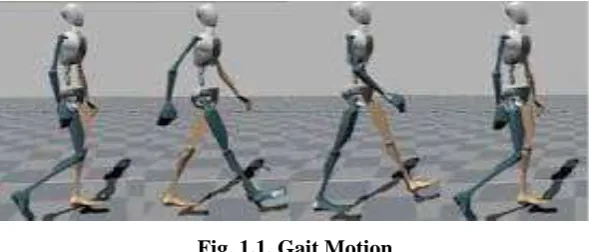
Fig. 1.1. Gait Motion
II. REVIEW OF RELATED WORKS
Gentiane Venture [1], discussed about the emotion characterization of human by their gait. The Vicon motion
capture system is used to capture the gait signals by using 41 marker set. There are 4 persons were involved in
index was found for each emotion and compared. At last this study proved the emotion characterization of each
sample gait signals.
Destephe [2] studied about the emotional intensity on happiness and sadness on walking. The cortex motion
capture system was used to capture the gait motions. The parameters used in this study were step height, step
length, stride length, stride phase, stance phase, cadence and velocity. The 2 samples were involved in this study.
To analyze the behaviors an evolution of the low emotive intensity to the high emotive intensity was calculated
and the intensity values were compared.
Masahiro TOBA, Kazuki INOVE [3], developed a stress analyzer to analyze a person’s stress level through the
speed of walking. They evolve this study by involving the teachers when they were close to their teaching job.
They have measured their walking speed before and after commitment of their class teaching. They found the
decreasing of speed after their teaching. And they clearly stated that the increasing stress level automatically
decrease the speed of walk.
Saša Radovanović, Milica Jovičić, Nadja P. Marić,Vladimir Kostić [4], discussed about the alteration in motor
and cognitive functioning of the depressed patients. They have explored the gait parameters and variability of
patients with major depressive disorder in dual task walking situations. Eight patients with 20 health controls
performed motor, mental and combined motor + mental task while walking.
The parameters used by them are cycle tie, stride length, swing tie, double support time and their coefficients of
variation
(CV). To analyze the differentiations between the patients and controls like age, gender and years ofeducation, the t-test, Fisher’s exact test and Mann-Whitney U test are used. The pair wise comparisons are
made, such as: base vs. mental, base vs. motor, motor vs. mental and mental vs. combined task performance.
The association between severity of depression and gait parameters were analyzed using Pearson correlation
coefficient. Hence the gait variability is having differences while involved in dual task.
Thus the study proved the gait characteristics are affected by the emotions. They suggested that, it is possible to
make use of the tool in differential diagnosis of psychiatric and neurological disorders based on gait pattern, as
well as monitoring response to therapy.
Ritta Baddoura and Gentiane Venture[5] discussed about the human motion characteristics in relation to feeling
of common or anxious during a make known short interface with a proactive humanoid. They proved that,
Emotions have a certain impact on body travels and attitude of the person who is experience them. This effect is
reflected in both interior physiological transform and outside physical expressions (Frijda 1986).
As per the above authors’ research, the experiment involves a triad: a robot and 2 participants (X and Y) at a
time. The participants are only invited to answer a questionnaire (in their own language to avoid ambiguity) on
the perception of robots. They are informed that the set is filmed and the IMU (Inertial Measurement Unit) are
used for each participant and placed around their head and wrist for motion capture. They do not know about the
robot’s intervention. The only instruction given to them is to answer a questionnaire. The experiment’s scenario
was validated by the ethical committee. To identify the motion characteristics the Principal component Analysis
(PCA) is used. Hence they proved that certain body movements and gestures can be closely associated to
affective states and that the arm and head motions of a human interacting with a humanoid partner are strongly
S.
No.
Author Year System Dataset Targeted
Emotions
No. of
Samples
Computational Methods
1 Gentiane
Venture
2010 Vicon
Motion
Capture
System
41 – Marker set in a
human body
Neutral attitude,
joy, anger and
sadness
4- 2 M, 2
F
Found the Similarity Index
2 Matthieu
Destephe July 2013 Cortex Motion Capture System Parameter Measurements(Step
height, Step Length,
Stride length, stride
phase, stance phase,
Cadence and velocity,
425 data records
Happiness,
sadness, anger
and fear
1 M, 1
F-2 Nos.
Behavior analysis
An evolution from the low
emotive intensity to the high emotive
intensity or a stagnation of the
characteristics.
Comparing the percentage value and different intensities of
walking
3 Masahiro
TOBA, Kazuki INOVE June 2011 Commercia l video Camera(CC TV)
Video capturing system Mental stress 376
persons
Calculating the speed of the walk
4 Sesa, Milica 2014 GaitRite
mat
Depressive
symptoms-rated using Hamilton
Rating Scale for
Depression(HAMD),
Depression 20
controlled subjects and uncontroll ed subjects
Temporal spatial gait
parameters acquired- cycle time, step
length, single and double support
time and variability of those
parameters.
Coefficient variability is calculated
rmANOVA has been used
5 Ritta Baddoura,
Gentiane
Venture
2014 Inertial
Measureme nt Units (IMU) sensors are placed around their head and wrist Motion intensity frequency and smoothness were calculated Fear and anticipation 40 subjects, humanoid
Frequency analysis – FF
Angular velocity
motion smoothness
Correlation coefficients
between pairs of variables were
calculated
6. Shigeru
Kuriyama, Yoshimi Kurihara, Yusuke irino and Toyohsia Kaneka
2002 Human
model
Pattern generator - - Geometrical model of a
human was generated
7 Tianxiang
Zhang (P), and
Gentiane
Venture (P)
2011 Optical
motion
capture-
Vicon
system
41 marker set – 20
motions are obtained
Neutral attitude,
joy, anger and
sadness
4 samples Feature vector with
angular information
PCA
Emotions cluster
calculated from least square method
8 Melanie
B.Cluss,
Elizabeth
A.Crane,
M.Melissa
Gross and
Barbara
L.Fredrickson
2001 6 Video
Cameras
Questionnaire, A 5-item
Likert scale
Neutral, joy,
Anger, Sad,
Content, Pride,
Fear, Surprise,
Disgust, None.
26 Under
Graduate
Students
(15 – F,
11 – M)
Coordinated data filtered
at 6 Hz
Gait parameters were calculated using Visual 3D
software.Linear Model Pair-wise comparisons by Tukey’s Honest
Signif icant Difference test.
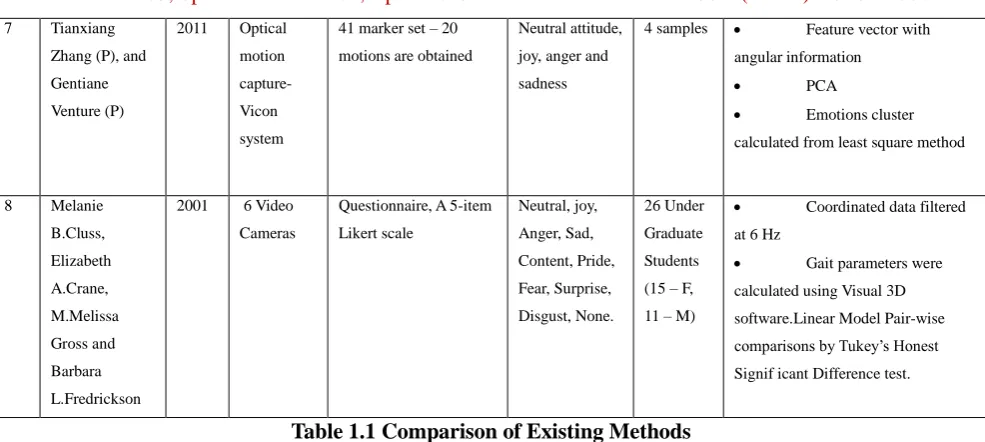
Table 1.1 Comparison of Existing Methods
Shigeru Kuriyama,Yoshimi Kurihara,Yusuke Irino and Toyohisa Kaneko [6] proposes a control methodology for
human gait with a pattern generator. The pattern generator generates cyclic signals via a couple of mutually
inhibited neurons, and drives a proportional derivative controller that supplies joint angles of a virtual human.
The state of the pattern generator is entrained by the signal of the controller, and such mutual feedback stabilizes
the generation of rhythmic signals for variable conditions. Legs and arms can automatically synchronize their
periodical movements without using a central supervisor because the corresponding neural oscillators mutually
feed their output signals. Their system generates various gaits in a common mechanism with a small number of
parameters, which is well suited for real-time, interactive and on-the-fly controls. Moreover, the movements
obtained from motion capture data can be controlled by introducing adjustable non-linear filters.
In order to extract a set of features describing the body of a person that performs an action, a geometrical
configuration of human body must be considered. Since the aim of the research is to increase robustness of
gesture classification by embedding human body configuration information in our data analysis loop while
keeping real-time performance, an ellipsoid model of human body has been adopted. In spite of this fairly
simple approximation compared with more complex human body models.
Tianxiang Zhang (P), and Gentiane Venture (P) [7] have justified that there is a possibility of recognizing the
emotions from gait data. Nearly 4 candidates have been involved in this study. The gait data was collected from
the Vicon - optical motion capture system using 41 marker set. They used a systematic method based on the 3D
position of the passive optical reflective marker. For each candidate, 34 degrees of freedom (DOF) model has
been used. Based on the PCA results the algorithm based on cluster analysis was developed that systematically
recognize the emotions. They proved that the possibility of emotions recognition with a mean rate of 80%.
Melanie B.Cluss, Elizabeth A.Crane, M.Melissa Gross and Barbara L.Fredrickson [8] suggested that the
emotion identification by gait data by using 25 under graduate students, and their emotions were identified by
the questionnaire with a 5-item likert scale. Their gait was observed by the observers and identified their
emotions. The features were coordinated and it was filtered at 6 Hz and the gait parameters were calculated
using Visual 3D software. Stride length and velocity were normalized by body height. A general linear model
was fitted using PROC GLM in SAS to determine the effects of emotion and gender on the dependent variables.
III. CONCLUSION
Thus the above metaphors show the awareness about the emotional identifications on gait motions. There is a
possibility to evolve the emotions through one’s gait posture. The gait signals were received on the pre defined
environment like floor sensor or wearable sensor systems, and statistical approaches were used to classify the
captured features. Too many approaches were adopted like creating a similarity index, geometrical models
creation, frequency analysis and angular velocity. The targeted emotions in the above studies are Neutral, Anger,
Sad, Surprise and Disgust. All studies have been proved the possibility of emotional identification on gait in
various performances.
REFERENCES
[1]. Gentiane Venture (2013), “Human Characterization and Emotion Characterization from Gait”, 32nd
Annual International Conference of the IEEE EMBS, Buenos Aires, Argentina, August 31 - September 4,
2010
[2]. Matthieu Destephe (2013), “The influences of emotional intensity for happiness and sadness on walking”,
35th Annual International Conference of the IEEE EMBS, Osaka, Japan, 3 - 7 July, 2013
[3]. Masahiro TOBA, Kazuki INOVE (2011), “Evolution of Human Distress by Ones Walking Speed- Towards
the Development of Early Warning System for Marine Pilots”, Proc. of the 2011 6th International
Conference on System of Systems Engineering, Albuquerque, New Mexico, USA - June 27-30,2011
[4]. Sesa, Milica (2014), “Gait characteristics in patients with major depression performing cognitive and
motor tasks while walking”, http://dx.doi.org/10.1016/j.psychres.2014.02.001
[5]. Ritta Baddoura, Gentiane Venture (2014), “Human motion characteristics in relation to feeling familiar or
frightened during an announced short interaction with a proactive humanoid”, Frontier in Neuroscience.
[6]. Shigeru Kuriyama, Yoshimi Kurihara, Yusuke irino and Toyohsia Kaneka (2002), “Physiological gait
controls with a neural pattern generator”, The Journal of visualization and Computer Animation, J. Visual.
Comput. Animat. 2002; 13: 107–119 (DOI: 10.1002/vis.284).
[7]. Tianxiang Zhang (P), and Gentiane Venture (P) (2011), “Emotion Recognition from Walk Pattern”, The
21st Annual Conference of the Japanese Neural Network Society (December, 2011).
[8]. A.Crane, M.Melissa Gross and Barbara L.Fredrickson (2001), “Effect of Emotion on the Kinematics of