University of Pennsylvania
ScholarlyCommons
Publicly Accessible Penn Dissertations
Fall 12-22-2010
Learning [Voice]
Joshua Ian Tauberer
University of Pennsylvania, [email protected]
Follow this and additional works at:
http://repository.upenn.edu/edissertations
Part of the
First and Second Language Acquisition Commons
Please see my home page, http://razor.occams.info, for the data files and scripts that make this reproducible research.
Recommended Citation
Tauberer, Joshua Ian, "Learning [Voice]" (2010).Publicly Accessible Penn Dissertations. 288.
Learning [Voice]
Abstract
The [voice] distinction between homorganic stops and fricatives is made by a number of acoustic correlates including voicing, segment duration, and preceding vowel duration. The present work looks at [voice] from a number of multidimensional perspectives.
This dissertation's focus is a corpus study of the phonetic realization of [voice] in two English-learning infants aged 1;1--3;5. While preceding vowel duration has been studied before in infants, the other correlates of post-vocalic voicing investigated here --- preceding F1, consonant duration, and closure voicing intensity --- had not been measured before in infant speech. The study makes empirical contributions regarding the development of the production of [voice] in infants, not just from a surface-level perspective but also with implications for the phonetics-phonology interface in the adult and developing linguistic systems. Additionally, several methodological contributions will be made in the use of large sized corpora and data modeling techniques.
The study revealed that even in infants, F1 at the midpoint of a vowel preceding a voiced consonant was lower by roughly 50 Hz compared to a vowel before a voiceless consonant, which is in line with the effect found in adults. But while the effect has been considered most likely to be a physiological and nonlinguistic
phenomenon in adults, it actually appeared to be correlated in the wrong direction with other aspects of [voice] here, casting doubt on a physiological explanation. Some of the consonant pairs had statistically significant differences in duration and closure voicing. Additionally, a preceding vowel duration difference was found and as well a preliminary indication of a developmental trend that suggests the preceding vowel
duration difference is being learned.
The phonetics of adult speech is also considered. Results are presented from a dialectal corpus study of North American English and a lab speech experiment which clarifies the relationship between preceding vowel duration and flapping and the relationship between [voice] and F1 in preceding vowels. Fluent adult speech is also described and machine learning algorithms are applied to learning the [voice] distinction using
multidimensional acoustic input plus some lexical knowledge.
Degree Type
Dissertation
Degree Name
Doctor of Philosophy (PhD)
Graduate Group
Linguistics
First Advisor
Jiahong Yuan
Second Advisor
Mark Liberman
Third Advisor
Daniel Swingley
Keywords
acoustic phonetics, language acquisition, phonological features, voice
Subject Categories
First and Second Language Acquisition
Comments
LEARNING [VOICE]
Joshua Ian Tauberer
A DISSERTATION
in
Linguistics
Presented to the Faculties of the University of Pennsylvania in Partial Fulfillment of the Requirements for the Degree of Doctor of Philosophy
2010
Jiahong Yuan
Assistant Professor, Department of Linguistics
Supervisor of Dissertation
Gene Buckley
Associate Professor, Department of Linguistics
Graduate Group Chair
Mark Liberman, Trustee Professor of Phonetics, Department of Linguistics Committee Member
Daniel Swingley, Associate Professor, Department of Psychology
— ‘Tricky Linguistics’, A Bit of Fry and Laurie (1989) —
Hugh: So let’s talk instead about flexibility of language, uh, linguistic elasticity if you like. Stephen: Yes, I think that I said earlier that I said that our language English—
Hugh: As spoken by us.
Stephen: As we speak it, yes, certainly. —defines it. We are defined by our language, if you will. Hugh: (to the audience) Hello, we’re talking about language.
Stephen: Perhaps I can illustrate my point. Let me at least try. Here’s a question. Hugh: What is it?
Stephen: Ah. Well my question is this: Is our language, English, capable, is English capable of sustaining demagoguery?
Hugh: Demagoguery? Stephen: Demagoguery.
Hugh: And by demagoguery you mean . . . ? Stephen: By demagoguery I mean demagoguery. Hugh: I thought so.
. . .
Acknowledgements
A dissertation is not just a degree or the culmination of years of effort. If you look close enough you will probably see rings for the many seasons that have come and gone, representing the deeply emotional states it went through — I went through — with among other things a confusing and protracted transformation in self-image from student to professional. Let me start at the beginning. I sincerely thank my advisor, Professor Jiahong Yuan, for his direction and encouragement. Stumbling out of syntax and into phonetics in my third year, things could have taken a more terrible turn, but Jiahong brings everyone quickly up to speed to the latest in acoustic and corpus phonetics. I also thank the remainder of my committee, Professors Mark Liberman, whose insights never cease to amaze, and Daniel Swingley, for valuable feedback. I’d also like to thank Professor Gene Buckley for serving on my proposal committee and Professors Tony Kroch, Charles Yang, and Maribel Romero for their unique ways they influenced my thinking and keeping me in the game. And I’d like to thank Amy Forsyth, our department’s administrative coordinator.
The last six+ years would not have been the same without my cohort, Laia Mayol, Lucas Cham-pollion, Keelan Evanini, Jonathan Gress-Wright, and Jean-François Mondon. I have fond memories of studying in the GSC and burgers at New Deck, at least until New Deck got old. Oh and I espe-cially note — and once again apologize for — the incident referred to in Mayol (2009, acknowledg-ments). I greatly enjoyed collaborating with Keelan on Tauberer and Evanini (2009), a portion of which made its way into this thesis. The p.lab and its many furniture arrangements would not have been the same without my friends and classmates Giang Nguyen (who suggested my thesis have something to do with babies), Laurel MacKenzie (“gellatto”), Yanyan Sui (tennis and soup), Aviad Eilam (trips to New York and gossip I soon forgot), Stefanie Brody (C3PO’s trills), Tanja Scheffler (many years of XTAG meetings and PWPL), and Michael Friesner (my first year buddy).
I wish my memories of Penn were not inextricably linked with some very painful years which I would just as soon forget. Without my friends, especially Andrew Clausen (who, while I’m here, I also thank for help with maximum likelihood estimation), David Robinson, Aliza Wasserman, and again Laia, Laurel, and Yanyan, I could not have made it through life, let alone the dissertation. I couldn’t overstate how important you all have been to me. (I also thank the TV show ‘House’.)
Much of the data used here was derived from existing corpora. The largest and most important was the Providence corpus, by Demuth, Culbertson, and Alter — thank you for making it available — and I thank the parents and children involved in the corpus as well. I also thank the two LibriVox readers whose works I used in Chapter 7 and the participants in the study in Section 5.2.
Finally I thank my family, most of all my parents Gale and Peter. No parents could be more encouraging, supportive, and interested, and best of all always ready for a game of scrabble. And really finally, I thank the remainder of my family for their page-counting support, especially my Bubby and late Zayde, my aunts and uncles, and my cousins (hugs).
ABSTRACT
LEARNING [VOICE] Joshua Ian Tauberer Supervisor: Jiahong Yuan
The [voice] distinction between homorganic stops and fricatives is made by a number of acoustic
correlates including voicing, segment duration, and preceding vowel duration. The present work
looks at [voice] from a number of multidimensional perspectives.
This dissertation’s focus is a corpus study of the phonetic realization of [voice] in two
English-learning infants aged 1;1–3;5. While preceding vowel duration has been studied before in infants,
the other correlates of post-vocalic voicing investigated here — preceding F1, consonant duration,
and closure voicing intensity — had not been measured before in infant speech. The study makes
empirical contributions regarding the development of the production of [voice] in infants, not just
from a surface-level perspective but also with implications for the phonetics-phonology interface in
the adult and developing linguistic systems. Additionally, several methodological contributions will
be made in the use of large sized corpora and data modeling techniques.
The study revealed that even in infants, F1 at the midpoint of a vowel preceding a voiced
con-sonant was lower by roughly 50 Hz compared to a vowel before a voiceless concon-sonant, which is in
line with the effect found in adults. But while the effect has been considered most likely to be a
physiological and nonlinguistic phenomenon in adults, it actually appeared to be correlated in the
wrong direction with other aspects of [voice] here, casting doubt on a physiological explanation.
Some of the consonant pairs had statistically significant differences in duration and closure voicing.
Additionally, a preceding vowel duration difference was found and as well a preliminary indication
of a developmental trend that suggests the preceding vowel duration difference is being learned.
The phonetics of adult speech is also considered. Results are presented from a dialectal
cor-pus study of North American English and a lab speech experiment which clarifies the relationship
between preceding vowel duration and flapping and the relationship between [voice] and F1in
pre-ceding vowels. Fluent adult speech is also described and machine learning algorithms are applied to
Contents
Acknowledgements iii
Abstract iv
Contents v
List of Tables vii
List of Figures viii
1 Introduction 1
2 The Acoustics of [voice] 4
2.1 Glottal signal, aspiration, and pharyngeal cavity expansion . . . 4
2.2 Obstruent duration . . . 8
2.3 Other correlates during the consonant . . . 10
2.4 Preceding vowel duration . . . 10
2.4.1 Comparison with other languages . . . 11
2.4.2 Interaction with other phenomena . . . 14
2.4.3 Phonological status . . . 18
2.5 Fundamental frequency in following vowels . . . 19
2.6 Formant structure of preceding vowels . . . 22
2.6.1 Monophthongs . . . 22
2.6.2 Diphthongs . . . 23
2.7 Formant structure of following vowels . . . 25
2.8 Other correlates during surrounding vowels . . . 25
2.9 Syllable onset differences . . . 25
2.10 Summary . . . 26
3 The Acquisition of [voice] 27 3.1 Gross development of [voice] production . . . 27
3.2 Development of the preceding vowel duration correlate . . . 29
3.3 Grammatical status of the PVD effect . . . 30
3.4 Discussion . . . 34
4 The Phonetic Implementation of Features 35
5 Experiments 1–2: Adult Speech 43
5.1 Experiment 1: English Dialectal Variation . . . 43
5.1.1 Previous work . . . 43
5.1.2 Methodology . . . 44
5.1.3 Results . . . 46
5.2 Experiment 2: Adult Lab Speech . . . 47
5.2.1 Methods . . . 48
5.2.2 Results . . . 50
5.2.3 Discussion . . . 53
6 Experiment 3: Infant Speech 55 6.1 Hypotheses . . . 57
6.2 Methods . . . 58
6.2.1 Corpus . . . 58
6.2.2 Data preparation . . . 58
6.2.3 Acoustic analysis . . . 61
6.3 Analysis . . . 63
6.3.1 Duration modeling . . . 63
6.3.2 Modeling first formant frequency . . . 65
6.4 Results . . . 65
6.4.1 Data overview . . . 65
6.4.2 Preceding vowel duration . . . 66
6.4.3 First formant frequency . . . 74
6.4.4 Consonant duration . . . 75
6.4.5 Closure voicing intensity . . . 77
6.4.6 Interactions between acoustic correlates . . . 77
6.5 Discussion . . . 81
7 Properties of Fluent Speech and Modeling the Learning Process 84 7.1 Methods . . . 85
7.1.1 Corpora and Alignment . . . 85
7.1.2 Features . . . 85
7.1.3 Acoustic Distribution . . . 88
7.1.4 Simple Clustering . . . 88
7.1.5 Cluster Merging . . . 93
7.1.6 Support Vector Machine . . . 94
7.2 Summary . . . 94
8 Summary and Concluding Remarks 96
A Experiment 2 Word List 98
B Maximum Likelihood Estimation Function 100
C Suggested Further Experiments 103
List of Tables
2.1 Keating (1984): Voice onset time values for voice contrasts in English, Polish, and
Thai. . . 5
2.2 Ratios of mean duration of vowels preceding voiced consonants to that before voice-less consonants in various languages reported in the literature. In some cases, in-cluding Polish and Czech, the mean of the individual ratios for minimal pairs is reported instead, which generally magnifies the value. . . 12
2.3 F0 perturbation in the four-way contrast of Hindi: Mean fundamental frequency in Hz in a vowel following a stop. F0 was measured following the release of voiced stops and following the start of voicing for voiceless stops (Kagaya and Hirose 1975). 21 3.1 Phone frequencies in adult infant-directed speech, as a percent of occurrence in each context. (Rows sum to 100, modulo rounding.) . . . 28
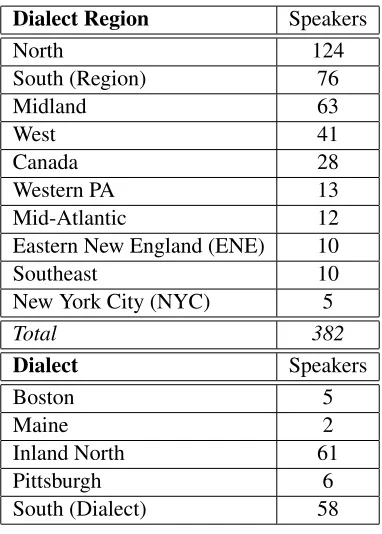
5.1 Counts of speakers used in this study by dialect region or dialect in the ANAE corpus. 45 5.2 Mean durations (ms) of vowels in word-final syllables by dialect region. . . 46
5.3 Post-vocalic voicing duration effect as a ratio (voiced vowel duration to pre-voiceless duration) for the dialect regions and two dialects, and standard errors of the mean. . . 47
6.1 Fifteen most frequent words in the corpus and their mean duration, ordered by fre-quency. Voiced types are marked with an asterisk for convenience. . . 67
6.2 Correlation coefficients (and p-values in parentheses) between vowel duration resid-uals, F1 residuals at vowel midpoint and offset, consonant duration residuals, and (the quantitative measure of) voicing intensity. The voiced and voiceless tokens are separated first. . . 80
7.1 Acoustic differences of voiced (VD) and voiceless (VL) stops, after transformation and normalization as described in the text. Each cell gives the mean value for voiced stops minus the mean value for voiceless stops followed by the number of standard deviations between the means. . . 90
7.2 Results of clustering fork= 2,3,4,8. . . 92
7.3 Results of simple clustering withk= 2,8and cluster merging. . . 94
7.4 Results of simple clustering withk= 2,8and SVM-based classification. . . 94
List of Figures
2.1 Ohde (1984): “Average F0 from voicing onset to the vowel target (period T) for
voiceless aspirated, voiceless unaspirated, and voiced stops according to place of articulation.” (Additional labels added for clarity.) . . . 20
4.1 A sketch of the phonetic implementation of [voice] in English, including the di-mensions VOT, closure voicing, and closure duration (see Chapter 2), and phase (see this section). . . 41
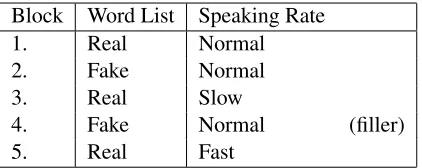
5.1 Experimental design for Experiment A. . . 49 5.2 PVD ratios. Data points summarized by the boxes are the voiced/unvoiced ratio
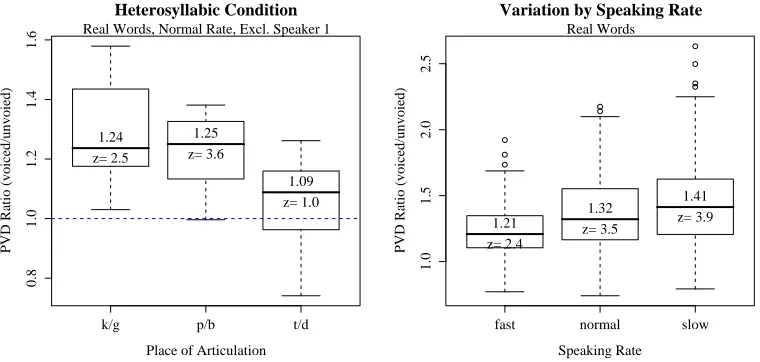
for each minimal pair separate by speaker. Left: By syllable structure, excluding flap target words in the heterosyllabic group. Right: By place of articulation in the tautosyllabic group. Median values are indicated above the median line in the boxes. Below the median line, the mean separability z-score is reported. . . 51 5.3 Left: PVD ratio by place of articulation in the heterosyllabic group. Speaker 1 was
excluded from this graph since she (impressionistically) failed to flap more often than other participants. Right: PVD ratio by speaking rate. . . 51 5.4 PVD ratios: Left: Real and nonsense words at a normal speaking rate. Right: Real
and nonsense words in the heterosyllabic group, by place of articulation. . . 52 5.5 Effect of post-vocalic voicing on vowel quality. Vowel names are located at the
mean max-F1/min-F2coordinate for tokens before voiced consonants. Arrows
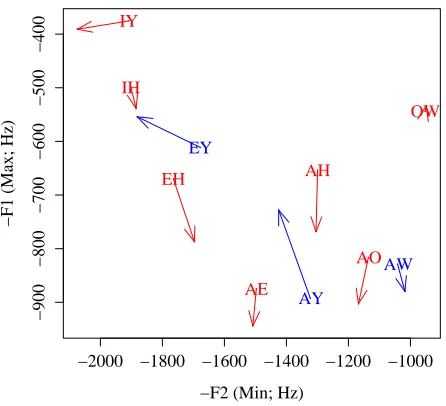
indi-cate the corresponding vowel quality before voiceless consonants. (Arrow lengths are computed as the mean of the within-speaker, within-minimal-pair differences, rather than pointing to the mean vowel target.) Monophthongs are in red, diph-thongs in blue. As opposed to the results reported in the text in this section, all collected tokens are included in this graph except those in the flapping context. . . 53
6.1 Left: Distribution of tokens across the ages in which the children were recorded. Right: Frequency of vowels, split by whether they preceded a voiced or voiceless consonant. . . 66 6.2 Comparison of the relative frequencies of intervocalic consonant phonemes in child
6.3 Raw vowel duration by age, post-vocalic voicing, and child in pre-pausal position.
Here and elsewhere, 95% confidence intervals are shown. . . 68
6.4 Raw vowel duration by age, post-vocalic voicing, and child in non-pre-pausal position. 69 6.5 Relative frequency of tokens at each age which were not pre-pausal, according to the definition given in the text. . . 69
6.6 Vowel duration residuals by age, post-vocalic voicing, and child in pre-pausal position. 72 6.7 Vowel duration residuals by age, post-vocalic voicing, and child in non-pre-pausal position. . . 73
6.8 Voiced-minus-unvoiced PVD difference by age, with tokens grouped in three-month bins, based on vowel duration residuals. . . 73
6.9 F1by age, post-vocalic voicing, and child, for monophthongs. . . 76
6.10 F1residual by age, post-vocalic voicing, and child, for monophthongs. . . 76
6.11 Consonant duration by age, voicing, place of articulation, and child. . . 77
6.12 Comparison of the two measurements of closure voicing intensity, the impressionis-tic qualitative measure and the quantitative and automaimpressionis-tic measure of signal intensity. 78 6.13 Closure voicing by age, according to the two measures (left: impressionistic, right: signal intensity). The same measurements for the fricatives are also shown but are not used. . . 78
6.14 Left: First formant frequency at vowel midpoint by vowel duration. Right: First formant frequency at vowel offset by consonant duration. (All measurements nor-malized as described in the text.) . . . 80
7.1 Spectrograms showing the automated detection of the start of aspiration (solid blue line) within the interval for the consonant determined by forced alignment (bounded by dashed red lines), and the surrounding phonemes. A missing aspiration line indi-cates the procedure failed to find a suitable location and such tokens were dropped from analysis. This is a random sample of pre-vocalic stops from the Around the World corpus. The identity of the phonemes are indicated above each spectrogram (‘sp’ stands for a pause). . . 87
7.2 Histograms by aspiration duration (left) and closure pitch (right). Around the World CV tokens. . . 89
7.3 Left: Aspiration duration by closure pitch. Right: Histogram of aspiration duration for those tokens with zero closure pitch. CV tokens from Pride and Prejudice. . . . 89
Chapter 1
Introduction
Phoneticians and phonologists use features such as [voice], [high], and [round] to categorize seg-ments. The [±voice] or [tense/lax] feature separates pairs of homorganic phonemes into two groups,
the [+voice] “voiced” phonemes /b,d,v/ etc. and the [-voice] “voiceless” phonemes /p,t,f/ etc. At the level of phonology, these sorts of distinctions play a role in phonological rules such as voice agree-ment in the ‘-s’ morpheme in English (‘cats’ [s] versus ‘dogs’ [z]), final devoicing in languages including German, or feature spreading such as in a case in New Julfa discussed later. At the level of phonetics, there are generalizations as well: all of the [+voice] stops share similar properties when it comes to the glottal state, aspiration, (shorter) stop closure duration, and (longer) preceding vowel duration (PVD), among other dimensions. But whereas phonological phenomena are investi-gated within a formal framework such as ordered rules or constraints, considerably less attention has been paid to the formal system that connects phonological features to their phonetic counterparts or correlates.
With that as a starting point, this dissertation concerns the production of the phonological [voice] contrast and its development in infants. The primary contribution is a corpus study of the phonetic realization of [voice] in two English-learning infants aged 1;1–3;5. While preceding vowel duration has been studied before in infants, other correlates of post-vocalic voicing investigated here — preceding F1, consonant duration, and closure voicing intensity — have not been measured before
in infant speech. The study will make empirical contributions regarding the development of the production of [voice] in infants, not just from a surface-level perspective but also with implications for the phonetics-phonology interface in the adult and developing linguistic systems. Additionally, several methodological contributions will be made in the use of large sized corpora and in model fitting for segment durations. Several new corpus studies of adult speech are also presented relating to the distributions of acoustic cues in fluent speech, machine learning of the [voice] distinction in fluent speech, a replication of past lab-speech research with new details, and dialectal variation in acoustic cues.
of [voice] in post-vocalic position. The present work looks at [voice] from a number of multidi-mensional perspectives and in particular attempts to classify phonetic dimensions as either being a part of amultidimensional linguistic competenceor as a physiological consequence of some other aspect of [voice] which actually is specified in the grammar.
Organization of this thesis
This dissertation is organized into six main chapters.
In Chapter 2 the acoustic dimensions of [voice] will be explored through a thorough review and critique of the relevant speech production literature. It has long been known that [voice] can be measured on many acoustic dimensions, even when we look to the left or right of the obstruent segment itself. Lisker (1986) identified sixteen acoustic differences between voiced and unvoiced word-medial /b/ and /p/. As he pointed out, not all are necessarily under separate linguistic con-trol of the speaker. They may not all be free to vary, owing to physiological constraints. In other words, while some phonetic (articulatory or acoustic) target may be specified as part of linguistic competence, other phonetic observations we may make about [voice] may be an almost accidental byproduct of the physical speech apparatus. This distinction is discussed for each acoustic dimen-sion. A focus is given to acoustic dimensions relevant in non-initial context, especially preceding vowel duration.
Chapter 3 reviews the development of [voice] in infants from a surface perspective, meaning what phones appear in children’s inventories, and from the perspective of the phonetics-phonology interface, meaning whether the child has learned the relationships between acoustic dimensions, phones, and phonemes.
With this in mind, I discuss a model of the phonetics-phonology interface in Chapter 4. The model is something that perhaps many phoneticians and phonologists implicitly assume, but the details seem to not have been discussed before. As research at the interface moves forward, we need a precise operational theory under which our work, such as this dissertation, can be carried out and evaluated. The focus on the model in Chapter 4 is where the phonetic aspects correlated with a phonological feature are stored, and the refinements I propose subsume all of the linguistically specified aspects of [voice] within essentially a [voice] cover-feature.
The phonetics of [voice] in adult speech is considered in Chapter 5. Section 5.1 presents the results of a dialectal corpus study of the preceding vowel duration difference aspect of [voice] in North American English, based on joint work with Keelan Evanini that was first reported in Tauberer and Evanini (2009). A lab experiment collecting lab speech is presented in Section 5.2 which clarifies the relationship between the preceding vowel duration effect and flapping and the relationship between [voice] and F1in preceding vowels.
The new corpus study of infant speech is presented in Chapter 6. In this chapter I also present a novel application of parameter estimation for segment durations in a linguistically plausible model of segment production, with full R code in Appendix B.
Chapter 7 returns to adult speech, but this time fluent adult speech. The chapter had two goals. First, it provides a descriptive account of the acoustics of [voice] in fluent speech on a number of acoustic dimensions. Compared to past work, the emphasis here is less on whether acoustic differences exist (e.g. shown by statistical significance) but whether the acoustic differences are large enough to be useful for discrimination, based on how separated the voiced and voiceless distributions are. Additionally in this chapter, machine learning algorithms are applied to the task
of learning the [voice] distinction using multidimensional input.
Appendix C lists a number of experimental directions that are raised by this dissertation (which I do not at this time have any intention of carrying out, but may serve useful for others).
How to read this thesis
Computing technology underlies much advancement throughout science. Technology makes new investigations possible. As it becomes faster to process data, such as with forced alignment tools as discussed several times in this dissertation, analyses of large-scale corpora reveal patterns that older technology was too insensitive to find. But technology has a second effect on the scientific method by making it easier for scientists to share work in a way that makes validation and replication easier (so-called reproducible research). The movement toward open access electronic journals, based on the receding costs of production and distribution, is a part of this side to technology. Another aspect is in how technology is used in the writing process.
This thesis was written using LATEX and, for the results section, Sweave by Friedrich Leisch1.
Sweave is a tool that integrates the R statistics program with LATEX so that R code can be embedded
within the LATEX document. This is a benefit for the reader, who can validate that numeric results
are justified by the analyses that generated them, and it is a benefit to the writer who can ensure that the numeric results reported are those in fact produced by the R analysis. In Section 6.3.2 the reader will see R code and R output intypewriter-style font. R code is marked by lines starting with >and+symbols.
As for terminology, the reader should note that I use [voice] exclusively to denote a phono-logical contrast, except in Chapter 4 when discussing alternative feature theories. I use “voiced” and “voiceless” or “unvoiced” (interchangeably) to refer to the feature values, but sometimes to the physical glottal state when it is clear. At other times I use “glottal state”, “glottal signal”, or “pho-netic voicing” when discussing the pho“pho-netic (articulatory, acoustic, or otherwise physical) aspect of voicing. As is traditional, angled lines /.../ indicate phonemes (i.e. grammatical contrasts) while square brackets [...] indicate phones (i.e. acoustic patterns).
1http://www.stat.umn.edu/
Chapter 2
The Acoustics of [voice]
The distinctive feature [voice] has largely been associated with voice onset time in the acoustic phonetics literature. This is due in part to the focus on utterance-initial segments. In this context, voice onset time is the most significant acoustic dimension for separating [+voice] from [-voice]. But it has long been known that [voice] can be measured on many acoustic dimensions, even when we look to the left or right of the obstruent segment itself. Lisker (1986) identified sixteen acoustic differences between voiced and unvoiced word-medial /b/ and /p/. As he pointed out, not all are necessarily under separate linguistic control of the speaker. They may not all be free to vary, owing to physiological constraints, but certainly some are.
In this chapter I review the literature on the acoustic dimensions of [voice] in English, with a focus on production (versus perception) and on non-initial context. In particular, the effect on pre-ceding vowel duration is given extensive focus. The review starts within the temporal bounds of the obstruent’s constriction and then moves to the properties of preceding and following vowels. Along the way it is evaluated whether each acoustic correlate of [voice] is merely a physiological conse-quence of some other articulatory dimension of [voice], or whether it is specified in the grammar separately from other aspects of [voice].
2.1
Glottal signal, aspiration, and pharyngeal cavity expansion
The most obvious and in some cases primary cue to voicing is the timing and intensity of the glottal signal (i.e. voice at the phonetic level), so it is the obvious place to begin. But the differences between voiced and voiceless goes well beyond Voice Onset Time.
Pre-vocalic stops
For pre-vocalic stops, Voice Onset Time (VOT; Lisker and Abramson 1964b), the time from release to the initiation of the glottal signal, is commonly considered the most salient distinguishing feature of voiced versus voiceless segments. The mapping from abstract [voice] to VOT differs across languages. In English utterance-initially, as reported in Keating (1984), the contrast is manifest primarily as a difference between short-lag VOT, meaning VOT mostly between 0 and 40 ms, and long-lag VOT, meaning between 50 and 90 ms. There is also occasional pre-voicing of voiced stops, that is, voicing during closure just before the release, which is represented by a negative VOT. Still, the production of the voicing categories is not perfectly separated. Flege and Brown (1982) reported
Pre-voicing Short-Lag VOT Long-Lag VOT English optional 0–40 ms 50–90 ms
Polish -150 – -30 ms 20–70 ms not used Thai <-40 ms 0–30 ms >20 ms
Table 2.1: Keating (1984): Voice onset time values for voice contrasts in English, Polish, and Thai.
15–25% of utterance-initial /b/ showing pre-voicing, only 5–10 percentage points more than the rate of pre-voicing invoiceless/p/.
Languages like English are called aspirating languages or are sometimes said to employ the [tense/lax] distinction rather than [voice]. In Polish, on the other hand, the contrast manifests as a difference between pre-voicing (-150 to -30 ms VOT) and short-lag VOT (20 to 70 ms). Lan-guages like Polish are said to be pre-voicing or employ the [voice] feature rather than [tense/lax]. Thai, finally, makes a three-way distinction between pre-voicing (less than -40 ms VOT), short-lag, and long-lag VOT (Keating 1984). See Table 2.1. Dutch, Puerto Rican Spanish, Hungarian, and Tamil pattern with Polish; Cantonese patterns with English and German; and Eastern Armenian and Korean pattern with Thai (Lisker and Abramson 1964a).
Because of the tight relationship between VOT and aspiration in languages like English the terms are often used interchangeably when referring to the voice contrast (Lisker and Abramson 1964a). There is also a tight articulatory relationship between the two as aspiration noise can only be heard if the time of maximal glottal opening is synchronous with the time of oral release (for a summary see Fuchs 2005). Jessen (2001) noted the terminological distinction due to Repp (1979) between ‘open interval’ which matches the interval measured by VOT and ‘aspiration’ which is when there is aperiodic noise.
However, these intervals may not line up. It is possible to have both negative VOT as well as aspiration. For German stops, Jessen (1998) reported utterance initial voiced stop aspiration mean durations of 21 ms and additionally a mean of 23 ms of pre-voicing (i.e. -23 ms VOT). (The means may be somewhat misleading as a representation of the degree of voicing, however, as the subjects were reported to voice inconsistently.) Hindi uses both acoustic signals contrastively in a 2x2 paradigm (Kagaya and Hirose 1975). Other languages make a three-way contrast between aspirated, unaspirated, and pre-aspirated. Pre-aspirated stops have aspiration preceding closure. In Icelandic, pre-aspiration is similar at least in duration to an /h/ preceding the consonant and appears to be either an allophonic variant of the voiceless (i.e. aspirated) stops or the realization of voicelessness in geminate stops (Suh 2001 for a summary and analysis).
VOT’s role in the voice contrast is generally thought of as a duration target: e.g. short-lag versus long-lag. But see below for Stevens and Klatt’s (1974) musing that it may be tied to an acoustic, spectral target (Section 2.7).
Post-vocalic stops
For post-vocalic stops, the phonetic contrast involving the glottal signal is slightly different. The cessation of voicing after closure is more rapid in voiceless stops, so instead a Voice Termination Time (VTT) from the onset of closure to the termination of voice would be more appropriate.1
1I am not aware of the origin of this term but it seems to be generally used, and I do not know of a general study on
Intervocalic stops, being post pre-vocalic and post-vocalic, have three relevant measures: VTT, VOT, and duration of aspiration. However, intervocalic stops are often voiced throughout closure, with no cessation of voicing between the preceding and following vowel. In these cases, measures of VOT and VTT are meaningless: VOT would extend negatively back from the release to before the obstruent began itself, perhaps to the start of the utterance, while VTT would extend forward from the start of closure perhaps indefinitely. The rate of voicing during closure not surprisingly is highly variable. Edwards (1981) reported that 45% of medial voiced stops exhibited voicing throughout closure; Flege and Brown (1982) reported approximately 75%. Even [-voice] stops can be voiced throughout closure: 8% in Flege and Brown (1982).
Intervocalic stops and pharyngeal cavity expansion
Another related measurement is the amount of voicing during closure, without regard to whether the voicing is at the start (as in a VTT measurement) or at the end (as in a negative VOT measurement). (Discontinuous voicing during closure does not seem possible. If there is voicing, it is near the edges.) Edwards reported that the mean duration of the glottal signal in intervocalic voiced stops was 78 ms during closure with mean closure duration of 96 ms (that’s 81% of closure duration). For voiceless stops the mean voicing duration was roughly 2.5 standard deviations lower, at 25 ms within a mean closure duration of 89 ms (that’s 28%). (The measurement of longer closure duration for voiced plosives is unusual.) This take on voicing duration is then a fourth measurement of voicing for plosives.
Closely related to the glottal signal is pharyngeal cavity expansion. During stop closure with no nasal opening, subglottal and supralaryngeal air pressures begin to equalize during voicing. If the transglottal pressure difference is not maintained by subglottal articulators or oral cavity expansion, voicing will terminate. If the shape of the vocal tract were fixed, voicing would last for just 15 ms. Passive expansion of the vocal tract walls, keeping supralaryngeal pressure low, allows for 65 ms of voicing. (Fuchs 2005) Recall that Edwards (1981) reported that the mean duration of the glottal signal during closure in intervocalic voiced stops was 78 ms. Both “active” and “passive” gestures can increase the volume of the pharyngeal cavity: active gestures being greater activity in certain muscles while passive gestures being less activity or the inhibition of activity in other muscles. But in a study with three subjects, Bell-Berti (1975) found that the use of four gestures that increase pharyngeal cavity size, two active and two passive, was not consistent across subjects. All subjects used at least one active gesture, but not all the same one, and one subject did not use either passive gesture. From the fact that active gestures can be used to extend voicing but further that the use of active and passive gestures is mixed, Bell-Berti concluded that [lax] was a poor description of voicing. We should also take from this that there is probably no linguistic specification of any particular gesture — whether active or passive — in the mental representation of [voice]. Rather, these gestures are recruited by speakers in an ad hoc manner to instantiate a more abstract, perhaps acoustic target, e.g. to maintain a certain prescribed amount of voicing.
Fricatives
The difference between voiced and unvoiced fricatives is manifest (partly) in voicing duration dur-ing frication — but glottal pulsdur-ing is not robustly present throughout voiced fricatives just as it is not robustly present throughout closures of voiced stops. Stevens, Blumstein, Glicksman, Burton, and Kurowski (1992) measured the difference in voicing during frication. However, rather than
ing the raw duration within the period of frication during which there was glottal pulsing, Stevens et al. opted for a stricter measurement excluding voicing at an amplitude less than 10dB below the amplitude at the boundary between the fricative and the vowel (where it should peak). The authors did not motivate the use of a threshold on amplitude rather than relying only the presence of glottal pulsing at all — however, I can imagine one reason was that determining the precise start and end of glottal pulsing can be something of an art because of the neighboring nonperiodicity of the glottal signal. By their measure, voiceless fricatives had 4 to 26 ms of glottal vibration depending on con-text, while voiced fricatives had 29 to 58 ms. The mean frication durations were not given but were around 80–100 ms. Fricative durations generally vary too with the voice contrast, as discussed be-low, in such a way as to magnify the difference in durations of voicing relative to the total frication duration. Jessen (1998) reported for German fricatives around 10 ms (unvoiced) vs. 75 ms (voiced) of glottal pulsing, or around 7% vs. 85% of frication duration. As I noted impressionistically for stops, for fricatives voicing occurs, if anywhere, near the boundary with a vowel, rather than spon-taneously in the middle of the segment, as one would expect given the high cost of initiating and terminating glottal vibration (Stevens et al. 1992).
The amount of glottal pulsing during frication depends on context. Based on electroglotto-graphic data for productions of English /z/ and /s/, Smith (1997) reported the rate of voicing for sentence-final, word-final, and word-medial positions. In sentence-final position all /z/ tokens she collected had glottal pulsing for less than 25% of the duration of frication. In word-final position followed by a voiceless consonant /z/ tokens generally had between 25%-90% of the frication du-ration voiced. In word-medial position, the percentage of voicing ranged between 25%-100%. For /s/, fewer than 2% overall had voicing for more than 25% of the duration of frication, most of the remainder having no voicing at all. The amount of voicing in /z/ is also sensitive to voicing in a following fricative, with substantially less preceding a voiceless fricative (Stevens et al. 1992).
Schissel (2008)2compared the glottal pulsing differences in English utterance-final
‘non-morph-emic’ /s,z/ as in ‘house’ (the noun/haUs/or the verb /haUz/) to the plural and possessive
mor-phemes ‘-s’ which are generally analyzed as agreeing in voicing with the preceding segment. She found that neither non-morphemic /s/ nor morphemic ‘-s’ following an unvoiced segment were ever, in her data, realized with glottal pulsing, and both non-morphemic /z/ and morphemic ‘-s’ following a voiced segment were realized with voicing less than one-third of the time.
It is not entirely surprising that one would find that glottal pulsing is not always present during stop closures and frication intervals. Voicing is difficult to sustain in both cases because of the transglottal air pressure difference that must be maintained in spite of other factors. This is discussed in the next section.
In a transillumination study of German intervocalic (sometimes word-initial) stops and fricatives (Jessen 1998), maximum glottal opening during stop closure or frication distinguished the voiced and unvoiced forms: unvoiced obstruents had greater opening. (In the case of stops, the duration of glottal opening during closure also discriminated the voiced and unvoiced forms, unvoiced forms having 50% longer opening, but this might be a by-product of the total segment duration correlate to be discussed next.) Jessen believed that while a glottal opening appeared in both voiced and unvoiced obstruents, the opening in voiced obstruents was due to changes in intraoral air pressure as a result of the oral constriction, while the greater glottal opening in unvoiced obstruents was a result of an active gesture. Strong evidence was not presented for this position, however. A review of the glottis and its degree of opening can be found in Fuchs (2005).
2.2
Obstruent duration
Voiceless obstruents have longer durations than voiced obstruents. For stops, the difference has been reported at around 60 ms, or one-to-two standard deviations, or a ratio of approximately 1.3-to-1, but studies have varied over whether the discriminating difference includes or excludes the burst and aspiration duration. Lisker (1957) included the release duration in measurements of intervocalic /p,b/ in trochaic minimal pairs and reported that durations for /b/ ranged from 65–90 ms and for /p/ from 90–140 ms. (Similar results were reported by Crystal and House (1988b); Edwards (1981).) Luce and Charles-Luce (1985) found similar results measuring up to the burst.
For fricatives and affricates a similar pattern obtains (Crystal and House 1988b; Stevens et al. 1992). Baum and Blumstein (1987) found in utterance-initial position unvoiced fricatives around 28 ms longer in frication duration than voiced fricatives, a ratio of unvoiced to voiced duration around 1.3. Despite the large difference, variability in duration was great and there was no clear boundary in duration times between the groups. The /s,z/ frication difference has also been found in French (Flege and Hillenbrand 1986), with a ratio greater than 2.0 word-finally.
Lisker (1957), Denes (1955), and Stevens et al. (1992) considered segment duration from the perceptual end, for word-medial stop closures, word-final frication durations, and frication durations in several contexts, respectively. Each showed that the unvoiced-voiced distinction was made by listeners at least in part based on the duration of the segment. Decreased segment duration lead to increased identification of segments as voiced, even if the segment has no glottal voicing. In Lisker’s case, the perceptual judgments followed an s-shaped curve and were in agreement with the production measurements in terms of the location of the cross-over from voiced to unvoiced.
The duration pattern is in the direction we would expect given the added difficulty of maintaining voicing during an obstruent. Voiced stops and fricatives are both difficult, though for different reasons. As discussed above, once the transglottal pressure difference equalizes during stop closure voicing stops. Thus the longer the closure, the less likely voicing will continue throughout. In both stops and fricatives, voicing requires the maintenance of the right tension and adduction of the vocal cords and a transglottal air pressure difference. It is more difficult to maintain voicing in a fricative. Unlike in stops, supralaryngeal pressure can be kept low by allowing air to escape through the fricative’s obstruction. But fricatives additionally require a pressure difference at the oral constriction, but there with the oral pressure higher. Coordination is required to hit the right targets at the two locations. See Ohala (1997) for a review of the factors involved in glottal voicing in obstruents.
De Jong and Zawaydeh (2002) mused, as discuss below in the section on vowel duration, that the presence of primary stress should amplify acoustic properties of segments that are linguistically specified. As opposed to the effect on vowel duration discussed below, the presence of stress on the syllable containing the obstruent has been reported to not magnify the voicing effect on duration (Crystal and House 1988b). To de Jong and Zawaydeh, this would indicate that closure duration is not linguistically specified and that the difference is a matter of, perhaps, physiology.
Could the duration difference be just a measurement bias? For plosives the termination of closure is marked reliably by a burst. The onset of closure is less reliably marked. At best there is rapidly decreasing intensity (e.g. Luce and Charles-Luce 1985), but persistence of glottal pulsing into closure might mitigate the intensity drop to make it appear as if the start of closure occurred later. This would create the illusion that voiced stops have shorter closure. (For instance, intensity decay time at the start of closure, measured as “the time needed for signal intensity, expressed in
decibels, to drop from 90% of its peak value to 10% of its peak value”, is 15–20 ms or 1.7 times longer before stimuli listeners identify as voiced stops, Hillenbrand, Ingrisano, Smith, and Flege 1984.) But since the closure duration difference does persist in whispered speech for /t,d/ and /s,z/ (Parnell, Amerman, and Wells 1977), the presence of voicing cannot be the cause of the duration difference. Frication duration differences are similarly found even between /s/ and partially and fully devoiced tokens of /z/, with about the same magnitude of duration difference in contexts that have greater devoicing (Smith 1997).
The duration of frication might still be a misleading measurement, Stevens et al. (1992) argued. While the frication duration varies according to the value of [voice], it seemed that the time from the initiation of the constriction gesture to its completion is constant across the two categories of [voice]. Stevens et al. measured this gesture intervocalically by tracking the F1 transition in a
preceding and following vowel. Though the duration of frication differed between /s/ at 108 ms and /z/ at 78 ms, the time from the start of transition in the preceding vowel to the end of transition in the following vowel was roughly the same for /s/ and /z/, at around 155 ms. In other words, the timing patterns of the supraglottal articulators were the same in /s/ and /z/, while the apparent difference in frication duration is due to a difference in timing of glottal gestures only. Because a different glottal position and transglottal pressure configuration are needed to initiate voicing, this all may mean that the frication duration difference is essentially a physiologically conditioned effect not under separate linguistic control from the specification of glottal voicing, and that the grammar in fact specifies equal durations for the two segments.
Evidence exists that a similar explanation cannot be made for stops based on an experiment that changed the glottal state of the stop without changing its underlying [voice] feature. Jansen (2004) measured regressive voicing assimilation (RVA), a coarticulatory process in English, in VC1C2
sequences. An example of RVA (based on Jansen 2004) is the different realization of /z/ in “Is {Bob, Pete} going?”: [IzbAb...] vs. [Ispit...]. The voicing of /z/ seems to be neutralized to match that of the following segment. Jansen (2004, 2007) reported results for VCC sequences where the two consonants spanned a word boundary, e.g. in r-less British English ‘brickwork depot’ vs. ‘brickwork tunnel’ vs. ‘Hamburg tenant’ vs ‘Hamburg dairy’, etc. Jansen measured several acoustic properties of the velar stop. The effect of the voicing in C2 on the duration of voicing during the
closure of C1 was near-categorical. While a /gr/ sequence showed 14 ms or 63% more closure
voicing than a /kr/ sequence (which is the usual voicing difference), a /kz/ sequence showed 15 ms or 58% more closure voicing in the /k/ than in the /g/ of a /gs/ sequence. On the other hand, stop closure duration was essentially not affected by the voicing feature on a following obstruent segment. The closure duration difference in /kr,gr/ was 14% and in /kz,gs/ 19% (/k/ greater in both cases). The glottal state cannot be said to be responsible for closure duration differences in stops.
Not unexpectedly then, the closure duration correlate of [voice] is reported to be not universal. In Danish, Hindi, Mandarin, and Swati Xhosa unvoiced stops have shorter closure (Jessen 2001). As it happens, Danish also has particularly long aspiration and it has been suggested that the closure duration correlate has been essentially sacrificed so as to highlight the aspiration contrast. In light of this cross-linguistic pattern, one would very much like to see whether these languages also lack a fricative duration correlate of [voice] (if they have the voice contrast for fricatives at all) — which would undermine a physiological account of frication duration.
in frication duration seems to be determined solely by differences in the glottal state, no effect of stress has been found, and in either case a vague principle of “conserve energy” would explain why the more difficult, voiced obstruents would be shorter even if the duration difference itself were not linguistically specified.
2.3
Other correlates during the consonant
Release bursts are said to be shorter and weaker following voiced versus voiceless stops, in both aspirating (short lag/long lag VOT) and pre-voicing (pre-voicing/long lag VOT) languages (for ref-erences see Jansen 2004, page 52 and Fischer and Ohde 1990).
In the bilabial stop pair /b,p/, lip pressure has been reported to be greater for the unvoiced phoneme in German word-medial intervocalic position but no difference was reported for English (Jessen 1998:278 for a summary).
Maximum airflow during the frication also was different between /z/ and /s/, regardless of the amount of glottal pulsing, with even near-or-fully devoiced /z/ having less maximum airflow than an /s/ in the same context. This suggested that the glottal position was somewhere between the open state of unvoiced /s/ allowing greatest airflow and the constricted state of a fully voiced /z/ impeding airflow. (Smith 1997)
2.4
Preceding vowel duration
A cross-linguistic phenomenon has been observed in which the duration of a vowel is longer when preceding a voiced obstruent than when preceding a voiceless obstruent (House and Fairbanks 1953; Luce and Charles-Luce 1985; Crystal and House 1988a among many others, some cited below). It has been variously called the post-vocalic consonant voicing effect, the vowel length effect, extrinsic vowel duration, and pre-fortis clipping. To put the emphasis on the consonant, rather than the vowel, the phenomenon will be referred to here as the preceding vowel duration (PVD) difference or PVD effect.3 The phenomenon is often described formally but descriptively as the distinction between
/bæt/ versus /bæ:d/ or V → [+long] / [+voice] in the style of Chomsky and Halle (1968), though it is by no means a settled issue whether the phenomenon ought to be described in terms of phonological lengthening, or whether the PVD effect is even a single phenomenon.
The duration difference is quite large, at least in English. In Section 5.2 I present the results of a replication of various past work on measuring the PVD effect using minimal and near-minimal pairs in a word-list-reading experimental design. Representative of past work, vowel duration before [+voice] obstruents was found to be as large as 1.5 times greater in monosyllables and 1.3 times greater in trochaic bisyllables than the corresponding vowel duration in the other half of the (near-)minimal pair. Within individual minimal pairs, the tokens were easily separable: an average of 3 to 5 standard deviations separated [+voice] and [-voice] cases. But the effect is far reduced outside of word-final, pre-pausal context (Crystal and House 1988a).
3The existing terms each have their issues. “Fortis” is an antiquated term and “pre-fortis clipping” makes a
com-mitment to the underlying process. “Vowel length” is a term used more often to refer to a phonological (i.e. binary) contrast rather than a continuous phonetic dimension. While “extrinsic vowel duration” has been used exclusively for this phenomenon, it is an odd term considering the number of extrinsic factors that affect vowel duration. And “post-vocalic consonant voicing effect” is unnecessarily verbose.
The PVD effect occurs within and across syllable boundaries (Chen 1970), for stops as well as fricatives (Umeda 1975; Stevens et al. 1992; Smith 1997). It affects not just an immediately preceding vowel but also the preceding vowel and any intervening sonorant (e.g. ‘sent’ vs. ‘send’, ‘false’ vs. ‘falls’, the vowel and sonorant both lengthening to roughly the same degree; Chen 1970; Crystal and House 1988a).
The PVD difference has been observed many, many times throughout the literature, especially in English. Chen (1970) is generally cited for his early, cross-linguistic comparison, although the sample size was dangerously small and the data were confounded by the position and context of the voiced/voiceless segment in each word (though it seems Chen got lucky). A number of factors have been shown to affect the PVD effect, at different levels of linguistic structure, but the results can be summarized that the PVD effect’s voiced–unvoiced difference is smaller when the vowel is in a context where it is expected for other reasons to have a shorter duration. This is Klatt’s (1973) “incompressibility” — that each successive shortening effect on a vowel has a diminished effect because of physical bounds on the speed of articulation. The voiced-unvoiced duration difference, in Klatt’s (1973) data, was 66 ms in a context where vowels were on average 165 ms in duration (the context was being in a monosyllabic word) but only 28 ms in a different context when the vowels were on average 117 ms (that’s in the first syllable of trochaic words). The effect of voicing on duration decreases after we apply the effect of position, one might say. But this incompressibility is so even when we consider the effects not as absolute differences but as multiplicative factors. Here I switch from viewing the PVD as a shortening, as Klatt did, but instead as a lengthening, as most research has done. In the first longer-vowels context voicing increased duration by 51 percent but in the second shorter-vowels context voicing increased duration by only 22 percent. In other words, the magnitude of the PVD effect is not constant either on an absolute time scale (i.e. milliseconds) or in terms of a proportion (1.51-to-1). (Also see Port 1981.)
Other work has looked at this variation in PVD ratio across contexts. The PVD ratio is much larger in pre-pausal position (a ratio of 1.5) than elsewhere (1.4 word-finally, 1.1 word-medially) (Umeda 1975, but also see Luce and Charles-Luce 1985; Crystal and House 1988a). The effect is also larger for stressed versus unstressed vowels (Davis and Summers 1989). It is also larger for vowels with greater intrinsic duration (Luce and Charles-Luce 1985) and in slow ‘tempo’ speech (1.18) than in fast ‘tempo’ speech (1.09) (Port 1981; Laeufer also notes work by Harris and Umeda in 1974). Other measurements of the PVD effect can be found in Summers (1987).
The PVD difference is also a perceptual cue. Denes (1955), looking at word-final /s,z/, found a strong effect of vowel duration on whether the final consonant was understood as voiced or unvoiced. He noted that the rate of perception as one category or the other was modeled well based on the ratio of the duration of the vowel to the consonant.
2.4.1 Comparison with other languages
The literature on the PVD effect has often portrayed it as a universal phenomenon but with a peculiar existence in English. The duration difference has been claimed to exist at least in Danish, Dutch, French, German, Hindi, Hungarian, Italian, Korean, Norwegian, Persian, Russian, and Spanish (see for references Kluender, Diehl, and Wright 1988), and of course English. Its apparent universality suggested early on that the PVD effect was a low-level possibly articulatory effect, something ne-cessitated by other factors such as the airflow differences in voiced and unvoiced obstruents, and so not a part of linguistic competence.
English 1.51 Peterson & Lehiste (1960) as cited in Chen (1970) English 1.45 House and Fairbanks (1953)
English 1.63 Chen (1970) French 1.15 Chen (1970) Russian 1.22 Chen (1970) Korean 1.31 Chen (1970)
English 1.57 Zimmerman and Sapon (1958) Spanish 1.17 Zimmerman and Sapon (1958) English 1.23 Laeufer (1992)
French 1.15 Laeufer (1992) Quebec French 1.32 Morasse (1995)
English 1.20 Flege and Port (1981) Arabic 1.03 Flege and Port (1981)
Czech 1.02 Keating (1980) Polish 1.0 Keating (1980)
Swedish 1.03 Elert (1964) as cited in Buder and Stoel-Gammon (2002) German 1.11 cited in Fintoft (1961), as cited in Chen (1970)
German 1.20 Braunschweiler (1997), word medial Catalan 1.17 Charles-Luce (1992)
Norwegian 1.23 Fintoft (1961) as cited in Chen (1970) Hungarian 1.2 Jansen (2004) (long vowels long)
Table 2.2: Ratios of mean duration of vowels preceding voiced consonants to that before voiceless consonants in various languages reported in the literature. In some cases, including Polish and Czech, the mean of the individual ratios for minimal pairs is reported instead, which generally magnifies the value.
not be present in Polish and Czech (Keating 1980), based on pair-list readings of intervocalic /t,d/. (Non-final position is a position where the effect size is reduced, but in English word-list reading still readily observed, see section 5.2.) Similar claims have been made about Arabic (Flege and Port 1981; de Jong and Zawaydeh 2002) and Swedish (Buder and Stoel-Gammon 2002, based on Elert (1964)). The presence or absence of the PVD effect in a language cross-cuts whether the language has a phonemic vowel length contrast; for instance, Dutch, Hungarian, Swedish, Czech, and Arabic all have a vowel length contrast, while only Dutch and Hungarian are claimed to have a PVD difference. On the other side of the table, of languages without phonemic vowel length, English and French have a PVD effect while Polish does not.
A summary of findings of the PVD effect cross-linguistically is reported in Table 2.2. For each language, the ratio of the mean duration of vowels preceding voiced consonants to that before voice-less consonants is reported. English shows a much larger duration difference between voiced and unvoiced consonants than all other languages in which the PVD effect has been studied, at least at face value. Taking the results from Chen (1970) as a representative example (its problems notwith-standing), the ratio of the mean duration of vowels before voiced consonants to that before voiceless consonants in English is roughly 1.5 with an absolute difference between the mean durations of 92 ms, while in French, Russian, Korean, etc. the ratios and differences are 1.2–1.3 and 28–53 ms.
Comparisons across languages are fraught with problems. A ratio of 1.1 or less, such as in
the reported cases of Arabic, Czech, and Swedish, might be a difference of a single pitch period, depending on vowel duration and F0, which is quite a small difference to extrapolate much of anything. It may have more to do with intensity decay time, which is 15–20 ms greater before stops identified by speakers as voiced (Hillenbrand et al. 1984), see page 8, a difference far too small to explain the PVD effect in English but about the right size to explain the PVD effect in these other languages.4 Chen’s (1970) results have been suspected of overestimating the difference between
English and the other languages (Kluender et al. 1988).
Zimmerman and Sapon (1958) very likely overestimated the effect in Spanish. They reported for the Latin American dialects of Spanish spoken by their subjects that intervocalic contrasts were between voiceless stops and voiced fricatives. If Spanish is like English where vowels are longer before fricatives than for stops (Umeda 1975), then the effect may have been largely due to not using true minimal pairs. I am not aware of any more recent studies of the PVD effect in Spanish. The results reported for Catalan, French, and German may have underestimated the effect. Charles-Luce (1992) for Catalan and Braunschweiler (1997) for German put the post-vocalic consonant in a non-final environment to escape word-final devoicing, which may reduce the PVD effect. (See page 17.). Laeufer’s (1992) more detailed analysis of the PVD effect in French suggests that previous measurements of the PVD effect in French were also underestimated and that there is no great difference with English.
English and French vowels differ in many ways: French vowels are often shorter than their English counterparts; English final stops are longer and are often, unlike in French, unreleased and when they are released their releases are shorter than those in French; French pre-pausal voiced stops are often (74%) followed by a vocalic release (a voicing cue unavailable in English that may relieve the PVD effect of its communicative load); and varieties of French, unlike English, lack syllabic stress (Laeufer 1992). Controlling for some of these factors in the two languages, Laeufer found a PVD ratio in French of 1.42 and in English 1.6, much closer than past work found. Laeufer noted, however, that vowel durations were not consistent between the two languages (in one condition 150 ms and 209 ms, respectively), and this may account for the difference in the PVD between the two languages. Klatt’s (1973) incompressibility says that durational changes will apply differently depending on the expected duration of the segment. When French vowels had similar durations to English vowels, which were the contexts of sentence-final position in French and sentence-medial position in English, the PVD ratios were much closer. (Also see Flege and Hillenbrand 1986 for similar results involving /s,z/.)
Laeufer’s (1992) work is important in several respects. First, it highlighted language-specific details that make cross-linguistic comparisons susceptible to confounding factors. Second, in light of the fact that independent vowel duration factors interact with the PVD effect (Klatt 1973; Port 1981) and that when vowel durations were matched between English and French the PVD ratios were very similar, it is not entirely clear that English and French differ with respect to PVD at all.
4It seems useful here to mention Chen’s (1970) explanation for the PVD effect in terms of the speed of closure
One can compare the PVD effect to different types of vowel durational phenomena in other languages. The magnitude of the PVD effect in English is still smaller than duration differences associated with a phonological length contrast, such as in Dutch (see for a summary Dietrich 2006), for which van Bergem reported that long vowels were 1.8 times longer than short vowels. The PVD effect is outdone also by the Scottish Vowel Length Rule (Scobbie, Turk, and Hewlett 1999), which among other things involves lengthening by a factor of 1.8 specifically before voiced fricatives.
In summary, there are at least two categories of languages, if not three. English is the proto-typical language exemplifying the PVD effect, and French may very well be included in the same category. Polish, Czech, Arabic, and Swedish have strong evidence for having no PVD difference (at least not beyond about a single pitch period if even that). As for the remaining languages, it is not clear. Where the effect has been probably overestimated, as in Spanish, the language might group with Polish etc. If languages remain, we may have a second type of PVD effect that is smaller than that of English and governed by a different mechanism entirely.
2.4.2 Interaction with other phenomena
When investigating whether a phenomenon is a matter of linguistic competence, rather than a phys-iological consequence of some other linguistic articulation, some have looked for whether the phe-nomenon interacts in interesting ways with other linguistic phenomena. In some cases, this is the same as asking whether the phenomenon is a productive process operating at the level of phonology or something more static below the level of the linguistic apparatus.
Stress
De Jong and Zawaydeh (2002, page 54) theorized that lexical stress could be a diagnostic for what aspects of a segment are linguistic and what aspects of a segment are not. “If some aspect of speech,” they wrote, “is part of the specification of a particular segmental phonemic entity, having that segment in a stressed syllable should be expressed by a more extreme instantiation of that aspect. However, if some aspect of speech is due to some other organizational or motor strategy, stress should not enhance its appearance in speech.” If only language was ever so straightforward. Let us not confuse de Jong and Zawaydeh’s hypothesis for a rigorously tested law, but we can take their points for what they are worth. It is also interesting to view this as a specific case of what has been reported elsewhere, that the PVD effect is greater in contexts in which vowel duration is expected to be greater for independent reasons.
De Jong (2004) contrasted vowel durations in the presence or absence of primary stress and in the context of either a voiced or voiceless following stop. His previous work (cited within) additionally included the contexts of stop versus fricative and singleton versus cluster coda. Vowels have been found to be shorter before voiceless stops (versus voiced stops), fricatives (versus stops), and cluster codas. The question was whether primary stress amplified the duration difference in each of those contexts. For instance: is the vowel duration difference between ‘bed’ and ‘bet’ (having primary stress) larger than the corresponding difference in ‘flower bed’ and ‘sports bet’ (having secondary stress), and in turn larger than that in ‘rabid’ and ‘rabbit’ (unstressed). In this case of post-vocalic voicing, yes, stress amplified the duration difference. (There was virtually no duration difference in the unstressed case anyway.) On the other hand, stress was not found to affect vowel duration differences when manner or coda size was a variable. The PVD effect, but not effects of clusters or manner of articulation, seemed to be a linguistic phenomenon.
De Jong and Zawaydeh (2002) applied this idea to vowel durations in Arabic. While Arabic has a similar use of stress as in English, they wrote, the vowel duration difference before voiced versus voiceless stops is considerably smaller than in English. Flege and Port (1981) found for Saudi Arabian Arabic and de Jong and Zawaydeh (2002) found for Ammani-Jordanian Arabic a mix of non-significant and significant duration differences. Although de Jong and Zawaydeh reported consistent patterns in the expected duration (that is, vowels longer before voiced consonants), the differences were on the order of 10 ms or a ratio of 1.1 throughout. This difference is far smaller than that observed in English and French, and roughly the difference of just one pitch period — small enough to wonder whether this is a reliable measurement in the first place. Not surprisingly then, the duration difference remained essentially nil whether or not the syllable containing the vowel had primary stress.
de Jong’s conclusion has been that the PVD effect in English is a linguistic process while in Arabic it is not. I noted above that the voicing effect on stop closure duration was not amplified by stress (Crystal and House 1988b) — we might similarly conclude that this is evidence that the stop closure duration difference is like the Arabic vowel duration difference in not being a part of the linguistic specification.
Intervocalic flapping
The interaction of the PVD effect with English t/d-flapping is an instructive case because flapping neutralizes the voice contrast on the surface. Well known as the ‘writer’/‘rider’ ambiguity, one must keep in mind that the ambiguity can impoverish the linguistic input so that even adults may not know the true (if there is such a thing) underlying form of infrequently-alternating words, such as ‘giddy’, which I innocently recently misspelled as “gitty”.
There are three possibilities for how the PVD effect will come out in these words. The first is that the preceding vowel duration difference is based on whether the flap is pronounced with glottal pulsing or not. In other words, the PVD effect is a consequence of the articulatory gesture. Fox and Terbeek (1977) found no duration difference according to the glottal state, although the comparison was based on a very small sample size, in part because voiceless flaps are rare.
The second possibility is that the PVD effect depends on the lexical or underlying specification of [voice]. In that case we would expect a /raIR@~/–/raI:R@~/ contrast, despite the neutralization of other aspects of the /t-d/ phonemic contrast. If this were true, the PVD effect could be described as an early-ordered rule, relative to the rule for flapping. (I certainly do not intend to commit to an ordered-rule framework, but it is convenient for exposition.) The third possibility is that the PVD effect depends on the [voice] feature at the end of the phonological component of the grammar, after flapping neutralizes the difference between /t,d/. In that case, the PVD effect would produce no difference between the two words in the minimal pair.


![Figure 4.1: A sketch of the phonetic implementation of [voice] in English, including the dimensionsVOT, closure voicing, and closure duration (see Chapter 2), and phase (see this section).](https://thumb-us.123doks.com/thumbv2/123dok_us/9260714.1464434/53.612.225.422.74.188/figure-phonetic-implementation-english-including-dimensionsvot-duration-chapter.webp)