
University of Pennsylvania
ScholarlyCommons
Publicly Accessible Penn Dissertations
2017
Learning From Strategically Controlled
Information
Daniel N. Hauser
University of Pennsylvania, [email protected]
Follow this and additional works at:https://repository.upenn.edu/edissertations
Part of theEconomic Theory Commons
This paper is posted at ScholarlyCommons.https://repository.upenn.edu/edissertations/2328 For more information, please [email protected].
Recommended Citation
Hauser, Daniel N., "Learning From Strategically Controlled Information" (2017).Publicly Accessible Penn Dissertations. 2328.
Learning From Strategically Controlled Information
Abstract
In the first chapter, ``Promoting a Reputation for Quality,'' I model a firm that manages its reputation for selling high quality products by investing in the quality of the product and by controlling the information consumers observe. As in \citet{BMTV}, quality is persistent, and evolves stochastically over time. Consumers do not observe product quality or the firm's actions directly, instead they form beliefs about the quality of the firm's product based on the information they observe. I focus on two cases, the good news case, where the firm can promote its product by releasing positive information, and the bad news case, where the firm can choose to censor negative information, and characterize Markov perfect equilibria.
In the good news case, promotion and investment are complements. The firm has incentives to invest because it can then promote its product. the firm does not invest in quality or promote at high reputation, invests and promotes at low reputations, and promotes but does not invest at intermediate reputations. This intermediate region reduces the firm’s incentives to invest in quality, relative to what would happen if information was exogenous. But reputation effects are persistent. The firm will always eventually have incentives to invest in quality and renew its reputation. In contrast, in the bad news case censorship and investment are substitutes. The firm can either invest to hide negative information about its product or censor this bad news. Unless censorship is sufficiently expensive, reputation effects break down and the firm never invests in the quality of its product.
In the second chapter, ``Bounded Rationality and Learning: A Framework and A Robustness Result'' (joint with Aislinn Bohren), we investigate how consumers learn from the actions of others. We consider what happens in a social learning environment when agents have potentially misspecified models of the world. Agents may misinterpret information they see about the world, and may also misinterpret how others view the world. We develop a set of tools that allow us to analyze asymptotic learning outcomes in the presence of model misspecification. This framework allows us to consider agents with a variety of biases, including the level-k models, confirmation bias, partisan bias, and models where agents over or under-weight the information contained in their private signals.
Degree Type
Dissertation
Degree Name
Doctor of Philosophy (PhD)
Graduate Group
Economics
First Advisor
George J. Mailath
Second Advisor
Keywords
Censorship, Learning, Model Misspecification, Promotion, Reputation
Subject Categories
Learning from Strategically Controlled Information
c
⃝ Copyright
2017
Acknowledgments
This dissertation would not be possible without the help and support of many
people, including:
George Mailath, my advisor, whose constant support, advice and criticism has
made me a better economist. Professor Mailath has consistently encourage me to
think about what the interesting economic questions are underlying my research,
and pushed me to tackle difficult technical problems. I am incredibly grateful for
all the help and support Professor Mailath has given me.
This dissertation would not be possible without the Aislinn Bohren (and not
just because she’s a co-author on 50% of it). Professor Bohren first encouraged me
to pursue the project that I developed in her second year class, which eventually
evolved into the first chapter of this dissertation, and her insights and suggestions
have been invaluable in developing my research agenda. Every part of this
dis-sertation has been improved dramatically thanks to Professor Bohren’s help and
support.
While it may be hard to tell, I’ve improved immeasurably not only as an
economist, but also as a writer thanks to Steven Matthews. If any of the math
in this dissertation is even remotely comprehensible, it’s thanks to the lessons I
learned as Professor Matthews’s TA, and if any of the economics in this
disserta-tion is interesting, it’s in no small part thanks to what Professor Matthews has
I’d also like to thank the other Professors at Penn, including Andrew Postlewaite,
Mallesh Pai, Rakesh Vohra, Yuichi Yamamoto, David Dillenberger and SangMok
Lee. I’d like to thank my undergraduate advisor and former employer Larry Ausubel
who encouraged me to pursue a career in economics. I couldn’t have done any of this
without the discussions I’ve had with the many friends I made here at Penn,
includ-ing Yunan Li, Nishant Ravi, Yiran Chen, Yiwen Wu, Angel Iglesias Diaz, Marjorie
Rutherford, Heidi Verheggen, Paul Sangrey, Takeaki Sunada, Behrang Kamali,
Sel-man Erol and Nick Janetos. I’d like to thank the University of Pennsylvania, and
Andrew Postlewaite and George Mailath, for the financial support they’ve provided
ABSTRACT
LEARNING FROM STRATEGICALLY CONTROLLED INFORMATION
Daniel N. Hauser
George J. Mailath
J. Aislinn Bohren
In the first chapter, “Promoting a Reputation for Quality,” I model a firm that
manages its reputation for selling high quality products by investing in the quality of
the product and by controlling the information consumers observe. As in Board and
Meyer-ter-Vehn (2013), quality is persistent, and evolves stochastically over time.
Consumers do not observe product quality or the firm’s actions directly, instead
they form beliefs about the quality of the firm’s product based on the information
they observe. I focus on two cases, the good news case, where the firm can promote
its product by releasing positive information, and the bad news case, where the
firm can choose to censor negative information, and characterize Markov perfect
equilibria.
In the good news case, promotion and investment are complements. The firm
has incentives to invest because it can then promote its product. the firm does
not invest in quality or promote at high reputation, invests and promotes at low
reputations, and promotes but does not invest at intermediate reputations. This
intermediate region reduces the firms incentives to invest in quality, relative to what
The firm will always eventually have incentives to invest in quality and renew its
reputation. In contrast, in the bad news case censorship and investment are
substi-tutes. The firm can either invest to hide negative information about its product or
censor this bad news. Unless censorship is sufficiently expensive, reputation effects
break down and the firm never invests in the quality of its product.
In the second chapter, “Bounded Rationality and Learning: A Framework and
A Robustness Result” (joint with Aislinn Bohren), we investigate how consumers
learn from the actions of others. We consider what happens in a social learning
en-vironment when agents have potentially misspecified models of the world. Agents
may misinterpret information they see about the world, and may also misinterpret
how others view the world. We develop a set of tools that allow us to analyze
asymp-totic learning outcomes in the presence of model misspecification. This framework
allows us to consider agents with a variety of biases, including the level-k models,
confirmation bias, partisan bias, and models where agents over or under-weight the
Contents
List of Figures x
1 Promoting a Reputation for Quality 1
1.1 Introduction . . . 1
1.2 Model . . . 11
1.3 The Good News Case . . . 16
1.4 The Bad News Case . . . 29
1.5 Exogenous News . . . 38
1.6 Conclusion . . . 43
2 Bounded Rationality and Learning: a Framework and a Robust-ness Result 45 2.1 Introduction . . . 45
2.2 The Common Framework . . . 51
2.2.1 The Model . . . 51
2.2.2 The Individual Decision-Problem . . . 57
2.2.3 Examples . . . 58
2.3 Learning Dynamics . . . 60
2.3.1 The Likelihood Ratio . . . 60
2.3.2 Main Result . . . 63
2.3.3 Proof of Theorem 4 . . . 70
2.4 Applications . . . 75
2.4.1 Level-k Model of Inference . . . 76
2.4.2 Partisan Bias . . . 87
2.4.3 Confirmation Bias . . . 93
2.5 Conclusion . . . 96
3 Appendix: Promoting a Reputation for Quality 98 4 Appendix: Bounded Rationality and Learning 133 4.1 Appendix . . . 133
4.1.1 Posterior Representation. . . 133
4.1.2 Proof of Theorem 4 . . . 138
4.2 Examples of Nested Models . . . 153
4.2.1 Rabin and Schrag (1999) . . . 153
4.2.2 Epstein et al. (2010) . . . 154
List of Figures
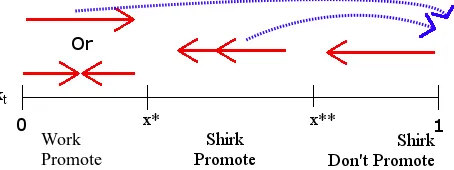
1.1 Structure of a MPE . . . 21
1.2 Belief Dynamics between arrivals . . . 21
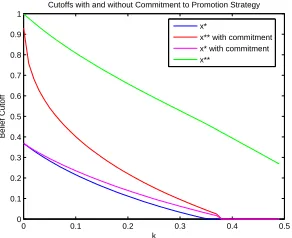
1.3 Optimal level of investment and promotion with and without com-mitment. . . 26
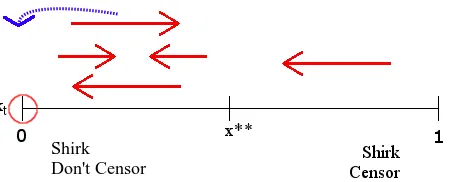
1.4 Bad News Equilibrium - Full Shirk . . . 33
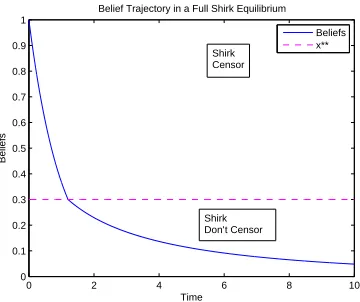
1.5 Belief Trajectory - Bad News, Full Shirk Equilibrium . . . 34
1.6 Bad News Equilibrium - Stop Censoring Before Stop Working . . . 36
1.7 Bad News Equilibrium - Stop Working before Stop Censoring . . . 38
1.8 Equilibrium with Temporary Promotion . . . 41
2.1 Probability of Learning Outcome - Level K . . . 84
2.2 Regions of Stability - Partisan Bias . . . 91
2.3 Partisan Bias Cut-offs . . . 92
1
Promoting a Reputation for Quality
1.1 Introduction
Firms often have a great deal of influence over the information consumers observe
about its product. A technology company advertises improvements to its phones,
a publisher sends out copies of books to reviewers to make guarantee good reviews,
and a tobacco company suppresses research into the negative effects of smoking. In
this paper, I allow firms to both invest and strategically manage the information
consumers observe about quality. This ability plays a crucial role in the incentive to
build and maintain a reputation. A firm’s ability to promote positive information
about the product is a complement for investment in the quality of the product,
and creates persistent reputation effects. In contrast, a firm’s ability to censor
information is a substitute for investment, and can completely destroy its incentive
to build quality. So while a smartphone manufacturer can recover from a bad
reputation through a combination of effective promotion and high quality products,
a tobacco company that can effectively censor negative information will never be
able to maintain a reputation in the long run.
product’s quality changes at a Poisson rate λ, and is fixed between arrivals, as in
Board and Meyer-ter-Vehn (2013). Quality is not observed by consumers; instead
they observe a Poisson process with an arrival rate that depends on both the quality
of the product and the firm’s choice of information. Whenever an arrival occurs,
consumers observe the quality of the firm’s product. The firm’s reputation is
mod-eled as consumers’ belief about current quality. The firm can promote its product
by increasing the intensity of this news process or censor information by
decreas-ing the intensity of this process. Consumer beliefs about past investment and past
quality play a crucial role in the firm’s current payoff. A consumer is willing to
pay a higher price for a product today if she thinks it was a high quality product
yesterday, so the firm has incentives to both invest in quality and in controlling the
information consumers observe in order to maintain its reputation.
I first consider the good news case, in which a firm selects the arrival rate of news
that the product is high quality. In this case, the firm chooses to generate signals
only when it is producing a high quality product. This creates incentives for the
firm to invest in quality, since the firm knows that it will then be able to promote the
product and sell it at a higher price. The ability to promote can create periods of
time where reputation cycles, but the firm is solely investing in promotion and not in
quality. The ability to control information can also damage incentives and hurt the
firm’s payoffs. Investing in quality and investing in promotion are complements,
need to promote makes investing more costly, because even if the firm creates a
high quality product, it still has to promote it in order to benefit from the quality
breakthrough. The firm is not only negatively impacted by the cost of promotion,
but is also damaged by lower consumer beliefs. Endogenous promotion decreases a
firm’s incentives to invest in quality, which in turn leads to lower consumer beliefs
and lower payoffs for the firm. Investment in quality is under-incentivized. Even
as investing in quality becomes arbitrarily cheap the firm still shirks when it has a
high reputation.
I focus on Markov Perfect Equilibrium (MPE) taking the firm’s reputation as the
state variable. By focusing on MPEs, I can investigate how the firm’s reputation
creates incentives for investment in quality and information. Every MPE of the
good news game is characterized by three regions. When consumer beliefs are high,
the firm chooses not invest in quality or promotion. At intermediate beliefs, the firm
promotes if it is selling a high quality product but chooses not to invest in quality. In
this intermediate region, the firm invests in promotion to restore its high reputation.
Finally, at low beliefs, the firm promotes when it has a high quality product, and
the firm invests in improving or maintaining quality, independent of the quality of
the product it is currently selling. The firm will never invest in quality unless it also
has incentives to promote, because there is no way for consumers to detect or punish
low levels of investment if they do not expect to see. This equilibrium structure is
Skrzypacz, and Varas (2015), who consider a similar model. In particular, the
intermediate region where the firm invests in promotion but not in quality does not
exist in either Board and Meyer-ter-Vehn (2013) (who take promotion as exogenous)
or Marinovic, Skrzypacz, and Varas (2015). This region allows the firm to profit
from promotion, which the firm never does in any MPE in Marinovic et al. (2015),
and leads to different long-run belief dynamics than the dynamics in Board and
Meyer-ter-Vehn (2013).
This insight applies to many economic settings. A smartphone manufacturer
initially invests heavily in both the quality of its new phone and in promoting it
when its reputation is very low. Once established, the firm only makes minor
im-provements to newer versions of the phone, yet it still spends a lot on advertising
newer versions. In the good news case, the firm utilizes its ability to control
pro-motion and the quality of its product to create and maintain its reputation. Even
though the firm is only investing in maintaining quality at very low reputations,
the firm’s reputation is still persistent, the firm will constantly invest in renewing
its reputation through promotion and occasional investment in quality.
Next, I consider the bad news case, where bad news about the product arrives at
a fixed rate, and the firm can suppress this information. Censorship and investment
are substitutes. A firm can reduce bad news by either investing in quality or
cen-soring the news. This can cause incentives to disintegrate. The firm is often willing
Oil companies, the food industry, and cigarette manufacturers are prime examples.
Instead of investing in better, safer products, they have invested significantly in
suppressing and undermining research that proves their products are harmful. For
instance, the Sugar Research Foundation paid three scientists $50,000 to
down-play research that showed a connection between heart disease and sugar.1 There is
significant evidence tobacco industry knew as early as 1963 about the hazards of
cigarettes, but hid this research from the public, and suppressed further research.23
Fossil fuel producers like Exxon knew about the harmful effects of fossil fuels over
10 years before it became public knowledge, and they actively worked to hide this
from the public.4
In the bad news case, any MPE can be characterized by two reputation cutoffs.
The firm invests in quality when its reputation is higher than a cutoff and doesn’t
invest otherwise. Similarly, the firm censors bad news when its reputation is
suffi-ciently high, and doesn’t otherwise. When censorship is cheaper than investment,
the firm opts not to invest in quality. Instead, it opts to censor bad news when its
reputation is high. Unless investment in quality is sufficiently less expensive than
censorship, the firm will always substitute censorship for investment in quality, and
therefore will never invest in the quality of its product. In these equilibria, the firm’s
1See
http://www.nytimes.com/2016/09/13/well/eat/ how-the-sugar-industry-shifted-blame-to-fat.html
2See
http://www.nytimes.com/1994/05/07/us/tobacco-company-was-silent-on-hazards.html
3Seehttp://www.nytimes.com/1994/04/29/us/
scientists-say-cigarette-company-suppressed-findings-on-nicotine.html
4Seehttps://www.scientificamerican.com/article/
reputation is transient. Consumers have no reason to believe the firm is investing
in its product, and therefore are skeptical of the product. This creates a situation
in which the firm would prefer to commit to never censor, and, in fact, may benefit
when censoring becomes more costly.
Finally, I consider the case of exogenous news. In the good news case, there
is some exogenous rate that good news arrives at, absent promotion, and in the
bad news case, the firm’s ability to censor is imperfect. Bad news can never be
shut down completely. In the good news case, if the cost of investment is high
enough relative to the cost of promotion and the speed of exogeneous news, then
the equilibria have the same structure as in the good news case without exogenous
news. But if the cost of investment is relatively low, then in the long run, the
firm’s reputation dynamics converge to the long run dynamics of the equilibrium in
Board and Meyer-ter-Vehn (2013). In the bad news case, the result that the firm
never invests in quality is robust to the firm being unable to shut down bad news
completely, and to the addition of small amounts of endogenous or exogenous good
news.
Literature Review
This paper builds on the reputation model of Board and Meyer-ter-Vehn (2013),
in which a firm invests in its product’s quality to build a reputation. Quality
on the firm’s current effort. They characterize how a firm builds and maintains
a reputation for selling a high quality product. The firm’s reputation dynamics
depend crucially on the information structure. In the good news case, the firm’s
reputation cycles. After good news arrives, the firm allows both its reputation and
its quality to decay by choosing not to invest and then resumes investment when
reputation is low to build it back up. On the other hand, in the bad news case,
the firm’s reputation is path dependent; the firm’s incentives increase as the firm’s
reputation becomes higher, so if the firm’s reputation ever becomes low enough,
the firm can never recover. Board and Meyer-ter-Vehn (2015) extend this model
to study a lifecycle model where the firm can choose to when to exit the market.
Halac and Prat (2014) use this framework to study the problem of a manager that
is trying to build a reputation for being attentive.
In related work Marinovic, Skrzypacz, and Varas (2015). They consider a similar
environment, where quality of the product evolves as in Board and Meyer-ter-Vehn
(2013), but the firm can now deterministically reveal its quality at any instant of
time, for a cost. They find that every Markov Perfect Equilibrium has many
coun-terintuitive features. Making it cheaper for the firm to reveal its type always lowers
payoffs, and the firm almost never benefits from a higher reputation. They resolve
this issue by showing that by using time as a state variable, they can significantly
enrich the state space, and support higher payoffs through a more elaborate system
of the MPE in their paper is a result of their modeling assumptions, and do not
hold when the firm can’t deterministically reveal its type. In contrast, my paper
establishes that the firm can (and will) invest in promotion and not quality at some
reputations, and its ability to promote allows the firm to extend the period it
col-lects reputational dividends. This cannot happen in Markov Perfect Equilibria in
Marinovic et al. (2015).
In addition to Board and Meyer-ter-Vehn (2013), several other papers model
reputation as beliefs over a persistent state, such as product quality, that evolves
endogenously over time. Cisternas (2015) considers a career concerns model where
the worker’s type evolves over time, and the worker can exert effort to try to mimic
higher or lower skilled workers. The worker’s quality is persistent, which gives the
firm persistent incentives to exert effort. Bohren (2012) considers an application
in which a firm’s current quality is partially determined by a persistent,
observ-able state variobserv-able that noisily depends on the firm’s past effort choices. One can
view the state as the firm’s reputation, as it informs consumers’ beliefs about the
firm’s current quality. This persistence gives the firm an incentive to invest in
qual-ity. Whether the firm continues to invest in quality at high states depends on the
boundedness of the return to quality.
There is an extensive different, but related, literature that models reputation as
an adverse selection problem, starting with Kreps, Milgrom, Roberts, and Wilson
Mailath, and Samuelson (2004). These papers model reputation as the consumer’s
belief about the firm’s type, which can either be a strategic type or a behavioral
type. In these papers, players do not care about the firm’s type directly, instead
they care about the strategic behavior that is induced by the possibility of the firm
being a behavioral type. Firms can credibly take actions they wouldn’t take in the
absence of reputation effects in order to influence the inference other players make
about their type. These reputational concerns allow the firm to achieve payoffs that
exceed the payoffs of the game where the consumers know the firm’s type.
There is also a literature on designing an information structure to encourage
reputation building. Dellarocas (2005) considers an environment where a long-lived
seller selling to short-lived buyers has a moral hazard problem, and the designer
designs a signal to help resolve this problem. This persistent signal improves the
seller’s incentives to exert effort, since she will be rewarded in future periods for
high values of the signal, and punished for low values. H¨orner and Lambert (2015)
consider a similar problem in a career concerns environment and in addition allow
the designer to choose multiple signals. In these papers, a precise choice of
informa-tion structure can reduce the moral hazard problem. Finally, Pei (2015) considers
how a firm can control the information the market sees about a worker in order
to keep the worker’s outside option low. He finds that the firm’s ability to hide
information about their workers reduces the firm’s ability to induce high levels of
One can view promotion in my paper as a form of advertisement. This is similar
in some ways to the informational story of advertising, explored in a large literature
that dates back to Nelson (1974) and Milgrom and Roberts (1986). These papers
model advertising as a signaling game, where consumers make inference based on the
firm’s expenditure on advertising. Firms with high quality products have lower costs
of advertising, and thus are able to launch more extravagant promotional campaigns.
I explore a different aspect of informational advertising. Consumers do not observe
advertising expenditure directly, or make inferences based on it. Instead, advertising
speeds up how fast consumers learn the quality of the product, which captures
features not only of traditional advertising, but also promotional campaigns like
sending preview copies of books to reviewers, supporting or suppressing research,
and encouraging good reviews. The model considered in this paper does not allow
for the possibility that firm can manipulate the informational content of news. For
instance, in the signaling story a firm with a low quality product can pretend to be
a firm with a high quality product, which cannot happen in this model.
The rest of this paper proceeds as follows. Section 1.2 outlines the model.
Sec-tion 1.3 presents the analysis the good news case, including the characterizaSec-tion
of equilibria, and comparisons to the the equilibria in Board and Meyer-ter-Vehn
(2013) and to the equilibria in the game in which the firm can commit to an
informa-tion structure. Secinforma-tion 1.4 presents the analyze the bad news case, and demonstrates
in quality. Finally, section 1.5 considers the addition of exogenous news, and what
impact this has on the structure of equilibria. All proofs are in the appendix.
1.2 Model
The Firm
Time is continuous, t ∈ [0,∞). There is a single long lived firm with stochastic
quality θt ∈ {L, H}. The firm has discount rate r. At each instant of time, the
firm chooses an action, which consists of a level of effort at ∈ [0,1] and a level of
promotion πt ∈ [0,π¯], for costs cat and kπt, where c > 0, k > 0 and ¯π > 0. The
upper bound on promotion, ¯π, is fixed and measures the maximum arrival rate of
news generated by the firm. A firm’s strategy is a stochastic process (at, πt)∞t=0
that determines the effort choice and level of promotion at each instant of time
given the history the firm has observed. These strategies are predictable processes
with respect to the σ-algebra generated by the quality Poisson process and the
news Poisson process. Quality evolves via Poisson shocks, as in Board and
Meyer-ter-Vehn (2013). Specifically, there is a Poisson process with intensity λ > 0.
Whenever there is an arrival of this process, θt becomes H with probability at and
Consumers
Consumers do not observeθt,atorπtdirectly. Consumers observe a Poisson process,
which provides a noisy signal that they use to form beliefs about θt. I consider
two processes, good news and bad news. This news process has intensity πt1θt=H
in the good news case, and intensity (¯π − πt)1θt=L in the bad news case. Let
xt = P r(θt = H|Fts), where Fts is the σ-algebra generated by the news process,
and the probability measure is the measure induced by the consumers’ beliefs about
the firm’s strategy.
In the good news case, news can only arrive when the firm is selling a high
quality product, and in the bad news case news can only arrive when the firm is
selling a low quality product. When a consumer sees news, she makes a positive
inference in the good news case and a negative inference in the bad news case. The
firm’s choice ofπ speeds up the arrival rate of good news and slows down the arrival
rate of bad news.
Payoffs
The firm receives a flow payoff ofxt. This can be motivated either as the willingness
to pay of consumers with utility 1θt=H or as consumers who are willing to pay 1
arriving at some rate proportional to the public belief. The firm maximizes
max ˆ
a,πˆ Eˆa,πˆ
(∫ ∞
0
e−rt[xt−catˆ −kπtˆ]dt
where the expectation is taken with respect to the actual probability measure
in-duced by the firm’s chosen effort and promotion levels, while xt is determined by
what consumers believe about the firm’s effort and promotion choices.
Solution Concept
I characterize Markov Perfect Equilibrium. These are equilibria where strategies
only condition on consumers’ beliefs and current quality.
Definition 1. A pure strategy Markov Perfect Equilibrium (MPE) consists of a
markov effort strategy a : [0,1]× {H, L} → [0,1], which maps public beliefs to
effort, and a markov promotion strategy π : [0,1]× {H, L} → [0,π¯] and believed
markov strategies ˜a and ˜π such that:
1. (a, π) are sequentially rational.
2. Beliefsxt are formed through Bayes Rule given believed strategies (˜a,π˜).5
3. Beliefs are correct, a= ˜a, π= ˜π.
An additional admissibility restriction must be placed on beliefs in order to
ensure the belief process has a unique solution in the MPE. These restrictions are
identical to the restrictions placed in Board and Meyer-ter-Vehn (2013). If beliefs
5While there may be off path actions in some cases considered in this paper, off path beliefs
follow the law of motion ˙xt = g(xt), then the drift g(x) must satisfy one of the
following conditions:
1. g(x) = 0
2. g(x)>0 andg(x) is right continuous at x,
3. g(x)<0 andg(x) is left continuous at x,
at any cutoff and beliefs can be partitioned into a finite set of intervals such that
both the effort and promotion choices are Lipschitz continuous on the interior of all
these intervals.
These restrictions are placed on consumer’s beliefs about the firm’s strategies,
not on the firm’s strategies themselves. Admissibility ensures that ˙x = g(x) has
a solution and when there are multiple solutions, I select the one consistent with
the discrete time approximation (for details, see Board and Meyer-ter-Vehn (2013)
or Klein and Rady (2011)). As in Board and Meyer-ter-Vehn (2013), this is a
relatively mild assumption that ensures beliefs are defined everywhere and are right
continuous when viewed as a function of t.
Discussion of the Model
There are many ways to interpret the quality process. For instance, arrivals can be
viewed as the firm’s ability to incorporate new discoveries, a firm investing in keeping
or abating deterioration of the firm’s technology. While the technology process
is stylized, it satisfies many intuitive properties of persistent quality. Beliefs drift
down when the firm is believed to be shirking and up when the firm is believed to
be working absent any promotion, and the firm’s incentives to exert effort depend
both on present and future quality.
The news process is similarly stylized. The assumption that arrivals of news can
only occur when the firm has a high quality product in the good news case, or when
the firm has a low quality product in the bad news case is a strong assumption.
This can be viewed as a requirement that a successful promotional campaign contain
evidence that the firm’s product is actually good, and that a negative news story
needs evidence that the firm’s product is actually bad. The Poisson structure
captures large jumps in beliefs about quality. For example, an actor winning an
academy award after a production company’s promotional campaign or a news story
about a popular brand of tires exploding causes beliefs to jump significantly. This
process abstracts away from infinitesimal information consumers receive constantly
about a product. For instance, a consumer continuously updating beliefs about
while they are using a product. This information seems more difficult for the firm
to control, although a model with brownian exogenous news may be an interesting
extension.
This information process and ¯π, the arrival rate of news, are important objects
to successfully create an ad campaign (or some other sort of signal) that convinces
consumers that the firm indeed is selling a high quality product or a measure of
how quickly consumers see an ad campaign. This upper bound encapsulates the
difficulty of creating a promotional campaign; how long it takes for the campaign
to permeate the public consciousness; and the difficulty of actually persuading
con-sumers. Therefore, it is in some ways a measure of persuasiveness.
1.3 The Good News Case
In the good news case, the signal process has intensity πt1θt=H. Arrivals can only
occur when the firm has a high quality product, in which case, beliefs jump to 1.
Between arrivals, beliefs follow the law of motion
˙
xt = λ|( ˜At{z−xt})
Quality Breakthroughs
− Π˜
txt(1−xt)
| {z }
Absence of signals ,
where ˜At = E(˜at|Ft) is the believed amount the firm is investing in quality and
˜
Πt=πt1θt=H is the believed level of promotion.
In between arrivals, the drift of consumer’s beliefs can be expressed as the sum of
two terms. The firm’s effort choice determines the first term ( ˜At−xt)λ. Depending
on how much effort the firm is believed to be exerting, this term is either positive
or negative. If consumer’s believe it is more likely that high quality products are
quality products, then it is negative, otherwise it is positive. The second term,
−π˜txt(1−xt) is determined by the firm’s choice of promotion. This term is negative
if consumers believe the firm is promoting, since it is more likely that no news arrives
if the firm is selling a low quality product, and 0 if the firm is not promoting.
The firm’s value function is
V(x, θ) = max
a,π E
(∫ ∞
0
e−rt[xt−cat−kπt]dt
θ0 =θ, x0 =x
)
.
This can be rewritten as
V(x0, θ) = max a,π
∫ ∞
0
e−∫0t(r+π(xs,θ)+λ)ds[xt+a(xt, θ)(λ(V(xt, H)−V(xt, L))−c)
+λV(xt, L) +π(xt, θ)1θ=H(V(1, θ)−k)]dt,
where xt is the solution to ˙xt =λ(˜at−xt)−π˜txt(1−xt). As in Board and
Meyer-ter-Vehn (2013), this can be rewritten as
V(xt, θ) = max a,π
∫ ∞
0
xt+a(xt, θ)(λD(xt)−c) +π(xt, θ)(∆(xt)−k)
+λV(xt, L)−λV(xt, θ)−rV(xt, θ)dt,
where D(x) =V(x, H)−V(x, L) and ∆(x) =V(1, H)−V(x, H). This implies the
following lemma.
solves
max
a∈[0,1]λD(x)a−ca,
π(x, H) solves
max
π∈[0,π¯]∆(x)π−kπ,
and π(xt, L) = 0 for all x.
The firm’s incentive to exert effort is driven by D(x), the change in the firm’s
expected payoffs if a quality change arrives at that instant. The firm’s incentive to
promote is driven by ∆(x); the change in payoffs if a beliefs jumped at that instant.
An important feature of this model is that the effort choice is independent of the
firm’s type, which greatly simplifies the analysis.
D(x) and ∆(x) have a tight relationship, because the increase in a firms payoff
from having high quality is due to the potential reputational benefits the firm
re-ceives in the future once it is selling a high quality product. This is captured in the
following proposition.
Lemma 2. The difference in expected payoffs between a firm selling a high quality
product and a firm selling a low quality product can be written as
D(x0) =
∫ ∞
0
e−(r+λ)tπ(xt, H)[∆(xt)−k]dt.
1. V(·, H) and V(·, L) are strictly increasing.
2. V(xt, H)≥V(xt, L) for all xt.
3. ∆(x) is decreasing.
4. D(x) is decreasing.
The value functions are increasing. Given any two initial conditions x0 and x∗0,
if x0 > x∗0 then xt > x∗t until the first arrival. The firm can then mimic the ∗-firm
and induce the same probability measure over θt and arrivals at all points, while
receiving a strictly higher flow payoff. Therefore, the its payoff must be higher.
Similarly, V(xt, H)≥V(xt, L) because a high quality firm can play the exact same
strategy as the low quality firm to guarantee themselves the same payoff. This
directly implies that ∆(x) is decreasing, and this, combined with the optimality of
π and the previous observation about xt and x∗t, implies thatD(x) is decreasing.
The previous lemmas imply that optimal strategies are cutoff strategies. The
firm shirks and doesn’t promote at high beliefs and as beliefs drift down eventually
starts promoting and working. This greatly simplifies the existence argument and
implies that in any equilibrium beliefs can be categorized into four different regions;
the region where the firm is promoting or working, the region where the firm is
promoting but not working, the region where the firm is working but not promoting
and the region where the firm is working and promoting. The following proposition
Proposition 1. Every Markov Equilibrium is characterized by two cutoffsx∗, x∗∗∈
[0,1), such that x∗ ≤x∗∗. Optimal strategies satisfy
a(x) =
1 if x < x∗
0 if x > x∗ ,
π(x, H) =
¯
π if x < x∗∗
0 if x > x∗∗ ,
and π(x, L) = 0. When π¯ ≤λ
• x∗ < x∗∗ in any MPE where x∗∗ >0.
• a MPE exists.
As beliefs decrease, the firm always begins promoting before it starts working.
If there were a region where consumers believed the firm was working and not
promoting, their beliefs would drift up, so it would never have any incentive to
promote once beliefs were high enough. But if this was the case, then the firm
would have no incentive to work, since the information consumers expect to see
wouldn’t change if the firm shirked. Therefore the firm must start promoting before
it starts working. This can lead to long cycles where the firm builds and maintains
reputation through promotion without exerting effort. After a quality breakthrough
its ability to promote to extend the period of time when it collects these dividends
without investing in quality.
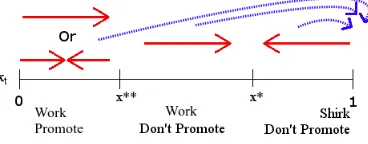
Figure 1.1: Structure of a MPE
0 0.2 0.4 0.6 0.8 1 1.2 1.4 1.6 1.8 2 0
0.1 0.2 0.3 0.4 0.5 0.6 0.7 0.8 0.9 1
Time
Beliefs
Evolution of Beliefs Between Arrivals
x* x**
Beliefs starting at 0 Beliefs starting at 1
Shirk Promote
Work Promote Shirk
Don’t Promote
Figure 1.2: Belief Dynamics between arrivals
Markov Perfect Equilibria always exist if λ ≥ π¯. From a technical perspective,
this assumption implies that beliefs are drifting up when the firm is investing and
down when the firm isn’t, which implies that at x∗ the drift is always 0 at any
equilibrium. This assumption means that the quality of the firm’s product changes
faster than the firm can signal that it has a high quality product. This is a
nat-ural assumption for a variety of applications. For instance, an athlete’s ability is
relatively responsive to how much effort they exerted at practice that season, while
constantly innovating, changing both hardware and software for a new phone, while
our beliefs that the next phone is going to be good or bad seem to change relatively
slowly. When a firm stops investing in its star employees, they leave and find new
employment much faster than the firm can credibly produce a evidence of high
quality, in particular in fields where the market for star employees is particularly
competitive.
The result that the firm never exerts effort before it starts promoting is also
present in Marinovic et al. (2015). But, unlike in Marinovic et al. (2015), this is
not always bad for the firm, since beliefs no longer jump to 0 as soon as consumers
believe the firm would be promoting but don’t see any news. In Marinovic et al.
(2015), promotion never has any value to the firm in equilibrium. The best possible
case is that the marginal benefit from promotion is equal to its cost. As opposed
to the MPEs in Marinovic et al. (2015), in this paper the firm exerts effort when
beliefs are non-zero and benefits from consumers giving them the benefit of the
doubt when they don’t see any news.
I consider two different types of commitment to investigate how endogenous
promotion changes firm payoffs. I first examine how the game with endogenous
promotion compares to the game with exogenous promotion from Board and
Meyer-ter-Vehn (2013). In this game, the firm pays a lump sum at the beginning of the
game in order to commit to promoting whenever it has a high quality product for
no flow cost.6 I then consider what strategy promotion strategy the firm would
like commit in the game with endogenous promotion. Since the firm’s promotion
strategy was not observable by consumers, the firm is unable to fully internalize
the impact its choice of promotion has on the drift of beliefs and on the level
of investment. By allowing the firm to commit to a promotion strategy, I can
investigate whether the firm is over or under-investing in promotion.
The ability to promote creates a moral hazard problem. The firm needs to
be promoting before it has any incentive to invest in its product. Consider the
alternative game from Board and Meyer-ter-Vehn (2013), where the firm cannot
control the news process. Instead consumers learn by observing an exogenous news
process with arrival rate ¯π1θt=H.
Board and Meyer-ter-Vehn (2013) show that in the game with exogenous
pro-motion, all MPEs have the following form
a(x, θ) =
1 if x < x∗BM
0 if x > x∗BM
for some cutoff x∗BM ∈[0,1]. Comparing this cutoff to the cutoff in when the firm
can endogenously promote allows me to look at how the ability to endogenously
choose the level of promotion changes how reputational concerns incentivize the
firm to invest in quality.
Proposition 2. Ifλ≥π¯then the equilibrium of the game with exogenous promotion
is unique and x∗BM ≥x∗ (and is strict as long asx∗BM ̸= 0). Let X be the stationary
distribution, supp(XBM)⊆supp(X).
The firm’s incentives to invest in quality are reduced when compared to the
game studied in Board and Meyer-ter-Vehn (2013). While the firm still eventually
invests in quality, it starts investing at lower reputations, so the incentive to exert
effort to avoid a bad reputation is diminished. The ability to choose when to
promote decreases the gap between the payoffs received by a firm selling a high
quality product and a firm selling a low quality product, so the firm chooses to
start working at a lower belief. This does not necessarily imply the firm is always
investing less in quality, because beliefs move in a fundamentally different way in the
two models. While the firm with exogenous promotion starts working at a higher
belief, it expect beliefs to jump to 1 more, since arrivals can occur anywhere, and
these arrivals delay when it has to begin investing in effort. On the other hand,
when the firm has a low quality product, it will begin investing sooner in the game
with exogenous promotion than in the game with endogenous promotion, because
no news can arrive to delay investment.
The firm receives some benefit from exogenous promotion. For instance, a firm
selling a low quality product when beliefs are close to 1 receives higher flow payoffs
for longer because consumers’ no longer make inferences from not seeing any news,
but there also is a cost. After news arrives, consumer beliefs can drop to a lower
firm’s payoffs. This suggests that a firm may benefit from committing to exogenous
promotion by hiring an outside advertising agency, in order to incentivize effort at
higher beliefs.
When promotion is exogenous, consumers learn that that the firm is selling a
high quality product more frequently.
Corollary 1. Let x0 = 1, and λ ≥ π¯. Let τ = inf{t > 0 : xt = 1}, and τBM =
inf{t >0 :xBM,t = 1}. Then E(τ)> E(τBM).
The expected time it takes for reputation to return to 1 is smaller when the firm
has committed to exogenous promotion. Reputation cycles more frequently when
the firm has committed to promote. The increased incentive to invest leads to a
higher shirk-work cutoffx∗, which in turn leads to consumers learning that the firm
is selling a high quality product more frequently.
This suggests that the firm may benefit overall from committing to promote
whenever it has a high quality product, independent of its reputation. If the firm
could pay an advertising agency a lump sum in exchange for the ad agency
commit-ting to promote, they would benefit from the enhanced incentives for investment
in quality. This is explored more in the following section, in the limiting case as
c→0.
In equilibrium, the firm is not fully internalizing the impact of its choice on
promotion on the law of motion for beliefs and on its choice of investment. To
With this commitment power, the firm internalizes its ability to control the drift of
beliefs, and how its choice determines what investment strategies are credible.
Proposition 3. Suppose λ ≥ ¯π. If the firm could commit to promoting below any
cutoff, it would commit to promoting at a cutoff x∗∗c ≤ x∗∗ for any x∗∗ that is a
promotion cutoff in a MPE of the original game.
Given an equilibrium, with cutoffs x∗, x∗∗, in the game where the firm has
com-mitted to the optimal promotion strategy, it chooses to invest in quality at a higher
reputation, x∗c ≥x∗ for anyx∗ that is a investment cutoff in the MPE of the original
game if θ0 =H and x0 ∈[0,1]\[x∗, x∗∗).
If θ0 =L, there exists some x >¯ 0 such that if x0 ≤x¯ the previous result holds.
0 0.1 0.2 0.3 0.4 0.5 0
0.1 0.2 0.3 0.4 0.5 0.6 0.7 0.8 0.9 1
k
Belief Cutoff
Cutoffs with and without Commitment to Promotion Strategy
x* x** with commitment x* with commitment x**
Figure 1.3: Optimal level of investment and promotion with and without commit-ment.
The firm commits to a higher level of promotion because it now internalizes
the impact its promotion has on the drift of beliefs. This in turn, can increase
the incentives to invest, by raising the payoff from a high reputation. The firm is
be promoting less, in order to prevent consumers from interpreting lack of news as
a bad sign, but without commitment power, it cannot convince consumers that it
wouldn’t promote at a higher reputation.
In order to capture how the firm’s ability to promote impacts incentives, it
is interesting to consider the limiting case as c → 0. This simplifies the firm’s
effort choice, and allows me to focus on the firm’s promotion decision and how that
decision impacts payoffs. In addition, while there may be multiple equilibria in
this model, these equilibria all converge to the same limiting equilibrium as c→0,
which allows me to characterize some comparative statics.
Proposition 4. As c→0, if λ≥π¯,
1. |x∗−x∗∗| →0
2. There is a unique point x¯∗∗ such that for any sequence of costs (cn)∞n=1 and
a corresponding sequence of equilibria, characterized by cutoffs (x∗n, x∗∗n)∞n=1,
x∗∗n →x¯∗∗. moreover x¯∗∗ <1.
3. In the limiting equilibrium, as k decreases payoffs increase.
Unlike in Marinovic et al. (2015), decreasing k doesn’t always decrease firm
payoffs. When costs are sufficiently low, the firm benefits from cheaper
promo-tion, because it increases the firm’s incentives to work. The gap between the work
cutoff and the promotion cutoff vanishes, but the firm still only works after it has
cred-ibly work unless consumers expect it to also promote when it has a high quality
product. Even as investment becomes arbitrarily cheap, the firm still doesn’t work
everywhere. The firm still has to pay for promotion to make effort worthwhile,
which indirectly makes effort costly.
Reputation cycles persist, even as investment becomes arbitrarily inexpensive.
The firm’s reputation drifts down until hitting x∗, and the firm then invests in
building it back up. Even a very established firm has to invest in promoting its
product.
In this limit, I can compare the payoffs from the game with exogenous promotion
to the game with endogenous promotion.
Proposition 5. Asc→0, ifλ≥π¯,VBM(x, θ)> V(x, θ)+E
(∫∞
0 e− rtkπ
t|x0 =x, θ0 =θ
) ,
where VBM is the value function from the game where news arrives at exogenous
rate π¯1θt=H.
So the firm would be willing to pay more than its total expected expenditure on
promotion in order to commit to promoting at rate ¯π whenever it has a high quality
product. In this limit, the firm is hurt by the ability to control promotion because it
leads to worse consumer beliefs. The firm benefits from hiring an advertising agency,
even if the agency doesn’t have any sort of comparative advantage or superior
technology. The firm benefits simply because the ad agency can be used as a
commitment device, convincing consumers that the firm will promote whenever it
The ability to promote also can lower the firm’s payoffs by causing beliefs to
drift down faster. If the firm could commit to never promote, beliefs would always
follow the law of motion ˙xt = λ(˜at −xt) instead of drifting down at rate ˙xt =
λ(˜at−xt)−π˜t(xt)(1−xt), but the firm also loses the ability to benefit from investing
in quality, since consumers no longer see any news. In the limit, as c → 0, I can
characterize which of these effects is larger.
Corollary 2. As c → 0, if λ ≥ π¯, payoffs in the limiting equilibrium are greater
than payoffs in the equilibrium where the firm has committed to never promote.
The firm still does benefit from promotion, even though it makes effort costly.
Since promotion allows consumers to distinguish between high and low quality firms,
it gives firms the ability to build a reputation. Without this promotion technology,
the firm would have no incentive to work because shirking would be undetectable.
These results contrast with Marinovic et al. (2015) where in any Markov Perfect
Equilibria, payoffs are decreasing as k decreases and the firm would rather commit
to not promoting in any MPE. The deterministic nature of the firm’s signaling
technology in Marinovic et al. (2015) model forces the firm to signal so frequently
that the firm no longer benefits at all from building a reputation.
1.4 The Bad News Case
In this section I consider the case in which consumers learn= about the firm’s
Unlike promotion, censorship is a substitute for effort and can cause incentives to
completely break down.
The difference between the good news and bad news model is the news process.
Now the news process has arrival rate max(0,π¯1θt=L−πt) andπt∈[0,π¯]. Consumer
beliefs now follow the law of motion
˙
xt= λ|( ˜At{z−xt})
Quality breakthroughs
+ (¯|π−Π˜t){zxt(1−xt})
Absence of news .
Unlike in the good news case, the signaling term now causes beliefs to drift up. If
consumers believe the firm is not censoring, not seeing any news is more likely to
occur when the firm is selling a high quality product. When news arrives, consumers
learn that θt=L and adjust their beliefs to 0.
Incentives to work and censor are now driven by the firm’s fear of consumers
figuring out that it is selling a low quality product. As before, the firm’s value
function can be written as
V(x, θ) =
∫ ∞
0
e−(∫0tr+λ+¯π−πsds)[x
s+ ¯π1θt=L(V(0, L)−V(xt, L))
+πt(V(xt, L)−V(0, L)−k))
+at(λ(V(xt, H)−V(xt, L))−c)
+λ(V(xt, L)−V(xt, θ))−rV(xt, θ)]dt.
incentive to invest is still driven byD(x), but now the incentive to promote is driven
by ∆(x) = V(xt, L)−V(0, L).
Lemma 3. (Sequential Rationality) The optimal a(xt, θ) solves
max
a∈[0,1]λD(xt)a−ca
and the optimal π(xt, L) solves
max
π∈[0,π¯]∆(xt)π−kπ.
This leads to very different effort choices than the good news case. Now the
firm has incentives to invest when beliefs are high, because it is worried about
consumers finding out that it has a low quality product. Like before, D(x) and
∆(x) are related.
Lemma 4. The difference in expected payoffs between a firm selling a high quality
product and a firm selling a low quality product can be written as
D(x0) =
∫ ∞
0
e−(r+λ)t[(¯π−π(xt, L))(∆(xt))−kπ(xt, L)]dt.
Moreover, payoffs satisfy the following properties for any beliefs
1. V(·, H) and V(·, L) are strictly increasing.
3. ∆(x) is increasing.
4. D(x) is increasing.
D(x) is increasing in x by similar logic as the good news case. ∆(xt) is clearly
increasing in x, and πt maximizes pointwise ∆(xt)πt−kπt. This is equivalent to
minimizing (¯π −πt)∆(xt) + kπt. Since ∆(xt) is strictly increasing in x, so the
minimum value of this is increasing in x. Moreover, as before, beliefs that start
out higher always stay higher, so for any x > x′, the integrand is always greater
for xt than for x′t, so D(x) > D(x′). This means, as before, equilibrium can be
characterized in terms of cutoffs x∗ and x∗∗.
Proposition 6. A MPE exists. Moreover, in any MPE, there exist cutoffs x∗ ∈
[0,1] and x∗∗∈(0,1] such that equilibrium strategies take the form
a(x, θ) =
1 if x > x∗
0 if x < x∗ ,
for θ ∈ {L, H},
π(x, L) =
¯
π if x > x∗∗
0 if x < x∗∗ ,
and π(x, H) = 0.
Consider any equilibrium where x∗ and x∗∗ are less than 1. Then there is a
working, and the firm never leaves this region. So in this region D(xt) = rk+¯πλ, the
difference in the payoff for the high and low quality firms comes purely from the low
quality firm having to pay the additional cost of censorship. This naturally implies
the following stark result
Proposition 7. When (1 + λr)c > kπ¯, there is a unique MPE.7 In that MPE the
firm never invests in quality.
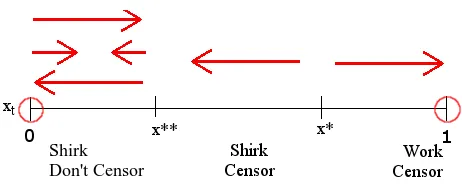
Figure 1.4: The structure of a full shirk equilibrium
The firm’s ability to censor gives it quite a bit of control over how much it loses
from quality switching from high to low. Since the firm can always censor bad
news after quality switches, it never loses more than kπ¯ at each instant of time
from being a low quality firm. Therefore it would never exert effort whenkπ¯ is low
enough relative to the cost of effort. If censoring bad news is too easy (for instance,
cheaper than exerting effort), then the firm would always choose to substitute effort
for censorship.
7In this proposition and the subsequent proposition, uniqueness is taken to mean that all
The intuition that leads to the firm never investing in quality holds for more
general classes of equilibria than Markov Perfect. The argument that the firm never
invests in quality straightforwardly generalizes to any equilibrium that uses calender
time in addition to belief and firm type as the state variables, and in fact it holds
for the class of all almost perfect bayesian equilibria.
Proposition 8. If (1 +rλ)c > kπ¯, the MPE from proposition 7 is the unique perfect
bayesian equilibrium.
This contrasts dramatically from the result in Board and Meyer-ter-Vehn (2013),
who find that without the ability to censor bad news, there are equilibrium where
the firm works. In fact, when λ ≥ π¯ and (r+λλ)(π¯r+¯π) > c, there are constants a < b
such that all x∗ ∈ [a, b] are is a cutoff of an equilbria where the firm works above
x∗ if the firm was unable to censor. But giving the firm the ability to censor for a
low enough cost completely destroys the firm’s incentives to invest.
0 2 4 6 8 10
0 0.1 0.2 0.3 0.4 0.5 0.6 0.7 0.8 0.9 1
Time
Beliefs
Belief Trajectory in a Full Shirk Equilibrium
Beliefs x** Shirk
Censor
Shirk Don’t Censor
This full shirk equilibrium has many undesirable properties from the firm’s
per-spective. While an equilibrium where the firm is working can have persistent
repu-tation building, with probability 1 in a full shirk equilibrium the firm’s repurepu-tation
vanishes in finite time. A firm that could commit to not censoring would not suffer
from these sorts of incentive problems. Board and Meyer-ter-Vehn (2013) identify
the possibility of equilibria where the firm works when the bad news technology
is exogeneous, but introducing sufficiently cheap censorship technology completely
destroys these incentives.
Corollary 3. Suppose (1 +λr)c > kπ¯. Let (rn)∞n=0 be a sequence of discount rates
such that rn → 0. Consider a sequence of equilibrium with discount rate rn, and
a sequence of equilibria of the game where the firm has committed to not censor.
Then:
1. limn→∞rn
(
Vn(x, θ) +E
(∫
e−rntkπ
tdt|x0 =x, θ0 =θ
))
≤lim infrnVc,n(x, θ).
2. This inequality is strict for any x >min(1− λ¯π,lim supx∗c,n)8
The firm’s willingness to pay for not censoring is always higher than the amount
the firm expects to spend on censorship in the game with endogenous censorship
as the firm becomes patient whenever the firm’s reputation starts high enough. As
the firm becomes patient, all that matters is where beliefs end up. In the game
with censorship, 0 is the unique absorbing state, beliefs always eventually converge
8A sufficient condition forx >lim supx∗
c,n is if ∫∞
0 e−
λtπ¯∫∞ t e−
¯
πsx
sds dt≥λc, where x0=x
to 0. On the other hand, in the game where the firm has committed, in any region
where beliefs are drifting up, with positive probability the firm eventually starts
selling a high quality product, never stops, and beliefs drift up towards 1. So the
firm receives a positive payoff with positive probability forever.
Whenkπ >¯ (1 + λr)c, there may exist equilibria where the firm invests in quality.
The firm now finds investing desirable because once it has a high quality product,
it has either shut down bad news or no longer needs to censor bad news. There
always exist equilibria of the form illustrated in the following figure.
Figure 1.6: The structure of an equilibrium where the firm stops censoring before it stops working.
In this equilibrium, the firm works and censors when it has a high reputation,
stops censoring at an intermediate reputation and stops working when its reputation
is low enough. In equilibria of this type, as long as x∗ > 0, beliefs can converge
to 0 or 1. At 1, the firm has the incentive to invest because if the firm chooses
not to invest and its product becomes a low quality product, it will then have to
censor news to maintain its high reputation. But, since censoring is sufficiently
expensive, the firm always has the incentive to invest in quality in order to not
that it is investing in quality, so it never benefits from investing in quality, and its
reputation can never recover. For very low c, the firm can have the incentive to
work everywhere, in which case beliefs converge to 1 with probability 1.
In this equilibrium, beliefs depend crucially on the both the initial condition
and are path dependent. In the region where the firm is censoring and investing,
beliefs converge to 1 with probability 1. If beliefs start in the region near 0 where
beliefs are drifting down, beliefs converge to 0 with probability 1. In every other
region, with positive probability beliefs converge to either 1 or 0.
While the game without censorship from Board and Meyer-ter-Vehn (2013) has
similar qualitative features, now a low quality firm with a high reputation can
benefit from the ability to censor. The low quality firm can’t be caught selling a low
quality product if it’s censoring, so it is better able to maintain a high reputation.
On the other hand, a firm with a high quality product and a high reputation is only
hurt by the ability to censor. Since the firm always has the incentive to invest in
quality in the region where it has chosen to censor, a firm that starts with a high
quality product never actually censors any bad news. On the other hand, the firm
faces beliefs that drift up more slowly than they would if the firm could convince
consumers that it was working and never censoring.
Equilibrium could also have the structure illustrated in the following figure.
Equilibria with this structure may not always exist, but there are parameter values
dis-Figure 1.7: The structure of an equilibrium where the firm stops working before it stops censoring.
tribution of beliefs is entirely determined by the initial belief. Unless beliefs start
in the region where the firm invests and censors, beliefs go to 0 with probability 1,
and otherwise beliefs go to 1 with probability 1. As in the previous case, the ability
to censor allows a low quality firm with a high reputation to preserve its reputation
until it successfully develops a better product. On the other hand, it now allows a
low quality firm with an intermediate reputation that never plans on investing in
quality to prevent its reputation from dropping to 0 until it is already very low.
1.5 Exogenous News
In this section I consider the case of exogenous news. In the good news case,
exoge-nous news means that good news can arrive even when the firm is not promoting,
and in the bad news case, the firm can no longer perfectly censor negative
informa-tion.
In the good news case, news now arrives at rate (µ+πt)1θt=H. Even when the

![Figure 2.1: Probability of Learning Outcome. (FL(s) = 53(s2−.04), FR = 103 (s− 12s2−3/5),supp F = [.2, .8])](https://thumb-us.123doks.com/thumbv2/123dok_us/9247423.1460953/97.612.188.445.86.304/figure-probability-learning-outcome-fl-fr-supp-f.webp)
![Figure 2.2: Regions of Stability. (πP = .9, FL(s) = s2, FR = 2s − s2, supp F = [0, 1])](https://thumb-us.123doks.com/thumbv2/123dok_us/9247423.1460953/104.612.186.447.83.291/figure-regions-stability-pp-fl-fr-supp-f.webp)
![Figure 2.3: Cut-off on ν for Learning Outcome. (πP = .9, FL(s) = s2, FR = 2s − s2,supp F = [0, 1])](https://thumb-us.123doks.com/thumbv2/123dok_us/9247423.1460953/105.612.195.448.345.549/figure-cut-o-learning-outcome-pp-fl-supp.webp)
