Ph.D . Thesis
University College London
N O N L IN E A R EFFECTS IN T W O -D IM E N S IO N A L
S E P A R A T IN G -F L O W T R A N S IT IO N
ProQuest Number: 10055402
All rights reserved
INFORMATION TO ALL USERS
The quality of this reproduction is dependent upon the quality of the copy submitted.
In the unlikely event that the author did not send a complete manuscript
and there are missing pages, these will be noted. Also, if material had to be removed,
a note will indicate the deletion.
uest.
ProQuest 10055402
Published by ProQuest LLC(2016). Copyright of the Dissertation is held by the Author.
All rights reserved.
This work is protected against unauthorized copying under Title 17, United States Code.
Microform Edition © ProQuest LLC.
ProQuest LLC
789 East Eisenhower Parkway
P.O. Box 1346
Abstract
In this thesis the main aim is to extend the theory governing the
unsteady separating flow of an incompressible fluid. In particular,
attention is restricted to the study of two-dimensional motion.
The governing equations are derived in chapter 2. It is assumed
that the incoming boundary layer has undergone a smooth separation
and that the region of concern is sufficiently far downstream that
viscous effects are confined to a thin free shear-layer and a thin
wall-layer. A high-frequency analysis is pursued, with the relative
scalings maintaining the standard triple-deck structure. The linear
instability of these governing equations is readily verified and the
work goes on to consider nonlinear properties.
In chapter 3 the link between the current and a more global type
of separation is highlighted. The study addresses the phenomenon of
a finite-time break-up of the governing equations and investigates
the existence of a particular break-up known to be possible in the
latter-mentioned global flow (see §§3.2-3.4 for details of this more
global flow-configuration). However, the analysis in §§3.5-3.7
suggests that such a break-up is not possible.
At this point the thesis turns to a numerical solution of the
governing equations. A novel type of numerical procedure is adopted
in which the numerical grid is transformed in such a way that the
deployment of grid nodes should enhance the numerical accuracy. This
procedure is explained in chapter 4 and tested (in chapter 5) on the
solution of the one-dimensional Burgers equation. The results are
found to be encouraging.
This numerical treatment (in chapter 6) leads to the analysis in
chapter 7 where a new distinct finite-time break-up is proposed for
the current flow problem. Lastly in chapter 7, the study returns to
a numerical solution of the governing equations, and different
initial conditions tend to confirm this new break-up numerically.
The thesis closes its main body of work in chapter 8 and notes
the possibility of the application of both the new break-up form and
the numerical technique to related flow problems.
Finally, an appendix is included which presents work in progress
C O N TE N TS
A b st r ac t . page 2
Cont ent s. 3
Ac kn owl ed ge me nt . 6
Chapter One:
Introduction
Chapter Two:
The structure of nonlinear disturbances
in separating flow, and their governing equations
le
§2.1 Linear and nonlinear stability analysis. 17
§2.2 The nonlinear governing equations. 24
Fi gur es 2.1-2.4. 27
Chapter Three:
The finite-time break-up
of separating motion : first analysis
31
§3.0 Introduction. 32
§3.1 A break-up solution for subsonic mid-scale
separating flow. 33
§3.2 A break-up solution for supersonic full-scale
separating flow. 35
§3.3 The downstream adjustment region at x=x^. 39
§3.4 The upstream adjustment region at x = — 2x^_. 40
§3.5 Seeking a corresponding break-up solution for
supersonic mid-scale separating flow. 41
§3.6 The downstream adjustment region at X = X + (revisited). 47
§3.7 The upstream adjustment region at X = — 2X^ (revisited). 51
Chapter Four:
Numerical grid generation
ei
§4.1 Introduction. 62
§4.2 A grid-transformation procedure. 64
Fi g u r e s 4.1-4.3. 70
Chapter Five:
An investigation into the efficiency of the
current grid-transformation procedure
73
§5.1 The one-dimensional Burgers equation. 74
§5.2 The analytic solutions of the one-dimensional
Burgers equation. 77
§5.3 The numerical solutions of the one-dimensional
Burgers equation. 81
§
5.4
Results and comparisons. 88§
5.5
Captions for figures 5.1-5.27. 90Fi gur es 5.1-5.27 93
Chapter Six:
A numerical treatment of the supersonic
mid-scale separating flow problem
120
§6.1 Captions for figures 6.1-6.7. 126
Chapter Seven:
The finite-time break-up of
separating motion : second analysis
134
§7.1 Introduction. 135
§7.2 Derivation of the mid-scale break-up
governing equations. 140
§7.3 The solution of the mid-scale break-up
governing equations. 145
§7.4 Numerical results and comparisons. 152
§7.5 Captions for figures 7.1-7.13. 156
Fi g u r es 7.1-7.13 158
Chapter Eight:
Discussion
in
Appendix A
175
F i g u r e A1 183
Acknowledgement
I am most grateful to ray supervisor, Professor F.T. Smith, for
suggesting this line of research and for his invaluable help,
guidance and encouragement throughout the course of this work.
Thanks go also to my family, friends and colleagues at U.C.L.
for their support and advice during the preparation of this thesis.
Financial support was provided by the Science and Engineering
Research Council (SERC).
I.P.V.
Our concern in this thesis is the study of the flow of an
incompressible fluid past a bluff body placed within an otherwise
parallel or nearly parallel main-stream flow. A theoretical
description of such flows, predicting and accounting for such
practically observed phenomena as separation, transition and
turbulence, would clearly be of great use, and the applications in
the fields of aerodynamics and meteorology, for example, are
obvious. These applications include vehicle and turbine design in
aerodynamics, and weather prediction and air-flow past buildings in
meteorology. Therefore the physical motivation for such a study is
clear. Our special emphasis is on unsteady separating flow and
tra n s i t i o n .
The framework which allows us to begin such a theoretical
approach is provided by the Navier-Stokes equations. These describe
the flow of a Newtonian fluid of constant density p* and kinematic
viscosity u * . Obviously, many real flows are fully three-dimensional
in nature. However, we will consider only two-dimensional motion
here, and concentrate on the understanding of this less complicated
problem. Hence the two-dimensional Navier-Stokes equations, in
nondimensional form, are:
f ; + = 0 , (1.1a)
^u , d u , ______ ________
d t d x d y d x ^ ReV^x^ ^ d y
Here (x,y), (u(x,y,t), v(x,y,t)), p(x , y , t ) denote the Cartesian
coordinates, the corresponding velocity components and the pressure,
respectively, nondimensionalized with respect to a typical length
scale /* of the flow, to a velocity scale C/* and to p * in turn.
These then fix the nondimensionalization of the time t with respect
to /*/[/*. The nondimensional coefficient R e = is the Reynolds
n u m b e r .
The boundary conditions for (l.la-c) are the no-slip
conditions u = v = 0 at any fixed surface, a condition of streaming
conditions in certain flow problems.
In many practical situations the Reynolds number Re takes very
large values (for example 10®, 10® in flow past airfoils). So a
useful working assumption would seem to be to suppose that the fluid
is effectively inviscid (i.e. to neglect the second-order
derivatives in (1.1b, c)): see, for example. Lamb (1932), Lighthill
(1978). An inviscid approximation to the flow solution is only
appropriate, however, if it gives the limit of the actual viscous
flow when the Reynolds number becomes asymptotically large (cf. the
inviscid theory predictions of zero drag and a nonzero slip velocity
at a fixed surface). An assumption that is therefore implicit in all
inviscid-flow studies is that the action of viscosity is important
only in certain narrow regions, such as boundary layers or surface
layers, which become vanishingly thin as the Reynolds number
increases. It is argued that these viscous regions may therefore be
neglected. A less stringent assumption is to suppose that the flow
in the viscous regions determines a second-order correction to the
predominantly inviscid fluid flow outside. The only requirement for
such an approach to work is an a p r i o r i knowledge of the location of
the viscous regions.
This idea forms the basis of the classical boundary-layer
theory in which, in the present context, it is assumed that viscous
effects are confined to a thin boundary layer lying close to the
body surface and possibly to a thin viscous wake. This configuration
was proposed by Prandtl (1904) who showed that such layers on flat
plates are of 0 ( R e “^/^) thickness, and his theory allowed viscosity
to be correctly accounted for, such that the no-slip condition could
be satisfied at the body surface within the boundary layer. The
Navier-Stokes equations (l.la-c) can be re-scaled to give the
boundary-layer equations which are driven by a prescribed pressure
variation, obtained via the inviscid analysis for the majority of
the flow. Then in principle a matching between the solutions in the
two flow regions is possible. An exact solution of the
boundary-layer equations was provided by Blasius (1908), who discovered a
similarity variable for flow over a flat plate, leading to a
It would appear, therefore, that an attractively ordered
scheme is possible for obtaining solutions of (l.la-c) when Re ^ 1.
Unfortunately, however, apart from a few notable exceptions (those
described by Smith (1982), for example; namely the flat plate,
marginal separations. Smith & Daniels* (1981) flow), this classical
scheme above never works.
Its main deficiency (Brown k Stewartson (1969)) is that it
cannot cope with any flow reversal in the boundary layer. Such flow
reversal is inevitably approached in the classical boundary layer on
any thick and/or nonaligned body. This is supported by the accurate
numerical treatments described by Brown k Stewartson (1969) which
indicate that the Goldstein (1948) singularity occurs at the point
where the onset of flow reversal occurs. Stewartson (1970) then
showed that this Goldstein singularity is not removable in general,
although there are exceptions for particular cases, notably Smith k
Daniels (1981).
The resolution of the above difficulty is now known to be in
the development of a local three-tiered structure, the triple-deck.
This structure was developed by Stewartson k Williams (1969),
Neiland (1969) and Messiter (1970), although its origins lie in the
work of Goldstein (1930), who analyzed the wake behind a flat plate
in order to try to continue the Blasius solution into the wake
region, and of Lighthill (1953), who considered interactions between
a boundary layer and a supersonic main stream which take place
without separation.
The crucial element of the triple-deck structure is that the
pressure that drives the viscous flow in the wall layer now
interacts with the inviscid pressure in the outer potential region.
This is in contrast with the above classical scheme which treats the
boundary-layer pressure gradient as prescribed, and leads to the
difficulties described above.
The pressure in the triple-deck middle zone, which is of the
same normal extent as the oncoming boundary layer, is simply the
Blasius solution pressure, or a small correction to it. Therefore an
upper inviscid layer just above the existing boundary layer is
necessary to eiisuie interaction.
layer must be equated in magnitude with the inner pressure form.
This and the requirement that the viscous lower layer be subjected
to inertial, pressure-gradient, and viscous forces permits us to
present below an order of magnitude argument to derive the triple
deck scales (Smith (1982)). However, we should not forget that these
relative scalings were obtained via the protracted analytical
advances described earlier.
The Blasius boundary-layer solution considers a normal
variable scaled with respect to the boundary-layer thickness, R e “ ^^^.
If we propose a wall-layer thickness of 0(6Re~^^^) then, because the
Blasius profile has a streamwise velocity that becomes linear in the
normal variable as the boundary is approached, we expect that the
streamwise velocity in the wall layer will be of size 0(6). To
ensure a balance with pressure and viscous forces we must have the
pressure being of 0(6^) and then equate the local triple-deck
streamwise length scale I with the normal coordinate by /=0(6^).
The passive middle deck is displaced by the wall layer, which
in turn affects the upper deck where the displacement is still
0 (6Re’’^/^). This upper deck is one of potential flow, where the
streamwise and normal coordinates are of equivalent order. Hence we
expect the pressure to be of the order of the displacement slope.
Hence we require that
6
^ = 6Re-^/^/Z ,6
= ,from equating the inner and outer pressure magnitudes, and using
/= 0(6®). This fixes the length scales of the three tiers (figure
2.1). The upper deck then yields the potential flow equation (for a
subsonic main-stream flow) for the pressure there, with matching
constraints from the middle deck. The integration of this pressure
equation closes the unsteady interactive boundary-layer problem
which is specified in (2.1.2a-e) below.
Accurate numerical solutions (Jobe & Burggraf (1974) and many
others) of the triple-deck problem compare favourably with
experiments in a number of flow configurations, including
trailing-edgc flows and breakaway separations, and support the m u l t i
Ve remark again here that in this thesis we address only
two-dimensional features of fluid flow theory. Even in many
three-dimensional flowsy cross-flow effects are small and the
two-dimensional model is a close approximation to the three-two-dimensional
solution. For example, large-scale separation in a globally
three-dimensional motion is often probably a quasi-planar process anyway
(see F i d d e s ’ (1980) application to vortex-sheet separation), since
separation itself takes place abruptly. Moreover, the analysis
described herein applies to small local regions (cf. the small
0(Re"^/^) streamwise length scale of the triple-deck, for example)
and in some cases could apply to three-dimensional flows locally
anyway. However, cross-flow effects can be significant, e.g. Orszag
k Kells (1980), Stewart k Smith (1987), although we are not
concerned with such phenomena in this work.
The onset of flow reversal in a boundary layer is a precursor
to boundary-layer separation, in general, and hence we turn now to a
discussion of laminar separation at high Reynolds number.
For steady motion, i.e. when 5/dt = 0, the two-dimensional
separation process itself is now quite well understood on the
theoretical side (as reviewed by Smith (1977), Messiter (1979),
Stewartson (1981), Sychev (1982)). This was made possible by the
triple-deck interactive behaviour which permits a sizeable adverse
pressure gradient to lead to regular separation of the boundary
layer. This is quite unlike the noninteractive classical
boundary-layer theory described earlier. The fundamental difference is that
the Goldstein singularity at separation in the classical boundary
layer ewtôT due to the three-layered interactive structure of
the triple-deck.
Further, we may identify two types of separation:
small-scale separation, which occurs in the vicinity of a small
disturbance, such as a slight change in the wall conditions
compatible with the scalings of the interactive structure (and
therefore usually Reynolds-number dependent); and
large-scale separation, which is provoked by a sizeable disturbance
(e.g. an obstacle of finite dimensions) to the flow. Ve consider the
second of these in the present work. Large-scale separation is often
while the Reynolds number of a flow may easily be increased, the
geometry is usually fixed.
In unsteady flows, i.e. those with nonzero time dependence,
the question of hydrodynamic stability is raised. This is concerned
with the issue of when and how laminar flows break down, their
subsequent development, and their ultimate transition to turbulence.
Lord Rayleigh (1880,1887) considered the two-dimensional,
inviscid stability (i.e. (l.la-c) in the limit Re-+oo) of certain
nonuniform flows and suggested that such flows are stable unless
they contain an inflectional base profile. However, further analyses
at the time were at odds with the most basic observations, due to
the inviscid nature of these Rayleigh-type studies.
Viscosity effects were first included when an analysis of the
stability of the Navier-Stokes equations with respect to
infinitesimal disturbances was developed. Here (l.la-c) are
linearized and a normal-mode analysis is used to obtain the
celebrated Orr-Sommerfeld equation, which is a fourth-order, linear
differential equation for the stream function of a small
flow-perturbation. By various expansion techniques Tollmien (1929),
Schlichting (1933,1935) and other workers found approximate
solutions to this equation for two-dimensional parallel flows. They
suggested analytically the existence of instability waves and
predicted neutral curves to define stable and unstable regimes of
various flows. Lin (1945) made similar calculations and some
improvements and subsequently, Schubauer k Skramstad (1947) showed
the existence of these T o i Imien-Schlichting waves experimentally.
The agreement with the T o i Imien-Schlichting theory was found to be
good, particularly for higher values of the Reynolds number.
These investigations considered the basic flow to be
independent of the streamwise coordinate, assuming that any effects
from the growth of the boundary layer were minimal. Smith (1979a)
proposed an alternative approach 1 cf rationally incorporating these
nonparallel effects. He showed that the T o i Imien-Schlichting modes
could be described by a triple-deck structure. The length scales in
operation for this structure actually coincide with those of the
triple-deck that arises at boundary-layer sepaia t i o n . Hence
to solving the interactive boundary-layer equations ((2.1.2a, b)
below) together with the appropriate pressure-displacement law (e.g.
(2.1.2e) for a subsonic main-stream flow) and boundary conditions
((2.1.2c,d) below).
For small-scale separation suitable decay conditions hold in
the far field. In contrast, large-scale, or breakaway, separation
causes an 0(1) global change in the outer inviscid flow and requires
further consideration. Here the main part of the oncoming boundary
layer shifts away from the body surface and appears in the outer
flow as a thin free shear layer of concentrated vorticity,
separating regions of predominantly inviscid flow. Therefore the
shear layer thickness is initially 0(Re~^^^).
To pursue a stability analysis we take the laminar separating
flow (Smith (1977)) as the starting configuration and study the
development, with time, of disturbances applied locally in the flow.
From the classical 1 inearized-stabi1 ity theory associated with
infinitesimal disturbances (e.g., see Drazin & Reid (1981)), it is
known that such nonparallel basic flows are susceptible to linear
instabilities of the Rayleigh, Kelvin-Helmholtz and Gortler types on
a local quasi-parallel basis, as well as to the viscous
Tollmien-Schlichting instabilities which are possible in virtually all
realistic boundary layers. The first three of these concern the
inviscid limit (i.e. Re— ^oo) in which the shear layer appears as a
vortex sheet and they are due to the possible inflectional nature of
the velocity profile, and/or the local curvature of the basic
separating flow.
It is fairly clear that the development of any sufficiently
small disturbances in the flow is controlled initially by the above
linear instability characteristics. However, as the instability
grows, nonlinear aspects will come increasingly into the reckoning,
and are indeed thought to be necessary in order to theoretically
address (Smith k Elliott (1985), Smith (1987)) observed phenomena
such as dynamic stall and transition (Bursnall k Loftin (1951),
Gault (1955), Gaster (1966), Mueller k Batill (1980)).
The triple-deck equations provide the starting point for the
consideration of nonlinear instability, and we focus on
whereby the flow is subjected to a local high-frequency disturbance.
In addition, in the current thesis we introduce, for the first
time for near-wall flows, effects due to the thickness of the shear
layer (Moore (1979), see also Saffman k Schatzman (1982,1982)),
which we have hitherto assumed to be negligible. This is presented
formally in chapter 2 for large-scale two-dimensional separation.
The physical links between transition and separation are
undeniable with many experimental investigations witnessing not only
the transition to turbulence of a laminar separating flow, but also
turbulent separation (see, for example, Gaster (1966), Kozlov
(1987), Sychev k Sychev (1980) and references therein).
Mathematically, the connection is evident in the fact that both
phenomena may be encountered via the interactive triple-deck
equations, if we address T o i Imien-Schlichting type transition (Smith
(1979a,b)) for example.
In fact, Hall k Smith (1991) propose that there are three main
types of strongly nonlinear transition. These are the
above-mentioned high-frequency/Euler theory, Tollmien-Schlichting theory
(e.g. Smith (1979b)) and vortex/wave interaction theory (e.g. Hall k
Smith (1989)).
In Appendix A, we consider a possible path to transition which
contains elements of all three of the above theories. It is a type
of vortex/wave interaction which occurs within the triple-deck
structure (i.e. Tollmien-Schlichting) at high frequencies. Also, a
degree of three-dimensionality is included. The present contribution
arose from discussions with Prof. F.T. Smith and is joint with him
and Dr. R.G.A. Bowles. We present the analysis, leading to the
governing equations, in Appendix A.
Moreover, we strongly expect a nonlinear break-down behaviour
of these governing equations. This belief is due to the findings of
Stewart k Smith (1992) on a related vortex/wave interaction. These
findings agree well with experimental observations (see their §5.3
and references therein) and, therefore, we feel that this line of
Chapter Two:
2.1
Linear and nonlinear stability analysis
Both small-scale and large-scale separating flows are very
prone to instability and subsequent transition in practice,
especially the large-scale forms. In this section we discuss their
linear and nonlinear unsteady properties on a local basis,
relatively close to the separation point, as opposed to the more
global unsteady features exhibited for example by Brown, Cheng k
Smith (1988).
Near separation and just beyond it there are many types of
1inear-instabi1ity modes that can be triggered off, starting with
viscous-inviscid T o i Imien-Schlichting waves upstream which owe their
existence to interaction between the local pressure and displacement
variations, i.e. they are encountered via a triple-deck structure
(see Smith (1986a)). These are followed soon by predominantly
inviscid Rayleigh modes (Smith k Bodonyi (1985), Tutty k Cowley
(1987)), as the separating flow develops a sufficiently strong
inflexion point, and possibly by viscous Gortler-vortex instability
due to the relatively large local curvature of the streamlines.
Further downstream the inviscid modes then tend to take on more of a
Kelvin-IIelmholtz nature (Drazin k Reid (1981), Moore (1979), Brown,
Cheng k Smith (1988), Smith (1987)) for a free shear layer as the
detached boundary layer moves further away from the surface. The
breeding ground for all these instabilities can be regarded as the
triple-deck structure, in two-dimensional or three-dimensional form,
since that structure describes not only Tollmien-Schlichting waves
(Smith (1979b,1986a)) but also the first appearance of inflexional
modes (Smith (1987)) and it connects up with Gortler instabilities
via its three-dimensional characteristics. It is important, in
addition, that the triple-deck structure also governs the basic,
separating, flow (Smith (1977)) locally, which is an unfortunate
point in a way, as the linearized instability problem for such a
basic flow is then almost irretrievably nonparallel in nature (see
(2.1.4a,b) below). In scaled terms, with A denoting the local
(x, y, z, t) = (A" ^ / V x , A " ^ / Vy , A - ^ / V z , A " ^ / Vt) , (2.1.1a)
(u, V, w, p) = (A^/'^cU, A ^ / V V , A^/^£V, A ^ / V p ) (2.1.1b)
where e = Re~^^®, both the separating flow and its major instabilities
are therefore controlled by the nonlinear viscous-inviscid
interactive problem
^ + 0Ÿ = 0 , (2.1.2a)
with
+
0
(2.1.2b)U = v
= 0 atY
= 0 , (2.1.2c)U ~ Y + A(X,T) as Y ^ oo , (2.1.2d)
P(X,T) = 1 , (2.1.2e)
where J- denotes the finite part of the Cauchy-HiIbert integral; also
we are restricting ourselves to two-dimensional features. Here the
basic steady separation is present for d / d T identically zero, with
the unknown displacement increment — A = — A rising as X^^^ far
downstream for an open or breakaway separation there (Smith (1977)),
which is our main concern, whereas closed local separations can also
occur, for flow over a surface-mounted obstacle for instance (Smith
(1986b), Messiter (1983)), with A and the unknown pressure P = P then
tending to zero instead in the far field. Unsteady separation
corresponds to nonzero T-dependence of course but that in turn
introduces linear or nonlinear instabilities. For, if a small
unsteady disturbance (decomposed as exp(iaX — iSlT) ) of scaled
frequency O is made in the incoming motion upstream, i.e. where the
basic motion is the parallel one U = Y, V = W = P = A = 0, then the
disturbance becomes unstable (Smith (1979b,1986a)) for
n > 0; (2.1.3)
flow is none other than the Tollmien-Schlichting instability,
governed by the linearized unsteady version of (2.1.2). The
nonlinear unsteady version then yields nonlinear
Tollmien-Schlichting waves (Smith k Stewart (1987), Smith (1984,1986a), Duck
(1985)) , travelling unsteady separations (Conlisk ei al (1987)) and
the possibility of break-up (Smith (1988), and chapters 3, 7 below)
and transition downstream. Separating basic motion, by contrast, in
general poses a more difficult nonparallel-flow problem as regards
the instability since the length scales of the separating motion and
the instability coincide, which is an unfortunate point rendering
the above decomposition invalid. That is, the governing equations
for a small disturbance,
^ ^ = 0 , (2.1.4a)
- i M + D ( X , Y ) § + û f + V ( X , Y ) | f + v f = - I + g (2.1.4b)
clearly cannot be reduced from partial- to ordinary-differential
ones, in the conventional Orr-Sommerfeld fashion, because the
coefficients U, V are nontrivially dependent on X, Y in separating
flow. Unfortunately, this somewhat obvious point is overlooked in
some studies of separating-flow stability.
The main options available therefore are: a computational
treatment of the partial-differential equations (2.1.4) or their
three-dimensional counterpart, with —i Q —^ d / d T for an initial value
problem say; or an analysis based on relatively short-scale
properties where the streamwise variation of U, V during separation
is a secondary effect. Ve pursue the latter course for incoming
Tollmien-Schlichting waves upstream to find how they develop and
change as the flow separates. See also Smith k Bodonyi (1985) as
regards inflexional instability, again within shorter length scales.
Short-scale Tollmien-Schlichting waves corresponding to large values
of Q, are found to remain neutral at leading order, with the
amplitude growth or decay being fixed at higher order by a
combination of viscous and nonparallel-flow effects (Smith
G = 1 / 2 ^ 2 + 3 ( - d A / d X ) / 4 . (2.1.5)
Hence an increasing/decreasing basic displacement (— A) has a
destabilizing/stabilizing effect on the incoming waves, as would be
expected physically. For breakaway separating motion in particular
the growth rate increases indefinitely downstream, on the present
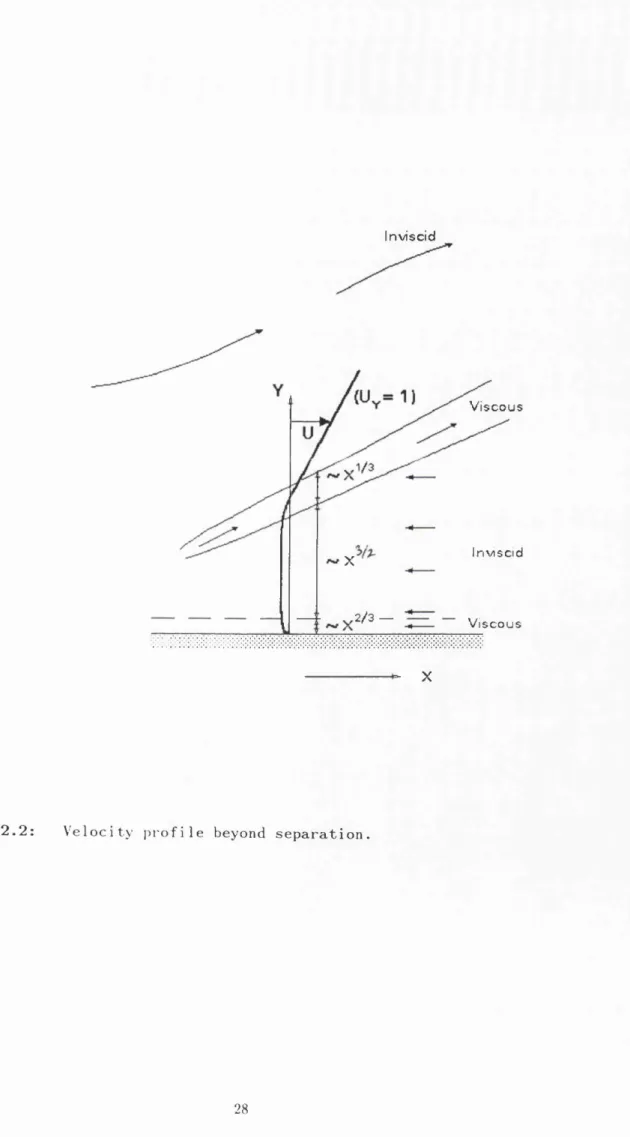
scale, since — A a then (Smith (1977)) (see figure 2.2).
Hence a new phase is entered relatively far beyond the
separation point. The critical distance involved is 0(0^/^), where
the main short waves have length 0(f2~'^^) locally and the scaled
departure distance is say, where A is 0(1). These scalings
may be obtained by the use of (2.1.5) or, alternatively, from first
principles via an order of magnitude argument in the following
manner. We suppose that the interaction occurs at a distance D
beyond separation and that the local X-scale is small, i.e.
X — >(X— D) <C D. Then, locally, we require
Y ~ ^ U ~ Y ~ A , P ^ Y (2.1.6a)
from an unsteady— nonlinear— pressure-gradient balance in the
X-momentum equation (2.1.2b), the boundary condition (2.1.2d) and the
pressure-displacement relation (2.1.2e) respectively. The scaling
for V then comes from continuity (2.1.2a). Also, we know
A ~ , T ~ < 1 (2.1.6b)
here for subsonic breakaway separation and for a high-frequency
analysis. The balances in (2.1.6a,b) yield the required scalings for
D, the local X-coordinate and also for the local flow parameters
(see below). At this 0(f2^/^) distance beyond separation the
unsteady-flow behaviour revolves around the stability of a simple quasi
parallel basic flow (figure 2.2), namely the uniform shear U ^ Y — A
above the now-detached shear layer, for Y > A, and the negligible
flow |U| <C 1 underneath, for 0 < Y < A, in scaled terms. This base
state is the downstream form of the steady breakaway-separating
motion in Smith (1977). The associated 1ineai and nonlinear
nonlinear regime, will be taken to be so at the first approximation
(see later).
Ve examine linear theory first, for a small travelling-wave
disturbance of scaled wave number a and wave speed c, then the
perturbation's stream function above the shear layer has the form
^ = p + A (Y— A — c) (2.1.7a)
for V > A, while underneath, in the slow-turning fluid occupying
0 < Y < A,
^ = p Y / c (2.1.7b)
to preserve tangential flow at or near the surface. Tildes here
denote perturbation quantities. The subsonic interaction law
(2.1.2e) now becomes
p = . (2.1.7c)
Here R e a l Ç a ) is taken to be positive, for downstream-moving
disturbances, although it is of interest that some instability also
results with R e a l ( n ) negative. Conservation of mass-flux (the
pressure is already continuous in (2.1.7a,b)) across Y = A therefore
yields the eigen-relation c^ — ac + a A = 0, from (2.1.7a-c). Physically
it seems more sensible to convert this relation to one determining a
for a given prescribed frequency Q ( = a c ) , which yields the cubic
equation
a^A - 0^1 + nf = 0
(2.1.8)
for a (Smith (1987)). This equation has certain notable properties.
First, it provides the continuation of the Tollmien-Schlichting mode
(the neutral wave above) : the solution for a can match to this
incoming Tollmien-Schlichting response, upstream, since there A — >0
and the second and third terms in (2.1.8) can then dominate, giving
in (2.1.7a)) and the first two terms in (2.1.8) become dominant,
yielding a — »fi/A. These waves are neutral and correspond to shortened
length scales, 1, again for A small when Q is fixed, or, more
generally, for small values of the parameter A ^ / Q governing (2.1.8).
Third, and in contrast, for large A (or A^ft), i.e. further
downstream, the first and third terms in (2.1.8) can dominate and
yield instability of a Kelvin-Helmholtz variety (cf. chapter 3),
since then (Q^/A)^^^exp( ± iir/S). Fourth, and perhaps the most
significant feature, is the criterion for instability, i.e. complex
roots for a from (2.1.8). For real wave numbers a the relation
(2.1.8) always yields temporal instability provided A > 0, but for
the practical alternative of a fixed-frequency disturbance, with Q,
specified as real, (2.1.8) is found to yield spatial instability if
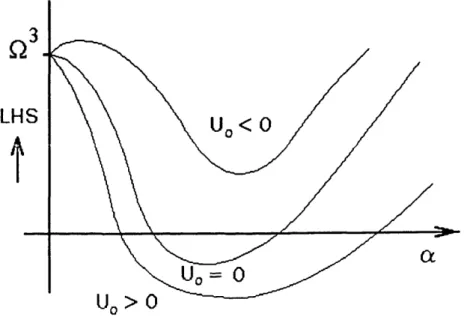
A exceeds the value A - c r i t where (see figure 2.3)
A-c r i t = . (2.1.9)
This value for A - c r i t may be obtained directly (Spiegel (1968)) or
from analysis near a repeated root of (2.1.8) for real values of a .
But since A = ( 2 b / 3 ) X ^ / ^ to leading order, with b % 0.44, this yields
the prediction
X-crit = (2.1.10)
for the distance between the separation point and the position of
abrupt enhanced instability. In dimensional terms, (2.1.10) becomes
x*-crit = /*(lî*/73b2[T)^/^A~'^/^Re"” /2^ (2.1.11)
from use of (2.1.1), where Q* is the dimensional frequency imposed
and I * , U * , Re are a typical length scale of the flow, the local
dimensional free-stream speed and Reynolds number respectively. The
range of validity of (2.1.11) is restricted, however, to
Re^/^tr/r C n* 4: , (2.1.12)
and the right restriction requiring the detachment distance to
remain small compared with the detached boundary-layer thickness.
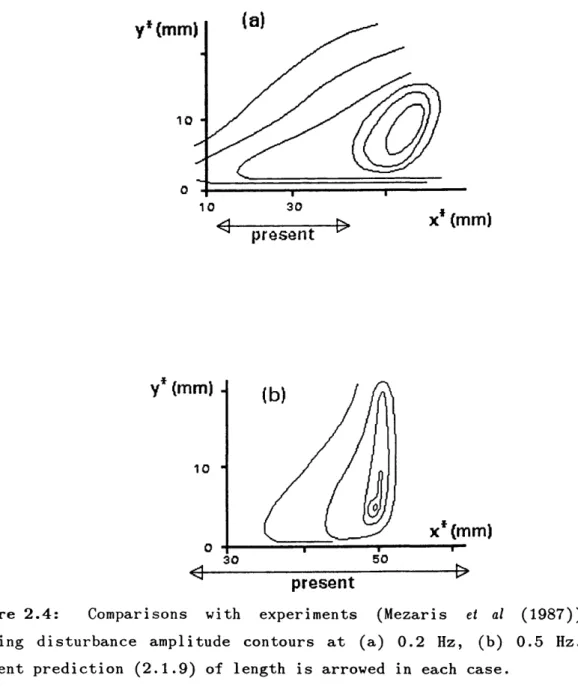
Comparisons by Mezaris ei al (1987) of their experimental results and
the prediction (2.1.11) show an encouraging amount of qualitative
agreement, and possibly also quantitative depending on the precise
value of the skin-friction factor A (see also figure 2.4).
The next steps necessary are to enlarge this theory, by going
beyond the restrictions in (2.1.12), by examining nonlinear
features, and by considering the three-dimensional version. The
first step, concerning restrictions, involves solving (2.1.4) for
0(1) values of the frequency parameter O to remove the left
restriction and, for the removal of the right restriction, solving
the spatial instability problem for the basic flow consisting simply
of the detailed Blasius profile but displaced from the surface by a
region of virtually zero motion (as in Brown, Cheng k Smith (1988)).
2.2 The nonlinear governing equations
The nonlinear extension of (2.1.8) stems from (2.1.2) in fact
and has
(u, V, p, A) - (n^/\ 0, n^/^) (
2
.2
.1
)with X — » 0(0^/^) Y -+ and the detached shear layer now
takes an unknown shape where we note again the abrupt 0(0"^/^)
X-scale. The governing equations above and below the thin shear
layer or interface are therefore the inviscid versions of (2.1.2),
+ Iÿ “ ^ ’ (2.2.2a)
+ U f + V f n = _ |P (2.2.2b)
subject to V = 0 at Y = 0, U ~ Y + A(X,T) as Y — »oo as before but now the
kinematic constraint at the interface requires
V = II + U | | at Y = S(X,T)db . (2.2.2c)
Here T — * Also, a simple assumption of tangential flow is made
at the solid surface, although that is likely to prove invalid at
later times: see also (Van Dommelen (1981), Smith & Burggraf (1985),
Smith (1987), Peridier et al (1991)). If zero vorticity is present
initially below the shear layer then the solution of (2.2.2a-c)
there produces
U = U(X,T), V = -y|^ (2.2.3)
so t h a t
d V
d T *
« U
‘d P
d X ’ (2.2.4a)
d S d T
d(su)
d \
=
0
.
(2.2.4b)Above the shear layer, by contrast
from (2.2.2a,b) and so (2.2.2c) yields
^ ( S + A) + (S + A ) A ( S + A) = . (2.2.4c)
The nonlinear system controlling U, P, S, A in this case is closed
by the pressure-displacement law
P ( X , T ) = , (2.2.4d)
in view of (2.1.2). As a check the linearized version of (2.2.4a-d),
for a small disturbance of the uniform state
U = 0, P = 0, S = A, A = — A, reproduces the dispersion relation
(2.1.8). That suggests something more, however, namely the existence
of a threshold amplitude for the nonlinear growth of disturbances,
because of (2.1.9). That is, nonlinear disturbances can grow (if A
locally exceeds A-crit) in the interval upstream of the linear
growth point of (2.1.10) or (2.1.11), thus causing substantial
instability to arise sooner. We note in passing that an upstream
movement of X-crit, corresponding to reduction of A-crit, also
results if there is significant reversed flow present in the eddy
since linearization about U = Uo and S = — A = A changes (2.1.8) to
+ ( Q - o U o ) ^ ( n - a?) = 0 . (2.2.5)
Thus if Uq < 0 complex roots for a arise at smaller values of A than for (2.1.8), i.e., as might be expected, reversed flow advances the
critical position of enhanced disturbance growth (see figure 2.3).
Hereinafter we consider the governing equations (2.2.4a-d) and
their supersonic-flow counterpart with (2.1.2e), and hence (2.2.4d),
replaced by
P = — . (2.2.4e)
Equations (2.1.2a-d) with (2.2.4e) (and hence (2.2.4a-c,e)) are
obtained via a transformation analogous to (2.1.1), but the orders
of magnitude corresponding to (2.2.1) will be different as — A oc X
goes through with (2.2.4e) replacing (2.1.2e) and (2.2.4d) and hence
(2.1.8) being replaced by
a^A -
+ iCf = 0 ,
(2.2.6)
which yields linear spatial instability for all A > 0. Thus it is
interesting that separation immediately destabilizes supersonic
motion, even though attached supersonic motion is stable to the
original viscous-inviscid waves.
Finally, we note here the effect of the thickness of the
detached boundary layer, which is implicit in the governing
equations (2.2.4a-e). The right-hand restriction (2.1.12), in
requiring the detachment distance to remain small compared with the
detached boundary-layer thickness, maintains the triple-deck
structure and hence our starting point is the system (2.1.2a-e), for
a subsonic main-stream flow. However, the current configuration is
sufficiently far downstream of the point of separation for the flow
field to be decomposed into two regions of predominantly inviscid
motion separated by a thin shear-layer or interface, and a viscous
wall-layer. The flow in the wall layer is governed by the viscous
unsteady boundary-layer equations driven by the pressure-gradient
determined from the inviscid flow above. Hence this layer remains
passive with respect to the main inviscid flow regions or is assumed
to be so (see below, however). The displacement across the boundary
layer, in contrast, requires the matching with the outer inviscid
motion (in the major part of the boundary layer) and results in the
flow forms below (2.2.4b), which in turn yield the equation (2.2.4c)
controlling the expression S + A . This expression (i.e. the difference
between the scaled shear-layer shape S and the scaled boundary-layer
displacement — A) is therefore representative of the effect of the
flow within the detached boundary layer. That is to say, although
the shear layer is taken to be relatively thin, the overall
boundary-layer thickness nevertheless produces an effect in the main
> X
(a)
(b)
(c)
Figure 2.1: The triple-deck, for breakaway separation and for
Tollmien-Schlichting instabilities in (a) — (c), Rayleigh and
Inviscid
Vis cous
Inviscid X
2/3 —
Vis cous
X
Figure 2.2: Velocity profile beyond separation.
LHS
U o = 0
Figure 2.3: Effect of eddy velocity Ug on stability, via the
y* (mm)
10 30
present
X* (mm)
y* (mm)
-x*(m m)
50 30
present
Figure 2.4: Comparisons with experiments (Mezaris et al (1987))
showing disturbance amplitude contours at (a) 0.2 Hz, (b) 0.5 Hz.
Chapter Three:
The finite-time break-up
3.0
Introduction
We have established, in the preceding chapter, the linear
spatial instability of both subsonic and supersonic breakaway
separating motions. This proneness to instability is also supported
by evidence from experiments on such nonparallel basic flows. In
practice, it is found that a separating laminar flow can break down
abruptly in spatial terms with a sudden turbulent reattachment
occurring just beyond the separation point. See, for example, the
works of Tani (1964), Caster (1966), Mueller & Batill (1980), Van
Dyke (1982), D o v g a l , Kozlov k Simonov (1987), Kozlov (1987), Mezaris
et al (1988) and references therein. Nonlinearity plays a key role in
such extreme phenomena and we now address the system (2.2.4a-e) to
examine the nonlinear features.
In this chapter we consider the possibility of a certain
finite-time break-up singularity of the subsonic/supersonic
separating motion governed by (2.2.4a-e). This singularity would
result in local eruptions of fluid into the main stream. In §3.1 and
§§3.2-3.4 we present this break-up solution in the context of
subsonic mid-scale and subsonic/supersonic full-scale separating
flows respectively. Exhaustive attempts were made to find a
corresponding break-up solution of the supersonic mid-scale
separating flow. These attempts failed, however, with the leading
order effects in each case being inconsistent with the requirement
of a continuous solution (see §3.5). Finally, the analysis of
§§3.5-3
.8
tends to suggest that such a break-up solution of mid-scale3.1 A break-up solution for subsonic mid-scale
separating flow
As a start, a possible break-up of the nonlinear unsteady
separating flow given by (2.2.4a-d) is summarized below. This is
quite different from, and indeed is more severe than, that for small
disturbances, as in chapter 2. This finite-time eruption can occur
locally, around X = X, say, in the form
( U , P , S , A ) ~ ((T,-T)-^/^0, (T,-T)"^P, (T,-T)-^/2s, (T,-T)"^/2a ) (3.1.1a)
as T — »T^— , with X — X, = (T^— T)^^^X where X is 0(1). Strictly, to obtain
(3.1.1a) we take X — X^ = (T^— T)*^X, for n > 0, and find, on substitution
into (2.2.4a-d) that n for all terms to remain at leading order.
From (2.2.4a-d) the controlling equations for the break-up are
i ( ( X + 0 ) 0 ) = -
2
^ , (3.1.1b)^ ( ( X + 2 0 ) S ) = 0 , (3.1.1c)
dX
^ ( ( X - t - S + Â)(S + Â)) = — 2 ^ , (3.1.Id)
m
-with 0, P, S, Â all tending to zero as |X| — »oo. If it exists, the
solution of (3.1.1b-e) is to have a split form analogous with that
of Brown, Cheng & Smith (1988), shown (actually for the supersonic
case) in §3.2 below, for a related full-scale unsteady separation
occurring on a more global scale (see below); the latter is in fact
a far-downstream form of the present mid-scale unsteady separation.
Thus, if the above is correct, the present unsteady separating flow
tends to become focussed in the streamwise direction but expands
laterally (i.e. S becomes unbounded), inducing an enhanced local
pressure variation. Beyond the break-up above a much stronger
Euler-type flow can come into play if the breakdown is sufficiently far
time singularity that is distinct from that of (3.1.1a-e) and,
indeed, is felt more likely to occur. This subsequent analysis is
performed for the supersonic regime as the matters involved become
3.2 A break-up solution for supersonic full-scale
separating flow
In the investigation for a supersonic-flow break-up analogous
to that given in §3.1 above, the solution of Brown, Cheng k Smith
(1988) is found to be central to the argument and is thus presented
here, for the supersonic case, for clarity and completeness. They
consider a slender two-dimensional airfoil of thickness-to-chord
ratio h placed symmetrically in a uniform stream U^ . The fluid is
taken to be inviscid and a free streamline leaves the body at some
point ahead of the t r a i
1
ing-edge and forms an eddy, or separatedregion, to the rear of the airfoil. The velocity components in the
direction of, and perpendicular to, the line of symmetry of the flow
are U^u, and the corresponding coordinates are /r, ly where / is
the chord length and the origin is at the leading edge; the pressure
is where is the constant density at infinity, and is
the time. The equation y = S { x ^ t ) of the eddy boundary is one of the
unk n o w n s .
On the assumption that the thickness ratio A <C 1, and that the
eddy width is also 0(A), the flow may be considered in two regions.
Outside the airfoil and eddy combination the flow is quasi-steady on
a long time-scale i = 0 { h ~ ^ ^ ^ ) and is a linear perturbation of the free
stream. Thus p is 0(A) and the value of p(r,0,f) is, for supersonic
flow, given by slender-airfoi
1
theory asp ( r , 0 , 0 = /(x) or ff(^’ 0 , (3.2.1)
according as x < Xq, x > Xg where y = /(x) is the equation of the
airfoil and Xq is the point of departure of the streamline from the
body. Ve shall not be concerned with the value of Xq which could, in
principle, be determined by a triple-deck smooth separation
condition or fixed at a corner in the airfoil geometry.
In the interior of the eddy the flow is nonlinear and is
assumed to be slow moving with v = 0 { h ^ ^ ^ ) and p =
0
(A), in aregion in which x =
0
(l) but y z z O { h ) since the eddy width iscomparable with the thickness of the airfoil. These scalings are
and for an unsteady— nonlinear— pressure-gradient balance in the
Navier-Stokes x-momentum equation. For viscosity to be unimportant it
is necessary that > ” 1» R being a representative Reynolds
number. With this condition, and A >C 1, the governing equations in
the eddy are
# + # = 0 ' # + " # + "I: = - Ê ' ° = - l ’
whence, since the pressure is independent of y, p is given by
p(x,0,f) in (3.2.1). The system (3.2.2) holds for x > Xq and its
solutions are to have, as material surfaces of the fluid, y = S ( ^ X j t )
above, and the airfoil y=/(x) below.
Assuming an initially zero distribution of vorticity in the
eddy, we find that u remains independent of y for all x, y, i . In this
case u = m
(
x,
<), y ^ + — equation (3.2.2b) reduces to= (3.2.3)
and the kinematic condition that at the eddy boundary
y = S { x , i ) becomes, when y is set equal to S in the expression for v
given above,
with / =
0
for values of x beyond the trailing edge. . .The system of equations governing u, p, S is thus (3.2.3),
(3.2.4) and (3.2.1). If, instead of a zero vorticity, we take ^ = G ,
for constant negative vorticity G, a similar analysis goes through,
incidentally (see Brown, Cheng & Smith (1988)).
The nonlinear break-up solution of the above system proposed
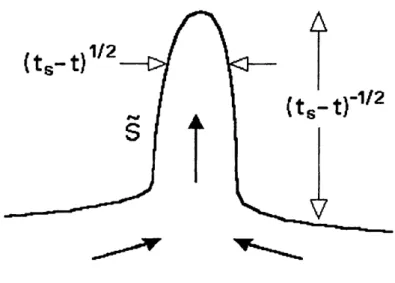
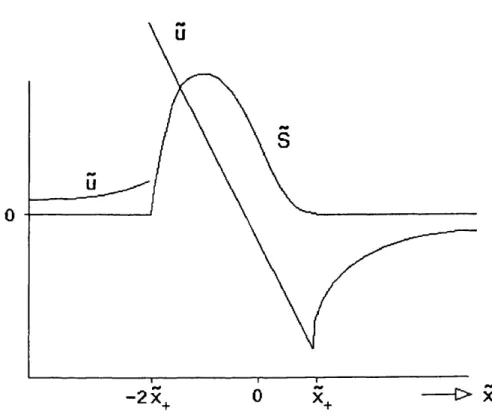
in the above paper has (figure 3.1)
( u , p , S ) ~ (3.2.5a)
as i tends to the break-up time locally near x=x^ say, with
For a solution local to (a?,,<,) we require ü, p, S to tend to zero as
IXI —+
00
, and S must also remain nonnegative since it represents thescaled eddy width. The governing equations for this break-up are
then
^ ( ( x + 2 ü ) S ) = 0 , (3.2.6a)
(x + û ) û ) = - 2 ^ , (3.2.6b)
p(x) = 0 (3.2.6c)
from substitution into (3.2.1), (3.2.3), (3.2.4), which on
integration yield the two equations
(ix + Û)S = C , |(x + û)ü + s' = D (3.2.7a,b)
for
0
, S, where C, D are constants. Ve see immediately that (3.2.7a)is unacceptable with the same nonzero C for all x since ü — + 0 as
|x
|—>00
and such a C cannot be both positive and negative. Hence we seek a solution with C = 0 and find that it has the following splitform :
Ü = — |x , (3.2.8a)
p = i ( x ^ - x ^ ) , (3.2.8b)
S = ^ ( x + 2 x + ) ( x - x + ) ^ (3.2.8c)
for - 2 x + < X < x+;
Ü = — |x -f
5
(x^-x+) for x > x^ , (3.2.8d)Û = — |x - i ( x ^ - x ^ ) for X < - 2 x + , (3.2.8e)
p = S = 0 for X > x+ , X < —
2
x+ . (3.2.8f)Here the positive constant x^ fixes the end-points of the
flow. The weak irregularities in the solution (3.2.8a-f) at the
end-points x = — 2x^ and x = x + (see figure 3.2) are smoothed out by
higher-order effects in adjustment regions in the neighbourhood of