STUDY OF MECHANICAL PROPERTIES OF HIGH
PERFORMANCE CONCRETE USING SILICA FUME
AND ROBO SAND
K.Eswaramma
1, K.Rajasekhar
2 1PG Student,
2Professor, Department of Civil Engineering,
Siddartha Educational Academy Group of Institution/ Integrated Campus,
Tirupathi(Rural)/ JNTUA Anathapuramu, (India)
ABSTRACT:
In the engineering industry, the improvement of existing materials allows for technology advancement and the
construction of more reliable structures without over design. High Performance Concrete (HPC) is a widely
utilized material in heavy structures, construction. This paper given the characteristics of HPC and the
influence of strength.HPC is a concrete meeting special combination of performance and uniformity with
normal mixing.
In this paper, we used two grades of concrete, which are high strength concretes, M40 and M50. We have used to
the mineral admixtures are Silica fume and Robo sand contributed by various reputed industries in India. The
reduction in the source of natural sand (quarry dust) and for reducing the production cost of concrete it needs
to identify alternative material substitute to sand as fine aggregate in the production of concrete. Attempts have
been study to the mechanical properties of concrete and investigate some properties of quarry dust and silica
fume, and the properties of those suitable materials to enable them to be used as partial replacement materials
for sand and cement relative in concrete.
Keywords: Compressive strength, Concrete, Silica Fume, ROBO Sand (Quarry dust)
I. INTRODUCTION
Concrete is the mostly used material in various types of construction, from the flooring of a hut to a multi
storied high rise structure, pathway to runway of an airport, underground tunnels, deep sea platforms, high-rise
chimneys and TV Towers. In the last millennium concrete has demanding requirements both in terms of
economy and performance while greatly varying from architectural masterpieces to the simplest utilities. It is
difficult consider to another material of construction which is versatile as concrete material. [1 and 2].
Invention of large plant of constructions and construction equipments around the world added to the increased
need of material. This leads to the use of alternative additive materials to enhance the quality of concrete in
construction. As an outcome of the investigation and researches, cement based concrete which having special
quality performance with respect to strength, workability and durability is known as “HIGH PERFORMANCE
CONCRETE” was developed.
The use of large quantities of concrete, it’s used for large amount of cement produces increasing CO2 emissions
and also major for the Green House Effect in Environment. The requirement of reduction of source of cement
recognized that the use of silica fume as a mineral admixture enhances the strength properties and durability of
concrete. The use of Robo sand (Quarry Dust) as partial replacement for sand, reduces the natural sand in
concrete production and also reduces cost of concrete. As a result it is identified to find the alternative suitable
material substitute to sand as fine aggregates in the production of concretes [3 and 4].
1.1
Silica Fume
Silica fume define as “very fine non-crystalline silica particle, which is produced in electric arc furnaces as a
by-product of the by-production of alloys or elemental silicon containing silicon”. It is usually a gray colored, some
similar properties to Portland cement or some fly ashes [5].
Silica fume is usually categorized as a supplementary cementitious material. This term refers to materials that
are used in concrete in addition to Portland cement. These materials can exhibit the following properties:
a) Cementitious - will gain strength when mixed with water
b) Pozzolanic and Cementitious - a combination of both properties.
1.2 Silica Fume Properties and Reactions in Concrete
Silica fume affects both the fresh and hardened properties of concrete. The effects on concrete are a result of the
physical and chemical properties of silica fume.
a) Chemical Properties
b) Physical Properties
c) Reactions in Concrete
d) Comparison with Other Supplementary Cementitious Materials.
1.3
Chemical Properties of Silica Fume
a) Amorphous
b) Silicon dioxide >85%
c) Trace elements depending upon type of fume.
1.4 Robo Sand
Robo sand (Quarry dust) is one type of sand manufactured in the quarries of stone. It is a substitute material for
the river sand used in production of concrete in construction. River sand, which is one of the constituents
material used in the concrete production, has become expensive and scarce recourses. So there is higher demand
for the alternative materials used in the fine aggregates.
The production of Quarry dust from the granite crushers is one of the alternative source materials for river sand.
The utilization of Quarry dust can be known as Robo sand, it has been accepted as construction materials.
Number of research has been done regarding the Robo as alternative materials for river sand. They have used
the Robo sand of particle size passed through 75 microns sieve.
II. EXPERIMENTAL DETAILS
2.1
Purpose of the Experiment
In the present paper work, it is planned to conduct lab Experiment using both mineral and chemical admixtures
The main benefit of this Experiment is to develop the properties of the construction material to use mineral and
chemical admixtures in relevant proportions in civil engineering constructions.
The following Experimental tests were conducted on the concrete specimens:
Compressive strength
Split tensile strength
Flexural strength
2.1.1 Test Program
The cubes and cylinders are of standard sizes with dimensions 150mmx150mmx150mm and 150mm x300mm.
2.1.2 Testing of Materials
In the present investigation the following materials were used.
Zuari -43 grade cement confirming to IS: 12269-1987.
Fine aggregate and coarse aggregate confirming to IS: 383-1970.
Admixtures
2.2 Materials Used in Present Project and their Properties
2.2.1 Cement
It is a binding material. It is the combination of two raw materials called calcareous and argillaceous. Birla
Super 43-grade Portland pozzolana cement grade ordinary Portland cement confirming to IS: 12269-1987 was
used in concrete.
Table 1: Properties of Cement
S.NO PROPERTY VALUES
1. Fineness of Cement 225 m2/kg
2. Specific gravity 3.05
3. Normal consistency 33%
4. Setting Time
a)Initial setting time 39mints
b) Final setting time 6 hours
2.2.2 Aggregate
As coarse aggregate crushed granite rock of 20mm maximum size was used. The fineness modulus is found for
fine aggregate and the fineness modulus of coarse aggregate is also found.
Table 2: Physical Properties of Aggregate
Specific gravity of fine aggregate 2.64
Specific gravity of coarse aggregate 2.48
2.2.3 Fine Aggregate
The fine aggregate was passing through 4.75 mm sieve and had a specific gravity values is kept 2.64. The Zone
of grading of fine aggregate was zone II as per Indian Standard specifications.
2.2.4 Coarse Aggregate
Coarse aggregate are the crushed stone is used for making concrete. The commercial stone is quarried, crushed,
and graded. Much of the crushed stone used is granite, limestone, and trap rock the coarse aggregate maximum
2.2.5 Water
Water fit for drinking is generally considered fit for making concrete. Water should be free from acids, oils,
alkalies, vegetables or other organic Impurities. Soft waters also produce weaker concrete. Water has two
functions in a concrete mix. Firstly, it reacts chemically with the cement to form a cement paste in which the
inert aggregates are held in suspension until the cement paste has hardened. Secondly, it serves as a vehicle or
lubricant in the mixture of fine aggregates and cement.
2.2.6 Mineral Admixtures
The finally these mineral admixtures which can be used to replace cement partially can be used as minerals
admixtures like silica fume and robo sand in this project.
2.2.6.1 Silica Fume
Silica fume is a by-product of producing elemental silicon metal or ferrosilicon alloys, its production by using
electric arc furnaces.Usually; these alternative materials have no impact on the performance of silica fume in
concrete.
Table 3: Physical Properties of Silica Fume
S.NO
DESCRIPTION VALUES
1. Particle size (typical) < 1 μm
2. Bulk density
(as-produced)
(densified)
130 to 430 kg/m3
480 to 720 kg/m3
3. Specific Gravity 2.2
Specific Surface 15,000 to 30,000 m2/kg
2.2.6.2 Robo Sand
Robo sand (quarry dust) is sand manufactured in the stone quarries. Number of research has been done
regarding the Quarry dust as alternative materials for river sand. They have used the crusher dust of size which
has been passed through 75 micron. ROBO sand are obtained from granite crushers was used in present concrete
to cast the cubes and cylinders. The bulk density of ROBO sand is 1768 kg/m3 and the specific gravity is 2.45
and the fineness modulus is 3.02.
2.2.6.3 Chemical Admixture
Super plasticizer used in the present work.
2.3 Experimental Investigation
In this experimental investigation, high strength grade of concretes M40 &M50 are studied by using alternative
materials of Silica fume as partial replacement with cement and Robo sand as partial replacement with the fine
aggregate. Cubes & Cylinders were cast with grade of concretes M40 and M50.
2.3.1 Compressive Strength
Compression test is the most common test conduct on hardened concrete, it can be easy test to perform the
concrete strength, and the most of the desirable characteristic of concrete properties are qualitively related to its
strength of compressive test.
The specimen of the cubes 150mmx150mmx150mm was cast to test various concrete mixtures for compressive
days and 90 days the compressive strength was conducted. The water and grit on the cubes was removed before
testing the cubes. The test was carried as per IS:516-1959.
Using the formula the compressive strength is
1. Compressive strength fc = P/A
Where fc = Compressive Strength in N/ mm
2
P = Cube load in N
A = cross section area of cube in mm2
2.3.2 Splitting Tensile Strength
Splitting tensile test is the most common test conduct on hardened concrete, it can be easy test to perform the
concrete strength, and the most of the desirable characteristic of concrete properties are qualitively related to its
strength of split tensile test.
The cylinder specimen of 150mmx 300 mm was cast to test various concrete mixtures for tensile strength. The
cylinders after the moulding were stored in curing tanks and on removal of cubes from water at 28 days the split
tensile strength was conducted. The water and grit on the cylinders was removed before testing the cubes.
Using the formula the compressive strength is
1. Split tensile strength=2 P/ ( dl) in N/ mm2
Where P = cylinder load in N
dl = surface area in mm2
2.4 Results and Discussion
2.4.1 Compressive Strength Test
The program of the experimental was designed to compare the properties of high strength concrete i.e.,
Compressive Strength of Cubes 150mmx150mmx150mm with high strength grade of concrete mix design M40
and M50 and with different replacement levels of Ordinary Portland cement with Silica Fume and Robo sand.
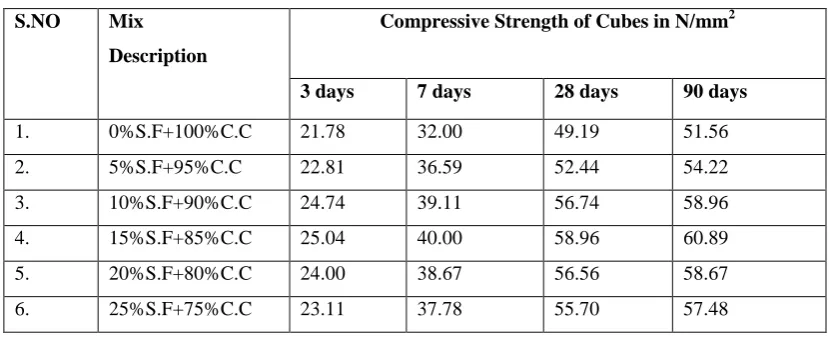
Table 4: Test Results For M
40Grade of Concrete
S.NO Mix
Description
Compressive Strength of Cubes in N/mm2
3 days 7 days 28 days 90 days
1. 0%S.F+100%C.C 21.78 32.00 49.19 51.56
2. 5%S.F+95%C.C 22.81 36.59 52.44 54.22
3. 10%S.F+90%C.C 24.74 39.11 56.74 58.96
4. 15%S.F+85%C.C 25.04 40.00 58.96 60.89
5. 20%S.F+80%C.C 24.00 38.67 56.56 58.67
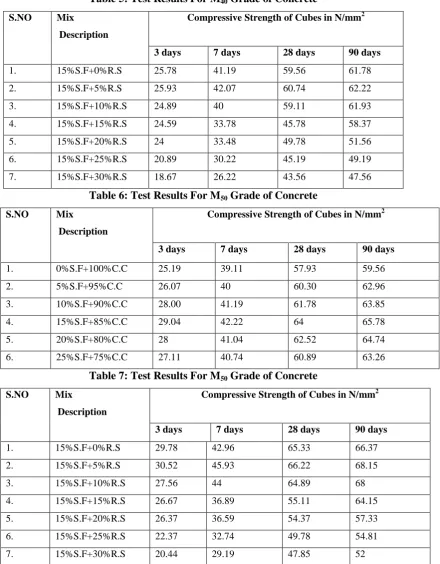
Table 5: Test Results For M
40Grade of Concrete
Table 6: Test Results For M
50Grade of Concrete
S.NO Mix
Description
Compressive Strength of Cubes in N/mm2
3 days 7 days 28 days 90 days
1. 0%S.F+100%C.C 25.19 39.11 57.93 59.56
2. 5%S.F+95%C.C 26.07 40 60.30 62.96
3. 10%S.F+90%C.C 28.00 41.19 61.78 63.85
4. 15%S.F+85%C.C 29.04 42.22 64 65.78
5. 20%S.F+80%C.C 28 41.04 62.52 64.74
6. 25%S.F+75%C.C 27.11 40.74 60.89 63.26
Table 7: Test Results For M
50Grade of Concrete
2.3.2 Split Tensile Strength Test
The test results of split tensile strength of design mix M40 and M50 on standard 150x300mm cylinder at 28 days
age obtained are tabulated in the table.
S.NO Mix
Description
Compressive Strength of Cubes in N/mm2
3 days 7 days 28 days 90 days
1. 15%S.F+0%R.S 25.78 41.19 59.56 61.78
2. 15%S.F+5%R.S 25.93 42.07 60.74 62.22
3. 15%S.F+10%R.S 24.89 40 59.11 61.93
4. 15%S.F+15%R.S 24.59 33.78 45.78 58.37
5. 15%S.F+20%R.S 24 33.48 49.78 51.56
6. 15%S.F+25%R.S 20.89 30.22 45.19 49.19
7. 15%S.F+30%R.S 18.67 26.22 43.56 47.56
S.NO Mix
Description
Compressive Strength of Cubes in N/mm2
3 days 7 days 28 days 90 days
1. 15%S.F+0%R.S 29.78 42.96 65.33 66.37
2. 15%S.F+5%R.S 30.52 45.93 66.22 68.15
3. 15%S.F+10%R.S 27.56 44 64.89 68
4. 15%S.F+15%R.S 26.67 36.89 55.11 64.15
5. 15%S.F+20%R.S 26.37 36.59 54.37 57.33
6. 15%S.F+25%R.S 22.37 32.74 49.78 54.81
Table 8: Test Results for M
40Grade of Concrete
SL.NO. Mix
Description
Split tensile strength of cylinders in N/mm2
C.C 5% 10% 15% 20% 25% 30%
1. C.C+S.F 4.10 4.48 4.53 4.67 4.95 4.43 -
2. S.F+R.S 4.81 5.00 4.62 4.57 4.34 4.2 4.1
Table 9: Test Results for M
50Grade of Concrete
SL.NO. Mix
Description
Split tensile strength of cylinders in N/mm2
C.C 5% 10% 15% 20% 25% 30%
1. C.C+S.F 4.81 5 5.14 5.23 5.38 4.95 -
2. S.F+R.S 5.71 5.61 5.05 4.86 4.72 4.53 4.39
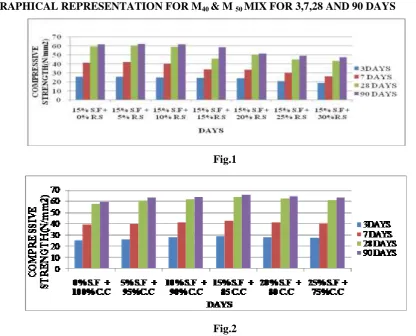
2.3.3 Observations and Discussion on Compressive and Splitting Tensile Strength
It has been observed that with the addition of silica fume and Robo sand ,the compressive strength of concrete at
the age of 3,7,28 and 30 days has conducted and has increased with various proportions of the mix and also
conducted splitting tensile strength of concrete at the age of 28 days has increased with various proportions. The
increased strength range 15% S.F - 20% R.S for M40 grade of concrete and also 15% S.F – 15% R.S for M50
grade of concrete.
GRAPHICAL REPRESENTATION FOR M
40& M
50MIX FOR 3,7,28 AND 90 DAYS
Fig.1
Fig.3
III. CONCLUSION
Based on the present experimental investigation, the following conclusions are drawn.
1. In HIGH PERFORMANCE CONCRETE design of mix proportion, as water- cement ratio adopted is low
value, super plasticizers are necessary required to maintained workability.
2. In concrete grade of M40 , the water-cement ratio of 0.4 is insufficient for providing good
Workability, hence super plasticizers are necessary for those grades of concrete.
3. For M40 grade with silica fume of 15%, the percentage increase in compressive strength ,and split
Tensile strength is maximum.
4. For M50 grade with silica fume of 15%, the percentage increases in compressive strength and split tensile
strength is maximum.
5. It is observed that for M40 grade of concrete the maximum compressive strength is achieved at 15%
replacement of silica fume and 10% replacement of ROBO sand.
IV. ACKNOWLEDGEMENT
I express my sincere thanks to my guide Professor, K.Rajasekhar for the guidance and giving all encouragement
in the work.
I sincerely thank to Assistant professor, G.Vinod kumar, Tirupati for his support in my work.
REFERENCES
[1]. Indian standard code recommended by the method of concrete Mix Design (IS: 10262-2009).
[2]. M.S.Shetty, concrete technology & practice, published by S.Chand & Company, 5thedition.
[3]. N. Krishna Raj, Design of concrete mix published by 4rd edition.
[4]. The author of Venkatesh Babu DL, Natesvan SC. Some investigations of Silica fume replacing by concrete,
The Indian Journal of publication, September 2004, pp. 57-60.
[5]. Gaitero, J. J., I. campillo, and A. Guerrero. Reduction of the Calcium Leaching Rate of Paste of Cement by
Addition of Nano silica particles. Cement and Concrete Research, Vol. 38, 2008, pp. 1112–1118.
[6]. Constantinides, G., and F.-J. Ulm., The Effect of Two Types of C-S-H on the cement Elasticity -Based
Materials: Results from Nanoindentation and Micromechanical Modeling. Cement and Concrete Research,
[7]. Constantinides, G., F.-J. Ulm and K. van Vliet. On the Use of Nano- indentation for Cementitious
Materials. Materials and Structures/ Matériaux et Constructions, Vol. 36, No. 257, 2003, pp. 191–196.
[8]. A.K. Mullick “Performance of with Binary cement blends” the Indian Concrete Journal, January 2007.
[9]. Surenra P. Shah, et al. “Controlling Properties of Concrete through Nano Technology” (ACBM Centre,
North Western University, USA), Proc. of the International Conference on advances in Concrete,