602 | P a g e
PERFORMANCE EVALUATION OF ROUTING
POLICY IN DELAY TOLERANCE NETWORK WITH
VARIOUS MOBILITY MODELS
Navdeep Kour
1, Gopal Sharma
2 1M.tech, Dept. Of Computer Sc. And App.Ch. Devi Lal University, Sirsa(Hr), (India)
2
Asst. Prof. of Comp. Sc. And App. Dept Ch. Devi Lal University, Sirsa(Hr), (India)
ABSTRACT
DTN is a wireless network. A Wireless Network is computer network that uses wireless connection for
connecting nodes in network. DTN follow “store carry forward” mechanism for transferring data. DTN routing protocols instead take advantage of temporal paths created in the network as nodes encounter their neighbors
and exchange messages they have been asked to forward. DTN has different routing protocols for transferring
data. Here, performance of four routing protocols Epidemic, First contact, Direct delivery, and Prophet is
evaluated with Random way Point Model, Shortest Path Map-Based Movement Model, Map Route Movement
Model under two different scenarios and show best routing protocols among them. It is implemented in ONE
simulator.
Keywords Delay Tolerance Network, Models, ONE, Routing Protocols, Scenario
.
I. INTRODUCTION
Delay Tolerance Network is less infrastructure wireless system with long lasting partition. DTN does not have
end to end path connectivity between nodes. It is an intermittently connected network. When a node has a
packet for transfer, it store and carry the packet until it does not find any node connection. When two nodes
come in contact, they exchange the packet according to requirement, this is forwarding process. So, DTN work
on store carry forward mechanism. Routing and forwarding of data packets in DTN is a challenging task
because of the uncertainty of mobility and intermittent behavior of the nodes. DTN has many issues in routing
and for these issues best routing protocol should be known. One of the current research aspects in DTN is
evaluating the best routing strategies. Many researchers have worked on different routing strategies to evaluate
their performance based on different performance metrics. Performance of routing strategies can also evaluate
using mobility models present in DTN. Here, analysis is done on routing strategies Epidemic, Prophet, First
Contact and Direct Delivery through mobility models Shortest path map based, Map route movement, Random
603 | P a g e
understanding of the basic characteristics and functioning of the protocols. By using these results researchers
can further study by choosing the best routing strategies.
II. ROUTING PROTOCOL
A Routing protocol specifies how routers select routes between two nodes on computer network and
communicate with each other. A routing protocol shares information first among immediate neighbors and then
throughout the network. There are many protocols in Delay Tolerance Network. Here, following four protocols
are studied:
2.1 Prophet
Prophet stands for Probability Routing Protocol using History of Encounters and Transitivity. Prophet does not
send bundles of messages in network. It is a prediction based scheme. It is based on delivery predictability,
transitivity and aging. If a node visited a location many times than there is a possibility to visit that location
again. There are three parts of the delivery predictability calculation. First, the delivery predictability metric is
updated whenever nodes encounters, so that nodes that are often encountered have high delivery predictability.
The delivery predictabilitymust age since a pair of nodes does not encounter each other for a moment of time.
Transitivityis also applied in PROPHET. Based on the observation that if node A frequently encounters node B,
and node B frequently encounters node C, hence node C probably is a good node to forward messages destined
for node A.
2.2 Epidemic
Epidemic is easiest routing protocols in delay tolerance network. When a node receives a message, it spread a
copy of message to all other nodes. This approach is less effort approach but there is no delivery guaranty.
When a node receives a message its buffer will update with message and its unique identifier, this is called
summary vector. When two nodes come in contact they exchange and compare their summary vectors to
identify which message they do not have and subsequently request them.
2.3 First Contact
First contact is simplest routing protocol for sending data from source to destination in delay tolerance network.
It is single copy scheme. When anode receive a message it check for connection if any connection is available
then message will send otherwise node will wait for connection. Only one copy of message will forward to
available node and message will delete from buffer after forwarding message. In this protocol source node and
intermediate node forward message to nearby node which encounter first until message deliver to destination. If
any intermediate node fails to carry message then message will lost.
2.4 Direct Delivery
In direct delivery routing source node send message directly to destination node. In this protocol source node
604 | P a g e
overhead and long waits time. Message will never deliver if source and destination does not come in range. This
scheme is best when nodes have full knowledge of network.
3. Models
Models are used to achieve realism based on practical traces and synthetic theories. There are many mobility
models in DTN. Here, following three mobility models are used in evaluation:
3.1 Random way point model
In this model, each node move towards a randomly chosen location. It includes a random pause time after each
movement for selecting new location. Uniform distribution is used to sampling the direction, angles, speed and
pause time in this model.
3.2 Shortest Path Map-Based Movement Model
Shortest path model used Dijkstra’s shortest path algorithm to discover the shortest path to the destination. A
map of network is used for data transfer. Each node has knowledge of map and chooses route according to map.
Node calculate shortest path from map and choose this path to reach the destination.
3.3 Map Route Movement Model
In this model, some nodes are assigned predetermined routes that they must travel on the map. Routes within the
map contain many points and these points are termed as stops on the routes. Nodes wait on every stop for some
time before traveling to the next stop. Nodes follow the shortest path approach to reach the destination.
IV. SCENARIO
In this, simulation is done on tram group t on node speed. Scenario is done with different routing policy and
different models.
Scenario Speed of nodes
Node speed=10, 20, 30, 40, 50, 60, 70, 80
No. of Tram Node fix=5
In this scenario, Node speed is changed and nodes remained fix. All routing policies are also evaluated with all
models for performance comparison.
V. METHODOLOGY
Performance of different routing policy is evaluated with mobility models on the basis of different performance
metrics using ONE simulator. The simulator is used to simulate the mobility environment and the open system
interconnection layers utilized in wireless simulation. The Opportunistic Networking Environment simulator is a
605 | P a g e
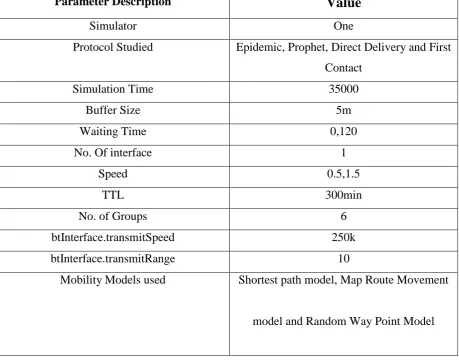
5.1 Simulation Parameters
Parameter Description
Value
Simulator
One
Protocol Studied
Epidemic, Prophet, Direct Delivery and First
Contact
Simulation Time
35000
Buffer Size
5m
Waiting Time
0,120
No. Of interface
1
Speed
0.5,1.5
TTL
300min
No. of Groups
6
btInterface.transmitSpeed
250k
btInterface.transmitRange
10
Mobility Models used
Shortest path model, Map Route Movement
model and Random Way Point Model
Table 1
5.1 Performance metrics
5.2.1 Delivery Ratio
It is defined as the ratio of the number of messages actually delivered to the destination and the number of
messages sent by the sender.
Total Delivered Message
Delivery Ratio = ---
606 | P a g e
5.2.2 Buffer Time Average
This is the average time that messages spend during its transit in the buffer nodes. This is not a metric of time
spent in the buffer by the messages delivered, but it is the average of the time spent by all messages delivered
and abandoned or stranded in the buffers of intermediate nodes.
5.2.3 Average Latency
The latency measured here is the time that elapses between the creation of a message and its delivery at its
destination.
VI. SIMULATION RESULTS AND DISCUSSION
6.1 Delivery Ratio
Delivery ratio of all routing policies with three models is:
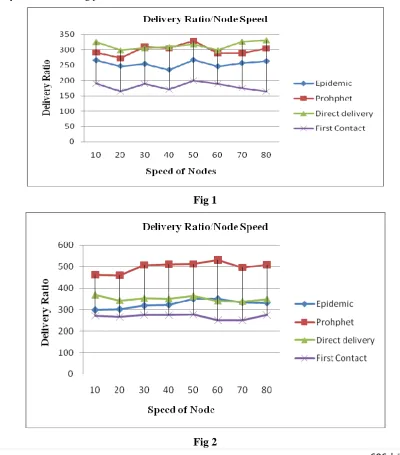
Fig 1
607 | P a g e
Fig 3
Delivery ratio obtained of all different routing policy with different models is shown from “Fig 1” to “Fig 3”.
Delivery ratio of all policy increased with increment in speed of nodes. Prophet gives overall best performance
with all three models.
6.2 Buffer Time Average
Buffer Time Average of all routing policy with all models is:
608 | P a g e
Fig 5
Fig 6
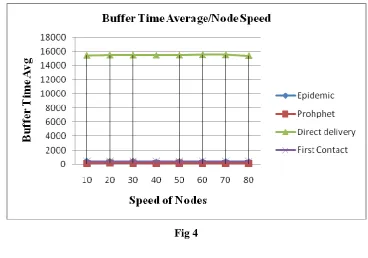
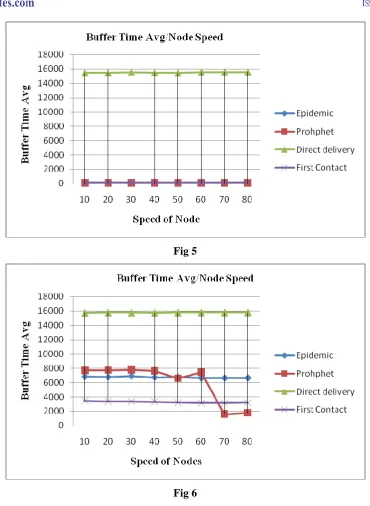
Buffer Time average obtained of all different routing policy with different models is shown from “Fig 4” to “Fig
6”. Buffer time average decreased with increment in node speed. Prophet gives overall best performance with all
three models.
6.3 Average Latency
609 | P a g e
Fig 7
Fig 8
610 | P a g e
Average Latency obtained of all different routing policy with different models is shown from “Fig 7” to “Fig 9”.
Average Latency decreased with increment in node speed. In “Fig 7” and “Fig 8” Prophet and Epidemic less
average latency but in “Fig 9” First contact less average latency.
VII. CONCLUSION
Empirical results illustrate that the performance of a routing protocol varies widely with different models by
varying node speed. From this entire evaluation final conclusion is that Prophet is best among all other routing
strategies under this scenario. Epidemic is on second place after Prophet but overall performance of Prophet is
best. On other hand Map route movement model is better than other used models. All routing strategies gave
good result using it. Prophet also gave best result using Map route movement model. By using these results
researchers can further study the performance of other routing protocols of DTN or can choose the best routing
strategies for future works in DTN.
REFERENCES
1. Vinit Kumar and Anita Singhrova, “Movement Models Based Performance Comparison of Routing
protocols in Delay Tolerant Networks”, International Journal of Innovative Research in Science,
Engineering and Technology, Vol. 3, Issue 8, August 2014.
2. Avni A Barad, “Performance Evaluation of Sociality Based Routing Protocol using Human Mobility Model in Delay Tolerant Network”, International Journal of Advance Engineering and Research Development,
Volume 2,Issue 6 June, 2015.
3. Ponsundari.S and Siva Ganesh.E, “Designing a Human Mobility Model Based Routing Protocol for Delay
Tolerant Network”, International Journal of Innovative Research in Computer and Communication
Engineering, Vol. 1, Issue 2, April 2013.
4. Heena and Vishal Garg, “Performance Analysis of Various Movement Models in DTN”, IOSR Journal of
Computer Engineering, 2012.[5] Md Yusuf S. Uddin, David M. Nicol and Tarek F. Abdelzaher, “A Post-Disaster Mobility Model for Delay Tolerant Networking”, Proceedings of the 2009 Winter Simulation
Conference.
5. Bhed Bahadur Bista and Dand B. Rawat, “Energy Consumption and Performance of Delay Tolerant
Network Routing Protocols under Different Mobility Models”, IEEE, 2016.
6. Mohamed Ababou and Rachid Elkouch, “IMPACT OF MOBILITY MODELS ON SUPP-TRAN
OPTIMIZED DTN SPRAY AND WAIT ROUTING PROTOCOL”, International Journal of Mobile
Network Communications & Telematics, Vol. 4, No.2, April 2014.
7. Hemal Shah, Yogeshwar Kosta and Darshana Patel, “Characterization & Evaluation of Mobility Metrics for Levy walk using MobiSim”, Ganpat University Journal of Engineering & Technology, Vol.-1, Issue-1,
611 | P a g e
8. Dr. B. Ramakrishan, “Modeling and Simulation of Efficient Cluster Based Manhattan Mobility Model for
Vehicular Communication”, Journal of Emerging Technologies in Web Intelligence, Vol. 6, No.2, May
2014.
9. Marcin Kawecki and Radosław Olgierd Schoeneich, “Mobility-based routing algorithm in delay tolerant
networks”, Kawecki and Schoeneich EURASIP Journal on Wireless Communications and Networking. 10. Beena Rani and Mrs. Shailja, “A Review on Mobility Models in DTN”, IJIRST, Vol-2, Issue 03, August
2015.
11. Santosh Kumar, S. C. Sharma and Bhupendra Suman, “Mobility Metrics Based Classification & Analysis
of Mobility Model for Tactical Network”, International Journal of Next-Generation Networks, Vol.2, No.3,
September 2010.
12. Vijay Kumar Samyal, Sukvinder Singh Bamber and Nirmal Singh, “Performance Evaluation of Delay
Tolerant Network Routing Protocols”, ICAET 2015.
13. M Shahzamal, M F Pervez and M A U Zaman, “MOBILITY MODELS FOR DELAY TOLERANT NETWORK: A SURVEY”, IJWMN, Vol. 6, No. 4, August 2014.
14. Sulma Rashid, Qaisar Ayub and M. Soperi Mohd Zahid, “Impact of Mobility Models on DLA (Drop
Largest) Optimized DTN Epidemic routing protocol”, International Journal of Computer Applications,
Volume 18– No.5, March 2011.
15. Samina Mansuri and Yogeshwar Kosta, “Performance Analysis of Drop Policies for Different Mobility
Models in DTN”,International Journal of Computer Applications, Volume 59– No.14, December 2012.
16. Naviya Dayanand and Amarsinh Vidhate, “Improved Routing Protocol for Delay Tolerant Network”,
IJARCSSE, Volume 6, Issue 4, April 2016.
17. SuvarnaPatil“Delay Tolerant Networks – Survey Paper “et al Int. Journal of Engineering Research and
ApplicationsISSN : 2248-9622, Vol. 4, Issue 2( Version 2), February 2014.
18. Jian Shen, SangmanMoh, and Iiyong Chung Routing protocol in Delay Tolerance network: a comparative
survey.
19. InadyutiDutt “ Issues in Delay Tolerant Networks: A Comparative Study” International Journal of