Contributors to Violent Behavior Among Elementary and Middle
School Children
Mark I. Singer, PhD*; David B. Miller, PhD*; Shenyang Guo, PhD*; Daniel J. Flannery, PhD‡; Tracy Frierson, PhD*; and Karen Slovak, PhD*
ABSTRACT. Objective. To examine the relative con-tributions of exposure to violence, parental monitoring, and television-viewing habits to children’s self-reported violent behaviors. The study hypothesized that: 1) chil-dren’s exposure to violence would be associated posi-tively with self-reported violent behaviors; 2) parental monitoring would be associated negatively with chil-dren’s violent behaviors; and 3) the number of daily television-viewing hours and a preference for watching violent television shows would be associated positively with children’s violent behaviors.
Methods. The study used a survey design with an anonymous self-report questionnaire administered to students (grades 3– 8) in 11 public schools. A total of 2245 students participated in the study, representing 80% of the students attending the participating schools during the survey. The subjects were from 7 to 15 years of age; 51% were male, 57% were white, 33% percent were black, and 5% were Hispanic.
Results. Hierarchical multiple regression analysis of the total sample revealed that the combination of demo-graphic variables, parental monitoring, television-view-ing habits, and exposure to violence explained 45% of students’ self-reported violent behaviors. Violence expo-sure and parental monitoring were the most influential contributors in explaining children’s violent behaviors, accounting for 24% and 5% of the variance in violent behaviors, respectively.
Conclusions. All three hypotheses were supported. A significant association was demonstrated linking vio-lence exposure, lack of parental monitoring, and televi-sion-viewing habits with children’s self-reported violent behaviors within a diverse sample of elementary and middle school students. Our findings support the impor-tance of parental monitoring of children and emphasize the need to identify and to provide services to youth who are exposed to violence.Pediatrics1999;104:878 – 884; vi-olent behaviors, exposure to violence, community violence, aggression, parental monitoring.
ABBREVIATION. B,bweight.
P
hysical aggression and violent behavior are fre-quent and pervasive events in the lives of chil-dren. Studies have documented the extent of exposure to violence among youth in the United States, and, even in light of concerns about the un-derreporting of victimization in child populations,1,2the findings are sobering. Murder is the fourth lead-ing cause of death among children,14 years of age.3
Although the overall death rate for youth decreased between 1979 and 1991, the homicide rate climbed to 22.4 per 100 000, an increase of 55%. Gender and ethnic differences are stark. The homicide rate for males was 400% higher than that for females, and black youth were eight times more likely to be vic-tims of homicide compared with white youth.4
Inter-national comparisons highlight the severity of the problem of children’s victimization in the United States. Homicide rates for children,15 years of age were five times higher in the United States than for children in the other 25 industrialized nations com-bined. Firearm deaths were particularly alarming, with 86% of all firearm deaths across the 26 indus-trialized nations occurring in the United States.5
Nonlethal victimization rates also are disturbing. It is estimated that for every homicide there are;100 assaults, many resulting in serious injury.6 Violent
victimization rates among young adolescents (12–15 years of age) have increased 36% over the past 2 decades.4National telephone surveys of youth have
reported victimization rates as high as 35%,1,7and a
recent self-report survey of exposure to violence showed that two thirds of urban and 40% of subur-ban middle school students had been beaten up, robbed, stabbed, or shot.8 Violent victimization is
being recognized increasingly as a major cause of morbidity and mortality among children and youth in the United States.
Numerous studies have documented the relation-ship between children’s exposure to violence and various forms of psychologic distress including de-pression,9 –11anxiety,12dissociation,13,14and
posttrau-matic stress.10,15–18Furthermore, the emotional effects
of childhood victimization seem to be persistent and linger into adulthood.19,20However, children are not
only victimized by violence, they are also the perpe-trators of violence at increasingly younger ages.21
Children#12 years of age represented 8% of juvenile arrests for violent crimes in 1995, and youth 13 and 14 years of age represented 23% of arrests. From 1980 to 1995, arrests of children #12 years of age for From the *Mandel School of Applied Social Sciences, Case Western Reserve
University, Cleveland, Ohio; and the ‡Department of Criminal Justice, Kent State University, Kent, Ohio.
Received for publication Aug 4, 1998; accepted Mar 18, 1999.
Reprint requests to (M.I.S.) Mandel School of Applied Social Sciences, Case Western Reserve University, 10900 Euclid Ave, Cleveland, OH 44106-7164. E-mail: [email protected]
violent crimes increased by 102%. Several cross-sectional surveys have found high rates of weapon carrying among adolescents.22,23 An epidemiologic
sample of urban school children24 reported that
in-volvement in carrying lethal weapons (eg, knife or gun) starts well before middle school years and in-creases with age. By 13 years of age, 15% of girls and 22% of boys in the study’s sample reported that they had carried a lethal weapon.
Perhaps driven in part by juvenile violent crime rates, there is increased attention to the relationship between exposure to violence and children’s own aggressive and violent behaviors. Of all child behav-ior problems, aggression has arguably the most far reaching social and psychologic implications for the child, the family, and society. Aggressive behavior in childhood has been demonstrated to be very stable across time and situations into adulthood and is associated closely with juvenile and adult criminal convictions.25–27
Survey research,28 comparative studies,12,29 and
longitudinal research30,31 have demonstrated a
rela-tionship between children’s exposure to violence and their own violent and aggressive behaviors. The ma-jority of this research has investigated the effects of family violence such as physical abuse on subse-quent violent behavior. Less is known about the effects of a range of victimization experiences, par-ticularly the transfer of maladaptive behaviors such as aggression across nonfamilial pathways. Several studies have reported associations between self-reports of exposure to violence in the community and aggressive behavior,32,33but this association has
not reached significance consistently.34
In addition to home, neighborhood, and school violence, children are exposed to portrayals of vio-lence in the news and entertainment media. Numer-ous studies have documented the role of television in fostering violent behaviors among children.35– 40Two
recent meta-analyses investigating the relationship between violence viewed on television and aggres-sive behavior in children concluded that exposure to portrayals of violence on television was associated consistently with children’s aggressive behaviors.41,42
Although these studies do not suggest that viewing violence on television is one of the most important determinants of children’s aggressive behaviors, they indicate that such viewing can have significant behavioral and emotional consequences for children. Recently, attention has been given to the role of parents in protecting children from initiating various types of high-risk behaviors including violence. A study of risk behaviors in over 12 000 adolescents revealed that parent and family connectedness were protective against most measured health risk behav-iors except pregnancy.43Among family process
vari-ables, parental monitoring of children has been iden-tified as one of the proximal determinants of early development and maintenance of antisocial and de-linquent behaviors in both children and adoles-cents.44 – 46 Numerous studies have reported an
in-verse relationship between parental monitoring of children and children’s participation in antisocial and delinquent activities.47–50
Few, if any, studies have explored simultaneously the relative contributions of television-viewing hab-its, parental monitoring, and violence exposure to explain children’s violent behaviors. This study was designed to examine the above in a large, multieth-nic, multisite community sample of children. We hypothesized that: 1) children’s exposure to violence will be associated positively with self-reported vio-lent behaviors; 2) parental monitoring will be asso-ciated negatively with children’s violent behaviors such that children who are monitored more highly will report lower levels of violent behavior; and 3) the number of hours of daily television-viewing hours and a preference for watching violent televi-sion shows will be associated positively with chil-dren’s violent behaviors.
METHODS
The study used a survey design with a 45-minute, anonymous self-report questionnaire administered to third through eighth grade students in the 1995–1996 school year during regular school hours. The questionnaire was pretested on a socioeconomically diverse sample of children. Students were informed that their participation was completely voluntary. The study protocol was approved by the University Review Committee for Human Stud-ies of Case Western Reserve University.
All students in grades 3 through 8 who were present on the day that the survey was administered were eligible for inclusion. The 11 public schools in 3 school districts in Ohio included 3 central city schools in Cleveland, 4 schools in a small northeast Ohio city, and 4 schools from a rural county in northern Ohio. Students in the Cleveland schools resided in predominantly lower or lower-middle socioeconomic neighborhoods. The small city schools were located in a town whose residents were characterized primarily as blue-collar workers. Students from the rural schools resided in a blue-collar school district composed of several small towns and villages, which were designated as a rural school district by the Ohio Department of Education.
Variables and Instrumentation
Demographic Variables
Demographic information included age, grade level, gender, race/ethnicity, and parental composition at home. Race was cat-egorized into four groups: black, Hispanic, white, and other. To measure parental composition in the home, respondents were asked with whom they lived: mother only, father only, mother and father, or neither mother nor father. This question did not distin-guish between biological parents and other parental figures.
Recent Exposure to Violence
fac-tors derived from principal component analysis on the Recent Exposure to Violence items in the previous study51were as fol-lows: 1) witness of neighborhood violence (a50.87); 2) victim or witness of home violence (a50.75); 3) witness of school violence (a50.80); 4) victim/witness of a shooting/knife attack (a50.70); and 5) victim of school or neighborhood violence (a50.68).
The following Cronbach’s as were achieved for the current study’s sample: 1) witness of neighborhood violence (0.80); 2) victim/witness of home violence (0.77); 3) witness of school vio-lence (76); 4) victim/witness of a shooting/knife attack (0.75); 5) victim of school or neighborhood violence (0.72); and 6) sexual abuse (0.52). All Cronbach’sas with the exception of sexual abuse are.0.70, indicating an acceptable level of reliability. The scale for sexual abuse is comprised of only two items, a probable reason for its lower reliability.
Past Exposure to Violence
Past exposure to violence was measured through a modified 12-item version of the 10-item Past Violence Exposure Scale used in a previous study.51Children were asked to report specific acts of violence that they had experienced or witnessed during their lifetimes, not including the past year. The same types of violence described in the Recent Exposure to Violence Scale were included with the exception of gun-pointing (an important behavior that we had failed to measure in the 10-item version). The specific settings (home, school, and neighborhood) were excluded for all questions because of concern about memory recall for events that occurred
.1 year in the past. The same 4-point Likert scale response choices were used, ranging from never (score of 0) to very often (score of 3). Previously reported51reliability based on Cronbach’s as for three factors extracted from the Past Exposure to Violence Scale were as follows: 1) witness of past violence (a50.80); 2) victim of past violence (a50.66); and 3) victim/witness of a shooting or knife attack (a50.71).
For the current sample, based on results from exploratory and confirmatory factor analyses, two items (“self been attacked or stabbed with a knife” and “self been shot at or shot with a real gun”) needed to be removed because of unclear factor loadings. Out of the remaining items, three dimensions (scales) were found to measure past violence exposure. These dimensions and their corresponding Cronbach’s as are as follows: 1) witness of past violence (0.79); 2) victim of past violence (0.68); and 3) victim/ witness of sexual abuse (0.59). Allas indicate a moderate level of reliability and can be accepted by common standard, although the reliability of sexual abuse is lower than is desired, again, probably attributable to the small number of scale items (ie, 2).
Violent Behaviors
Aggressive behaviors were measured by asking students to report how often during the past year they had engaged in each of five violent acts: threatening others; slapping, hitting, or punching someone before the other person hit them; slapping, hitting, or punching someone after the other person hit them; beating some-one up; and attacking somesome-one with a knife. A 4-point Likert scale with the response categories never (score of 0), sometimes (score of 1), often (score of 2), and almost every day (score of 3) was used
to assess the frequency of each type of violence. A similar 6-item scale used in a previous study52achieved a Cronbach’saof 0.79; and, for the current sample, the Cronbach’sawas 0.77.
Parental Monitoring
Parental monitoring is the degree to which a parent is aware of his or her child’s daily activities and friends. Parental monitoring was measured using an adaptation of a 6-item parental monitor-ing scale50that previously had achieved a Cronbach’saof 0.77. Parental monitoring items included such questions as: “How im-portant is it for your parents or guardian to know who your friends are?” and “Do your parents or guardian make you come home at a certain time at night?”. An additional question regard-ing punishment by parents was added to the original 6 items for the present study: “Do your parents or guardian punish you if you break the rules?” Likert scale response choices were never or not important (score of 0); sometimes or a little important (score of 1); usually or pretty important (score of 2); and always or very important (score of 3). For this study’s sample, Cronbach’sa5
0.76.
Television Viewing
Children were asked about how much television they watched per day with answer options of: no television,,1 hour of televi-sion viewing per day, 1 to 2 hours, 3 to 4 hours, 5 to 6 hours, and
.6 hours. A second question asked what types of television shows children preferred watching. Show topics included: “shows that are funny,” “shows that teach me things,” “shows that have lots of action and fighting,” “shows about kids and their families,” “shows about imaginary places,” “shows that talk about news and current events,” and “shows that feature music videos.”
RESULTS Description of the Sample
A total of 2245 students participated in this study. This figure represents 80% of the students present in the schools at the time the survey was administered. Based on participating schools’ records of student enrollment, our final sample was representative of each school with respect to gender, age, and race.
Almost equal percentages of males (50.9%) and females (49.1%) are represented in the final sample. The average age of the participants is 11 years old (standard deviation: 1.8 years; range: 7–15 years). The sample was 57% white, 33% black, 5% Hispanic, and 4% other. Of the students, 54% were living with both their mother and father.
Univariate and Bivariate Analyses
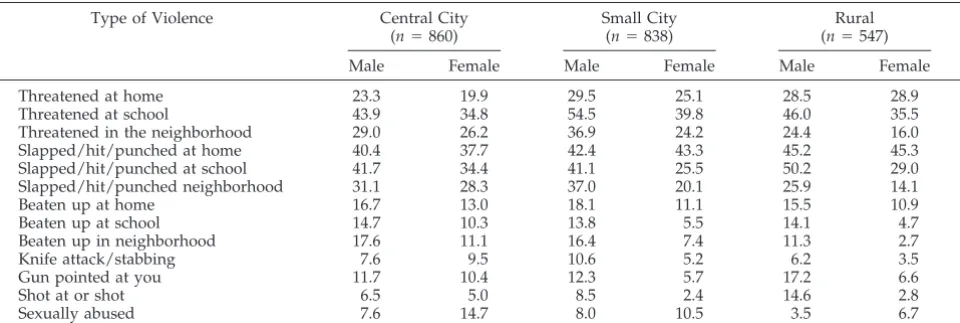
Across geographic sites and genders, children’s reports of being threatened or slapped/hit/punched
TABLE 1. Percentage of Students Victimized by Violence Within the Past Year
Type of Violence Central City
(n5860)
Small City (n5838)
Rural (n5547)
Male Female Male Female Male Female
Threatened at home 23.3 19.9 29.5 25.1 28.5 28.9
Threatened at school 43.9 34.8 54.5 39.8 46.0 35.5
Threatened in the neighborhood 29.0 26.2 36.9 24.2 24.4 16.0
Slapped/hit/punched at home 40.4 37.7 42.4 43.3 45.2 45.3
Slapped/hit/punched at school 41.7 34.4 41.1 25.5 50.2 29.0
Slapped/hit/punched neighborhood 31.1 28.3 37.0 20.1 25.9 14.1
Beaten up at home 16.7 13.0 18.1 11.1 15.5 10.9
Beaten up at school 14.7 10.3 13.8 5.5 14.1 4.7
Beaten up in neighborhood 17.6 11.1 16.4 7.4 11.3 2.7
Knife attack/stabbing 7.6 9.5 10.6 5.2 6.2 3.5
Gun pointed at you 11.7 10.4 12.3 5.7 17.2 6.6
Shot at or shot 6.5 5.0 8.5 2.4 14.6 2.8
at home were quite uniform (Table 1). However, greater percentages of boys than of girls reported being beaten up at home, at school, and in the neigh-borhood. Approximately 12% of boys in central city and small city schools and 17% of boys in rural schools reported having had a gun pointed at them within the last year, and 6% to 11% reported being attacked or stabbed with a knife. A higher percent-age of girls than of boys reported being abused sex-ually within the past year with girl’s rates ranging from 7% to 15%.
Rates of witnessing violence were high for both genders (Table 2). Recent witnessing of violence was consistently higher at school than at home or in the neighborhood for all geographic sites. The highest percentages of children witnessing more serious forms of violence (ie, beatings, knife attacks/stab-bings, and shootings) were students at central city schools.
Table 3 contains the findings of students’ reports of their own violent behaviors within the past year. Almost without exception, boys reported higher rates of violence toward others than did girls across all three sites. Hitting others was reported to be very common behavior for all students surveyed. The per-centage of both boys and girls who reported hitting someone else before being hit was large across all three sites: approximately one half of central city, small city, and rural boys, as well as one half of central city girls reported hitting someone else before they were hit. Approximately 42% of small city girls and 37% of rural girls reported initiating this behav-ior toward others at least once within the past year. The number of students who reported hitting someone in retaliation, hitting someone after being hit, was high for both boys and girls. Over 8 in 10 boys and;7 in 10 girls reported hitting someone else after being hit. This behavior showed a very strong pattern of consistency across genders and across sites.
Parental monitoring items indicated some varia-tion between genders. Approximately 88% of girls compared with 69% of boys indicated that when they were not in school, it was important or very impor-tant for a parent to know where they were; and 86% of girls compared with 77% of boys indicated that
their parents usually or always expected them to call if they were going to be late. However, almost equal percentages of girls (60%) and boys (58%) indicated that they usually or always got punished by their parents if they broke the rules.
To understand more about the students’ reported levels of parental monitoring and the relationship between parental monitoring and other constructs of interest, two groups were created that comprise the upper quartile of scores and the lower quartile of scores on the Parental Monitoring Scale and were renamed the high monitor and low monitor groups. This reduced the sample size on the following anal-yses to approximately one half of the total sample.
A two-way (monitor 3 gender) analysis of vari-ance was used to compare the responses of children who reported high parental monitoring with the re-sponses of children who reported low parental mon-itoring on the dependent measure, violent behaviors. The primary effect for monitor was significant, F(1,1202) 5 124.99; P , .01. There was no significant
effect for monitor by gender. A subsequent univari-ate test revealed that children in the low monitor group reported significantly higher levels of violent behavior than did those children in the high-monitor group (monitor5 4.09 and 2.45, respectively). h2, a
measure of the strength of a statistically significant effect, revealed that 9.4% of the variability in a stu-dent’s score on violent behaviors can be attributed to his or her score on the Parental Monitoring Scale.
Over 1 in 5 students reported watching.6 hours of television per day. For boys, the most popular type of television programming was “shows that have lots of action and fighting” (44%). For girls, the most highly endorsed type of television program-ming was “shows that are funny” (38%).
Multiple Regression Analysis
Through use of hierarchical multiple regression, we assessed the degree to which students’ own vio-lent behaviors could be explained by five demo-graphic variables, parental monitoring score, two television-viewing habits, six recent violence expo-sure variables, and three past violence expoexpo-sure vari-ables. Each of these sets of variables was entered hierarchically into a multiple regression analysis
re-TABLE 2. Percentage of Students Witnessing Violence Within the Past Year
Type of Violence Central City
(n5860)
Small City (n5838)
Rural (n5547)
Male Female Male Female Male Female
Witnessed threats at home 27.8 26.6 27.0 24.4 23.4 22.7
Witnessed threats at school 72.9 68.7 81.0 80.2 68.3 64.8
Witnessed threats in the neighborhood 59.8 59.9 52.2 48.6 34.5 30.1
Witnessed slap/hit/punch at home 45.6 50.4 37.2 41.8 37.1 38.0
Witnessed slap/hit/punch at school 80.8 77.2 78.7 73.9 74.2 65.6
Witnessed slap/hit/punch in neighborhood 68.1 70.1 57.9 51.9 36.1 35.3
Witnessed beating at home 33.8 34.5 19.4 21.4 16.6 15.6
Witnessed beating at school 78.0 75.7 67.9 67.5 62.2 55.1
Witnessed beating in neighborhood 70.2 72.3 48.6 43.2 33.8 29.4
Witnessed knife attack/stabbing 45.9 40.7 22.4 17.5 10.7 5.5
Witnessed gun pointing 51.4 42.1 24.9 15.8 20.0 9.4
Witnessed someone shot at or shot 44.3 37.5 16.4 11.4 13.1 7.8
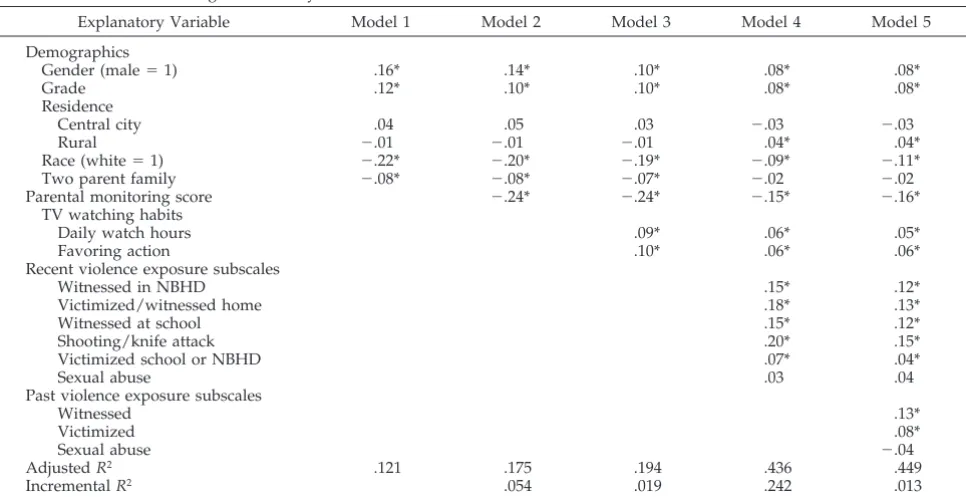
sulting in five models that account for students’ vi-olent behavior. In this hierarchical analysis, each model adds a new set of variables that builds from the previous model (see Table 4). Thus, the newly added set of variables’ unique contribution to ex-plaining violent behavior is indicated while control-ling for the previously entered variables.
Demographic variables included: gender (0 female and 1 male), grade, site (0 small city), race (0 white), and 2-parent family. Television-viewing habits in-cluded hours of television viewed per day and fa-voring action television shows.
Parental monitoring and television-viewing habits were entered after demographics to control for their effects before examining the impact of violence ex-posure on violent behavior. The results of our anal-yses indicated that a significant amount of variance in students’ violent behavior was explained by model 5 when all variables were taken into account. AllR2values andR2increments were significant (P,
.05). The R2in the final model indicated that 45% of
the variance in student’s violent behavior can be accounted for by demographics, parental monitor-ing, television-viewing habits, and exposure to vio-lence (recent and past). The greatest increase in ex-plained variance occurred in model 4, which entered recent violence exposure variables, resulting in a 0.24
increment with demographics, parental monitoring, and television-viewing behaviors held constant.
The relative importance of variables in predicting violent behavior was determined by comparing stan-dardized regression coefficients or b weights (B). Among demographic variables, race (B 5 20.11), gender (B 5 0.08), and grade (B 5 0.08) were the three most important predictors of students’ violent behavior.
Male children and children in higher grades had higher levels of violent behavior. Racial differences, however, are confounded with covariants such as socioeconomic status and parental education, and therefore cannot be interpreted with accuracy.
The parental monitoring score was a major con-tributor among the five sets of variables (B5 0.16). Students who reported higher levels of parental monitoring reported lower levels of violent behavior. Parental monitoring consisted of elements such as being required to be home at a certain time, parental knowledge of the identities of their children’s friends, and children receiving consequences for breaking rules at home. Television-viewing habits made modest, yet statistically significant, contribu-tions to the explained variable in violent behavior scores (B5 0.05; B50.06).
Violence exposure variables were powerful
con-TABLE 3. Percentage of Students’ Self-Reported Acts of Violence Within the Past Year
Violent Act Central City
(n5860)
Small City (n5838)
Rural (n5547)
Male Female Male Female Male Female
Threatened to hurt others 56.3 47.5 53.9 42.7 48.8 27.0
Hit someone before you were hit 60.3 51.8 52.5 41.7 47.8 37.1
Hit someone after you were hit 84.8 76.2 80.9 69.7 80.1 66.4
Beaten someone up 69.0 57.1 52.6 28.6 42.8 22.0
Attacked/stabbed someone with a knife 7.5 8.3 4.9 3.1 2.7 2.0
TABLE 4. Hierarchical Regression Analysis on Violent Behaviors
Explanatory Variable Model 1 Model 2 Model 3 Model 4 Model 5
Demographics
Gender (male51) .16* .14* .10* .08* .08*
Grade .12* .10* .10* .08* .08*
Residence
Central city .04 .05 .03 2.03 2.03
Rural 2.01 2.01 2.01 .04* .04*
Race (white51) 2.22* 2.20* 2.19* 2.09* 2.11*
Two parent family 2.08* 2.08* 2.07* 2.02 2.02
Parental monitoring score 2.24* 2.24* 2.15* 2.16*
TV watching habits
Daily watch hours .09* .06* .05*
Favoring action .10* .06* .06*
Recent violence exposure subscales
Witnessed in NBHD .15* .12*
Victimized/witnessed home .18* .13*
Witnessed at school .15* .12*
Shooting/knife attack .20* .15*
Victimized school or NBHD .07* .04*
Sexual abuse .03 .04
Past violence exposure subscales
Witnessed .13*
Victimized .08*
Sexual abuse 2.04
AdjustedR2 .121 .175 .194 .436 .449
IncrementalR2 .054 .019 .242 .013
tributors to the prediction of violent behavior. The important recent violence exposure contributors were exposure to shooting/knife attacks (B 50.15), victim or witness of home violence (B 5 0.13), wit-ness of neighborhood violence (B 5 0.12), and wit-ness of school violence (B 5 0.12). Witnessing past violence (B 5 0.13) also made an important contri-bution to explaining violent behavior.
DISCUSSION
This study illustrates the high rates of exposure to violence and violent behaviors among elementary and middle school children. Compared with the con-texts of home and neighborhood, high percentages of students reported witnessing violence at school. However, students’ reports of victimization at school were not higher than were their reports of victimiza-tion at home or in the neighborhood. This suggests that when violence occurs at school, it is witnessed by many children. Curiosity often may compel stu-dents to approach fights or loud altercations rather than to avoid such occurrences.
Beating someone up, a potentially injurious form of violent behavior, was reported by over two thirds of central city boys, and approximately one half of central city girls and small city and rural boys. High percentages of both boys and girls across all sites reported hitting someone after being hit, reflecting the strength of children’s impulses for physical retal-iation and the apparent cultural support for this type of violent act. Of even greater concern is the high percentage of boys who reported striking others first (ie, hitting someone before they hit you). A previous study of.3700 high school students found similarly high levels of boys striking first.52 This type of
pe-remptory violence is troubling because a growing number of studies based on information processing theory have demonstrated that, compared with other children, children repeatedly exposed to violence have lower thresholds of impulse control, are poorer judges of impending violence, and more frequently overreact to perceived threats.30,53 Therefore,
stu-dents who peremptorily strike others may be fre-quently incorrect in their perceptions of impending attack from others.
The high percentage of children reporting having had a gun pointed at them (particularly rural students) is of additional concern. Children’s inappropriate ac-cess to firearms has been a source of ongoing concern in the United States and represents a serious potential health hazard. This study suggests that residing in a rural community does not protect children from the improper handling of firearms. Thus, similar to their counterparts in urban settings, pediatricians practicing in rural communities should be concerned about their patients’ access to and use of firearms.
After controlling for the effects of demographics, lack of parental monitoring, violence exposure, and television-viewing habits were found to be related reliably to children’s self-reported violent behaviors. Therefore, each of the initial three hypotheses was supported. Parental monitoring and recent violence exposure were the most robust predictors of violent behavior, accounting for 5% and 24% of the variance
in violent behavior, respectively. However, it is im-portant to note that although the influences of tele-vision viewing were statistically significant, the con-tribution of television viewing to explaining violent behavior was relatively small.
Our findings underscore the importance of parental monitoring of children because low parental monitor-ing was a primary contributor to children’s reports of engaging in violent behavior. Parental monitoring also may be a marker for a home environment that empha-sizes the importance of broader parent–child commu-nication. Knowing where children are when they are not in school, knowing the identities of children’s friends, expecting children to be home at a particular time, and providing consequences for children when they break the rules were associated reliably with lower levels of violent behaviors. The import of these child-rearing skills should be emphasized by pediatricians and by other professionals working with children and their families.
The relationship between violence exposure and vi-olent behaviors suggests that pediatricians working with children who have sustained violence-related in-juries should screen routinely for violence exposure, particularly in emergency settings. In these settings, consideration should be given to referring children who have sustained violence-related injuries to pro-grams in which more extensive evaluations and long-term interventions can be obtained. Screening for vio-lence exposure in primary care settings would serve as part of clinical preventive services by identifying chil-dren who are at high risk of exhibiting violent behav-iors and providing them with appropriate referrals to address these potential behaviors as well as to mini-mize their future exposure to violence.
This study was limited by the geographic scope from which the sample was drawn and provided correlational rather than causal inferences. Further-more, exposure to violence and the perpetration of violent behavior are interrelated, with the possibility that many of the children exposed to violence are the same youth who are perpetrating violence against others. Our data cannot disentangle the potentially reciprocal nature of this relationship. These relation-ships would be elucidated further by prospective longitudinal studies of children and by samples rep-resentative of diverse locations. Nevertheless, our study represents one of the largest investigations to date on the relationship between violence exposure and violent behaviors among elementary and middle school children and illustrates the strength of vio-lence exposure and the importance of parental mon-itoring and television viewing as contributors to chil-dren’s risk for engaging in violence.
ACKNOWLEDGMENTS
The research for this study was supported by Grant 96.1093 from the Ohio Department of Mental Health, Columbus, Ohio; and by grants from the True-Mart Fund, Cleveland, Ohio; the Nord Family Foundation, Lorain, Ohio; and the Sedgwick Fund, Cleveland, Ohio.
REFERENCES
child abuse and neglect, United States, 1979 through 1988.Pediatrics. 1993;92:338 –343
3. Snyder HN, Sickmund M, Poe-Yamagata E.Juvenile Offenders and Victims: 1996 Update on Violence. Washington, DC: US Dept of Justice, Office of Juvenile Justice and Delinquency Prevention; 1996 4. Sells CW, Blum RW. Morbidity and mortality among US adolescents: an
overview of data and trends.Am J Public Health. 1996;86:513–519 5. Centers for Disease Control and Prevention. Rates of homicide, suicide,
and firearm-related death among children—26 industrialized countries.
Morb Mortal Wkly Rep CDC Surveill Summ. 1997;46:101–105
6. DeJong W.Preventing Interpersonal Violence Among Youth: An Introduc-tion to School, Community, and Mass Media Strategies. Washington, DC: US Dept of Justice, National Institute of Justice; 1994
7. Children’s Institute International.National Teen Survey on Youth Violence. Los Angeles, CA: Freeman, Sullivan & Co; 1996
8. Campbell C, Schwarz DF. Prevalence and impact of exposure to inter-personal violence among suburban and urban middle school students.
Pediatrics. 1996;98:396 – 402
9. Cerezo-Jimenez MA, Frias D. Emotional and cognitive adjustment in abused children.Child Abuse Negl. 1994;18:923–932
10. Duncan RD, Saunders BE, Kilpatrick, DG, Hanson, RF, Resnick, HS. Childhood physical assault as a risk factor for PTSD, depression, and substance abuse: findings from a national survey.Am J Orthopsychiatry. 1996;66:437– 448
11. Famularo R, Kinscherff R, Fenton T. Psychiatric diagnosis of maltreated children: preliminary findings.J Am Acad Child Adolesc Psychiatry. 1992; 31:863– 867
12. Flisher AJ, Kramer RA, Hoven CW, et al. Psychosocial characteristics of physically abused children and adolescents.J Am Acad Child Adolesc Psychiatry. 1997;36:123–131
13. Irwin HJ. Traumatic childhood events, perceived availability of emo-tional support, and the development of dissociative tendencies.Child Abuse Negl. 1996;20:701–707
14. Malinosky-Rummell R, Hansen DJ. Long-term consequences of child-hood physical abuse.Psychol Bull. 1993;114:68 –79
15. Famularo R, Fenton T, Kinscherff R, Ayoub C, Barnum R. Maternal and child posttraumatic stress disorder in cases of child maltreatment.Child Abuse Negl. 1994;18:27–36
16. Fitzpatrick K, Boldizar J. The prevalence and consequences of exposure to violence among African American youthJ Am Acad Child Adolesc Psychiatry. 1993;32:424 – 430
17. Graham-Bermann SA, Levendosky AA. Traumatic stress symptoms in children of battered women.J Interpersonal Violence. 1998;13:111–128 18. Horowitz K, Weine S, Jekel J. PTSD symptoms in urban adolescent girls:
compounded community trauma.J Am Acad Child Adolesc Psychiatry. 1995;34:1353–1361
19. Henning K, Leitenberg H, Coffey P, Turner T, Bennett RT. Long-term psychological and social impact of witnessing physical conflict between parents.J Interpersonal Violence. 1996;11:35–51
20. Perez CM, Widom CS. Childhood victimization and long-term intellec-tual and academic outcomes.Child Abuse Negl. 1994;18:617– 633 21. Butts JA, Snyder HN.The Youngest Delinquents: Offenders Under age 15.
Juvenile Justice Bulletin. Washington, DC: US Department of Justice, OJJDP; 1997
22. Centers for Disease Control and Prevention. Youth risk behavior sur-veillance—United States, 1995.Morb Mortal Wkly Rep CDC Surveill Summ. 1996;45:4. Supplement
23. Callahan CM, Rivara FP. Urban high school youth and handguns: a school-based survey.JAMA. 1992;267:3038 –3042
24. Arria AM, Wood NP, Anthony JC. Prevalence of carrying a weapon and related behaviors in urban schoolchildren, 1989 to 1993.Arch Pediatr Adolesc Med. 1995;149:1345–1350
25. Huesmann L, Eron L, Lefkowitz M, Walder L. The stability of aggres-sion over time and generations.Dev Psychol. 1984;20:1120 –1134
26. Maxfield MG, Widom CS. The cycle of violence: revisited 6 years later.
Arch Pediatr Adolesc Med. 1996;150:390 –395
27. Olweus D. The stability of aggression reaction patterns in human males: a review.Psychol Bull. 1979;85:852– 875
28. Schwab-Stone M, Ayers T, Kasprow W, et al. No safe haven: a study of violence exposure in an urban community.J Am Acad Child Adolesc Psychiatry. 1995;34:1343–1352
29. Sternberg KJ, Lamb ME, Greenbaum C, et al. Effects of domestic vio-lence on children’s behavior problems and depression.Dev Psychol. 1993;29:44 –52
30. Dodge KA, Bates JE, Petitt GS. Mechanisms in the cycle of violence.
Science. 1990;250:1678 –1683
31. Widom CS. Does violence beget violence: A critical examination of the literature.Psychol Bull. 1989;106:3–28
32. Attar BK, Guerra NG, Tolan PH. Neighborhood disadvantage, stressful life events, and adjustment in urban elementary school children.J Clin Psychology. 1994;23:391– 400
33. Bell CC, Jenkins EJ. Community violence and children on Chicago’s southside.Psychiatry. 1993;56:46 –54
34. Cooley-Quille MR, Turner SM, Beidel DC. Emotional impact of chil-dren’s exposure to community violence: a preliminary study.J Am Acad Child Adolesc Psychiatry. 1995;34:1362–1368
35. American Psychological Association.Violence and Youth: Psychology’s Response. Washington, DC: American Psychological Association; 1993 36. Andison FS. TV violence and viewer aggression: an accumulation of
study results 1956 –1976.Public Opin Q. 1977;41:314 –331
37. Friedrich-Cofer L, Huston AC. Television violence and aggression: the debate continues.Psychol Bull. 1986;100:364 –371
38. Huesmann RL, Malamuth NM. Media violence and antisocial behavior: an overview.J Soc Issues. 1986;42:1– 6
39. Huston AC, Donnerstein E, Fairchild H, et al.Big world, small screen: the role of television in American society. Lincoln, NE: University of Nebraska Press; 1992 40. Ceneterwall BS. Television and violence.JAMA. 1992;267:3059 –3063 41. Paik H, Comstock G. The effects of television violence on antisocial
behavior: a meta-analysis.Commun Res. 1994;21:516 –546
42. Wood W, Wong FY, Chachere JG. Effects of media violence on viewers’ aggression in unconstrained social interaction.Psychol Bull. 1991;109: 371–383
43. Resnick MD, Bearman PS, Blum RW, et al. Protecting adolescents from harm: findings from the national longitudinal study on adolescent health.JAMA. 1998;278:823– 832
44. McCord J. Some child-rearing antecedents of criminal behavior in adult men.J Pers Soc Psychol. 1979;:9;1477–1486
45. Patterson G, Dishion T. Contributions of families and peers to delin-quency.Criminology. 1985;:23:63–79
46. Wilson H. Parental supervision: a neglected aspect of delinquency.Br J Criminol. 1980;20:203–235
47. Friedrich A, Flannery D. The effects of ethnicity and acculturation on early adolescent delinquency.J Child Fam Stud. 1995;4:69 – 87 48. Ramsey E, Walker H, Shinn M, O’Neill R, Stieber S. Parent management
practices and school adjustment.School Psychol Rev. 1989;18:513- 525 49. Patterson G, Stouthamer-Loeber M. The correlation of family
manage-ment practices and delinquency.Child Dev. 1984;55:1299 –1307 50. Flannery D, Vazsonyi A, Torquati J, Friedrich A. Ethnic differences in
risk for early adolescent substance use.J Youth and Adolesc. 1994;23: 194 –213
51. Singer MI, Anglin TM, Song L, Lunghofer L. Adolescents’ exposure to violence and the association of psychological trauma. JAMA. 1995; 273:477– 482
52. Song L, Singer MI, Anglin TM. Violence exposure and emotional trauma as contributors to adolescents’ violent behaviors.Arch Pediatr Adolesc Med. 1998;152:531–536
DOI: 10.1542/peds.104.4.878
1999;104;878
Pediatrics
and Karen Slovak
Mark I. Singer, David B. Miller, Shenyang Guo, Daniel J. Flannery, Tracy Frierson
Children
Contributors to Violent Behavior Among Elementary and Middle School
Services
Updated Information &
http://pediatrics.aappublications.org/content/104/4/878 including high resolution figures, can be found at:
References
http://pediatrics.aappublications.org/content/104/4/878#BIBL This article cites 43 articles, 2 of which you can access for free at:
Subspecialty Collections
http://www.aappublications.org/cgi/collection/media_sub
Media
son_prevention_sub
http://www.aappublications.org/cgi/collection/injury_violence_-_poi
Injury, Violence & Poison Prevention
http://www.aappublications.org/cgi/collection/for_your_benefit
For Your Benefit
following collection(s):
This article, along with others on similar topics, appears in the
Permissions & Licensing
http://www.aappublications.org/site/misc/Permissions.xhtml in its entirety can be found online at:
Information about reproducing this article in parts (figures, tables) or
Reprints
DOI: 10.1542/peds.104.4.878
1999;104;878
Pediatrics
and Karen Slovak
Mark I. Singer, David B. Miller, Shenyang Guo, Daniel J. Flannery, Tracy Frierson
Children
Contributors to Violent Behavior Among Elementary and Middle School
http://pediatrics.aappublications.org/content/104/4/878
located on the World Wide Web at:
The online version of this article, along with updated information and services, is
by the American Academy of Pediatrics. All rights reserved. Print ISSN: 1073-0397.