R E V I E W
Open Access
Towards 5G cellular network forensics
Filipo Sharevski
Abstract
The fifth generation (5G) of cellular networks will bring 10 Gb/s user speeds, 1000-fold increase in system capacity, and 100 times higher connection density. In response to these requirements, the 5G networks will incorporate technologies like CUPS, NFV, network slicing, and CIoT. Each of these 5G features requires system adaptations to enable acquisition and forensic processing of cellular network evidence. This paper reviews the digital forensics mechanisms for Lawful Interception and user localization available in LTE and LTE-Advanced networks together with the associated evidence types, tools for forensic analysis, and supporting legal framework. The challenges and potential adaptations for retaining these capabilities in the future 5G networks are also discussed to outline the future research directions for cellular network forensics.
Keywords: Cellular networks, LTE/LTE-Advanced, 5G, Lawful Interception (LI), Lawful Access Location Services (LALS)
1 Introduction
Cellular networks evolved through four generations and the fifth is projected for commercial roll-out in 2022. Currently, there are 7.5 billion worldwide cellular sub-scriptions, each generating 5 GB of traffic per month on average [1]. The subscription and traffic volume is fore-cast to increase fivefold in the next 5 years, requiring 5G to accommodate 1000 times the system capacity of the current LTE/LTE-Advanced networks. The pervasiveness of cellular access implies that most crimes are, or will be, facilitated by cellular devices. To support legal processing, cellular network forensic investigations are necessary in obtaining critical evidence, especially in cases where it is infeasible to physically seize a cellular device or a critical transient data is needed promptly [2].
Cellular network forensics is a cross-discipline of digital forensics and cellular networks with the goal to inves-tigate cellular network-facilitated crimes under a legally obtained warrant for the purpose of crime reconstruc-tion. These criminal activities can be carried out with a direct network support (e.g., perpetrators communicate over a cellular network) or network is incidental to the crime (e.g., the network can provide historical data about calls or user locations). The investigations in cellular net-work can be in real time and non-real-time. The real-time
Correspondence:[email protected]
College of Computing and Digital Media, DePaul University, 243 S Wabash Ave, Chicago, IL 60610 USA
investigations work with evidence transiting over the net-work at the time of the crime or the attack like ongoing calls, browsing sessions, or triangulated geolocation coor-dinates of a user. The non-real-time investigations work with evidence in relation to past user activity such as charging data records or user’s most visited cell. Prior to every investigation, operators and law enforcement agen-cies (LEAs) must establish forensic readiness to ensure secure identification, acquisition, and delivery of cellu-lar network evidence [3,4]. These operations are realized with two forensics mechanisms,Lawful Interception(LI) andLawful Access Location Services(LALS).
This article reviews the implementation of LI and LALS in LTE and LTE-Advanced networks. Various types of LI and LALS evidence are also presented together with tools and techniques for cellular network forensic analysis. The challenges for continuous support of LI and LALS are discussed in the context of the key technologies for 5G evolution including Control and User Plane Separation (CUPS), Network Functional Virtualization (NFV), net-work slicing, and CIoT. Several adaptations of the current LI and LALS operations for each 5G technology are pro-posed and elaborated to ensure the future cellular network forensic investigations are conducted as similarly as pos-sible to the current practice. The article concludes with a discussion of the legal and privacy aspects of the current and future cellular network forensics practice.
SharevskiEURASIP Journal on Information Security (2018) 2018:8 Page 2 of 16
2 LTE cellular network forensics
2.1 Lawful Interception
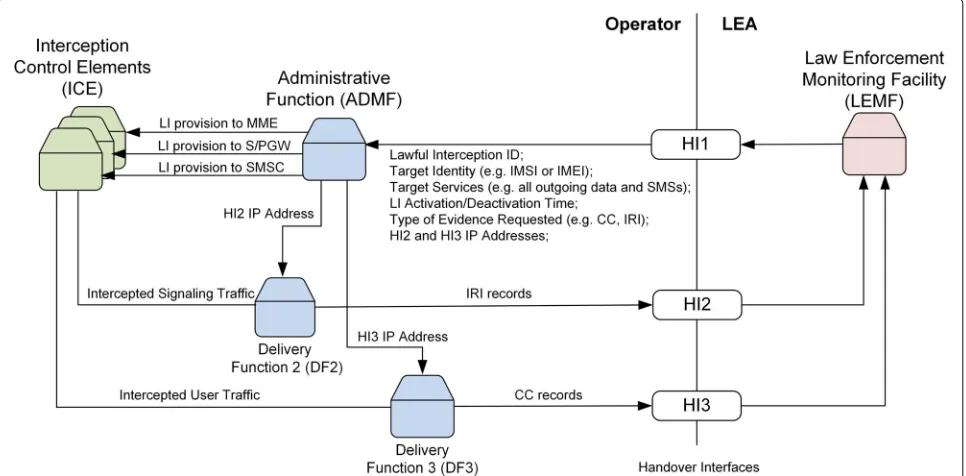
LI refers to the legally provisioned action performed by a cellular network operator to make the communication and the communication-related information available to one or more LEA [5]. Figure1shows the LI architecture for LTE/LTE-Advanced networks. Every LI is invoked for atarget identity,e.g., suspected user or victim, and/or a target service,e.g., all outgoing data and SMSs. The target identity is specified with either a MSISDN, IMSI, IMEI, or a combination of them. To distinguish between differ-ent LI requests, the Law Enforcemdiffer-ent Monitoring Facility (LEMF) uses a unique LIID. This information together with the time period for interception and the delivery information is sent over the HI1. Every operator has an internal Administration Function (ADMF) that takes the requests, provisions the LI to the Interception Control Elements (ICEs), and configures the IP addresses of the delivery interfaces.
The example shown in Fig.1depicts interception of all outgoing data and SMS, so in this case ADMF provisions LI at the MME, S/P-GW, and the SMSC [6]. Operators can intercept two types of cellular data: user trafficand signaling traffic. The intercepted user traffic is referenced asContent of Communication (CC)and delivered over the HI3 in a pre-defined format to the LEMF (e.g., audio or pcap files). The intercepted signaling traffic is referenced asInterception-Related Information (IRI)and is delivered over the HI2 in various IRI record types.
All interfaces use a specific LI protocol implementation, shown on Fig.2. The LI application layer is responsible for authentication and encrypted delivery of the admin-istrative messages, the IRI records, and the CC. The LI session layer encapsulates the IRI records and CC data before it sends them over a TCP/IP connection so the LEMF can distinguish between different LI application messages. The encapsulation is realized using the ITOT protocol over port 106 [7].
2.1.1 Interception-Related Information (IRI)
There are four types of IRI records that the network can provide to the LEA:
• IRI-BEGIN—The first event of a communication attempt of the target identity
• IRI-END—The end of a communication attempt; closing the IRI transaction for the targeted identity and/or service
• IRI-CONTINUE—Intermediary record at any time during a communication within the IRI transaction
• IRI-REPORT record—Used for
non-communication-related events, for example, a network attach request
The IRI records and CC data need to be corre-lated for a given target identity. For that purpose, each IRI record contains a unique correlation number. In addition, the IRI records contain information about
Fig. 2The LI protocol stack. The encryption and authentication keys used on the LI application layer are negotiated during the forensic readiness phase between the operators and the LEA
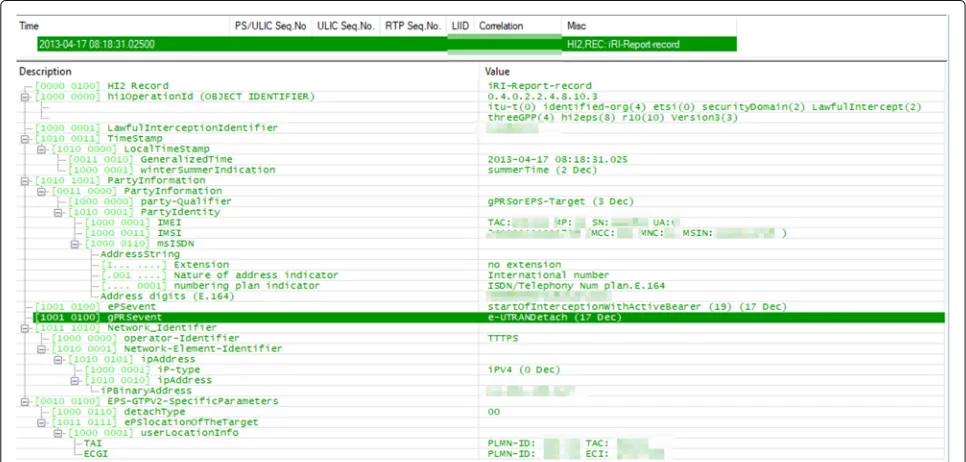
the observed MSISDN/IMSI/IMEI, source/destination IP address, source/destination ports, APNs, dialed and connected numbers, serving cell(s), TAI, SMS sender/receiver, SMS content, and date/times/duration of the interception events [6]. An example of IRI-REPORT record for an EUTRAN detach event processed with the STINGA LI-Analyzer tool is shown in Fig. 3 [8]. The intercepted signaling traffic indicates the time and date (LocalTimeStamp attribute) when the target identity ini-tiated the network detach (gPRSevent and detachType
attribute), either by switching off the cellphone, battery loss, or removing the SIM card.
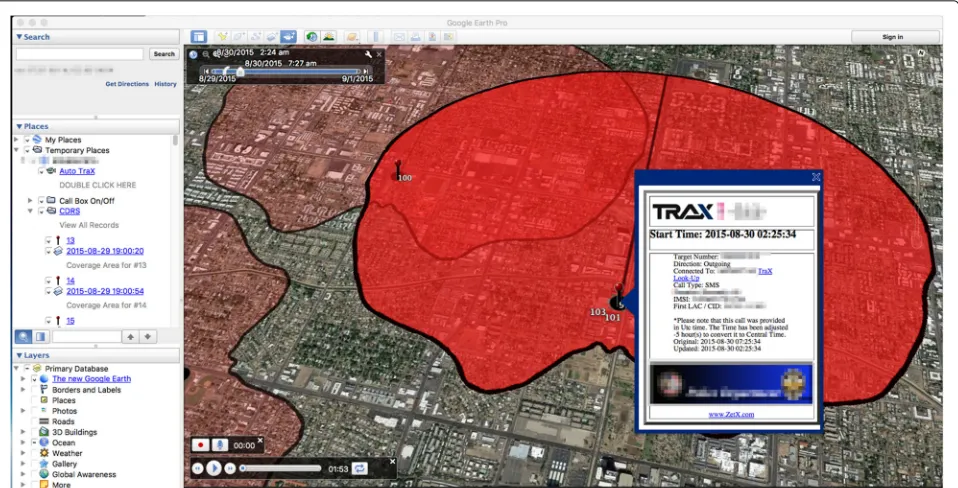
For non-real-time investigations, investigators have the alternative to use the IRI records in conjunction with the charging data records (CDRs) generated by each ICE for charging purposes. The CDRs contain similar informa-tion as the IRI records and are often used in investigainforma-tions because they can be obtained offline from the operators. An example of an originating SMS CDR used in plotting a location with Google Earth and the TraX software is shown in Fig.4[9]. In this case, the CDR shows the time, date, and the location where the target identity was reg-istered when sending a SMS of interest (operator usually supplies the coordinates of their base stations so the LEA can infer the location from the LAC/CID parameters). This information can be verified with the IRI record asso-ciated with the same event, which can further reveal the content of the originating SMS (usually sent as part of the signaling traffic).
2.1.2 Content of Communication (CC)
The CC data represents the actual user traffic that is real-ized over the cellular network by the target identity. It includes actual voice conversations intercepted and deliv-ered in formats like .wav files or IP sessions delivdeliv-ered in packet captures like .pcap files. To determine whether the conversational parties from the intercepted voice CC are the ones subject to investigation, variousforensic speaker recognition techniques are used to analyze the voice CC. The aural/acoustic technique relies on experienced
SharevskiEURASIP Journal on Information Security (2018) 2018:8 Page 4 of 16
Fig. 4A CDR for an LTE voice call. This is an original CDR from a non-real-time cellular network investigation so the MSISDN, IMSI, LAC, and CID are blurred to protect the anonymity of the target identity
human perception in matching the intercepted voice CC and a recorded voice based on the phonetic similarity between the two sources [10]. The auditor-instrumental technique employs statistical analysis of common voice features like the average fundamental frequency, artic-ulation rate, formant central frequencies, rhythm, and voice quality to determine for the same purpose. In the automatic forensic speaker recognition, the recognition system works by extracting voice features of a training set of speech data to model different speaker patterns that are later compared with the features extracted of the inter-cepted voice CC to yield a similarity score with the target speaker. Among the most prominent tools for automatic forensic speaker recognition is ALIZE [11].
For the IP CC data, the analysis of the packet cap-tures is performed using standardized tools and tech-niques for regular network forensics processing, e.g., Wireshark. Figure 5shows a Wireshark capture of DNS query and a HTTPS session establishment encapsulated in a GTP tunnel. The CC data in this case is corre-lated with an IRI-BEGIN record to indicate the beginning of the user IP traffic, IRI-CONTINUE records for the duration of the session or the interception, and IRI-END records when the user closes its session or the intercep-tion is terminated (the correlaintercep-tion number for the CC is not shown in the figure but is supplemented over the HI3 interface and is similar to the one present on the IRI records).
2.2 Lawful Access Location Services—LALS
LALS refer to the legally provisioned action performed by a cellular network operator to make location information available to one or more LEAs. Cellular networks provide Location Services (LCS) that utilize the geographic loca-tion of the user (i.e., advertising or an emergency local-ization). For this purpose, cellular networks implement a LCS architecture with LMUs in the radio network to execute the localization measurement and SMLCs in the core network to communicate the location information with the LCS clients. SMLCs communicate the localiza-tion requests using the LPP protocol to the LMUs, which in turn coordinate with the target identities to calculate their current location. This location information can be provided to external entities, for example LEAs. The user location is calculated using either of these localization methods [12]:
• ECID—The coordinates of the cellular device are derived by measuring either the RTT or the AoA of a reference signal between one or three base stations and the cellular device (known also astriangulation). The precision of the ECID positioning is between 50 m and 1 km, but the Time-To-First-Fix (TTFF) is less than a few seconds for more than 90% accuracy.
Fig. 5A CC record for an LTE DNS and HTTPS user session. The capture is taken from a test LTE network setup using the OAI open-source LTE implementation [25]
from a reference TOA from its serving station (known also asmultilateration). Each of the RSTD measurements describes a hyperbola or ellipsoid so the intersection of their focus lines provides the coordinates of the cellular device. OTDOA precession is less than 50 m with a TTFF of around 10 s but less than 70% accuracy.
• UTDOA—This is a similar positioning method as OTDOA in which the LMUs measure the time difference of arrival of the uplink reference signals from the cellular device. The advantage of the UTDOA is that it requires minimum device involvement, so it improves the accuracy to more than 90% while retaining the same precision and timing as OTDOA.
• A-GNSS—The standalone navigation based on GPS requires unobstructed line of sight between the user and at least four satellites. Given that most of the time users are indoors and cannot satisfy this requirement, cellular networks assist the users by supplying information about the availability and configuration of GPS satellites. The user then measures the available GPS signals so it can calculate its 3-dimensional coordinates and report them to the SMLC. The precision and timing of the A-GNSS is less than 1 m and TTFF of 35 s, though the accuracy is below 80% because the GPS signals needed might not be always available for measurement (for example, almost 50% of the user calls/sessions are indoors).
The LCS architecture allows for various positioning pro-cedures, depending on the entity initiating the localization request. For example, the network can induce a localiza-tion after an emergency attach from a user (referred to as EPC-NI-LR) or if an external client like a LEA requests localization for a target identity (referred to as EPC-MT-LR). External LCS clients can be location-based adver-tising companies, map services, or Enhanced 911/112 systems. Each external client has to be authorized to use the LCS service by the network and the users. For lawful localization, the LEA needs to obtain a warrant and secure the delivery and storage of the location information for the target identities investigated.
In general, all the procedures follow the logical posi-tioning sequence shown in Fig.6. The SMLC server com-municates the positioning capabilities with the targeted UE and sends additional assistance data (e.g., A-GNSS information for satellites, signal references for OTDOA or UTDOA) so the UE can perform the positioning measure-ments. These measurements are communicated back to the SLMC in a form of a IRI-REPORT record and, depend-ing on the localization method, provide the information on UE’s latitude, longitude, altitude, altitude direction, and, optionally, its relative velocity.
SharevskiEURASIP Journal on Information Security (2018) 2018:8 Page 6 of 16
Fig. 6The general LCS procedure in LTE/LTE-Advanced networks. For LALS-invoked user localization, the LEA is authorized as an LCS client that requests subscribers’ (target identity) localization information
or for aperiodic localization. The immediate localization is invoked when the LEA needs the location of the target in real-time, while the period localization is used in non-real-time cases where the LEA can track the movement of the target identity over a longer period of time. For the periodic localization, the LEA can specify the report-ing interval and the number of reports it needs from the SMLC depending on the needed tracking granularity. In cases where the LEA needs to localize a target identity that uses a specific service, e.g., SMS, the enhanced location for IRI is used.
3 Cellular network forensics in 5G
5G is envisioned to achieve 1000 times increase in sys-tem throughput, peak data rate of 10 Gb/s, and 100 times higher connection density [13]. The new genera-tion of cellular networks will support new deployment scenarios including high-speed vehicles and trains, IoT, commercial air-to-ground service, and service for light aircraft/helicopters. To meet these requirements, the net-work architecture introduces a series of novel technolo-gies including CUPS, NFV, network slicing, and CIoT.
3.1 Control and User Plane Separation—CUPS
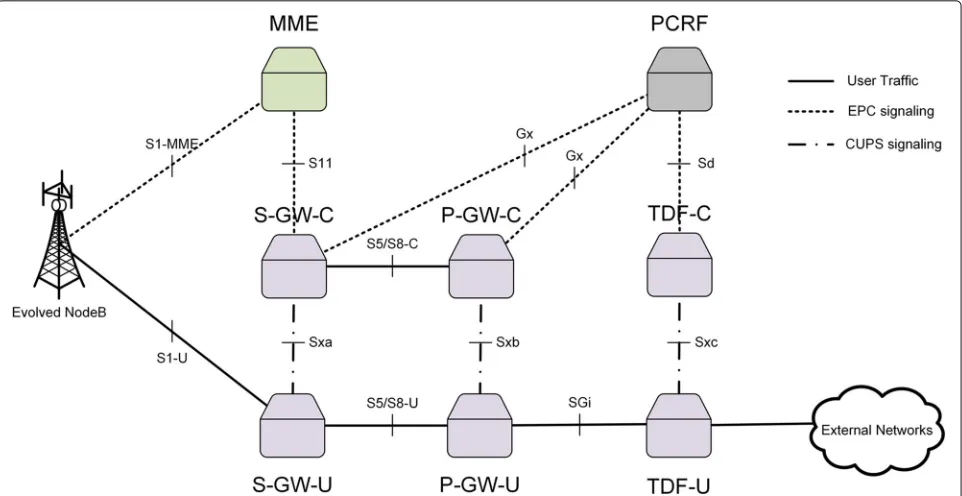
The idea behind the CUPS is to separate the control and user plane for the S-GW, P-GW, and the TDF. LTE and LTE-Advanced networks already provide separation
by implementing most of the control functions in the MME and the user traffic delivery functions in S/P-GW. CUPS takes this separation further to allow independent network scaling—deploying more user plane nodes (e.g., forwarder routers) closer to the network edge without increasing the number of control nodes for applications including tethering, local Vehicle-to-X communications, augmented reality, or optimized video streaming [14].
Figure7shows an example of CUPS-based 5G network architecture where the control plane of the S/P-GW ele-ments and the TDF terminate the GTP-C (S5/S8) and Diameter (Gx) protocols. Three new interfaces are intro-duced in this architecture, Sxa, Sxb, and Sxc, all of which implement the PFCP protocol over UDP/IP. The control elements use PFCP to establish, modify, and delete Sx ses-sions on the user elements (a user can be served with more than one user element). For this purpose, PFCP allows provisioning of rules like packet detection, forwarding action, QoS enforcement, or usage reporting where each rule is defined in a separate PFD.
Fig. 75G CUPS network architecture. The S-GW and P-GW are split into control elements (S-GW-C and P-GW-C) and user elements (S-GW-U and PG-W-U)
the interception configuration, which in case a CC data is requested, they need to instruct the user elements to route the interception to the DF3. This can be done by defining a new PFD “lawful interception” that is provisioned as a special packet forwarding action to the DF3. Because mul-tiple control elements can be involved in the user traffic delivery, DF3 must be able to consolidate the user traffic before it hands to the HI3 interface using the Sx user ses-sion identifier. For the LEA to be able to correlate the IRI and CC for a target identity, DF2 and DF3 have to include
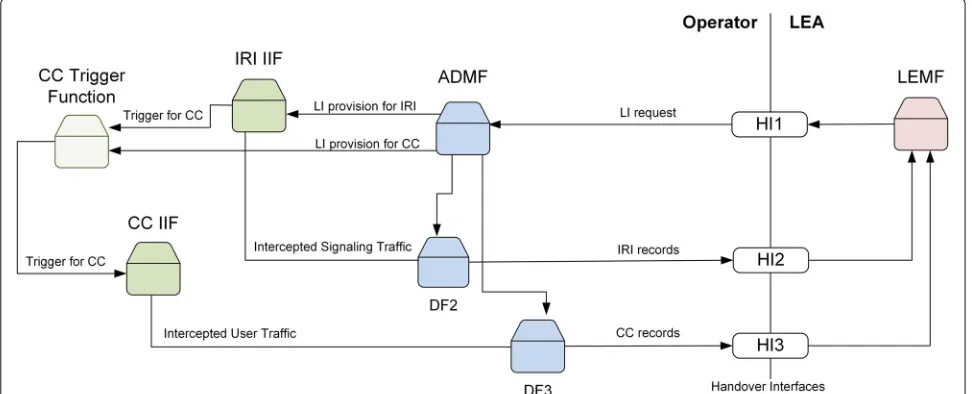
the Sx user session identifier in the delivered evidence material. The modified LI architecture including these modifications for a CUPS network deployment is shown in Fig.8.
From a LALS perspective, the target positioning is not affected with the separation of the control and user planes because the mobility management for LCS is handled sep-arately by the MME and is independent of the cellular service used. Same holds for the enhanced location for IRI, given that each user is served by only one control node
SharevskiEURASIP Journal on Information Security (2018) 2018:8 Page 8 of 16
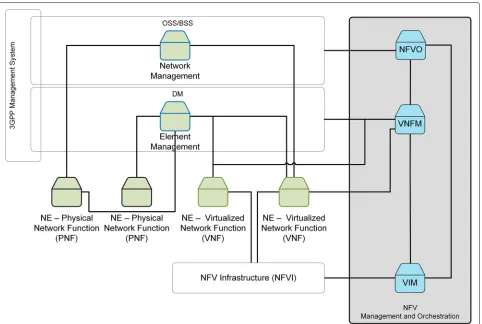
Fig. 9Mapping between ETSI NFV-MANO and 3GPP for managing cellular networks. The proposed management and orchestration works for cellular networks with both standard and virtualized network functions
which informs the MME and SMLC of the target identity using the service of interest for investigation. It is worth mentioning that LALS also need to be supported for MEC applications, where the service part of the service-based localization is offered on the local cloud. In this case, the LALS procedure shown in Fig.6stays the same; only the SMLC needs to be able to request the service details from the MEC server and include them in the subscriber location report back to the LEA.
3.2 Network Functional Virtualization—NFV
One of the major key technologies that will be integrated in the future 5G systems is virtualization of network functions or NFV. NFV refers to the replacement of tradi-tional specialized hardware devices with software that can be installed on standardized, off-the-shelf hardware [15]. Cellular network operators can use NFV to virtualize the MME or S/P-GW functions to reduce costs and increase flexibility for changes in network capacity, for example. The mapping between the reference ETSI NFV-MANO architecture and 3GPP is shown in Fig. 9. The 3GPP network management comes as a part of the OSS/BSS segment that is controlled by the NFVO. The virtual
VNFM manages the 3GPP VNF residing on the NFVI in coordination with the general element management. The element management is also responsible for managing the PNF as part of the 3GPP management system. The NFVI by itself is managed by the VIM.
For this purpose, [16] discusses potential use of a PKC scheme between the ADMF and the ICEs (as the points of interception), the SMLC, and the NFV-MANO entities. However, LI and LALS can include broad set of services and might be invoked for a longer period of time during which the target identity may start using services from NFVs residing out of the authorized jurisdiction. In this case, the LI and LALS certificates need to be revoked (other alternative is to use shorter expiration times for each certificate but that might result in a PKC manage-ment burden). This mechanism has a potential impact on real-time investigations in that critical IRI records or CC data might not be collected while the user and signal-ing traffic transits through the VNFs due to revoked or expired certificates.
Together with the PKC mechanism, [16] proposes addi-tion of a CCTF to the standard LI architecture to allow for provisioning of CC internal interception functions in a NFV environment. The purpose of the CCTF is to deter-mine the location of the NFV ICE associated to the target CC traffic. In cases where the location and/or addressing information for the ICE is not known until the target iden-tity registers (or makes a call in the case of voice), the IRI typically provides the necessary information for the pro-visioning of the NFV (e.g., the IP address and port for the content streams). Therefore, in the LI adaptation for NFV shown in Fig.10, the CCTF is triggered by the IRI inter-cept function and the ADMF before the LI is provisioned through the CC interception function.
3.3 Network slicing
Network slicing is a feature that allows cellular network operators to create customized network partitions per traffic category, performance, or subscriber type [17]. For
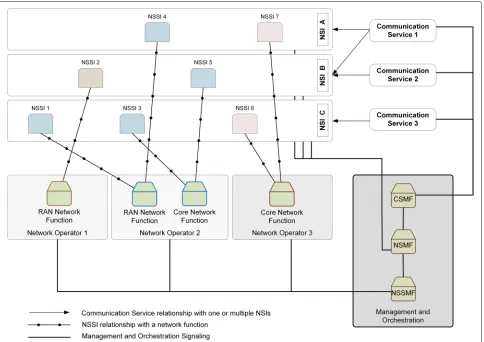
example, operators can create a slice for CIoT devices or slices for capacity/coverage on demand. These logical par-titions are referred to as NSIs and can contain one or more subnets—NSSI. The NSSIs further contain network func-tions (which can be virtualized, too) belonging to the core and/or the RAN as shown in Fig.11. The network slic-ing concept in Rel. 15 assumes business models where (1) network operators can define flexible relationships with their subscribers or (2) different network operators share portions of the network, e.g., the RAN. In both cases, the network operators manage and orchestrate their core net-works and optionally share the management of the radio network with other operators.
In general, the concept of network slicing enables multi-tenancy or vertical markets, and so, in Rel. 16, a new business model is discussed where only part of the network is owned and managed by a network operator, e.g., enabling private slices [18]. Four poten-tial management options are considered for this business model:
• A network operator provides the virtual/physical infrastructure and the PNF/VNF; a private third party uses the dedicated functionality provided by the network operator
• A network operator provides the virtual/physical infrastructure and the PNF/VNF; a private third party manages some PNF/VNF via APIs provided by the network operator
• A network operator provides the virtual/physical infrastructure; a private third party provides some PNF/VNF
• A private third party provides some PNF/VNF and manages them
SharevskiEURASIP Journal on Information Security (2018) 2018:8 Page 10 of 16
Fig. 11Rel. 15 network slicing architecture. The CSMF is responsible for translating communication service-related requirement to network slice-related requirements and communicates with the NSMF. The NSMF is responsible for management and orchestration of NSI and communicates with the NSSMF. The NSSMF is responsible for management and orchestration of NSSI
All management options for supporting private slices have an impact on the LI and LALS mechanisms. In the network slicing models from Rel. 15, all the involved oper-ators are subject of national regulation and the exiting LI and LALS mechanisms can be adapted with small modifi-cations as discussed in the next two subsections. However, private third parties might not be regulated, so the foren-sic investigations of users belonging or using private slices require redefined procedures for LI and LALS. To support LI and LALS for private slices, a trust relationship between the network operators and the private third parties must be defined.
For the first management option, the third party must trust the network operator when provisioning the LI and LALS requests and delivering the cellular network evi-dence back to the LEA. The third party in this case might need to be allowed to authorize these requests with a direct access to the ADMF. For the second and third sec-ond management option, ADMF needs to be adapted so it can provision LI and LALS to the PNF/VNF managed and/or provided by the third party. For the fourth option,
the LEA needs to establish separate handover interfaces with the third party. In all cases, the LEA needs to be able to authenticate and verify the trustworthiness of the cellular network evidence delivered by the third party.
3.3.1 Lawful Interception adaptations for network slicing
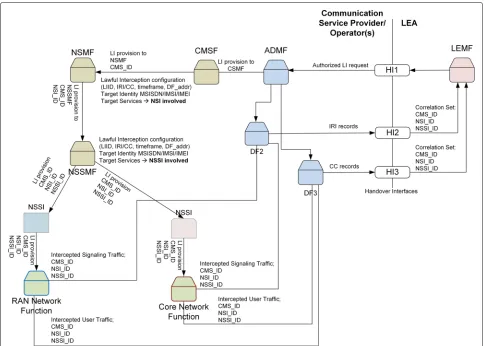
Fig. 12LI adaptations for the Rel. 15 network slicing architecture. For the LEA to be able to distinguish and correlate CIoT traffic (signaling and both IP and non-IP traffic), a triplet of IDs including the communication service identifier, the NSI identifier, and the NSSI identifier is proposed
NSI_IDs part of the communication service, identifies the NSSI involved, and sends the updated LI provision-ing info to the NSSMF. The NSSMF identifies the NSSIs, adds their NSSI_IDs to the LI configuration, and instructs the serving network functions—which ultimately realize the service of interest—to deliver the requested IRI/CC to DF2 and DF3, respectively. For a Rel. 15 network slic-ing, the correlation set propagated in the IRI and CC records to the LEA includes the triplet CMS_ID, NSI_ID, and NSSI_ID. These adaptations can be kept for Rel. 16, but the ADMF needs to be updated to support authoriza-tion of private slices and the LEMF to receive delivery of IRI records and CC data on a separate set of handover interfaces for the same target identity or communication service.
3.3.2 Lawful Access Location Services adaptations for network slicing
The Rel. 15 network slicing offers an interesting oppor-tunity for operators to share the LCS function as part of the second business model that allows RAN sharing. This
is an optimization for LALS because the LEA in this case needs to work with only one SMLC instead of multiple SMLCs hosted by each network operator. The immedi-ate and periodic positioning will not be affected because they happen regardless of the communication service cur-rently used by the target identity. For the enhanced loca-tion for IRI posiloca-tioning, the localizaloca-tion IRI records need to include the correlation set of CMS_ID, NSI_ID, and NSSI_ID so the geographical movement trajectories over the investigated period can be reconstructed according to the NSI(s) and NSSI(s) involved in the communication service of interest. These adaptations will also work for the first business model and are shown in Fig.13.
3.4 Cellular Internet of Things—CIoT
SharevskiEURASIP Journal on Information Security (2018) 2018:8 Page 12 of 16
Fig. 13LALS adaptation for the Rel. 15 network slicing architecture. Few extra steps are added in the LCS procedure so the SMLC can include the CMS_ID, NSI_ID, and NSSI_ID in the subscriber location reports sent back to the LEA
legacy machine-to-machine communications. GSM has the largest global coverage footprint and very small time-to-market, which is a huge advantage for readily available CIoT applications [20]. eMTC is an adaptation of the cur-rent LTE access to accommodate CIoT applications like wearables, CCTV, object tracking, or smart healthcare. It enables 15-dB enhancement over the standard LTE cover-age and extends the DRX to relax the latency and provide bigger delay budget needed for many CIoT applications. eMTC is fully compatible with the standard LTE/LTE-Advanced architecture, making it relatively easy to sup-port in the currently deployed LTE networks [21]. For CIoT applications like smart metering that require modest data rates, relaxed latency, longer battery life, extended coverage, and massive capacity, 3GPP introduces the self-contained NB-IoT radio access. The narrower bandwidth of only 200 kHz allows for significant reduction in device complexity, supporting sporadic (maximum latency of 10 s) and low-rate CIoT traffic (50 kbps) for a battery life between 5 and 10 years [21].
The CIoT network architecture introduces a new node in the EPC, the Cellular IoT Serving Gateway Node (C-SGN), shown in Fig. 14. C-SGN incorporates the
MME and S/P-GW roles, performing only necessary func-tions like simplified NAS signaling, security, and mobility and session management. The C-SGN is fully integrated with the HSS, SMS-GMSC, and IWMSC to enable non-IP services in case the CIoT applications require such.
3.4.1 Lawful Interception adaptation for CIoT
Fig. 14The general CIoT architecture. The S-GSN communicates user and signaling traffic over the S1-lite interface with the CIoT radio access network. The S8*, SGi*, and Gd/Gdd* interfaces indicate CIoT-specific session management per the IoT application requirements defined in the AS. The application server is realized as a service running on a remote cloud
3.4.2 Lawful Access Location Services adaptation for CIoT
The general LCS architecture for LTE/LTE-Advanced requires adaptations to enable LALS positioning for CIoT devices. The limited computational and memory resources restrict these devices to perform
immediate positioning measurements while they are in CONNECTED state, which is a necessary prerequisite for most of the positioning procedures. Therefore, the CIoT devices need to be allowed to perform measurements in IDLE state when they have most of their resources
SharevskiEURASIP Journal on Information Security (2018) 2018:8 Page 14 of 16
Fig. 16LALS integration with the CIoT architecture. SMLC must allow for IDLE state measurement for computational and power-restricted CIoT devices
available. In the proposed CIoT LCS procedure shown in Fig. 16, the SMLC uses a flag to indicate support for an IDLE state measurement. In this case, the positioning measurements are performed in IDLE and communicated back in CONNECTED state. The SMLC accommodates this prolongation with an extended timer, depending on the CIoT application [22].
This LCS modification for CIoT affects both the real-time and non-real-real-time forensic localization. In the case of immediate localization, the LEA has no option but to accommodate to this delay. In the case of periodic local-ization, the LEA might need to use a larger reporting granularity (fewer reports and a longer report interval) to be able to track the location of a CIoT device over a prolonged period of time. For the enhanced location for IRI localization, the LEA also needs to expect delayed and out-of-order reports, given that many of the target identities will respond to the localization requests in a prolonged and uncoordinated manner.
4 Cellular network forensics—legal and privacy aspects
4.1 Cellular network forensics in the European Union The use of LI and LALS within the European Union is covered by the Council Resolution 96/C 329/01 requiring
the LEA to be able to access all IRI records and CC data from user and signaling traffic transiting or stored by cellular network operators, as well as request subscriber localization information. The 2002/20/EC directive estab-lished guidelines concerning cooperation between LEAs and cellular network operators which made LI and LALS a condition for granting cellular networks the authority to operate [23]. The 2002/20/EC directive also contains a number of conditions that may be attached to the gen-eral authorization for providing LI and LALS in confor-mity with Directive 97/66/EC and Directive 95/46/EC on the protection of individuals with regard to the process-ing of personal data and on the free movement of such data.
4.2 Cellular network forensics laws in the USA
covers the use of LI and LALS for intelligence purposes where the target identity could not be a US citizen, work-ing as an agent on behalf of a foreign country. The invocation of LI and LALS under FISA requires prior authorization by the FISC federal court. The Title II of US Patriot Act allows LEAs to obtain authorization for LI or LALS by demonstrating that the IRI and CC records arerelevant for an investigation, rather than the stricter FISA requirement to demonstrate that the tar-get identity isexplicitlyinvolved in unauthorized activities and terrorism.
4.3 Cooperative cellular network forensic investigations In general, prior the LI and LALS are invoked, the LEA must obtain a court warrant and implement pri-vacy protections for safe storage and analysis of the acquired cellular network evidence. Warrantless invoca-tion of LI and LALS is possible if it is determined that an emergency situation exists involving immediate dan-ger of death or serious physical injury to any person, conspiratorial activities threatening the national secu-rity interest, or conspiratorial activities characteristic of organized crime. The responsible LEA in such a case needs to apply for a warrant approving the intercep-tion within few days after the LI and LALS evidence acquisition has occurred to the appropriate court. With a probable increase use of CIoT in the future, however, there is another possibility for another type of warrant-less acquisition of cellular network evidence, namely the digital witness methodology proposed in [2] that enables citizens to share their CIoT data with some privacy guarantees.
A CIoT device can be adigital witnesswith the capa-bilities of identifying, collecting, safeguarding, and com-municating cellular network evidence. The digital witness is harmonized with the ISO/IEC 29100 privacy princi-ples to stimulate the cooperation of citizens in foren-sics investigations. This is an interesting and promising approach for augmenting CIoT LI and LALS; however, the LEA must be able to correlate and possibly verify the evidence material collected from the CIoT digital wit-nesses with the material acquired from the CIoT network operator.
5 Conclusions
The forensic capabilities of LI and LALS currently avail-able in LTE/LTE-Advanced networks were reviewed to propose adaptations and discuss implementation chal-lenges with the main technologies envisioned for 5G. CUPS, NFV, network slicing, and CIoT are developed largely in insolation so integration into the 5G ecosystem will impact the continuous support for LI and LALS. Dif-ferent correlation mechanisms per technology, multiple streams of IRI and CC records, and potential inclusion
of third parties in the cellular service realization are just some of the challenges LEAs need to address to keep the LI and LALS capabilities in the future 5G networks. Equally relevant is the legal aspect of conducting cellular network investigations. With the traffic served by virtu-alized functions that can reside in multiple jurisdictions, LEAs also need to find a way to continuously support LI and LALS, especially for real-time investigations. On top of this, LEAs are increasingly challenged with the anal-ysis of third party encrypted CC, which, depending on the jurisdiction, might preclude LEAs to decrypt the user traffic of interest.
Abbreviations
3GPP: 3rd generation partnership project; 5G: 5th generation; A-GNSS: Assisted Global Navigation Satellite Systems; AoA: Angle of Arrival; API: Application programming interface; APN: Access point name; AS: Application server; BSS: Business support systems; C-SGN: Cellular service gateway node; CALEA: Communications Assistance for Law Enforcement Act; CC: Content of Communication; CCTF: CC triggering function; CDR: Charging data records; CGI: Cell global identity; CID: Communication identifier; CIoT: Cellular IoT; CMS: Communication service; CSMF: Communication service management function; CUPS: Control and user plane separation; DNS: Domain name service; DSS: Digital signature standard; E-CGI: Evolved cell global identity; EC-GSM-IoT: Extended coverage for GSM IoT; ECID: Enhanced cell ID; ECPA: Electronic Communications Privacy Act; eDRX: Extended discontinuous reception; eMTC: Evolved machine type communication; EPC-MT-LR: EPC network initiated localization request; EPC-NI-LR: EPC network mobile terminating localization request; EPC: Evolved packet core; ETSI: European
telecommunication standardization union; EUTRAN: Evolved UTRAN; FISA: Foreign Intelligence Surveillance Act; FISC: FISA court; GPS: Global positioning system; GSM: Global system for mobile; GTP: Gateway tunneling protocol; HI1: Handover interface 1; HI2: Handover interface 2; HI3: Handover interface 3; HSS: Home subscriber system; HTTPS: HyperText transfer protocol secure; ICE: Interception Control Elements; IMEI: International Mobile Equipment Identity; IMSI: International Mobile Subscriber Identity; IoT: Internet of Things; IP: Internet Protocol; IRI: Interception-Related Information; ISDN: Integrated Service Digital Network; ITOT: ISO Transport Service on top of TCP (ITOT)—also referred to as TPKT; IWMSC: Interconnection Mobile Switching Center; LAC: Location area code; LAI: Location area identity; LALS: Lawful Access Location Services; LCS: Location Services; LEA: Law enforcement agency; LEMF: Law Enforcement Monitoring Facility; LI: Lawful interception; LIID: Lawful interception identifier; LMU: Location measurement units; LPP: LTE positioning protocol; LTE: Long-term evolution; MANO: Management and orchestration; MEC: Mobile edge computing; MME: Mobility management entity; MSC: Mobile switching center; MSISDN: Mobile subscriber ISDN number; NAS: Non-access stratum; NB-IoT: Narrow band IoT; NFV: Network functional virtualization; NFVI: NFV infrastructure; NFVO: NFV orchestrator; NSI: Network slice instance; NSMF: NSI management function; NSSI: Network slice subnet instance; NSSMF: NSSI management function; OAI: Open air interface; OCCSSA: Omnibus Crime Control and Safe Streets Act; OSS: Operations support systems; OTDOA: Observed time difference of arrival; P-GW: Packet gateway; PDCP: Packet data convergence protocol; PFCP: Packet forwarding control protocol; PFD: Packet flow description; PKC: Public key certificate; PLMN: Public land mobile network; PNF: Physical network function;
SharevskiEURASIP Journal on Information Security (2018) 2018:8 Page 16 of 16
Acknowledgements
The author wishes to acknowledge UTel Systems and ZetX for their technical support and provision of their tools for cellular network forensic analysis.
Availability of data and materials
The materials supporting the conclusions of this article are included within the article.
Authors’ contributions
The entire manuscript is a sole contribution of the author. The author read and approved the final manuscript.
Authors’ information
Filipo Sharevski received his PhD degree in information security and cyber forensics from Purdue University in 2015. He currently is an assistant professor of cybersecurity at DePaul University, Chicago, IL, USA. He has worked as a cellular network engineer and has conducted practical research in cellular network forensics for his doctoral dissertation. He has established and is currently leading the Cellular Network Security Lab at DePaul University exploring targeted cyberattacks against LTE/LTE-A and future 5G cellular architectures. He has published in internationally recognized and peer-reviewed journals, conferences, and workshops. He is the author of the book “Mobile Network Forensics: Emerging Challenges and Opportunities.” His research interests include cellular networks, cyber forensics, cellular Internet of Things, cyberoperations, and cybersecurity gamification.
Competing interests
The author declares that he has no competing interests.
Publisher’s Note
Springer Nature remains neutral with regard to jurisdictional claims in published maps and institutional affiliations.
Received: 15 January 2018 Accepted: 6 June 2018
References
1. Ericsson Mobility Report (2017). https://www.ericsson.com/en/mobility-report. Accessed 12 Oct 2017
2. A Nieto, R Rios, L Javier, IoT-Forensics meets privacy: towards cooperative digital investigations. Sensors.18(2), 492 (2018)
3. International Standardization Organization: ISO/IEC 27035:2011 – Information security incident management, (Geneva, 2016).https://www. iso.org/standard/62071.html
4. International Standardization Organization: ISO/IEC 27037:2012 guidelines for identification, collection, acquisition and preservation of digital evidence, (Geneva, 2012).https://www.iso.org/standard/44381.html
5. 3rd Generation Partnership Project: TS 33.106 V14.1.0 - Technical Specification Group Services and System Aspects; 3G security; Lawful interception requirements (Release 14). (3GPP, Sophia Antipolis, 2017).
http://www.3gpp.org
6. 3rd Generation Partnership Project: TS 33.108 V14.1.0 - Technical Specification Group Services and System Aspects; 3G security; Handover interface for Lawful Interception (LI) (Release 14). (3GPP, Sophia Antipolis, 2017).http://www.3gpp.org
7. ETS Institute. Lawful Interception (LI); Cloud-Virtual Services for Lawful Interception (LI) and Retained Data (RD). (ETSI, Sophia Antipolis, 2016).
http://www.etsi.org/deliver/etsi_tr/101500_101599/101567/01.01.01_60/ tr_101567v010101p.pdf. Accessed 20 Jan 2018
8. STINGA Lawful Interception Analyzer.https://utelsystems.com. Accessed 15 Oct 2017
9. ZetX.http://zetx.com. Accessed 15 Oct 2017
10. A Drygajlo, inForensic Speaker Recognition: Law Enforcement and Counter Terrorism, ed. by A Neustein, HA Patil. Automatic speaker recognition for forensic case assessment and interpretation (Springer, New York, 2012), pp. 3–20
11. A Larcher, J-f Bonastre, B Fauve, KA Lee, L Christophe, H Li, JSD Mason, J-y Parfait, inInterspeech. 14th Annual Conference of the International
Speech Communication Association. ALIZE 3.0—open source toolkit for state-of-the-art speaker recognition, (Lyon, 2013), pp. 2768–2772 12. 3rd Generation Partnership Project: TS 27.071 V14.1.0 - Services and
System Aspects; Location Services (LCS); Service description; Stage 1 (Release 14). (3GPP, Sophia Antipolis, 2017)
13. 3rd Generation Partnership Project: TR 38.913 V14.3.0 - Technical Specification Group Radio Access Network; Study on Scenarios and Requirements for Next Generation Access Technologies; (Release 14). (3GPP, Sophia Antipolis, 2017).http://www.3gpp.org
14. P Schmitt, B Landais, FY Yang. Control and user plane separation of EPC nodes (CUPS). (3GPP, Sophia Antipolis).http://www.3gpp.org/cups. Accessed 16 Oct 2017
15. G McQuaid, DR Cione. Lawful interception in virtualized networks. 3GPP, Sophia Antipolis, 2017). https://www.sicurezzaegiustizia.com/lawful-interception-in-virtualized-networks-sept-2017/. Accessed 20 Jan 2018 16. ETS Institute. Network functional virtualization (NFV); NFV Security; Privacy
and Regulation; Report on Lawful Interception Implications. (ETSI, Sophia Antipolis, 2015).http://www.etsi.org
17. 3rd Generation Partnership Project: TR 28.801 V2.0.1 - Technical Specification Group Services and System Aspects; Telecommunication management; Study on management and orchestration of network slicing for next generation network (Release 15). (3GPP, Sophia Antipolis, 2017).http://www.3gpp.org
18. 3rd Generation Partnership Project: Feasiblity Study on Business Role Models for Network Slicing in Rel. 16. (3GPP, Sophia Antipolis, 2018).
http://www.3gpp.org
19. 3rd Generation Partnership Project: 3GPP TR 23.720 V13.0.0 - 3rd Generation Partnership Project; Technical Specification Group Services and System Aspects; Study on architecture enhancements for Cellular Internet of Things (Release 13). (3GPP, Sophia Antipolis, 2016).http:// www.3gpp.org
20. Cellular networks for massive IoT.https://www.ericsson.com/assets/local/ publications/white-papers/wp_iot.pdf. Accessed 14 Oct 2017
21. An overview of 3GPP enhancements on machine to machine communications. IEEE Commun. Mag.54(6), 14–21 (2016) 22. 3rd Generation Partnership Project: 3GPP TR 23.730 V14.0.0 - 3rd
Generation Partnership Project; Technical Specification Group Services and System Aspects; Study on extended architecture support for Cellular Internet of Things (CIoT) (Release 14). (3GPP, Sophia Antipolis, 2016). 3GPP TR 23.730 V14.0.0
23. Government Access to Encrypted Information.https://www.loc.gov/law/ help/encrypted-communications/european-union.php. Accessed 17 Oct 2017
24. H Miller, The ready guide for intercept legislation (2007)
![Fig. 5 A CC record for an LTE DNS and HTTPS user session. The capture is taken from a test LTE network setup using the OAI open-source LTEimplementation [25]](https://thumb-us.123doks.com/thumbv2/123dok_us/874665.1584968/5.595.58.540.82.333/record-https-session-capture-network-setup-source-lteimplementation.webp)