O R I G I N A L A R T I C L E
Effect of vegetable oils on the colour stability of four tropical
woods during natural and artificial weathering
Milosˇ Pa´nek1•Ladislav Reinprecht2
Received: 6 May 2015 / Accepted: 17 September 2015 / Published online: 22 October 2015
ÓThe Japan Wood Research Society 2015
Abstract The aim of this paper was to study effect of transparent and pigmented vegetable oils on the colour sta-bility of selected tropical woods during their natural and artificial weathering. The surfaces of four tropical woods recommended for garden furniture and outdoor architec-ture—kusia (Nauclea diderrichiiMerill), bangkirai (Shorea obtusaWall., Sh. spp.), massaranduba (Manilkara bidentata A. Chev.; M. spp.) and jatoba´ (Hymenaea courbarilL.)— were treated with vegetable oil Woca ‘‘Exterior Oil Exclu-sive’’ of the transparent, teak or bangkirai shade. Native samples of these wood species were also tested. Both weathering processes, the natural according to EN 927-3, lasting 1–36 months, and the artificial in Xenotest according to modified EN 927-6, lasting 1–12 weeks, showed that the colour coordinates L*, a*, b* changed more in the early stages of weathering. Bangkirai wood treated with teak oil had the best colour stability. The highest changes of the colour coordinatesDL*,Da*,Db* and the total colour dif-ference DE* occurred for kusia wood treated with trans-parent oil. Linear correlation of DE* was the highest between 12 months of outdoor weathering and 4 weeks of artificial weathering but results were not always clear for the most other compared cases.
Keywords Tropical woodVegetable oilPigment WeatheringColour stability
Introduction
Tropical wood species are usually characterised by a high durability against biodegradation agents due to the pres-ence of specific extractive substances—flavonoids, tannins, etc. However, to the colour changes of wood exposed in exterior conditions significantly contribute not only extractives [1–4], but also lignin [5–7]. The colour changes of some tropical woods caused by weathering were observed in more scientific papers [1,2,8–10]. Generally, the colour stability of tropical woods significantly depends not only on the wood species and the surface treatment methods, but also on the area of their exposure [10, 11]. Due to their specific properties, i.e. usually high resistance to biological agents, high density and high resistance to mechanical wear, high-dimensional stability, and good aesthetic, tropical woods are used as wood decking, clad-dings, garden constructions and furniture in various world regions, including Central Europe.
Therefore, it is convenient to determine for individual tropical wood species the direction and degree of their colour changes in defined local climatic conditions. The aesthetic function of wooden products in the exterior can be extended by selecting the most resistant wood species in terms of colour stability. It is also important to determine the influence of protective coatings on the initial colour of wood before ageing, and the effect of pigments, UV-ab-sorbents or screeners, hydrophobic and other substances present in coatings for reduction of the colour changes of wood surfaces during weathering. Simulation of the natural weathering of painted wood can be done via artificial
& Milosˇ Pa´nek
1 Faculty of Forestry and Wood Sciences, Czech University of
Life Sciences Prague, Kamy´cka´ 129, 165 21 Prague 6-Suchdol, Czech Republic
2 Faculty of Wood Sciences and Technology, Technical University in Zvolen, Masarykova 24, 960 53 Zvolen, Slovak Republic
accelerated ageing in Xenotest [12, 13]. However, it is necessary to determine their correlation relations according to different wood species, different finishes and different places of exposure which depend on local weather condi-tions [11, 14–16]. This problem has not yet been investi-gated in detail, especially for tropical wood species exposed in the urban or industrial environment of Central Europe.
The aim of this study was to determine the colour sta-bilisation effect of three vegetable oils applied on four tropical woods exposed to natural and artificial weathering. Simultaneously, using correlation analyses, we wanted to simulate natural weathering with the accelerated weather-ing in Xenotest.
Materials and methods
Tropical woods
Samples without sapwood, knots and other growth inho-mogeneity were prepared from boards of four wood spe-cies: (1) kusia (Nauclea diderrichii Merill)—795 kg/m3, (2) bangkirai (Shorea obtusaWall., Sh. spp.)—987 kg/m3, (3) massaranduba (Manilkara bidentata A. Chev.; M. spp.)—1012 kg/m3, (4) and jatoba´ (Hymenaea courbaril L.)—907 kg/m3, conditioned in a climate room at 20°C and 65 % RH to a constant moisture content of about 12 %. Samples for the natural weathering had a dimensions of 375978920 mm (L9R9T) in accordance with EN 927-3 [17], and those for the accelerated weathering carried out according to a modified EN 927-6 [18] had dimensions of 3893898 mm (L9R9T). Top surfaces of
samples were grinded along grains with the 120-grit sandpaper. Lateral surfaces of samples were treated with silicone as protection against water.
Vegetable oils
The Woca Denmark (WoodCare USA LLC) vegetable oil with UV-, and mould-protection effects, is a water-based composition recommended for finishing of wooden products in an exterior. It was used in three colour shades: (a) transparent without pigments ‘‘Exterior Oil Exclusive Natural’’, (b) teak pigmented ‘‘Exterior Oil Exclusive Teak’’, (c) bangkirai pigmented ‘‘Exterior Oil Exclusive Bangkirai’’.
Treatment of tropical woods with vegetable oils
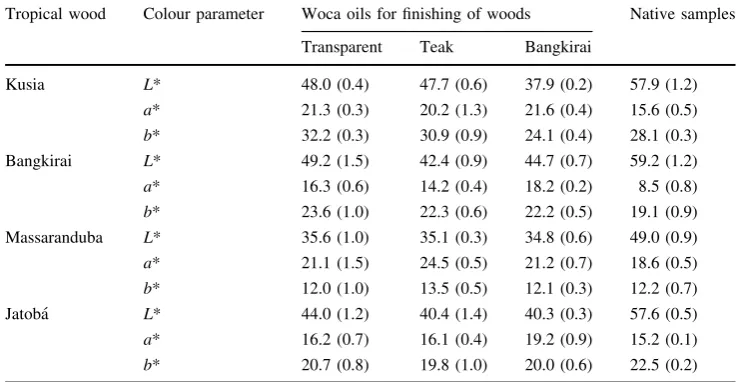
Samples of four tropical woods conditioned on a moisture content of about 12 % were painted in one layer with the Woca Denmark oils in the amount of 80 ±10 g m-2. These oils partly changed the initial colours of native tropical woods, even when using transparent oil (Table1). Salas et al. also observed colour changes of tropical woods after treatment with transparent oils. [19].
Natural and artificial weathering
The natural weathering of wood samples was carried out from 1st August 2010 to 31st July 2013 in the outside exposition of the Technical University in Zvolen, Slovakia, Central Europe, at a height above sea level of app. 300 m, under a slope of 45°in south orientation according to EN 927-3 [17]. The exposition place is located in a hollow with
Table 1 Colour parameters of
native tropical woods finished with Woca oils
Tropical wood Colour parameter Woca oils for finishing of woods Native samples
Transparent Teak Bangkirai
Kusia L* 48.0 (0.4) 47.7 (0.6) 37.9 (0.2) 57.9 (1.2)
a* 21.3 (0.3) 20.2 (1.3) 21.6 (0.4) 15.6 (0.5)
b* 32.2 (0.3) 30.9 (0.9) 24.1 (0.4) 28.1 (0.3)
Bangkirai L* 49.2 (1.5) 42.4 (0.9) 44.7 (0.7) 59.2 (1.2)
a* 16.3 (0.6) 14.2 (0.4) 18.2 (0.2) 8.5 (0.8)
b* 23.6 (1.0) 22.3 (0.6) 22.2 (0.5) 19.1 (0.9)
Massaranduba L* 35.6 (1.0) 35.1 (0.3) 34.8 (0.6) 49.0 (0.9)
a* 21.1 (1.5) 24.5 (0.5) 21.2 (0.7) 18.6 (0.5)
b* 12.0 (1.0) 13.5 (0.5) 12.1 (0.3) 12.2 (0.7)
Jatoba´ L* 44.0 (1.2) 40.4 (1.4) 40.3 (0.3) 57.6 (0.5)
a* 16.2 (0.7) 16.1 (0.4) 19.2 (0.9) 15.2 (0.1)
b* 20.7 (0.8) 19.8 (1.0) 20.0 (0.6) 22.5 (0.2)
Native samples, without any treatment, have also been used in experiment
The mean values in each series are from six measurements (n=6)
a high occurrence of foggy days, smog and high tempera-ture differences between summer (to about 35°C) and winter (to about-25°C). The climate conditions [20,21], i.e. the mean temperature, relative humidity, precipitation and solar radiation, were measured daily at the Arboretum Zvolen weather station—3 km from our exposition field (Table2). The natural weathering lasted 36 months with evaluation of the colour parameters of samples after 1, 3, 6, 12, 24, and 36 months.
Artificial weathering of tested samples was carried out in the Q-SUN Xe-1-S Xenotest (Q-Lab Corporation, USA). It lasted 12 weeks and used the modified conditions of the standard EN 927-6 [18] (Table3). The colour parameters of samples were evaluated after 1, 2, 3, 4, 5, 6, 7, 8, 9, 10, 11, and 12 weeks.
Colour analyses
The colours of samples before and after weathering were measured by the Color Reader CR-10 (Konika Minolta, Japan). Six measurements per sample exposed to natural weathering and four measurements per sample exposed to artificial weathering were carried out for each ageing time. Evaluations were done in the CIE-L*a*b* colour system on the basis ofL*,a*, andb* colour coordinates, where:L* is lightness from 0 (black) to 100 (white),a* is chromaticity coordinate?(red) or - (green), and b* is chromaticity coordinate?(yellow) or -(blue). Relative colour chan-ges of samplesDL*,Da* andDb* between their weathered and initial state were determined, and finally, according to
the Euclidean distances the total colour differences DE* [22] were calculated by Eq. (1):
DE¼pffiffiffiffiffiffiffiffiffiffiffiffiffiffiffiffiffiffiffiffiffiffiffiffiffiffiffiffiffiffiffiffiffiffiffiDL2þDa2þDb2 ð1Þ
Statistical evaluation
Colour changes related to the species of tropical wood, the type of vegetable oil and the time of weathering in an exterior or in Xenotest were evaluated in the program STATISTICA 10—mean values, standard deviations, Duncan’s tests; and, for DE* also linear correlations for modelling the natural weathering by Xenotest.
In the linear correlations, the 12 weeks of artificial weathering were divided into three equal time intervals (after 4, 8 and 12 weeks), and the 36 months of natural weathering into 4 equal time intervals (after 6, 12, 24 and 36 months). Between the total colour differences DE*, determined during the artificial and natural weathering, similarities using linear correlations and evaluation of their coefficients of determination were searched for in these defined time intervals (R2).
Results and discussion
Effect of tropical wood species on weathering
From the four tropical wood species tested in their native state, the least colour stable was the kusia wood (seeDE*
Table 2 Climatic conditions
during natural weathering from 0 to 36 months, i.e. from the 1st August 2010 to 31st July 2013 [20,21]
Climatic conditions Exposure time (months)
0–1 1–3 3–6 6–12 12–24 24–36
Temperature (°C) 18.5 8.9 -2.6 14.7 9.4 9.4
RH (%) 86 91 92 77 80 86
Sum of precipitation (mm) 87.6 256.7 92.3 373.2 538.9 860.0
Sum of global radiation (kWh/m2) 138.2 177.7 86.6 846.4 1176.8 1089.1
Sum of snow cover days (day) – – 23 14 68 57
RHrelative humidity
Table 3 One 1-week cycle of samples’ exposure in Xenotest, by modified EN 927-6 [18]
Weathering in Xenotest: one cycle=1 week (168 h) Functions
1st step 24 h Temperature 45±3°C, water spray (off), UV (off)
2nd step A 2.5 h Temperature 50±3°C, water spray (off), UV Irradiance 0.55 W m-2at 340 nm B 0.5 h Temperature 20±1°C, water spray (on), UV (off)
A?B 3 h
Sub-cycle (A?B): 48 sub-cycles93 h of one, i.e. together 144 h
According to EN 927-6 [18]: UV lamps are used instead of an 1800 W xenon lamp
in Fig.1), having a light colour (seeL* value was 57.9 in Table1), smaller density (see ‘‘Materials and methods’’), and non-homogenous porous surface when compared to the other species. Its colour change in an exterior—greying, connected with increase of its green (-a*), blue (-b*) and dark (-L*) shade—was significantly affected by settling of dark dust particles and other impurities into its surface layers. Effects of impurities in combination with other factors for increasing of the colour changes in wood were also observed for other tropical woods tested in this work (Fig.1), and are also known from other scientific works.
For example, the negative effect of the initial lighter col-ours of wood was described by Salas et al. [19], the neg-ative effect of a smaller density of wood in the works of Kataoka et al. [23] and Williams et al. [8], and the effect of rougher wood surface in the works of Van den Bulcke et al. [24] and De Windt et al. [25]. The naturally darkest wood species—massaranduba (seeL* value was 49.0 in Table1) darkened in an exterior at least (seeDL* in Fig.1).
Significant colour changes of native kusia and jatoba´ woods in Xenotest also reflected their small colour sta-bility in an ideal environment, i.e. without the presence of
Fig. 1 The total colour
impurities (see DE* was 30.4 for kusia and 31.9 for jatoba´ after 12 weeks of artificial weathering in Fig.1). It was documented by a significant loss of the original lightness and strong yellow shade, and by a milder loss of red shade (see L*, a*, b* values in Table1; DL*, Da*, Db* values in Fig.1). By this result, the effect of a lower density of woods for a lower colour stability of kusia and jatoba´ wood was proven. Generally, in Xenotest, a grey-ing of wood surfaces occurred similarly with natural weathering, connected with increase in its green (-a*) and blue (-b*) shades. However, now the greying was not combined with darkening of wood samples due to
dust particles, but it was combined with lightning (?L*) of samples due to washing of photodegraded dark lignin and hemicelluloses from aged surfaces, and also due to washing of darker extractives.
Jatoba´ wood by Costa et al. [26] is a less colour stable tropical wood species in exterior conditions. Baar and Gryc [27] observed a higher colour change in jatoba´ than in massaranduba wood, but only when using shorter UV exposure time in Xenotest (for 144 h), and without water spraying. A lower colour stability of native jatoba´ in comparison with the native massaranduba wood was also found in this work, both for natural and artificial
Fig. 2 The total colour
weathering (see DE* was 25.1 for jatoba´ and 19.4 for massaranduba after 36 months of natural weathering and DE* was 31.9 for jatoba´ and 22.5 for massaranduba after 12 weeks of artificial weathering in Fig.1). The colour stability of the most dense woods, bangkirai and mas-saranduba, was a comparable in the exterior, while bangkirai was more stable in Xenotest.
An interesting result is that the colour changes of native bangkirai wood without oil treatment were the most pro-nounced at the beginning of natural weathering (after 1 month DE* was 18.7), and then they settled the same (after 9 monthsDE* was 19.3)—see Fig.1. This could be
explained by the great overall colour change of bangkirai wood during the first weeks of exposure to UV radiation in accordance with work Kishino and Nakano [28]. Further total colour changes due to action of water and penetration of dirt and dust particles into its surface layers were insignificant—or less important.
The weathering processes of native tropical woods, in most cases, confirmed the highest effect of darkening in an exterior (-DL*) or lightening in Xenotest (?DL*), and blueing in both an exterior and in Xenotest (-Db*), for their total colour differencesDE* (Fig.1). A similar result was also found in the work of Salas et al. [19].
Fig. 3 The total colour
The effect of pigments in vegetable oils on the weathering of tropical woods
The mean changes of the colour parametersDL*,Da*,Db* and the total colour differenceDE* of four tropical woods coated with three types of vegetable oils, which occurred during their natural and artificial weathering, are shown in Figs.2, 3 and 4. The mean total colour differences DE* arising from the natural weathering, together with the standard deviations and Duncan’s tests related to woods treated with the transparent oil are shown in Table4.
During both weathering processes, i.e. the natural and artificial, the transparent vegetable oil had the least pho-tostabilization effect for treated tropical woods (see DE* mainly during 12 months of weathering in Table4 and in Figs. 2, 3, 4). Using the transparent oil, the initial colour space of bangkirai and massaranduba woods was partly preserved; however, only in the first month of the natural exposure. On the other hand, during weathering, the transparent oil applied on the surfaces of kusia wood caused even greater colour changes when compared to those which occurred in native kusia wood.
Fig. 4 The total colour
The pigments in the vegetable oils used for treatment of tropical woods reduced their colour changes during weathering (Figs.2,3,4). During natural weathering, this result for theDE* was confirmed by a statistical analyses, as well (Table4). The positive effect of pigments well corresponds with the work of Kropf et al. [29]. The colour stabilisation effects of teak and bangkirai pigmented oils for different wood species were expressed differently.
The lesser influence of tropical wood species on their colour changes in the initial period of exposure was observed in more works [25, 30, 31]. Similarly, in our work, oil finish in the bangkirai shade had a more positive effect on massaranduba wood. On the other hand, more colour stable for other wood species (bangkirai, kusia, jatoba) was oil finish with the teak shade. A possible explanation for this observation is that the specific type and content of different extractives in massaranduba wood influenced the colour change of the pigment in the used oil. Effect of different species of tropical woods on their colour
stability after treatment with pigmented paints was also found in other works [19,24,25].
Variance in the DE* values of tropical woods treated with two types of pigmented oils were partly reduced after prolonged periods of natural weathering, and usually remained consistently lower than those in native—un-treated surfaces and surfaces native—un-treated with the transparent oil (seeDE* in Table4; Figs.1,2,3,4). A positive effect of paints on the colour stability of treated wood exists, but it is not always clear. Valverde and Moya [32] and Williams and Feist [33] also observed an insignificant improvement of the colour stability of native—untreated tropical woods by paintings’ application. Richter et al. [34] observed the effect of wood species on the degra-dation intensity of paints on wooden products and on their colour stability. The effect of wood species and types of paint on the total colour change DE* during artificial ageing in Xenotest was also observed by E Silva et al. [35].
Table 4 The total colour
differencesDE* of tropical woods (kusia, bangkirai, massaranduba, jatoba´) finished with the Wood Denmark vegetable oils (transparent, teak, bangkirai) during natural weathering in an exterior
Vegetable oil Time of weathering(month) DE* (total colour difference of wood)
Kusia Bangkirai Massaranduba Jatoba´
Transparent 1 7.4 (0.8)– 4.8 (0.9)– 11.3 (2.0)– 9.6 (2.2)–
3 16.1 (1.7)– 17.5 (2.0)– 13.1 (0.6)– 11.8 (1.5)–
6 22.7 (1.8)– 19.9 (1.3)– 17.1 (0.5)– 15.8 (0.8)–
9 26.9 (1.4)– 21.7 (1.5)– 20.6 (0.6)– 20.2 (0.3)–
12 29.7 (0.6)– 23.7 (1.1)– 23.8 (0.5)– 24.4 (0.7)–
24 37.3 (0.5)– 26.9 (1.6)– 24.3 (1.6)– 22.9 (0.4)–
36 30.6 (0.3)– 23.1 (1.3)– 22.9 (1.0)– 26.3 (0.1)–
Teak 1 3.7 (0.8) a 9.1 (0.8) a 13.9 (0.6) b 4.4 (1.2) a
3 8.9 (0.8) a 9.7 (1.0) a 15.0 (0.4) c 5.8 (1.3) a
6 14.7 (0.6) a 10.3 (1.1) a 18.3 (0.9) d 9.8 (0.9) a
9 17.9 (1.8) a 10.3 (1.4) a 21.8 (1.0) d 12.1 (1.8) a
12 19.5 (1.7) a 11.2 (1.8) a 25.5 (0.7) c 15.2 (2.5) a
24 25.7 (1.8) a 16.0 (1.7) a 29.2 (0.6) a 19.7 (1.9) a
36 30.3 (1.0) d 21.7 (1.1) d 27.6 (0.9) a 30.1 (0.2) a
Bangkirai 1 4.4 (0.3) a 15.6 (0.8) a 12.2 (1.1) d 10.6 (1.5) d
3 9.1 (0.9) a 15.5 (0.5) c 10.5 (0.8) b 10.6 (0.8) d
6 13.2 (0.5) a 15.9 (0.6) a 12.6 (0.9) a 14.0 (1.1) c
9 16.6 (0.4) a 15.8 (0.5) a 13.7 (0.8) a 14.5 (1.1) a
12 18.1 (0.4) a 17.2 (0.3) a 16.0 (0.5) a 15.4 (0.6) a
24 23.3 (0.2) a 22.9 (0.4) a 20.3 (1.0) a 21.2 (0.3) d
36 24.1 (0.9) a 24.3 (0.7) d 23.8 (1.1) d 29.6 (0.6) a
The mean values in each series are from six measurements (n=6)
The numbers in the parentheses are the standard deviations
Using Duncan’s test, the results within samples treated with the teak and bangkirai oils were evaluated in relation to the reference samples treated with transparent oil (99.9 % significance level (a); 99 % signifi-cance level (b); 95 % signifisignifi-cance level (c); and no statistical signifisignifi-cance atpC0.05 (d)
Massaranduba wood finished with pigmented oils appeared to be the less photostable during artificial weathering in Xenotest (see DL* and DE* in Figs.3, 4. DE* was 31.2 with teak pigmented and 29.2 with bangkirai pigmented oil after 12 weeks of artificial weathering). In this case, significant lighteningDL* and a high total colour differenceDE* were observed. This result can be explained
by its initial darkest shade before ageing (L* =49.0) compared to other tested tropical woods (Table1).
Generally, of the tested tropical woods, bangkirai wood was the most colour stable in both cases, i.e. natural and with oil finishes. In Xenotest, it was always resistant to colour changes independently if it was not treated (seeDE* in Fig.1), or was treated with transparent or pigmented oils (see DE* in Figs.2, 3,4). In outdoor areas, it had good long-term colour stability after treatment with teak pig-mented oil (see DE* in Fig.3).
Correlations and modelling of colour changes of painted wood between natural and artificial weathering
The linear correlations for the total colour differencesDE* achieved between artificial and natural weathering are shown in Table5, and for two selected cases also in Fig.5. Linear correlation analysis showed some of the modelling possibilities of natural weathering in an exterior by means of artificial ageing in Xenotest. However, the achieved results were not always clear (Table5).
The maximal correspondences for the DE* were achieved between weathering that lasted 1 week in Xenot-est and 24 months in an exterior (R2=0.52), 4 weeks in Xenotest and 12 months in an exterior (R2=0.68—see also Fig.5a), 8 weeks in Xenotest and 12 months in an exterior (R2=0.60), and 12 weeks in Xenotest and 12 months in an exterior (R2=0.55) (Table5). An inter-esting result is that 1 week of accelerated weathering modelled quite accurately 2 years of exterior weathering. After a longer period of testing in an exterior, the coefficient of determination decreased (Table 5; see also Fig.5b with R2=0.41). Correspondences for theDE* comparing both
Table 5 Linear correlations for the total colour changes DE*
between the artificial weathering in Xenotest (1–12 weeks) (x) and the natural weathering in an exterior (6–36 months) (y) testing 12 com-positions in one series (n=12), i.e. four tropical woods (kusia, bangkirai, massaranduba, jatoba´) painted with three kinds of veg-etable oils (transparent, teak, bangkirai)
Artificial weathering in Xenotest (weeks)
Natural weathering in an exterior (months)
Linear regression for
DE*
Coefficient of determination R2
1 6 1.03x?8.04 0.28
12 1.37x?10.22 0.24
24 2.00x?9.90 0.52
36 0.88x?19.88 0.27
4 6 0.41x?9.38 0.43
12 0.75x?9.06 0.68
24 0.58x?15.73 0.41
36 -0.01x?26.22 0.00
8 6 0.30x?8.78 0.36
12 0.57x?7.64 0.60
24 0.41x?15.34 0.31
36 -0.01x?26.24 0.00
12 6 0.26x?8.74 0.30
12 0.51x?6.99 0.55
24 0.33x?15.76 0.23
36 -0.01x?26.50 0.00
Fig. 5 Linear correlations for the total colour changesDE* between artificial weathering in Xenotest (4 weeks) and natural weathering in
weathering methods were a slightly lower after 6 months of natural weathering, connected with a small decreasing of the value ofR2(Table5). So, finally it can be seen that the best similarity of the total colour changes DE* in the Xenotest for 12 series of painted tropical woods (four spe-cies with three oils) was observed after 12 months of weathering in the exterior (Figs.2,3,4; Table5).
During longer periods of natural weathering from 24 to 36 months, colours with oil-painted tropical woods remain grey only with a partial change of colour coordinatesDa*, Db* due to absorption of dust particles into surface layers and leaching of degradation components from cell walls. In the opposite case, during Xenotest accelerated ageing in clear air and spray water conditions [21], some larger differences of colours of tested woods and paints were also observed after longer testing time. This was then connected with a significant decrease of the coefficient of determi-nation (R2) for the linear correlations of theDE* between two ageing methods (Table5).
From the experimental results, it is evident, that the colour stability of painted tropical woods during artificial weathering in Xenotest was often different compared to their stability during natural weathering in an exterior. This is more or less closely connected with different processes of degradation—leaching of extractives and depolymerized lignin from surface layers using these two ageing methods [13,16]. The effects of dust particles also influenced colour changes in the exterior [7]. A problem of comparison of results from these two weathering methods was already discussed in the works of Za´vada [36], Valverde and Moya [11] and Gru¨ll et al. [13]. The necessity of additional exterior tests for more exact results was proposed by Crewdson and Ketola [37]. Although light from the xenon lamps is observed as the best simulating process of sunlight degradation [12,38], in the model accelerated weathering process, different results can be achieved due to absence of dust which causes darkening of wood surfaces degraded by UV- and VIS-light and water in the exterior.
Generally, modelling of painted wood weathering is a very complicated process. The results of different scientific works give various conclusions [11,13,36] and research works are still not finished. The benefit of this work was the determi-nation that for modelling the colour change of wood in the exterior, it is sufficient to use only Xenotest weathering that lasts a defined time—e.g. 4 weeks in this work. Longer peri-ods of artificial ageing did not affect refining the significance. Overall, it is possible to say that the finishing veg-etable Woca Denmark oils stabilised the colour of tropical woods only during shorter exposure, and mainly if pig-mented oils were used. This can be explained by a lower permeability of exotic woods, when a lower penetration of oils could not save surface layers of wood for a longer time [24]. Vegetable oils only impregnated the surface layers of
wood, and result was a faster washout of oils due to the weathering. The painted surfaces of wood must be regu-larly renewed, and thus it is possible, mainly through pigmented treatment adjustments, to keep colour fastness in exterior exposures.
Conclusion
The aim of this research was to study the effects of transparent and pigmented vegetable oils on the colour stability of selected tropical woods at their natural and artificial weathering. The colour changes of tested tropical wood species in the outdoor exposition in the Central European climate conditions were already highly signifi-cant after 6 months. The most colour stable wood species was bangkirai, without or with oil treatment.
Using oil paints, the colour change of treated wood can be mitigated, especially using pigmented ones. To achieve stable colours of oiled wood surfaces, they must be renewed frequently, optimally within 6–12 months.
The supposed total colour change of tested tropical woods in the exterior could be modelled by Xenotest in some cases but results were not always clear.
Acknowledgments This research was funded by the Grant Agency
of the Slovak Republic, Project APVV-0200-12 and by Grant Agency of the Faculty of Forestry and Wood Sciences, Project No. 20143127. The authors would like also to thank Ms. E. Dˇ urcˇı´kova´ for her technical assistance.
References
1. Pastore TCM, Santos KO, Rubim JC (2004) A spectrocolori-metric study on the effect of ultraviolet irradiation of four tropical hardwoods. Bioresour Technol 93:37–42
2. Yamauchi S, Sudiyani Y, Imamura Y, Doi S (2004) Depth pro-filing of weathered tropical wood using Fourier transform infra-red photo-acoustic spectroscopy. J Wood Sci 50:433–438 3. Pandey KK (2005) A note on the influence of extractives on the
photo-discoloration and photo-degradation of wood. Polym Degrad Stab 87:375–379
4. Barreto CCK, Pastore TCM (2009) Resistance to artificial weathering of four tropical woods: the effects of the extractives. Cienc Florest 19:23–30
5. Sudiyani Y (1999) Chemical characteristics of surfaces of hard-wood and softhard-wood deteriorated by weathering. J Wood Sci 45:348–353
6. Sudiyani Y, Imamura Y, Doi S, Yamauchi S (2003) Infrared spectroscopic investigations of weathering effects on the surface of tropical wood. J Wood Sci 49:86–92
7. Evans PD (2008) Weathering and photoprotection of wood. ACS Symp Ser 982:69–117
9. Pandey KK (2005) Study of the effect of photo-irradiation on the surface chemistry of wood. Polym Degrad Stab 90:9–20 10. Mattos BD, De Cademartori PHG, Lourenc¸on TV, Gatto DA
(2014) Colour changes of Brazilian eucalypts wood by natural weathering. Int Wood Prod J 5(1):33–38
11. Valverde JC, Moya R (2014) Correlation and modeling between color variation and quality of the surface between accelerated and natural tropical weathering inAcacia mangium,Cedrela odorata and Tectona grandiswood with two coating. Color Res Appl 39:519–529
12. Forsthuber B, Schaller C, Gru¨ll G (2013) Evaluation of the photo stabilising efficiency of clear coatings comprising organic UV absorbers and mineral UV screeners on wood surfaces. Wood Sci Technol 47:281–297
13. Gru¨ll G, Tscherne F, Spitaler I, Forsthuber B (2014) Comparison of wood coating durability in natural weathering and artificial weathering using fluorescent UV-lamps and water. Eur J Wood Wood Prod 72:367–376
14. Creemers J, De Meijer M, Zimmermann T, Sell J (2002) Influ-ence of climatic factors on the weathering of coated wood. Holz Roh Werkst 60:411–420
15. Schnabel T, Zimmer B, Petutschnigg AJ (2009) On the modelling of colour changes of wood surfaces. Eur J Wood Wood Prod 67:141–149
16. Ru¨ther P, Jelle BP (2013) Color changes of wood and wood-based materials due to natural and artificial weathering. Wood Mater Sci Eng 8(1):13–25
17. EN 927-3 (2006) Paints and varnishes—coating materials and coating systems for exterior wood—Part 3: natural weathering test. European Committee for Standardization, Brussels 18. EN 927-3 (2006) Paints and varnishes—Coating materials and
coating systems for exterior wood—Part 6: exposure of wood coatings to artificial weathering using fluorescent UV lamps and water. European Committee for Standardization, Brussels 19. Salas C, Moya R, Vargas-Fonseca L (2014) Optical performance
of finished and unfinished tropical timbers exposed to ultraviolet light in the field in Costa Rica. Wood Mater Sci Eng 9(1):1–17 20. Sarvasˇova´ I (2015) Development of Arboretum Borova´ hora tree
species collection in the period 2005–2014. Dendroflora of Central Europe—utilization of knowledge in research, education and practice. Technical University in Zvolen, Slovakia, pp 101–108
21. Lesˇtianska A, Vido J, Strˇelcova´ K (2014) Evaluation of extremity climatic characteristics in the Zvolenska´ valley and its sur-rounding in different forest vegetation levels during the vegeta-tion seasons 2009–2013. Transport of water, chemicals and energy in the soil-plant-atmosphere system, vol 21. International Poster Day and Institute of Hydrology Open Day, Institute of Hydrology SAS, Bratislava, pp 159–170
22. CIE (1986) Colorimetry, 2nd edn, CIE Pub. No. 15.2. Commis-sion Internationale de l’Eclairage, Vienna, p 74
23. Kataoka Y, Kiguchi M, Fujiwara T, Evans PD (2005) The effects of within-species and between-species variation in wood density on the
photodegradation depth profiles of sugi (Cryptomeria japonica) and hinoki (Chamaecyparis obtusa). J Wood Sci 51:531–536 24. Van den Bulcke J, Rijckaert V, Van Acker J, Stevens M (2006)
Adhesion and weathering performance of waterborne coatings applied to different temperate and tropical wood species. J Coat Technol 3(3):185–191
25. De Windt I, Van den Bulcke J, Wuijtens I, Coppens H, Van Acker J (2014) Outdoor weathering performance parameters of exterior wood coating systems on tropical hardwood substrates. Eur J Wood Wood Prod 72:261–272
26. Costa JA, Gonc¸alez JC, Camargos JAA, Gomes IAS (2011) Photodegradation of two tropical wood species: jatoba´ (Hy-menaea courbaril) and tauari (Couratari oblongifolia) submitted to ultraviolet radiation. Cerne 17(1):133–139
27. Baar J, Gryc V (2012) The analysis of tropical wood discol-oration caused by simulated sunlight. Eur J Wood Wood Prod 70:263–269
28. Kishino M, Nakano T (2004) Artificial weathering of tropical woods. Part 2: color change. Holzforschung 58:558–565 29. Kropf FW, Sell J, Feist WC (1994) Comparative weathering tests
of North American and European exterior wood finishes. For Prod J 44:33–41
30. Custo´dio JEP, Euse´bio MI (2006) Waterborne acrylic varnishes durability on wood surfaces for exterior exposure. Prog Org Coat 56:59–67
31. Podgorski L, Merlin A, Deglise X (1996) Analysis of the natural and artificial weathering of a wood coating by measurement of glass transition temperature. Holzforschung 50:282–287 32. Valverde JC, Moya R (2010) Effect of weathering on color of two
coating applied on Cedrela odorata and Carapa guianensis wood. Maderas Cienc Tecnol 12(3):171–180
33. Williams RS, Feist WC (1994) Effect of pre-weathering, surface roughness, and wood species on the performance of paint and stains. J Coat Technol 66:109–121
34. Richter HG, Schwab E, Von Arps-Aubert T, Nock HP (2004) Quality assessment of laminated window scantlings from mixed tropical hardwoods after long-term exposure to weathering. J Trop For Sci 16:350–356
35. E Silva JO, Pastore TCM, Pastore F Jr (2007) Resistance to artificial weathering of five tropical woods and of two finish products. Cienc Florest 17:17–23
36. Za´vada V (2010) The light stability of transparent coating materials is influenced by the location of exposition. Acta Universitatis Agriculturae et Silviculturae Mendelianae Brunen-sis 58:239–258
37. Crewdson MJ, Ketola WD (2009) Best practices in weathering: outdoor and accelerated testing compared. Eur Coat J 4:116–121 38. Tolvaj L, Mitsui K (2005) Light source dependence of the