A rare cause of chronic elbow pain in an
adolescent baseball player: a case report
David Wasylynko,
BSc, MS, ND, DC11 Private practice, Surrey, BC
Corresponding author: David Wasylynko 102 10366 136A St., Surrey, BC V3T 5R3 e-mail: [email protected]
Tel: 604 585-1588
The author reports no conflicts of interest in the preparation of this manuscript. Patient consent to submit this case for publication was obtained. © JCCA 2016
Objective: To present a case of chronic elbow pain as a
result of a hidden underlying osteochondral defect. Clinical Features: A 17-year old baseball player presented with chronic lateral elbow pain. Examination revealed swelling of the elbow with signs of possible ligament, muscle, and tendon injury.
Diagnosis and Treatment: Although there was apparent soft-tissue injury, the elbow swelling created immediate suspicion of a more serious underlying condition. Examination revealed a swollen and tender elbow, with plain x-ray confirming a subchondral bone disorder (osteochondral defect) of the capitellum. Surgical repair was performed by an orthopedic surgeon using DeNovo NT Natural Tissue Grafts: the implantation of small pieces of juvenile joint cartilage into the affected area, using glue-like fibrin. Rehabilitation of the elbow began immediately following surgery.
Summary: Examination and imaging indicated that elbow pain in an adolescent baseball player could be from multiple sources, however, the chronic swelling
Objectif : Présenter un cas de douleur chronique du
coude résultant d’une anomalie ostéo-cartilagineuse sous-jacente cachée.
Caractéristiques cliniques : Un joueur de baseball de 17 ans souffrait d’une douleur chronique latérale du coude. L’examen a révélé un gonflement du coude avec des signes de blessures possibles au ligament, au muscle et au tendon.
Diagnostic et traitement : Bien qu’il y ait une blessure
évidente des tissus mous, le gonflement du coude a immédiatement indiqué une affection sous-jacente plus grave. L’examen a révélé un coude enflé et douloureux, une radiographie simple confirmant un trouble de l’os sous-chondral (anomalie ostéo-cartilagineuse) du capitellum de l’humérus. Une chirurgie réparatrice a été réalisée par un chirurgien orthopédiste qui a eu recours à des greffes de tissus naturels DeNovo NT : l’implantation de petits morceaux de cartilage articulaire juvénile dans la zone touchée, avec de la colle de fibrine. La réhabilitation du coude a commencé immédiatement après l’intervention chirurgicale.
Résumé : L’examen et l’imagerie indiquent que la
Introduction
Elbow pain in an adolescent baseball player is not an un-usual occurrence. The reasons for the elbow pain may at times be due to unusual circumstances such as tumours and undiagnosed fractures. Although most elbow com-plaints in young baseball players are the result of either traumatic injury or repetitive stress, it is important to rec-ognize that elbow pain may signify the presence of an injury not restricted to the soft-tissues. This is especial-ly true when a red flag such as painful joint swelling is present.
One possible reason for such joint swelling is an osteo-chondral defect. Such a defect is a progressive stage of osteochondrosis/osteochondritis dissecans. This condi-tion is relatively rare, necessitates different treatment op-tions, and is associated with variable recovery dependent on the stage of the condition’s development. Osteochon-dritis dissecans (OCD) is a commonly used term. How-ever, due to the paucity of inflammatory cells found on the osteochondral articular surface of the bone, a more appropriate term would be osteochondrosis, which does not assume the presence of an inflammatory process.1,2
A similar condition commonly confused with OCD is Panner’s disease (an osteonecrosis of the capitellum). Although the two conditions appear similar, there are sig-nificant differences between them. The most important difference is the age of onset. Panner’s disease occurs in children below the age of 12, with some authors stating the upper range to be at 10 years of age. Panner’s disease tends to be self-limiting and presents as a focal osteone-crosis of the entire capitellum. OCD on the other hand commonly occurs in adolescence, is laterally located, and is variable in terms of prognosis. Some authors feel that there may be a progressive connection between the two disorders.1,3
OCD in the capitellum of the elbow has been described in the literature by numerous authors.1-9 Although it is
considered a rare condition when present, it is most com-monly found in the capitellum. The exact incidence of the condition is speculative, with current estimates of 1.3% to 1.6% amongst little league players.4 It is not uncommon
for this injury to be confused with osteonecrosis, Panner’s disease, Little Leaguers elbow, and hereditary epiphyseal dysplasia.5
This case is of particular interest to chiropractors who treat athletes in general, and most relevant to those who treat baseball players. Elbow injuries from various mech-anisms are common in adolescent baseball players. It is important for clinicians to realize that at times muscu-loskeletal conditions requiring a more thorough investi-gation may masquerade as sprains and strains and could potentially be missed. The misdiagnosis may result in damaging sequelae such as disruption of the normal endo-chondral ossification process (disruption of the growth plate).6 Chronic joint swelling is one such red flag that
should not be overlooked.
Case Presentation
A 17-year-old baseball player presented with right elbow pain of approximately one year in duration. The pain was diffuse throughout the elbow, and had progressive-ly worsened. The elbow was aggravated with throwing, particularly on the follow-through and the player did not recall any specific trauma or injury to the elbow. He had been previously diagnosed and treated for a sus-pected chronic lateral epicondylitis. Regrettably for the patient there had been no relief from any of the treat-ment received. He reported that the treattreat-ment consisted of muscle stimulation, Graston technique, massage, and “strong” stretching.
raised suspicion of a condition requiring immediate and further investigation.
(JCCA. 2016;60(3):226-232)
k e y w o r d s : chiropractic, elbow pain,
chondroblastoma, osteochondral bone defect, joint swelling
gonflement chronique a éveillé des soupçons d’une condition exigeant un examen plus poussé.
(JCCA. 2016;60(3):226-232)
m o t s c l é s : chiropratique, douleur du coude,
Clinical Findings
Inspection of the elbow revealed significant swelling on the lateral aspect of the joint. Range of motion was lim-ited in extension to approximately 150° with discomfort. Flexion of the elbow was minimally limited. Varus and valgus stress on the medial and lateral holding elements respectively did not induce any excessive movement due to ligamentous laxity. The ulnar collateral ligament, al-though tender, appeared intact. Digital percussion of the epicondyles produced pain on the lateral epicondyle. There was also soft-tissue swelling and tenderness to pal-pation over the lateral aspect of the elbow.
Strength testing of the elbow resulted in pain-related weakness in flexion, extension, pronation, and supination. Palpation revealed multiple tender areas around the elbow joint, particularly over the distal aspect of the brachialis and lateral head of the biceps muscles. Similar tenderness was found on the lateral forearm extensors, common ex-tensor tendon, and pronator teres muscle. Notwithstand-ing an absence of ligamentous laxity, pain was elicited during palpation of the ulnar collateral ligament and an-nular ligament. The shoulder joint revealed a significant
decrease in external rotation. All other ranges, strength, upper limb reflexes, and sensation appeared to be normal.
Differential Diagnosis and Follow-up
The physical examination indicated that this could have been an atypical or complicated case of soft-tissue dam-age. Soft-tissue differentials included a mild sprain of the ulnar collateral and annular ligaments, and strains of the pronator teres, biceps, brachialis, and elbow extensor group.
The presence of swelling with progressively worsening pain was potentially ominous and indicated a need to refer for plain x-ray imaging and subsequent medical evalua-tion. In the initial stages of the evaluation, benign tumours such as osteoid osteoma, giant cell tumour, or chond-roblastoma were considered. Of these, chondchond-roblastoma was most consistent with both the age of the patient and presence of swelling. Malignant tumours that required consideration in order of incidence were osteosarcoma, Ewing sarcoma, and synovial sarcoma.7
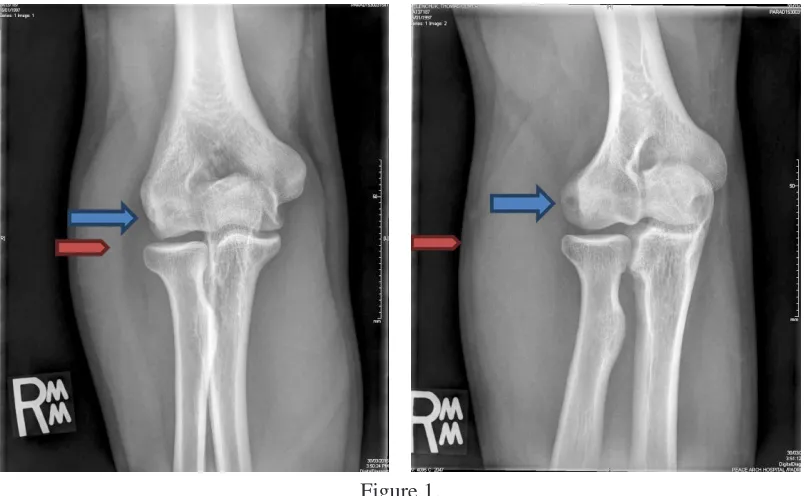
The radiographs revealed an osteochondral defect in the right lateral capitellum of the elbow (Figure 1). Fol-Figure 1.
Plain radiographs of the elbow prior to surgical intervention.
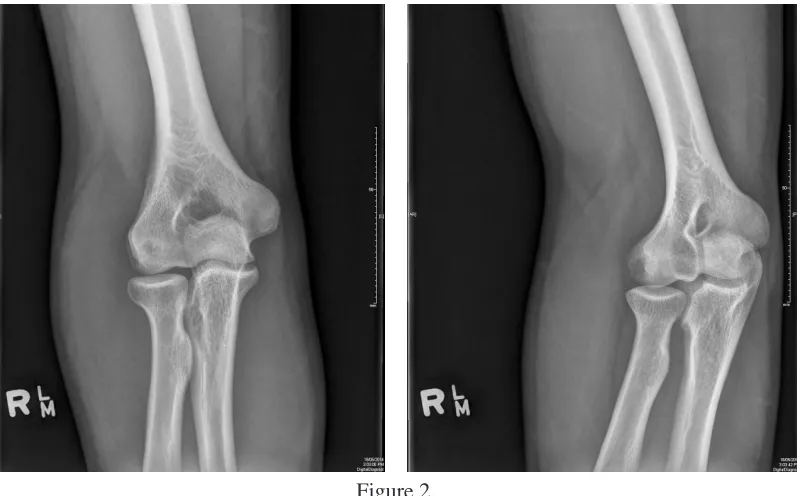
lowing confirmation of the diagnosis, the patient con-sulted an orthopedic surgeon where a De Novo NT allog-raft procedure was performed. At approximately 7 months post-surgery and rehabilitation, the patient was able to begin light throwing. Post-surgical radiographs were re-ported as normal with no focal or suspicious abnormality noted. In addition, there was no evidence of joint effusion identified (Figure 2).
Discussion
Etiology
It is generally accepted that the etiology of OCD of the elbow is largely unknown. A review of the literature indicates that there appears to be some common ground amongst most authors as to the most likely origins of the condition.1-9 The most obvious suspicions for the
develop-ment of an osteochondral defect are repetitive micro-trauma, and compromised blood flow to the elbow. OCD is found primarily in throwing athletes and gymnasts due to the excessive compressive and shearing forces on the lateral compartment of the elbow.
During the late cocking and early acceleration phases of throwing a significant valgus stress occurs at the elbow, producing abnormal compressive forces across the radio-capitellar joint. This is especially significant in a develop-mentally immature elbow. The continued stresses result in a localized injury to the subchondral bone in the form of fatigue fractures and diminished support for the over-lying articular cartilage. Consequently, this combination of events results in a breakdown and potential fragmenta-tion of the cartilage and bone. It is believed that 60% of axial compression forces across the elbow are transmitted to the radiocapitellar joint.5,9
According to Yadao et al.5 the vascular supply to the
distal humerus may be considered marginal, which sug-gests that the lack of blood (ischemia) may play a part in the development of OCD. Further to this, the small blood vessels enter posteriorly to the capitellar epiphysis and extend over the epiphyseal cartilage, which is a site of significant contact and compression. It is therefore conceivable that repetitive stress in this area may lead to the development of OCD. If this injury is left untreated, symptomatic degenerative change appears to be inevit-Figure 2.
able, leading to damage and fragmentation of the articular cartilage.5 There is some belief that a genetic component
to the disease may exist based on reports of OCD occur-ring in generations of families.5
OCD may initially be asymptomatic in the early stages but with continued overuse, will progress to a symptom-atic state that can potentially end an athlete’s career.10
Takahara et al.9 described the early development and
de-tection of OCD utilizing MRI. They observed capitellar abnormalities while screening adolescent baseball pitch-ers and noted that those individuals developed OCD over time. Early changes in the capitellum were identified by low signal intensity on T1-weighted images, while T2-weighted images displayed no abnormalities. They also found that diagnostic ultrasound revealed a localized flattening of the subchondral bone with a normal outline of the articular cartilage. Plain radiographs with the elbow at 45° of flexion displayed a slight flattening and sclerosis of the superficial aspect of the capitellum.9
As noted by Krych et al.10, many bone and soft-tissue
tumours present disproportionately in young and active patients who are often involved in athletic activities. In such instances the clinician may misdiagnose these rare tumours as more common sports injuries.10 Walker et al.11
emphasize that both joint-related tumours and sports in-juries often afflict young, active patients, and the symp-toms may overlap significantly. In these cases, lack of ad-equate imaging studies may result in either a significant delay in diagnosis or an inappropriate and unnecessary arthroscopic procedure.11
Therapeutic Intervention
Many authors have discussed the treatment options avail-able for OCD. Although conservative treatment may be effective in certain circumstances, there is general agree-ment that a variety of surgical options tend to provide bet-ter outcomes.12-17
The therapeutic protocols for OCD are somewhat de-pendent on the stage of the condition. If caught early in the process, conservative management may be effective. Matsuura et al.13 produced a retrospective paper on 176
individuals with osteochondrosis of the humeral capitel-lum. Of the 101 patients that received conservative care, healing occurred in 90.5% of stage I lesions (radiolucent areas on plain radiograph) and 52.9% of stage II lesions (non-displaced fragments). On average, stage I required
14.9 months to heal, while the stage II patients resolved in 12.3 months. According to that study, treatment con-sisted of refraining from heavy use of the elbow for six months.13 In contrast, Takahara et al.14 found that there
was only a slight chance of the capitellum healing with conservative care, regardless of stage.
In this particular case the condition had been pro-gressing for 12 to 18 months and required surgical re-pair. Although different surgical techniques have been developed to repair chondral and osteochondral lesions, the literature demonstrates only fair to good results when performed, even in the appropriate circumstances. Addi-tionally, there is significant controversy in regards to the indications and outcomes of these various procedures.13
The specific procedure utilized in this case was a DeNovo NT allograft. This particular technique has not been used often in the elbow but has been administered with empir-ically good success in the knee. Therefore, its application for the elbow was largely untested. Additionally, rehabili-tation of the elbow following this specific surgery was done without the benefit of previous cases, but was guid-ed simply by general basic principles of rehabilitation for other post-surgical orthopedic conditions. According to Tompkins et al.15 “most surgeons develop personal
treat-ment preferences guided by training, published literature, outcome data, education conferences, expert opinion, and personal experience. As a recently developed cartilage-re-pair technique, the role of DeNovo NT has not been clear-ly defined”.15 This is especially true with regards to the
capitellum.
The DeNovo NT (natural tissue) repair process inserts juvenile articular cartilage into the damaged bone. The particulated allograft chondral fragments are attached to the bone defect and held in place with adhesive fibrin. The fibrin has been shown in vitro to support chondrocyte overgrowth, thereby assisting in the healing process. The juvenile chondrocytes are used due to their greater poten-tial for cell division and matrix production.13
stretch tubing was utilized to strengthen flexion, extension, pronation, and supination. The volume of work consisted of one to two sets of 20 repetitions initially, progressively increasing the number of sets and weight as tolerance to the exercise increased. The patient also developed gener-al fitness, utilizing an exercise bike, and maintained core strength and upper and lower limb strength where possible without aggravating the repaired elbow. The general fit-ness program was supervised by an athletic therapist who included left arm goblet squats, left side back rows, plyo-metric boxes, weighted sit-ups and agility drills. At 16 to 20 weeks weighted wrist pronation was performed with 5 lbs, progressing by 24 to 28 weeks to 10 lbs. The volume remained consistent at 10 reps for 3 sets. Dumbbell biceps curls and triceps extension were performed with 5 to 15 lb weights (15 reps/3 sets) progressing from 16 to 28 weeks. At week 24, light push-ups were introduced.
By 28 weeks post-surgery, the patient began light throwing in the form of wrist flicks and light hitting off a tee at 40-50% of maximum. He continued to strengthen the arm with his normal workout routine, while increasing general fitness under the supervision of the team trainer. By 32 to 36 weeks, the goal of rehabilitation was achieved with a return to non-competitive play.
Clinical Significance
OCD of the capitellum is rare, but is most often found in adolescent overhead athletes, and was therefore a condi-tion requiring a high degree of suspicion in the current case.6 More importantly to clinicians is the awareness
of the multiple implications of chronic joint swelling. In this case the patient claimed to have been assessed and treated by numerous different practitioners for the afore-mentioned signs and symptoms. That so many different individuals failed to recognize a condition more signifi-cant than a soft-tissue injury highlights the need to under-stand the many reasons for chronic joint swelling.
The treatment for OCD, particularly when chronic, is surgical intervention. If the condition is recognized early, prior to frank symptoms, but in the presence of the typical mechanism of injury and age of the athlete, development of more serious sequelae may be prevented. According to Kida et al.4 introduction to the game at an early age may
be a risk factor for OCD of the humeral capitellum. Addi-tionally, the duration of competitive play, a history of cur-rent and prior elbow pain when throwing, and position
played may also be considerations.4 Generally in regard
to the latter, one would expect a higher incidence of OCD in pitchers and catchers, due to the high number of throws executed. In this particular case, the patient was a first baseman, which simply exemplifies the fact that playing position may not be a reliable proxy measure of volume of throwing activity.
Summary
Chronic swelling within a joint should always be con-sidered suspect, particularly in young athletes, and not dismissed as simply an atypical soft-tissue sprain or strain. Serious conditions are rare but when present, may masquerade as a common athletic injury. Conditions that are unresponsive to initial therapy should be investigated further. OCD is an example of a potentially serious con-dition that can mimic a common athletic soft-tissue in-jury, yet if diagnosed early, may resolve simply with rest. Conversely, if misdiagnosed and mismanaged, OCD can potentially become a career-ending injury.
Acknowledgments
The author would like to thank Dr. Jeffrey Quon, Dr. John Taylor and Ms. Stacey Kumar for their assistance in pre-paring this manuscript.
References:
1. Gonzalez-Lomas G, EllAttrache N. Elbow osteochondritis dissecans and olecranon stress fractures in young athletes. J Am Acad Orthop Surg. 2010:18: 87-105.
2. Kobayashi K, Burton K, Rodner C, Smith B, Caputo A. Lateral compression injuries in the pediatric elbow: Panner’s disease and osteochondritis dissecans of the capitellum. J Am Acad Orthop Surg. 2004;12: 246-254. 3. Wroblewski R, Urban M, Michalik D, Zakrzewski P,
Langner M, Pomianowski S. Osteochondrosis of the capitellum of the humerus (Panner’s disease, osteochondritis dissecans). Case study. Ortopedia Traumatologia Rehabilitacja. 2014;1(6); 79-90. 4. Kida Y, Morihara T, Kotoura Y, Hojo T, Taciiri H,
Sukenari T, et al. Prevalence and clinical characteristics of osteochondritis dissecans of the humeral capitellum among adolescent baseball players. Am J Sports Med. 2014;42(8): 1963-1971.
5. Yadao M, Field L, Savoie F. Osteochondritis dissecans of the elbow. AAOS Instructional Course Lectures. 2004;53; 599-605.
the secondary physis of the epiphysis? American Journal Rheum. 2012;199: 1121-1128.
7. Mihata T, Quigley R, Robicheaux G, McGarry M, Neo M, Lee T. Biomechanical characteristics of osteochondral defects of the humeral capitellum. Am J Sports Med. 2013;41(8); 1909-1914.
8. Bradley J, Petrie R. Osteochondritis dissecans of the humeral capitellum. Clin Sports Med. 2001;20(3): 565-590. 9. Takahara M, Shundo M, Kondo M, Suzuki K, Nambu T,
Ogino T. Early detection of osteochondritis dissecans of the capitellum in young baseball players. J Bone and Joint Surg. 1998;80-A(6): 892-897.
10. Krych A, Odland A, Rose P, Dahm D, Levy B, Wenger D et al. Oncologic conditions simulate common sports injuries. J Am Acad Orthop Surg. 2014;22: 223-234. 11. Walker E, Brian P, Longo V, Fox E, Frauenhoffer E,
Murphey M. Dilemmas in distinguishing between tumor and that posttraumatic lesion with surgical or pathologic correlation. Clin Sports Med. 2013;32: 559-576.
12. Ruchelsman D, Hall M, Youm T. Osteochondritis dissecans of the capitellum: current concepts. J Am Acad Orthop Surg. 2010;18: 557-567.
13. Matsuura T, Kashiwaguchi S, Iwase T, Takeda Y, Yasui N. Conservative treatment for osteochondrosis of the humeral capitellum. Am J Sports Med. 2008;36(5): 868-873. 14. Takahara M, Ogino T, Fukushima S, Tsuchida H,
Kaneda K. Nonoperative treatment of osteochondritis dissecans of the humeral capitellum. Am J Sports Med. 1999;27(6):728-733.
15. Tompkins M, Adkisson D, Bonner K. DeNovo NT Allograft. Oper Tech Sports Med. 2013;21: 82-89. 16. Cain E, Dugas J, Wolf R, Andrews J. Elbow injuries in
throwing athletes: a current concepts review. Am J Sports Med. 2003;31(4): 621-634.