Department of Electrical and Computer Engineering, Binghamton University, Binghamton, NY 13902, USA
Correspondence should be addressed to Jun Yu, [email protected]
Received 7 May 2007; Accepted 22 October 2007
Recommended by A. Piva
The Break Our Watermarking System (BOWS) contest gave researchers three months to defeat an unknown watermark, given three marked images and online access to a watermark detector. The authors participated in the first phase of the contest, defeating the mark while retaining the highest average quality among attacked images. The techniques developed in this contest led to general methods for reverse-engineering a watermark algorithm via experimental images fed to its detector. The techniques exploit the tendency of watermark algorithms to admit characteristic false positives, which can be used to identify an algorithm or estimate certain parameters.
Copyright © 2007 Scott Craver et al. This is an open access article distributed under the Creative Commons Attribution License, which permits unrestricted use, distribution, and reproduction in any medium, provided the original work is properly cited.
1. INTRODUCTION
The Break Our Watermarking System (BOWS) contest gave researchers a unique opportunity to test existing techniques for breaking a watermarking algorithm [1]. The contest also posed the researcher with a separate problem: given an un-known watermark detector, can one deduce the underlying algorithm from its output? This can also be attacked using adaptive inputs to a detector, except in this case the inputs are not used to find a better image, but to leak information about a detector structure’s components. We used this approach to reverse-engineer the BOWS watermark, by posing carefully designed images to the watermark detector. Afterwards we extended our techniques to a general algorithm for plumb-ing a detection region with the goal of determinplumb-ing unknown algorithm parameters.
This paper is organized as follows: inSection 2, we sum-marize our participation in the BOWS contest, and the tac-tics we used to reverse-engineer the underlying watermark-ing algorithm. In Section 3, we extend our strategy to a general mathematical approach to deducing an unknown algorithm using oracle attacks. In Section 4, we show re-sults for reverse-engineering a normalized correlation detec-tor. We conclude that reverse-engineering a watermark de-tector is possible, although an intelligent human being can presently deduce far more with far fewer experimental in-puts.
2. THE BOWS CONTEST
The Break Our Watermarking System (BOWS) contest chal-lenged researchers to render an undetectable image mark of unknown design. The goal was to attack water-marked images while maintaining a minimum quality level of 30 dB PSNR; the winner was the participant who main-tained the highest average PSNR over three test images. In the first phase of the contest, the algorithm was secret; for the second phase, the algorithm was published.
Our research team applied the strategy of reverse-engineering the watermark before attacking the images. We determined the frequency transform, subband, and then an exploitable quirk in the detector that made it sensitive to noise spikes. This allowed us to achieve the highest average PSNR, 39.22 dB PSNR, by the end of the first phase of the contest [2]. The second phase was won by Andreas Westfeld, who achieved an amazing quality level of 58.07 dB PSNR. This quality level exceeded even the quantization error in-curred by digitizing the image in the first place [3].
2.1. Reverse-engineering the detector
(a) Image 1 (b) Image 2 (c) Image 3
Figure1: The three images from the BOWS contest.
Figure 2: A severely degraded image (3.956 dB PSNR) with the watermark still detectable, suggesting a feature space of 8-by-8 AC DCT coefficients.
in the spatial domain; we suspected a common domain and constructed experimental images to test our suspicions.
A critical aspect of our attack was to construct severe false positives, images which should fail to trigger the detector un-less a specific watermark feature space was being used.1We call this propertysuper-robustness:the property of a water-marking algorithm to survive select types of quality degrada-tion far beyond what any reasonable person would expect. If we can distort an image in a way to make it unrecognizable and if the watermark is still detectable, then we have found an attack to which it is super-robust. This is in fact a secu-rity weakness, because an unusual immunity to one attack (which we call amode of super-robustness) can leak informa-tion about the underlying algorithm.
By testing various severe alterations of the image, we de-termined that the watermark followed an 8-by-8 block
trans-1While a “false positive” typically denotes an unwatermarked image mis-taken for a watermarked one, we also consider an image a “false positive” if it is so thoroughly altered that we expect itshouldhave no detectable watermark.
form, surviving attacks like the one inFigure 2. We suspected a block DCT transform, which we further confirmed by ex-periment. We then submitted images with bands removed from each block. We determined the largest bands we could remove without hurting the watermark, to determine the suspected DCT subband used by the detector.
We used the knowledge that watermarks commonly re-side in low-frequency and middle-frequency bands, a tactic described by Miller et al. [4]. We also guessed that a water-mark algorithm would employ subbands following geomet-ric patterns, like upper triangular or square subsets of the DCT matrix. Thus we erased lower-triangular sections of the matrix and the gnomonic sections. The union of these two attack regions gave us the largest “pattern” we could remove without damaging the watermark.Figure 3shows the small-est region of geometric significance, which matched that used by the BOWS watermark [5].
2.2. Breaking the watermark
To break the watermark, we first damaged a large interval of feature space coefficients until the watermark was removed. Then, we iteratively fixed the damaged coefficients while the watermark remained undetectable. Our algorithm was as fol-lows.
(1) LetC1,. . .,Cnbe all in-band DCT coefficients, sorted by decreasing magnitude.
(2) Find the smallestksuch that the watermark fails when coefficientsC1,. . .,Ck are multiplied by a distortion valueD.
(3) Form=k−1· · ·1,
(a) restore coefficientCmto its original value; (b) if the watermark becomes detectable, redestroy
coefficientCm.
Figure3: Experimental removal of DCT subbands. Shaded regions are the largest lower-triangular and gnomonic subbands removable without detector failure.
It is curious that so few coefficients need be modified: our previous analysis suggested a subband of 49152 coefficients per image (512-by-512 grayscale images, 4096 8-by-8 blocks, 12 AC coefficients taken per block,) so we suspected that our attack was exploiting some detector weakness.
3. REVERSE-ENGINEERING USING AN ORACLE
In the first BOWS contest, the sensitivity attack was widely used and proved to be very successful [3,6,7]. In this pa-per, we use oracle attacks for a different purpose: rather than removing the watermark, we seek to learn as much as possi-ble about an unknown watermarking algorithm. We model a watermark detector as a three-stage algorithm. Images are first subjected to atransform,for example, a DCT or wavelet transform, to produce features used by the watermark em-bedder. Then, a particularsubbandis chosen for embedding and detection. Finally, the selected features are fed into a spe-cific detection algorithm, which we model as computing a detection statistic which is compared to a threshold. Wa-termark detectors need not follow this structure, but many do. If common transforms and detector statistics are used, this structure implies a geometrically simple detection region that facilitates our attacks.
Our methods for reverse-engineering mirror the strat-egy used in the BOWS contest: create severe false positives to identify an algorithm by its modes of super-robustness.
ical [9]. In this case, an expanding noise vector will move outward in a direction with a significant component along the watermark vector, and so a severe false alarm will leak information about the watermark.
Our noise snakes are constructed via the following algo-rithm.
(1) Start with test imageI, treated here as a vector. (2) Initialize our snake vector toJ←I.
(3) Do fork=1, 2,. . .,Kthe following.
(a) Choose a vector uniformly over the n -dimen-sional unit hypersphereSn.
This can be accomplished by constructing an
n-dimensional Gaussian vectorXN(0,σ2I) and scaling the vector to unit length.
(b) Choose a scaling factorα, which for normalized correlation is proportional to the length ofJ. (c) IfJ+αXstill triggers the watermark detector,J←
J+αX.
(d) Else, discardXand leaveJunchanged.
In high dimensions, a noise snake seems to converge quickly to the detection region boundary, and grow outward. Instead of snakes within the detection cone, we have snakes
ona cone, which provide useful information about the detec-tion region.
3.2. Estimation of a detection threshold
To use noise snakes to estimate detector parameters, we first need the following lemma.
Lemma 1. IfWis chosen uniformly over the unitn-sphereSn,
andvis an arbitrary vector, the probabilityPr [W·v >cosθ]
is
Sn−1 Sn
θ
0sin
n−2x dx, (1)
whereSis the surface volume ofS.
Proof. SinceWis uniform, the probability of any set of vec-tors is proportional to its measure. Let us integrate over the vaxis: consider pointt ∈ [−1, 1] representing the v com-ponent of the hypersphere. For each t, we have a shell of radiusr =√1−t2, contributing a total hypersurface mea-sure ofSn−1rn−2
√
(a) Image 1 (b) Image 2 (c) Image 3
Figure4: The three images after the attack. Note the few, but obvious, block artifacts.
w
(a)
φ θ
w
(b)
Figure5: Two independently generated snakes have approximately perpendicular off-axis components.
dimensions is composed of circular shells, and each circular shell has contribution 2πr√dt2+dr2=S2r1√dt2+dr2. The sphere portion with angle beneathθis
Area=
r=sinθ
r=0 Sn−1r
n−2dt2+dr2
=
r=sinθ
r=0 Sn−1r n−2
1 + dt 2
dr2dr
=
r=sinθ
r=0 Sn−1r n−2
1 +r 2
t2dr
=
r=sinθ
r=0 Sn−1r n−2dr
t
(2)
since 2t dt+2rdr=0. Substitutingr =sinx, we getdr/t=dx and
Area=Sn−1
θ
0sin n−2x dx,
(3)
and we divide by the total surface areaSnto get the probabil-ity of hitting that region.
The area of a unit hypersphereSnis
Sn=
⎧ ⎪ ⎪ ⎪ ⎪ ⎪ ⎨ ⎪ ⎪ ⎪ ⎪ ⎪ ⎩
2(n+1)/2π(n−1)/2
(n−2)!! fornodd,
2πn/2
(1/2)n−1! forneven.
(4)
The opening fraction Cn = Sn−1/Sn−2 therefore has a closed form [10]
Cn=
⎧ ⎪ ⎪ ⎪ ⎪ ⎨ ⎪ ⎪ ⎪ ⎪ ⎩
1 2
(n−2)!!
(n−3)!! fornodd,
1 π
(n−2)!!
(n−3)!! forneven.
(5)
Corollary 1. For an arbitrary vectorv, a uniformly chosenW, and a positive , Pr [W·v < cos(π/2 +)] = Pr [W·v > cos(π/2−)].
Proof. We have Pr [W·v < cos(π/2 +)] = Pr [W·(−v) > cos(π/2−)]. BecauseWis uniform, Pr [W·(−v)>cos(π/2 −)]=Pr [W·(u)>cos(π/2−)], whereuis any vector.
TF]. If we subtract wand then normalize each snake, the symmetric distribution implies thatW =(S−w)/S−w uniformly distributed over the unitn−1 sphere.
To show that the angle converges toπ/2 in probability, we observe that for noise snakesSandT, with off-axis compo-nentsW1=(S−w)/S−wandW2=(T−w)/T−w, and for an>0,
Pr [|W1·W2|>cos(π/2−)]
=2Sn−1 Sn
π/2−
0 sin n−2x dx
≤(n−2)!! (n−3)!! π 2sin
n−2(π/2−). (6)
For any, there exists anNsuch that forn > N, (n−2)/(n− 3)sinπ/2− < 1, and so this bound goes to 0. Hence the probability of falling outside anofπ/2 drops to 0, and so cos−1(W
1·W2) converges toπ/2 in probability.
This observation gives us a simple method to estimate the cone angle from two constructed noise snakesX andY of equal length. Using trigonometry, we have (√2rsinθ)2 = r2+r2−2rrcosφ, whereφis the angle between the snakes andris the snake length (seeFigure 5). Rearranging,
sin2θ=1−X·Y, (7)
then we can calculate the cone angle and detector threshold by generating two snakes of sufficient length, and computing their dot product.
3.3. Estimation of feature space dimension
Once we have an appropriate estimate for the cone angle, we can apply another technique to estimate the feature space size, a more useful piece of information. To achieve this, we use the detection oracle again to deduce the error rate under two different noise power levels.
If we have a watermark vectorw which falls within the detection cone, and add a uniform noise vectorr, the proba-bility of detection is
Pr [δ=1]=Sn−1 Sn
ψ
0sin n−2
x dx, (8)
ψ=θ+ sin−1
w
rsinθ
, (9)
1 13 25 37 49 61 73 85 97 109
Experiment number
Figure6: Estimated threshold using two noise snakes. The thresh-old value isτ=0.5.
Estimated dimension
1 7 13 19 25 31 37 43 49 55
Experiment 0
100 200 300 400 500 600 700 800 900 1000
Dimension
Figure7: Estimated dimension using two noise snakes. The feature dimension isn=500.
whereθis the cone angle, which we estimate using the tech-nique described earlier. The second equation has one un-known, the watermark lengthw. The top equation has one unknown,n; the hit ratePY can be estimated by experiment. If we then considerPYfor uniform noise vectors of length A, and then for noise of lengthB, we can combine these equa-tions into the following identity:
tanθ= AsinψA−BsinψB
AcosψA−BcosψB, (10)
whereψAandψBare the integration limits in (8). Here is our algorithm.
(1) Choose power levelsAandB. They can be arbitrary, as long as the error rate under those noise levels is rea-sonably estimable.
(2) Use the watermark detector to estimatePAandPB, the detection rate under unform noise of lengthsAandB, respectively.
0 0.1 0.2 0.3 0.4 0.5 0.6 Lengthr
0 0.05 0.1 0.15 0.2 0.25 0.3 0.35 0.4 0.45 0.5
P
robabilit
y
PY
PY∗r∗12 PY
(a)
0 0.1 0.2 0.3 0.4 0.5 0.6
Lengthr
0 0.05 0.1 0.15 0.2 0.25 0.3 0.35 0.4 0.45 0.5
P
robabilit
y
PY
PY∗r∗12 PY
(b)
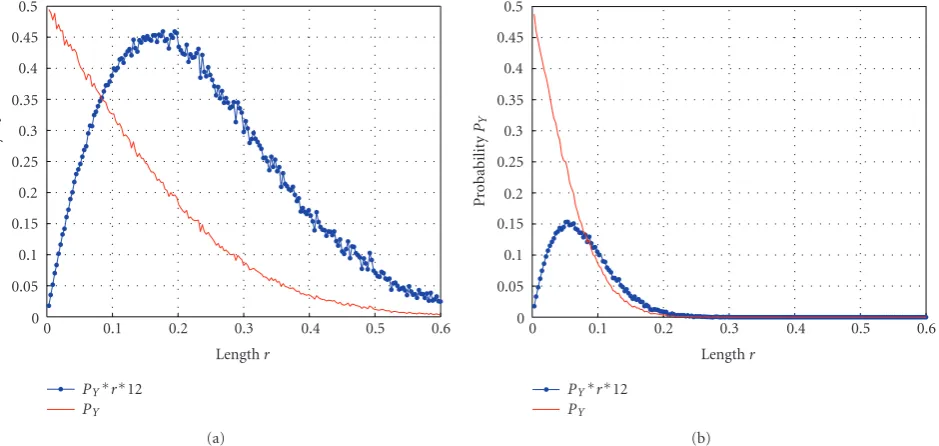
Figure8: Detection ratePY and average growth rateαPYas a function of the step lengthα. Above, a cone angle ofπ/3 andn=1000. Below π/3 andn=9000. The optimal step length to maximizeαPYis about 0.16 and 0.06, respectively.
(a) Use the hypothesizednand estimated detection rates in (8) to estimateψAandψB. These param-eters are easily determined by Newton’s method in one dimension, becausePA andPB are inte-grals with respect toψAandψB, respectively.
(b) Computen← |tanθ−(AsinψA−BsinψB)/ (AcosψA−BcosψB)|.
(4) Choose the value ofnthat minimizes the error.
4. RESULTS
4.1. Estimating detector parameters
We tested these techniques using a generic watermark detec-tor with a feature space of variable size selected from 8×8 AC DCT coefficients. We used normalized correlation with a detection threshold of 0.5.2 We first generated noise snakes to deduce the detector’s threshold. Figure 6shows our es-timates for a detector with τ = 0.5. This required an av-erage of 1016 detector queries per experiment, to generate two snakes.Figure 7shows the corresponding dimension es-timates, once the threshold is deduced to be 0.5.
Note that in this detector the asymptotic false alarm probability is approximately 2.39×10⁻³³. This means that we can roughly estimate a very low false alarm probability in only thousands of trials.
2A proper detector should have a much higher threshold, since forτ=0.5, the false alarm rate is unnecessarily low. However, in our experience wa-termark detectors are often designed in anad hocmanner, and a threshold value exactly between 0.0 and 1.0 is not uncommon.
4.2. Optimal step length
When generating a noise snake by adding a uniform noise vector, we must confront two conflicting factors: large noise vectors are more likely to move us out of the detection region, but small noise vectors contribute little length per iteration. The ideal noise vector length is one which maximizes the ex-pected incrementαX·Pr [δ=1].
When choosing a noise increment for a noise snake, the appropriate amplification factorαis proportional to the length of the snake as it grows. This can be seen by a simple geometric argument: the cone is congruent to scaled versions of itself. Thus if there is an optimal lengthαto extend a snake of length 1, thenMαis optimal to extend a snake of length M. We need only estimate the appropriateαfor a snake of unit length. Unfortunately, the optimal growth rate depends on both cone angle and dimension, both of which are un-knowns to the reverse-engineering.
The growth rate of a noise snake is thus exponential in the number of queries. However, the growth rate is slow: Figure 8shows some estimates forαwhich range from 0.16 to 0.06, withnin the thousands. For larger feature sets, growth is small. We determine in our experiments that for realistic feature sizes, a snake of useful length requires a number of queries roughly proportional to the dimensionn.
5. CONCLUSION
We have developed several techniques for the reverengineering of a watermark detector by construction of se-vere false alarms. This approach mirrors our strategy in the BOWS contest, in which we constructed experimental images by trial and error, rather than by generic algorithm.
lows severe false positives which leak information about the detector.
ACKNOWLEDGMENTS
This research is made possible by support from the Air Force Office of Scientific Research, under Award FA9550-95-1-0440. Example code for algorithms in Sections3.2and 3.3, for estimating detector threshold and dimension, and for estimating optimal snake growth, can be found online at http://bingweb.binghamton.edu/∼scraver/snakeCode.tar.
REFERENCES
[1] “The Break Our Watermarking System (BOWS) contest,” http://lci.det.unifi.it/BOWS/.
[2] S. Craver, I. Atakli, and J. Yu, “How we broke the BOWS water-mark,” inSecurity, Steganography, and Watermarking of Multi-media Contents IX, vol. 6505 ofProceedings of SPIE, San Jose, Calif, USA, January 2007.
[3] Westfeld A., “Tackling bows with the sensitivity attack,” in Se-curity, Steganography, and Watermarking of Multimedia Con-tents IX, vol. 6505 ofProceedings of SPIE, San Jose, Calif, USA, January 2007.
[4] M. L. Miller, G. J. Doerr, and I. J. Cox, “Applying informed coding and embedding to design a robust, high capacity wa-termark,”IEEE Transactions on Image Processing, vol. 13, no. 6, pp. 792–807, 2004.
[5] I. J. Cox, J. Kilian, F. T. Leighton, and T. Shamoon, “Secure spread spectrum watermarking for multimedia,”IEEE Trans-actions on Image Processing, vol. 6, no. 12, pp. 1673–1687, 1997. [6] A. Westfeld, “Lessons from the bows contest,” inProceedings of the Multimedia and Security Workshop, vol. 2006, pp. 208–213, Geneva, Switzerland, 2006.
[7] P. Comesa˜na and F. P´erez-Gonz´alez, “Two different ap-proaches for attacking bows,” inSecurity, Steganography, and Watermarking of Multimedia Contents IX, vol. 6505 of Proceed-ings of SPIE, San Jose, Calif, USA, January 2007.
[8] S. Craver and J. Yu, “Reverse-engineering a detector with false alarms,” inSecurity, Steganography, and Watermarking of Mul-timedia Contents IX, vol. 6505 ofProceedings of SPIE, San Jose, Calif, USA, January 2007.
[9] M. L. Miller, I. J. Cox, and J. A. Bloom,Digital Watermarking, Morgan Kaufman, San Francisco, Calif, USA, 2002.