R E S E A R C H
Open Access
Research on face feature extraction based
on K-mean algorithm
Pengcheng Wei
1*, Zhen Zhou
2, Li Li
1and Jiao Jiang
2Abstract
Face recognition technology is an application technology of information security, which is a kind of multi-disciplinary technology, such as comprehensive mathematics, pattern recognition, and biological
characteristics. With the development of technology applications, the requirements for accuracy and anti-counterfeiting of face recognition are also increasing. In this paper, the K-mean algorithm is used to analyze the face features. Firstly, the biometric features of the face are extracted, and then the K-mean method is used to cluster the face features. Lastly, the SVM method is used to classify. The results show that the K-mean method can achieve high recognition performance with fewer feature numbers.
Keywords: Face recognition, K-mean, Support vector machine (SVM)
1 Introduction
With the development of information technology and net-works, the use of identification and authentication in peo-ple’s daily lives has become more frequent. The traditional authentication methods based on user name and pass-word are less and less suitable for the current identifica-tion requirements. Therefore, more convenient, reliable, and secure authentication methods need to be introduced. Face recognition technology (FRT) is a multi-disciplinary application technology that has been developed with the increasing demand for information security. FRT has be-come the research object of many researchers because it takes the human face as the object of recognition and meets the requirements of identification.
Feature extraction and classifiers are the two main components of face recognition. In order to achieve a high level of face recognition technology, researchers have used various methods to extract features of hu-man faces since the 1960s [1]; the collection features and relative positions of eyes, nose, mouth, and chin are used as features for face recognition. After Turk et al. [2] started to use the reconstructed weight vec-tor as the recognition feature, it became a direction
to construct “feature face” recognition technology by
using the image features of the face, and many of the feature analysis methods were introduced into face recognition. Among these feature analysis methods, principal component analysis (PCA), linear discrimin-ant analysis (LDA), and independent component ana-lysis (ICA) are more popular. For example, in 2017, Li, Xiang-Yu’s [3] research team proposed a face rec-ognition method based on rapid principal component analysis for the problem of low face recognition ac-curacy under non-limiting conditions. By using the Haar feature classifier to extract features of the ori-ginal data and then using the PCA method to process the extracted features, the LFW face database is used for verification. The results show that the method can
achieve good recognition results. Similarly, Vyas [4]
and Low [5] research teams have successfully used
PCA to analyze and identify face features. The exist-ing research results show that the use of face features can achieve personal identification, but face features will change with different changes in light, posture, scene, etc., what effect these will have on face recog-nition results? Such research results are rare.
Although the face recognition technology has grad-ually matured after years of research, when the acqui-sition conditions are not ideal, fingerprint recognition, iris recognition, and other technologies are better than face recognition technology in recognition rate and stability. This is because in face recognition the * Correspondence:[email protected]
1School of Mathematics and Information Engineering, Chongqing University
of Education, Chongqing, China
Full list of author information is available at the end of the article
is greater than different people under the same illu-mination condition. The image of the face, the evalu-ation of the face recognition system, further validates this conclusion. Even for the top face recognition sys-tem, the recognition accuracy will decrease with the change of illumination. (2) Attitude change: At this stage, when collecting the face image, the person to be captured is required to face the collection device, so that the feature of the face can be better extracted, but when the face is looked up to a certain extent or tilted downward by a certain extent, at that time, the face recognition system will have difficulty extracting features with strong representation ability and even fail to detect human faces, resulting in a decrease in the accuracy of face recognition. (3) Expression
changes: People’s expressions are ever-changing, and
the same expression of the same person shows differ-ent forms even in differdiffer-ent time periods, which brings great trouble to the face recognition system, and changes in facial expressions will lead to the move-ment of facial feature pointing further causing the computer to not accurately locate the specific posi-tions of these feature points, and the extracted fea-tures cannot accurately depict the identity of the face, so the expression change will greatly affect the accur-acy of face recognition. (4) Occlusion problem: short hair keeps growing, beauty is replaced with framed eyes, and wearing a hat, these behaviors will block the face more or less, resulting in some features of the face unable to be extracted, and ultimately lead to decrease in the accuracy of face recognition.
Therefore, it is important to extract the face fea-tures that can adapt to environmental changes and improve the robustness of the recognition results.
Clustering technology [10–13] is to group similar
features into a group, because of the similarity be-tween the same class, so it can be used as a basis for classification, and the similarity which is not the same between the same class can allow differences in the type of features, which solves the problem that the partial change of the face features caused by the change of the environment affecting the classifi-cation accuracy. K-mean is a widely used method in cluster analysis. For example, in the research of
Wagstaff [14], the K-mean method is used to
search knowledge discovery, and the clustering re-search is carried out on 16 data sets to improve the
is classified and calculated, and the recognition rate result shows that the expression has the greatest influence on the recognition rate. The recognition rate of adding expressions was reduced to 67%.
2. The K-mean method was used to cluster face features. By analyzing the face feature sets with different light, expression, and scar, the results showed that K-mean can improve the recognition effect, and the feature change recognition rate due to expression works best, recognition rate increased to 91%.
2 Proposed method
Figure 1 shows the steps of the face feature extraction
method using K-mean in this paper:
The K-mean face recognition process defined in this
paper includes seven steps as shown in Fig. 1:
se-lected sample set; facial feature localization; extraction of local features; clustering; partitioning of samples and training sets; classification calculation; and recog-nition result analysis.
Selected sample sets: With the development of face recognition technology, there are more and more open standardized face databases. The purpose of these face database designs is different, and some databases are not public databases. Therefore, at the beginning of this study, we first choose the right one. The database required in this paper selects the appropriate sample set from the standard database;
Facial feature localization: The human face includes many features, some of which change with the
environment, while others have strong anti-interference to environmental changes. In order to better describe these specials, we first need to locate these facial features;
Extracting local features: After the facial features are located, the facial features of each part are extracted according to the method set herein. In order to better cluster, in this step we choose Gabor transform for denoising;
more stable and will not be interfered by special samples.
Support vector machine (SVM) classification: The classification stability of SVM is used to classify and identify the extracted facial features;
Analysis of results: Analysis of the impact of different parameters on the recognition results.
This paper mainly uses Gabor transform smoothing method, K-mean clustering method, and SVM classifica-tion method.
2.1 Gabor
The Gabor function proposed by Gabor in 1964 is actually the translation function of Gaussian function in frequency
domain [8]. The Gabor transform belongs to the
win-dowed Fourier transform, and the Gabor function can ex-tract related features in different scales and directions in the frequency domain. In addition, the Gabor function is similar to the biological function of the human eye, so it is often used as texture recognition and has achieved good results.
The two-dimensional Gabor function is calculated as follows:
φjð Þ ¼x k2j exp − k2jx2
2σ2
!
exp ikjx
−exp σ 2
2 −
In order to fully cover the frequency space and provide information for clustering as much as possible, this paper selects 20 frequencies corresponding to 8 posi-tions for transformation. Therefore, the frequency do-mainv= 0∼19 and the directionu= 0∼7.
The calculation ofkjin formula 1 is as follows:
kj¼ kkjx jy
¼ kv cosϕu kv sinϕu
wherekv¼2−vþ22π;φ
u¼uπ8.
According to the above formula, the face feature point
x satisfying the distributionp(x) can be obtained. If the
feature point coordinate of x is (a, b), the Gabor
Fig. 1Face recognition framework based on K-mean
function transformation formula corresponding to the pointxis as follows:
jjð Þ ¼x Z
p x0 φj x−x
0
d2x0
2.2 K-mean method
The K-mean algorithm is a classical distance-based algo-rithm. The similarity is evaluated by the distance. The larger the distance between two points is, the smaller the similarity is. Otherwise, the bigger the similarity is. Finally, get one by one class.
Divide any i group of objects into K point groups.
Calculate the average value of data objects near K point to promote high similarity of point groups. The average value of point groups can be calculated as follows:
μk ¼ Xn
i¼1
ci¼kg
xð Þi
Xn
i¼1
ci¼k
where ci represents the nearest point group in the data points i and K, i= 1...n. μk indicates the center point of
the point group.
2.3 SVM
SVM is a kind of supervised classifier, which is widely used as recognition tools because it can avoid
the computational complexity brought by a high
dimension [16–18]. In face recognition research,
there are also many studies using SVM as a classifier [19–21].
In this paper, SVM method is used, face feature vector is taken as input feature, Jackknife [22] method is used as test sample partition method, and RBF is taken as SVM kernel function. The Jackknife method is a method of dividing samples. Each time, a sample is randomly deleted from the sample set, and the remaining samples are taken as input samples. The final calculation result takes the mean of multiple classification results, thereby avoiding the specificity of the sample.
3 Experimental results
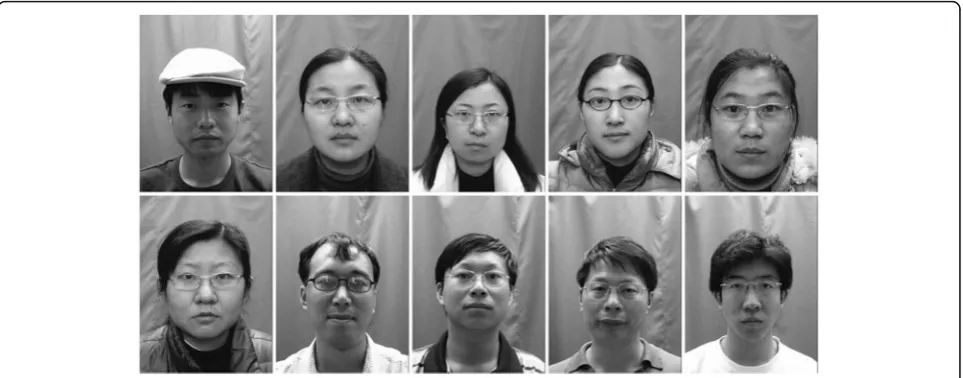
The data in this paper are from the face database (cas-Peal) of the Institute of Technology of the Chinese Academy of Sciences in 2003. Selected were 100 of the 1040
sub-jects’ face samples as experimental samples (as shown
in Fig. 2). In this database, we choose expression and
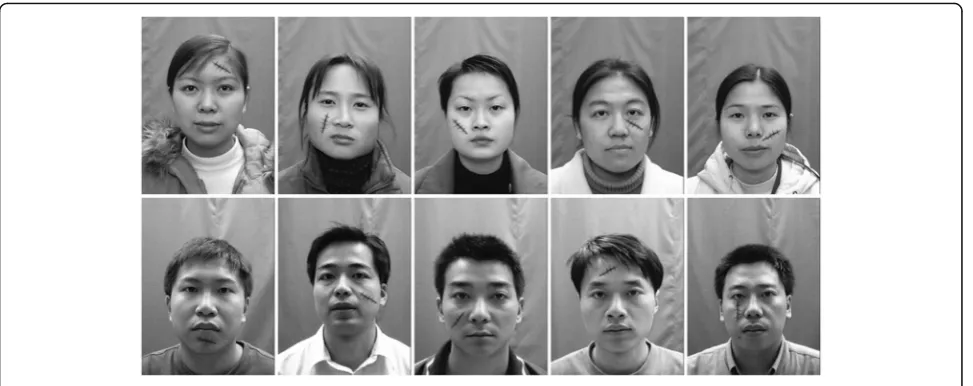
illumination as experimental subjects. At the same time, in order to study the effect of scars on experi-mental results, we artificially increase the scars on the face pictures of each subject.
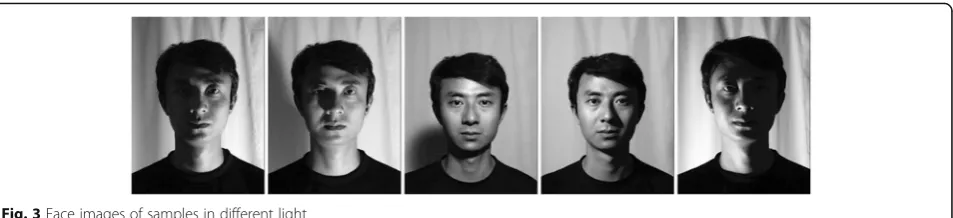
In this sample database, in addition to normal face im-ages, gestures, expressions, decorations, lighting, back-ground, distance, and time characteristics are included. In order to simplify, this paper is unified as illumination and expression, as shown in Fig. 3 and Fig. 4, whereas Fig.5 randomly adds a scar to the subject’s face picture.
Fig. 3Face images of samples in different light
In the K-mean clustering, the selection of the cen-ter point is an important step. In the existing re-search results of face recognition, it is mentioned that the face image satisfies a certain distribution in the gray space. According to this result, we have achieved the positioning of the central department. According to the general orientation of the human face, the major categories in this paper are mainly divided into eye features, nasal features, mouth fea-tures, and cheek features. The eye features are di-vided into seven parts: pupil, the four corners of the eye, pupil vertical intersection point, and the dis-tance between right and left eyebrows. The nasal features are divided into three parts: the tip of the nose and two nostrils. The mouth features are di-vided into five parts: the center of the lips and the four endpoints. The cheek features are divided into five parts: the chin, the intersection of the horizontal position of the lip center and the left and right cheeks, the intersection of the center of the eye, and the left and right cheeks. Positioning is shown in Fig. 6.
4 Discussion
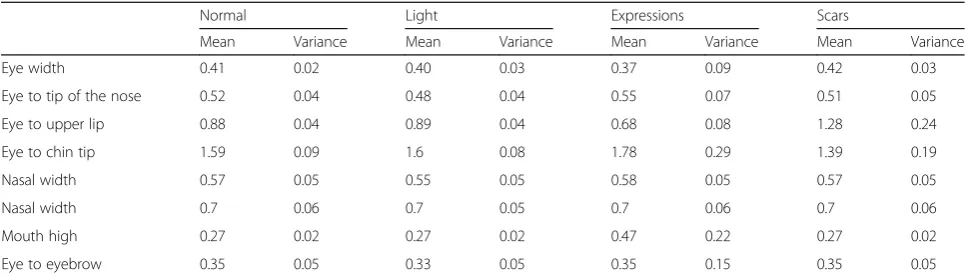
Feature extraction is performed for different sites. The features extracted in this paper include the eyes, nose, and face. The detailed characteristics are shown in Table1. Table1 shows the mean of the feature values in different poses.
As can be seen from the results in Table 1, compared
with the normal state, in the case of different light condi-tions, the mean part will become larger and some will become smaller. This may be due to the gray and white im-ages used in this paper, different lighting has a greater influ-ence on the prominent and concave parts of the face, although the mean value differs greatly, but the variance of the feature is not much different. Compared with the nor-mal state, the characteristics of expressions are quite differ-ent. The reason may be that different expressions may cause facial deformation, and the features based on distance measurement have a greater influence, resulting in greater variance. However, for artificial scars, the change in charac-teristics is smaller compared with the normal state. The reason may be that this paper only adds one scar and there-fore has limited impact on the characteristics.
Fig. 5Face pictures with randomly added scars
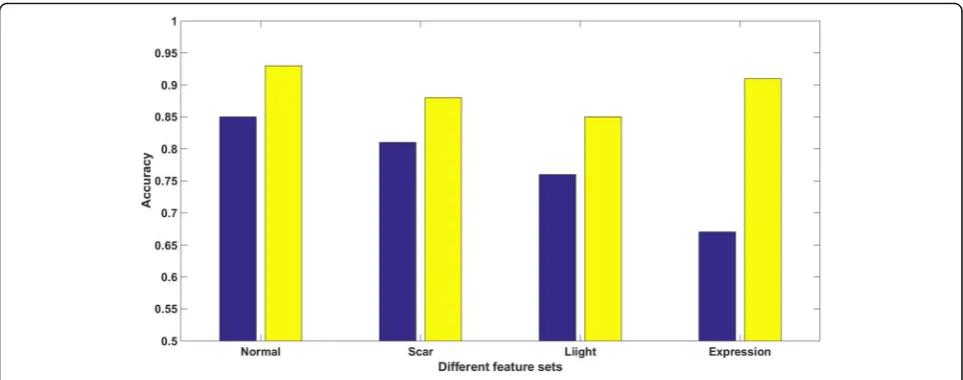
It can be seen from Fig. 7 that the different postures have different effects on the subject’s characteristics, of which expression has the greatest impact, followed by light, and scars have the smallest impact. If this feature is used as an input parameter for classification, the rec-ognition rate for sample adding a scar is 81%, and the recognition rate for sample adding a light interference is 76%, and the recognition rate for sample adding
differ-ent expressions is only 67%. The results in Fig. 7 show
that after adding different interferences, the recognition rate is lower than the normal recognition rate. By using the method of K-mean to cluster features, because the features in a certain range can be grouped into one class, the robustness of features to interference is improved.
Figure 8 shows the recognition results before and after
K-mean clustering.
The result of Fig. 8 shows that the recognition rate is improved by K-mean clustering, but the degree of im-provement is different. The K-mean clustering feature has the strongest anti-interference ability to the expres-sion feature, and the recognition effect reaches 91%. The anti-interference ability of the light and the scar are
poor. The recognition rate increased from 81 to 88% and from 76 to 85% respectively.
The reason for the appearance of the phenomenon in Fig. 8 is that K-mean is classified using the distance of the feature. Because the expression only changes the physical position of the human face through muscle expansion, but many features are performed by the translation, the relative distance does not change much. Therefore, in the cluster analysis, different expression features are still divided into a class, but the interference of light and the gray image is used in this paper, the fea-ture difference is not caused by distance. The same is true for the impact of the scar. Therefore, the K-mean method does not improve the recognition effect greatly.
From the comparison of the above results, we can conclude that the facial features have obvious categories, so the clustering method is more suitable for face recog-nition. The different types of features of the face change with the scene, and the recognition effect is influential, but this effect is different for feature recognition. In these scenarios, the method of cluster analysis has the best influence on expressions. Therefore, for ordinary
Nasal width 0.57 0.05 0.55 0.05 0.58 0.05 0.57 0.05
Nasal width 0.7 0.06 0.7 0.05 0.7 0.06 0.7 0.06
Mouth high 0.27 0.02 0.27 0.02 0.47 0.22 0.27 0.02
Eye to eyebrow 0.35 0.05 0.33 0.05 0.35 0.15 0.35 0.05
face recognition systems, K-mean method is selected as feature extraction. The method is more suitable.
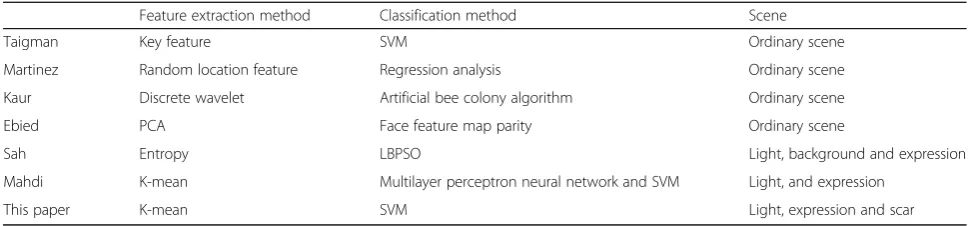
Among the existing research results, the more represen-tative research teams include Taigman, Martinez, Kaur, Ebied, Sah, and Mahdi. They have obtained rich research results in the research of face recognition. Taigman et al. [23] proposed to extract a few key features on the image first, and then use the support vector regression method to extract facial features. This method has a good effect in improving the face recognition rate. Martinez et al. [24] proposed the use of regression analysis for face feature se-lection. During each iteration, the output of the regression is based on the image features extracted at random loca-tions within a specific range. As the iteration continues, random range of sampling is also constantly evolving to en-sure that the algorithm moves in the right direction. Kaur [25] proposed a natural heuristic method of feature extrac-tion and feature selecextrac-tion for face recogniextrac-tion. He uses discrete wavelet method to extract facial features and ex-tracts the artificial bee colony algorithm by optimizing the fitness function. The features are screened, and the selected features are used for face recognition. The experimental re-sults show that a good face recognition effect can be achieved in the case of small data sets. Ebied [26] uses prin-cipal component analysis (PCA) to extract facial features and reduce dimensionality of facial features, in view of the fact that the face dimension is large and the accuracy of face recognition is reduced. He also used the mirror face technology to analyze the parity of the face feature map in detail. Experiments show that the method can improve the face recognition rate better, but the time consumption is more, and the training set is more demanding. Because illu-mination, background, and expression have a great
influ-ence on face feature extraction, Sah [27] proposed an
entropy-based GWT feature extraction and face recognition algorithm based on LBPSO feature selection. He proposed
using entropy-based Gabor wavelet transform (GWT) and logarithmic binary particle swarm optimization (LBPSO) to improve the performance of face recognition. GWT can ef-fectively reduce the extracted feature dimension. LBPSO is used to search the global feature space. The optimal solu-tion is obtained, and the experimental results show that the algorithm is robust to the data of external environment changes. Mahdi [28] proposed a new feature extraction al-gorithm in face recognition. He first divides the image in the training set into several small parts, then puts all the same part of the image in one set and obtains the appropri-ate value by K mean and K points of convergence, then using principal component analysis to obtain high-level fea-tures of face images, and finally using multi-layer percep-tron neural network and support vector machine for face recognition. The experimental results show that the method can improve the recognition rate and the computa-tional complexity is low.
The existing research results are shown in Table2. As can be seen from Table 2, most of the results of facial recognition research are rare in common scenes, and there is no uniform standard for different scene compar-isons. Therefore, the corresponding recognition results are not listed in Table2.
5 Conclusions
Face recognition is a biometric identification technology with great development potential. It has broad applica-tion prospects in the fields of banking, public security system, and social welfare protection. After decades of research, face recognition has made great progress and progress. At present, face recognition can achieve higher accuracy under control and cooperation conditions, but under non-control and non-coordination conditions, face recognition is still a very challenging topic. Facial
features are easily affected by factors such as
illumination and expression, which leads to a sharp de-cline in recognition rate. Therefore, it is of great
prac-tical significance to develop a feature extraction
algorithm with high robustness and ability to extract fea-tures with better representation ability.
In this paper, different data sets of different facial ex-pressions, light, and scars are designed. K-mean method is used to cluster different data sets, and SVM is used for classification research. The comparative analysis re-sults show that the method designed by this paper can be improved. The recognition rate of different data sets, especially for expression data sets, has a different expres-sion recognition rate of 91%. The results show that using the K-mean method can greatly improve the classifica-tion effect.
Abbreviations
FRT:Face recognition technology; ICA: Independent component analysis; LDA: Linear discriminant analysis; LFW: Labeled Faces in the Wild; PCA: Principal component analysis; RBF: Radial basis function; SVM: Support vector machine
Acknowledgements
The authors thank the editor and anonymous reviewers for their helpful comments and valuable suggestions.
Funding
This work was supported by Chongqing Big Data Engineering Laboratory for Children, Chongqing Electronics Engineering Technology Research Center for Interactive Learning, the Science and Technology Research Project of Chongqing Municipal Education Commission of China (No.KJ1601401), the Science and Technology Research Project of Chongqing University of Education (No.KY201725C), Basic research and frontier exploration of Chongqing science and Technology Commission (cstc2014jcyjA0704).
Availability of data and materials
We can provide the data.
Authors’contributions
All authors take part in the discussion of the work described in this paper. The author PC W wrote the first version of the paper. The author ZZ and LL did part experiments of the paper. JJ revised the paper in different version of the paper, respectively. The contributions of the proposed work are as follows: To our best knowledge, our work is the first one to use the K-mean algorithm to analyze the face features. Firstly, the biometric features of the face are extracted, and then the K-mean method is used to cluster the face features. Lastly, the SVM method is used to classify. All authors read and ap-prove the final version of the manuscript.
Authors’information
Pengcheng Wei was born in Hechi, Guangxi, P.R. China, in 1975. He received the Ph.D. degree from Chongqing University, P.R. China. Now, he works in the School of Mathematics and Information Engineering, Chongqing University of Education. His research interests include computational intelligence, information security, and big data analysis.
Zhen Zhou was born in Hechuan, Chongqing, P.R. China, in 1994. He received the bachelor’s degree from Nanchang University, P.R. China. Now, he studies in the College of Automation, Chongqing University of Posts and Telecommunications. His research interests include computational intelligence, information security, and big data analysis.
Li Li was born in Hechuan, Chongqing, P.R. China, in 1986. She received the Master degree from Chongqing University, P.R. China. Now, she works in the School of Mathematics and Information Engineering, Chongqing University of Education. Her research interests include cloud security, chaos encryption, and information security.
Jiang Jiao was born in Macheng, Hubei, P.R. China, in 1993. She received the undergraduate degree from Huanggang Normal University, P.R. China. Now, she is a graduate student in the School of Automation, Chongqing University of Posts and Telecommunications. Her research direction is cloud storage.
Ethics approval and consent to participate
Chongqing University of Education approved the study.
Consent for publication
Approved.
Competing interests
The authors declare that they have no competing interests. We confirm that the content of the manuscript has not been published or submitted for publication elsewhere.
Publisher’s Note
Springer Nature remains neutral with regard to jurisdictional claims in published maps and institutional affiliations.
Author details
1
School of Mathematics and Information Engineering, Chongqing University of Education, Chongqing, China.2School of Automation, Chongqing
University of Posts and Telecommunications, Chongqing, China.
Received: 27 May 2018 Accepted: 30 July 2018
References
1. WW Bledsoe,The model method in facial recognition, vol 15 (Panoramic Research Inc, Palo Alto, 1966), p. 47
2. M Turk, A Pentland, Eigenfaces for recognition [J]. J. Cogn. Neurosci.3(1), 71–86 (1991)
3. X-Y Li, Z-X Lin, inThe Euro-China Conference on Intelligent Data Analysis and Applications. Face Recognition Based on HOG and Fast PCA Algorithm (Springer, Cham, 2017)
Mahdi K-mean Multilayer perceptron neural network and SVM Light, and expression
4. RA Vyas, SM Shah, Comparison of PCA and LDA techniques for face recognition feature based extraction with accuracy enhancement [J]. Int. Res. J. Eng. Technol.4(6), 3332–3336 (2017)
5. CY Low, ABJ Teoh, CJ Ng, inIEEE Transactions on Circuits and Systems for Video Technology. Multi-fold Gabor, PCA and ICA filter convolution descriptor for face recognition [J] (2017)
6. F Schroff, D Kalenichenko, J Philbin, inProceedings of the IEEE conference on computer vision and pattern recognition. Facenet: A Unified Embedding for Face Recognition and Clustering (2015)
7. OM Parkhi, A Vedaldi, A Zisserman, inBMVC. Vol. 1. No. 3. Deep Face Recognition (2015)
8. Y Wen et al., inEuropean Conference on Computer Vision. A Discriminative Feature Learning Approach for Deep Face Recognition (Springer, Cham, 2016)
9. X Zhu et al., inProceedings of the IEEE Conference on Computer Vision and Pattern Recognition. High-Fidelity Pose and Expression Normalization for Face Recognition in the Wild (2015)
10. S Guha, N Mishra,Clustering Data Streams [M]//Data Stream Management
(Springer, Berlin, 2016), pp. 169–187
11. G Aad, B Abbott, J Abdallah, et al., Topological cell clustering in the ATLAS calorimeters and its performance in LHC run 1[J]. Eur. Phys. J. C77(7), 490 (2017)
12. NM Kopelman, J Mayzel, M Jakobsson, et al., Clumpak: A program for identifying clustering modes and packaging population structure inferences across K [J]. Mol. Ecol. Resour.15(5), 1179–1191 (2015)
13. L Anderson, É Aubourg, S Bailey, et al., The clustering of galaxies in the SDSS-III baryon oscillation spectroscopic survey: Baryon acoustic oscillations in the data releases 10 and 11 galaxy samples [J]. Mon. Not. R. Astron. Soc.
441(1), 24–62 (2014)
14. K Wagstaff, C Cardie, S Rogers, inEighteenth International Conference on Machine Learning. Constrained K-means Clustering with Background Knowledge (Morgan Kaufmann Publishers Inc, Williamstown, 2001), pp. 577–584
15. SH Kang, B Sandberg, AM Yip, A regularized k-means and multiphase scale segmentation [J]. Inverse Prob. Imaging5(2), 407–429 (2017)
16. V Vapnik, R Izmailov, Knowledge transfer in SVM and neural networks. Ann. Math. Artif. Intell.81(1–2), 3–19 (2017)
17. D Singh et al., inCommunication, Control and Intelligent Systems (CCIS), 2015. An Application of SVM in Character Recognition with Chain Code (IEEE, Mathura, 2015)
18. X Chang et al., inInternational Conference on Machine Learning. Complex Event Detection Using Semantic Saliency and Nearly-Isotonic SVM (2015) 19. C Ding et al., Multi-directional multi-level dual-cross patterns for robust face
recognition. IEEE Trans. Pattern Anal. Mach. Intell.38(3), 518–531 (2016) 20. Y Gao, J Ma, AL Yuille, Semi-supervised sparse representation based
classification for face recognition with insufficient labeled samples. IEEE Trans. Image Process.26(5), 2545–2560 (2017)
21. MS Hossain, G Muhammad, Cloud-assisted speech and face recognition framework for health monitoring. Mob. Netw. Appl.20(3), 391–399 (2015) 22. C-C Chang, S-H Chou, Tuning of the hyperparameters for L2-loss SVMs with
the RBF kernel by the maximum-margin principle and the jackknife technique. Pattern Recogn.48(12), 3983–3992 (2015)
23. Y Taigman, M Yang, MA Ranzato, et al., inIEEE Conference on Computer Vision and Pattern Recognition. Deep Face: Closing the Gap Tohuman-Level Performance in Face Verification [C] (2014), pp. 1701–1708
24. B Martinez, MF Valstar, X Binefa, et al., Local evidence aggregation for regression-based facial point detection [J]. IEEE Trans. Pattern Anal. Mach. Intell.35(5), 1149–1163 (2013)
25. H Kaur, VK Panchal, R Kumar, inSixth International Conference on Contemporary Computing (IC3). A Novel Approach Based on Nature Inspired Intelligence for Face Feature Extraction and Recognition [C] (2013), pp. 149–153
26. HM Ebied, inInternational Conference on Informatics and Systems (INFOS). Feature extraction using PCA and Kernel-PCA for face recognition [C] (2012), pp. 72–77
27. R Sah, BV Shreeja, K Manikantan, et al., inInternational Conference on Communications and Signal Processing (ICCSP). Entropic-GWT based feature extraction and LBPSO based feature selection for enhanced face recognition [C] (2015), pp. 180–184