C O M M E N T A R Y
Open Access
A framework for understanding the
characteristics of complexity in biology
Joseph Dauer
*and Jenny Dauer
Abstract
Understanding the functioning of natural systems is not easy, although there is general agreement that understanding complex systems is an important goal for science education. Defining what makes a natural system complex will assist in identifying gaps in research on student reasoning about systems. The goal of this commentary is to propose a framework that explicitly defines the ways in which biological systems are complex and to discuss the potential relevance of these complexity dimensions to conducting research on student reasoning about complexity in biology classrooms. We use an engineering framework for dimensions of complexity and discuss how this framework may also be applied to biological systems, using gene expression as an example. We group dimensions of this framework into
components,functional relationshipsamong components,processes,manifestations, andinterpretationswithin biological systems. We explain four steps that discipline-based education researchers can use to apply these dimensions to explore student reasoning about complex biological systems.
Keywords:Biological systems, Complexity, Systems thinking, Undergraduate, Post-secondary
Background
For many science educators, the passion for our work stems from a deep sense of awe for the complexity of natural systems that we have come to recognize as beau-tiful. We also share a common goal to help students recognize, appreciate, and understand the complexities of natural phenomena. In particular, the intricacies of biological systems are important for students to under-stand for medical, environmental, and social health. Un-derstanding how biological complexity is manifest at different levels of organization (molecules to ecosystems) is a major challenge for advancing twenty-first-century biology (National Research Council (NRC) 2009) and for preparing undergraduate students to address difficult is-sues that our society faces (American Association for the Advancement of Science (AAAS) 2011). This same goal is expressed in different ways throughout primary and secondary standards in the USA and post-secondary education, both generally in terms of sequences of in-creasing sophistication across grade bands and specific-ally in terms of concepts that students should master (AAAS 2011; NRC 2012).
Despite general agreement about the importance of understanding complexity, the meaning of “complexity” is not often defined. For example, NRC’s“A Framework for K-12 Science Education” (2012) and the “Next Generation Science Standards”(NGSS Lead States 2013) in the USA promote scale and systems and systems modeling; however, the use of the word “complexity” throughout the documents includes as follow:“complex food molecules [sugars],” that “organisms are complex,” and that ecosystems are “complex, interactive systems.” The NRC framework does not specify what characteris-tics make molecules, organisms, or ecosystems complex.
A system has been described as complex (Jacobson 2001; Johnson 2009) if it exhibits particular characteris-tics including the following:
– Having many interacting agents
– Being affected by agents’behaviors (i.e., positive and negative feedback) that can be modified based on history
– Being open
– Having emergent properties that arise without a central control
– Showing patterns that arise both ordered and disordered
* Correspondence:[email protected]
School of Natural Resources, University of Nebraska-Lincoln, 3310 Holdrege Street, Lincoln, NE 68583-0995, USA
Some of these characteristics are present in the way that complex biological systems are described in“Vision and Change in Undergraduate Biology Education: A Call to Action” (AAAS 2011), either explicitly or implicitly in the text. However, when thinking about biology instruc-tion, a problem arises—complexity is not a singular idea, but rather has many characteristics. If a biology in-structor wanted to make complexity a centerpiece of his or her curriculum, what is the best way to help students recognize, explain, and grapple with the characteristics of complexity in a way that is coherent and generalizable across levels of organization and different contexts? The goal of this commentary is to present a framework for a language of complexity that may aid instructors in this endeavor, as well as education researchers who seek to understand student learning about complexity.
Explicitly addressing complexity in classrooms: the need for a complexity framework
The characteristics of complex systems listed above are based on observations. The list, with the exception of feedback on behavior, does not reveal mechanistic or causal relationships that give rise to the observed phenomenon. We think that when learning about com-plex systems, students will benefit from a more concrete connection between mechanistic relationships and the resulting phenomenon with complex characteristics (Doyle et al. 2008; Hmelo et al. 2000; Jacobson & Wilensky 2006; Wilensky & Resnick 1999). For example, diffusion is the result of millions of molecules moving independently, yet students associate the term diffusion more with the phenomenon of moving from high con-centration to low concon-centration than the causal mechan-ism of molecular kinetics (Garvin-Doxas & Klymkowsky 2008). Focusing on mechanisms will mean extra foot-work for an instructor to discuss both abstract system behaviors like movement of molecules and concrete ex-amples like diffusion in lungs during gas exchange in a way that is explicitly linked (Goldstone & Son 2005; Levy & Wilensky 2008). But, revealing generalizable mechanisms can be a powerful way for students to make sense of systems, specifically explaining complexity at multiple biological scales and how this complexity impacts processes across these scales (Jacobson & Wilensky 2006; Verhoeff et al. 2008).
There is a struggle inherent to introducing students to new concepts and portraying the depth of complexity that we hope to have them achieve by the time they have advanced in their learning. There is a danger of being too complex and losing students in cognitive overload (Reber & Kotovsky 1997; Schnotz & Kürschner 2007), but there is also a danger in being too simple in a way that promotes misconceptions (Feltovich et al. 2004) and can promote memorization instead of understanding
(Jiménez-Aleixandre et al. 2000). Students’ misconcep-tions frequently arise from reductive biases (Spiro et al. 1988), which are tendencies to reduce important aspects of complexity. For example, medical students have been shown to misunderstand the impact of cardiac output on venous pressure because they treat a continuous process such as blood flow as a more simple discrete process (Feltovich et al. 1994). In cognitive flexibility theory, conditions that help students acquire knowledge while preventing reductive biases will allow students to master complexity and transfer this knowledge across contexts (Spiro et al. 1988). The conditions to promote mastery of complexity include avoiding oversimplifica-tion, providing multiple representations, increasing con-nectedness of concepts and skills, and offering explicit guidance on managing complexity (Hmelo-Silver et al. 2007; Jacobson & Wilensky 2006; Spiro et al. 1988).
Chi (2005) provided an explanation about why some misconceptions about systems are so robust and sup-ported the idea of instruction that explicitly addresses characteristics of complexity. She compared students’ conceptual thinking about two processes: the flow of blood in human circulatory systems versus diffusion of dye in water. The flow of blood is an example of a direct process because the aggregate components of the heart (the structure of the chambers and valves) are directly causing the global pattern of blood direction and speed. Diffusion is an example of an emergent process because the mechanism is explained by the collective interaction of the dye and water molecules rather than any single or aggregate components. She observed that students’ mis-conceptions of emergent processes are robust because they misinterpret emergent processes as a direct process. For example, students might explain diffusion as a series of sequential steps where first the oxygen “comes in” and then the carbon dioxide would“go out,”rather than simultaneous movement of a collection of molecules (Chi 2005). Overcoming this misconception requires students to know about emergent processes in order to overcome their predisposition to conceive of all pro-cesses as direct. This conceptual change in systems thinking is difficult to achieve and may require students to first become aware of ontological categories such as “direct”and“emergent,”and then shift their conceptions across categories (Chi, 2005). Therefore, students’ lack of awareness of these categories may promote reductive biases. If generalizable explanations of processes are taught explicitly, they may help students recognize and understand a variety of systems characteristics in mul-tiple contexts.
classrooms. We agree with Jacobson and Wilensky (2006) and Chi (2005) that providing instructors with explicit language to define what makes a system “complex” will help teachers be more adept in inte-grating specific aspects of complexity in their teaching and to determine when to include or exclude or draw connections between concepts. We propose a frame-work below to address this need, which represents generalizable dimensions of complexity that provide the ontological basis for complex systems.
Adapting an engineering framework for biological complexity
Our approach builds on the work of Feltovich and col-leagues (Feltovich et al. 2001; Feltovich et al. 2004, 1994) who have identified eleven dimensions of complexity in engineered systems. Speaking from their expertise in cognition, they suggest that these eleven dimensions of complexity make designing systems (in their case, intelli-gent design systems) very difficult. They suggest that the reductive biases of learners in general, and cognitive en-gineers specifically, result in oversimplification and even-tually poor performance and misconceptions.
Biological systems evolved through eons of time and are not constructed and therefore not exactly analogous to engineered systems (Modell et al. 2015). Despite the difference between engineered and biological systems, we propose that these eleven characteristics are a useful framework for approaching research on student learning
about biological systems and aid biology educators and researchers to move beyond the phenomenological de-scriptions of systems. By doing so, we are also proposing that there are a relatively small number of definable characteristics that makelivingsystems complex.
In order to more clearly apply these dimensions to biology, we grouped Feltovich et al.’s dimensions into those that deal with the components of the system, the
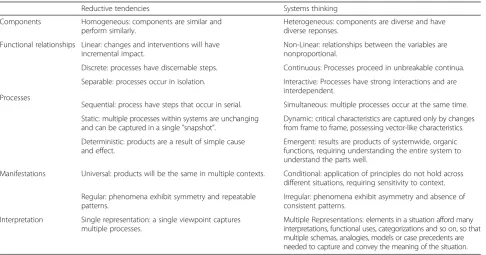
functional relationships (i.e., mathematical relationships) among components, theprocessesby which components interact, the manifestation of those relationships and processes, and theinterpretationof the system or how a given biological system may viewed differently by dif-ferent audiences both in terms of functionality and representation. We changed the name of one original di-mension from“mechanism/organicism”to“deterministic/ emergent” to better align with familiar terminology in biology. We eliminated another dimension (“surface/ deep”) because we felt this dimension was encom-passed by all of the other dimensions. The 10 dimen-sions are described in Table 1 with an eye toward the hypothesis that students may be susceptible to reduc-tive biases in one or more dimensions.
Previous science education research have proposed ways to investigate student understanding of complex systems. One example is the structures-behavior-function (SBF) framework that has been used to both support and research students’systems thinking (Bray-Speth et al. 2014; Dauer et al. 2013; Hmelo-Silver et al. 2007;
Table 1Dimensions of complexity (right column), taken and adapted from Feltovich et al. (2004), organized into components, functional relationships, etc. The middle column represents the potential reductive tendencies that affect learners’reasoning about complex biological systems (Spiro et al. 1988)
Reductive tendencies Systems thinking
Components Homogeneous: components are similar and perform similarly.
Heterogeneous: components are diverse and have diverse reponses.
Functional relationships Linear: changes and interventions will have incremental impact.
Non-Linear: relationships between the variables are nonproportional.
Processes
Discrete: processes have discernable steps. Continuous: Processes proceed in unbreakable continua.
Separable: processes occur in isolation. Interactive: Processes have strong interactions and are interdependent.
Sequential: process have steps that occur in serial. Simultaneous: multiple processes occur at the same time.
Static: multiple processes within systems are unchanging and can be captured in a single "snapshot".
Dynamic: critical characteristics are captured only by changes from frame to frame, possessing vector-like characteristics.
Manifestations
Deterministic: products are a result of simple cause and effect.
Emergent: results are products of systemwide, organic functions, requiring understanding the entire system to understand the parts well.
Universal: products will be the same in multiple contexts. Conditional: application of principles do not hold across different situations, requiring sensitivity to context.
Regular: phenomena exhibit symmetry and repeatable patterns.
Irregular: phenomena exhibit asymmetry and absence of consistent patterns.
Interpretation Single representation: a single viewpoint captures multiple processes.
Liu & Hmelo-Silver 2009; Vattam et al. 2011). Like the framework we propose in this article, SBF was first uti-lized in engineered systems (Goel & Stroulia, 1996) then adapted by Hmelo-Silver and colleagues in biological sys-tems (Hmelo-Silver et al. 2007; Hmelo-Silver & Pfeffer 2004; Jordan et al. 2008). Another commonality between the SBF model and the framework we propose is that components in our framework mirrors“structures”in SBF representations and is a critical piece for teaching students about complex systems. As Hmelo-Silver et al. (2007) point out, it is a critical first step for learners to be aware of the components in order to describe the operation of the system. However, our proposed framework for com-plexity in biological systems differs from the SBF frame-work in important ways. “Behaviors” and “functions” do not map exactly onto our framework. Our framework describes the ontological level of behavior, so processes in our framework explain behaviors. For example, air moving in and out of the lungs is a behavior facilitated by the lungs and diaphragm (structures/components). The process of air moving in and out of the lungs is a continuous, interactive, simultaneous, and dynamic set of processes. SBF representations, like student-created models, are limiting in that the nature of some processes cannot easily be represented in the models frequently used to elicit learners’ mental models of the systems (Dauer et al. 2013; Hmelo-Silver et al. 2007). For example, representing the diffusion of oxygen and carbon dioxide across a capillary wall in a lung as a simultaneous (not se-quential) process is challenging in a static drawing unless the learner specifically reports this process as simultan-eous. Similarly, the function, or purpose of the system, e.g., to facilitate gas exchange, is not captured in our framework, except somewhat in the interpretation sion. Instead, in our framework, the manifestation dimen-sions describe how the combination of processes is manifest in the system and the nature of those manifesta-tions. Again, SBF representations have some limitations in that the nature of some manifestations may be challenging to represent in a static drawing unless specifically noted.
The goal of this commentary is to present a framework for complexity dimensions and to discuss the potential relevance of these complexity dimensions to teaching and to conducting research on student reasoning about complexity in biology classrooms. This framework of complexity dimensions can aid researchers in using a more specific language around complexity and inspire new potential research questions around student learn-ing. At present, there are significant gaps in research about undergraduate student reasoning about complex-ity, and our understanding of student reasoning is cru-cial for teaching biological systems. We present a sort of prescription for how a biology education researcher may use the dimensions of complexity, using gene expression
as an example, to highlight how we have found these di-mensions to be useful in organizing our own thinking about potential research questions.
Discussion
Determine how the biological concept is complex
We find it useful to first examine a single biological con-cept to determine how the dimensions of complexity are reflected in the characteristics of the concept. When considering the concept of gene expression, we can sep-arately consider components, functional relationships, processes, manifestations, and interpretation (Table 1) to make explicit the ontological dimensions of complexity. The components of the system include DNA and RNA sequences, ribosomes, and proteins. The functional rela-tionships are the rates and frequencies of biochemical reactions that happen at an atomic, molecular, cellular, and organismal level and contribute to a phenotype. The processes in gene expression include the following: tran-scription, translation, gene regulation by transcription factors, and interactions with the environment. The manifestation of gene expression is the phenotype of an organism, either directly if one gene-one trait or indir-ectly through protein interactions. The interpretation might include multiple representations (or models) of gene expression that highlight subcellular, cellular, or-ganismal, or population levels of biological organization to be used for various purposes. For example, a phys-ician or scientist may view the gene expression system with a different lens depending on if the context is med-ical, ecologmed-ical, evolutionary, or hereditary.
Next, we can consider how gene expression might be complex and hypothesize about potential reductive tendencies of our students when reasoning about this complexity. The components may be “heterogeneous” because mutations in DNA nucleotide sequences occur frequently and may or may not be corrected, become fixed in the population, or be expressed at all. The func-tional relationships may be “non-linear” because tran-scription factors may have a pleiotropic, cascading effect (Hadorn 1961). The processes in gene expression may be “interactive” because transcription occurs only when regulatory factors are readily available from previous transcription and translation processes (Latchman 2010). The manifestation of the process of gene expression can be “conditional” because of two different mechanisms: (1) gene expression in different body organs may be due to differential gene regulation or (2) gene expression may be influenced by epigenetics due to environmental factors (Ansel et al. 2008; Shah & Sukumar 2010).
manifestations aid students who are prone to focus on just the components of a system (Batzri et al. 2015; Hmelo-Silver et al. 2007), in developing systems thinking or the ability to consider many of the dimensions of a system simultaneously. Breaking down concepts this way may aid instructors in being aware of when and how to break down content into simpler pieces without oversimplifying in a way that may hinder students from a deeper level of understanding as they progress in their learning (Spiro et al. 1988). A framework of generalizable dimensions of complexity may give in-structors ideas for how to illustrate complexity more ac-curately or to include “exceptions to the rule” that play an important role in the fabric of living systems. There are volumes of literature on students’ lack of general knowledge about genes, alleles, chromosomes, and pro-teins (Couch et al. 2015; Garvin-Doxas & Klymkowsky 2008; Smith et al. 2008; Tsui & Treagust 2010). Focusing on one particular dimension within a biology concept, such as how the manifestations of gene expression are “conditional” or “universal,” may direct and simplify how we approach research questions about how students reason about gene expression. For the remainder of our example, we chose to consider how teachers could instruct about conditional manifestations within the concept of gene ex-pression due either to gene regulation or epigenetics.
Investigate what is known about how students reason about this dimension
Naturally, the best place to begin a research question is by examining primary literature about student learning within this dimension. Using the complexity framework to research student learning about biology is novel, as suggested by the lack of previous literature at this detailed level of analysis. We have found an uneven amount of research conducted on some dimensions compared to others. For example, there is literature on student reasoning about emergent manifestations (Hmelo-Silver & Pfeffer 2004; Jacobson 2001; Levy & Wilensky 2008; Wilensky & Resnick 1999) but no re-search, that we could find, about student learning of conditional manifestations. Our proposed framework of complexity in biology may be useful in highlighting opportunities for new research focusing on one par-ticular dimension of complexity. However, there is a lack of overall guidance in the literature on the relative importance, relevance, and learning difficulty of any par-ticular dimension, so some aspects of the framework may prove to be more fruitful than others.
As we investigated literature, we found articles sug-gesting teaching strategies related to gene regulation and epigenetics (for example, Colón-Berlingeri 2010; Drits-Esser et al. 2014; Heyduck & Harms 2015), but not directly related to reasoning about conditional
manifestations related to gene expression. Some aspects of gene regulation are less complex and easier for stu-dents to understand according to the literature. For ex-ample, students’ conceptions about which cells in an organism possess genes for a given trait can be remedied during instruction (Makarevitch et al. 2015). (All cells except red blood cells and cornified cells in your skin, hair, and nails possess a copy of each gene in the gen-ome, although there are copy number variations within different cells of an organism (Redon et al., 2006).) How-ever, other aspects of gene regulation and epigenetics are more difficult for students to understand and relate to familiar concepts of the transcription and translation. For example, of advanced molecular biology students who understand the impact of transcription factors, 30 % are unable to reason about methylation or the regulation of transcription factors by environmental cues (Couch et al. 2015). After our literature search, we gained little insight on student tendencies toward sim-plistic explanations of gene expression by ignoring dif-ferential gene regulation in organisms or epigenetics. Therefore, there exists an opportunity for research on how students learn about conditional manifestations in general and specifically related to gene expression.
Look for reductive tendencies in student explanations The initial data to be collected about student reasoning about complexity dimensions in the context of biology may take multiple forms such as constructed models, short an-swer explanations, interviews, or multiple-choice questions. Constructed models (from question prompts targeting spe-cific dimensions) may provide critical information about some dimensions, for example, heterogeneous components, simultaneous processes, or non-linear functional relation-ships (Bray-Speth et al. 2014; Dauer et al. 2013; Liu & Hmelo-Silver 2009). For example, in a recent semester, introductory biology students at our university constructed conceptual models of gene regulation of expression and struggled to represent simultaneous events in the lac op-eron system (JT Dauer, unpublished data).
Students’written explanations or verbal explanations in an interview may be the most effective way to reveal the nuances of student reasoning about complexity, especially pertaining to the processes and manifestations present in the system. Interview questions that ask student to explain gene expression phenomena may reveal students’ reduc-tive tendencies or difficulty understanding gene regulation or epigenetics. Examples are as follows:
Cells in the human body contain 46 chromosomes,
In a multicellular organism, cells contain the same genes. However, these organisms generally have many different cell types with different morphology and physiology (e.g., neurons versus liver cells). How is this possible?
Cells in the liver and the pancreas contain both the gene for the protein serum albumin that makes up blood plasma and the gene for protein amylase that helps digest starch. However, only the liver produces the protein serum albumin and only the pancreas produces amylase. Can you explain why? Can you explain how this happens?
Identical twins have an identical set of genes. Do identical twins have the same gene expression? Can anything from an individual twin’s life experiences influence what genes are producing proteins in their body? Why? How?
The result of this research would be a first-order ap-proximation of student reasoning of the complexity di-mension in a given context. Fully capturing students’ mastery of complexity would require extensive research for the other nine dimensions plus interactions among dimensions, applied to multiple biology concepts—an overwhelming proposition. But small steps, like focusing on a single understudied dimension or applying what is known from well-studied dimensions to similar dimen-sions, can lead to generalizations that will advance our knowledge about how students know and learn complexity.
Design an intervention to test if reductive tendencies can be overcome
Continuing with our example of conditional manifesta-tions in gene expression, the next step would be to de-sign a set of instructional material and assessments or to refine existing materials based on results from observa-tions of student thinking. The results of observaobserva-tions in step 3 should help inform learning objectives, support tools, and assessments. Instructional materials should be designed to support student explanations to include the complexity and nuance of regulation of gene expression and epigenetics. An instructor should be explicit in linking biological phenomena to the concept that the process and quantity of transcription and translation are conditional on the presence of transcription factors and environmen-tal cues. Instructors may explicitly discuss with students how manifestations of process that occur at the atomic and cellular levels in a living organism may be conditional, emergent, or irregular and that gene expression is an example of a conditional manifestation.
There are many existing resources on regulation of gene expression and epigenetics (Billingsley & Carlson 2010; Colón-Berlingeri 2010; Drits-Esser et al. 2014;
Militello 2013) that could be modified to provide an intervention to student learning grounded in how stu-dents learn this dimension of complexity. An example is Makarevitch et al. (2015) who have designed gene ex-pression laboratory exercises related to abiotic stress effects on maize. Their curriculum for upper-level genet-ics classrooms allows students to propose hypotheses about how stress may affect the expression of different genes, then explore online repositories of gene expres-sion data to test their hypotheses. This inquiry approach is carefully choreographed to allow student inquiry while maintaining a focus on the underlying biological content.
We also envision derivations of this approach that may further emphasize conditional manifestations or other dimensions of complexity in a simulated environment. Simulations provide an excellent opportunity for students to model, quantify, or visualize systems complexity. Learn.Genetics (http://learn.genetics.utah.edu) provides interactive visualizations of epigenetics. Several resources exist for designing or modifying simulations to improve visualizing complex systems. For example, Wilensky, col-leagues, and other contributors (Jacobson & Wilensky, 2006; Resnick & Wilensky, 1998; Wilensky & Resnick, 1999) have developed models using a multi-agent simula-tor called NetLogo, that allows users to simulate systems through simple rules governing the agents and the envir-onment (the extensive reference list is available at: http:// ccl.northwestern.edu/netlogo/references.shtml). The Cell Collective (http://cellcollective.org), while focused cur-rently on cellular scale systems, allows computational biol-ogists and students to create models of biological systems with or without the underlying mathematical expression (Helikar et al., 2012, 2015). These software platforms may allow researchers to develop learning modules related to specific dimensions of complexity and test the efficacy of instructional materials related to these dimensions.
Conclusions
ultimately guide instruction that assists students in learning about complex biological systems.
Obviously, instructors will always need to simplify concepts when they present new ideas to students. Without a clear definition of systems complexity, it is not easy for instructors to know how to simplify con-cepts or how to deliberately present additional complex-ity in instruction. Additionally, instructors may lack language that could be used to provide explicit instruc-tion on generalizable concepts of complexity. The framework we propose may provide a roadmap of the ontology of complexity for both instructors and re-searchers as they explore a range of biological systems understanding from reductive tendencies to expert sys-tems thinking.
Acknowledgements
We would like to thank J. Momsen, E. Offerdahl, E. Bray-Speth, T. Long, K. Montooth, T. Helikar, and numerous reviewers for their thoughtful comments and suggestions on the earlier versions of this manuscript.
Authors’contributions
The two authors of this paper equally shared responsibility for conceptual development and writing of this manuscript. Both authors read and approved the final manuscript.
Authors’information
JTD is an Assistant Professor of Life Science Education and studies student learning in undergraduate biology courses. He studied plant ecology focused on population dynamics and seed dispersal for his MS and PhD in Ecology at Penn State University. JTD was a post-doctoral research at Michigan State University on student conceptual model construction in biology. In education, he has examined how conceptual modeling reflects students’changing understanding of biology concepts like the central dogma, homeostasis, and community interactions. His work is motivated by difficulties in students’ conceptual and mathematical reasoning with complex biological systems. JMD is an Assistant Professor of Science Literacy in the School of Natural Resources, University of Nebraska-Lincoln. Her BS was in Secondary Education and Biology, MS in Ecology at Penn State University. JMD obtained a PhD in Forest Science from Oregon State University studying calcium cycling in forests. During her post-doctoral research at Michigan State University, she investigated secondary students’learning about matter and energy. JMD’s current research interests include students systems thinking in biology and understanding post-secondary students’science-informed decision-making about socioscientific issues.
Competing interests
The authors declare that they have no competing interests.
Received: 1 April 2016 Accepted: 28 July 2016
References
AAAS. (2011). Vision and change in undergraduate biology education: a call to action.
Achieve, Inc. (2013).Next generation science standards. Washington, DC: Achieve, Inc. Retrieved from http://www.nextgenscience.org/next-generation-science-standards.
Ansel, J., Bottin, H., Rodriguez-Beltran, C., Damon, C., Nagarajan, M., Fehrmann, S.,… Yvert, G. (2008). Cell-to-cell stochastic variation in gene expression is a complex genetic trait.PLoS Genetics,4(4), e1000049.
Batzri, O., Ben-Zvi Assaraf, O., Cohen, C., & Orion, N. (2015). Understanding the Earth systems: expressions of dynamic and cyclic thinking among university students.Journal of Science Education and Technology, 24(6), 761–775. Billingsley, J., & Carlson, K. A. (2010). Epigenetic effects of diet on fruit fly lifespan:
an investigation to teach epigenetics to biology students.The American Biology Teacher, 72(4), 231–234.
Bray-Speth, E., Shaw, N., Momsen, J., Reinagel, A., Le, P., Taqieddin, R., & Long, T. (2014). Introductory biology students’conceptual models and explanations of the origin of variation.CBE-Life Sciences Education, 13(3), 529–539. Chi, M. (2005). Commonsense conceptions of emergent processes: why some
misconceptions are robust.The Journal of the Learning Sciences, 14(2), 161–199. Colón-Berlingeri, M. (2010). Using an active-learning approach to teach
epigenetics.The American Biology Teacher, 72(4), 221–222.
Couch, B. A., Wood, W. B., & Knight, J. K. (2015). The molecular biology capstone assessment: a concept assessment for upper-division molecular biology students.CBE Life Sciences Education, 14(1), 1–11.
Dauer, J. T., Momsen, J. L., Speth, E. B., Makohon-Moore, S. C., & Long, T. M. (2013). Analyzing change in students’gene-to-evolution models in college-level introductory biology.Journal of Research in Science Teaching, 50(6), 639–659. Doyle, J., Radzicki, M., & Trees, W. (2008). Measuring change in mental models of complex dynamic systems. In H. Qudrat-Ullah, J. M. Spector, & P. I. Davidsen, Complex Decision Making(pp. 269–294). Berlin Heidelberg: Springer. Drits-Esser, D., Malone, M., Barber, N., & Stark, L. (2014). Beyond the central
dogma: bringing epigenetics into the classroom.The American Biology Teacher, 76(6), 365–369.
Feltovich, P., Coulson, R. L., & Spiro, R. J. (2001). Learners’(mis) understanding of important and difficult concepts: a challenge to smart machines in education. In K. Forbus & P. J. Feltovich (Eds.),Smart machines in education: the coming revolution in educational technology(pp. 349–375). Menlo Park: AAAI/MIT Press.
Feltovich, P., Hoffman, R. R., Woods, D., & Roesler, A. (2004). Keeping it too simple: how the reductive tendency affects cognitive engineering.IEEE Intelligent Systems, 19(3), 90–95.
Feltovich, P., Spire, R. J., Coulson, R. L., & Adami, J. F. (1994).Conceptual understanding and stability, and knowledge shields for fending off conceptual change. Springfield: Southern Illinois University School of Medicine. Garvin-Doxas, K., & Klymkowsky, M. W. (2008). Understanding randomness
and its impact on student learning: lessons learned from building the biology concept inventory (BCI).CBE-Life Sciences Education, 7(2), 227–233. Goel, A., & Stroulia, E. (1996). Functional device models and model-based
diagnosis in adaptive design.Artificial Intelligence for Engineering, Design, Analysis and Manufacturing, 10(04), 355–370.
Goldstone, R. L., & Son, J. Y. (2005). The transfer of scientific principles using concrete and idealized simulations.Journal of the Learning Sciences, 14(1), 69–110. Hadorn, E. (1961).Developmental genetics & lethal factors. London: Methuen and
Co Ltd, John Wiley and Sons, Inc.
Helikar, T., Cutucache, C. E., Dahlquist, L. M., Herek, T. A., Larson, J. J., & Rogers, J. A. (2015). Integrating interactive computational modeling in biology curricula. PLoS Computational Biology, 11(3), e1004131.
Helikar, T., Kowal, B., McClenathan, S., Bruckner, M., Rowley, T., Madrahimov, A.,… Rogers, J. A. (2012). The cell collective: toward an open and collaborative approach to systems biology.BMC Systems Biology,6(1), 96.
Heyduck, B., & Harms, U. (2015). An out-of-school practical exercise: an examination of different DNA methylation conditions using a restriction assay.Journal of Biological Education, 49(2), 179–189.
Hmelo, C. E., Holton, D. L., & Kolodner, J. L. (2000). Designing to learn about complex systems.Journal of Learning Science, 9(3), 247–298.
Hmelo-Silver, C. E., Marathe, S., & Liu, L. (2007). Fish swim, rocks sit, and lungs breathe: expert-novice understanding of complex systems.Journal of Learning Science, 16(3), 307–331.
Hmelo-Silver, C. E., & Pfeffer, M. G. (2004). Comparing expert and novice understanding of a complex system from the perspective of structures, behaviors, and functions. Cognitive Science: A Multidisciplinary Journal, 28(1), 127–138.
Jacobson, M. (2001). Problem solving, cognition, and complex systems: differences between experts and novices.Complexity, 6(3), 41–49. Jacobson, M., & Wilensky, U. (2006). Complex systems in education: scientific and
educational importance and implications for the learning sciences.Journal of the Learning Sciences, 15(1), 11–34.
Jiménez-Aleixandre, M. P., Bugallo Rodríguez, A., & Duschl, R. A. (2000).“Doing the lesson”or“doing science”: argument in high school genetics.Science Education, 84(6), 757–792. http://doi.org/10.1002/1098-237X(200011)84: 6<757::AID-SCE5>3.0.CO;2-F.
Johnson, N. (2009). Two’s company, three is complexity. InSimply complexity: a clear guide to complexity theory(pp. 3–18). London: Oneworld Publications. Jordan, R., Gray, S., Demeter, M., Liu, L., & Hmelo-Silver, C. (2008). Adding
Latchman, D. S. (2010).Gene control. New York: Garland Science, Taylor and Francis Group, LLC.
Levy, S. T., & Wilensky, U. (2008). Inventing a“mid level”to make ends meet: reasoning between the levels of complexity.Cognition and Instruction, 26(1), 1–47.
Liu, L., & Hmelo-Silver, C. E. (2009). Promoting complex systems learning through the use of conceptual representations in hypermedia.Journal of Research in Science Teaching, 46(9), 1023–1040.
Makarevitch, I., Frechette, C., & Wiatros, N. (2015). Authentic research experience and“big data”analysis in the classroom: maize response to abiotic stress. CBE-Life Sciences Education, 14(3), 1–12.
Militello, K. T. (2013). Studying epigenetic DNA modifications in undergraduate laboratories using complementary bioinformatic and molecular approaches. Biochemistry and Molecular Biology Education, 41(5), 334–340.
Modell, H., Cliff, W., Michael, J., McFarland, J., Wenderoth, M. P., & Wright, A. (2015). A physiologist’s view of homeostasis.Advances in Physiology Education, 39(4), 259–266.
National Research Council. (2012). In S. R. Singer, N. R. Nielsen, & H. A. Schweingruber (Eds.),Discipline-based education research: understanding and improving learning in undergraduate science and engineering. Washington, D.C: The National Academies Press.
NRC. (2009).A new biology for the 21st century. Washington, D.C.: National Academies Press.
Reber, P. J., & Kotovsky, K. (1997). Implicit learning in problem solving: the role of working memory capacity.Journal of Experimental Psychology: General, 126(2), 178.
Redon, R., Ishikawa, S., Fitch, K. R., Feuk, L., Perry, G. H., Andrews, T. D.,…Hurles, M. E. (2006). Global variation in copy number in the human genome.Nature, 444(7118), 444–454.
Resnick, M., & Wilensky, U. (1998). Diving into complexity: developing probabilistic decentralized thinking through role-playing activities.The Journal of the Learning Sciences, 7(2), 153–172.
Schnotz, W., & Kürschner, C. (2007). A reconsideration of cognitive load theory. Educational Psychology Review, 19(4), 469–508.
Shah, N., & Sukumar, S. (2010). The Hox genes and their roles in oncogenesis. Nature Reviews Cancer, 10(5), 361–371.
Smith, M. K., Wood, W. B., & Knight, J. K. (2008). The genetics concept assessment: a new concept inventory for gauging student understanding of genetics. CBE - Life Sciences Education, 7, 422–430.
Spiro, R. J., Coulson, R. L., Feltovich, P., & Anderson, D. K. (1988). Cognitive flexibility theory: advanced knowledge acquisition in ill-structured domains. In V. Patel (Ed.),Tenth annual conference of the cognitive science society proceedings(pp. 375–383). Hillsdale: Erlbaum. http://www.academia.edu/ download/30566058/24-710-Chapter22.pdf.
Tsui, C.-Y., & Treagust, D. (2010). Evaluating secondary students’scientific reasoning in genetics using a two-tier diagnostic instrument.International Journal of Science Education, 32(8), 1073–1098.
Vattam, S. S., Goel, A. K., Rugaber, S., Hmelo-Silver, C. E., Jordan, R., Gray, S., & Sinha, S. (2011). Understanding complex natural systems by articulating structure-behavior-function models.Journal of Educational Technology and Society, 14(1), 66–81.
Verhoeff, R. P., Waarlo, A. J., & Boersma, K. T. (2008). Systems modelling and the development of coherent understanding of cell biology.International Journal of Science Education, 30(4), 543–568.
Wilensky, U., & Resnick, M. (1999). Thinking in levels: a dynamic systems approach to making sense of the world.Journal of Science Education and Technology, 8(1), 3–19.
Submit your manuscript to a
journal and benefi t from:
7Convenient online submission
7Rigorous peer review
7Immediate publication on acceptance
7Open access: articles freely available online 7High visibility within the fi eld
7Retaining the copyright to your article