RESEARCH
Daily urinary creatinine predicts the
weaning of renal replacement therapy in ICU
acute kidney injury patients
Nicolas Viallet
1, Vincent Brunot
1, Nils Kuster
2, Delphine Daubin
1, Noémie Besnard
1, Laura Platon
1,
Aurèle Buzançais
1, Romaric Larcher
1, Olivier Jonquet
1and Kada Klouche
1,3*Abstract
Background: In acute kidney injury (AKI), useless continuation of renal replacement therapy (RRT) may delay renal recovery and impair patient’s outcome. In this study, we aimed to identify predictive parameters that may help to a successful RRT weaning for AKI patients.
Methods: We studied 54 surviving AKI patients in which a weaning of RRT was attempted. On the day of weaning (D0) and the following 2 days (D1 and D2), SAPS II and SOFA scores, 24-h diuresis, 24-h urinary creatinine and urea (UCr and UUr), creatinine and urea generation rates (CrGR and UrGR) and clearances (CrCl and UrCl) were collected. Patients who remained free of RRT 15 days after its discontinuation were considered as successfully weaned. Results: Twenty-six RRT weaning attempts succeeded (S+) and 28 failed (S−). Age, previous renal function, SAPS II and SOFA scores were comparable between groups. At D0, 24-h diuresis was 2300 versus 1950 ml in S+ and S−, respectively, p = 0.05. At D0, D1 and D2, 24-h UUr and UCr levels, UrCl and CrCl, and UUr/UrGR and UCr/CrGR ratios were significantly higher in S+ group. By multivariate analysis, D1 24-h UCr was the most powerful parameter that was associated with RRT weaning success with an area under the ROC curve of 0.86 [0.75–0.97] and an odds ratio of 2.01 [1.27–3.18], p = 0.003.
Conclusions: In ICU AKI, 24-h UCr appeared as an efficient and independent marker of a successful weaning of RRT. A 24-h UCr ≥5.2 mmol was associated with a successful weaning in 84 % of patients.
Keywords: Acute kidney injury, Renal replacement therapy, Weaning, Urine output, Urinary creatinine
© 2016 The Author(s). This article is distributed under the terms of the Creative Commons Attribution 4.0 International License (http://creativecommons.org/licenses/by/4.0/), which permits unrestricted use, distribution, and reproduction in any medium, provided you give appropriate credit to the original author(s) and the source, provide a link to the Creative Commons license, and indicate if changes were made.
Background
Acute kidney injury (AKI) is a common condition in the intensive care unit (ICU). Approximately 5 % of ICU patients suffering from AKI require renal replacement therapy (RRT) [1]. Such patients have a hospital mortality rate of 45–70 % [1–6], and those surviving to hospital dis-charge continue to carry a high risk for long-term mor-bidity and mortality [7–10]. Several studies have shown that between 10 and 30 % of patients with AKI who required RRT will remain dialysis dependent at discharge
[7–13]. Yet, renal function in AKI surviving patients requiring RRT ultimately recovers in the vast majority of case (more than 90 % of patients) [14]. However, per-formances of RRT may have untoward effects that con-tribute to the prolongation of renal failure or impede the ultimate recovery of renal function [15]. Indeed, RRT represents an independent and an added risk factor for mortality [16–18] as it exposes the patient to several complications like catheter-related infections or throm-bosis, bleeding favored by anticoagulation, hemodynamic instability. The prolonged continuation of RRT could also be deleterious for renal recovery, particularly in cases of intradialytic hemodynamic instability, inducing renal ischemic lesions [19]. Renal biopsy in patients with prolonged AKI treated by hemodialysis showed regions
Open Access
*Correspondence: [email protected]
1 Department of Intensive Care Medicine, Lapeyronie University Hospital, 371, Avenue du Doyen G. Giraud, 34295 Montpellier, France
of fresh tubular necrosis days-to-weeks after the initial insult [20]. RRT may also delay renal recovery possibly by purification of mediators and growth factors needful for the tubular repair [21]. Moreover, RRT may remove unpredictable amounts of antibiotics, amino acids and nutrients. Also, RRT represents a significant additional cost in the patient’s care. It is therefore a matter of con-cern to identify which factors present at the time of dis-continuation may help physicians in predicting successful cessation of RRT [22]. To the best of our knowledge, a paucity of studies has been reported on RRT weaning during AKI [23–26]. Sepsis-related Organ Failure Assess-ment (SOFA) score [23, 26] and 2-h creatinine clearance [25] have been reported as a reliable predictive factors, but urine output remains the most consistent parameter significantly associated with the success of weaning [24]. This study was therefore undertaken to investigate and identify parameters, particularly 24-h urinary creatinine, present at the time of RRT weaning that would be associ-ated with successful cessation of RRT during AKI.
Patients and methods
This retrospective study was conducted, from Janu-ary 2008 to December 2012, in two medical ICUs of the Montpellier University Hospital, France. It was approved by our local institutional review board (Ethic Committee of Montpellier; Comité de protection des personnes: CPP Sud Mediterranée 4) which waived informed consent from the patients or their relatives.
Study population
Patients admitted to the ICU for AKI requiring RRT that survived and in which an attempt of weaning was realized were enrolled in the study. Exclusion criteria included pregnancy, age <18 years old, previous chronic renal failure stage ≥4, AKI of obstructive, glomerular or vascular etiology. AKI patients that underwent acute RRT for less than 3 days (no attempt of weaning), and patients without an attempt of weaning RRT or trans-ferred to another unit before an attempt of weaning were also excluded. Decisions regarding the initiation, man-agement and discontinuation of RRT were made by the referring physician according to the guidelines of the intensive care and nephrology societies [22]. The choice of RRT modality was depending on patient hemody-namic stability and was daily re-evaluated. Patients with hemodynamic instability or severe fluid overload were preferentially treated with pre-dilutional continuous venovenous hemodiafiltration (CVVHDF) or on-line sustained low-efficiency daily dialysis-filtration (SLEDD-f), and those with hemodynamic stability were preferen-tially treated with on-line intermittent hemodiafiltration (IHDF) [27].
Study design
An RRT cessation was considered as an attempt of wean-ing when referred to a medical decision and if it lasted more than 72 h. Only the first attempt was analyzed for each patient. Current criteria required for weaning attempt were the association of an urine output of at least 20 ml/h without diuretics [24, 28], a restored and stable hemodynamic and respiratory conditions, no new kid-ney aggression (mainly toxic and predictable), no need to continue RRT for the previously mentioned reasons. A successful weaning was defined as the cessation of RRT for at least 15 days. This endpoint defined two groups of patients: S+ for the success of the weaning attempt and S− if it failed.
Data collection
Baseline patient characteristics were recorded, including age, gender, cause of AKI, comorbidities, previous renal function (estimation of glomerular filtration rate—eGFR, by the Chronic Kidney Disease Epidemiology, CKD-epi formula [29]), weight, urine volume. Severity of illness was determined at the inclusion using the simplified acute physiology score II (SAPS II) and the Sequential Organ Failure Assessment (SOFA) score. RRT modalities were collected during treatment.
Day 0 (D0) was defined as the day of RRT cessation at the weaning attempt, and D1, D2 the 2 following days. From D0 to D2, we daily collected the following param-eters: non-renal SOFA score, patient’s weight, 24-h urine output, dose of furosemide, fluid balance (intake out-put), mean arterial pressure, dose of vasopressors, use of mechanical ventilation, creatinine and urea blood and urine levels. Blood samples were drawn and 24-h urine samples were collected at D0 and every following day. Creatinine and urea clearance (CrCl and UrCl), diuretic response index and creatinine and urea generation rate (CrGR and UrGR, respectively) were estimated at D1 and D2 according to:
• Diuretic response index (ml/mg) = 24-h urine out-put (ml)/daily dose of furosemide (mg)
• CrGR D1 (µmol/mn) = [(SCrD1 − SCrD0) × 0.6 × w eight) + (UCr × urine volume)]/time D0 − D1
• UrGR D1 (µmol/mn) = [(SUr D1 − SUr D0) × 0.6 × weight) + (UUr × urine volume)]/time D0 − D1
• CrCl (ml/mn) = (UCr × 24-h urine volume)/ (Scr × 1440)
• UrCl (ml/mn) = (UUr × 24-h urine volume)/ (Sur × 1440)
Early re-renal replacement therapy, defined as relapsed need for RRT within 15 days after D0 was considered as the primary outcome variable. Duration of mechanical ventilation, vasopressor treatment and RRT, hospital and 3-month mortality, and the need of RRT after 3 months were also collected.
Statistical analyses
Statistical analyses were performed using the software R 3.1.0 (R Foundation for Statistical Computing, Vienna, Austria). We first performed a descriptive analysis by computing the frequencies and the percents for catego-rial data; means or medians, standard deviations, quartiles and extreme values for continuous data. We also checked for the normality of the continuous data distribution using the Shapiro–Wilk tests. The univariate analysis was per-formed using two-tailed Student’s t test for continuous variables, Fisher and Chi-square tests for categorial vari-ables or two-tailed Mann–Whitney–Wilcoxon test when appropriate. The areas under the receiver operator char-acteristic (ROC) curves and their confidence interval (CI) were calculated using the method of DeLong. The optimal threshold value was set for each ROC curve through the Youden index (corresponding to the maximum of the sum sensitivity + specificity). CIs for sensitivity (Se), specificity (Sp), positive predictive value (PPV) and negative predic-tive value (NPV) were calculated by bootstrap (2000 boot-strap samples). The most relevant variables including urine output, serum creatinine, creatinine clearance, urea and creatinine generation rate and 24-h urinary urea and creati-nine obtained by logistic regression were included in multi-variate models. The urea and creatinine kinetics in the two groups of patients were modeled using mixed models. A p value less than 0.05 was considered statistically significant.
Results
Population
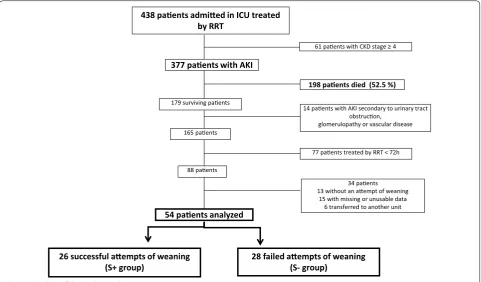
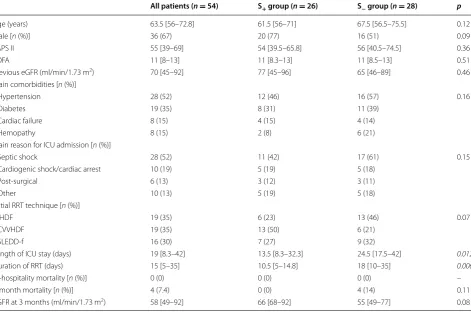
During the study period, 377 consecutive patients were admitted in ICUs with AKI treated by RRT in which 179 survived (survival rate 47.4 %). After exclusion of 125 patients, 54 were eligible for analysis: 18 females and 36 males (flowchart, Fig. 1). Patient’s characteristics, main comorbidities and reasons of ICU admission are summa-rized in Table 1. The RRT modalities were equally repre-sented in the study population. At DO, non-renal SOFA score has decreased reaching a median value of 3, and more than half of population was still on mechanical ven-tilation (Table 2). Median duration of RRT prior to the first attempt of weaning was 11 days.
Factors related to the success of weaning of RRT
Among the 54 patients, 26 attempts of weaning suc-ceeded (S+ group) while 28 failed (S− group). Baseline
characteristics of the two groups were comparable (Table 1). The proportion of CVVHDF was more impor-tant in S+ group (50 vs 21 %) and conversely for IHDF, but differences were not statistically significant (p = 0.07). At the day of RRT cessation, the proportion of patients mechanically ventilated was similar between groups as were non-renal SOFA score and prior duration of RRT. Clinical parameters including mean arterial pressure, dose of vasopressors, mechanical ventilation and fluid balance did not differ between the two groups. However, a higher weight decrease was observed in the success group but without significant differences (Table 2).
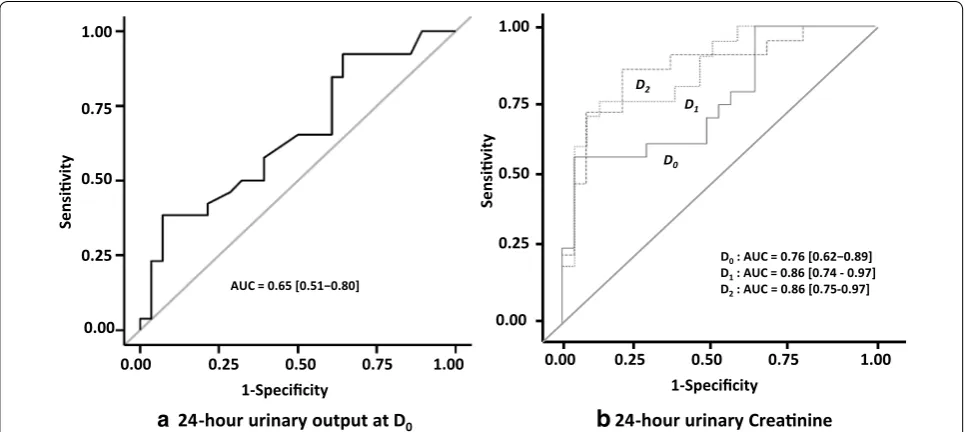
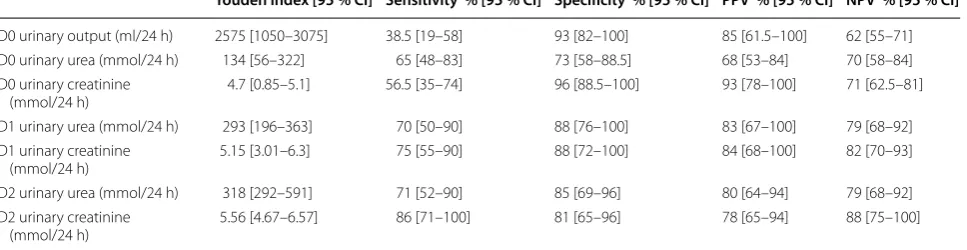
At D0, D1 and D2 urea and creatinine blood levels did not differ between the two groups (Table 3). At D0, 24-h urine output tended to be higher in S+ group (2300 vs 1950 ml, p = 0.052) but most of patients were treated by diuretics in both groups (73 vs 86 %). Diuretic response index was significantly higher in the S+ group at D0 with a significant decrease in furosemide dose the following two days as compared to S− (Table 3). UrCl, CrCl, UUr and UCr levels were significantly higher in group S+ at D0, D1 and D2. UUr/UrGR and UCr/CrGR ratios were also significantly higher in S+ group (Table 3). By multi-variate analysis, 24-h UCr was the most powerful vari-able to predict the success of RRT weaning. At D0, its area under the ROC curve (AUC and 95 % CI) was 0.76 [0.62–0.89] as compared to that of 24-h urine output: 0.66 [0.51–0.80] (Fig. 2). AUC of 24-h urinary creatinine was 0.86 [0.75–0.97] and 0.86 [0.75–0.97] at D1 and D2, respectively (Fig. 2). D1 24-h creatininuria was a strong predictor of successful weaning with an odds ratio at 2.01 [1.27–3.18], p = 0.003, independently of age, weight and diuresis and showed Se, Sp, NPV and PPV at 75, 88, 82 and 84 %, respectively, when ≥5.2 mmol/24 h [3.1–6.3] (Table 4).
Patients’ outcome
A significantly shorter ICU length of stay (13.5 vs 24.5 days) and a shorter duration of RRT (10.5 vs 18 days) were observed in the S+ group (Table 1). Patients from the S− group had resumed RRT 4 (3–11) days after the attempt of weaning. Twenty-one of the 28 patients of this group were weaned of RRT after a second attempt, whereas 7 needed more than two attempts (only one patient was re-dialyzed after the seventh day). Hospital survival was at 100 % in both groups, but 3 months later, 4 patients deceased in the S− group and none in the S+ group.
Discussion
24-h urine output to predict RRT weaning was signifi-cantly altered by the use of diuretics. In contrast, 24-h urinary creatinine appeared as a powerful marker of suc-cessful discontinuation of RRT even if patients received diuretics.
A large majority of ICU patients with AKI may recover sufficient kidney function to be independent of RRT. Indeed, all surviving patients we investigated herein recovered and were weaned from RRT even if several weaning attempts were necessary in some of them. Cur-rently, practices of RRT weaning during AKI depend on every center policy and vary from a “wait and see” and a “go fast” attitudes. The “wait and see” attitude may pro-long needlessly RRT and expose the patient to its haz-ardous effects without any benefits. Conversely a “go fast” attitude may lead to several unsuccessful attempts of weaning with the subsequent requirement of re-insti-tution that is by itself harmful. Appropriate cessation of RRT is obviously critical regarding clinical and eco-nomic outcomes. There is, however, a paucity of data about how and when to stop RRT in critically ill patients with AKI, and identification of predictive factors of suc-cessful cessation of RRT is scarce. This lack of evidence contrasts with the field of mechanical ventilation, where many studies dealing with the process of weaning have been conducted [30]. We sought therefore to evaluate, in
the present study, whether cessation of RRT can be early determined on the basis of clinical and routinely used parameters.
Previous studies have reported the association of the success of an interruption of RRT with age [23], previ-ous renal function [24, 25], the prior length of RRT, the SOFA score at ICU admission [23, 26] and its decrease from admission to the day of attempt [23]. None of these parameters have been found determinant in the suc-cess of weaning in our study. Blood parameters includ-ing serum urea and creatinine and their kinetic were also helpless to guide the weaning of RRT in our population. Urine output was reported to be the most important predictor of successful discontinuation of RRT. In the trial by Bouman et al. [31], continuous RRT was discon-tinued when the urine output returned to and was sta-ble at more than 60 ml/h, but there were no data about the optimal rate of urine output predicting the success of weaning. Wu et al. [23] evaluated retrospectively 94 patients weaned from IHDF for 5 or more days, of which 64 were free from RRT for ≥30 days. 24-h diuresis was at 1435 ± 1172 versus 598 ± 700 ml in the success and the re-dialysis groups, respectively, but diuretics were used in 36 % of patients of both groups. Oliguria (100 ml in 8 h) was independently associated with re-initiation of RRT [23]. The BEST Kidney investigators [24] found that urine 438 paents admied in ICU treated
by RRT
28 failed aempts of weaning (S- group)
377 paents with AKI
61 paents with CKD stage ≥ 4
179 surviving paents
198 paents died (52.5 %)
165 paents
14 paents with AKI secondary to urinary tract obstrucon,
glomerulopathy or vascular disease
88 paents
77 paents treated by RRT < 72h
34 paents 13 without an aempt of weaning
15 with missing or unusable data 6 transferred to another unit
26 successful aempts of weaning (S+ group)
54 paents analyzed
output of >400 ml/day without diuretics had the best operative characteristics with a Se, Sp, PPV and NPV of 0.47, 0.81, 0.81 and 0.77, respectively. However, diuretics administration negatively affected its predictive ability. They concluded that patients with more than 400 ml/day of urine without diuretics or more than 2300 ml/day with
diuretics have more than 80 % of chance to successful dis-continuation of RRT. Recently, an urine output >8.5 ml/ kg/24 h was also found to predict IHDF weaning [32]. In our study, at the day of attempt, 24-h urine output failed to predict the success of weaning (2300 vs 1900 ml/24 h, p = 0.052) but a high proportion of our patients, more Table 1 Patients characteristics, comorbidities, causes of ICU admission, RRT modalities at initiation of therapy and out-come according to the success or failure of RRT weaning attempt
Italic values indicate significance of p value (p <0.05)
Results are displayed in median [interquartile range] if quantitative variable; and number and percentage if categorial variable p: differences between S+ and S− groups
SAPS II Simplified Acute Physiology Score, SOFA Sequential Organ Failure Assessment, eGFR estimated glomerular filtration rate, IHDF intermittent hemodiafiltration, CVVHDF continuous venovenous hemodiafiltration, SLEDD-f sustained low-efficiency daily dialysis-filtration, RRT renal replacement therapy
All patients (n = 54) S+ group (n = 26) S− group (n = 28) p
Age (years) 63.5 [56–72.8] 61.5 [56–71] 67.5 [56.5–75.5] 0.12
Male [n (%)] 36 (67) 20 (77) 16 (51) 0.09
SAPS II 55 [39–69] 54 [39.5–65.8] 56 [40.5–74.5] 0.36
SOFA 11 [8–13] 11 [8.3–13] 11 [8.5–13] 0.51
Previous eGFR (ml/min/1.73 m2) 70 [45–92] 77 [45–96] 65 [46–89] 0.46
Main comorbidities [n (%)]
Hypertension 28 (52) 12 (46) 16 (57) 0.16
Diabetes 19 (35) 8 (31) 11 (39)
Cardiac failure 8 (15) 4 (15) 4 (14)
Hemopathy 8 (15) 2 (8) 6 (21)
Main reason for ICU admission [n (%)]
Septic shock 28 (52) 11 (42) 17 (61) 0.15
Cardiogenic shock/cardiac arrest 10 (19) 5 (19) 5 (18)
Post-surgical 6 (13) 3 (12) 3 (11)
Other 10 (13) 5 (19) 5 (18)
Initial RRT technique [n (%)]
IHDF 19 (35) 6 (23) 13 (46) 0.07
CVVHDF 19 (35) 13 (50) 6 (21)
SLEDD-f 16 (30) 7 (27) 9 (32)
Length of ICU stay (days) 19 [8.3–42] 13.5 [8.3–32.3] 24.5 [17.5–42] 0.012
Duration of RRT (days) 15 [5–35] 10.5 [5–14.8] 18 [10–35] 0.006
In-hospitality mortality [n (%)] 0 (0) 0 (0) 0 (0) –
3-month mortality [n (%)] 4 (7.4) 0 (0) 4 (14) 0.11
eGFR at 3 months (ml/min/1.73 m2) 58 [49–92] 66 [68–92] 55 [49–77] 0.08
Table 2 Characteristics of the 54 analyzed patients at the first day (D0) of weaning of RRT
Weight’s variation means between admission and D0 p: differences between S+ and S− groups
SOFA Sequential Organ Failure Assessment
All patients (n = 54) S+ group (n = 26) S− group (n = 28) p
Non-renal SOFA 3 [1–6] 3 [1–5] 3.5 [1–7] 0.21
Mean arterial pressure (mmHg) 83 [77–93] 85 [77–93] 83 [76–94] 0.33
Mechanical ventilation [n (%)] 30 (56 %) 15 (57.7 %) 15 (53.6 %) 0.42
Weight’s variation (kg) −2.5 [− 9.3; −2.3] −6 [− 11; +1.5] −1.5 [− 4.9; +4] 0.12
than 75 %, received furosemide. We observed, however, that furosemide induced a significantly higher diuresis in the success group. Indeed, recent studies reported a
significantly higher urine output in case of successful discontinuation of RRT even if diuretics were used [25, 26]. Nevertheless, the usefulness of diuresis to guide RRT Table 3 Serum urea, serum creatinine, 24-h urine output, diuretics, urea and creatinine clearance, 24-h urinary urea and creatinine, urea and creatinine generation rate, urinary urea/urea generation rate and urinary creatinine/creatinine generation rate ratios at the day (D0) of attempt of weaning and the following two days (D1, D2)
Italic values indicate significance of p value (p <0.05)
Results are displayed in median [interquartile range] if quantitative variable; and number and percentage if categorial variable p: differences between S+ and S− groups
S urea serum urea, S creat serum creatinine, Furo furosemide, Diuretic RI diuretic response index, Cl clearance, UUr urinary urea, UCr urinary creatinine, UrGR urea generation rate, CrGR creatinine generation rate, Ur urea, Cr creatinine
D0 D1 D2
S+ S− p S+ S− p S+ S− p
S urea (mmol/l) 10 [7.6–13] 7.3 [6.2–12] 0.56 16 [12–24] 17 [14–21] 0.26 22 [15–37] 24 [20–27] 0.54
S creat (µmol/l) 105 [73–170] 83 [64–117] 0.36 177 [136–294] 158 [115–197] 0.15 227 [137–309] 218 [155–314] 0.65 24-h urinary output
(l) 2.3 [1.5–3.5] 1.9 [1.0–2.5] 0.05 2.4 [1.8–3.7] 2.6 [1.7–3.3] 0.46 2.7 [2.1–3.4] 2.5 [1.7–3.3] 0.32
Use of furo [n (%)] 19 (73) 24 (86) 0.42 15 (59) 25 (89) 0.009 9 (35) 21 (75) 0.005
Dose of furo
(mg/24 h) 470 [215–1000] 1000 [483–1000] 0.06 500 [125–970] 1000 [500–1000] 0.01 500 [250–1000] 1000 [500–1000] 0.01 Diuretic RI (ml/mg) 6 [2.9–15.4] 2.1 [1.1–6.4] 0.02 4.6 [3.6–26.4] 3.2 [1.9–4.3] 0.06 5.8 [2.5–8.2] 3.4 [2.6–5.8] 0.09
UrCl (ml/min) 15 [8–20] 6 [4–12] 0.008 12.5 [8–20] 7 [5–9] 0.001 13 [9–18] 6 [4–8] <0.001
CrCl (ml/min) 31 [15–41] 18 [7–26] 0.009 31 [18–40] 15 [8–21] 0.002 31 [16–42] 13 [6–21] <0.001
UUr (mmol/24 h) 187 [72–339] 85.9 [44–157] 0.031 357 [195–569] 147 [95–224] 0.002 592 [230–672] 236 [113–272] 0.002 UCr (mmol/24 h) 4.9 [2.5–6.4] 2.55 [0.7–3.9] 0.002 6.65 [5–8.8] 3.5 [1.6–4.4] <0.001 8.1 [6–9.5] 4.4 [2.2–5.2] <0.001
UrGR (µmol/min) 530 [331–722] 318 [254–442] 0.02 428 [257–681] 305 [232–393] 0.08
CrGR (µmol/min) 6.8 [5.8–9.9] 4.1 [2.9–5.2] <0.001 6.2 [4.8–7.8] 4 [3.4–4.9] 0.002
UUr/UrGR (%) 51 [36–61] 36 [24–48] 0.03 71 [62–84] 48 [31–60] <0.001
UCr/CrGR (%) 72 [53–85] 57 [40–67] 0.047 94 [77–100] 67 [44–82] <0.001
1-Specificity
0.00 0.25 0.50 0.75 1.00
D0: AUC = 0.76 [0.62−0.89] D1: AUC = 0.86 [0.74 - 0.97] D2: AUC = 0.86 [0.75-0.97] D0
D1
D2
AUC = 0.65 [0.51−0.80]
Sensivity
0.00 0.25 0.50 0.75 1.00
1-Specificity
0.00 0.25 0.50 0.75 1.00
Sensivity
0.00 0.25 0.50 0.75 1.00
24-hour urinary output at D0
a
b
24-hour urinary Creanineweaning is clearly reduced since diuretics often may be necessary to correct or avoid a fluid overload [33]. We sought then to determine predictive factors that would be independent of diuretics like urinary creatinine and urea. Urea and creatinine collected in urine during 24-h were significantly higher at the day of attempt of RRT weaning and the following 2 days (with a gradual increase) in the success group. By multivariate analysis, 24-h creatininuria was the most powerful predictor of success of weaning. A level ≥5.2 mmol/24 h had a Sp, Se, NPV and PPV of 75, 88, 82 and 84 %, respectively. Dif-ferences of creatinine urinary level observed between the two groups should not be related to muscle mass, as they were independent of patient’s age and weight. Also, these differences may not be explained by differences of urea or creatinine generation rate since ratios of urinary levels to generation rates were significantly higher in the success group. Of note, clearance of creatinine (and urea) was significantly higher in the S+ group, as reported by Fröh-lich et al. [25]. In a recent study, Aniort and colleagues [32] sought also to identify predictive factors of intermit-tent hemodialysis weaning by investigating retrospec-tively 67 AKI patients. They found that daily urinary urea was the best weaning marker with an optimal threshold >1.35 mmol/kg/24 h (AUC 0.96, 95 % CI 0.93–0.99) as compared to 24-h urine output. In the contrary of our findings, they did not observe any differences in urinary creatinine between weaned and unweaned patients. However, almost 1/3 of their patients (22/67) have a base-line GFR < 30 ml/mn and expectedly 26/67 patients did not recovered renal function. Our population included exclusively patients with a baseline GFR ≥ 60 ml/mn explaining, at least for a part, these discordant results.
RRT modalities (continuous or intermittent) may affect renal recovery and dialysis dependence, but their effects remain a matter of debate. A systematic review of the lit-erature including mainly observational studies concluded
that patients who received intermittent RRT had a signif-icant increased risk of dialysis dependency as compared to those who received continuous RRT [34]. We observed indeed a higher proportion of continuous therapies with a higher weight decrease in the success group. However, differences were not significant and our RRT strategy was based on hemodynamic precluding any conclusions from our study. It is noteworthy that two recent studies failed to demonstrate any impact of RRT modalities on renal recovery [35, 36].
Patients who require RRT for AKI have a mortality exceeding 60 %, but most patients that recover func-tion enough to be free from RRT survive to hospital dis-charge [37]. In the study of BEST Kidney investigators [24], patients whose CRRT was successfully stopped had better outcome than those who needed to be re-treated (mortality: 28.5 vs 42.7 %, p = <0.0001, respectively). In our study, the patients who were weaned from RRT after a second or more attempt had a significantly higher length of RRT and of ICU stay as compared to patients successfully weaned. Moreover, we observed that 4/28 patients of the failed group deceased 3 months later and none in the success group. Whether failure of discontinu-ation of RRT is just a marker of severity of disease or is harmful by itself remains questioned [38].
This study has several limitations. First, it was a retro-spective and bi-center cohort study. Second, the wean-ing of RRT was not based on standardized criteria but decided by the attending physician who obviously fol-lowed general rules. Third, daily urinary creatinine requires 24-h urine collection, a procedure routinely performed with accuracy in ICUs. The measurement of urinary creatinine in a shorter time period or as spot urine concentration would be more easily feasible but may induce less accuracy. Nevertheless, the use of uri-nary creatinine as a marker of RRT cessation should be internally and externally validated to be used in routine Table 4 Performances of 24-h urine output, 24-h urinary creatinine and urea to predict the success of an attempt of renal replacement therapy weaning
PPV positive predictive value, NPV negative predictive value, CI confidence interval
Youden index [95 % CI] Sensitivity % [95 % CI] Specificity % [95 % CI] PPV % [95 % CI] NPV % [95 % CI]
D0 urinary output (ml/24 h) 2575 [1050–3075] 38.5 [19–58] 93 [82–100] 85 [61.5–100] 62 [55–71]
D0 urinary urea (mmol/24 h) 134 [56–322] 65 [48–83] 73 [58–88.5] 68 [53–84] 70 [58–84]
D0 urinary creatinine
(mmol/24 h) 4.7 [0.85–5.1] 56.5 [35–74] 96 [88.5–100] 93 [78–100] 71 [62.5–81]
D1 urinary urea (mmol/24 h) 293 [196–363] 70 [50–90] 88 [76–100] 83 [67–100] 79 [68–92]
D1 urinary creatinine
(mmol/24 h) 5.15 [3.01–6.3] 75 [55–90] 88 [72–100] 84 [68–100] 82 [70–93]
D2 urinary urea (mmol/24 h) 318 [292–591] 71 [52–90] 85 [69–96] 80 [64–94] 79 [68–92]
D2 urinary creatinine
practice. Last, we defined the attempt of weaning as a discontinuation of RRT during 72 h and estimated a suc-cess if discontinuation lasted more than 15 days. Vari-ous definitions have been used including an interruption of RRT during at least 5 days [23], but we thought that this duration may be too short regarding the severity of our patients. Also, considering RRT weaned after 7 days of interruption, as chosen by others [24, 25] has revealed insufficient. In the BEST Kidney cohort, for example, 15 patients considered as RRT-free were re-treated by CRRT before discharged from the ICU [24]. Indeed, Wu et al. [23] observed that an average of 10.1 ± 6.1 days lasted before re-dialysis if the attempt of weaning RRT failed.
Conclusions
In summary, the usefulness of 24-h urine output to pre-dict the success of RRT weaning in AKI patients treated by diuretics may be significantly altered. Our study showed that 24-h urinary creatinine, in spite of diuretic use, is an independent and performing predictive fac-tor of successful RRT weaning. A 24-h urinary creati-nine ≥5.2 mmol indicates that RRT will be successfully stopped in 84 % of cases. Larger and prospective stud-ies are needed to confirm our observations and to test a strategy of RRT weaning based on urine output, urinary creatinine and urea, and severity scores.
Abbreviations
AKI: acute kidney injury; AUC: area under the curve; CI: confidence interval; CrCl: creatinine clearance; CrGR: creatinine generation rate; CVVHDF: continu-ous venovencontinu-ous hemodiafiltration; D0, D1, D2: day of renal replacement therapy weaning attempt and the following 2 days; eGFR: estimated glomeru-lar filtration rate; ICU: intensive care unit; IHDF: intermittent hemodiafiltration; NPV: negative predictive value; OR: odds ratio; PPV: positive predictive value; ROC: receiver operating characteristic; RRT: renal replacement therapy; SAPS: Simplified Acute Physiology Score; Se: sensitivity; SLEDD-f: sustained low-efficiency daily dialysis-filtration; SOFA: Sequential Organ Failure Assessment; Sp: specificity; UCr: 24-h diuresis urinary creatinine; UrCl: urea clearance; UrGR: urea generation rate; UUr: 24-h diuresis urinary urea.
Authors’ contributions
NV, VB and KK designed the study; NK did the statistical analysis; NV, VB and KK interpreted the data and wrote the manuscript; and NK, DD, NB, LP, AB, RL and OJ contributed to interpretation of data. All authors read and approved the final manuscript.
Author details
1 Department of Intensive Care Medicine, Lapeyronie University Hospital, 371, Avenue du Doyen G. Giraud, 34295 Montpellier, France. 2 Department of Bio-chemistry, Lapeyronie University Hospital, Montpellier, France. 3 PhyMedExp, INSERM U1046, CNRS UMR 9214, University of Montpellier, Montpellier, France.
Acknowledgements
None.
Competing interests
The authors declare that they have no competing interests.
Received: 25 April 2016 Accepted: 11 July 2016
References
1. Uchino S, Kellum JA, Bellomo R, Doig GS, Morimatsu H, Morgera S, Schetz M, Tan I, Bouman C, Macedo E, Gibney N, Tolwani A, Ronco C. Acute renal failure in critically ill patients: a multinational, multicenter study. JAMA. 2005;294:813–8.
2. Hoste EA, Schurgers M. Epidemiology of acute kidney injury: how big is the problem? Crit Care Med. 2008;36(Suppl 4):146–51.
3. Metnitz PG, Krenn CG, Steltzer H, Lang T, Ploder J, Lenz K, Le Gall JR, Druml W. Effect of acute renal failure requiring renal replacement therapy on outcome in critically ill patients. Crit Care Med. 2002;30:2051–8. 4. Andrikos E, Tseke P, Balafa O, Cruz DN, Tsinta A, Androulaki M, Pappas
M, Ronco C. Epidemiology of acute renal failure in ICUs: a multi-center prospective study. Blood Purif. 2009;28:239–44.
5. Mehta RL, Pascual MT, Soroko S, Savage BR, Himmelfarb J, Ikizler TA, Paganini EP, Chertow GM. Spectrum of acute renal failure in the intensive care unit: the PICARD experience. Kidney Int. 2004;66:1613–21. 6. Ympa YP, Sakr Y, Reinhart K, Vincent JL. Has mortality from acute renal
failure decreased? A systematic review of the literature. Am J Med. 2005;118:827–32.
7. Coca SG. Long-term outcomes of acute kidney injury. Curr Opin Nephrol Hypertens. 2010;19:266–72.
8. Lafrance JP, Miller DR. Acute kidney injury associates with increased long-term mortality. J Am Soc Nephrol. 2010;21:345–52.
9. Goldberg R, Dennen P. Long-term outcomes of acute kidney injury. Adv Chronic Kidney Dis. 2008;15:297–307.
10. Wald R, Quinn RR, Luo J, Li P, Scales DC, Mamdani MM, Ray JG. Chronic dialysis and death among survivors of acute kidney injury requiring dialysis. JAMA. 2009;302:1179–85.
11. Bagshaw SM, Mortis G, Godinez-Luna T, Doig CJ, Laupland KB. Renal recovery after severe acute renal failure. Int J Artif Organs. 2006;29:1023–30.
12. Uchino S, Bellomo R, Kellum JA, Morimatsu H, Morgera S, Schetz MR, Tan I, Bouman C, Macedo E, Gibney N, Tolwani A, Oudemans-Van Straaten HM, Ronco C. Patient and kidney survival by dialysis modality in critically ill patients with acute kidney injury. Int J Artif Organs. 2007;30:281–92. 13. Van Berendoncks AM, Elseviers MM, Lins RL. Outcome of acute kidney injury with different treatment options: long-term follow-up. Clin J Am Soc Nephrol. 2010;5:1755–62.
14. Delannoy B, Floccard B, Thiolliere F, Kaaki M, Badet M, Rosselli S, Ber CE, Saez A, Flandreau G, Guérin C. Six-month outcome in acute kidney injury requiring renal replacement therapy in the ICU: a multicentre prospective study. Intensive Care Med. 2009;35:1907–15.
15. Palevsky PM, Baldwin I, Davenport A, Goldstein S, Paganini E. Renal replacement therapy and the kidney: minimizing the impact of renal replacement therapy on recovery of acute renal failure. Curr Opin Crit Care. 2005;11:548–54.
16. Elseviers MM, Lins RL, Van der Niepen P, Hoste E, Malbrain ML, Damas P, Devriendt J. Renal replacement therapy is an independent risk factor for mortality in critically ill patients with acute kidney injury. Crit Care. 2010;14:R221.
17. Clec’h C, Darmon M, Lautrette A, Chemouni F, Azoulay E, Schwebel C, Dumenil AS, Garrouste-Orgeas M, Goldgran-Toledano D, Cohen Y, Timsit JF. Efficacy of renal replacement therapy in critically ill patients: a propen-sity analysis. Crit Care. 2012;16:R236.
18. Bagshaw SM, Uchino S, Kellum JA, Morimatsu H, Morgera S, Schetz M, Tan I, Bouman C, Macedo E, Gibney N, Tolwani A, Oudemans-van Straaten HM, Ronco C, Bellomo R. Association between renal replacement therapy in critically ill patients with severe acute kidney injury and mortality. J Crit Care. 2013;28:1011–8.
19. Schiffl H. Renal recovery after severe acute renal injury. Eur J Med Res. 2008;13:552–6.
20. Solez K, Morel-Maroger L, Sraer JD. The morphology of “acute tubular necrosis” in man: analysis of 57 renal biopsies and a comparison with the glycerol model. Medicine (Baltimore). 1979;58:362–76.
21. Liu KD, Brakeman PR. Renal repair and recovery. Crit Care Med. 2008;36(Suppl 4):187–92.
22. Kidney Disease Improving Global Outcomes: Clinical practice guidelines for acute kidney injury. http://www.kdigo.org/clinical_practice_guide-lines/pdf/KDIGO%20AKI%20Guideline.pdf (2012). Accessed 14 April 2016. 23. Wu VC, Ko WJ, Chang HW, Chen YW, Lin YF, Shiao CC, Chen YM, Chen YS,
weaning from postoperative acute renal replacement therapy. Intensive Care Med. 2008;34:101–8.
24. Uchino S, Bellomo R, Morimatsu H, Morgera S, Schetz M, Tan I, Bouman C, Macedo E, Gibney N, Tolwani A, Straaten HO, Ronco C, Kellum JA. Discontinuation of continuous renal replacement therapy: a post hoc analysis of a prospective multicenter observational study. Crit Care Med. 2009;37:2576–82.
25. Fröhlich S, Donnelly A, Solymos O, Conlon N. Use of 2-hour creatinine clearance to guide cessation of continuous renal replacement therapy. J Crit Care. 2012;27:744.
26. Heise D, Gries D, Moerer O, Bleckmann A, Quintel M. Predicting restora-tion of kidney funcrestora-tion during CRRT-free intervals. J Cardiothorac Surg. 2012;7:6.
27. Klouche K, Amigues L, Serveaux-Delous M, Machado S, Delabre JP, Laydet E, Mauran P, Jonquet O, Canaud B. Implementing on-line hemodiafiltra-tion as a renal replacement therapy for ICU acute renal failure: a single-center report of feasibility, safety and hemodynamic tolerance over a seven-year period. Blood Purif. 2012;34:10–7.
28. VA/NIH Acute Renal Failure Trial Network, Palevsky PM, Zhang JH, O’Connor TZ, Chertow GM, Crowley ST, Choudhury D, Finkel K, Kellum JA, Paganini E, Schein RM, Smith MW, Swanson KM, Thompson BT, Vijayan A, Watnick S, Star RA, Peduzzi P. Intensity of renal support in critically ill patients with acute kidney injury. N Engl J Med. 2008;359:7–20. 29. Levey AS, Stevens LA, Schmid CH, Zhang YL, Castro AF III, Feldman HI,
Kusek JW, Eggers P, Van Lente F, Greene T, Coresh J. A new equation to estimate glomerular filtration rate. Ann Intern Med. 2009;150:604–12. 30. Esteban A, Frutos F, Tobin MJ, Alía I, Solsona JF, Valverdú I, Fernández
R, de la Cal MA, Benito S, Tomás R, Carriedo D, Macías S, Blanco J, for the Spanish Lung Failure Collaborative Group. A comparison of four methods of weaning patients from mechanical ventilation. N Engl J Med. 1995;332:345–50.
31. Bouman CS, Oudemans-Van Straaten HM, Tijssen JG, Zandstra DF, Kesecioglu J. Effects of early high-volume continuous venovenous hemofiltration on survival and recovery of renal function in intensive care patients with acute renal failure: a prospective, randomized trial. Crit Care Med. 2002;30:2205–11.
32. Aniort J, Ait Hssain A, Pereira B, Coupez E, Pioche PA, Leroy C, Heng AE, Souweine B, Lautrette A. Daily urinary urea excretion to guide intermit-tent hemodialysis weaning in critically ill patients. Crit Care. 2016;20:43. 33. Bouchard J, Soroko SB, Chertow GM, et al. Fluid accumulation, survival and recovery of kidney function in critically ill patients with acute kidney injury. Kidney Int. 2009;76:422–7.
34. Antoine G, Schneider AG, RinaldoBellomo R, Sean M, Bagshaw SM, Neil J, Glassford NJ, Lo S, Jun M, Cass A, Gallagher M. Choice of renal replace-ment therapy modality and dialysis dependence after acute kidney injury: a systematic review and meta-analysis. Intensive Care Med. 2013;39:987–97.
35. Truche AS, Darmon M, Bailly S, et al. Continuous renal replacement ther-apy versus intermittent hemodialysis in intensive care patients: impact on mortality and renal recovery. Intensive Care Med. 2016. doi:10.1007/ s00134-016-4404-6.
36. Liang KV, Sileanu FE, Clermont G, Murugan R, Pike F, Palevsky PM, Kellum JA. Modality of RRT and recovery of kidney function after AKI in patients surviving to hospital discharge. Clin J Am Soc Nephrol. 2016;11:30–8. 37. Uchino S. The epidemiology of acute renal failure in the world. Curr Opin
Crit Care. 2006;12:538–43.