O R I G I N A L A R T I C L E
Evaluation of two surfacing methods on black spruce wood
in relation to gluing performance
Svetka Kuljich•Julie Cool•Roger E. Herna´ndez
Received: 3 April 2012 / Accepted: 7 December 2012 / Published online: 22 December 2012
ÓThe Japan Wood Research Society 2012
Abstract Surface quality and gluing performance of black spruce samples prepared by peripheral straight-edge knife planing and sanding were studied. Four wavelengths (1.5, 1.9, 3.1, and 6.5 mm) and four rake angles (15°, 20°, 25°, and 30°) were tested for peripheral planing. Three feed speeds (4, 10.5, and 17 m/min) and three grit size sand-papers (80, 100, and 120) were studied for sanding. The resulting surfaces were glued with an isocyanate adhesive and tested to evaluate their gluing performance (shear strength and percent wood failure). Results revealed that planing with a rake angle of 20°and wavelengths of up to 3.1 mm produced wood surfaces with adequate glueline shear strength. Sanding with 80-grit sandpaper produced the best glueline shear strength, regardless of feed speed. After accelerated aging, the loss of gluing performance was lower for the sanded samples compared with that of planed samples. In general, sanding process produced better wood surfaces for bonding with the adhesive studied.
Keywords Peripheral planingSandingGluing performance IsocyanateBlack spruce wood
Introduction
In woodworking, planing and sanding operations are commonly used to obtain acceptable surfaces prior to adhesive application. One of the most important properties influencing further manufacturing processes such as coat-ing or glue application and their adhesion is surface roughness of solid wood. Previous works have reported better glue joint mechanical properties when surface roughness is increased in spruce wood [1], Japanese woods [2], red oak [3], and hard maple woods [4].
According to Koch [5], quality of peripheral-planed surfaces is generally improved by short wavelengths (or feed per knife) and low height of knife marks. This is generally accomplished by increasing the cutting circle diameter, number of jointed knives, or by reducing feed speed. Indeed, reduction in feed speed decreases the nor-mal cutting force [5,6] by reducing chip dimensions. Rake angle and jointing operation are also important factors influencing surface quality during planing process. For several species, better surface quality is observed as rake angle decreases from 30°to 15°[7–9], whereas the effect of jointing operation depends on wood species and knife wear [3, 10, 11]. On the other hand, Carrano et al. [6] reported an increase in surface quality when decreasing the depth of cut. However, Iskra and Herna´ndez [12] found that surface quality is not affected by depth of cut during routing paper birch wood with different grain orientations. Difference between these two studies could be related to the efficiency of feeding systems used for conducting the experiments (vibrational effects).
Quality of sanding depends on several parameters like wood species, interface pressure, type of abrasive mineral, sanding orientation, and grit size. For example, silicon carbide sandpaper yielded better surface quality than S. KuljichR. E. Herna´ndez (&)
De´partement des sciences du bois et de la foreˆt, Centre de recherche sur le bois, Pavillon Gene-H. Kruger, 2425, rue de la Terrasse, Universite´ Laval, Quebec, QC G1V 0A6, Canada e-mail: [email protected]
J. Cool
FPInnovations, 319, rue Franquet, Quebec, QC G1P 4R4, Canada
aluminum oxide sandpaper [13–15]. Furthermore, sanding parallel to the grain produced smoother surfaces than across to the grain [13]. In peripheral sanding, Carrano et al. [16] observed better surface quality with P220-grit compared with P150-grit sandpaper for white oak, sugar maple, and white pine woods. Significant effects of feed rate and spindle speed were also reported on surface roughness. Moreover, Sinn et al. [17] observed a strong linear positive correlation between roughness and grit size for spruce and beech woods.
Properties, such as surface roughness and wettability, and characteristics, which refer to the anatomic structure and how it is affected by machining, of planed and sanded surfaces differ largely. Microscopical surface analyses show that crushed or damaged cells are more common in abrasive-planed material than in knife-planed wood [18,
19]. More specifically, sanded wood is characterized by a layer of crushed cells at the surface and subsurface, lumens clogged by fine dust, scratches, and packets of micro-fibrils torn out from cell walls [20]. Generally, planed surfaces show less crushed and damaged cells compared to sanded surfaces [21]. However, lower roughness values in sanded surfaces of aspen [22] and paper birch [23] woods com-pared with that of planed surfaces were observed. According to Richter et al. [24] and Herna´ndez and Cool [23], sanding produces homogeneous surfaces that could reduce the influence of the anatomical structure on the roughness profile.
The species studied in this paper, black spruce, is one of the most important boreal species in Canada. The wood is widely used in construction applications such as lumber and glued structural members. However, little information is available on its machining properties. This species has been included in a general study on Canadian woods undertaken by Lihra and Ganev [25]. Based on the ASTM D1666 [26], cutting parameters for planing this wood were suggested when using a conventional peripheral planing process. Compared with other wood species, black spruce proved difficult to plane in a manner that produces defect-free surfaces. However, Cool and Herna´ndez [21, 27] recently showed that peripheral planing induced good surfaces for mechanical adhesion of poly (vinyl acetate) glue and an acrylic water-based coating. This study was oriented to use this wood for appearance purposes.
It is also of interest to optimize the machining param-eters for preparing the surfaces of this wood for the pro-duction of glued structural members. Therefore, the aim of the present work was to evaluate the effect of peripheral straight-edge knife planing and sanding processes applied on black spruce wood prior to isocyanate glue bonding. Four feed speeds and four rake angles for peripheral planing, and three feed speeds and three grit size sandpa-pers for sanding were studied. The gluing shear
performance was evaluated at constant hygrothermal con-ditions and after exposing specimens to an accelerated aging treatment.
Materials and methods
Testing materials
Tests were carried out with black spruce [Picea mariana (Mill) B.S.P.] wood, which came from Chibougamau region, in northern Quebec. A total of 250 kiln-dried boards of 38 mm964 mm were stored in a conditioning room at 20°C and 60 % relative humidity (RH) until they reached 12 % equilibrium moisture content (EMC). After conditioning, each board was crosscut into three matched sections of 660 mm (L) length. All sections were machined to 60 mm (T) width, and 21 mm (R) thickness. Boards were then separated into twenty-five groups, with each group to be submitted to a specific treatment. Mean density (mass divided by volume at 12 % EMC) and the variation coefficient of each group were 538 kg/m3 and 5.8 %, respectively. Each board underwent a surfacing treatment and was resectioned to prepare specimens for roughness [50 mm (L)] and gluing [two laminated blocks of 305 mm long (L) each].
Machining treatments
A peripheral straight-edge knife planing was used to sur-face the specimens. Previous cuts were carried out to level samples prior to each surfacing treatment. The planing treatment was done with a Weining Powermat 1000 moulder equipped with a cutterhead having 51 mm of cutting radius. The cutterhead rotation speed was kept at 4800 rpm with four different feed speeds, 7, 9, 15, and 31 m/min. The last two feed speeds are substantially faster than those of previous studies and consequently more comparable to the ones normally used by the industry of glued structural members. This produced wavelengths (or feed per knife) of 1.5, 1.9, 3.1, and 6.5 mm, respectively. Cutting depth was 2 mm and the rake angle was studied at four levels: 15°, 20°, 25°, and 30°. The clearance angle was kept constant at 20°for each rake angle.
The linear velocity of drums was kept constant at 20 m/min for all sanding programs. Oscillating blowers performed cooling and cleaning of the belt during sanding.
After surfacing, boards were glued with a resin formu-lation according to the technical recommendations supplied by the adhesive manufacturer. An ISOSET WD3-A322 emulsion resin combined with an ISOSET CX-47 cross-linker was used. This adhesive is part of the group of isocyanates, which is different to those used in previous studies. The adhesive was applied within a 3-h period after machining to ensure fresh and clean wood surfaces. Glue was applied on one face at a spread rate of 227.4 g/m2. The assembled boards were cured by a Wilkesboro NC radio frequency press, a method currently used in the industry. A uniform pressure of 1207 kPa was applied during 575 s (an initial pressure of 15 s followed by 20 s of radio frequency, and 540 s of final pressure). After curing, the laminated boards were stored in a conditioning room at 20°C and 60 % RH for 1 week before cutting the gluing shear test specimens.
Microscopic evaluation
Cubes of 10 mm were cut to observe tangential and end-grain surfaces. Tangential surfaces were used to evaluate fibrillation level and open lumens, whereas end-grain sur-faces were used to analyze cell damage. One end-grain surface was carefully cut with a razor blade mounted on a microtome. All cubes were desiccated with phosphorous pentoxide (P2O5) for 1 week and mounted onto standard aluminum stubs. Environmental scanning electron microscopy micrographs were taken for two representative machined samples for each machining condition.
Surface quality evaluation
Surface topography measurements were carried out on defect-free zones with a Micromeasure confocal micro-scope equipped with a 3-mm optical pen having a precision of 0.4lm. A representative surface of 1.2591.25 cm was analyzed per sample. Data was collected with the Surface Map 2.4.13 software using an acquisition frequency of 300 Hz and a scanning speed of 12.5 mm/s. The digitizing step was therefore 41.6lm. Three dimensional parameters were determined using Mountains software. Mean rough-ness (Sa), root-mean-square roughness (Sq), maximum height of peaks (Sp), maximum depth of valleys (Sv), and ten point height of surface (Sz) were calculated according to ISO 4287 [28]. The core roughness depth was calculated from the Abbot curve according to ISO 13565-2 [29]. A threshold was set to artificially truncate extreme values (at the top and/or bottom), which can be generated by a pro-filometer in optical triangulation. A cut-off length of
2.5 mm combined with a robust Gaussian filter based on ISO/DTS 16610-31 [30] were applied for calculations. Accelerated aging
Half of shear strength specimens underwent an accelerated aging treatment based on ASTM D 3434 [31]. The treat-ment consisted of 12 cycles of immersing samples in boiling water for 10 min, cooling for 4 min at 23°C and drying for 57 min at 107±2°C. After aging, the speci-mens were conditioned at 20°C and 60 % RH until they reached their initial EMC of 12 %. The other half of the specimens were kept unaged.
Glueline mechanical tests
The glueline strength of the accelerated aged and unaged specimens was evaluated according to ASTM D 905 [32]. An MTS RT50 universal testing machine having a maxi-mum capacity of 50 kN and 0.18 % precision fitted-out with a gluing shear fixture was used. Load was applied at a speed of 5 mm/min until separation of the substrates. Cross section of the specimen and load at failure were recorded, and the average gluing shear stress was calculated. The percent wood failure was estimated by image treatments using Photoshop CS4 software based on the method described in Cool and Herna´ndez [21]. Percent wood fail-ure gives information on bond formation: low percent values indicate that the bond is weaker than the wood, whereas high percent values are associated with a bond that is stronger than the wood [33]. The premise of measuring percent wood failure is that structural adhesives are gen-erally assumed to be stronger than the substrate. Therefore, failure plane in properly fabricated joints should be located in the wood and not in the glueline.
Statistical analysis
performed at 5 percent probability level when required. Simple correlation analysis was performed between surface quality parameters and shear strength and wood failure data. The normality of the data was verified using Shapiro– Wilk test.
Results and discussion
Microscopy End-grain surfaces
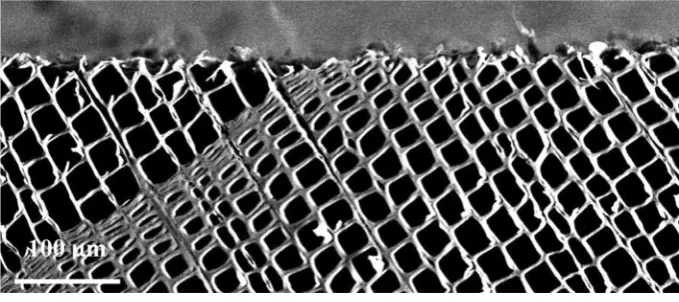
Peripheral planing treatments studied in this experiment induced little subsurface damage in black spruce wood surfaces. This damage was characterized by slight cell wall deformation in the first row of earlywood cells (not shown). The occurrence of permanent cell wall deformation was scarce and most samples were sound (Fig.1). Furthermore, few differences were observed among samples regardless of machining parameters. Previous research reported little impact of feed speed in anatomic features of planed black spruce wood samples [27]. As shown in Fig.1, cutting action in latewood often took place in or close to the middle lamella. In opposition, cutting knives appeared to have cut through earlywood cells. Similar results were reported previously by Cool and Herne´andez [27] for planed black spruce wood.
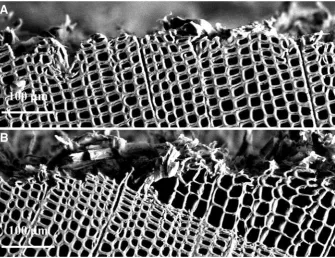
Sanding treatments induced a certain level of damage in black spruce wood surfaces (Fig.2). For all studied con-ditions, earlywood cells were more damaged than those of latewood. Because cutting forces involved in sanding are important, earlywood cells were crushed and deformed down a depth of about 50lm (Fig.2b). As reported by Cool and Herna´ndez [35], subsurface damage did not consist of a uniform layer of crushed or deformed cells and some earlywood cells appeared sound. On the other hand, latewood cells were only slightly deformed and most remained sound (Fig.2). Their thicker cell walls, in com-parison to those of the earlywood, offer a greater stiffness
and strength to the cutting action. However, micro-ruptures were induced in the middle lamella or through rays (Fig.2) and extended down the first 4–5 cells (*70lm). As mentioned by Cool and Herna´ndez [21], these micro-rup-tures could act as discontinuities during the moisturizing-drying cycles of weathering. Thus, they could contribute to release stresses produced in wood during weathering. Tangential surfaces
Planed surfaces were characterized by open lumens of trac-heids and rays, plateau-like areas, and fibrillation (Fig.3). The availability of lumens should favor glue filling and penetration as well as increase mechanical anchorage of glue (Fig.3) [21]. Fibrillation should also increase mechanical anchorage of glue by enhancing the actual surface available for adhesion. According to micrographs, little effect of feed speed could be observed, whereas the rake angle had a higher impact on the planed surfaces. At low rake angles, surfaces showed similar features to those reported previously when similar cutting parameters were used [27]. In contrast, as rake angle was increased, fibrillation was reduced but some micro-tearing appeared (Fig.3b). This tearing could be associated to type I chip formation, which is normally favored when using high rake angles or when planing occurs in presence of grain deviation.
Sanded surfaces were characterized by an important level of fibrillation (Fig.4). If not firmly attached to the surface, this fibrillation could reduce adhesion. However, adhesion could be increased by the level of fibrillation since it increases the actual surface available for mechan-ical anchorage. The abrasives also produced grooves in the surfaces that were visible at the microscopic level and should favor glue spreading in the longitudinal direction. Surface topography
PCA was performed to reduce the number of observed variables (surface quality parameters) to a smaller number of components. PCA mathematically produces several
Fig. 1 Transverse ESEM
linear combinations of observed variables where each lin-ear combination is a component. Variables that are corre-lated with another but largely independent of other subsets of variables are combined into components [36]. The number of components was estimated according to the Kaiser Criterion, which retains only components with an eigenvalue[1. Consequently, the surface parameters for each machining treatment were grouped into one principal component. For peripheral planing, the factor loadingsSa (0.99), Sq (0.98), Sp (0.97), Sv (0.93), Sz (0.92), and Sk (0.48) explained 80.2 % of the total variance. The principal component for sanding accounted for 94.3 % of the total variance and included Sa (0.99), Sq (0.99), Sp (0.99), Sv (0.94),Sz(0.94), andSk(0.96) as factor loadings.
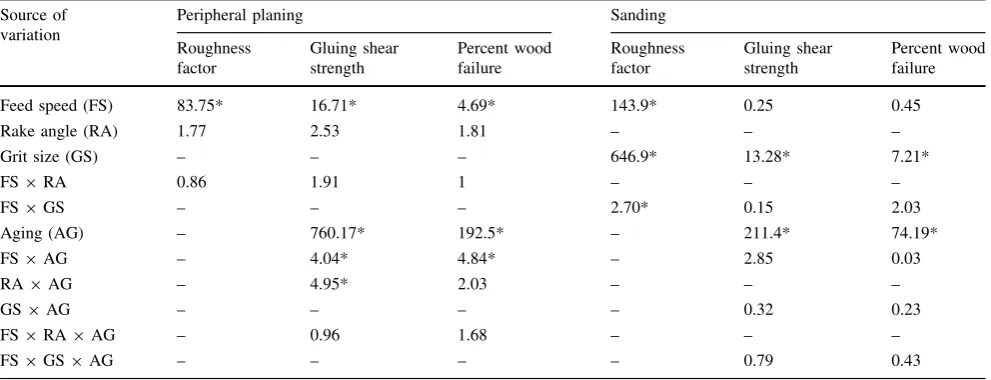
The variation in roughness produced by peripheral plan-ing was explained by one principal component, which was significantly affected by feed speed (Table1). Although little impact of feed speed was visible on micrographs, sur-face roughness increased with wavelength from 1.5 to 6.5 mm (7–31 m/min of feed speed). Table2shows that as feed speed decreased mean surface roughness (Sa), one of the surface quality parameters included in the PCA, decreased. Sadecreased 68 % when wavelength changed from 1.5 to 6.5 mm. Similar results were observed when helical planing black spruce wood from 1.1 to 2.0 mm of wavelength [37]. Shorter wavelengths are associated with lower peaks in machined surfaces. Thus, values of Sp (not shown) also showed this tendency. According to Carrano et al. [6] shorter wavelengths reduce surface damage. Furthermore, as machining conditions become more aggressive, the cutting forces increase, which can accelerates tool wear. As wear
progresses, the cutting tool will have more problems to generate clean and smooth surfaces. On the other hand, variation in rake angle did not affect surface roughness produced by peripheral planing. Cool and Herna´ndez [27] did not also find any difference in roughness between 15°and 20°rake angle when peripheral straight-edge knife planing black spruce wood prior to varnishing (at wavelengths lower than 1.3 mm). As mentioned earlier, rake angle had an effect on chip production at the microscopic level (Fig.3). A decrease in fibrillation combined with an increase in micro-tearing was observed when rake angle was increased. However, these observations were not confirmed by the roughness measurements probably because the reduction in fibrillation was compensated by the increase in micro-tear-ing. Another reason could be that the digitizing step used for roughness measurement (41.6lm) was not short enough to detect these features. Consequently, mean surface roughness did not change with the rake angle variation.
The variation in roughness due to sanding was also explained by one principal component. Thus, it represented adequately surface roughness of boards. A statistically significant double interaction was found between sanding program (or grit size) and feed speed (Table1). As grit size decreased from 80-grit to 120-grit, along with the decrease of feed speed from 17 to 4 m/min, surface roughness decreased (Table3). As expected, grit size had a significant impact on the smoothness of surface. Thus, sanding with lower grit size improves roughness of wood surfaces [15,
17]. Furthermore, lower feed speed means a longer dwelling time on the same spot during machining. This condition could remove some of the spring-back that
Fig. 2 Transverse ESEM
occurs in softwoods under high loads and contributes to improve wood surface quality. Consequently, the surface roughness decreases when machining with lower feed
speeds. Similar effects were reported by Carrano et al. [16]. The combined effect of the sanding program (or grit size) and feed speed is shown in Table4. Hence, a three-stage
Fig. 3 Tangential ESEM
micrograph of a black spruce wood sample planed with a rake angle of 15°and a wavelength of 1.5 mm (a) and a rake angle of 30°and a wavelength of 3.1 mm (b)
Fig. 4 Tangential ESEM
sanding program (80-100-120-grit size) combined with a feed speed of 4 m/min produced the best surface for sanded boards. In contrast, a single-stage sanding program (80-grit size) associated with a feed speed of 17 m/min increased surface roughness because it produced larger grooves on the surface.
The analysis of the topography showed that sanding with a three-stage program produced the best surface roughness (regardless of feed speed) compared with that of other sanding conditions and planed samples. These results are in agreement with Ritcher et al. [24], Herna´ndez and Cool [23], and Cool and Herna´ndez [21]. Sanding produces homogeneous surfaces and alters the cellular structure so that anatomical roughness is less distinguishable.
Glueline shear strength
For peripheral planing, the ANOVA showed that glueline shear strength and percent wood failure were affected by the interaction between feed speed and accelerated aging treatment. Table 4 shows that planing wood with
wavelengths up to 1.9 mm produced surfaces with the best glueline shear strength for the unaged samples. Equally, planing with wavelengths up to 3.1 mm generated wood surfaces with similar glueline shear strength for the aged samples. However, glueline shear strength was signifi-cantly reduced when planing at 6.5 of wavelength for both conditions (unaged and aged samples). It is therefore demonstrated that glueline shear strength decreased with increasing feed speed for the unaged and aged specimens. Moreover, percent wood failure increased slightly as feed speed increased, especially for aged specimens (Table4). During up-milling, as wavelength increases, direction of the resulting cutting forces will change from a pushing action to a pulling action [38]. This should increase surface roughness (as shown previously) and also produce more cellular damage, especially micro-ruptures formed between
Table 1 Fvalue obtained from the ANOVA for peripheral straight-edge knife planing and sanding
Source of variation
Peripheral planing Sanding
Roughness factor
Gluing shear strength
Percent wood failure
Roughness factor
Gluing shear strength
Percent wood failure
Feed speed (FS) 83.75* 16.71* 4.69* 143.9* 0.25 0.45
Rake angle (RA) 1.77 2.53 1.81 – – –
Grit size (GS) – – – 646.9* 13.28* 7.21*
FS9RA 0.86 1.91 1 – – –
FS9GS – – – 2.70* 0.15 2.03
Aging (AG) – 760.17* 192.5* – 211.4* 74.19*
FS9AG – 4.04* 4.84* – 2.85 0.03
RA9AG – 4.95* 2.03 – – –
GS9AG – – – – 0.32 0.23
FS9RA9AG – 0.96 1.68 – – –
FS9GS9AG – – – – 0.79 0.43
* Statistically significant at the 5 % probability level
Table 2 Mean surface roughness parameter (Sa) of black spruce
prepared by peripheral straight-edge knife planing at four feed speeds
Wavelength (mm) Feed speed (m/min) Sa(lm)
1.5 7 6.9a(0.1)bAc
1.9 10 7.3 (0.1)B
3.1 16 7.8 (0.1)C
6.5 33 11.6 (0.5)D
a Mean of 120 replicates (four rake angles pooled)
b Standard error of the mean in parentheses
c Means followed by the same letter are not significantly different at
5 % probability level
Table 3 Mean surface roughness parameter (Sa) of black spruce
prepared by sanding with three-stage programs and four three speeds
Sanding program Feed speed (m/min) Sa(lm)
80-grit 4 8.8a(0.2)bEc
10.5 10.8 (0.2)G
17 11.9 (0.2)H
80-100-grit 4 7.5 (0.1)D
10.5 8.9 (0.1)EF
17 9.3 (0.1)F
80-100-120-grit 4 5.4 (0.1)A
10.5 6.4 (0.1)B
17 6.8 (0.1)C
a Mean of 30 replicates
b Standard error of the mean in parentheses
c Means followed by the same letter are not significantly different at
and within cells. These micro-ruptures would develop deeper during the aging treatment, which could increase the percent wood failure.
Gluing shear strength was also significantly affected by the interaction between rake angle and aging treatment. However,Fvalues showed that the effect of rake angle on gluing shear strength was lower than that observed for feed speed variation (Table1). Mean values of glueline shear strength of surfaces prepared by peripheral planing using four rake angles are presented in Table5. For unaged samples, planing with a rake angle of 20°produced wood
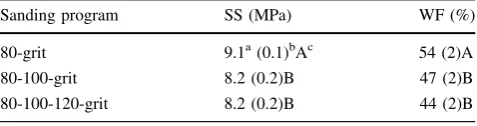
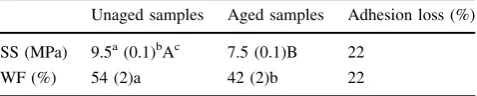
surfaces with better glueline shear strength compared with that of other rake angles. This rake angle should correspond to the production of type II chips, associated with high quality surface and low subsurface damage. In contrast, after aging there were no significant differences between shear strength means. Furthermore, glueline shear strength decreased as a result of the aging treatment underwent by the wood specimens (mean loss of 34 % in shear strength). For sanding experiments, the ANOVA (Table 1) showed simple statistically significant effects of grit size and aging treatment on glueline shear strength and percent wood failure. As grit size increased, shear strength and percent wood failure increased (Table6). The 80-grit sandpaper produced wood surfaces with a glueline shear strength and percent wood failure greater than the other two sanding programs tested (80-100- and 80-100-120-grit stages). Feed speed did not affect the glueline performance of the sanded boards.
It appears that finer roughness produced higher shear strength for planed specimens. In contrast, greater fibril-lation level corresponding to higher surface roughness seems to generate better glueline shear strength and higher percent wood failure for sanded specimens. However, the
Table 4 Mean glueline shear strength (SS) and percent wood failure (WF) of black spruce surfaces prepared by peripheral straight-edge planing
using four wavelengths for samples without and with an aging treatment
Wavelength (mm) Unaged samples Aged samples Adhesion loss
SS (MPa) WF (%) SS (MPa) WF (%) SS (%) WF (%)
1.5 9.5a(0.1)bAc 53 (2)b 6.2 (0.2)D 35 (2)d 35 34
1.9 9.4 (0.1)A 59 (2)ab 6.4 (0.2)D 35 (2)d 32 41
3.1 9.1 (0.2)B 60 (2)a 6.0 (0.2)D 39 (2)d 34 34
6.5 8.0 (0.2)C 58 (3)ab 5.2 (0.2)E 46 (2)c 35 21
a Mean of 120 replicates (four rake angles pooled)
b Standard error of the mean in parentheses
c Means followed by the same letter are not significantly different at 5 % probability level. Uppercase letters are for SS comparison; lowercase
letters are for WF comparison (in both cases for aged and unaged samples taken together)
Table 5 Mean glueline shear strength (SS) and percent wood failure (WF) of black spruce surfaces prepared by peripheral straight-edge planing
using four rake angles for samples without and with an aging treatment
Rake angle (°) Unaged samples Aged samples Adhesion loss
SS (MPa) WF (%) SS (MPa) WF (%) SS (%) WF (%)
15 8.8a(0.2)bBc 55 (2)a 5.8 (0.2)C 36 (2)b 34 35
20 9.4 (0.1)A 59 (2)a 6.0 (0.1)C 36 (2)b 36 39
25 9.1 (0.1)B 58 (2)a 5.9 (0.2)C 41 (2)b 35 29
30 9.0 (0.2)B 58 (3)a 6.4 (0.2)C 41 (2)b 28 29
a Mean of 120 replicates (four wavelengths pooled)
b Standard error of the mean in parentheses
c Means followed by the same letter are not significantly different at 5 % probability level. Uppercase letters are for SS comparison; lowercase
letters are for WF comparison (in both cases for aged and unaged samples taken together)
Table 6 Mean glueline shear strength (SS) and percent wood failure
(WF) of black spruce surfaces prepared by sanding with three grit size programs
Sanding program SS (MPa) WF (%)
80-grit 9.1a(0.1)bAc 54 (2)A
80-100-grit 8.2 (0.2)B 47 (2)B
80-100-120-grit 8.2 (0.2)B 44 (2)B
a Mean of 90 replicates (three feed speeds pooled)
b Standard error of the mean in parentheses
c Means within a column followed by the same letter are not
correlation analysis between the surface parameters and shear strength revealed some statistically significant but very low correlation coefficients. Similar results were reported by Cool and Herna´ndez [21]. According to Foll-rich et al. [1], tensile strength of joints increased with increasing surface roughness. Their finding was attributed to the enlarged surface and hence the enhanced bonding area facilitating mechanical interlocking between the adhesive and the wood surface. In contrast, lower rough-ness would decrease the mechanical anchorage of the surface. The molecules of the adhesive could also be too large to penetrate into the wood by the pits, which are generally aspired when kiln drying this wood species. As a consequence, glue penetration will be lower and glueline more affected during the aging treatment. Therefore, a certain level of roughness would be desirable to improve bonding of black spruce surfaces with the adhesive studied. Thus, a grit size of 80 was the most suitable for producing wood surfaces with adequate glueline performance when sanding black spruce. Similar results were reported by Shida and Hiziroglu [2] for four Japanese wood species.
As mentioned previously, glueline shear strength and percent wood failure values of each machining processes were affected by the aging treatment. For peripheral planing, these factors decreased about 34 and 33 % after aging, respectively (adhesion loss in Tables4, 5). For sanding, reduction in gluing performance due to weath-ering was lower (adhesion loss of 22 %, Table7). Moisture saturation and subsequent drying cycles may have pro-duced internal stresses related to swelling and shrinkage of wood. These stresses would reduce the gluing performance by breaking wood-glue bonds and by increasing the num-ber of micro-ruptures. Similar effects of aging treatments have been reported elsewhere [3,10,19,39].
Results revealed, for peripheral straight-edge knife plan-ing, that a rake angle of 20°and wavelength of up to 1.9 mm produced wood surfaces with adequate glueline shear strength for samples without an aging treatment. After aging, wavelength could be increased up to 3.1 mm at any of the
rake angles studied. For sanding, 80-grit sandpaper produced better glueline shear strength, regardless of feed speed. Weathering provoked a higher loss in adhesion for planed samples compared with those sanded. Therefore, sanding process seemed to produce better wood surfaces for bonding with the type of adhesive used (isocyanate).
Conclusions
Wood surfaces of black spruce obtained by sanding gave better gluing performance than those obtained by periph-eral straight-edge knife planing. This behavior was observed using an isocyanate adhesive and was more noticeable after an accelerated aging treatment. This result was unexpected as sanding is currently not used in the fabrication process of glued structural members. The level of fibrillation induced during sanding increases the actual surface available for mechanical anchorage. It was also demonstrated that using faster feed speeds, similar to those used in the industry, resulted in significant higher shear strengths. This demonstrates the relevance of reproducing industrial conditions in research. It was also shown that greater surface roughness produced better glueline shear strength, which was consistent with previous works.
Acknowledgments The authors wish to thank Denis Cossette from
Chantiers Chibougamau as well as Luc Germain and Daniel Bourgault for valuable assistance. This research was supported by the Value to Wood Program from the Natural Resources Canada, whose goal is to provide technological solutions to wood product manu-facturers in Canada through research and communication.
References
1. Follrich J, Vay O, Veigel S, Mu¨ller U (2010) Bond strength of end-grain joints and its dependence on surface roughness and adhesive spread. J Wood Sci 56:429–434
2. Shida S, Hiziroglu S (2010) Evaluation of shear strength of Japanese wood species as function of surface roughness. For Prod J 60:400–404
3. Herna´ndez RE, de Moura LF (2002) Effects of knife jointing and wear on the planed surface quality of northern red oak wood. Wood Fiber Sci 34:540–552
4. Ebewele RO, River BH, Koutsky JA (1980) Tapered double cantilever beam fracture tests of phenolic-wood adhesive joints. Part II. Effects of surface roughness, the nature of surface roughness, and surface aging on joint fracture energy. Wood Fiber 12:40–65
5. Koch P (1985) Utilization of hardwoods growing on southern pine sites, volume 2—processing. Agriculture Handbook. USDA For Serv For Prod Lab. Madison, WI
6. Carrano AL, Taylor JB, Lemaster R (2004) Machining-induced subsurface damage of wood. For Prod J 54:85–91
7. Herna´ndez RE, Bustos C, Fortin Y, Beaulieu J (2001) Wood machining properties of white spruce from plantation forests. For Prod J 51:82–88
Table 7 Mean glueline shear strength (SS) and percent wood failure
(WF) of black spruce surfaces prepared by sanding using three grit size programs and three feed speeds for samples without and with an aging treatment
Unaged samples Aged samples Adhesion loss (%)
SS (MPa) 9.5a(0.1)bAc 7.5 (0.1)B 22
WF (%) 54 (2)a 42 (2)b 22
a Mean of 270 replicates (three sanding programs and three feed
speeds pooled)
b Standard error of the mean in parentheses
c Means within a row followed by the same letter are not significantly
8. Herna´ndez RE, Constantineau S, Fortin Y (2011) Wood machining properties of poplar hybrid clones from different sites following various drying treatments. Wood Fiber Sci 43:394–411 9. Malkoc¸og˘lu A (2007) Machining properties and surface rough-ness of various wood species planed in different conditions. Build Environ 42:2562–2567
10. Herna´ndez RE, Naderi N (2001) Effect of knife jointing on the gluing properties of wood. Wood Fiber Sci 33:292–301 11. Herna´ndez RE, Rojas G (2002) Effects of knife jointing and wear
on the planed surface quality of sugar maple wood. Wood Fiber Sci 34:293–305
12. Iskra P, Herna´ndez RE (2009) The influence of cutting parame-ters on the surface quality of routed paper birch and surface roughness prediction modeling. Wood Fiber Sci 41:28–37 13. Taylor JB, Carrano AL, Lemaster RL (1999) Quantification of
process parameters in a wood sanding operation. For Prod J 49:41–46
14. Saloni DE, Lemaster RL, Jackson SD (2005) Abrasive machining process characterization on material removal rate, final surface texture, and power consumption for wood. For Prod J 55:35–41 15. de Moura LF, Herna´ndez RE (2006) Effects of abrasive mineral,
grit size and feed speed on the quality of sanded surfaces of sugar maple wood. Wood Sci Technol 40:517–530
16. Carrano AL, Taylor JB, Lemaster R (2002) Parametric charac-terization of peripheral sanding. For Prod J 52:44–50
17. Sinn G, Gindl M, Reiterer A, Stanzl-Tschegg S (2004) Changes in the surface properties of wood due to sanding. Holzforschung 58:246–251
18. Jokerst RW, Stewart HA (1976) Knife-versus abrasive-planed wood: quality of adhesive bonds. Wood Fiber 8:107–113 19. Caster D, Kutscha N, Leick G (1985) Gluability of sanded
lum-ber. For Prod J 35:45–52
20. de Meijer M, Thurich K, Militz H (1998) Comparative study on penetration characteristics of modern wood coatings. Wood Sci Technol 32:347–365
21. Cool J, Herna´ndez RE (2011) Evaluation of four surfacing methods on black spruce wood in relation to Poly(vinyl acetate) gluing performance. Wood Fiber Sci 43:194–205
22. Kilic M, Hiziroglu S, Burdurlu E (2006) Effect of machining on surface roughness of wood. Build Environ 41:1074–1078 23. Herna´ndez RE, Cool J (2008) Evaluation of three surfacing
methods on paper birch wood in relation to water- and solvent-borne coating performance. Wood Fiber Sci 40:459–469 24. Richter K, Feist WC, Knaebe MT (1995) The effect of surface
roughness on the performance of finishes. Part 1. Roughness characterization and stain performance. For Prod J 45:91–97
25. Lihra T, Ganev S (1999) Machining properties of eastern species and composite panels. Forintek Canada Corp., Project No. 2306, Quebec, Canada, p 62
26. ASTM D 1666 (2004) Standard methods for conducting machining tests of wood and wood base materials. American Society for Testing and Materials, Philadelphia
27. Cool J, Herna´ndez RE (2012) Characteristics of peripheral-planed black spruce wood surfaces in relation to water-borne coating performance. For Prod J 62:124–133
28. ISO 4287 (1997) Geometrical product specifications (GPS). Surface texture. Profile method. Terms. Definitions and surface texture parameters. International Standards Organization. British Standards Institute, London
29. ISO 13565-2 (1996) Geometrical product specifications (GPS). Surface texture. Profile method: surfaces having stratified func-tional properties. Part 2: height characterization using the linear material ratio curve. International Standards Organization. British Standards Institute, London
30. ISO/DTS 16610-31 (2007) Geometrical product specifications (GPS)—filtration. Part 31: robust profile filters. Gaussian regression filters. In draft. International Standards Organization 31. ASTM D 3434 (2000) Standard test method for multiple-cycle
accelerated aging test (automatic boil test) for exterior wet use wood adhesives. American Society for Testing and Materials, West Conshohocken, PA
32. ASTM D 905 (2003) Strength properties of adhesive bonds in shear by compression loading. American Society for Testing and Materials, Philadelphia
33. Marra AA (1992) Bond performance: testing and evaluation. In Technology of wood bonding principles in practice. Van No-strand Reinhold, New York, pp 377–410
34. SAS Institute (2007) SAS/Stat user’s guide, release 9.2 edn. SAS Institute Inc., Cary
35. Cool J, Herna´ndez RE (2011) Improving the sanding process of black spruce wood for surface quality and water-based coating adhesion. For Prod J 61(5):372–380
36. Tabachnick BG, Fidell LS (2007) Using multivariate statistics, 5th edn. Pearson, Allyn and Bacon, Boston, p 980
37. Cool J, Herna´ndez RE (2011) Performance of three alternative surfacing processes on black spruce wood and their effects on water-based coating adhesion. Wood Fiber Sci 43:365–378 38. Iskra P, Herna´ndez RE (2012) Analysis of cutting forces in
straight-knife peripheral cutting of wood. Wood Fiber Sci 44:134–144 39. Herna´ndez RE (1994) Effect of two wood surfacing methods on