Using Bark Char Codes to PrediCt Post-fire
CamBiUm mortality
Sharon M. Hood1*, Danny R. Cluck2, Sheri L. Smith2, and Kevin C. Ryan1
1USDA Forest Service, Rocky Mountain Research Station,
Fire Sciences Laboratory, 5775 Highway 10 W, Missoula, Montana 59808, USA
2USDA Forest Service, Forest Health Protection,
Region 5, 2550 Riverside Drive, Susanville, California 96130, USA
*Corresponding author: Tel.: (406) 329-4818; e-mail: [email protected]
aBstraCt
Cambium injury is an important factor in post-fire tree survival. Measurements that quantify the degree of bark charring on tree stems after fire are often used as surrogates for
direct cambium injury because they are relatively easy to assign and are non-destructive. However, bark char codes based on these measurements have been inadequately tested to determine how well they relate to live or dead cambium. Methods for assessing cambium injury through direct sampling have also been questioned as a potential factor
for increasing tree mortality. In this study we used data collected from 11 wildfires and 6 prescribed fires in California, Idaho, Montana, and Wyoming to develop a relationship
between bark char codes and cambium status for 14 coniferous species. Burned trees were assessed at groundline for bark char severity on each bole quadrant and then sampled at the center of each quadrant to determine cambium status (live or dead). We found that the moderate and deep bark char codes were strongly associated with dead cambium for thin-bark species: lodgepole pine (Pinus contorta), whitebark pine (P. albicaulis), western white pine (P. monticola), western redcedar (Thuja plicata), Engelmann spruce (Picea
engelmannii), western hemlock (Tsuga heterophylla), and subalpine fir (Abies lasiocarpa). However, bark char codes were somewhat inaccurate in predicting cambium status of the
thicker-bark species of white fir (Abies concolor), incense cedar (Calocedrus decurrens), ponderosa pine (Pinus ponderosa), Jeffrey pine (P. jeffreyi), Douglas-fir (Pseudotsuga menziesii), western larch (Larix occidentalis), and sugar pine (P. lambertiana). We also evaluated the effect of direct cambium sampling on ponderosa pine tree mortality in eastern Montana. Mortality rates were equivalent for eastern Montana ponderosa pines with and without cambium sampling. Our results support using bark char codes as surrogates for cambium sampling in tree species with thin bark, but bark char codes for
thick-bark species, especially the moderate char code, are often not accurate fire-injury
variables, as they do not correlate well with cambium status.
Keywords: bark char, basal injury, cambium, tree mortality
Citation: Hood, S.M., D.R. Cluck, S.L. Smith, and K.C. Ryan. 2008. Using bark char codes to
introdUCtion
A tree’s ability to survive after fire largely
depends on the level of injury sustained to the crown, bole, and roots (Ryan 1982, Filip
et al. 2007). The level of fire-caused crown
injury is relatively easy to determine by direct examination, while injuries to the bole and roots
are much more difficult to quantify without
destructive sampling (Ryan 1982). As a result, surrogate measures have been developed to
assess the degree of post-fire cambium injury
and, to a lesser extent, root injury. However, relationships between these easily-observed surrogates and actual injury remain speculative (Fowler and Sieg 2004).
A tree’s susceptibility to cambium injury
from heating is primarily influenced by
heat duration and bark thickness (Ryan and Frandsen 1991), and secondarily by tree species morphology, due to varying bark thermal properties (van Mantgem and Schwartz 2003). The rate of cambium death also varies by species and season (Dickinson and Johnson 2004). The time required to cause cambium death from heat is proportional to the square of bark thickness (Martin 1963, Reifsnyder et al. 1967, Peterson and Ryan 1986, Rego and Rigolot 1990).
Various methods have been developed to estimate cambium injury from heating because direct sampling is invasive and time consuming,
and because injury is difficult to predict from
models (see Fowler and Sieg 2004 for a review). Jones et al. (2004) recently developed a stem heating model to predict cambium
death from surface fires. However, the model
requires duration of the heat pulse as an input, which is usually unknown. In addition, this model is still in the testing and developmental stages for many tree species. Other methods include estimating the percentage of the tree bole that was charred (Peterson and Arbaugh 1986, Beverly and Martell 2003, Keyser et al.
2006, Sieg et al. 2006), assessing the degree
of charring around the tree bole (Ryan 1982,
Harrington and Hawksworth 1990, McHugh and Kolb 2003, Thies et al. 2006), and assessing height of stem bark char (Regelbrugge and Conard 1993). Others have directly sampled a portion of the cambium (Mann and Gunter 1960, Hare 1965, Ryan et al. 1988, Peterson and Arbaugh 1989, Ryan 1990, Ryan and Steele 1990, Finney 1999, Ryan and Amman 1996, Hood and Bentz 2007, Hood et al. 2007), but this method still does not measure the total amount of cambium injury.
Ryan (1982) first developed categories
(codes) of bark char severity to indicate stem
injury resulting from fire, but he cautioned that
these codes should only be used in conjunction with direct cambium sampling. However, these codes and others have since been used
as a surrogate for stem injury in post-fire tree
mortality models (Peterson and Arbaugh 1986, Peterson and Arbaugh 1989, Harrington and Hawksworth 1990, Regelbrugge and Conard 1993, Beverly and Martell 2003, Hély et al.
2003, McHugh and Kolb 2003, Kobziar et al.
2006, Sieg et al. 2006, Thies et al. 2006). While these studies reported that various measures of
bark char were statistically significant variables
for predicting delayed tree mortality, it is unknown how well bark char actually relates to cambium injury for many species (Fowler and Sieg 2004).
Few studies to date have tested the relationship between the Ryan (1982) codes and cambium status (Breece 2006, Hood and Bentz 2007, Hood et al. 2007). All reported an increase in cambium injury with increasing char severity, but noted that moderate charring is not clearly associated with either live or dead
cambium. Our study is the first to examine the
relationship of bark char to cambium injury for several species over a range of diameters at
breast height (dbh) and fire types.
Martell 2003, Thies et al. 2006). However, there is no empirical evidence that cambium sampling increases the probability of tree mortality. Van Mantgem and Stephenson (2004) found no difference in mortality between cored and uncored trees 12 years after they had been cored to determine age and growth rates. More injurious sampling of trees, however, may affect mortality rates. Heyerdahl and McKay (2001), for example, removed tree sections that averaged 8 % of the cross-sectional area and 7
cm thick to assess fire history and observed that
mortality among the sectioned trees was low (8
%), but significantly higher than mortality for
unsectioned trees.
In this study we used data collected from
multiple wild and prescribed fires in the western
US to: 1) assess the relationship between the Ryan (1982) bark char codes and cambium status (live/dead) for 14 conifer species over
a range of tree sizes and fire types (prescribed fire and wildfire) and 2) evaluate the effect of
direct cambium sampling on tree mortality
rate. Combining fires allowed for a rigorous
assessment of the validity of using bark char codes as a surrogate measure of cambium
injury after fire. Species tested were lodgepole
pine (Pinus contorta), whitebark pine (P.
albicaulis), western white pine (P. monticola), western redcedar (Thuja plicata), Engelmann spruce (Picea engelmannii), western hemlock (Tsuga heterophylla), subalpine fir (Abies lasiocarpa), white fir (A. concolor), incense cedar (Calocedrus decurrens), ponderosa pine (P. ponderosa), Jeffrey pine (P. jeffreyi),
Douglas-fir (Pseudotsuga menziesii), western larch (Larix occidentalis), and sugar pine (P.
lambertiana).
methods
Fire Descriptions
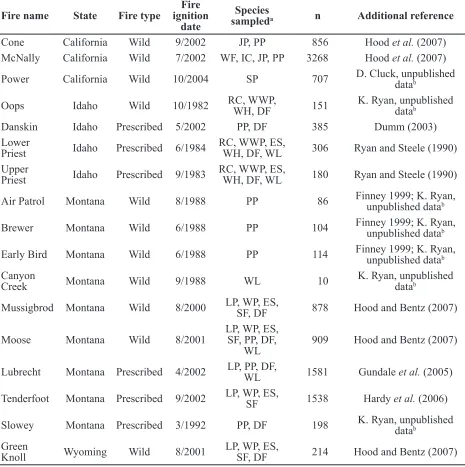
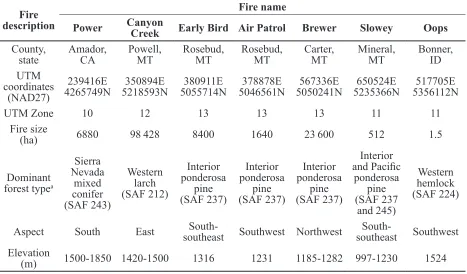
We collected fire-injury data from mixed-severity burned areas in 11 wildfires and 6
prescribed fires in California, Idaho, Montana, and Wyoming within one year of the fires (Table 1). All fires except the Power, Oops,
Canyon Creek, Slowey, Air Patrol, Brewer, and
Early Bird fires (Table 2) have been reported
elsewhere and will not be described here. The Power Fire began approximately 44 km east of Pioneer, California, in Amador County, and burned areas of private timberlands and the Eldorado National Forest, including a small portion of the Mokelumne Wilderness. It was
primarily a moderate surface fire with some
pockets of individual tree torching. Daytime temperatures at the nearby Beaver weather station were 24 ºC to 25 ºC with 10 hr fuel
moisture between 6 % to 8 %.
The Canyon Creek Fire was ignited by lightning in Montana near the end of an
unusually hot and dry fire season. The study
site was near the North Fork of the Blackfoot
River in an area burned by intense surface fire,
essentially consuming all duff and completely
scorching and killing Douglas-fir and lodgepole
pine in the stand. Daytime temperatures at the nearby Lincoln ranger station were 31 ºC to 34 ºC
with 10 hr fuel moisture between 3 % to 4 %. The Early Bird, Air Patrol, and Brewer Fires in eastern Montana were ignited by lightning.
Active surface fires burned the stands in the three
study areas. The Early Bird Fire was east of Lame Deer, Montana, on the Northern Cheyenne Indian Reservation. Daytime temperatures were around 38 ºC. The Air Patrol Fire was also on
the Northern Cheyenne Indian Reservation approximately 16 km southeast of Lame Deer, Montana. Daytime temperatures were 30 ºC to
36 ºC with fine fuel moisture between 3 % to 5
%. The Brewer Fire began in the Long Pines Range of the Custer National Forest between Ekalaka, Montana, and Camp Crook, South Dakota. Daytime temperatures were between 37 ºC to 44 ºC accompanied by single digit fine
fuel moisture.
habitat in ponderosa pine on the Lolo National Forest, 12 km northwest of Superior, Montana. A helicopter ignited the unit by using plastic spherical ignition devices. Conditions at the time of the burn were sunny, temperatures were 10 ºC to 18 ºC, relative humidity was 34 % to 50
%, and surface litter and upper duff moisture
contents were 14 % and 12 %, respectively. Lower duff and mineral soil were moist. The
resultant fire was an actively spreading surface fire with a light depth of burn (Ryan 2002).
The Oops Fire was a small wildfire that escaped from a nearby site preparation fire and
burned a mixed conifer forest on the Priest River Fire name State Fire type ignition Fire
date
Species
sampleda n Additional reference Cone California Wild 9/2002 JP, PP 856 Hood et al. (2007) McNally California Wild 7/2002 WF, IC, JP, PP 3268 Hood et al. (2007) Power California Wild 10/2004 SP 707 D. Cluck, unpublished datab
Oops Idaho Wild 10/1982 RC, WWP, WH, DF 151 K. Ryan, unpublished datab
Danskin Idaho Prescribed 5/2002 PP, DF 385 Dumm (2003)
Lower
Priest Idaho Prescribed 6/1984 RC, WWP, ES, WH, DF, WL 306 Ryan and Steele (1990) Upper
Priest Idaho Prescribed 9/1983 RC, WWP, ES, WH, DF, WL 180 Ryan and Steele (1990) Air Patrol Montana Wild 8/1988 PP 86 Finney 1999; K. Ryan, unpublished datab
Brewer Montana Wild 6/1988 PP 104 Finney 1999; K. Ryan, unpublished datab
Early Bird Montana Wild 6/1988 PP 114 Finney 1999; K. Ryan, unpublished datab Canyon
Creek Montana Wild 9/1988 WL 10 K. Ryan, unpublished datab Mussigbrod Montana Wild 8/2000 LP, WP, ES, SF, DF 878 Hood and Bentz (2007)
Moose Montana Wild 8/2001 LP, WP, ES, SF, PP, DF,
WL 909 Hood and Bentz (2007) Lubrecht Montana Prescribed 4/2002 LP, PP, DF, WL 1581 Gundale et al. (2005)
Tenderfoot Montana Prescribed 9/2002 LP, WP, ES, SF 1538 Hardy et al. (2006)
Slowey Montana Prescribed 3/1992 PP, DF 198 K. Ryan, unpublished datab Green
Knoll Wyoming Wild 8/2001 LP, WP, ES, SF, DF 214 Hood and Bentz (2007) Table 1. Trees sampled for each fire included in the data analysis. Additional fire information is described
in the noted references.
a Species: LP – lodgepole pine, WP – whitebark pine, WWP – western white pine, RC – western redcedar,
ES – Engelmann spruce, WH – western hemlock, SF – subalpine fir, WF – white fir, IC – incense cedar, JP – Jeffrey pine, PP – ponderosa pine, DF – Douglas-fir, WL – western larch, SP – sugar pine.
Experimental Forest in the Selkirk Mountains on the Idaho Panhandle National Forest, Idaho. The site was a mixed conifer forest dominated by western hemlock, with a heavy coarse woody debris component of rust-killed western
white pine. The fire burned around 1.5 ha at night in mid-October 1983. No significant rain
had fallen for a month, and fuels were very dry
for that time of year. The fire consumed all of
the duff and resulted in extensive basal injury.
The burn was classified as an active surface, moderate depth of burn fire (Ryan 2002).
Field Sampling
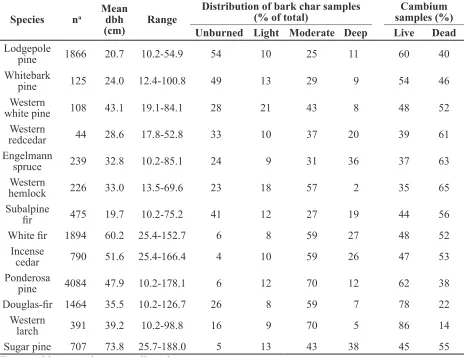
We sampled randomly selected trees to
represent a wide range of fire injuries and
diameters (Table 3). We selected sample locations that burned under mixed-severity
conditions, with either no plans for post-fire
salvage or where only dead trees (i.e., no green needles) would be cut. Trees sampled
from non-California fires were clustered into
randomly chosen plots. For the California
fires, individual fire-injured trees were selected over a range of fire severity levels in an attempt to fill a matrix of injury levels, size classes, and
species. At each tree, we measured dbh at 1.4 m above the ground on the uphill side of the tree and recorded tree species. No distinction was made between ponderosa pine and Jeffrey pine for the McNally and Cone Fires due to similar morphological characteristics, so we will only refer to ponderosa pine hereafter. We visually divided the base of each tree into quadrants and assessed bark char and cambium condition in
each quadrant. Quadrants for most fires were
oriented with the slope, one quadrant being on the uphill side, one on the downhill side, and
two on the cross-slope. In flat areas and in California fire sites, quadrants were oriented
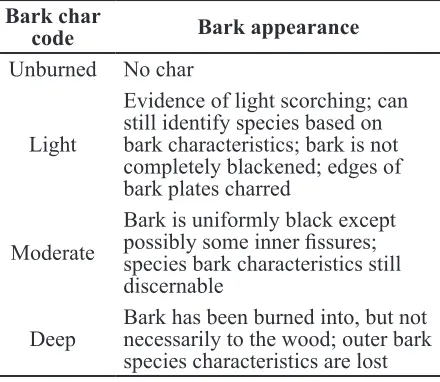
in the cardinal directions. We assigned each quadrant as unburned, light, moderate, or deep bark char (Ryan 1982) (see Table 4 for descriptions) based on its average level of charring near the groundline (non-California Fire
description
Fire name
Power Canyon Creek Early Bird Air Patrol Brewer Slowey Oops County,
state Amador, CA Powell, MT Rosebud, MT Rosebud, MT Carter, MT Mineral, MT Bonner, ID UTM
coordinates (NAD27)
239416E
4265749N 5218593N350894E 5055714N380911E 5046561N378878E 5050241N567336E 5235366N650524E 5356112N517705E
UTM Zone 10 12 13 13 13 11 11
Fire size
(ha) 6880 98 428 8400 1640 23 600 512 1.5
Dominant forest typea
Sierra Nevada
mixed conifer (SAF 243)
Western larch (SAF 212)
Interior ponderosa
pine (SAF 237)
Interior ponderosa
pine (SAF 237)
Interior ponderosa
pine (SAF 237)
Interior
and Pacific
ponderosa pine (SAF 237
and 245)
Western hemlock (SAF 224)
Aspect South East southeastSouth- Southwest Northwest southeastSouth- Southwest Elevation
(m) 1500-1850 1420-1500 1316 1231 1185-1282 997-1230 1524 a Eyre 1980
Table 2. General location and physical features of sampled trees in fires that have not been previously
fires) or within 0.3 m (1 ft) of groundline (California fires). In the center of each quadrant,
we directly sampled cambium at groundline by removing a small portion of the bark to reveal the cambium. We visually assessed each direct sample for cambium status as described in
Ryan (1982) for all fires except those in eastern
Montana. These samples were treated with a vital stain (Ryan 1982) to determine cambium status. Live cambium is light in color, moist, and pliable. Dead cambium is darker in color and either resinous or hardened (Ryan 1982).
Ponderosa pine trees from the Air Patrol, Brewer, and Early Bird Fires in eastern Montana
were part of a larger post-fire tree mortality
study. We randomly selected approximately
20 % of the study trees for direct sampling to determine cambium status (307 of 1748 trees) by removing a sample of cambium at groundline from each quadrant using an increment borer. We did not sample cambium on the other trees. We also assessed percent crown volume scorched for each tree. We revisited all trees in
this study annually for four years post-fire to
assess tree mortality.
Data Analysis
We used logistic regression to evaluate the relationship between direct measurement of cambium status and external bole char ratings for each species. This included all visually Species na Mean dbh
(cm) Range
Distribution of bark char samples
(% of total) samples (%)Cambium Unburned Light Moderate Deep Live Dead Lodgepole
pine 1866 20.7 10.2-54.9 54 10 25 11 60 40
Whitebark
pine 125 24.0 12.4-100.8 49 13 29 9 54 46
Western
white pine 108 43.1 19.1-84.1 28 21 43 8 48 52
Western
redcedar 44 28.6 17.8-52.8 33 10 37 20 39 61
Engelmann
spruce 239 32.8 10.2-85.1 24 9 31 36 37 63
Western
hemlock 226 33.0 13.5-69.6 23 18 57 2 35 65
Subalpine
fir 475 19.7 10.2-75.2 41 12 27 19 44 56
White fir 1894 60.2 25.4-152.7 6 8 59 27 48 52
Incense
cedar 790 51.6 25.4-166.4 4 10 59 26 47 53
Ponderosa
pine 4084 47.9 10.2-178.1 6 12 70 12 62 38
Douglas-fir 1464 35.5 10.2-126.7 26 8 59 7 78 22
Western
larch 391 39.2 10.2-98.8 16 9 70 5 86 14
Sugar pine 707 73.8 25.7-188.0 5 13 43 38 45 55
Table 3. Tree characteristics of species sampled in study and included in data analysis. Species are arranged in ascending order of bark thickness using bark thickness equations in FFE-FVS.
assessed and stained cambium samples. Because four samples were taken per tree, we used estimates from generalized estimating equations to account for within tree correlation (Liang and Zeger 1986). We only included trees that were alive at the time of initial assessment in the analysis because we assumed cambium was dead for dead trees. We included tree dbh in the model to evaluate whether the predictive accuracy of the bole char codes
varied with tree size. We evaluated fire type
(wild or prescribed) for model inclusion for
those species where sufficient data existed:
lodgepole pine, Engelmann spruce, subalpine
fir, ponderosa pine, and Douglas-fir. We
retained all variables with p-values <0.05 in
the full model. If dbh was significant in the
model, we developed a second model without dbh in order to compare the added value of using dbh to predict cambium status from bark char. We performed all analyses in SAS (PROC GENMOD, SAS Institute, v. 9.1) using the following model form:
where PDeadCambiumis the probability of dead
cambium, B0, B1, and Bk are regression
coefficients, and X1 and Xk are independent
variables (bark char code, dbh, and fire type).
All whitebark pine, western white pine, and western hemlock quadrants with deep bark char had dead cambium. Logistic regression models cannot converge when 100 % of categorical variable samples have the same response (Hosmer and Lemeshow 2000). Therefore, we did not include quadrants with deep char when developing the equations for whitebark pine, western white pine, and western hemlock.
All tables and figures list species in
ascending order of bark thickness based on the bark thickness equations in the Fire and Fuels Extension to the Forest Vegetation Simulator (FFE-FVS) (Reinhardt and Crookston 2003). In this model, western white pine and western redcedar have the same bark thickness, as do
ponderosa pine, Douglas-fir, and western larch.
We did not measure bark thickness directly because this variable would be impractical for managers to measure due to the time required.
Also, sampling occurred post-fire when a
portion of bark on many trees had burned
away and pre-fire bark thickness could not be
determined.
We tested differences in four-year
post-fire mortality, crown volume scorched (%),
and dbh between ponderosa pines with and without cambium sampling from the Air Patrol, Brewer, and Early Bird Fires using a general linear mixed model (Littell et al. 1996). We
included fire name and plot number within fire
as random effects.
resUlts
For all species, the percentage of quadrants with dead cambium increased with increasing bark char severity (Figure 1), and bark char
codes were significantly correlated with
cambium status (Table 5). Over 80 % of the quadrants with moderate and deep bark char had dead cambium for species with thinner bark: lodgepole pine, whitebark pine, western white pine, western redcedar, Engelmann
spruce, western hemlock, and subalpine fir
Bark char
code Bark appearance Unburned No char
Light
Evidence of light scorching; can still identify species based on bark characteristics; bark is not completely blackened; edges of bark plates charred
Moderate
Bark is uniformly black except
possibly some inner fissures;
species bark characteristics still discernable
Deep Bark has been burned into, but not necessarily to the wood; outer bark species characteristics are lost Table 4. Bark char codes and description of bark appearance (adapted from Ryan 1982).
))] ... ( exp( 1 /[
1 0 1 1 k k
m
DeadCambiu B B X B X
(Figure 1a-g). Even light bark char indicated dead cambium for the majority of these thin-barked species. In contrast, cambium was dead for only 17 % to 54 % of the samples with moderate charring on species with thicker
bark: white fir, incense cedar, ponderosa pine, Douglas-fir, western larch, and sugar pine
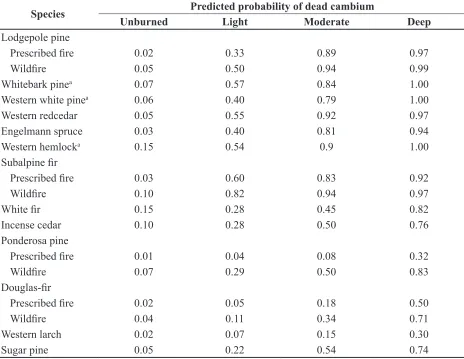
(Figure 1h-m). Except for western larch, deep char on thick-barked species usually indicated dead cambium as well. Regression models also predicted a high probability (>0.8) of dead cambium when quadrants had moderate or deep bark char for lodgepole pine, whitebark pine, western white pine, western redcedar, Engelmann spruce, western hemlock, and
subalpine fir—all species with relatively thin
bark (Table 6).
A small percentage of unburned quadrants had dead cambium for all species. These
quadrants either were dead before the fire,
or a small portion of the quadrant may have been charred and that was where the cambium
happened to be sampled, or we sampled uncharred bark directly adjacent to charred bark. The bark char codes were assigned based on the average level of charring in each quadrant and the cambium was only sampled at the center of each quadrant. Therefore, the codes did not always match where the cambium was sampled.
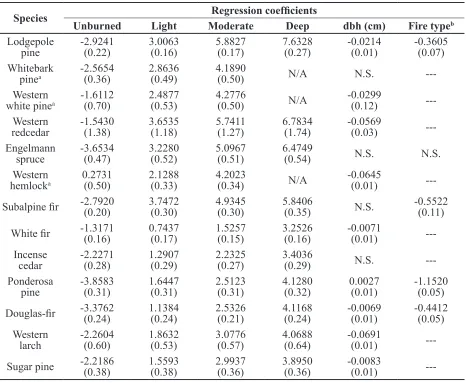
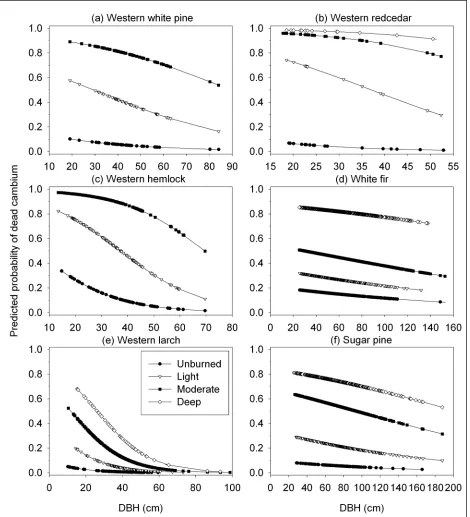
Diameter was a statistically significant
variable for predicting the probability of dead cambium for all species except whitebark pine,
Engelmann spruce, subalpine fir, and incense
cedar (Table 5). For species where dbh was
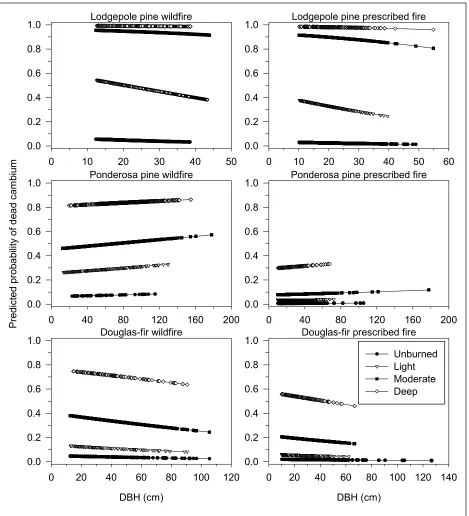
significant, the predicted probability of dead
cambium decreased as dbh increased except for ponderosa pine, where the relationship was reversed (Figures 2 and 3). The predicted probability of dead cambium changed less than 20 % across the range of diameters for all species except western white pine, western hemlock, and western larch. The decrease in the predicted probability of dead cambium
Western larch
unburned light moderate deep
Ponderosa pine
unburned light moderate deep
Whitebark pine Engelmann spruce
Western hemlock P e rc en t D ea d C am b ium S am p les 0 20 40 60 80 100
Subalpine Fir White fir Incense cedar
unburned light moderate deep
(a) (b) (c) (d) (e)
(f) (g) (h) (i) (j)
Lodgepole pine 0 20 40 60 80 100 Western redcedar Western white pine
Sugar pine
Bark Char Code
unburned light moderate deep
(m) (k)
Douglas-fir
unburned light moderate deep 0 20 40 60 80 100 (l)
was particularly sharp for western larch as dbh increased, with little difference between bark codes for trees greater than 55 cm dbh (Figure 2e).
Fire type (wild vs. prescribed) was
significant in predicting lodgepole pine, subalpine fir, ponderosa pine, and Douglas-fir dead cambium (Table 5). It was not significant
for Engelmann spruce. Predicted probability of dead cambium by bark char code was lower for
prescribed fires than wildfires (Table 6, Figure
3). The predicted probability of dead ponderosa
pine cambium from prescribed fires was low
for all char codes and tree sizes (Figure 3). There was no difference in the amount of ponderosa pine mortality four years
post-fire between trees with cambium sampling
and those that were not sampled for cambium injury (40 % trees died with cambium sampling compared to 39 % without cambium sampling, DF = 1746, P = 0.7667). The two groups did
not have significantly different crown scorch
Species Regression coefficients
Unburned Light Moderate Deep dbh (cm) Fire typeb Lodgepole
pine -2.9241 (0.22) 3.0063 (0.16) 5.8827 (0.17) 7.6328 (0.27) -0.0214 (0.01) -0.3605 (0.07) Whitebark
pinea -2.5654 (0.36) 2.8636 (0.49) 4.1890 (0.50) N/A N.S. ---Western
white pinea -1.6112 (0.70) 2.4877 (0.53) 4.2776 (0.50) N/A -0.0299 (0.12) ---Western
redcedar -1.5430 (1.38) 3.6535 (1.18) 5.7411 (1.27) 6.7834 (1.74) -0.0569 (0.03) ---Engelmann
spruce -3.6534 (0.47) 3.2280 (0.52) 5.0967 (0.51) 6.4749 (0.54) N.S. N.S. Western
hemlocka 0.2731 (0.50) 2.1288 (0.33) 4.2023 (0.34) N/A -0.0645 (0.01)
---Subalpine fir -2.7920 (0.20) 3.7472 (0.30) 4.9345 (0.30) 5.8406 (0.35) N.S. -0.5522 (0.11)
White fir -1.3171 (0.16) 0.7437 (0.17) 1.5257 (0.15) 3.2526 (0.16) -0.0071 (0.01)
---Incense
cedar -2.2271 (0.28) 1.2907 (0.29) 2.2325 (0.27) 3.4036 (0.29) N.S. ---Ponderosa
pine -3.8583 (0.31) 1.6447 (0.31) 2.5123 (0.31) 4.1280 (0.32) 0.0027 (0.01) -1.1520 (0.05)
Douglas-fir -3.3762 (0.24) 1.1384 (0.24) 2.5326 (0.21) 4.1168 (0.24) -0.0069 (0.01) -0.4412 (0.05)
Western
larch -2.2604 (0.60) 1.8632 (0.53) 3.0776 (0.57) 4.0688 (0.64) -0.0691 (0.01) ---Sugar pine -2.2186 (0.38) 1.5593 (0.38) 2.9937 (0.36) 3.8950 (0.36) -0.0083 (0.01) ---Table 5. Full regression model coefficients by species to predict probability of dead cambium from bark
char codes. Species are arranged in ascending order of bark thickness using bark thickness equations in
FFE-FVS. N.S. indicates regression coefficient is not significant; all other coefficients are significant
(p-value < 0.05). Empirical standard error estimates are in parentheses.
a N/A: not applicable. All deep bark char samples had dead cambium and therefore could not be included in the regression analysis.
b Class levels for fire type: prescribed fire = 1; wildfire = -1. Dash (---) indicates data were insufficient to
(54 % scorch for both groups, DF = 1743, P = 0.8078) or dbh (29.2 cm for cambium sampled trees and 28.2 cm for trees without cambium sampling, DF = 1743, P = 0.0646).
disCUssion
Many studies have found various measures
of bark char to significantly predict delayed tree mortality after fire (see Fowler and Sieg
2004). This study shows that bark char severity is related to cambium death. The probability of dead cambium increased with increasing bark char severity for all species tested, but moderate char was not clearly associated with either live or dead cambium for thicker-bark species
(Figure 1). Breece (2006) found an ambiguous relationship between Ryan’s (1982) bark char codes, actual cambium injury, and ponderosa pine tree mortality and reported that only 42 % of cambium samples with moderate char were dead. Breece et al. (2008) concluded that the
codes should not be used for post-fire ponderosa
pine mortality models. Moderate char was the most commonly assigned category for most of the species included in this study. Therefore, the use of moderate bark char as a surrogate for cambium status on thick-bark species could
lead to large errors when estimating post-fire
tree injury, thus limiting the utility of bark char codes.
Species Unburned Predicted probability of dead cambiumLight Moderate Deep Lodgepole pine
Prescribed fire 0.02 0.33 0.89 0.97
Wildfire 0.05 0.50 0.94 0.99
Whitebark pinea 0.07 0.57 0.84 1.00
Western white pinea 0.06 0.40 0.79 1.00
Western redcedar 0.05 0.55 0.92 0.97
Engelmann spruce 0.03 0.40 0.81 0.94
Western hemlocka 0.15 0.54 0.9 1.00
Subalpine fir
Prescribed fire 0.03 0.60 0.83 0.92
Wildfire 0.10 0.82 0.94 0.97
White fir 0.15 0.28 0.45 0.82
Incense cedar 0.10 0.28 0.50 0.76
Ponderosa pine
Prescribed fire 0.01 0.04 0.08 0.32
Wildfire 0.07 0.29 0.50 0.83
Douglas-fir
Prescribed fire 0.02 0.05 0.18 0.50
Wildfire 0.04 0.11 0.34 0.71
Western larch 0.02 0.07 0.15 0.30
Sugar pine 0.05 0.22 0.54 0.74
Table 6. Predicted probability of dead cambium by bark char code and fire type when dbh is excluded
from the model. Species are arranged in ascending order of bark thickness using bark thickness equations in FFE-FVS.
Figure 2. Predicted probability of dead cambium by bark char code for species where dbh is significant in
the model. All western white pine and western hemlock quadrants with deep bark char were dead and could
not be included in the regression analysis. Lodgepole pine, ponderosa pine, and Douglas-fir are shown in Figure 3 because fire type is significant in the model. Species are arranged in ascending order of bark
thickness using bark thickness equations in FFE-FVS.
Given the same dbh and bark char code,
wildfires resulted in higher rates of dead cambium compared to those in prescribed fires for lodgepole pine, subalpine fir, ponderosa
pine, and Douglas-fir. However, the actual differences in probabilities between wildfires and prescribed fires were only large for
Lodgepole pine wildfire
0 10 20 30 40 50 0.0
0.2 0.4 0.6 0.8
1.0 Lodgepole pine prescribed fire
0 10 20 30 40 50 60 0.0
0.2 0.4 0.6 0.8 1.0
Ponderosa pine wildfire
0 40 80 120 160 200
Pr
edic
ted
pr
oba
bility
o
f d
ea
d
cam
bium
0.0 0.2 0.4 0.6 0.8
1.0 Ponderosa pine prescribed fire
0 40 80 120 160 200 0.0
0.2 0.4 0.6 0.8 1.0
Douglas-fir wildfire
DBH (cm)
0 20 40 60 80 100 120 0.0
0.2 0.4 0.6 0.8
1.0 Douglas-fir prescribed fire
DBH (cm)
0 20 40 60 80 100 120 140 0.0
0.2 0.4 0.6 0.8 1.0
Unburned Light Moderate Deep
Figure 3. Predicted probability of dead cambium by bark char code and fire type for species where dbh and fire type are significant in the model. Species are arranged in ascending order of bark thickness using bark
thickness equations in FFE-FVS.
the higher proportions of dead cambium in
wildfires is likely due to higher levels of fuel
and duff consumption caused by burning under drier, more extreme weather conditions than
those of prescribed fires. In addition, because
1991). The Slowey, Danskin, and Lubrecht
Fires—the prescribed fires from which ponderosa pine data were collected—were early season, low intensity surface fires with
modest amounts of duff at the tree bases (K.C. Ryan and S.M. Hood, personal observation).
While the pre-wildfire duff depths are
unknown, differences in basal duff depths may be another reason why predicted probability of
dead cambium was lower for prescribed fires than wildfires. In contrast, Ryan and Frandsen
(1991) found that even in a relatively moist summer, extensive basal injury occurred in a late August prescribed burn which consumed deep duff mounds around large diameter, old ponderosa pine in Glacier National Park.
Prescribed fires in areas with deep, dry duff
mounds will likely result in cambium injury
similar to that observed in our wildfires. Although dbh was a significant explanatory
variable for cambium mortality in many species, predicted probability of dead cambium changed little across the range of diameters observed except for western hemlock and western larch. This suggests that, for management purposes, the
models that exclude dbh are probably sufficient
for all examined species except western larch and western hemlock (Table 6). Keyser et al.
(2006) reported that bark char measurements greatly improved prediction of ponderosa pine tree mortality for trees smaller than 40 cm dbh, but had a reduced value for predicting mortality of trees larger than 40 cm dbh. Bark thickness generally increases with increasing dbh for a given species. Therefore, equivalent bark char ratings on smaller diameter, and thus thinner-barked, trees should be associated with higher levels of cambium injury than in larger diameter, thicker-barked trees.
The ponderosa pines in our study were much larger than those in Keyser et al. (2006), and ponderosa pine was the only species in which predicted mortality of cambium increased as dbh increased. Ryan and Frandsen (1991) found a similar relationship for ponderosa pines
in a prescribed fire in northwestern Montana. Other studies have found higher post-fire
mortality rates for larger and smaller diameter trees than mid-diameter trees (McHugh and Kolb 2003, Hood et al. 2007) and attributed the relationship to higher levels of cambium injury resulting from consumption of deep duff mounds, which are common at the base of larger diameter trees. Complete consumption of deep duff at the bases of large diameter trees may be the reason for increased cambium injury in these large trees (Ryan and Frandsen 1991, Swezy and Agee 1991, Kaufmann and Covington 2001).
Sample size varied greatly between species
(Table 3), and it is difficult to control for
these differences (Rudy King, USDA Forest Service, personal communication). Models developed from small sample sizes may have less precision than those developed from larger samples, and it may only be possible to detect strong associations between the independent and dependent variables with small samples
(Whittemore 1981). The significant relationship
of bark char codes to cambium status indicate that it is a strong association for all species
tested here. The differences in significance for dbh and fire type among species may be
partially explained by the variation in sample sizes and indicate that these variables have a weaker association with cambium status than bark char codes.
ConClUsions
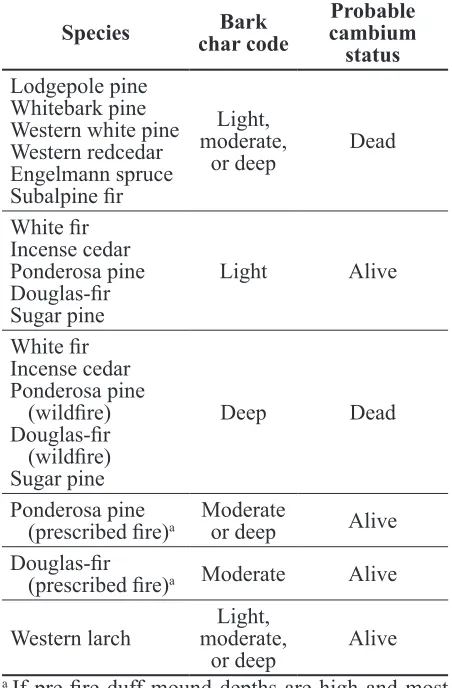
Bark char codes are a good indicator of cambium status for the thin-bark species included in this analysis and can be used to save sampling time for many species when
determining post-fire tree injury (Table 7).
However, moderate bark char was not strongly associated with dead cambium for thicker-bark
species. For these species (white fir, incense cedar, ponderosa pine, Douglas-fir, and sugar
determine injury when bark char is moderate. Western larch cambium is most likely alive regardless of the degree of bark charring.
It may be possible to improve the accuracy of predicting cambium status by initially comparing bark char codes to sampled cambium and developing an understanding of the association between bark char and the underlying cambium condition. Splitting the moderate char rating into two codes may also improve accuracy. Future research to test these ideas for improving the accuracy of bark char codes is needed.
Results from this study show that tree injury from direct sampling of the cambium using an increment borer does not contribute to additional
post-fire ponderosa pine tree mortality. We
expect a similar response from other tree species or from sampling with a hatchet due to similar wound response mechanisms among species and wound sizes (Shigo and Marx 1977). This research indicates that direct cambium sampling is a better variable than bark char codes for use
in post-fire tree injury assessments for species
with thick bark and that direct sampling can be performed without causing additional tree mortality.
Species char codeBark cambium Probable status Lodgepole pine
Whitebark pine Western white pine Western redcedar Engelmann spruce
Subalpine fir
Light, moderate,
or deep Dead
White fir
Incense cedar Ponderosa pine
Douglas-fir
Sugar pine
Light Alive
White fir
Incense cedar Ponderosa pine
(wildfire) Douglas-fir
(wildfire)
Sugar pine
Deep Dead
Ponderosa pine
(prescribed fire)a Moderate or deep Alive
Douglas-fir
(prescribed fire)a Moderate Alive
Western larch moderate, Light,
or deep Alive Table 7. Recommended management guidelines for using Ryan (1982) bark char codes as a surrogate for
direct cambium sampling after fire. Species/code
combinations not listed are not clearly associated with either live or dead cambium and should be sampled directly to determine injury.
a If pre-fire duff mound depths are high and most
of the duff is consumed in the fire, then the
probability of cambium mortality is higher.
aCknowledgements
literatUre Cited
Beverly, J.L., and D.L. Martell. 2003. Modeling Pinus strobus mortality following prescribed fire
in Quetico Provincial Park, northwestern Ontario. Canadian Journal of Forest Research 33: 740-751.
Breece, C.R. 2006. Effects of prescribed fire on bark beetle activity and tree mortality in
southwestern ponderosa pine forests. Thesis, Northern Arizona University, Flagstaff, USA.
Breece, C.R., T.E. Kolb, B.G. Dickson, J.D. McMillin, and K.M. Clancy. 2008. Prescribed fire
effects on bark beetle activity and tree mortality in southwestern ponderosa pine forests. Forest Ecology and Management 255: 119-128.
Dickinson, M.B., and E.A. Johnson. 2004. Temperature-dependent rate models of vascular cambium cell mortality. Canadian Journal of Forest Research 34: 546-559.
Dumm, G. 2003. Fire effects on fine roots and ectomycorrhizae of ponderosa pine and Douglas-fir following a prescribed burn in a central Idaho forest. Thesis, University of Idaho, Moscow,
USA.
Eyre, F.H. 1980. Forest cover types of the United States and Canada. Society of American Foresters, Washington DC, USA.
Filip, G.M., C.L. Schmitt, D.W. Scott, and S.A. Fitzgerald. 2007. Understanding and defining
mortality in western conifer forests. Western Journal of Applied Forestry 22: 105-115.
Finney, M. 1999. Fire-related mortality of ponderosa pine in eastern Montana. Unpublished
Report INT-93800-RJVA on file at USDA Forest Service, RMRS Fire Sciences Laboratory,
Missoula, Montana, USA.
Fowler, J.F., and C.H. Sieg. 2004. Postfire mortality of ponderosa pine and Douglas-fir: a review
of methods to predict tree death. USDA Forest Service General Technical Report RMRS-GTR-132.
Gundale, M.J., T.H. DeLuca, C.E. Fiedler, P.W. Ramsey, M.G. Harrington, and J.E. Gannon. 2005. Restoration treatments in a Montana ponderosa pine forest: effects on soil physical, chemical and biological properties. Forest Ecology and Management 213: 25-38.
Hardy, C., H.Y. Smith, and W. McCaughey. 2006. The use of silviculture and prescribed fire to manage stand structure and fuel profiles in a multi-aged lodgepole pine forest. Pages 451-464 in: P.L. Andrews, and B. Butler, editors. Fuels Management—How to Measure Success:
Conference Proceedings. USDA Forest Service Proceedings RMRS-P-41.
Hare, R.C. 1965. Chemical test for fire damage. Journal of Forestry 63: 939.
Harrington, M.G., and F.G. Hawksworth. 1990. Interactions of fire and dwarf mistletoe on
mortality of southwestern ponderosa pine. Pages 234-240 in: J. S. Krammes, editor. Effects
of fire management of southwestern natural resources: symposium proceedings. USDA Forest
Service General Technical Report RM-191.
Hély, C., M. Flannigan, and Y. Bergeron. 2003. Modeling tree mortality following wildfire in the
southeastern Canadian mixed-wood boreal forest. Forest Science 49: 566-576.
Heyerdahl, E., and S.J. McKay. 2001. Condition of live fire-scarred ponderosa pine trees six years
after removing partial cross sections. Tree-Ring Research 57: 131-139.
Hood, S.M., and B. Bentz. 2007. Predicting post-fire Douglas-fir beetle attacks and tree mortality
Hood, S.M., S.L. Smith, and D.R. Cluck. 2007. Delayed tree mortality following fire in northern California. Pages 261-283 in: R.F. Powers, editor. Restoring fire-adapted ecosystems:
Proceedings of the 2005 National Silviculture Workshop. USDA Forest Service General Technical Report PSW-GTR-203.
Hosmer, D.W., and S. Lemeshow. 2000. Applied logistic regression, 2nd edition. John Wiley and Sons, New York, New York, USA.
Jones, J.L., B.W. Webb, D.M. Jimenez, J. Reardon, and B. Butler. 2004. Development of an
advanced one-dimensional stem heating model for application in surface fires. Canadian
Journal of Forest Research 34: 20-30.
Kaufmann, G.A., and W.W. Covington. 2001. Effect of prescribed burning on mortality of presettlement ponderosa pines in Grand Canyon National Park. Pages 36-42 in: R.K. Vance, C.B. Edminster, W.W. Covington, and J.A. Blake, editors. Ponderosa pine ecosystems restoration and conservation: steps toward stewardship: conference proceedings. USDA Forest Service Proceedings RMRS-P-22.
Keyser, T.L., F.W. Smith, L.B. Lentile, and W.D. Shepperd. 2006. Modeling postfire mortality of ponderosa pine following a mixed-severity wildfire in the Black Hills: the role of tree morphology and direct fire effects. Forest Science 52: 530-539.
Kobziar, L., J.J. Moghaddas, and S. Stephens. 2006. Tree mortality patterns following prescribed
fire in a mixed conifer forest. Canadian Journal of Forest Research 36: 3222-3238.
Liang, K.Y., and S.L. Zeger. 1986. Longitudinal data analysis using generalized linear models. Biometrika 73: 13-22.
Littell, R.C., G.A. Milliken, W.W. Stroup, and R.D. Wolfinger. 1996. SAS system for mixed
models. SAS Institute, Cary, North Carolina, USA.
Mann, W.F., and E.R. Gunter. 1960. Predicting the fate of fire-damaged pines. Forests and People
10: 26-43.
Martin, R.E. 1963. Thermal properties of bark. Forest Products Journal 3: 419-426.
McHugh, C., and T.E. Kolb. 2003. Ponderosa pine mortality following fire in northern Arizona.
International Journal of Wildland Fire 12: 7-22.
Peterson, D.L., and M.J. Arbaugh. 1986. Postfire survival in Douglas-fir and lodgepole pine:
comparing the effects of crown and bole damage. Canadian Journal of Forest Research 19: 1175-1179.
Peterson, D.L., and M.J. Arbaugh. 1989. Estimating postfire survival of Douglas-fir in the Cascade
Range. Canadian Journal of Forest Research 19: 530-533.
Peterson, D.L., and K.C. Ryan. 1986. Modeling postfire conifer mortality for long-range planning.
Environmental Management. 10: 797-808.
Regelbrugge, J.C., and S.G. Conard. 1993. Modeling tree mortality following wildfire in Pinus ponderosa forests in the central Sierra Nevada of California. International Journal of Wildland Fire 3: 139-143.
Rego, F., and E. Rigolot. 1990. Heat transfer through bark—a simple predictive model. Pages
157-161 in: J.G. Goldammer, and M.J. Jenkins, editors. Fire in Ecosystem Dynamics. Proceedings Third International Symposium on Fire Ecology. May 16-20, 1989, Freiburg, Federal Republic of Germany.
Reinhardt, E., and N. Crookston. 2003. The fire and fuels extension to the forest vegetation
simulator. USDA Forest Service, Rocky Mountain Research Station General Technical Report RMRS-GTR-116.
Ryan, K.C. 1982. Techniques for assessing fire damage to trees. Pages 1-11 in: J. Lotan, editor. Proceedings of the symposium: fire, its field effects. Intermountain Fire Council.
Ryan, K.C. 1990. Predicting prescribed fire effects on trees in the interior West. Pages 148-162 in: M.E. Alexander and G.F. Bisgrove, editors. The art and science of fire management:
proceedings of the First Interior West Fire Council Annual Meeting and Workshop. Forestry Canada Northwest Region Northern Forestry Centre Information report (Northern Forestry Centre (Canada)) NOR-X-309.
Ryan, K.C. 2002. Dynamic interactions between forest structure and fire behavior in boreal
ecosystems. Silva Fennica 36: 13-39.
Ryan, K.C., and G.D. Amman. 1996. Bark beetle activity and delayed tree mortality in the Greater
Yellowstone Area following the 1988 fires. Pages 151-158 in: J. Greenlee, editor. The ecological implications of fire in Greater Yellowstone: proceedings of the second biennial conference on
the Greater Yellowstone Ecosystem. International Association of Wildland Fire.
Ryan, K.C., and W.H. Frandsen. 1991. Basal injury from smoldering fires in mature Pinus ponderosa Laws. International Journal of Wildland Fire 1: 107-118.
Ryan, K.C., D.L. Peterson, and E.D. Reinhardt. 1988. Modeling long-term fire-caused mortality of Douglas-fir. Forest Science. 34: 190-199.
Ryan, K.C., and B.M. Steele. 1990. Cambium mortality resulting from broadcast burning in mixed conifer shelterwoods. Pages 108-116 in: D.C. MacIver, H. Auld, and R. Whitewood, editors. Proceedings of the 10th Conference on Fire and Forest Meteorology. Forestry Canada.
Shigo, A.L., and H.G. Marx. 1977. CODIT (Compartmentalization of Decay In Trees). USDA Forest Service Bulletin No. 405.
Sieg, C.H., J.D. McMillin, J.F. Fowler, K.K. Allen, J.F. Negron, L.L. Wadleigh, J.A. Anhold,
and K.E. Gibson. 2006. Best predictors for postfire mortality of ponderosa pine trees in the
Intermountain West. Forest Science 52: 718-728.
Swezy, D.M., and J.K. Agee. 1991. Prescribed-fire effects on fine-root and tree mortality in
old-growth ponderosa pine. Canadian Journal of Forest Research 21: 626-634.
Thies, W.G., D.J. Westlind, M. Loewen, and G. Brenner. 2006. Prediction of delayed mortality of
fire-damaged ponderosa pine following prescribed fires in eastern Oregon, USA. International
Journal of Wildland Fire 15: 19-29.
van Mantgem, P., and M. Schwartz. 2003. Bark heat resistance of small trees in Californian mixed conifer forests: testing some model assumptions. Forest Ecology and Management 178: 341-352.
van Mantgem, P.J., and N.L. Stephenson. 2004. Does coring contribute to tree mortality? Canadian Journal of Forest Research 34: 2394-2398.