O R I G I N A L A R T I C L E
Open Access
Influence of Multi-Gene Allele
Combinations on Grain Size of Rice and
Development of a Regression Equation
Model to Predict Grain Parameters
Chan-Mi Lee, Jonghwa Park, Backki Kim, Jeonghwan Seo, Gileung Lee, Su Jang and Hee-Jong Koh
*Abstract
Background:Grain size is one of the key factors determining yield and quality in rice. A large number of genes are involved in the regulation of grain size parameters such as grain length and grain width. Different alleles of these genes have different impacts on the grain size traits under their control. However, the combined influence of multiple alleles of different genes on grain size remains to be investigated. Six key genes known to influence grain size were investigated in this study:GS3,GS5,GS6,GW2,qSW5/GW5, andGW8/OsSPL16.Allele and grain measurement data were used to develop a regression equation model that can be used for molecular breeding of rice with desired grain characteristics.
Results: A total of 215 diverse rice germplasms, which originated from or were developed in 28 rice-consuming countries, were used in this study. Genotyping analysis demonstrated that a relatively small number of allele combinations were preserved in the diverse population and that these allele combinations were significantly associated with differences in grain size. Furthermore, in several cases, variation at a single gene was sufficient to influence grain size, even when the alleles of other genes remained constant. The data were used to develop a regression equation model for prediction of rice grain size, and this was tested using data from a further 34 germplasms. The model was significantly correlated with three of the four grain size-related traits examined in this study.
Conclusion:Rice grain size is strongly influenced by specific combinations of alleles from six different genes. A regression equation model developed from allele and grain measurement data can be used in rice breeding programs for the development of new rice varieties with desired grain size and shape.
Keywords:Rice, Grain Size, Regression Equation Model, Allelic Combination
Background
Rice is one of the most important crops in the world alongside wheat and maize. The top five countries for rice production and consumption are China, India, Indonesia, Bangladesh, and Vietnam. According to a 2009 survey, the combined population of these coun-tries represented nearly half of the total world popula-tion (http://data.worldbank.org/). Numerous addipopula-tional
countries are also engaged in rice production and con-sumption, as well. This indicates the importance of rice as a staple food crop worldwide, and particularly in Asia. The world population continues to increase rap-idly and this increase has led to a growing demand for rice. Enhancement of grain yield as well as grain quality is therefore of key agricultural importance.
Rice yield potential is affected by at least four char-acteristics: panicles per unit area of land, number of spikelets per panicle, percentage of filled grains, and 1000-grain weight (KGW). Of these, KGW is a par-ticularly complex trait that is determined by a
* Correspondence:[email protected]
Department of Plant Science, Plant Genomics and Breeding Institute, Research Institute for Agriculture and Life Sciences, Seoul National University, Seoul 151-921, South Korea
combination of grain size-related traits such as grain length (GL), grain width (GW), and grain length to width ratio (LWR) (Tan et al. 2000). Grain size is a further quality trait used by the global market. Grain size preference varies depending on the geographical location. For instance, rice consumers in Thailand, Lao PDR, Cambodia, Malaysia, and the Philippines prefer long and slender grains, while those in Korea, Japan, Northern China and Taiwan prefer shorter and plumper grains (Calingacion et al. 2014). Grain size therefore influences the market available for any given crop (Redoña and Mackill 1998). A combination of different factors influence the grain size of rice. These include GL, GW, LWR, and grain thickness, all of which significantly correlate with grain weight (Tan et al. 2000). In summary, rice grain size and yield are closely related to one another and can be explained by a combination of grain size-related traits.
A large number of genes are associated with rice grain size, and many of their functional roles have been eluci-dated in a range of studies (Zuo and Li 2014). In most cases, Quantitative trait loci (QTLs) linked to grain size parameters, such as length and width, allowed genes in-volved in grain size regulation to be fine mapped and
characterized. For instance, GRAIN WIDTH and
WEIGHT2 (GW2) gene, which encodes a RING-type E3 ubiquitin ligase, was fine mapped from a major QTL re-sponsible for rice grain width and weight (Song et al. 2007). From two rice varieties showing contrast grain
width, Fengaizhan 1 (FAZ1; small-grain indica-type
variety) and Wuyujing 3 (WY3; large-grainjaponica-type
variety), two alleles of GW2 gene were distinguished by
a single nucleotide polymorphism (SNP) in exon 4. The SNP resulted in a premature translational termination of GW2 protein, and was thought to be responsible for the enhanced grain width and weight in WY3 compared to
FAZ1.GRAIN SIZE 3(GS3) gene, which encodes a
puta-tive transmembrane protein, was fine mapped from a major QTL responsible for grain length and weight (Fan et al. 2006). The functional role of GS3 has been sug-gested as a negative regulator to prevent the growth of
the grain size. Two alleles of GS3 gene, A and C, were
distinguished by a SNP in exon 2 (Takano-Kai et al. 2009). Similarly, this SNP also resulted in a premature translational termination of GS3 protein. It was reported that the allelic variation ofGS3gene was significantly as-sociated with the different grain length (Fan et al. 2009). In addition, an association study revealed that the
A-allele (C165A mutation) of GS3 gene was significantly
linked to enhanced rice grain length (Takano-Kai et al.
2009).GRAIN SIZE 5(GS5) gene, which encodes a
puta-tive serine carboxypeptidase, was fine mapped from a QTL responsible for grain size (Li et al. 2011). It was
also suggested that higher expression of GS5 was
significantly correlated with larger grain size. Three
al-leles of GS5 gene were distinguished by natural
varia-tions in the promoter region, and the rice varieties carrying these alleles also showed significant differences in grain width: H94- (narrow grain), Zhenshan97-(medium grain), and Zhonghua11-allele (wide grain). Therefore, these natural variations in the promoter re-gion were thought to be responsible for the different
grain width. qSW5/GW5 gene was fine mapped from a
major QTL responsible for grain width, QTL for rice
seed width on chromosome 5 (qSW5) (Shomura et al. 2008). Compared to the Kasalath (aus-type variety), the qSW5/GW5 gene region in Nipponbare (japonica-type variety) and in several indica-type varieties contained a large deletion and number of SNPs. Three alleles of qSW5/GW5 gene were distinguished by length of
dele-tion at theqSW5/GW5locus (Yan et al. 2011):
Kasalath-allele (no deletion), indica II-allele (950 bp deletion), and Nipponbare-allele (1,212 bp deletion). Analysis of variance (ANOVA) showed that germplasms carrying the Nipponbare-allele had wider grains than germplasms
with the other two alleles (Shomura et al. 2008).GRAIN
WIDTH 8/SQUAMOSA PROMOTER BINDING
PROTEIN-LIKE 16 (GW8/OsSPL16) gene, which en-codes a positive regulator of cell proliferation, was fine mapped from a major QTL responsible for grain width,
qGW8(Wang et al. 2012). It was also demonstrated that
higher expression of GW8/OsSPL16 resulted in
en-hanced rice grain width and yield due to promoted cell division and grain filling. In Basmati 385 (indica-type traditional Basmati variety), 10-bp deletion was found in the GW8/OsSPL16 promoter region compared to other twoindica-type varieties (HJX 74 and TN1), and named Basmati-allele. This deletion was thought to be respon-sible for the slender grain in Basmati 385 compared to
HJX 74. In addition, two alleles of GW8/OsSPL16 gene
were also distinguished by a SNP in exon 1: HJX 74-and TN1-alleles. Beside these, several genes involved in regulation of rice grain size were also identified by other
approaches. For instance,GRAIN SIZE 6(GS6) gene was
isolated from an ethylmethanesulfonate (EMS)-induced
mutant,gs6(Sun et al. 2013).GS6encodes a member of
GRAS family proteins, which plays an important role in reducing rice grain size. Three alleles of the GS6 gene, type I to III, were distinguished by nucleotide variants in the promoter region. Of these, the type I-allele is found
predominantly in japonica-type varieties, which have
wider and heavier grains than varieties with the other two alleles.
grain size when considering breeding for preferred grain shape and subsequently enhanced rice grain yield.
In this study, we examined allele combinations of above-mentioned six key genes that were previously shown to influence grain size. A total of 215 rice germ-plasms from diverse countries were examined. The data were used to develop a regression equation model with potential for use in molecular breeding of rice. These re-sults will facilitate prediction of grain size and facilitate efficient breeding of rice varieties with desirable grain yield and shape characteristics.
Results
Diverse Grain Size in the Rice Germplasm Collection A total of 215 rice germplasms collected from 28 rice-consuming countries were used to investigate the influ-ence of allele combinations of six key genes on rice grain size (Additional file 1). This collection contained diverse rice germplasms from wild species to modern cultivars: tropical japonica (24), temperate japonica (63), indica (85), aromatic (9), aus (15), wild species (1), traditional (1), and ungrouped (17). The average grain size differed substantially between the different germplasms with re-spect to four grain size-related traits (GL, GW, LWR,
and KGW). The GL range was 6.09–10.81 mm, GW
range was 2.21–4.32 mm, LWR range was 1.79–4.34,
and KGW range was 14.49–51.91 g (Additional file 1).
Significant correlations between these four traits were observed in the germplasm collection (Additional file 2). This suggests that the four traits determining grain size are tightly related to one another and play important roles in regulating rice grain size.
Allele Distributions of Six Genes Involved in Determining Grain Size
Numerous genes are associated with rice grain size, and the functional roles of many of their protein products have been elucidated in a range of studies (Zuo and Li 2014). However, the allelic contributions of multiple genes to grain size and shape have not yet been ex-plored. In this study, allelic variation in several genes was used to develop a regression equation model that could be used for molecular breeding in rice.
Six key genes were investigated: GS3 (Os03g0407400),
GS5 (Os05g0158500), GS6 (Os06g0127800), GW2
(Os02g0244100), GW8/OsSPL16 (Os08g0531600), and
qSW5/GW5 (Os05g0187500). The genes each had two or
three functional alleles in the diverse germplasm collec-tion, and grain size parameters such as length and width varied considerably with these alleles. The allele distribu-tions of the six genes were determined in the germplasm collection, then considered in the context of grain measurements.
Two alleles ofGS3 gene, A and C, were distinguished
by a SNP in exon 2 (Takano-Kai et al. 2009). A func-tional nucleotide polymorphism (FNP) marker, GS3-PstI, which was developed by Yan et al. (2011) was used to
determine the allele distribution of GS3 gene in the
germplasm collection. A- and C-alleles were found in 27 and 83 germplasms, respectively. Interestingly, an add-itional allele was also uncovered (named the B-allele) that contained a 45-base pair insertion in the first intron. The B-allele was found in the remainder of the collected germplasms. The additional B-allele necessitated use of a higher percentage agarose gel (2.5 %) than was used pre-viously. The different GS3 allelic groups exhibited dif-fered grain parameters: (1) germplasms with the A-allele had significantly higher GL and LWR values, and lower GW values, than the other allelic groups; (2) germplasms with the B-allele had intermediate GL and LWR values; and (3) germplasms with the C-allele had significantly lower GL and LWR values, and significantly higher GW values, than the other germplasms (Table 1). In sum-mary, the three alleles ofGS3gene were significantly as-sociated with differences in grain size-related traits (except for KGW) in the diverse germplasms used in this study.
Three alleles of GS5 gene, Zhenshan97, H94, and
Zhonghua11, were distinguished by natural variations in the promoter region (Li et al. 2011). Two derived
cleaved amplified polymorphic sequence (dCAPS)
markers were used to investigate the allelic distribution
of GS5 gene in the germplasm collection: (1) GS5-TaqI
for classification of the H94- and Zhenshan97-alleles, and (2) GS5-SalI to distinguish the Zhonghua11-allele. The Zhonghua11-allele was most abundant (135 out of 215 germplasms) and the Zhenshan97- and H94-alleles were found in 17 and 63 germplasms, respectively. Con-sistent with the previously published results (Li et al. 2011), the 135 germplasms carrying the Zhonghua11-allele had significantly higher GW values than the other germplasms. In addition to the GW, we also observed significant differences between the allelic germplasm groups for GL and LWR (Table 1).
Three alleles of GS6 gene, type I to III, were distin-guished by nucleotide variants in the promoter region (Sun et al. 2013). For this study, as only the type I-allele was associated with enhanced grain parameters, the type II- and type III-alleles were considered together (i.e., two categories were used: type I, and type II/III). An insertion-deletion (InDel) polymorphism marker,
indel-GS6, was designed in the promoter region of GS6 gene
In addition to GW and KGW, we also observed signifi-cant differences between the allelic germplasm groups for GL and LWR.
Two alleles ofGW2gene, FAZ1 and WY3, were
distin-guished by a SNP in exon 4 (Song et al. 2007). A dCAPS
marker, GW2-ScaI, was designed to examine allele
dis-tribution. The FAZ1-allele was found in almost all the germplasms, with only three carrying the WY3-allele (Hokuriku 130, Dearybbyeo 1, and Oochikara). As noted previously (Song et al. 2007), the WY3-allele germplasms had significantly higher GW and KGW values (Table 1).
This suggests that the WY3-allele ofGW2gene is
valu-able for grain size enhancement, but is relatively rare.
Three alleles of qSW5/GW5 gene, Kasalath, indica II,
and Nipponbare, were distinguished by length of
dele-tion at theqSW5/GW5 locus (Yan et al. 2011). A
previ-ously designed InDel marker, N1212del (Shomura et al. 2008), was used to investigate the allele distribution of qSW5/GW5 gene in the germplasm collection. All three qSW5/GW5 alleles were found in the collection. The Kasalath-allele was found in 90 germplasms, Indica II-allele in 41 germplasms, and Nipponbare-II-allele in 84
germplasms. Consistent with the previous study
(Shomura et al. 2008), the 84 germplasms carrying the
Nipponbare-allele of qSW5/GW5 gene had significantly
higher GW values than the germplasms with the other two alleles (Table 1). In addition, we also observed sig-nificant differences between the allelic germplasm groups for GL, LWR, and KGW.
Three alleles of GW8/OsSPL16 gene, Basmati, HJX74,
and TN1, were reported previously (Wang et al. 2012).
Here, an InDel marker, indel-GW8, was designed to
identify germplasms carrying the Basmati-allele. In addition, a specific genomic region containing the 5′ un-translated region (UTR) and first exon was sequenced to distinguish between the HJX74- and TN1-alleles. The
Basmati-allele ofGW8/OsSPL16was found in 111
germ-plasms, and 66 and 38 germplasms contained the HJX74- and TN1-alleles, respectively. In contrast with the previous study (Wang et al. 2012), germplasms with the Basmati-allele had wider grains than germplasms carrying the other two alleles. The three alleles ofGW8/ OsSPL16 gene were significantly associated with differ-ences in GL, GW, LWR, and KGW (Table 1).
Taken together, our data show that allelic variations of the six genes are widely distributed in our germplasm collection. In most cases, allelic variants are significantly associated with differences in three or more of the major traits (GL, GW, LWR, and KGW) for grain size.
Influence of Allele Combinations on Grain Size-related Traits
The genotyping results showed that several germplasms had a similar grain size and also shared a particular allele combination of the six key genes examined in this study.
For example, 33 germplasms had a GL of 6.16–8.15 mm
and had the same allele combination (B-allele of GS3,
Zhonghua11-allele of GS5, Nipponbare-allele of qSW5/
Table 1Allelic variation of genes involved in regulation of rice grain size
Grain length (mm) Grain width (mm) Grain length to width ratio 1000 grain weight (g)
Alleles Germplasms Means±SD Pvalue Means±SD Pvalue Means±SD Pvalue Means±SD Pvalue GS3 A-allele 27 9.35±0.49a <.0001* 2.90±0.57b <.0001* 3.35±0.67a <.0001* 28.80±6.83a 0.1587
B-allele 105 8.52±0.93b 2.97±0.37b 2.92±0.54b 26.86±5.40ab
C-allele 83 7.72±0.86c 3.28±0.39a 2.41±0.54c 26.66±4.12b
GS5 Zhenshan97 17 8.65±0.79a 0.0145* 2.87±0.34a 0.0001* 3.09±0.61a 0.0003* 26.40±2.57a 0.1293
H94 63 8.55±0.86ab 2.94±0.41b 2.98±0.58a 26.03±4.00a
Zhonghua11 135 8.16±1.08b 3.18±0.43b 2.64±0.64b 27.57±5.81a
GS6 Type I 101 8.05±1.06b 0.0003* 3.30±0.39a <.0001* 2.49±0.55b <.0001* 28.37±5.49a 0.0003*
Type II/III 114 8.55±0.92a 2.89±0.38b 3.03±0.62a 25.84±4.59b
GW2 WY3 3 8.91±0.94a 0.3093 3.84±0.21a 0.0021* 2.31±0.17a 0.21 48.54±2.93a <.0001*
FAZ1 212 8.31±1.02a 3.07±0.43b 2.78±0.65a 26.72±4.52b
qSW5/
GW5 Kasalath 90 8.81±0.92
a <.0001* 2.77±0.33c <.0001* 3.25±0.58a <.0001* 26.00±4.67b 0.0097*
Indica II 41 8.28±0.75b 3.11±0.29b 2.68±0.32b 26.61±3.51ab
Nipponbare 84 7.80±0.97c 3.41±0.33a 2.32±0.46c 28.34±6.07a
GW8/
OsSPL16 Basmati 111 7.99±1.05
b <.0001* 3.27±0.41a <.0001* 2.51±0.61b <.0001* 27.74±5.47a 0.0051*
HJX74 66 8.75±0.81a 2.93±0.39b 3.06±0.56a 27.21±4.65a
TN1 38 8.51±0.90a 2.82±0.32b 3.07±0.57a 24.62±4.56b
Data represent mean±standard deviation; ANOVA test, *P< 0.05
a, b,
andc
GW5, type I-allele of GS6, and Basmati-allele of GW8/ OsSPL16). This indicated that similarity in rice GL could be attributed to certain allele combinations even in the presence of different genetic backgrounds. We therefore grouped our germplasm collection according to allele combinations that were significantly associated with four
major traits (GL, GW, LWR, and KGW) for grain size and yield (Additional file 3).
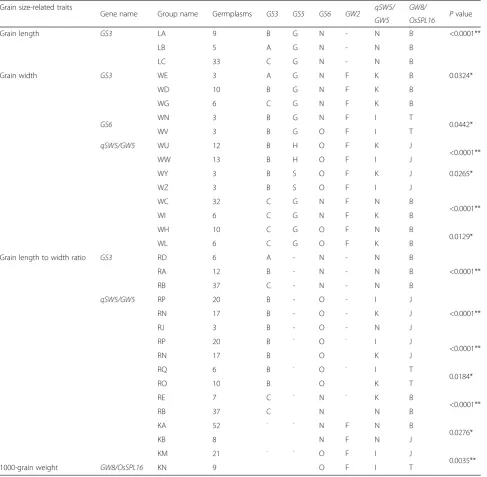
With respect to GL, significant differences were ob-served between alleles of five genes (GS3, GS5, qSW5/ GW5,GS6, andGW8/OsSPL16) (Table 1). Twenty-six of the 162 possible allele combinations for these five genes
Table 2Allele combinations including a single gene-specific allelic variation
Grain size-related traits
Gene name Group name Germplasms GS3 GS5 GS6 GW2 qSW5/ GW8/ Pvalue
GW5 OsSPL16
Grain length GS3 LA 9 B G N - N B <0.0001**
LB 5 A G N - N B
LC 33 C G N - N B
Grain width GS3 WE 3 A G N F K B 0.0324*
WD 10 B G N F K B
WG 6 C G N F K B
GS6 WN 3 B G N F I T 0.0442*
WV 3 B G O F I T
qSW5/GW5 WU 12 B H O F K J
<0.0001**
WW 13 B H O F I J
WY 3 B S O F K J 0.0265*
WZ 3 B S O F I J
WC 32 C G N F N B
<0.0001**
WI 6 C G N F K B
WH 10 C G O F N B
0.0129*
WL 6 C G O F K B
Grain length to width ratio GS3 RD 6 A - N - N B
RA 12 B - N - N B <0.0001**
RB 37 C - N - N B
qSW5/GW5 RP 20 B - O - I J
RN 17 B - O - K J <0.0001**
RJ 3 B - O - N J
RP 20 B - O - I J
<0.0001**
RN 17 B O K J
RQ 6 B - O - I T
0.0184*
RO 10 B O K T
RE 7 C - N - K B
<0.0001**
RB 37 C N N B
1000-grain weight GW8/OsSPL16
KA 52 - - N F N B
0.0276*
KB 8 N F N J
KM 21 - - O F I J
0.0035**
KN 9 O F I T
The significance of allelic variation of each gene in corresponding grain size-related trait was indicated byPvalue. ** and * indicate the significance at 1 % and 5 % level, respectively. The following characters represent each allele
A: A-allele type ofGS3, B: B-allele type ofGS3, and C: C-allele type ofGS3 G: Zhonghua11 type ofGS5, H: H94 type ofGS5, and S: Zhenshan97 type ofGS5 N: Type I ofGS6and O: Type II/III ofGS6
F: FAZ I type ofGW2
were found in 166 of the 215 germplasms. These combi-nations were termed group LA to LZ. Three or more germplasms constituted a group. Several combination groups showed a single gene-specific allelic variation. For instance, group LA, LB, and LC all had the same al-lele combinations for four genes (GS5,qSW5/GW5,GS6, and GW8/OsSPL16), but only differed at GS3. Other
groups (LD–LF and LJ–LL) also showed single
gene-specific allelic variation atGS3. Despite the similar allele combination patterns in these groups, average GL was significantly different only for group LA–LC (Additional file 4). These results indicate that allelic variation atGS3 plays an important role in regulation of rice GL in the presence of a certain allele combination of four other
genes (Zhonghua11-allele of GS5, Nipponbare-type of
qSW5/GW5, type I-allele of GS6, and Basmati-allele of GW8/OsSPL16). Although several other groups also
var-ied at only one gene (GS5, qSW5/GW5, GS6, orGW8/
OsSPL16), the average GL was not significantly different between these groups.
As for GW, significant differences were observed be-tween alleles of all six genes (GW2, GS3, GS5, qSW5/
GW5, GS6, and GW8/OsSPL16) (Table 1). Of the 324
possible allele combinations, 26 were present in a total
of 164 germplasms and were named group WA–WZ
(Additional file 3). Of these, average GW was signifi-cantly different in groups containing single gene-specific allelic variation at one of three genes (GS3, GS6, or qSW5/GW5), particularly when certain allele combina-tions of the other five genes were present (Table 2). For instance, average GW was significantly different between
WN and WV, which different only atGS6gene.
For LWR, significant differences were observed be-tween alleles of five genes (GS3,GS5,qSW5/GW5,GS6, and GW8/OsSPL16) (Table 1). Of the 162 possible allele combinations, 22 were observed in a total of 189
germ-plasms and were named group RA–RV (Additional file
3). Of these, the average LWR was significantly different in groups containing single gene-specific allelic variation
at one of two genes (GS3 or qSW5/GW5), particularly
when certain allele combinations of the other three genes were present (Table 2). For instance, the average LWR was significantly different between groups RN and
RP, which varied only atqSW5/GW5gene.
Significant allelic differences for KGW were observed
in four genes (GW2, qSW5/GW5, GS6, and GW8/
OsSPL16) (Table 1). Of the 36 possible allele combina-tions, 14 were found in a total of 206 germplasms and
were termed group KA–KN (Additional file 3). Of
these, KGW was significantly different in groups con-taining single gene-specific allelic variation only at GW8/OsSPL16 gene, particularly when certain allele combinations of the other three genes were present (Table 2). For instance, KGW was significantly different
between KM and KN, which varied only at GW8/
OsSPL16gene.
Our results, taken together, indicate that a certain type of allele combination plays an important role in regula-tion of rice grain size and yield, even in the presence of difference genetic backgrounds. The results also suggest that particular allele combinations have a strong influ-ence on single gene-specific allelic variation for grain size and yield.
Development of a Regression Equation Model
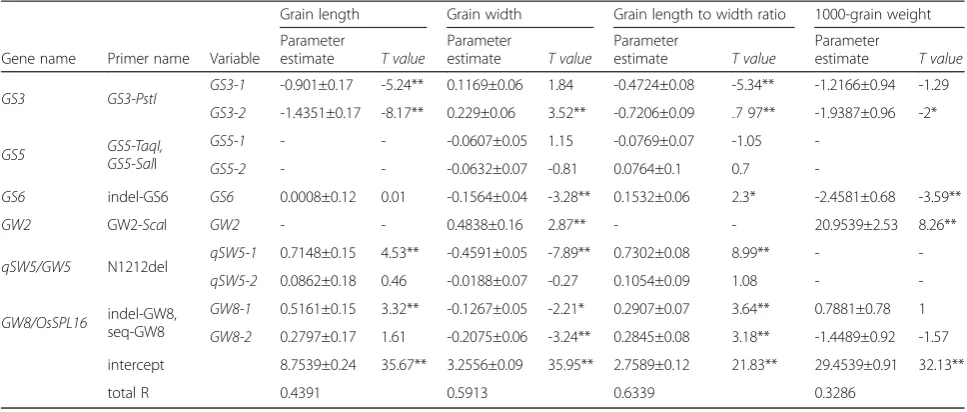
Allelic distribution data for the six genes examined in this study were used to develop a regression equation model. Allele data were first converted into dummy vari-ables. Genes with significant allelic associations with grain size-related traits (GL, GW, LRW, and KGW) were used as independent variables (Table 1). Regression ana-lysis was performed using these data. Parameter esti-mates, standard deviations, and, t values were calculated accordingly (Tables 3 and 4). These values indicated the contribution levels of each molecular marker to differ-ences in grain size-related traits. For instance, the
influ-ence of allelic variation at GW2gene in GW and KGW
was significantly analyzed by use of a dCAPS marker,
GW2-ScaI. These values were used to develop a
regres-sion equation model for prediction of rice grain size.
Validation of a Regression Model
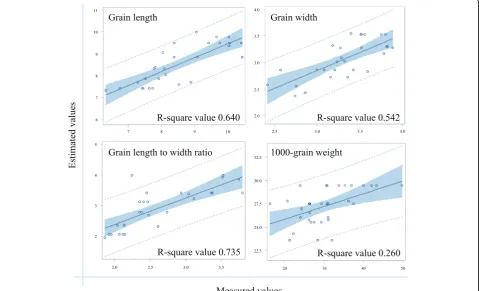
To evaluate the regression equation model, allele and grain size-related trait data were gathered from an add-itional 34 germplasms of diverse origin and grain size (Additional file 5). The estimated values of each grain size-related trait (GL, GW, LRW, or KGW) were calcu-lated using the regression equation model, and these values were then compared with actual measurements. The model had substantial predictive power for three traits (GL, R2= 0.640; GW, R2= 0.542; and LWR, R2= 0.735) (Fig. 1). However, predictive power for KGW was low (R2= 0.260), suggesting that grain weight is possibly regulated in a complex manner compared to grain length and width.
Discussion
Discovery of an Additional Allele ofGS3Gene
A causal C to A mutation in the second exon of theGS3
(Takano-Kai et al. 2013). Germplasms carrying the
B-allele of GS3gene had an intermediate GL compared to
the germplasms carrying the A- and C-alleles (Table 1). As noted above, enhanced GL in C165A varieties was at-tributed to the truncated GS3 protein (Mao et al. 2010). It has been reported that aberrant splicing can be gener-ated by insertions in intron regions (Sironen et al. 2006). We propose that such an aberrant splicing event could have been generated by the 45-bp intronic insertion in the B-allele, and that this led to modified translation of GS3 protein. Comparisons of the B- and C-allele tran-scripts would verify such aberrant splicing. The presence of the novelGS3allele in a large proportion of the tested germplasms highlights its importance. The B-allele will
enhance our understanding of the influence of GS3 on
grain size-related traits.
The Influence of Allele Combinations from Six Genes on Rice Grain Size
A large number of genes are involved in regulation of rice grain size, and there are consequently thousands of possible allele combinations governing grain traits. Here, we examined the influence of allelic variation in six genes on grain size-related traits:GS3,GS5, GS6, GW2, GW8/OsSPL16, and qSW5/GW5. Allele data and grain parameters were used to develop and test a regression equation model for prediction of grain size. Our results showed that a relatively small number of allele combina-tions persisted in the diverse rice germplasm collection,
and that these combinations were significantly associ-ated with differences in grain size. We also noted that single gene-specific allelic variation played an important role in regulation of grain size in the presence of certain allele combinations. For example, GL was significantly different between allelic groups LA, LB, and LC, which had the same alleles for four of the five genes under con-sideration, but not between LD–LF or LJ–LL, which also differed at only one of the five genes (Additional file 4). These results suggest that particular allele combinations have substantial influences on rice grain size.
Application of a Regression Equation Model for Prediction of Rice Grain Size
A regression equation model was generated using allele and trait data from 215 germplasms. The model was then tested against data from a further 34 diverse germ-plasms. R-square values indicative of correlation were obtained for three grain size-related traits (GL, 0.640; GW, 0.542; and LWR, 0.735), but correlation was low for KGW (R2= 0.260) (Fig. 1). These values indicate the utility of our regression equation model for prediction of grain size in rice. Our data show that grain size is likely to be strongly influenced by combinations of certain al-leles, and the regression equation model therefore pro-vides a useful tool for rice molecular breeding. For example, rice grain size preferences vary between coun-tries, and the regression equation model could be used to develop novel rice varieties with grain length and Table 3Regression equation model for prediction of rice grain size
Grain length Grain width Grain length to width ratio 1000-grain weight
Gene name Primer name Variable
Parameter
estimate T value
Parameter
estimate T value
Parameter
estimate T value
Parameter
estimate T value
GS3 GS3-PstI GS3-1 -0.901±0.17 -5.24** 0.1169±0.06 1.84 -0.4724±0.08 -5.34** -1.2166±0.94 -1.29 GS3-2 -1.4351±0.17 -8.17** 0.229±0.06 3.52** -0.7206±0.09 -7 97** -1.9387±0.96 -2*
GS5 GS5-TaqI,GS5-SalI GS5-1 - - -0.0607±0.05 1.15 -0.0769±0.07 -1.05 -GS5-2 - - -0.0632±0.07 -0.81 0.0764±0.1 0.7
-GS6 indel-GS6 GS6 0.0008±0.12 0.01 -0.1564±0.04 -3.28** 0.1532±0.06 2.3* -2.4581±0.68 -3.59**
GW2 GW2-ScaI GW2 - - 0.4838±0.16 2.87** - - 20.9539±2.53 8.26**
qSW5/GW5 N1212del qSW5-1 0.7148±0.15 4.53** -0.4591±0.05 -7.89** 0.7302±0.08 8.99** - -qSW5-2 0.0862±0.18 0.46 -0.0188±0.07 -0.27 0.1054±0.09 1.08 -
-GW8/OsSPL16 indel-GW8,seq-GW8 GW8-1 0.5161±0.15 3.32** -0.1267±0.05 -2.21* 0.2907±0.07 3.64** 0.7881±0.78 1 GW8-2 0.2797±0.17 1.61 -0.2075±0.06 -3.24** 0.2845±0.08 3.18** -1.4489±0.92 -1.57 intercept 8.7539±0.24 35.67** 3.2556±0.09 35.95** 2.7589±0.12 21.83** 29.4539±0.91 32.13**
total R 0.4391 0.5913 0.6339 0.3286
** and * indicate the significance at 1 % and 5 % level, respectively A Dummy variable substitution;
GS3: A-allele (0,0), B-allele (1,0), and C-allele (0,1)
GS5: H94 type (0,0), Zhonghua 11 type (1,0), and Zhenshan 97 type (0,1)
GS6: Type I (0) and Type II/III (1)
GW2: FAZ1 allele (0) and WY3 allele (1)
width within a desirable range. However, it is important to note that, although the R-square values seen in this study indicate some correlation, the current model is limited in its predictive ability as only six genes were ex-amined. The model will be improved by inclusion of novel alleles as they are discovered (such as the B-allele ofGS3 discovered in this study) and by addition of data from more genes. In addition, the model developed here can be used alongside other models to refine breeding for other yield potential and grain quality traits. For ex-ample, several regression equation models have been de-veloped to estimate rice eating quality (Lestari et al. 2009; Lestari et al. 2015).
Conclusion
Allelic variation of six key genes involved in regulation of rice grain size was widely distributed in a collection of 215 germplasms, indicating that the collection was rep-resentative of genetic diversity in rice (Oryza sativa L.). Several germplasms in our collection that had similar grain traits (such as length and width) also shared allele combinations. These results suggest that rice grain size is likely determined by particular allele combinations of several genes involved in regulation of grain size. The re-sults were used to develop a regression equation model that can be used for rice molecular breeding programs. Our data and regression model will be valuable for Table 4Regression equation model for prediction of rice grain size
Regression equation models
Grain length 8.7539+0.0008(GS6)+0.0094(GS5_1)+0.0133(GS5_2)+0.7148(qSW5_1)+0.0862(qSW5_2)-0.9010(GS3_1)-1.4351(GS3_2)+ 0.5161(GW8_1)+0.2797(GW8_2)
Grain width 3.2556-0.1564(GS6)+0.0607(GS5_1)-0.0632(GS5_2)+0.4838(GW2)-0.4591(qSW5_1)-0.0188(qSW5_2)+0.1169(GS3_1)+ 0.2290(GS3_2)- 0.1267(GW8_1)-0.2075(GW8_2)
Grain length to width ratio 2.7589+0.1532(GS6)-0.0769(GS5_1)+0.0764(GS5_2)+0.7302(qSW5_1)+0.1054(qSW5_2)-0.4724(GS3_1)-0.7206(GS3_2)+ 0.2907(GW8_1)+0.2845(GW8_2)
1000-grain weight 3.2556-0.1564(GS6)+0.0607(GS5_1)-0.0632(GS5_2)+0.4838(GW2)-0.4591(qSW5_1)-0.0188(qSW5_2)+ 0.1169(GS3_1)+0.2290(GS3_2)- 0.1267(GW8_1)-0.2075(GW8_2)
market-targeted rice breeding programs such as those aimed at different grain size preferences in different countries.
Methods
Plant Materials and Grain Size Measurements
A total of 215 rice germplasms that were developed in, or originated from, 28 rice-consuming countries were used in this study (Additional file 1). Rice plants were examined under natural field conditions in the experi-mental farm of Seoul National University, Suwon, Korea. Normal agricultural practice was followed for field man-agement. Harvested rice grains were air-dried for 1 month prior to measurement. A total of ten fully filled grains were randomly chosen for each rice germplasm. The size of selected grains (GL, GW, and LWR) was measured using SmartGrain Version 1.2 software (Tanabata et al. 2012). The KGW of each germplasm was determined by measuring 200 fully filled grains and multiplying by five.
Genomic DNA Extraction, PCR, and Sequencing
Genomic DNAs were extracted from young rice seed-lings using a modified CTAB DNA extraction procedure (Murray and Thompson 1980). PCR was performed in a
reaction volume of 20 μL containing 40 ng of genomic
DNA, 0.2 μM of each primer, 200 μM of each dNTP,
10 mM Tris–Cl (pH 8.3), 50 mM KCl, 1.5 mM MgCl2,
0.01 % gelatin, and 0.5 U of Taq DNA polymerase. PCR amplifications were carried in a DNA Engine Tetrad 2 Peltier Thermal Cycler (Bio-Rad) using the following program: 5 min at 94 °C; 32 cycles of 45 s at 94 °C, 30 s at 47–65 °C, 20 s at 72 °C; and 10 min final extension at 72 °C (Additional file 7). Amplified PCR products were
separated on a 1–3 % agarose gel to validate the
expected fragment size.
Statistical Analysis
All statistical analyses were performed using SAS statistical software (SAS Enterprise Guide 6.1 and SAS 9.4; http://www.sas.com/). ANOVA test
(includ-ing Duncan’s test) was used to determine significant
associations between the six selected genes and four grain size-related factors (GL, GW, LWR, and KGW). For multiple regression analysis, allelic variation of the six genes was converted to dummy variables. Al-lelic variation was scored in two ways, depending on the number of alleles: 1 (allele A) and 0 (allele B); or 00 (allele A), 10 (allele B), and 01 (allele C). The genes that showed significant associations with grain
size-related traits were further verified examined
using general linear model analysis (McCullagh 1984). Measured values were considered as dependent vari-ables, while binary molecular marker data were con-sidered as independent variables (Lestari et al. 2009).
These data were used to develop a regression equa-tion model for predicequa-tion of rice grain size.
Additional files
Additional file 1:A list of germplasms.(XLSX 62 kb)
Additional file 2:Relationships between grain size-related traits. (XLSX 8 kb)
Additional file 3:Allele combination of genes showing significant associations with grain size-related traits.(XLSX 17 kb)
Additional file 4:A single gene-specific allelic variation atGS3. (XLSX 11 kb)
Additional file 5:A list of germplasms for evaluation of the regression equation model.(XLSX 16 kb)
Additional file 6:Electrophoresis profiles ofGS3analysis with the dCAPS marker.PCR products were amplified using GS3-PstIand then digested withPstI at 37 °C. Digested products were separated on a 2.5 % agarose gel. 1: undigested (A-allele, 512 bp), 2 + 4: digested (B-allele, 339 bp + 218 bp), and 3 + 4: digested (C-allele; 294 bp + 218 bp). (PDF 96 kb)
Additional file 7:A list of primers.(XLSX 9 kb)
Abbreviations
ANOVA:Analysis of Variance; dCAPS: Derived Cleaved Amplified Polymorphic Sequence; EMS: Ethylmethanesulfonate; FAZ1: Fengaizhan 1; FNP: Functional Nucleotide Polymorphism; GL: Grain Length; GW: Grain Weight;
InDel: Insertion-deletion; KGW: 1000-grain Weight; LWR: Grain Length to Width Ratio; QTLs: Quantitative Trait Loci; SNP: Single Nucleotide Polymorphism; UTR: Untranslated Region; WY3: Wuyujing 3. Competing interests
The authors have no potential competing interests to declare. Authors’contributions
CL conducted all the experiments and data analyses in this study and wrote the manuscript. JP checked the data and contributed to the manuscript. BK, JS, GL, and SJ provided scientific comments and assisted with data analyses. HJK conceived and designed this study and finalized the manuscript. All authors read and approved the final manuscript.
Acknowledgements
This study was supported by a grant from the Next-Generation BioGreen 21 Program (No. PJ01102401) of the Rural Development Administration, Korea. Received: 30 July 2015 Accepted: 15 October 2015
References
Calingacion M, Laborte A, Nelson A, Resurreccion A, Concepcion JC, Daygon VD, Mumm R, Reinke R, Dipti S, Bassinello PZ, Manful J, Sophany S, Lara KC, Bao J, Xie L, Loaiza K, El-hissewy A, Gayin J, Sharma N, Rajeswari S, Manonmani S, Rani NS, Kota S, Indrasari SD, Habibi F, Hosseini M, Tavasoli F, Suzuki K, Umemoto T, Boualaphanh C, et al (2014) Diversity of global rice markets and the science required for consumer-targeted rice breeding. PLoS One 9, e85106. doi:10.1371/journal.pone.0085106
Fan C, Xing Y, Mao H, Lu T, Han B, Xu C, Li X, Zhang Q (2006) GS3, a major QTL for grain length and weight and minor QTL for grain width and thickness in rice, encodes a putative transmembrane protein. Theor Appl Genet 112:1164–1171. doi:10.1007/s00122-006-0218-1
Fan C, Yu S, Wang C, Xing Y (2009) A causal C-A mutation in the second exon of GS3 highly associated with rice grain length and validated as a functional marker. Theor Appl Genet 118:465–472. doi:10.1007/s00122-008-0913-1 Lestari P, Ham T-H, Lee H-H, Woo M-O, Jiang W, Chu S-H, Kwon S-W, Ma K,
Lestari P, Jiang W, Chu S-H, Reflinur S, Kusbiantoro B, Kim B, Piao R, Cho Y-C, Luo Z, Chin J-H, Koh H-J (2015) DNA markers for eating quality of indica rice in Indonesia. Plant Breed 134:40–48. doi:10.1111/pbr.12234
Li Y, Fan C, Xing Y, Jiang Y, Luo L, Sun L, Shao D, Xu C, Li X, Xiao J, He Y, Zhang Q (2011) Natural variation in GS5 plays an important role in regulating grain size and yield in rice. Nat Genet 43:1266–1269. doi:10.1038/ng.977 Mao H, Sun S, Yao J, Wang C, Yu S, Xu C, Li X, Zhang Q (2010) Linking differential
domain functions of the GS3 protein to natural variation of grain size in rice. PNAS 107:19579–19584. doi:10.1073/pnas.1014419107
McCullagh P (1984) Generalized linear models. Eur J Oper Res 16:285–292. doi:10.1016/0377-2217(84)90282-0
Murray MG, Thompson WF (1980) Rapid isolation of high molecular weight plant DNA. Nucleic Acids Res 8:4321–4326. doi:10.1093/nar/8.19.4321
Redoña ED, Mackill DJ (1998) Quantitative trait locus analysis for rice panicle and grain characteristics. Theor Appl Genet 96:957–963. doi:10.1007/
s001220050826
Shomura A, Izawa T, Ebana K, Ebitani T, Kanegae H, Konishi S, Yano M (2008) Deletion in a gene associated with grain size increased yields during rice domestication. Nat Genet 40:1023–1028. doi:10.1038/ng.169
Sironen A, Thomsen B, Andersson M, Ahola V, Vilkki J (2006) An intronic insertion in KPL2 results in aberrant splicing and causes the immotile short-tail sperm defect in the pig. Proc Natl Acad Sci USA 103:5006–5011. doi:10.1073/ pnas.0506318103
Song X-J, Huang W, Shi M, Zhu M-Z, Lin H-X (2007) A QTL for rice grain width and weight encodes a previously unknown RING-type E3 ubiquitin ligase. Nat Genet 39:623–630. doi:10.1038/ng2014
Sun L, Li X, Fu Y, Zhu Z, Tan L, Liu F, Sun X, Sun X, Sun C (2013) GS6, a member of the GRAS gene family, negatively regulates grain size in rice. J Integr Plant Biol 55:938–949. doi:10.1111/jipb.12062
Takano-Kai N, Jiang H, Kubo T, Sweeney M, Matsumoto T, Kanamori H, Padhukasahasram B, Bustamante C, Yoshimura A, Doi K, McCouch S (2009) Evolutionary history of GS3, a gene conferring grain length in rice. Genetics 182:1323–1334. doi:10.1534/genetics.109.103002
Takano-Kai N, Jiang H, Powell A, McCouch S, Takamure I, Furuya N, Doi K, Yoshimura A (2013) Multiple and independent origins of short seeded alleles of GS3 in rice. Breed Sci 63:77–85. doi:10.1270/jsbbs.63.77
Tanabata T, Shibaya T, Hori K, Ebana K, Yano M (2012) SmartGrain: high-throughput phenotyping software for measuring seed shape through image analysis. Plant Physiol 160:1871–1880. doi:10.1104/pp.112.205120
Tan YF, Xing YZ, Li JX, Yu SB, Xu CG, Zhang Q (2000) Genetic bases of appearance quality of rice grains in Shanyou 63, an elite rice hybrid. Theor Appl Genet 101:823–829. doi:10.1007/s001220051549
Wang S, Wu K, Yuan Q, Liu X, Liu Z, Lin X, Zeng R, Zhu H, Dong G, Qian Q, Zhang G, Fu X (2012) Control of grain size, shape and quality by OsSPL16 in rice. Nat Genet 44:950–954. doi:10.1038/ng.2327
Yan S, Zou G, Li S, Wang H, Liu H, Zhai G, Guo P, Song H, Yan C, Tao Y (2011) Seed size is determined by the combinations of the genes controlling different seed characteristics in rice. Theor Appl Genet 123:1173–1181. doi:10.1007/s00122-011-1657-x
Zuo J, Li J (2014) Molecular genetic dissection of quantitative trait loci regulating rice grain size. Annu Rev Genet 48:99–118. doi:10.1146/annurev-genet-120213-092138
Submit your manuscript to a
journal and benefi t from:
7Convenient online submission 7Rigorous peer review
7Immediate publication on acceptance 7Open access: articles freely available online 7High visibility within the fi eld
7Retaining the copyright to your article