https://doi.org/10.5194/ms-9-349-2018
© Author(s) 2018. This work is distributed under the Creative Commons Attribution 4.0 License.
The computation of bending eigenfrequencies of
single-walled carbon nanotubes based on
the nonlocal theory
Jozef Bocko, Pavol Lengvarský, Róbert Hu ˇnady, and Juraj Šarloši
Department of Applied Mechanics and Mechanical Engineering, Technical University of Košice, Košice, 04200, Slovakia
Correspondence:Pavol Lengvarský ([email protected])
Received: 23 April 2018 – Revised: 27 July 2018 – Accepted: 23 October 2018 – Published: 1 November 2018
Abstract. In this work, a recently proposed nonlocal theory of bending is used in the analysis of eigenfre-quencies of single-walled carbon nanotubes (SWCNTs). The nanotube vibration is analyzed in the form of a homogenized continuum. Classical treatment where a nanotube is approximated by standard beam theory, is replaced by the more sophisticated nonlocal method of material interactions where a nonlocal parameter is used. The eigenfrequencies are computed by the combination of analytical as well as numerical methods for four dif-ferent carbon nanotube (CNT) supports. Various types of supports are considered for the analysis: fixed–simply supported, fixed–free, simply–simply supported and fixed–fixed. Due to the huge amount of computed data, only outcomes of eigenfrequency computations for the nanobeams of armchair type with fixed and simply supported ends, and different nonlocal parameters are represented in the form of graphs at the end of the article. The study shows how the nanotube eigenfrequencies depend on nonlocal parameters as well as on the length and diameter of CNTs. The obtained results are in good agreement with the results published in papers which were gained by different procedures.
1 Introduction
Functional materials and nanomaterials are attracting a lot of attention in the areas of modern engineering. The internal structure of such materials is relatively simple but the deter-mination of their properties is often associated with difficul-ties. In many cases, the theoretical treatments with indirect measurements of conjugated behavior lead to the solution of a stated problem. In our case, we will deal with the determi-nation of eigenfrequencies of carbon nanotubes. The eigen-frequencies are very important parameters of these structures because their measurement can serve as a base for the de-termination of elastic properties, e.g., Young’s modulus of homogenized materials.
The massive investigation of carbon nanotubes started after publishing well-known article (Iijima, 1991). CNTs are large macromolecules composed exclusively of carbon atoms. Nanotubes can be formally obtained by rolling up a single-walled plane sheet of graphite, called graphene, into
a cylindrical shape. Nanotubes have remarkable mechanical properties. The most important task in the design of a ma-chine is to find an adequate material for a particular struc-ture. In principle, the aim is to use strength and lightweight material. Nowadays, in mechanical engineering, the carbon nanotubes are candidates that fulfill such demands as parts of composite materials (Wu and Chou, 2012; Yayli, 2014). Be-sides of mechanical properties, the scientists focus their re-search on electrical, thermal and optical properties of CNTs. Many applications of CNTs are oriented to the area of biol-ogy and medicine.
the nonlocal theory has to be used (Eringen, 2002). Accord-ing to the underlyAccord-ing theory, strain in every point of a body influences a stress level at the investigated point.
Different applications of the nonlocal theory can be found in many research papers. A review on the application of the nonlocal continuum theory for static and dynamic loadings of carbon nanotubes and graphene sheets is presented in the paper of Arash and Wang (2012). The nonlocal elastic beam model, the elastic shell model and the elastic plate model is established for modeling carbon nanotubes and graphene sheets. The different loading states as bending under trans-verse loading of CNTs, buckling analysis of axial loaded CNTs and free vibration of CNTs are described. Using the nonlocal continuum mechanics in nonlinear stability analy-sis of graphene sheets is presented in paper (Asemi et al., 2014). The Galerkin method with the nonlocal parameter for the analysis of simply supported orthotropic graphene sheets is used. The paper reports that the nonlocal parameter has significant effect on the postbuckling behavior of graphene sheets. Kirchhoff’s plate theory with the nonlocal parameter is used for eigenfrequency investigation of nanoplates with elastic (Winkler–Pasternak) boundary conditions in the re-search of Chakraverty and Behera (2015). The effect of the aspect ratio, the elastic boundary conditions and the nonlocal parameter is presented. A forced vibration of a single- and double-walled carbon nanotube under excitation of a moving harmonic load has been analyzed using nonlocal elasticity theory by Rahmani et al. (2017, 2018).
The vibrations of tensioned nanobeams using the nonlocal beam theory are investigated by Bagdatli (2015). The nonlin-ear frequencies for fixed–fixed and simply–simply supported Euler–Bernoulli nanobeams are presented. The vibration be-havior of the nanobeams with small scale effects represented by the nonlocal parameter is studied in the research of Lim et al. (2010). The forced vibration of SWCNTs is investigated by the nonlocal theory in ¸Sim¸sek (2010). The SWCNTs as nonlocal Euler–Bernoulli beams are modeled and the effects of aspect ratio and nonlocal parameter on vibration behavior of SWCNTs are discussed. The vibrational behavior of CNTs using wave propagation approach is studied by Hussain et al. (2017), Hussain and Nawaz (2017). Other applications of the nonlocal theory and the vibration behavior of carbon nan-otubes with different boundary conditions can be found in papers (Narendar and Gopalakrishnan, 2012; ¸Sim¸sek, 2011; Thongyothee et al., 2013; Wang et al., 2015; Yang et al., 2010). The properties of single-walled carbon nanotubes are well described in papers (Arash and Wang, 2012; Fu et al., 2012; Gupta and Batra, 2008; Harik, 2002; Karliˇci´c et al., 2015; Kumar and Srivastava, 2016; Lee and Chang, 2012).
In this paper, the bending frequencies of single-walled car-bon nanotubes based on nonlocal stress theory are investi-gated. The carbon nanotubes are represented by the Euler–
ing diameters) in papers Bocko and Lengvarský (2014a, b, c). Novelty of paper lies in investigation of chirality effects to eigenfrequencies, comparision of semianalytical methods with the finite element method (FEM) for different nonlocal parameters for boundary condition of type fixed–free. Fur-ther, the eigenfrequencies are computed for four different supports (fixed–simply supported, fixed–free, simply–simply supported and fixed–fixed) of carbon nanotubes, the semian-alytical results for fixed–simply supported armchair CNTs with different lengths and five nonlocal parameters are pre-sented in graphical form at the end of the article. Finally, the comparison of the results with results from Imani Yengejeh et al. (2014), Lü et al. (2007), Zhang et al. (2009) is done.
2 Carbon nanotube as a beam
The elasticity theory of continuum media is based on sev-eral fundamental assumptions: the principle of objectivity, determinism, material symmetry, equipresence, causality, lo-cal action, etc. The principle of lolo-cal action represents the fact that stress at a material point is related exclusively to the deformations in its immediate surroundings. On the other hand, in the nonlocal continuum theory, this assumption is abandoned, and the stress tensor at the investigated part of continua is influenced by the movement of all points of con-tinua (Eringen, 2002). The equation for nonlocal stress is written as:
σ(x)=
Z
V
K x0−x , τ
T(x0)dV(x0), (1)
T(x)=C(x):(x). (2)
Here,T(x) is the stress tensor at pointx,C(x) is the fourth-order elasticity tensor,(x) is the strain tensor and relation K(x0−x
τ) is the nonlocal modulus defined by Eringen
(2002). The material parameterτ is expressed by relation τ=√µ/ l. Here, the so-called nonlocal parameterµ repre-sents the influence of using very small distances. This pa-rameter can be evaluated from relationµ=e20li2. Here,e0is a material constant,li is the internal characteristic length and lis the external characteristic length. More information about using the nonlocal parameterµin connection with beams can be found in Reddy and Pang (2008). Simplified Eq. (1) can be written as:
1−τ2l2∇2σ=T, (3)
parame-Figure 1.The scheme of lattice structures(a)graphene sheet,(b)single-walled carbon nanotubes.
terµ(Thongyothee et al., 2013):
σxx−µ ∂2σxx
∂x2 =Eεxx. (4)
Combination of the nonlocal theory and the theory of free vibration of a beam allows us to write the following relation (Thongyothee et al., 2013):
mb(x)µ ∂2u ∂t2 +
∂2 ∂x2
EJ(x)∂
2u
∂x2
=0. (5)
Here, u is the transverse displacement of the beam, mb is the mass of beam related to the unit length,J is the second moment of cross-section area. In the overall motions of the beam, the various parts will move in unison, the relative pro-portion of their displacements being unchanged with time. This leads to the separation of space and time variables. Fi-nally, considering constant cross-section of the beam, we get the differential equation of fourth order with respect to the independent space variablex:
ψIV(x)−β4ψ(x)=0. (6)
Here,ψ(x) is an eigenvector (eigenmode) and the parameter β is defined as:
β4=ω
2µm b
EJ (7)
The scalar quantityω, in the above relation, is the angular frequency of vibrations of the free CNT. The substitution of β into the Eq. (6), results into the formula:
ψ(x)= (8)
B1cos(βx)+B2cosh(βx)+B3sin(βx)+B4sinh(βx) Here,B1,B2,B3,B4are determined in accordance with the given support conditions of the nanobeam.
3 The Numerical solution of frequency equation
3.1 Geometry of carbon nanotubes
Rolling up of a graphene sheet (Fig. 1a) can be accomplished in many ways and in principle it can be described by a chiral
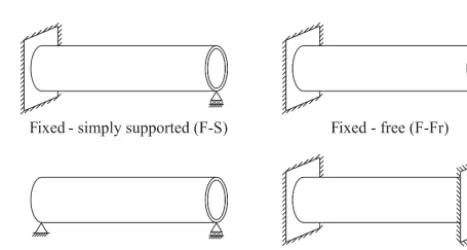
Figure 2.The applied boundary conditions on nanobeams.
vectorchor a chiral angleθ:
ch=na1+ma2, (9)
θ=arcsin
√
3m
2
√
n2+m2+nm. (10)
Having fixed vectorsa1anda2the pairs of integers (n,m) specify the chirality of SWCNT. Two limit states of CNTs (n, 0) or (θ=0◦) and (n,n) or (θ=30◦) are called zigzag and armchair (Fig. 1b), respectively. The intermediate states of CNTs (n,m) or (0◦< θ <30◦) define chiral nanotubes, (Fig. 1b).
Chirality influences the response of carbon nanotubes to external disturbances. Beside of chirality we will use another important characteristic parameter of the carbon nanotube, its lengthL.
3.2 Boundary conditions
equation results in the following characteristic equations: (F–S):
sin(βL) cosh(βL) sin(βL)+sinh(βL) cos(βL)+cosh(βL)
=0, (11)
(F–Fr):
sin(βL)+sinh(βL) cos(βL)+cosh(βL) cos(βL)+cosh(βL) sinh(βL)−sin(βL)
=0, (12)
(S–S):
sin(βL) sinh(βL)
−sin(βL) sinh(βL)
=0, (13)
(F–F):
sin(βL)−sinh(βL) cos (βL)−cosh(βL) cos(βL)−cosh(βL) −sin(βL)−sinh(βL)
=0, (14)
and they finally lead to the relations:
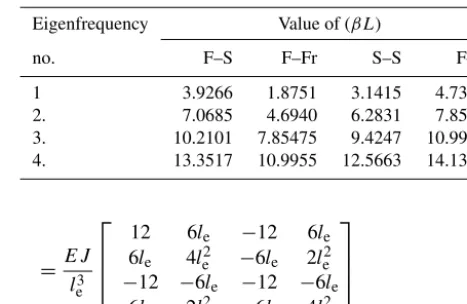
(F–S):sinh(βL) cos(βL)−cosh(βL) sin(βL)=0, (15) (F–Fr):1+cos(βL) cosh(βL)=0, (16) (S–S):sin(βL) sinh(βL)=0, (17) (F–F): −1+cos(βL) cosh(βL)=0. (18) Because the nanotube is modeled as a continuum by ho-mogenization method, the characteristic equations are tran-scendental ones. The roots (βL) of the equations for the pre-scribed supports were obtained using program MATLAB®. The first fourth values (βL) can be found in Table 1. The ra-dian frequenciesωresult from Eq. (7) and for the frequencies f we have formulaf =ω/2π.
The second moment of area J with respect to the axis which is perpendicular to the axial direction of the beam is related to the thickness of the nanotube shell. Because there is no certainty in the definition of this parameter, different values can be found in the literature. Here, we use relations from Swain et al. (2013):
mb=ρA=4.8×10⁻²⁴R (kg nm−1), (19) EJ =1713.92R2−794.16R+109.24 (kg nm−3s−2), (20) whereRis the radius of the nanotube. The chirality parame-ters (n,m) characterize the radius of CNT, and the radius is defined by equation:
R=a0 q
3 n2+m2+nm
/2π (21)
wherea0=0.1424 nm is the distance between two neighbor-ing carbon atoms and the chirality parameters for our com-putations arem=n.
4 Finite element modelling of carbon nanotubes
In this chapter, the nonlocal finite element formulation is pre-sented. The mass and stiffness matrices of finite element are derived from Eq. (5).
The element stiffness matrix can be defined as:
Ke =EJ le
Z
0
d2N(x) dx2
d2NT(x)
dx2 dx (22)
Eigenfrequency Value of (βL)
no. F–S F–Fr S–S F–F
1 3.9266 1.8751 3.1415 4.7300
2. 7.0685 4.6940 6.2831 7.8532 3. 10.2101 7.85475 9.4247 10.9956 4. 13.3517 10.9955 12.5663 14.1371
=EJ l3 e
12 6le −12 6le 6le 4l2e −6le 2l2e
−12 −6le −12 −6le 6le 2l2e −6le 4l2e
and the nonlocal element mass matrix can be defined as:
Me =mbµ le
Z
0
d2N(x) dx2
d2NT(x)
dx2 dx (23)
=mbµle
420
156 22le 54 −13le 22le 4l2e 13le −3le2
54 13le 156 −22le
−13le −3le2 −22le 4l2e
.
5 Results and discussion
At first, the effect of chirality on the eigenfrequencies of CNTs is investigated. The chirality angle varies from 0 to 30◦. The semianalytical computations of the first two eigen-freqeuncies are accomplished for different types of CNTs but with approximately the same diameters. The length of the tubes is 10 nm and the following types of boundary condi-tions are used (Fig. 2): fixed–free (F–Fr) and simply–simply supported (S–S). From computations (Table 2) result that the chirality has effect on the change of CNTs eigenfrequencies due to the small change of tube diameter. The maximum dif-ference in the eigenfrequencies is 7 %. Under otherwise iden-tical conditions, the effect of the chirality of SWCNTs can be neglected. For this reason, only armchair CNTs are investi-gated in this paper.
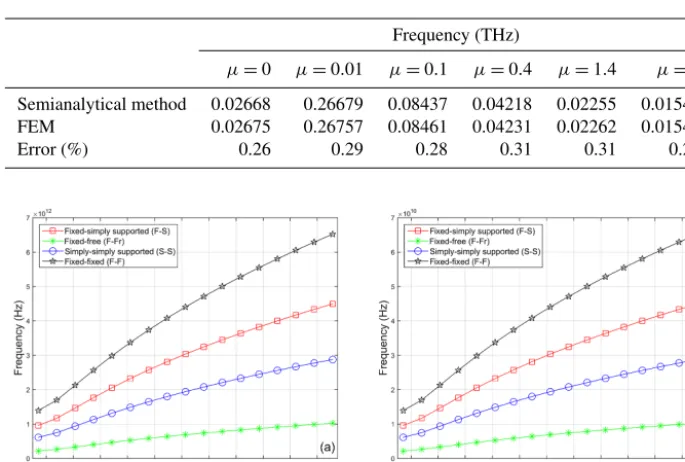
The results for the tube chirality (5,5), length 10 nm and boundary condition of type F–Fr computed by the semiana-lytical as well as FEM are given in Table 3. The 100 elements are used for the FEM. It is clear from the results that both methods give almost the same results.
Table 2.Eigenfrequencies of carbon nanotubes with different chiral angles and boundary conditions.
SWCNT (n,m) Chiral angle (◦) Diameter (nm) Frequency (THz)
F–Fr (1st) F–Fr (2nd) S–S (1st) S–S (2nd)
(9, 0) 0.00 0.7047 0.02795 0.17515 0.07845 0.31381
(8, 2) 10.89 0.7177 0.02858 0.17912 0.08023 0.32092 (7, 3) 17.00 0.6960 0.02753 0.17249 0.07726 0.30905 (6, 4) 23.41 0.6826 0.02689 0.16852 0.07548 0.30192 (5, 5) 30.00 0.6781 0.02668 0.16719 0.07489 0.29955
Table 3.The first eigenfrequency of carbon nanotubes for both methods with different nonlocal parameter.
Frequency (THz)
µ=0 µ=0.01 µ=0.1 µ=0.4 µ=1.4 µ=3
Semianalytical method 0.02668 0.26679 0.08437 0.04218 0.02255 0.01541 FEM 0.02675 0.26757 0.08461 0.04231 0.02262 0.01545
Error (%) 0.26 0.29 0.28 0.31 0.31 0.26
Figure 3.The first eigenfrequencies of armchair nanotubes with the nonlocal parameterµ=0.01 and length(a)L=10 nm,(b)L=100 nm.
Figure 4.The first eigenfrequencies of armchair nanotubes with the nonlocal parameterµ=0.1 and length(a)L=10 nm,(b)L=100 nm.
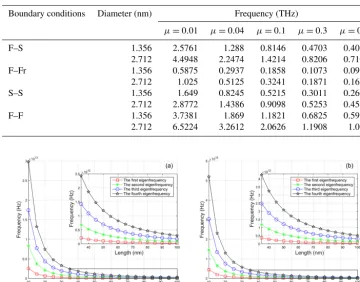
to D=2.712 nm. The length of considered CNTs varies fromL=10 nm toL=100 nm. The nonlocal parameterµ is chosen to be 0.01, 0.04, 0.1, 0.3 and 0.4, respectively. The minimal computed eigenfrequency f =0.9289 GHz was obtained for the fixed–free CNT with the diameterD=
0.5424 nm, the lengthL=100 nm and the nonlocal param-eter µ=0.4. The maximal computed eigenfrequency f=
eigenfre-Boundary conditions Diameter (nm) Frequency (THz)
µ=0.01 µ=0.04 µ=0.1 µ=0.3 µ=0.4
F–S 1.356 2.5761 1.288 0.8146 0.4703 0.4073
2.712 4.4948 2.2474 1.4214 0.8206 0.7107
F–Fr 1.356 0.5875 0.2937 0.1858 0.1073 0.0929
2.712 1.025 0.5125 0.3241 0.1871 0.1621
S–S 1.356 1.649 0.8245 0.5215 0.3011 0.2607
2.712 2.8772 1.4386 0.9098 0.5253 0.4549
F–F 1.356 3.7381 1.869 1.1821 0.6825 0.5911
2.712 6.5224 3.2612 2.0626 1.1908 1.033
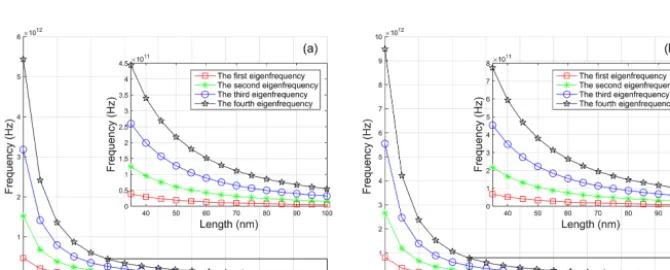
Figure 5.The first four eigenfrequencies of fixed–simply supported armchair nanotubes with nonlocal parameterµ=0.01,(a)nanotube with chirality (n,m)=(10, 10) and diameterD=1.356 nm,(b)nanotube with and chirality (n,m)=(20, 20), diameterD=2.712 nm.
quencies of armchair SWCNTs with the nonlocal parameter µ=0.01 on the diameter for 10 nm long CNT is shown in Fig. 3a and for 100 nm in Fig. 3b. Similarly, Fig. 4 shows the results of computations for the nonlocal parameterµ=0.1, so that the dependence of the first eigenfrequencies of arm-chair SWCNTs with the nonlocal parameter on the diameter for 10 nm long CNT is shown in Fig. 4a and for 100 nm in Fig. 4b.
The graphs conclude that increasing diameter of the car-bon nanotube leads to higher first eigenfrequency and the eigenfrequencies of ten times longer carbon nanotubes are hundred times lower. Comparison of Figs. 3 and 4 shows that ten times higher value of nonlocal parameter leads to ap-proximately three times lower eigenfrequencies. The value of nonlocal parameter affects more the eigenfrequencies of the carbon nanotubes with a smaller diameter.
As there is a huge number of possible combinations of pa-rameters, we have focused our attention on the first eigen-frequencies for the diameters D=2R=1.356 nm for chi-rality (10, 10) andD=2.712 nm for chirality (20, 20). The comparison of the first eigenfrequencies for all considered boundary conditions of armchair nanotubes with the length L=10 nm is given in Table 4. It is clear from Table 4 that diameter, nonlocal parameter and boundary conditions have
effect on the eigenfrequencies of nanotubes. In principle, the higher value of the nonlocal parameter the lower value of eigenfrequencies. Opposite tendency is seen for the diame-ter of CNTs. The highest first eigenfrequencies were com-puted for the fixed–fixed boundary conditions of CNTs and the lowest first eigenfrequencies for the fixed–free boundary conditions.
Due to complexity, the effect of the nonlocal parameter on only first four eigenfrequencies of armchair CNTs was stud-ied. The graphs in Figs. 5–9 show relations between eigenfre-quencies and lengthLof carbon nanotube with the F–S type boundary conditions. The nonlocal parameter was the same as above.
The graphs show that the eigenfrequencies decrease with increasing length and nonlocal parameter. The eigenfrequen-cies for the nonlocal parameter equal 0.01 are approximately three times lower than for the nonlocal parameter 0.1.
Figure 6.The first four eigenfrequencies of fixed–simply supported armchair nanotubes with nonlocal parameterµ=0.04,(a)nanotube with chirality (n,m)=(10, 10) and diameterD=1.356 nm,(b)nanotube with and chirality (n,m)=(20, 20), diameterD=2.712 nm.
Figure 7.The first four eigenfrequencies of fixed–simply supported armchair nanotubes with nonlocal parameterµ=0.1,(a)nanotube with chirality (n,m)=(10, 10) and diameterD=1.356 nm,(b)nanotube with and chirality (n,m)=(20, 20), diameterD=2.712 nm.
Figure 8.The first four eigenfrequencies of fixed–simply supported armchair nanotubes with nonlocal parameterµ=0.3,(a)nanotube with chirality (n,m)=(10, 10) and diameterD=1.356 nm,(b)nanotube with and chirality (n,m)=(20, 20), diameterD=2.712 nm.
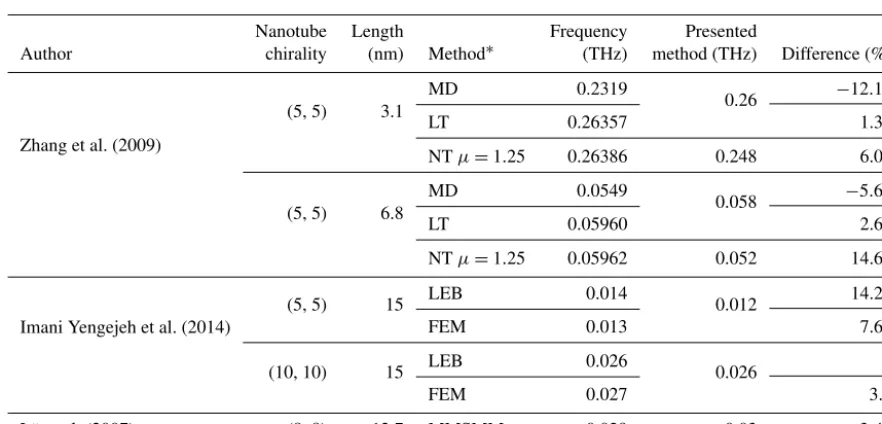
by different authors and methods with the result of method in the article. The biggest difference in this comparison does not exceed 15 %.
6 Conclusion
We discussed the analytical computation of eigenfrequencies of SWCNTs based on nonlocal beam theory and the
sup-Figure 9.The first four eigenfrequencies of fixed–simply supported armchair nanotubes with nonlocal parameterµ=0.4,(a)nanotube with chirality (n,m)=(10, 10) and diameterD=1.356 nm,(b)nanotube with and chirality (n,m)=(20, 20), diameterD=2.712 nm.
Table 5.The comparison of the first eigenfrequencies with published results.
Nanotube Length Frequency Presented
Author chirality (nm) Method∗ (THz) method (THz) Difference (%)
Zhang et al. (2009)
(5, 5) 3.1
MD 0.2319
0.26 −12.12
LT 0.26357 1.35
NTµ=1.25 0.26386 0.248 6.01
(5, 5) 6.8
MD 0.0549
0.058 −5.65
LT 0.05960 2.68
NTµ=1.25 0.05962 0.052 14.65
Imani Yengejeh et al. (2014)
(5, 5) 15 LEB 0.014 0.012 14.29
FEM 0.013 7.69
(10, 10) 15 LEB 0.026 0.026 0
FEM 0.027 3.7
Lü et al. (2007) (8, 8) 12.7 MMSMM 0.029 0.03 −3.45
∗MD: Molecular Dynamics, LT: Local Timoshenko beam, NT: Nonlocal Timoshenko beam,µ: nonlocal parameter, LEB: Local Euler–Bernoulli beam, FEM: Finite Element Method, MMSMM: Modified Molecular Structural MechanicsTables may have a footer.
ported beam are given in the graphic form. Five different val-ues of nonlocal parameter were used and its influence on the computed eigenfrequencies is shown.
It can be stated that:
– The effect of the chirality of SWCNTs can be neglected. – The nanotube eigenfrequencies depend on nonlocal pa-rameters, as well as on the length and diameter of CNTs.
– Increase in the diameter of a carbon nanotube leads to higher eigenfrequencies and the eigenfrequencies of ten times longer carbon nanotubes are hundred times lower.
– Higher nonlocal parameter leads to the smaller eigenfre-quencies of CNTs. Ten times higher value of nonlocal parameter leads to approximately three times smaller eigenfrequencies.
– The eigenfrequencies of shorter and, in general, smaller carbon nanotubes are more affected by the value of non-local parameter.
– The presented results are in good agreement with the results published in other papers.
– The experimentally measured eigenfrequencies can be used for the determination of Young’s modulus of ho-mogenized single-walled carbon nanotubes.
Data availability. Data can be made available upon reasonable request. Please contact Pavol Lengvarský ([email protected]).
Author contributions. BJ formulated theoretical description of work and prepared analytical formulations; LP performed semi-analytical computations; HR accomplished FEM computations; ŠJ wrote the paper with contributions from all co-authors.
Competing interests. The authors declare that they have no con-flict of interest.
Acknowledgements. The authors gratefully acknowledge the support given by the Slovak Grant Agency VEGA under the grant no. 1/0731/16 Development of Modern Numerical and Experi-mental Methods of Mechanical System Analysis. no. 1/0355/18 The use of experimental methods of mechanics for refinement and verification of numerical models of mechanical systems with a focus on composite materials and ITMS: 26220120060 supported by the Research and Development Operational Programme funded by the ERDF.
Edited by: Anders Eriksson
Reviewed by: two anonymous referees
References
Arash, B. and Wang, Q.: A review on the application of nonlocal elastic models in modeling of carbon nan-otubes and graphenes, Comput. Mater. Sci., 51, 303–313, https://doi.org/10.1016/j.commatsci.2011.07.040, 2012. Asemi, S. R., Mohammadi, M., and Farajpour, A.: A study on
the nonlinear stability of orthotropic single-layered graphene sheet based on nonlocal elasticity theory, Lat. Am. J. Solids Struct., 11, 1515–1540, https://doi.org/10.1590/S1679-78252014000900004, 2014.
Bagdatli, S. M.: Non-linear transverse vibrations of tensioned nanobeams using nonlocal beam theory, Struct. Eng. Mech., 55, 281–298, https://doi.org/10.12989/sem.2015.55.2.281, 2015. Bocko, J. and Lengvarský, P.: Bending vibrations of carbon
nan-otubes by using nonlocal theory, Procedia Eng., 96, 21–27, https://doi.org/10.1016/j.proeng.2014.12.093, 2014a.
Bocko, J. and Lengvarský, P.: The use of nonlocal theory for bending vibrations of single-walled car-bon nanotubes, Appl. Mech. Mater., 611, 332–336, https://doi.org/10.4028/www.scientific.net/AMM.611.332, 2014b.
Bocko, J. and Lengvarský, P.: Vibration of single-walled carbon nanotubes by using nonlocal theory, Am. J. Mech. Eng., 2, 195– 198, https://doi.org/10.12691/ajme-2-7-5, 2014c.
Chakraverty, S. and Behera, L.: Small scale effect on the vibration of non-uniform nanoplates, Struct. Eng. Mech., 55, 495–510, https://doi.org/10.12989/sem.2015.55.3.495, 2015.
Eringen, A. C.: Nonlocal Continuum Field Theories, Springer-Verlag, New York, 2002.
Fu, Y. M., Zhou, H. Q., and Zhang, P.: Nonlinear free vibration of nanowires including size effects, Micro Nano Lett., 7, 348–352, https://doi.org/10.1049/mnl.2011.0689, 2012.
Gupta, S. S. and Batra, R. C.: Continuum structures equiv-alent in normal mode vibrations to single-walled car-bon nanotubes, Comput. Mater. Sci., 43, 715–723, https://doi.org/10.1016/j.commatsci.2008.01.032, 2008. Harik, V. M.: Mechanics of carbon nanotubes: applicability of the
continuum-beam models, Comput. Mater. Sci., 24, 328–342, https://doi.org/10.1016/S0927-0256(01)00255-5, 2002. Hussain, M. and Naeem, M. N.: Vibration analysis of single-walled
carbon nanotubes using wave propagation approach, Mech. Sci., 8, 155–164, https://doi.org/10.5194/ms-8-155-2017, 2017. Hussain, M., Naeem, M. N., Shahzad, A., and He, M.: Vibrational
behavior of single-walled carbon nanotubes based on cylindri-cal shell model using wave propagation approach, AIP Adv., 7, 045114, https://doi.org/10.1063/1.4979112, 2017.
Iijima, S.: Helical microtubules of graphitic carbon, Nat., 354, 56– 58, https://doi.org/10.1038/354056a0, 1991.
Imani Yengejeh, S., Akbar Zadeh, M., and Öchsner, A.: Numerical modeling of eigenmodes and eigenfrequen-cies of hetero-junction carbon nanotubes with pentagon– heptagon pair defects, Comput. Mater. Sci., 92, 76–83, https://doi.org/10.1016/j.commatsci.2014.05.015, 2014. Karliˇci´c, D., Murmu, T., Adhikari, S., and McCarthy, M.:
Non-Local Structural Mechanics, John Wiley & Sons, Inc., Hoboken, NJ, USA, 2015.
Kumar, D. and Srivastava, A.: Elastic properties of CNT- and graphene-reinforced nanocomposites us-ing RVE, Steel. Comp. Struct., 21, 1085–1103, https://doi.org/10.12989/scs.2016.21.5.1085, 2016.
Lee, H. L. and Chang, W. J.: Frequency analysis of carbon-nanotube-based mass sensor using non-local Timoshenko beam theory, Micro Nano Lett., 7, 86–89, https://doi.org/10.1049/mnl.2011.0469, 2012.
Lim, C. W., Li, C., and Yu, J.: Free vibration of pre-tensioned nanobeams based on nonlocal stress theory, J. Zhejiang Univ. Sci. A, 11, 34–42, https://doi.org/10.1631/jzus.A0900048, 2010. Lü, J., Chen, H., Lü, P., and Zhang, P.: Research of natural frequency of single-walled carbon nanotube, Chin. J. Chem. Phys., 20, 525, https://doi.org/10.1088/1674-0068/20/05/525-530, 2007.
Narendar, S. and Gopalakrishnan, S.: Nonlocal continuum mechan-ics formulation for axial, flexural, shear and contraction cou-pled wave propagation in single walled carbon nanotubes, Lat. Am. J. Solids Struct., 9, 497–514, https://doi.org/10.1590/S1679-78252012000400005, 2012.
Rahmani, O., Norouzi, S., Golmohammadi, H., and Hos-seini, S. A. H.: Dynamic response of a double, single-walled carbon nanotube under a moving nanoparticle based on modified nonlocal elasticity theory considering sur-face effects, Mech. Adv. Mater. Struc., 24, 1274–1291, https://doi.org/10.1080/15376494.2016.1227504, 2017. Rahmani, O., Shokrnia, M., Golmohammadi, H., and Hosseini,
¸Sim¸sek, M.: Vibration analysis of a single-walled carbon nan-otube under action of a moving harmonic load based on nonlocal elasticity theory, Physica E, 43, 182–191, https://doi.org/10.1016/j.physe.2010.07.003, 2010.
¸Sim¸sek, M.: Forced vibration of an embedded single-walled car-bon nanotube traversed by a moving load using nonlocal Timoshenko beam theory, Steel. Comp. Struct., 11, 59–76, https://doi.org/10.12989/scs.2011.11.1.059, 2011.
Swain, A., Roy, T., and Nanda, B. K.: Vibration behaviour of single walled carbon nanotube using finite element, Int. J. Theor. Appl. Res. Mech. Eng., 2, 129–133, 2013.
Thongyothee, C., Chucheepsakul, S., and Li, T.: Nonlo-cal elasticity theory for free vibration of single-walled carbon nanotubes, Adv. Mat. Res., 747, 257–260, https://doi.org/10.4028/www.scientific.net/AMR.747.257, 2013.
mal elasticity theory, Lat. Am. J. Solids Struct., 12, 1918–1933, https://doi.org/10.1590/1679-78251904, 2015.
Wu, A. S. and Chou, T.-W.: Carbon nanotube fibers for advanced composites, Mat. Today, 15, 302–310, https://doi.org/10.1016/S1369-7021(12)70135-9, 2012. Yang, J., Ke, L. L., and Kitipornchai, S.: Nonlinear free
vibration of single-walled carbon nanotubes using nonlo-cal Timoshenko beam theory, Physica E, 42, 1727–1735, https://doi.org/10.1016/j.physe.2010.01.035, 2010.
Yayli, M. Ö.: On the axial vibration of carbon nanotubes with different boundary conditions, Micro Nano Lett., 9, 807–811, https://doi.org/10.1049/mnl.2014.0398, 2014.