Page 322
PROJECT-ORIENTED TEACHING AND GENDER-SPECIFIC DIFFERENCES IN THE PERCEPTION OF COMPETENCIES IN PROJECT MANAGEMENT
Marco Haid, Peter Heimerl
Division for Management in Health and Sport Tourism, UMIT Hall, Eduard-Wallnöfer-Zentrum 1, 6060 Hall in Tirol, Austria
Abstract
The present study aims to investigate the influence of project-oriented teaching and gender on individual’s perception of the relevance of project management-specific competences. 59 students of the bachelor’s program ‘Economics, Health and Sports Tourism’ at the LFU Innsbruck and the UMIT Hall were surveyed twice, once at the beginning and once after completion of the project-oriented course ‘Strategic Business Management’ using a questionnaire. The results indicate that the students perceive all project management-specific competences as more relevant after the course. The social and personal competencies are assessed the most important, followed by technical competences, which are also considered to be very relevant. Context competences, on the other hand, are considered less relevant by comparison. Further, the results show that there are gender-specific differences in the assessment. Female participants tend to rate almost all competencies higher in terms of their relevance. In particular, women consider social and personal competencies as well as technical competences to be significantly more important. This study offers an insight into the perception and assessment of competences. Both the insight into which competencies are considered relevant and which differences exist between individuals should serve the further development of teaching methods as well as the organisation and conception of seminars.
Keywords: project management, project-oriented learning, relevance perception, gender-specific differences, assessment of competences
1. INTRODUCTION
1.1 Increasing importance of projects and project management-specific competences
A project can be defined as a sequence of unique, interdisciplinary, complex, and connected activities that have a specific objective which must be completed by a specific time in accordance with specification (Wysocki 2019). It is characterised by the uniqueness of the condition as a whole (DIN 2009). Due to the relatively simple initiation and high adaptability, projects are increasingly used in different companies and branches and are therefore becoming more important (Becker & Hofmann, 2010). Projects enable flexible and rapid action in an increasingly diverse and fast-paced environment (Pfetzing & Rhode 2009). It is estimated that employees and managers will be more and more involved in projects and spend a large part of their time in project teams in the future (Heyse & Erpenbeck 2009). In an increasingly project-oriented world, collaboration is becoming a particularly relevant issue, as project work will be carried out in and between more and more company departments and organisational units (Boss & Larmer 2018). Dynamic adaptation processes, which are becoming indispensable for companies, will presumably drive further intensification and implementation.
Page 323
example, communication or teamwork, and technical competences (IPMA 2015). Future-oriented study programs should support the acquisition of these competencies and integrate appropriate courses and teaching methods which can meet the requirements resulting from the growing importance of projects and project management.
1.2 Project-oriented teaching at universities
Increased demand for qualified people leads to the necessity to offer or expand more courses to impart the necessary competencies in project management (Stöhler, Förster & Brehm 2018). In many universities, project management is already part of the curriculum of a large number of study programs (Stöhler 2017; Liebehenschel 2013). The connection of projects with other courses is particularly widespread in order to effectively link and strengthen theoretically conveyed content with practical expertise and project-specific knowledge (Stöhler 2018). Thus, the involvement of projects moreover helps to strengthen the practical relevance of study programs (Kruse 2009).
Project teaching and project-oriented teaching are popular methods and forms of teaching that are geared to work in projects. Project teaching must meet various characteristic requirements, such as situational orientation, social learning or interdisciplinarity (Gudjons 1984). If some of these characteristics cannot be fulfilled due to certain restrictions, one no longer speaks of project teaching, but project-oriented teaching (Gudjons 1998). Thus, project-oriented teaching is less strict concerning the requirements and is therefore used more frequently. Nevertheless, the orientation towards projects to impart project management-specific competencies remains the same. It is rather the question of how realistic the fulfilment of all requirements necessary for project teaching is. In most cases, this will not be possible, which is why project teaching is also described as an unattainable ideal (Hänsel 1988). Irrespective of the teaching form and method, the integration of projects in the curriculum supports the professional and interdisciplinary qualification and enables the development of necessary competencies for successful project management.
1.3 Perception of the relevance of competences and gender-specific differences
An important aspect of university teaching is the identification of important aspects and relevant competencies. Particularly at the beginning of study programs and new learning contents, recognition of the importance of partial competences is an essential step for further development, as it offers the opportunity to set priorities and learning objectives as well as to acquire or develop competencies for which there was too little time in the courses.
The perception of the relevance of different competencies may vary considerably both according to the disciplinary context (e.g. management, behavioural sciences) and according to personal characteristics, like gender (Lizio & Wilson 2008). Referring to the disciplinary context, students’ perception of the relevance of competences may vary depending on how important they consider them to their expected professional or disciplinary identity (Lizio & Wilson 2008). For example, a management student may assess business related competencies, such as accounting more relevant than students from other disciplines. Gender may be another influencing factor in this respect. In line with a traditional gender role perspective, one possible argument would be that women value interpersonal competencies higher, and men value problem-solving abilities higher (Lizio & Wilson 2008; Bergen & Williams 1991). From a contemporary status or role-based perspective, one may argue that students would evaluate competences more in terms of anticipated work roles than in terms of gender (Lizio & Wilson 2008; Deaux & Major 1987).
Page 324
The studies mentioned deal with leadership and management in general. In addition, there are also studies specifically focused on project management. The work of Duong and Skitmore (8) identifies interpersonal communication, teamwork and influence and sensitivity as important competencies in project management and shows by existing studies that women are better at it. Further studies specifically focused on project management found differences between men and women (Rodríguez et al. 2017, Chipulu et al. 2014, Karch 2012), with women being more oriented towards social and interpersonal aspects.
1.4 Research Objective
The growing importance of projects and the increasing implementation of project management in the curricula of many study programs lead to the necessity of ongoing evaluation and investigation of the influence and development of project management-specific forms of learning. The focus of this study is to investigate the influence of project-oriented learning and gender on student’s perception of the relevance of project management-specific competencies. Hence the following research questions arise: RQ 1: Do students perceive project-management-specific competencies more relevant after
participating in project-oriented courses?
RQ 2: Are there gender-specific differences in the perception of the relevance of project management competencies?
The results are used to investigate whether project-oriented courses can highlight the relevance of competences and how to take gender-specific differences into account to enable effective and efficient learning processes. Thus, the present study is intended to serve as a basis for possible further developments of project-oriented courses as well as to contribute to a critical discussion of the forms of teaching and methods used.
The remainder of the paper is organised as follows: Section 2 gives an overview of competences in project management. Section 3 includes the research method, design and procedure. Section 4 presents the data analysis and the results. Section 5 contains the discussion and conclusion.
2. PROJECT MANAGEMENT COMPETENCES
Page 325 Context Competence ('Perspective')
Strategy Understanding strategies, visions and missions and aligning project
management with them
Governance, structures and processes
Coordinate projects with the rules of the organisation and the organisational processes
Compliance, standards and
regulations Observe all kinds of regulations and rules
Power and Interests Recognise power potentials, influences and interests of all persons involved
and use them for the benefit of the project
Culture and values Recognising different cultures and values and integrating them in project
management
Personal and Social Competence ('People')
Self-reflection and self-management
Understand and reflect on one's behaviour and influence in the project; Set personal goals and review progress
Personal integrity and reliability Clear, consistent, reliable and responsible behaviour in project management
Personal Communication Communicate effectively and efficiently
Relationships and Commitment Building personal relationships and ensuring good collaboration
Leadership Lead people according to the situation and in an exemplary manner
Teamwork Develop efficient teams and recognise group dynamics
Conflicts and crises Recognising and managing conflicts and crises
Versatility Promoting creativity, versatility and innovation
Negotiation Negotiate according to the situation in order to reach satisfactory agreements
Result orientation Focus on goals and results
Technical competence ('Practice')
Project design Know and integrate project goals, resources and stakeholders
Requirements and goals Identify and integrate stakeholder expectations and requirements
Scope of services and delivery objects
Estimate the content and scope of the project and understand and control the scope of services
Schedule and dates Planning, organising and coordinating project schedules
Organisation, information and documentation
Design and manage projects as a separate organisation and collect and document information
Quality Identifying and ensuring the required quality
Costs and financing Planning, securing and monitoring project costs and financing
Resources Planning, securing and distributing resources
Procurement Procure resources effectively and efficiently
Planning and control Planning, coordination, management and controlling of the entire project
management
Opportunities and risks Identify and manage opportunities and risks
Stakeholders Understanding and managing the social environment of the project
Change and Transformation Be able to deal with changes in the project management in a suitable way
Page 326 3. RESEARCH DESIGN AND ADMINISTRATION
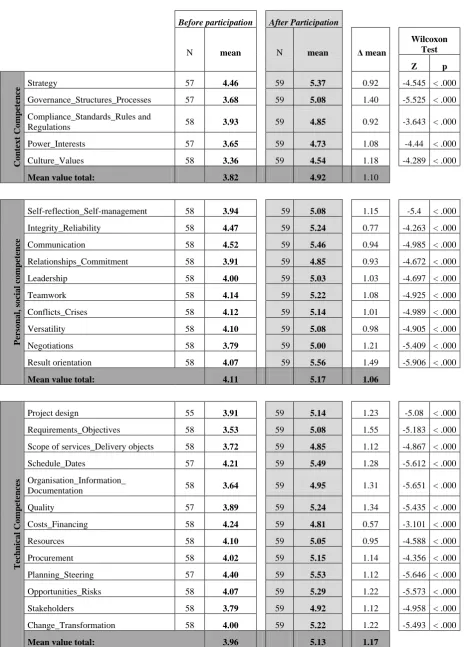
The study uses a questionnaire to investigate the influence of project-oriented teaching and gender on the perceived relevance of competences. The questionnaire collects the gender of the participants and measures the perceived relevance of all 28 competencies according to ICB 4 (see Table 1). The measurement of the relevance is carried out using six-point Likert scales ranged from 1 (completely irrelevant) to 6 (very high relevance).
The participants of the study are students of the bachelor’s program ‘Economy, Health and Sports Tourism’ at the LFU Innsbruck and the UMIT Hall. The study is conducted as part of the oriented course ‘Strategic Business Management’. In order to examine the influence of project-orientated teaching on the participants' perception of relevance, the survey is conducted at the beginning and end of the seminar, which allows the investigation of differences before and after participation. Both surveys are conducted in hardcopy form on the premises of the university.
Due to the organisation of the Likert scales, the gathered data can be regarded as quasi-metric, which why the study uses the arithmetic mean as a measure for central tendencies (Uhlemann 2014). The study further utilises the nonparametric tests Wilcoxon for related samples and Mann-Whitney U for independent samples to investigate significant differences. These tests are used in particular for ordinal data or in cases where interval data do not approximate a normal distribution (Janssen & Laatz 2010). Although the gathered data can be regarded as quasi-metric, the Kolmogorov-Smirnov test and the analysis of histograms show no normal distribution. The selected significance level is 0.05, i.e. if p is less than 0.05, there is a significant difference between the samples. However, if p exceeds 0.05, no significant difference exists. The data analysis is conducted with SPSS and R.
4. RESULTS AND DISCUSSION
4.1 Demographics
All students present took part in the poll. In total, 58 surveys were carried out at the beginning and 59 at the end of the course. Except for 8 missing assessments of competences in the first survey, all data could be used for evaluation and analysis. In the first survey, 62% of the participating students were female, and 38% male and the average age was 21.03 years. In the second survey, minor changes resulted from the additional data set. 61% of the participants were female, and 39% male. The average age was 21.36 years. Over 90% of the students were in the second semester.
4.2 Student’s perception of the relevance of competences
Page 327
Before participation After Participation
N mean N mean Δ mean
Wilcoxon Test
Z p
Con
tex
t
Comp
ete
nce
Strategy 57 4.46 59 5.37 0.92 -4.545 < .000
Governance_Structures_Processes 57 3.68 59 5.08 1.40 -5.525 < .000
Compliance_Standards_Rules and
Regulations 58 3.93 59 4.85 0.92 -3.643 < .000
Power_Interests 57 3.65 59 4.73 1.08 -4.44 < .000
Culture_Values 58 3.36 59 4.54 1.18 -4.289 < .000
Mean value total: 3.82 4.92 1.10
Pe
rsonal,
s
oci
al
com
pete
nc
e
Self-reflection_Self-management 58 3.94 59 5.08 1.15 -5.4 < .000
Integrity_Reliability 58 4.47 59 5.24 0.77 -4.263 < .000
Communication 58 4.52 59 5.46 0.94 -4.985 < .000
Relationships_Commitment 58 3.91 59 4.85 0.93 -4.672 < .000
Leadership 58 4.00 59 5.03 1.03 -4.697 < .000
Teamwork 58 4.14 59 5.22 1.08 -4.925 < .000
Conflicts_Crises 58 4.12 59 5.14 1.01 -4.989 < .000
Versatility 58 4.10 59 5.08 0.98 -4.905 < .000
Negotiations 58 3.79 59 5.00 1.21 -5.409 < .000
Result orientation 58 4.07 59 5.56 1.49 -5.906 < .000
Mean value total: 4.11 5.17 1.06
Tec
hn
ic
al
Comp
ete
nces
Project design 55 3.91 59 5.14 1.23 -5.08 < .000
Requirements_Objectives 58 3.53 59 5.08 1.55 -5.183 < .000
Scope of services_Delivery objects 58 3.72 59 4.85 1.12 -4.867 < .000
Schedule_Dates 57 4.21 59 5.49 1.28 -5.612 < .000
Organisation_Information_
Documentation 58 3.64 59 4.95 1.31 -5.651 < .000
Quality 57 3.89 59 5.24 1.34 -5.435 < .000
Costs_Financing 58 4.24 59 4.81 0.57 -3.101 < .000
Resources 58 4.10 59 5.05 0.95 -4.588 < .000
Procurement 58 4.02 59 5.15 1.14 -4.356 < .000
Planning_Steering 57 4.40 59 5.53 1.12 -5.646 < .000
Opportunities_Risks 58 4.07 59 5.29 1.22 -5.573 < .000
Stakeholders 58 3.79 59 4.92 1.12 -4.958 < .000
Change_Transformation 58 4.00 59 5.22 1.22 -5.493 < .000
Mean value total: 3.96 5.13 1.17
Page 328 4.3 Gender-specific differences
Table 3 compares the results of the responses of women and men obtained from the two surveys. Before and after participation in the course, the female participants perceive almost all competences more relevant than the male participants in the mean. In the survey before participating in the course, the female students rated the competence 'communication' most relevant. The male participants perceived the competence 'integrity and reliability" most importantly. In the survey after participation in the course, both female and male participants rated the competence 'result orientation' most relevant.
Before Participation After Participation
female participants male participants female participants male participants
N mean N mean
Mann-Whitney
U test N mean N mean
Mann-Whitney U test
U p U p
C o nte x t comp etenc
e Strategy 35 4.69 22 4.09 236.5 0.0055 35 5.49 24 5.21 354.5 0.2507
Governance_Structures_
Processes 35 3.89 22 3.36 273.5 0.0535 35 5.34 24 4.71 238.5 0.0026
Compliance_Standards_
Rules and Regulations 36 4.06 22 3.73 322.0 0.2125 35 5.03 24 4.58 307.5 0.0692
Power_Interests 35 3.74 22 3.50 324.5 0.2948 35 4.86 24 4.54 358.0 0.3055
Culture_Values 36 3.36 22 3.36 378.0 0.7576 35 4.71 24 4.29 326.0 0.1241
P ers o na l. so ci a l c o m petence
Self-reflection_Self-management 36 3.94 22 3.93 391.5 0.9408 35 5.14 24 5.00 354.5 0.2507
Integrity_Reliability 36 4.56 22 4.32 294.5 0.0655 35 5.43 24 4.96 238.5 0.0026
Communication 36 4.72 22 4.18 283.0 0.0306 35 5.51 24 5.38 307.5 0.0692
Relationships_
Commitment 36 4.00 22 3.77 338.0 0.3192 35 4.97 24 4.67 358.0 0.3055
Leadership 36 4.19 22 3.68 279.0 0.0450 35 5.17 24 4.83 326.0 0.1241
Teamwork 36 4.36 22 3.77 239.0 0.0073 35 5.40 24 4.96 354.5 0.2507
Conflicts_Crises 36 4.25 22 3.91 322.0 0.2018 35 5.23 24 5.00 238.5 0.0026
Versatility 36 4.14 22 4.05 362.5 0.5581 35 5.14 24 5.00 307.5 0.0692
Negotiations 36 3.97 22 3.50 288.0 0.0667 35 5.23 24 4.67 358.0 0.3055
Result orientation 36 4.22 22 3.82 270.0 0.0313 35 5.66 24 5.42 326.0 0.1241
Techni ca l C o m pet ence
Project design 35 4.03 20 3.70 288.5 0.2352 35 5.29 24 4.92 314.0 0.0701
Requirements_Objectives 36 3.81 22 3.09 226.5 0.0041 35 5.26 24 4.83 332.0 0.1421
Scope of services_Delivery
objects 36 3.81 22 3.59 339.0 0.3296 35 4.83 24 4.88 402.0 0.7665
Schedule_Dates 35 4.46 22 3.82 217.5 0.0032 35 5.63 24 5.29 298.0 0.0315
Organisation_Information_Do
cumentation 36 3.75 22 3.45 334.0 0.2830 35 5.00 24 4.88 391.5 0.6325
Quality 35 3.94 22 3.82 336.5 0.3912 35 5.29 24 5.17 387.0 0.5752
Costs_Financing 36 4.50 22 3.82 236.0 0.0053 35 4.74 24 4.92 409.5 0.8645
Resources 36 4.39 22 3.64 207.0 0.0013 35 5.09 24 5.00 406.0 0.8138
Procurement 36 4.39 22 3.41 165.0 0.0001 35 5.17 24 5.13 412.5 0.8996
Planning_Steering 35 4.57 22 4.14 281.0 0.0473 35 5.60 24 5.42 364.0 0.3209
Opportunities_Risks 36 4.08 22 4.05 358.5 0.5183 35 5.46 24 5.04 316.5 0.0792
Stakeholders 36 4.00 22 3.45 284.5 0.0616 35 5.17 24 4.54 256.0 0.0068
Change_Transformation 36 4.19 22 3.68 275.0 0.0410 35 5.34 24 5.04 341.0 0.1870
Page 329 4. CONCLUSION
The present study investigates the influence of project-oriented learning and gender on the perception of the relevance of project management-specific competencies. The results provide empirical evidence that all competencies are assessed more relevantly after participation in the project-oriented course. Hence, it can be concluded that project-oriented teaching is capable of increasing the perception of relevance. Personal and social as well as technical competencies are assessed the most important. Context competences, on the other hand, are considered to be relatively less relevant. Based on the results, there are several opportunities for possible developments in project-oriented teaching. As personal and social competencies are considered to be particularly relevant, they should be intensively addressed and regularly reflected upon. This could not only lead to a more intensive learning process, but also to a higher motivation of the participants. In the case of technical competences, a similar effect could be achieved by integrating further teaching methods. For example, small case studies could specifically support the acquisition of individual competencies. With regard to the lower assessed relevance of context competences, their importance should be shown more clearly in project-oriented teaching. This can take place in the context of the projects or also in the form of short lectures. The second is recommended if it is not or only with difficulty possible to depict the individual competencies within the framework of the projects.
Numerous studies show that women and men differ in leadership and management style. Women regularly focus more on social and interpersonal aspects. The results of the present work indicate gender-specific differences in the perception of relevance. Women assess almost all of the 28 examined competences more relevant than men. 11 differences in the first survey and 6 differences in the second survey were statistically significant. Most of them exist in the area of 'social and personal competencies' as well as in the area of 'technical competencies'. Thus, the results can support the findings of previous studies on the existence of gender-specific differences and women's focus on social aspects. In addition, this study indicates that women also give higher priority to technical skills in some cases. Significant differences were observed, among others, in the competencies 'Schedule and Dates' and 'Planning and Steering'. This may lead to the assumption that women in project management concentrate more on time management and the organisation and implementation of processes than men. Based on the results, special attention should be paid in project-oriented teaching to a balanced composition of the project groups in terms of gender. Also, regular reflection and evaluation of competencies should be carried out.
A limitation of this study is that the participants had no or little experience in project management. The results could change as experience increases. Future studies should, therefore, involve both participants with little and participants with much experience in order to examine the influence of experience on the perception of relevance.
REFERENCES
WYSOCKI, R. K., 2019. Effective Project Management: Traditional, Agile, Extreme, Hybrid: Wiley. DIN Deutsches Institut für Normung e. V., 2009. Projektmanagement - Projektmanagementsysteme - Teil 5: Begriffe (DIN 69901-5).
BECKER, W., and HOFMANN, M., 2010. Projektmanagement in deutschen Unternehmen. Controlling, 22(10), 557–564.
PFETZING, K., and ROHDE, A., 2009. Ganzheitliches Projektmanagement. Berlin: Schmidt.
HEYSE, V., and ERPENBECK, J., 2009. Kompetenztraining. 64 modulare Informations- und Trainingsprogramme für die betriebliche, pädagogische und psychologische Praxis. 2nd ed. Aufl. Stuttgart: Schäffer-Poeschel.
Page 330
JUNGMANN, T., KÜHN, F., and NIMSCH, C., 2010. Forschendes Lernen im industriellen Projektmanagement. Zeitschrift für Hochschulentwicklung, 5(3), 87–104.
PATZAK, G., and RATTAY, G., 2014. Projektmanagement. Projekte, Projektportfolios, Programme und projektorientierte Unternehmen. 6., wesentlich erweiterte und aktualisierte Auflage. Wien: Linde Verlag Ges.m.b.H. (Linde international).
INTERNATIONAL PROJECT MANAGEMENT ASSOCIATION (IPMA), 2015. Individual
Competence Baseline für Projektmanagement (ICB) 4. Available at:
<https://www.pma.at/files/downloads/98/icb4-fuer-projektmanagement-oesterreichische-fassung-bildschirmoptimiert.pdf> [Accessed 8 July 2019].
STÖHLER, C., FÖRSTER, C., and BREHM, L., 2018. Projektmanagement lehren. Studentische Projekte erfolgreich konzipieren und durchführen. Wiesbaden: Springer Gabler.
STÖHLER, C., 2017, Wie reagieren Hochschulen auf die Nachfrage von Absolventen mit Projektmanagement-Kompetenzen?. Die neue Hochschule (DNH), Fachzeitung des Berufsverbands der Professorinnen und Professoren an deutschen Fachhochschulen, 6, 22-25.
LIEBEHENSCHEL, J., 2013. Software-Engineering Projekte in der Ausbildung an Hochschulen - Konzept, Erfahrungen und Ideen. In: A. SPILLNER and H. LICHTNER, ed. Proceedings of the 13th Workshop on Software Engineering im Unterricht der Hochschulen (SEUH 2013). vol. 956, pp. 27– 34.
STÖHLER, C., 2018, Vermittlung von Projektmanagement-Kompetenzen im Studium. erleben&lernen, 3(4), 42-47.
KRUSE, E., 2009, Projektstudium und Praxisbezüge im Bologna-Prozess - Reform der Reform?. Sozial Extra, 33(1), 42-47.
GUDJONS, H., 1984. Was ist Projektunterricht? Begriff - Merkmale - Abgrenzungen. WPB, 36(6), 260–266.
GUDJONS, H., 1998. Was ist Projektunterricht?. In: J. BASTIAN and H. GUDJONS, ed. Das Projektbuch. Hamburg: Bergmann und Helbig, pp. 14-27.
HÄNSEL, D., 1988. Was ist Projektunterricht, und wie kann er gemacht werden?. In: D. HÄNSEL and H. MÜLLER, ed. Das Projektbuch Sekundarstufe. Weinheim/Basel: Beltz, pp. 13-45.
LIZZIO, A., and WILSON, K., 2004. First‐year students' perceptions of capability. Studies in Higher Education, 29(1), 109–128.
BERGEN, D. J., and WILLIAMS, J. E., 1991. Sex stereotypes in the United States revisited: 1972– 1988. Sex Roles, 24(7), 413–423
DEAUX, K., and MAJOR, B., 1987. Putting gender into context: An interactive model of gender-related behavior. Psychological Review, 94(3), 369–389.
BISCHOFF, S., 2010. Wer führt in die Zukunft: Männer und Frauen in Führungspositionen der Wirtschaft in Deutschland – die 5. Studie. Bielefeld: W. Bertelsmann Verlag.
KRISPEL, A., 2017. Sozial-kommunikative Kompetenzen von Führungskräften: danzig & unfried. AINSWORTH, E., AINSORTH, M., n.d. Gender and 360 feedback - Talent Innovations. Available at: <http://360.talentinnovations.com/gender-360> [Accessed 8 July 2019].
DUONG, T., and SKITMORE, M., 2003. Female Project Managers´ Workplace Problems: A survey. Journal of Women and Minorities in Science and Engineering, 9, 1–29.
Page 331
CHIPULU, M., OJIAKO, U., GARDINER, P., WILLIAMS, T., MOTA, C., MAGUIRE, S., SHOU, Y., STAMATI, T., and MARSHALL, A., 2014. Exploring the impact of cultural values on project performance. International Journal of Operations & Production Management, 34(3), 364–389. KARCH, D.M., 2012. Gender-based comparison of project manager leadership behaviors: A quantitative study. Capella University.