Page 350
DIFFERENCE BETWEEN COGNITIVE DEVELOPMENTS OF DEPARTMENT OF ARCHITECTURE AND DEPARTMENT OF MECHANICAL ENGINEERING STUDENTS
N. Aslı Kaya, Şeniz Çıkış
Izmir Institute of Technology, Turkey
Abstract
It is well known that cognitive stages can be improved by education. In the light of this knowledge, the purpose of this study was to understand whether education philosophies have an effect on cognitive stages development. To achieve this purpose, two design based disciplines which have been rooted different philosophical perspectives were designated to collect data. The first one is Department of Architecture, represents constructivist education philosophy and the second one is Department of Mechanical Engineering represents traditional education philosophy.
A sample of 42 students, whom enrolled first and last grades of the departments, voluntarily participated in the study. Participants were asked to answer Social Paradigm Belief Inventory (SPBI) to determine their cognitive stages, and by the comparison of results according to grades and disciplines, it is found that there is a slight, yet significant difference between the cognitive developments of students, favour to Department of Architecture. So, it is concluded that educational philosophies might have effect on cognitive development on behalf of constructivist education philosophy.
Key words: Cognition, Design Education, Social Paradigm Belief Inventory (SPBI), educational philosophies
1. INTRODUCTION
Design problems are always complex, ill-defined and multi-layered. Thus, to solve a design problem, one should employ higher thinking skills than formal thought besides creative and unique approaches. As Rittel and Webber (1973) states, these “wicked problems” cannot be formulated and tested in laboratories, every single problem might have more than one solution and explanations, and even more they might be symptoms of other problems. Also Schön (1983) claims that because of design problems are outputs of problematic cases; structurally they are puzzling, troubled and dubious. So, design is an approach to solving problems where the variables are complex, the data is incomplete, and the outcome is uncertain. Therefore, the nature of design knowledge is both tacit and explicit. Because of the tacit part of design knowledge, creativity is associated with design practice. As Cross (2007) highlights, the “mysterious, creative part of designing” is the ability of identifying the problem, estimating outputs of possible design solutions and employing different kind of reasoning than common. In other words, creativity plays a crucial role in every step of designing process. That is why one of the crucial aims of design education is teach how to think different.
Page 351
In modern societies education is carried according to curriculums. Curriculums are the conceptualizations of what to teach and how to teach within education objectives, and serve as an action plan for teachers. Goodlad (1984) states that epistemology is the keystone of curriculum designs as it is the main determiner of educational objectives, materials and outcomes. Design education is not independent from epistemology, and destined to seek answers of questions as; “what is design knowledge?”, “how should design be known and understood?” and “how shall we decide what to teach?” according to philosophical paradigms. Inevitably, design education has affected different philosophical paradigms and there is no study to reveal which one is more successful on developing cognitive stages. Hence, the purpose of this study was to compare success of education philosophies in design education on cognitive stages developments, and to find answer of what is the role of education philosophies on developing cognitive stages and creativity question.
2. DESIGN EDUCATION
When literature is reviewed, it can be seen that subjectivism, positivism and constructivism had an effect upon design education as philosophical paradigms.
In design education, echoes of subjectivism can be traced on apprenticeship and art education. According to Subjectivism truth cannot be analysed in laboratories and test tubes because of it is dependent to individual’s mind and subjective experiences. Researchers, such as Paul Feyerbend, Christopher Frayling, Harry Collins, Berto Pandolfo, Erik Bohemia and Kerry Harman, supported subjectivism in design education due to similarities between subjectivism and design activity by pointing that it cannot be tested since it is an individual activity that takes place inside a person’s head, and designers deal with real world problems which closely connected to subjective experiences. Thus, design education should be constructed on personal, practice-based, subjective knowledge. Subjectivist education based on encouraging students to progress and create their own subjective knowledge, and does not seek to teach. So, education can be independent from a plan what to teach and how to teach. According to Friedman (1997), this kind of craft education is a problem for design because it leads future designers to design unrealistic and impractical products such as “teapots that don’t pour; tea kettles that burn the hand when they do pour; cups that deny the physics of liquids; chairs that tip over; furniture that induces physical stress; knives that can’t be held safely when cutting; lemon squeezers that send as much liquid down the decorative legs of the utensil as into the juice cup; and so on.” By facing these problems and accepting the lack of subjectivist educational view point, design education shifted to positivism with the efforts of settling design on inquiry-based problem-solving process.
Page 352
Like subjectivism, positivist approaches on design education fall short to fulfil design’s needs, such as presenting unique solutions and designing methods, socially and aesthetically rich artefacts and iterative characteristic of design activity. With the Wang’s (2010) words “the creative ‘leap in the dark’ is the core experience of design studio” and the positivist paradigm fails to explain this “irrational” activity. Thus, positivism could not have solely domination in design research and education. Although there are courses mainly rooted to positivism and mostly borrowed from engineering education, such as ergonomics, statics, materials and structures, the core of design education is still design studios where the actual design practice is learned.
As a distinctive pedagogical approach, design studios are unique rituals in design education. Nigel Cross states that even though technical information and technical rationality are constituents of design activity, the core of it is design studios. Therefore, according to him, the will of “scientizing” design can be achieved by employing different kind of approaches where solving formed and well-defined problems of messy and complex situations are possible. Thus, the epistemology of design should be different from epistemology of science. Owing to this approach, design researchers, such as Cross, Tjalve, Hubka, Pahl and Beitz, Julier and French, developed successful scientific design methods and deepened design culture especially in all design disciplines.
By basing on the idea that knowledge construction can be achieved by participating actively and learning by experiences, design culture is grounded to constructivist approaches (Feast and Melles, 2010). Because of this overlapping foundations between design and constructivism, besides having many other similar characteristics like hands-on, experiential, collaborate, project-based and tasked-based learning styles, design education has been influenced by constructivist education approaches a lot. According to Cross (2001), these characteristics are the founders of designerly ways of knowing and best definition of this knowledge domain is Donald Schön’s “epistemology of practice” (1983). Like Cross, Schön (1983, 1987, 1992a, 1992b) also rejects technical rationality and positivism in design and supports constructivism by echoing John Dewey’s, a famous writer and researcher in constructivist education field, ideas on bridging knowledge and practice in education, and balancing theory and practice. In the view of such approaches, Schön (1983) founded a new theory, Reflection in Action, and qualified design learning as reflective practice where the experiences and knowledge acquired during design process are shared. According to Schön (1987), design teachers cannot transmit design knowledge it forthrightly because it is tacit, but reflect it, by reflection-on-action and reflection-in-action methods. As his reflection is a kind of dialect between student and teacher this activity effects both of their knowledge and enhance it mutually. This knowledge is called knowledge-in-action. Yet, this knowledge is still tacit, so teacher and student should speak design language, where words are blended with drawings. But this language should be created with a post-formal manner due to tacitness and abstraction level of it, besides thinking design as an integrated whole system. Therefore, student should be cognitively ready to understand this language and making moves within the compass of wholeness. According to Piaget (1958) thinking as whole starts at late formal thought stages and according to Commons and Ross (2008) can only practice at post-formal thought stage.
3. POST-FORMAL THOUGHT
Page 353
Commons et al (2008) call the subsequent levels of formal operational stage as post-formal thinking levels, and according to them the skills gained at these levels are more successful at problem finding, problem reconstruction and problem solving. At design problem solving process, defining design problem and identifying the constituents of it have critical importance to successfully reach to a solution (Schön, 1983). At post formal thought stages individuals can re-construct problems according to solution possibilities and this characteristic allows to individual deal with complexness of ill-defined problems.
There are two types of thinking in post-formal thought stage. First of them is relativistic thinking and individuals acquire skills of viewing a case from many perspective, and comparing multiple views according to relevance to the problem. These characteristics of relativistic thinking are answers of design’s rigour vs. relevance (Schön, 1983) dilemma. Acoording to Schön (1983) dilemma of rigor or relevance arises from the insistence on to solve real-life problems in closed-systems by applying technical knowledge which constituted by researched based theory and techniques to ill-defined problems, yet ill-defined problems cannot be solved adequately in closed systems. Unlike positivisms rigid and linear reasoning approach, constructivist reasoning ground on relativism and congruence which allows working with open-systems and enables thinking more complex and creative. Thus, relativistic thinking can be accepted as a source of greater diversity and novelty (Wu and Chiou, 2008).
Second type of thinking in post-formal thought stage is dialectical thinking. While dialectically thinking, individual aware it is an evolution process of conceptual wholeness and its constituents (Basseches, 1989). This awareness let individual crack the case open, break with traditional ways of problem solving, and act more creatively. As another characteristic of dialectical thinking, individual can assess the problems from different perspectives and she can compare and contrast potential solutions according to these assessments.
When reflective and dialectical thinking are employed simultaneously individual is able to reconstruct problems, compare and contrast possible solutions, synthesize new systems from prescribed ones, integrate contradictory cases by evaluate problems from different perspectives, and hence she can produce truly creative innovations. These are also the goals of design education, thus it can be inferred that students’ cognitive levels and creativeness are closely connected to philosophy of education which has a huge impact on cognitive developments, and educating students to be post-formal thinkers is should be one of the main goals of design education.
4. CASE STUDY
Two different departments which are both of involving design domain were chosen to collect data, in order to represent two different education philosophies. The first one is Department of Architecture, represents constructivist education philosophy and the second one is Department of Mechanical Engineering represents traditional education philosophy. A sample of 42 students, whom enrolled Department of Architecture and Department of Mechanical Engineering first and last grades, participated in the study.
Page 354
Absolute Statement: You can know a person completely. This is because after a long enough time a person's real self emerges; allowing you to see what makes him or her tick.
Relativistic Statement: You cannot know a person completely. This is because a person seems different all the time depending on what part of him or her you look at.
Dialectic Statement: You cannot know a person completely. This is because getting to know a person in a particular way means not getting to know him or her in some other way.
Separate scores were computed for the number of statements chosen. Participants were given one point for an absolute statement, two points for a relativistic statement and three points for a dialectical statement where 1 is formal thinking stage - absolute thinking sub-stage, 2 is post-formal stage - relativistic thinking sub stage and 3 is post-formal stage - dialectical thinking sub stage. After the scores summed, means were calculated. Data summarised and analysed with the aid of the SPSS v13 software on a desktop computer.
5. RESULTS AND DISCUSSION
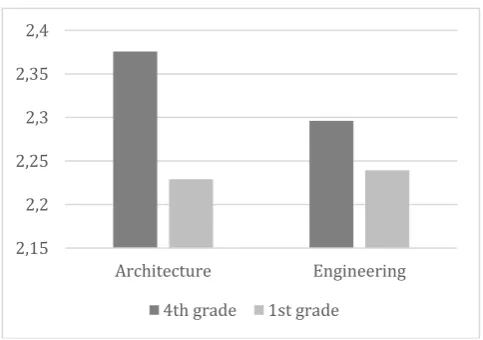
Department of Architecture and Department of Mechanical Engineering first and last grades students’ SPBI scores are given in Table 1.
SPBI N Std. Deviation
Architecture 1st grade 2.2290 10 .12297 Architecture 4th grade 2.3757 7 .08121
Engineering 1st grade 2.2393 15 .15140 Engineering4th grade 2.2960 10 .11413
Table 1. Detailed number of students and their mean scores of SPBI
As scores close to 1 point shows tendencies towards to formal thinking, scores close to 2 points shows tendencies towards to relativistic thinking and scores close 3 shows tendencies towards to dialectical thinking, when scores compared it can be conclude that all participants tend to think relativistic and all of them are post-formal thinkers.
SPBI N Std. Deviation
Architecture 1st grade 2.2290 10 .12297 Engineering 1st grade 2.2393 15 .15140
Table 2. First graders mean scores of SPBI
Page 355
SPBI N Std. Deviation
Engineering4th grade 2.3757 7 .08121 Architecture 4th grade 2.2960 10 .11413
Table 3. Last graders mean scores of SPBI
After completing four years design education in different disciplines, which are rooted different education philosophies, while architecture students perform 0.1467 points improvement on their thinking levels in total, the difference between mechanical engineering first and last grade students remains at 0.0567 points. This thinking level improvement difference between architecture students and mechanical engineering students shows that architecture education contributes 2.6 times more than mechanical engineering students on cognitive developments of students.
Figure 1. Graphical comparison of SPBI scores
As stated in detail before, higher thinking levels, especially relativistic and dialectical thinking, leads individuals to be more creative, and by education students’ cognitive developments can be fostered. So, it can be expected that education philosophies might affect students’ creativity indirectly. When all the results of this study are reviewed it can be conclude that architecture education have more impact on students’ cognitive developments, and by taking into account architecture education roots to constructivist education philosophy, it can be stated that constructivist education philosophy contributes more on students’ cognitive development than positivist education philosophy. Therefore, constructivist education philosophy might be more successful on fostering creativity than positivist education philosophy.
2,15 2,2 2,25 2,3 2,35 2,4
Architecture Engineering
Page 356 REFERENCES
Basseches, M. 1989, ‘Dialectical thinking as an organized whole: Comments on Irwin and Kramer.’ in M. L. Commons, J. D. Sinnott, F. A. Richards, & C. Armon (Eds.), Adult development: Comparisons and applications of developmental models, New York: Praeger, pp. 161-178.
Commons, M. L, Bresette L. M., & Ross S. N. 2008, ‘The Connection Between Postformal Thought and Major Scientific Innovations, World Futures.’ The Journal of Global Education, 64:5-7, p. 504
Cross, N. 2007, Designerly Ways of Knowing. Birkhauser.
Feast, L. & Melles, G. 2010, ‘Epistemological Positions in Design Research: A Brief Review of the Literature.’ 2nd International Conference on Design Education. Unıversity Of New South Wales, Sydney, Australia, 28 June - 1 July 2010.
Friedman, K. 1997, ‘Design Science and Design Education.’ in Peter McGrory (Eds.), Challenge of Complexity Helsinki: University of Art and Design Helsinki UIAH, pp. 54-72.
Goodlad, J. I. 1984, ‘Placed called school.’ New York: McGraw Hill Co.
Kramer, D. A., Kahlbaugh, P. E., & Goldston, R. B. 1992, ‚A measure of paradigm beliefs about the social world.’ Journal of Gerontology 47 180-189.
Lawson, B. (2006). How Designers Think. Oxford UK: Architectural Press/Elsevier. P. 155
Mellou, E. 1996, ‘Can Creativity Be Nurtured in Young Children?’ Early Child Development and Care, v119 p119-130
Piaget, J. 1958, Growth of logical thinking from childhood to adolescence. Basic Books: New York
Rittel H & Webber M. 1973, ‘Dilemmas in a General Theory of Planning.’ Policy Sciences Vol.4: 155–169
Salama, A. 1995, New trends in architectural education. NC, USA: Tailored Text & Unlimited Potential Publishing.
Schön, D. A. 1983, The Reflective Practitioner: How Professionals Think in Action, New York, Basic Books.
Schön, D. A. 1987, Educating the Reflective Practitioner: Toward a New Design for Teaching and Learning in the proffessions. San Francisco, Jossey-Bass
Schön, D. A. 1992, ‘Designing as Reflective Conversation with the Materials of a Design Situation.’ Research in Engineering Design 3:131-147
Wang, T. 2010, ‘A new paradigm for design studio education.’ International Journal of Art & Design Education Volume 29, Issue 2, pages 173–183