https://doi.org/10.5194/amt-11-5153-2018 © Author(s) 2018. This work is distributed under the Creative Commons Attribution 4.0 License.
Constructing a precipitable water vapor map from regional
GNSS network observations without collocated
meteorological data for weather forecasting
Biyan Chen1,2,3, Wujiao Dai1,2,3, Zhizhao Liu4, Lixin Wu1,3, Cuilin Kuang1,2,3, and Minsi Ao5 1School of Geosciences and Info-Physics, Central South University, Changsha, Hunan, China
2Key Laboratory of Precise Engineering Surveying and Deformation Disaster Monitoring of Hunan Province, Changsha, Hunan, China
3Key Laboratory of Metallogenic Prediction of Nonferrous Metals and Geological Environment Monitoring Ministry of Education, School of Geosciences and Info-Physics, Central South University, Changsha, Hunan, China
4Department of Land Surveying and Geo-Informatics, Hong Kong Polytechnic University, Hong Kong, China 5Hunan Province Mapping and Science and Technology Investigation Institute, Changsha, Hunan, China Correspondence:Biyan Chen ([email protected])
Received: 17 March 2018 – Discussion started: 2 May 2018
Revised: 21 August 2018 – Accepted: 22 August 2018 – Published: 11 September 2018
Abstract.Surface pressure (Ps)and weighted mean temper-ature (Tm)are two necessary variables for the accurate re-trieval of precipitable water vapor (PWV) from Global Navi-gation Satellite System (GNSS) zenith total delay (ZTD) es-timates. The lack of Ps orTm information is a concern for those GNSS sites that are not collocated with meteorological sensors. This paper investigates an alternative method of in-ferring accuratePsandTmat the GNSS station using nearby synoptic observations.PsandTmobtained at the nearby syn-optic sites are interpolated onto the location of the GNSS sta-tion by performing both vertical and horizontal adjustments, in which the parameters involved inPsandTmcalculation are estimated from ERA-Interim reanalysis profiles. In addition, we present a method of constructing high-quality PWV maps through vertical reduction and horizontal interpolation of the retrieved GNSS PWVs. To evaluate the performances of the Ps andTmretrieval, and the PWV map construction, GNSS data collected from 58 stations of the Hunan GNSS network and synoptic observations from 20 nearby sites in 2015 were processed to extract the PWV so as to subsequently gener-ate the PWV maps. The retrievedPsandTmand constructed PWV maps were assessed by the results derived from ra-diosonde and the ERA-Interim reanalysis. The results show that (1) accuracies ofPs andTm derived by synoptic inter-polation are within the range of 1.7–3.0 hPa and 2.5–3.0 K, respectively, which are much better than the GPT2w model;
(2) the constructed PWV maps have good agreements with radiosonde and ERA-Interim reanalysis data with the over-all accuracy being better than 3 mm; and (3) PWV maps can well reveal the moisture advection, transportation and con-vergence during heavy rainfall.
1 Introduction
While GNSS signals are transmitted from satellites to ground receivers, they are delayed by the terrestrial tropo-sphere. In GNSS data processing, the tropospheric delay is usually expressed as the zenith total delay (ZTD) multiplied by a mapping function, and sometimes plus horizontal gra-dients for a better GNSS positioning performance (Lu et al., 2016). The accuracy of the GNSS ZTD estimates depends on the data processing strategies and on the global prod-ucts used in the processing. At present, ZTDs are likely to be determined with accuracies up to several millimeters by a wide range of GNSS processing software (Pacione et al., 2017; Yuan et al., 2014). ZTD is normally divided into two parts: the zenith hydrostatic delay (ZHD) which is caused by the dry gases of the troposphere and the zenith wet de-lay (ZWD) which stems from the water vapor. The ZHD can be accurately calculated using empirical models with surface pressure (Ps)measured by meteorological sensors (Saasta-moinen, 1972). ZWD is readily obtained with the subtraction of ZHD from ZTD. The precipitable water vapor (PWV) can then be retrieved from ZWD with a conversion factor which is a function of the weighted mean temperature (Tm).Tmcan be calculated by numerical integration from the vertical pro-files of atmospheric temperature and humidity (Davis et al., 1985). PWV is a key parameter in studying water vapor vari-ations during severe weather phenomena, since it can reflect the inflow and outflow of water vapor in a vertical air column above a certain area (Yao et al., 2017).
As stated above, the retrieval of PWV from GNSS ZTD needs two key meteorological parameters: Ps andTm. The first choice is to measure thePs by a barometer collocated at the GNSS station. However, a large number of GNSS stations have been deployed for positioning purposes and are not equipped with collocated meteorological sensors. In this case, one may use pressure derived from a global atmo-spheric reanalysis (Dee et al., 2011; Zhang et al., 2017), inter-polated from nearby meteorological observations (Alshawaf et al., 2015; Musa et al., 2011; Wang et al., 2007) or pre-dicted by a blind model (Boehm et al., 2015; Wang et al., 2017). For Tm, since the temperature and humidity profiles are very difficult to obtain, particularly in a near-real-time mode,Tm has to be calculated from a model. An empirical Tmmodel dependent on surface temperature (Ts)(Bevis et al., 1994; Li et al., 2018) or a blind model developed from atmospheric reanalysis products (Boehm et al., 2015; Yao et al., 2013; Zhang et al., 2017) is often employed.
The work presented in this paper is carried out for con-structing high-quality PWV maps by a regional GNSS net-work in the Hunan Province, China, for precipitation fore-casts and analysis. The constructed high-quality PWV maps will also be of significant value for monitoring and early warning of geological disasters, such as landslides and debris flows. In such a near-real-time application, the use of reanal-ysis products is not feasible.PsandTmhave to be determined only using a blind model or nearby surface synoptic stations. The use of blind models is a very convenient means;
how-ever, most blind models (e.g., global pressure and tempera-ture 2 wet, GPT2w; Boehm et al., 2015) are developed at a global scale and are not likely to capture regional small-scale variations. More accuratePsandTmcould be achieved by in-terpolation from nearby meteorological observations if they can be accessed simultaneously. In this study, we investigate the construction of PWV maps from GNSS observations over the Hunan Province by performing the following five tasks: (1)Tm–Ts relationship and vertical reduction models forPs andTmare developed for each synoptic station; (2)PsandTm data interpolated by nearby meteorological observations are compared with those derived from radiosonde and GPT2w models; (3) a PWV vertical reduction model is developed for each GNSS station; (4) a PWV interpolation is performed over the whole Hunan region and evaluated by radiosonde and European Centre for Medium-Range Weather Forecasts (ECMWF) ERA-Interim reanalysis (hereafter abbreviated as ERA-I); and (5) the water vapor variation during a heavy rain event that occurred over a wide range of Hunan is examined based on PWV maps.
This paper is organized as follows. Section 2 presents the study area and the datasets used in the study. Section 3 de-scribes the methodology to retrieve PWV from GNSS data. The strategy for meteorological data interpolation,Tm mod-eling and PWV interpolation is also presented in this section. The assessment ofPsandTminterpolated by nearby synop-tic observations is described in Sect. 4. The PWV maps con-structed by GNSS data and PWV evolution during a heavy rain event are also presented in Sect. 4. The summary and conclusions are given in Sect. 5.
2 Study area and data description
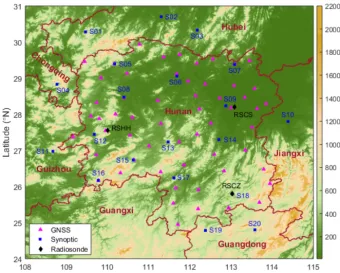
Figure 1.Geographic distribution of GNSS, synoptic and radiosonde stations in Hunan and surrounding provinces.
interval of 30 s. In this study, the ZTDs are estimated us-ing a GNSS precise point positionus-ing (PPP) technique with the Bernese 5.2 software (Dach et al., 2015). To examine their performance in real-time applications, IGS (Interna-tional GNSS Service) ultra-rapid satellite orbit data and clock corrections are adopted in PPP processing. The ZTDs are estimated with an interval of 30 min, whilst the horizon-tal gradients are estimated every 12 h. The global mapping function (GMF) is used (Boehm et al., 2006) in the esti-mation, and GNSS observations with elevation angles be-low 5◦ are rejected. Evaluation results show that our esti-mated ZTDs have an accuracy of ∼9 mm in the compari-son by radiocompari-sonde-measured ones. However, some stations in the Hunan GNSS network are not collocated with me-teorological sensors; thus, they cannot be directly used for water vapor monitoring. Except the Hunan GNSS network, there are many GNSS stations without meteorological obser-vations distributed across the province, which could be in-cluded for enhancing the quality of constructed PWV maps in the future. Therefore, a strategy of using nearby synoptic observations is needed to acquire the necessary meteorologi-cal parameters for GNSS PWV retrieval. As shown in Fig. 1, a total of 20 synoptic sites situated in Hunan and surrounding provinces can be used for this study. The average distance be-tween a synoptic station and a GNSS station is about 41 km. The 6-hourly pressure and temperature data measured at the synoptic sites can be retrieved from the National Center for Atmospheric Research (NCAR) (http://rda.ucar.edu/datasets/
ds336.0/, last access: March 2018). For real-time applica-tions, pressure and temperature data at a given epoch are ex-trapolated from empirical models established using the past 20-day data. Here, the four-order Fourier function is adopted for the empirical models. In addition, quality-assured atmo-spheric profiles observed by three radiosonde sites (marked with black diamonds in Fig. 1) from the Integrated Global Radiosonde Archive (IGRA) (Durre et al., 2006) will be used to evaluate the meteorological data and PWV measurements. Both RSCS and RSCZ stations are equipped with GTS1 ra-diosonde sensors, whilst the type of GZZ2 sensor is adopted by the RSHH station (refer to https://www1.ncdc.noaa.gov/ pub/data/igra/history/igra2-metadata.txt, last access: March 2018).
2.2 ECMWF reanalysis
ERA-Figure 2.Time series of surface pressure provided by radiosonde, synoptic adjustment and GPT2w model over the whole year of 2015 at three radiosonde stations:(a)RSCS,(b)RSCZ and(c)RSHH, all of which are located in the Hunan Province, China.
I provides pressure, temperature, humidity and many other meteorological variables at 37 isobaric levels from 1000 to 1 hPa with a 6 h interval. The reanalysis contains grid prod-ucts with 11 different scales from 0.125◦×0.125◦to 3◦×3◦, and the horizontal resolution of 0.25◦×0.25◦is selected for this study, which equals to about 26 km in Hunan.
2.3 GPT2w model
The global pressure and temperature (GPT) model, which is developed using spherical harmonics (Boehm et al., 2007), can provide pressure and temperature at any site in the vicin-ity of the Earth’s surface. Lagler et al. (2013) significantly improved the GPT model, especially for its spatial and tem-poral variability, and named this new version as GPT2. An extension version called GPT2w was developed by Boehm et al. (2015) with improved capability to determine ZWD in blind mode. Besides the pressure and temperature, the re-fined GPT2w model also provides various parameters such as water vapor pressure, weighted mean temperature and the temperature lapse rate.
3 PWV map construction with GNSS network observations
3.1 Retrieval of PWV from GNSS ZTD
To retrieve PWV from GNSS-inferred ZTD, ZHD should be determined first. The ZHD calculation formula is theoreti-cally derived based on the assumption that the air is an ideal gas and that the troposphere satisfies the hydrostatic equi-librium (Davis et al., 1985). Saastamoinen (1972) derived the most widely used ZHD model as follows (Chen and Liu, 2016a):
ZHD=2.2793Ps/(1−0.0026 cos 2ϕ−0.00028h), (1) whereϕ is the station latitude (unit: radians) and h is the height of the station above sea level (unit: km). By sub-tracting ZHD from ZTD, the remainder ZWD can then be converted to PWV by using the formula below (Askne and Nordius, 1987):
PWV= 10
5
(k3/Tm+k02)Rv
ZWD, (2)
wherek3=3.776×10⁵K2hPa−1,k02=16.52 K hPa−1and Rv=461.495 J K kg−1 are physical constants (Rüeger,
fol-lows (Davis et al., 1985):
Tm= R e(h)
T (h)dh R e(h)
T (h)2dh
, (3)
wheree(h)andT (h)are the water vapor pressure (hPa) and temperature (K) at height h, respectively. Since the humid-ity and temperature profiles are usually unavailable, a linear relationship between surface temperatureTsandTmis often adopted to determine theTm:
Tm=a+bTs, (4)
wherea andb are coefficients that need to be fitted locally using radiosonde or reanalysis profiles.
3.2 Spatial adjustments forPsandTm
Because some stations in the Hunan GNSS network are not equipped with meteorological sensors, a method of spatially adjusting nearby meteorological observations to the GNSS stations was developed. Adjacent synoptic sites within the 100 km radius of a given GNSS station are employed in the adjustments. The adopted radius ensures at least one synoptic site being located within the circumference centered on the GNSS station. For each GNSS site, on average, two synoptic stations fall into that circumference. First, surface pressure and mean weighted temperature data at the synoptic sites are adjusted to the heightHs of the given GNSS station (Zhang et al., 2017):
Ps=Preµ(Hs−Hr), (5)
Tm=Tmr+α (Hs−Hr) , (6) wherePr,TmrandHrare the pressure (hPa), weighted mean temperature (K) and height (km) at the synoptic site, respec-tively. Here, Tmr is calculated by Eq. (4) using the surface temperature (K) measured on site.PsandTmare the pressure and weighted mean temperature corresponding to the height Hsat the synoptic site.µandαare parameters needed to be estimated at the synoptic site.
Then the vertically adjusted meteorological data are inter-polated to the location of the GNSS station according to
yG= n P
i=1
exp −di2×yi n
P
i=1
exp −di2
, (7)
wherenis the number of synoptic sites with a distance less than 100 km to the given GNSS site, yG is the interpolated value,yi is the adjusted meteorological data at synoptic site
i, anddiis the distance between synoptic siteiand the GNSS
station.
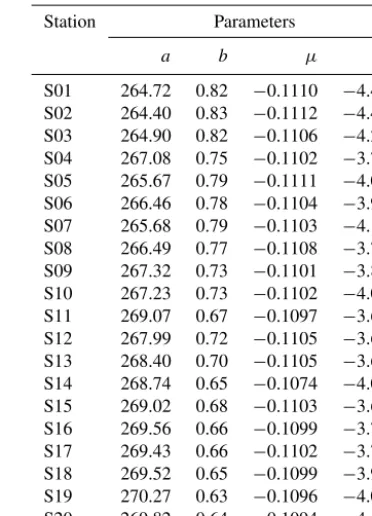
Table 1.Estimated values ofa,b,µandαfor the 20 synoptic sites using ERA-I atmospheric profiles over the whole year of 2014.
Station Parameters
a b µ α
S01 264.72 0.82 −0.1110 −4.47 S02 264.40 0.83 −0.1112 −4.48 S03 264.90 0.82 −0.1106 −4.25 S04 267.08 0.75 −0.1102 −3.76 S05 265.67 0.79 −0.1111 −4.05 S06 266.46 0.78 −0.1104 −3.90 S07 265.68 0.79 −0.1103 −4.16 S08 266.49 0.77 −0.1108 −3.79 S09 267.32 0.73 −0.1101 −3.88 S10 267.23 0.73 −0.1102 −4.09 S11 269.07 0.67 −0.1097 −3.66 S12 267.99 0.72 −0.1105 −3.66 S13 268.40 0.70 −0.1105 −3.64 S14 268.74 0.65 −0.1074 −4.06 S15 269.02 0.68 −0.1103 −3.69 S16 269.56 0.66 −0.1099 −3.78 S17 269.43 0.66 −0.1102 −3.70 S18 269.52 0.65 −0.1099 −3.96 S19 270.27 0.63 −0.1096 −4.04 S20 269.82 0.64 −0.1094 −4.14
3.3 PWV interpolation from GNSS stations
With the use of interpolated Ps and Tm, PWV data at the GNSS stations could be obtained in near-real time. In order to construct the PWV map, GNSS PWV data are used to in-terpolate at a 0.25◦×0.25◦grid. Similar to the meteorolog-ical data, PWVs at nearby GNSS stations are interpolated to the given heightHpof the grid point as follows (Dousa and Elias, 2014):
PWV=PWVr
1−β (Hs−Hr) Ts
βθ××Rgd
, (8)
4 Results and discussion
4.1 Evaluation ofPsandTminterpolated by synoptic data
All the parameters includingaandbin Eq. (4),µin Eq. (5) andαin Eq. (6) are estimated locally at each synoptic site using reanalysis products. In this study, the values of a,b, µandα(their values are given in Table 1) for each site are fitted from ERA-I atmospheric profiles over the whole year of 2014. With the use of the estimated parameters, spatial ad-justments forPsandTmto radiosonde stations are performed throughout the year of 2015. Then the interpolated meteoro-logical data are directly compared with the radiosonde obser-vations.
Figure 2 shows the time series of Ps provided by ra-diosonde, synoptic interpolation and the GPT2w model at three radiosonde stations over 2015. Surface pressures inter-polated from synoptic observations have a very good agree-ment with radiosonde-measured ones. The GPT2w model basically reflects the variation trend of Ps throughout the year; however, it is unable to capture the fluctuations which are especially obvious in winter and spring months. Similar results can be observed in Fig. 3 forTmcomparison. Detailed statistics of the comparison results are given in Table 2. The root-mean-square errors (RMSEs) ofPsandTmderived from synoptic interpolation vary in the range of 1.7–3.0 hPa and 2.5–3.0 K, respectively. In comparison, the RMSEs from the GPT2w model are 4.7–5.6 hPa and 3.8–4.2 K, respectively, for Ps andTm, which are much larger than the synoptic in-terpolation method. In terms of maximum and minimum dif-ferences, GPT2w-derived values are significantly larger than those derived from synoptic interpolation, further indicating the GPT2w model is less accurate. According to Eq. (1), a 1 hPa error in surface pressure would cause about a 2.3 mm error in ZHD. Therefore, a 3 hPa error in Ps will result in an error of about 6.9 mm in ZHD (∼1.15 mm in PWV). The relative error of the PWV caused by theTmerror is approx-imately equal to the relative error of the Tm (Zhang et al., 2017). Derived from Fig. 3 and Table 2, the relative error of synoptic-data-interpolatedTm is about 1 %. In the study region, the PWV value is usually less than 80 mm, mean-ing the PWV error caused by theTmerror is within 0.8 mm. In addition, as mentioned in Sect. 2.1, our estimated ZTDs have an accuracy of about 9 mm (∼1.45 mm in PWV). On the whole, the accuracy of PWV retrieved from GNSS ZTD using Ps and Tm from synoptic interpolation is better than 3.4 mm. Following the same error analysis, the uncertainty of PWV caused by the GPT2w model is about 4.6 mm. 4.2 Evaluation of PWV by radiosonde
At each GNSS station, GNSS-derived ZTDs are converted to PWVs with the use of meteorological parameters inter-polated from synoptic data. In order to evaluate the
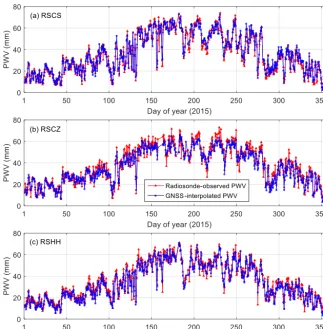
GNSS-derived PWV, the GNSS PWVs are interpolated onto the ra-diosonde stations according to Eqs. (7) and (8) for a direct comparison with radiosonde-measured ones. As displayed in Fig. 4, GNSS-interpolated PWVs agree well with the radiosonde-measured ones at all the three radiosonde sta-tions. Mean biases of the PWV differences at RSCS, RSCZ and RSHH station are−0.59, 1.04 and 1.40 mm, respectively (see Table 3). In terms of the RMSE, they are 2.47, 2.94 and 2.69 mm for RSCS, RSCZ and RSHH stations, respec-tively. It is notable that for weather nowcasting, the accuracy threshold is 3 mm (Yuan et al., 2014). This indicates that the GNSS-derived PWVs are accurate enough for the application of weather nowcasting. Additionally, the probability density function (PDF) of PWV differences and the fractional error as percent by radiosonde 5 mm PWV bins are exhibited in Fig. 5. As shown in Fig. 5a, about 83 % PWV differences are within the range of−5 to 5 mm. The fractional errors vary from about−15 % to 6 % as radiosonde PWV increases from 0 to 75 mm. When PWV values are less than 10 mm, there is an obvious wet bias relative to the radiosonde. This is probably related to the dry bias of Chinese-made GTS1 and GZZ2 radiosonde sensors caused by solar heating (Moradi et al., 2013), whereas an obvious dry bias can be observed for PWV values larger than 65 mm. The dry bias is likely due to the overestimation of water vapor by radiosonde as the Chinese radiosonde types are known to have a moist bias for large PWV ranges (Nash et al., 2011). A similar effect has also been found for other radiosonde types and was as-cribed to the humidity sensors suffering from contamination from rain and clouds during radiosonde ascents (Bock et al., 2005).
4.3 PWV comparison between ERA-I products and GNSS interpolation data
Figure 3.Time series of weighted mean temperature provided by radiosonde, synoptic adjustment and GPT2w model over the whole year of 2015 at three radiosonde stations:(a)RSCS,(b)RSCZ and(c)RSHH, all of which are located in the Hunan Province, China.
Table 2.Comparison ofPsandTmfor radiosonde–synoptic and radiosonde–GPT2w at the three radiosonde stations.
Comparison RSCS RSCZ RSHH
Ps(hPa) Tm(K) Ps(hPa) Tm(K) Ps(hPa) Tm(K)
Radiosonde vs. synoptic Bias 2.91 1.47 −1.66 1.14 −2.58 1.49 RMSE 2.97 2.92 1.74 2.58 2.61 2.76 Max 5.04 9.69 0.48 7.42 −1.33 9.17 Min 1.01 −6.40 −3.82 −5.18 −3.82 −5.40 Radiosonde vs. GPT2w Bias 1.23 1.59 2.02 1.68 3.06 2.23 RMSE 4.70 3.84 4.76 4.02 5.56 4.16 Max 13.75 13.29 12.26 14.21 14.96 14.48 Min −16.13 −7.44 −13.46 −8.08 −14.94 −6.34
Table 3. Comparison between radiosonde-observed and GNSS-interpolated PWV at the three radiosonde stations.
Radiosonde Bias RMSE Max Min station (mm) (mm) (mm) (mm) RSCS −0.59 2.47 7.46 −7.96 RSCZ 1.04 2.94 10.44 −11.15 RSHH 1.40 2.69 9.27 −8.59
Figure 4.Time series of PWV measured by radiosonde and interpolated by GNSS over the whole year of 2015 at three radiosonde stations:
(a)RSCS,(b)RSCZ and(c)RSHH.
Figure 6.Map of(a)bias and(b)RMSE of the differences between ERA-I PWV and GNSS-interpolated PWV over the Hunan Province for the year 2015. Black contours represent the elevation (unit: m).
Figure 7. (a)PDF of PWV difference,(b)fractional error as percent by ERA-I 5 mm PWV bins, and(c)relationship between RMSE and elevation for the comparison between ERA-I and GNSS.
accurately capture the highly dynamic water vapor variation in the vertical direction and (2) the performance of the ERA-I PWV product degrades in mountainous regions due to the larger errors caused by PWV averaging over cells with highly variable surface topography (Alshawaf et al., 2017). 4.4 Monitoring water vapor variations using
GNSS-derived PWV maps
The ultimate goal of this study is to apply the constructed PWV maps for the study of weather forecasting. We fur-ther investigated the water vapor variations during a large-scale heavy-precipitation event using the PWV maps derived from GNSS observations. In June 2015, the Hunan Province suffered several large-scale regional torrential rains, which caused major floods and massive landslides in some places. An average rainfall of 236 mm over the whole province was recorded in that month, and the accumulated rainfall ex-ceeded 500 mm in many areas. In this study, we focused on a heavy rainfall process occurring during 6–8 June 2015. Fig-ure 8 exhibits the geographic distribution of the daily
accu-mulated precipitation over the Hunan Province for 6, 7 and 8 June 2015. The precipitation data are retrieved from the Tropical Rainfall Measuring Mission (TRMM), a joint mis-sion of NASA (National Aeronautics and Space Administra-tion) and the Japan Aerospace Exploration Agency to mea-sure rainfall for weather and climate research (Kummerow et al., 1998; Lau and Wu, 2011). As shown in Fig. 8a, the accumulated precipitation on 6 June decreased from about 60 mm at the southeast to 0 mm at the northwest. On 7 June, rainfalls were observed over most parts of the province with heavy precipitation mainly occurring in the northern Hunan Province. Afterwards, on 8 June, the precipitation weakened on most of the Hunan Province except for an increase in the northeast.
Figure 8.Map of daily accumulated precipitation in the Hunan Province on(a)6 June 2015,(b)7 June 2015 and(c)8 June 2015. The precipitation data were retrieved from the TRMM with a spatial resolution of 0.25◦×0.25◦.
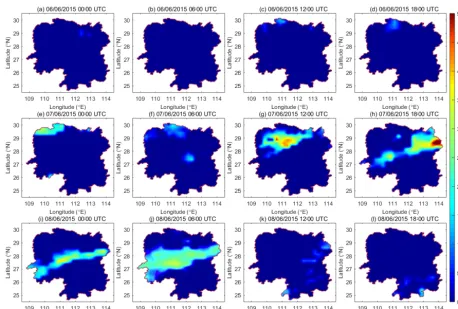
Figure 9.Evolution of GNSS-derived PWV maps for the Hunan Province every 6 h from 00:00 UTC, 6 June 2015, to 18:00 UTC, 8 June 2015.
PWV from south to north, indicating that a large amount of moisture from the south flowed into Hunan. This is consis-tent with the precipitation pattern displayed in Fig. 8a in that the rainfall gradually decreased from south to north. On 7 June, significant PWV changes mainly concentrated in re-gions north of 28◦N. Especially in the northeast, PWV
Figure 10.Evolution of rain rate maps for the Hunan Province every 6 h from 00:00 UTC, 6 June 2015, to 18:00 UTC, 8 June 2015. The rain rate data were retrieved from the TRMM with a spatial resolution of 0.25◦×0.25◦.
Figure 11.Map of the correlation coefficient between precipitation and PWV for the heavy rainfall process of 6–8 June 2015 over the Hunan Province. Black contours represent the elevation (unit: m). The correlation coefficients were calculated for the accumulated precipitation and PWV for the 6–8 June 2015 period.
largely decreased in the north whilst they slightly expanded in the south. Referring to the rain rates at the corresponding epochs, as shown in Fig. 10, we cannot observe close corre-lations between the PWV and the rain rate. Larger moisture convergence is not necessarily linked with higher rain rate occurrence. This is because the moisture convergence is not the only cause of precipitation, whilst it is also controlled by many other factors such as wind, temperature and terrain. However, the GNSS-derived PWV maps are able to reveal the moisture advection, transportation and convergence dur-ing the heavy-precipitation event.
by triggering convective initiation and enhancement (Lab-bouz et al., 2013). Therefore, precipitation and PWV corre-late more closely in mountainous regions than flat terrains, and mountainous regions are often sensitive areas prone to high frequency of heavy precipitation.
5 Summary and conclusions
The lack of collocated meteorological data at the GNSS sta-tion makes it difficult to take full advantage of GNSS obser-vations for weather studies. This paper investigates an alter-native method for accurate determination of PWV for near-real-time applications using GNSS data and nearby synop-tic observations. Moreover, we present a method to construct PWV maps with the use of a GNSS network, which is critical for improving the forecasting capability of extreme weathers, e.g., heavy rainfall.
The proposed approach for PWV map construction con-sists of two main steps: (1) the Ps andTm derived at the nearby synoptic sites are interpolated onto the location of the GNSS stations through both vertical and horizontal ad-justments and (2) vertical reduction and horizontal interpola-tion are performed to construct PWV map using the retrieved GNSS PWV. In this study, ERA-I data over the whole year of 2014 were employed to estimate all the parameters in-volved in the above two steps. The accuracies of the synoptic-interpolated and GPT2w-derivedPsandTmhave been evalu-ated by comparing them against the observed values at three radiosonde sites in 2015. The RMSEs ofPs andTmderived from the GPT2w model vary in the range of 4.7–5.6 hPa and 3.8–4.2 K, respectively. The RMSEs from synoptic interpo-lation are 1.7–3.0 hPa and 2.5–3.0 K, respectively, which are much better than the GPT2w model.
In addition, GNSS-interpolated PWVs are assessed with respect to reference PWV values from radiosonde and ERA-I. GNSS-interpolated PWVs show a good agreement with the radiosonde-measured ones with RMSEs varying in the range of 2.4–3.0 mm. In the comparison with ERA-I, the biases of their differences vary from −8 to 6 mm over the Hunan Province and mountainous regions have a larger bias than flat regions in general. The RMSEs are within the range of 2–8 mm, with those for most regions being less than 3 mm. For PWV values less than 10 mm or more than 60 mm, there is an obvious wet or dry bias relative to ERA-I. Furthermore, the RMSEs are found to increase with increased elevation in general, and a high correlation coefficient of 0.73 is obtained between RMSE and elevation.
We further apply the constructed PWV maps to moni-tor the water vapor variability during a large-scale heavy-precipitation event that occurred during 6–8 June 2015 in the Hunan Province. Results demonstrate that it is possible to re-veal the moisture advection, transportation and convergence during the heavy rainfall using PWV maps. Since the orog-raphy provides favorable conditions for precipitation
forma-tion, we also find that the precipitation and PWV correlate more closely in mountainous regions, especially in hillsides and valleys.
This research demonstrates the potentials of retrieving ac-curate PWV from GNSS observations using adjacent syn-optic data and generating high-quality PWV maps from the GNSS network for weather prediction in near-real time. Fu-ture work will focus on the three following issues: (1) exam-ining the reliability of the PWV map construction in other areas with highly dynamic water vapor, (2) assessing the per-formance of the constructed PWV maps with higher spatial and temporal resolutions, and (3) assimilating the PWV maps into a numerical prediction model to enhance the capability of extreme weather forecasting.
Data availability. The ECMWF ERA-Interim reanalysis products
are available online (http://apps.ecmwf.int/datasets/) (ECMWF, 2018). The radiosonde data were obtained from http://weather. uwyo.edu/upperair/sounding.html (University of Wyoming, 2018). The TRMM rainfall data were provided by https://pmm.nasa. gov/data-access/downloads/trmm (NASA, 2018). The synoptic ob-servations were provided by http://rda.ucar.edu/datasets/ds336.0/ (NCAR, 2018). The SRTM30 PLUS data were provided by http: //topex.ucsd.edu/index.html (University of California San Diego, 2018). The GNSS observations of the Hunan GNSS network pre-sented in this study are available from the authors upon request ([email protected]).
Author contributions. BC and WD designed this study, developed
the methodology, performed the analysis and wrote the manuscript. ZL, LW, CK and MAO provided guidance and helped polish the manuscript.
Competing interests. The authors declare that they have no conflict
of interest.
Special issue statement. This article is part of the special issue
“Ad-vanced Global Navigation Satellite Systems tropospheric products for monitoring severe weather events and climate (GNSS4SWEC) (AMT/ACP/ANGEO inter-journal SI)”. It is not associated with a conference.
Acknowledgements. This work was supported by the Research
https://pmm.nasa.gov/data-access/downloads/trmm (last access: March 2018). The synoptic observations were provided by the Na-tional Center for Atmospheric Research (NCAR), from the website http://rda.ucar.edu/datasets/ds336.0/ (last access: March 2018). The SRTM30 PLUS data were provided by the Satellite Geodesy research group at the Institute of Geophysics and Planetary Physics, Scripps Institution of Oceanography, University of California San Diego, from the website http://topex.ucsd.edu/index.html (last access: March 2018). Finally, the authors want to thank the University of Wyoming for providing the radiosonde data. Edited by: Roeland Van Malderen
Reviewed by: three anonymous referees
References
Ahrens, C. and Samson, P.: Extreme weather and climate, 1 Edn., 22 February 2010, Brooks Cole, United States of America, 2011. Alshawaf, F., Fuhrmann, T., Knopfler, A., Luo, X., Mayer, M., Hinz, S., and Heck, B.: Accurate Estimation of Atmospheric Wa-ter Vapor Using GNSS Observations and Surface Meteorolog-ical Data, IEEE Trans. Geosci. Remote Sens., 53, 3764–3771, https://doi.org/10.1109/TGRS.2014.2382713, 2015.
Alshawaf, F., Balidakis, K., Dick, G., Heise, S., and Wickert, J.: Estimating trends in atmospheric water vapor and temperature time series over Germany, Atmos. Meas. Tech., 10, 3117–3132, https://doi.org/10.5194/amt-10-3117-2017, 2017.
Askne, J. and Nordius, H.: Estimation of tropospheric delay for mi-crowaves from surface weather data, Radio Sci., 22, 379–386, 1987.
Becker, J. J., Sandwell, D. T., Smith, W. H. F., Braud, J., Binder, B., Depner, J., Fabre, D., Factor, J., Ingalls, S., Kim, S.-H., Ladner, R., Marks, K., Nelson, S., Pharaoh, A., Trim-mer, R., Von Rosenberg, J., Wallace, G., and Weatherall, P.: Global Bathymetry and Elevation Data at 30 Arc Sec-onds Resolution: SRTM30_PLUS, Mar. Geod., 32, 355–371, https://doi.org/10.1080/01490410903297766, 2009.
Bevis, M., Businger, S., Herring, T. A., Rocken, C., Anthes, R. A., and Ware, R. H.: GPS meteorology: Remote sensing of atmo-spheric water vapor using the Global Positioning System, J. Geo-phys. Res.-Atmos., 1984–2012, 97, 15787–15801, 1992. Bevis, M., Businger, S., Chiswell, S., Herring, T., Anthes, R.,
Rocken, C., and Ware, R. H.: GPS Meteorology: Mapping zenith wet delays onto precipitable water, J. Appl. Meteorol., 33, 379– 386, 1994.
Bock, O., Keil, C., Richard, E., Flamant, C., and Bouin, M.: Vali-dation of precipitable water from ECMWF model analyses with GPS and radiosonde data during the MAP SOP, Q. J. R. Me-teorol. Soc., 131, 3013–3036, https://doi.org/10.1256/qj.05.27, 2005.
Boehm, J., Niell, A., Tregoning, P., and Schuh, H.: Global Map-ping Function (GMF): A new empirical mapMap-ping function based on numerical weather model data, Geophys. Res. Lett., 33, https://doi.org/10.1029/2005GL025546, 2006.
Boehm, J., Heinkelmann, R., and Schuh, H.: Short Note: A global model of pressure and temperature for geodetic applications, J. Geod., 81, 679–683, https://doi.org/10.1007/s00190-007-0135-3, 2007.
Boehm, J., Möller, G., Schindelegger, M., Pain, G., and Weber, R.: Development of an improved empirical model for slant de-lays in the troposphere (GPT2w), GPS Solut., 19, 433–441, https://doi.org/10.1007/s10291-014-0403-7, 2015.
Brenot, H., Neméghaire, J., Delobbe, L., Clerbaux, N., De Meut-ter, P., Deckmyn, A., Delcloo, A., Frappez, L., and Van Roozendael, M.: Preliminary signs of the initiation of deep convection by GNSS, Atmos. Chem. Phys., 13, 5425–5449, https://doi.org/10.5194/acp-13-5425-2013, 2013.
Chen, B. and Liu, Z.: A Comprehensive Evaluation and Anal-ysis of the Performance of Multiple Tropospheric Models in China Region, IEEE Trans. Geosci. Remote Sens., 54, 663–678, https://doi.org/10.1109/TGRS.2015.2456099, 2016a.
Chen, B. and Liu, Z.: Global Water Vapor Variability and Trend from the Latest 36-Year (1979 to 2014) Data of ECMWF and NCEP Reanalyses, Radiosonde, GPS and Mi-crowave Satellite, J. Geophys. Res.-Atmos., 121, 11442–11462, https://doi.org/10.1002/2016JD024917, 2016b.
Dach, R., Lutz, S., Walser, P., and Fridez, P.: Bernese GNSS Soft-ware Version 5.2, https://doi.org/10.7892/boris.72297, 2015. Davis, J. L., Herring, T. A., Shapiro, I. I., Rogers, A. E. E., and
Elgered, G.: Geodesy by radio interferometry: Effects of atmo-spheric modeling errors on estimates of baseline length, Radio Sci., 20, 1593–1607, 1985.
Dee, D. P., Uppala, S. M., Simmons, A. J., Berrisford, P., Poli, P., Kobayashi, S., Andrae, U., Balmaseda, M. A., Balsamo, G., Bauer, P., Bechtold, P., Beljaars, A. C. M., van de Berg, L., Bid-lot, J., Bormann, N., Delsol, C., Dragani, R., Fuentes, M., Geer, A. J., Haimberger, L., Healy, S. B., Hersbach, H., Hólm, E. V., Isaksen, L., Kållberg, P., Köhler, M., Matricardi, M., McNally, A. P., Monge-Sanz, B. M., Morcrette, J.-J., Park, B.-K., Peubey, C., de Rosnay, P., Tavolato, C., Thépaut, J.-N., and Vitart, F.: The ERA-Interim reanalysis: configuration and performance of the data assimilation system, Q. J. Roy. Meteorol. Soc., 137, 553– 597, https://doi.org/10.1002/qj.828, 2011.
Dousa, J. and Elias, M.: An improved model for calculating tropospheric wet delay, Geophys. Res. Lett., 41, 4389–4397, https://doi.org/10.1002/2014GL060271, 2014.
Durre, I., Vose, R. S., and Wuertz, D. B.: Overview of the integrated global radiosonde archive, J. Climate, 19, 53–68, 2006. ECMWF: European Centre for Medium-Range Weather Forecasts
(ECMWF) ERA-Interim reanalysis, available at: http://apps. ecmwf.int/datasets, last access: March 2018.
Guerova, G., Jones, J., Douša, J., Dick, G., de Haan, S., Pottiaux, E., Bock, O., Pacione, R., Elgered, G., Vedel, H., and Bender, M.: Review of the state of the art and future prospects of the ground-based GNSS meteorology in Europe, Atmos. Meas. Tech., 9, 5385–5406, https://doi.org/10.5194/amt-9-5385-2016, 2016. Kummerow, C., Barnes, W., Kozu, T., Shiue, J., and Simpson, J.:
The tropical rainfall measuring mission (TRMM) sensor pack-age, J. Atmos. Ocean. Tech., 15, 809–817, 1998.
Labbouz, L., Van Baelen, J., Tridon, F., Reverdy, M., Hagen, M., Bender, M., Dick, G., Gorgas, T., and Planche, C.: Precipita-tion on the lee side of the Vosges Mountains: Multi-instrumental study of one case from the COPS campaign, Meteorol. Z., 22, 413–432, https://doi.org/10.1127/0941-2948/2013/0413, 2013. Lagler, K., Schindelegger, M., Boehm, J., Krásná, H., and
geodetic techniques, Geophys. Res. Lett., 40, 1069–1073, https://doi.org/10.1002/grl.50288, 2013.
Lau, K.-M. and Wu, H.-T.: Climatology and changes in tropi-cal oceanic rainfall characteristics inferred from Tropitropi-cal Rain-fall Measuring Mission (TRMM) data (1998–2009), J. Geophys. Res., 116, https://doi.org/10.1029/2011JD015827, 2011. Li, L., Wu, S., Wang, X., Tian, Y., He, C. and Zhang, K.:
Sea-sonal Multifactor Modelling of Weighted-Mean Temperature for Ground-Based GNSS Meteorology in Hunan, China, Adv. Mete-orol., 1–13, https://doi.org/10.1155/2017/3782687, 2017. Li, L., Wu, S.-Q., Wang, X.-M., Tian, Y., He, C.-Y. and Zhang,
K.-F.: Modelling of weighted-mean temperature using regional ra-diosonde observations in Hunan China, Terr. Atmos. Ocean. Sci., 29, 187–199, https://doi.org/10.3319/TAO.2017.05.26.01, 2018. Lu, C., Li, X., Li, Z., Heinkelmann, R., Nilsson, T., Dick, G., Ge, M., and Schuh, H.: GNSS tropospheric gradi-ents with high temporal resolution and their effect on pre-cise positioning, J. Geophys. Res.-Atmos.„ 121, 912–930, https://doi.org/10.1002/2015JD024255, 2016.
Lu, N., Qin, J., Gao, Y., Yang, K., Trenberth, K. E., Gehne, M., and Zhu, Y.: Trends and variability in atmospheric precipitable water over the Tibetan Plateau for 2000–2010, Int. J. Climatol., 35, 1394–1404, https://doi.org/10.1002/joc.4064, 2015. Mohanakumar, K.: Stratosphere troposphere interactions: An
intro-duction, Springer, New York, USA, 2008.
Moradi, I., Soden, B., Ferraro, R., Arkin, P., and Vömel, H.: As-sessing the quality of humidity measurements from global oper-ational radiosonde sensors, J. Geophys. Res.-Atmos., 118, 8040– 8053, https://doi.org/10.1002/jgrd.50589, 2013.
Musa, T. A., Amir, S., Othman, R., Ses, S., Omar, K., Abdullah, K., Lim, S. and Rizos, C.: GPS meteorology in a low-latitude region: Remote sensing of atmospheric water vapor over the Malaysian Peninsula, J. Atmos. Sol.-Terr. Phys., 73, 2410–2422, https://doi.org/10.1016/j.jastp.2011.08.014, 2011.
NASA: National Aeronautics and Space Administration (NASA) TRMM precipitation data, available at: https://pmm.nasa.gov/ data-access/downloads/trmm, last access: March 2018.
Nash, J., Oakley, T., Vömel, H., and Li, W.: WMO Intercomparison of high quality radiosonde systens, World Meteorological Orga-nization, Instruments and observations, Yangjiang, China, 2011. NCAR: National Center for Atmospheric Research (NCAR) synop-tic data, available at: http://rda.ucar.edu/datasets/ds336.0/T, last access: March 2018.
Pacione, R., Araszkiewicz, A., Brockmann, E., and Dousa, J.: EPN-Repro2: A reference GNSS tropospheric data set over Europe, Atmos. Meas. Tech., 10, 1689–1705, https://doi.org/10.5194/amt-10-1689-2017, 2017.
Rüeger, J. M.: Refractive index formulae for radio waves, in Inte-gration of Techniques and Corrections to Achieve Accurate En-gineerin, p. 13, Washington, D.C. USA., 2002.
Saastamoinen, J.: Atmospheric correction for the troposphere and stratosphere in radio ranging of satellites, Geophys. Monogr. Ser., 15, 247–251, 1972.
University of Wyoming: Radiosonde data, Department of Atmo-spheric Science of the University of Wyoming, http://weather. uwyo.edu/upperair/sounding.html, last access: March 2018. Van Baelen, J., Reverdy, M., Tridon, F., Labbouz, L., Dick,
G., Bender, M., and Hagen, M.: On the relationship be-tween water vapour field evolution and the life cycle of pre-cipitation systems, Q. J. Roy. Meteorol. Soc., 137, 204–223, https://doi.org/10.1002/qj.785, 2011.
Wang, J., Zhang, L., Dai, A., Van Hove, T., and Van Baelen, J.: A near-global, 2-hourly data set of atmospheric precipitable water from ground-based GPS measurements, J. Geophys. Res., 112, D11107, https://doi.org/10.1029/2006JD007529, 2007. Wang, X., Zhang, K., Wu, S., He, C., Cheng, Y., and Li, X.:
De-termination of zenith hydrostatic delay and its impact on GNSS-derived integrated water vapor, Atmos. Meas. Tech., 10, 2807– 2820, https://doi.org/10.5194/amt-10-2807-2017, 2017. Yao, Y., Shan, L., and Zhao, Q.: Establishing a method of
short-term rainfall forecasting based on GNSS-derived PWV and its application, Sci. Rep., 7, 12465, https://doi.org/10.1038/s41598-017-12593-z, 2017.
Yao, Y. B., Zhang, B., Yue, S. Q., Xu, C. Q., and Peng, W. F.: Global empirical model for mapping zenith wet delays onto precipitable water, J. Geod., 87, 439–448, https://doi.org/10.1007/s00190-013-0617-4, 2013.
Yuan, Y., Zhang, K., Rohm, W., Choy, S., Norman, R., and Wang, C.-S.: Real-time retrieval of precipitable water vapor from GPS precise point positioning, J. Geophys. Res.-Atmos., 119, 10044– 10057, https://doi.org/10.1002/2014JD021486, 2014.
Zhang, H., Yuan, Y., Li, W., Ou, J., Li, Y., and Zhang, B.: GPS PPP-derived precipitable water vapor retrieval based on Tm/Ps from multiple sources of meteorological data sets in China, J. Geophys. Res.-Atmos., 122, 4165–4183, https://doi.org/10.1002/2016JD026000, 2017.