www.the-cryosphere.net/10/1915/2016/ doi:10.5194/tc-10-1915-2016
© Author(s) 2016. CC Attribution 3.0 License.
Sliding of temperate basal ice on a rough, hard bed: creep
mechanisms, pressure melting, and implications for ice streaming
Maarten Krabbendam
British Geological Survey, Lyell Centre, Research Avenue South, Edinburgh EH14 4AP, UK
Correspondence to:Maarten Krabbendam ([email protected])
Received: 22 February 2016 – Published in The Cryosphere Discuss.: 1 April 2016 Revised: 5 August 2016 – Accepted: 18 August 2016 – Published: 5 September 2016
Abstract.Basal ice motion is crucial to ice dynamics of ice sheets. The classic Weertman model for basal sliding over bedrock obstacles proposes that sliding velocity is controlled by pressure melting and/or ductile flow, whichever is the fastest; it further assumes that pressure melting is limited by heat flow through the obstacle and ductile flow is controlled by standard power-law creep. These last two assumptions, however, are not applicable if a substantial basal layer of tem-perate (T ∼Tmelt)ice is present. In that case, frictional
melt-ing can produce excess basal meltwater and efficient water flow, leading to near-thermal equilibrium. High-temperature ice creep experiments have shown a sharp weakening of a factor 5–10 close to Tmelt, suggesting standard power-law
creep does not operate due to a switch to melt-assisted creep with a possible component of grain boundary melting. Pres-sure melting is controlled by meltwater production, heat ad-vection by flowing meltwater to the next obstacle and heat conduction through ice/rock over half the obstacle height. No heat flow through the obstacle is required. Ice streaming over a rough, hard bed, as possibly in the Northeast Greenland Ice Stream, may be explained by enhanced basal motion in a thick temperate ice layer.
1 Introduction
The manner in which ice deforms within an ice sheet and moves or slides over its base is critical to accurately model the dynamic past, present and future behaviour of such ice bodies (e.g. Marshall, 2005). Internal deformation of cold ice is fairly well understood, and predictions made on the basis of physical laws (e.g. “Glen’s flow law”) are broadly con-firmed by observations (e.g. Dahl-Jensen and Gundestrup,
1987; Paterson, 1994; Cuffey and Paterson, 2010; Ryser et al., 2014; see Paterson (1991) for problems with dusty ice and Hooke (1981) for a general critique). This is not the case for basal sliding, for which many parameters are poorly constrained (e.g. Cuffey and Paterson, 2010). Instead, many models of modern ice sheets use an empirical drag factor or slip coefficient, derived from observed ice velocity and esti-mated shear stresses (e.g. MacAyeal et al., 1995; Gudmunds-son and Raymond, 2008; Ryser et al., 2014). Using an em-pirical drag factor is reasonable to describe and understand present-day, near-instantaneous ice-sheet behaviour but can-not reliably predict or reconstruct ice velocities if parameters such as ice thickness, driving forces and meltwater produc-tion change significantly.
(Smith, 1948; Stokes and Clark, 2003; Roberts and Long, 2005; Bradwell et al., 2008; Eyles, 2012; Bradwell, 2013; Eyles and Putkinen, 2014; Krabbendam et al., 2016). In these areas, the deforming-bed models cannot apply because little or no soft sediment is present. These palaeo-ice stream zones are surrounded by areas also subjected to less intense, but still warm-based, ice erosion suggesting intermediate ice veloci-ties (e.g. Bradwell, 2013), consistent with ice velocity anal-ysis and borehole observations from the Greenland Ice Sheet that show significant warm-based sliding (10–100 m yr−1)
outside ice-streams (Lüthi et al., 2002; Ryser et al., 2014; Joughin et al., 2010). Thus, fast ice flow appears to be possi-ble on hard, rough beds and cannot be explained by a simple cold/warm thermal boundary (cf. Payne and Dongelmans, 1997). In Greenland, the massive Northeast Greenland Ice Stream (NEGIS) remains difficult to explain, as current ex-planations invoke geologically unreasonably high geother-mal heat flows (e.g. Fahnenstock et al., 2001) and a de-formable bed with an unknown and questionable till source (Christianson et al., 2014).
A solution may be presented by the presence of a basal layer of temperate ice (ice at the melting temperature Tm),
below cold ice that makes up the remainder of the ice sheet. Drilling in Greenland Ice Sheet adjacent to the Jakobshavn Isbræ has recorded a basal layer of temperate ice below cold ice of some 30 m thickness (Lüthi et al., 2002), equal to or greater in height than typical bedrock obstacles (roches moutonnées, whalebacks) in most crystalline gneiss terrains (Krabbendam and Bradwell, 2014). Temperate ice has also been modelled to occur beneath other parts of the Greenland Ice Sheet (e.g. Dahl-Jensen, 1989; Calov and Hutter, 1996; Greve, 1997). Two pertinent questions follow from these ob-servations:
1. How does such a temperate layer develop and how is it maintained, given that it is overlain by cold ice? In situ measurements at a glacier base and experiments have re-cently shown that warm-based basal sliding occurs un-der significant friction, caused by basal-debris/bedrock contacts (Iverson et al., 2003; Cohen et al., 2005; Zoet et al., 2013), generating significant frictional heat at the base, which is important for the development of a tem-perate ice layer.
2. If basal sliding operates in temperate ice, is the rheol-ogy of temperate ice adequately described by a standard power law? How do horizontal thermal gradients, nec-essary for regelation to proceed, build up? The essence of the classic Weertman (1957) sliding model is that basal ice movement past an obstacle occurs by pres-sure melting around the obstacle and by ductile flow en-hanced by stress concentrations near the obstacle, with ductile flow being more important for larger obstacles. The rheology of enhanced ductile flow is normally de-scribed by a standard power law (“Glen’s flow law”), whereas pressure melting is regarded to be limited by
heat flowthrough the obstacle. Sparse experimental ev-idence, however, suggests that temperate ice is consid-erably weaker than cold ice, and that creep may not be modelled reliably according to a standard power law (e.g. Colbeck and Evans, 1973; Duval, 1977; Morgan, 1991). Furthermore, in a basal temperate ice layer it may be that no thermal gradient across an obstacle can be maintained and that pressure melting at the stoss side has different thermal controls than in the classic model. Numerous studies have improved upon the Weertman sliding model, focussing on more realistic geometries of the bedrock obstacles, more sophisticated analyses of the stresses near the obstacles and models that allow for lee-side cavitation, which was not allowed in the original model (e.g. Kamb and La Chapelle, 1964; Kamb, 1970; Nye, 1970, Lli-boutry, 1993; Schoof, 2005). Nevertheless, the mechanical behaviour of temperate ice moving over a rough, hard bed remains poorly constrained.
This paper deals with four issues. Firstly, the problem of how a temperate layer can grow and be maintained below cold ice is discussed. Secondly, it will be shown that the two critical assumptions of classic Weertman sliding (enhanced ductile flow controlled by a standard power law and pressure melting controlled by heat flow through an obstacle) cannot be applied to temperate ice, and alternative controlling mech-anisms are proposed. Thirdly, the implications of the differ-ent behaviour of temperate ice below cold ice for thermo-mechanical modelling of ice sheets are discussed. Finally, it is suggested that the development of a temperate basal ice layer may help to explain the occurrence of ice streaming on rough, hard beds, such as seen on deglaciated terrains and possibly also below the NEGIS.
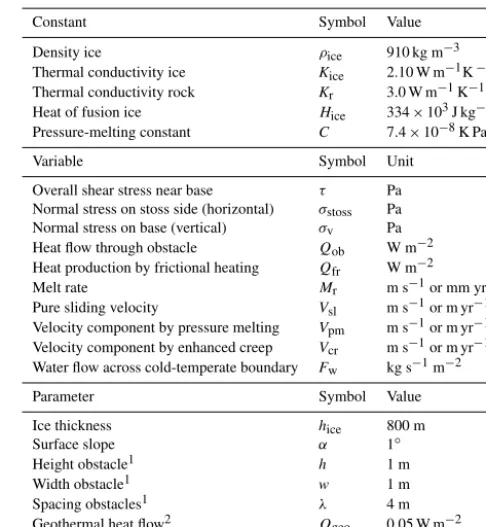
The paper takes a conceptual approach, focussing on the primary thermodynamic and rheological controls so as to achieve an improved conceptual model of basal ice motion around bedrock obstacles, rather than the exact quantifica-tion of geometries and stress distribuquantifica-tions around such ob-stacles. Constants, variables and parameters used, as well as their units, are shown in Table 1.
2 Basal meltwater production by frictional sliding Consider sliding over a flat area without obstacles, over which debris-laden ice slides under friction. Friction pro-duces drag and heat. Frictional heat production Qfr and
geothermal heat flowQgeo together control the heat budget
at the base of ice sheets. Frictional heat production is con-trolled by the friction coefficientµ, the normal vertical stress
σnvand the sliding velocityVslaccording to
Qfr=µσvVsl≈µ(Pi−Pw)Vsl in [W m−2]. (1)
The normal vertical stressσv can be taken as the effective
This is the standard friction model, using empirically de-rived bulk friction coefficients averaged over an area con-taining many debris particles (e.g. Budd et al., 1979; Co-hen et al., 2005; Emerson and Rempel, 2007; Zoet et al., 2013), rather than the theoretical models that consider in-dividual clasts (e.g. Boulton, 1974; Hallet, 1979). Iverson et al. (2003) measured µ = 0.05 in situ below a glacier; Budd et al. (1979) measured µ=0.04–0.1 for experimen-tal sliding over rocks of different micro-roughness and Zoet et al. (2013) reported µ=0.01–0.05 for experimental slid-ing at the pressure-meltslid-ing point, but much higher values (µ=0.2–0.6) at colder temperatures and also, intriguingly, for warm-based sliding of ice over sandstone, which suggest that different bedrock lithologies can result in very differ-ent friction coefficidiffer-ents and hence basal melting rates. Emer-son and Rempel (2007) observed high friction coefficients of
µ=0.2–0.4 for particles coarser than silt and concentrations > 1 % in experiments with very high basal melting rates. Al-together, friction by ice with basal debris is significant (Co-hen et al., 2005).
A temperate layer of ice has no significant thermal gradi-ent and cannot conduct heat (see Sect. 3). Any heat produced at the base therefore causes basal melting, with the resultant melting rateMrgiven by
Mr=
Qgeo+Qfr
Hiceρice
in [m s−1], (2)
whereHice is the heat of fusion of ice andρice the density
of ice. Water pressurePwand friction coefficientµ(which is
largely controlled by debris concentration) are likely to vary significantly in space and time. These variations affect the frictional heat production (Eq. 1) and hence the melting rate. The potential contribution of frictional heat due to basal slid-ing as a function of µ andPw is graphically illustrated in
Fig. 1. It is clear that under a range of circumstances, fric-tional heating can be equal or greater than the geothermal heat flow (see also Paterson, 1994; Calov and Hutter, 1996). Even atµ=0.05 (close to the friction coefficient of Teflon) heat production can be significant. At moderate sliding ve-locities (< 10 m yr−1), heat production at a warm base can be twice the heat production at a cold base, whilst at high slid-ing velocities typical of ice streams (> 50 m yr−1), frictional
heating swamps geothermal heat flow. Note that the likely significant spatial variations in friction coefficient and bed roughness at the base of an ice sheet imply that it is not reli-able to derive geothermal heat flow on the basis of basal melt rates alone (cf. Fahnestock et al., 2001; Greve, 2005).
The question now becomes, what happens with the water produced by frictional heating? There are two possibilities, not mutually exclusive:
1. The water drains away, initially along a film which may evolve into a dispersed drainage system and further into a channelised drainage system (e.g. Weertman and Birchfield, 1983). Generally water will drain away in
Table 1.Constants, variables and parameters with chosen values.
Constant Symbol Value
Density ice ρice 910 kg m−3
Thermal conductivity ice Kice 2.10 W m−1K−1
Thermal conductivity rock Kr 3.0 W m−1K−1
Heat of fusion ice Hice 334×103J kg−1
Pressure-melting constant C 7.4×10⁻⁸K Pa−1
Variable Symbol Unit
Overall shear stress near base τ Pa
Normal stress on stoss side (horizontal) σstoss Pa
Normal stress on base (vertical) σv Pa
Heat flow through obstacle Qob W m−2
Heat production by frictional heating Qfr W m−2
Melt rate Mr m s−1or mm yr−1
Pure sliding velocity Vsl m s−1or m yr−1
Velocity component by pressure melting Vpm m s−1or m yr−1
Velocity component by enhanced creep Vcr m s−1or m yr−1
Water flow across cold-temperate boundary Fw kg s−1m−2
Parameter Symbol Value
Ice thickness hice 800 m
Surface slope α 1◦
Height obstacle1 h 1 m
Width obstacle1 w 1 m
Spacing obstacles1 λ 4 m
Geothermal heat flow2 Qgeo 0.05 W m−2
1same as Weertman (1957)
2typical range: 0.03–0.07 W m−2or 30–70 mW m−2
the direction of ice flow and ultimately discharge from the ice sheet, thus representing overall mass loss. Any thermal gradient along the base will be continuously smoothed by the advective heat transport of the flowing water. As a result, the entire basal environment (basal ice, water and top of bedrock) approaches the pressure-melting point, with a near-uniform temperature and no significant horizontal thermal gradients.
2. If water cannot drain away freely, the water will re-main under pressure. Water may move upwards through the temperate ice layer to the cold-temperate bound-ary (CTB). Here it will refreeze and release its latent heat; this heat will warm up the cold ice just above the CTB and thus thicken the temperate layer, as further ex-plained below.
3 Growing and maintaining a temperate ice layer The growth and continuance of a temperate ice layer below cold ice is an interesting problem in its own right. The prob-lems associated with this are two-fold (Fig. 2):
0 400 600 800 1000 1200 1400
200
0 10 50 100
40 60 80 100 120 140
20
0
150 200 250
Heat production
Q
geo
+
Q
fr
(mW m
-2)
Sliding velocity Vsl (m yr )-1 µ = 0.
05, Pw = 0
orµ = 0.
1, Pw =50
%
Pice = 700 kPa
hice ~ 800 m
M
elt
water
production
(mm
yr
)
-1
µ = 0.05, Pw =5
0 %
µ = 0.05, Pw= 90 % µ = 0
.2, P
w =
50 %
µ = 0.2, Pw = 90 %
Q = 50 m Wgeo m-2 Northeast Greenland Ice stream
BoreHole D
µ = 0.1, Pw= 90 %
FOXX GULL
Figure 1.Basal heat production (left) caused by geothermal heat flux and frictional heating as a function of basal sliding velocity, for different values of friction coefficientµand water pressurePwas a percentage of overburden pressure. Geothermal heat flow taken at 50 mW m−2.
On the right-hand side the rate of meltwater production, assuming all heat is taken up by melting. Sliding velocities of Borehole D (adjacent to Jakobshavn Isbræ) after Lüthi et al. (2002); melt rate calculated on basis of thermal gradient, using Eq. (1). Sliding velocities and basal melt production of Northeast Greenland Ice stream after Joughin et al. (2001) and Fahnestock et al. (2001). GULL and FOXX show seasonal range of basal ice velocities deduced from borehole data near Swiss Camp, West Greenland (Ryser et al., 2014).
1 2
3
4
T = Tm
-1°C -2°C
Qgeo ~ 50 mW m–2
Temperate ice (T~Tm) CTB
Qgeo + Qfr ~ 50–500 mW m–2 Strain heating
Water transport
Deformation thickening
Geothermal gradient ~ 25 °C km–1
Heat of fusion at CTB, ~ 100 mW m–2
Thermal gradient ~ 0 °C km–1
Conductive thermal gradient ~ 25 °C km–1
Cold ice
Thermal gradient ~ 50 °C km–1
Heat conduction through bedrock high
+1°C
Figure 2.Constraints on the thermal growth of the temperate layer and mechanisms for heating cold ice above the CTB; numbers refer to text. Schematic thermal gradient of Borehole D is indicated in red line (after Lüthi et al., 2002). CTB is the cold-temperate boundary;Qgeo
is the geothermal heat flow;Qfris the heat production by frictional heating.
much steeper than can be maintained by heat conduc-tion alone (Dahl-Jensen, 1989; Paterson, 1994; Funk et al., 1994). In Borehole D north of Jakobshavn Isbræ, this thermal gradient has been measured as 0.05◦C m−1 (=50◦C km−1!) (Lüthi et al., 2002). There is thus the tendency to cool and hence shrink the temperate layer. For a temperate layer to exist and grow, energy must thus be added to the CTB (e.g. Clarke et al., 1977; Blat-ter and HutBlat-ter, 1990);
ii. A temperate ice layer has no bulk thermal gradient (it has in fact a very small negative gradient, but this is ignored here), so no heat can be conducted through it;
it forms a near-ideal thermal barrier (e.g. Aschwanden and Blatter, 2005).
Several mechanisms can be invoked to add energy to the CTB, despite the absence of a thermal gradient (Fig. 2):
1. Bedrock highs can conduct heat: if these penetrate the CTB, heat can be conducted into cold ice. This mecha-nism is limited by the heat conductivity of rock and the height of the obstacle; it cannot explain a CTB above a bedrock high.
2014). However, this can only redistribute temperate ice and move it into cold ice rather than lead to an overall thickening of the temperate layer itself.
3. Strain heating within deforming cold ice above the CTB. Given that this zone is subject to high strain this may be significant (e.g. Clarke et al., 1977; Iken et al., 1993; Cuffey and Paterson, 2010). However, the sharp nick in the temperature profile in Borehole D (Fig. 2, see Lüthi et al., 2002) suggests that most heat is transferred across the CTB rather than generated by strain heating within the cold ice above the CTB.
4. Transport of water through the temperate layer. If water moves upward through the temperate layer and crosses the CTB, it freezes, releases its latent heat and warms the cold ice just above the CTB. As the ice temperature rises toTm, the CTB moves upwards and the temperate
layer thickens. A water flux through the temperate layer therefore equates with a heat flow. An intergranular vein network of water likely exists along grain boundaries in temperate ice (Nye and Frank, 1973; Mader, 1992). If (locally)Pw>Pibecause of a poorly connected
sub-glacial drainage system (highPwhas been observed in
drill hole C in Greenland; Iken et al., 1993), then wa-ter can migrate upwards against gravity either by per-colation or possibly by hydraulic fracturing. Water may also migrate as bubbles during ductile deformation, as suggested by the experiments of Wilson et al. (1996). Lovell et al. (2015) suggested that the “dispersed” basal ice facies found close to the base in surge glaciers may form by shear deformation and partial melting along grain boundaries, resulting in an upward flux of liquid and gas along grain boundaries. Although temperate ice has a low permeability (Lliboutry, 1971), even a small water flux is very effective in transporting “heat” be-cause of the large latent heat of melting compared to the specific heat capacity of ice: 1 kg of freezing water can heat 160 kg of ice by 1◦C (Paterson, 1994). To main-tain the CTB with a thermal gradient of 0.05◦C m−1 just above it (Fig. 2), an energy flow of 0.105 W m−2is required, about twice the normal geothermal heat flow (see Appendix A). This in turn requires a flux of water through the temperate layer of∼23 mm yr−1(see Ap-pendix A), well within the range of water production by frictional melting at moderate to high sliding velocities. This mechanism is probably the most important to grow and maintain a temperate layer.
4 The creep component in temperate ice
In Weertman’s (1957) model, stress concentrations build up around an obstacle according to
σstoss=
1 6τ λ
2(wh)−1, (3)
where σstoss is the normal stress on the stoss side, acting
horizontally; τ is the overall shear stress; λ is the spac-ing between obstacles; and w and h the width and height of the obstacle, respectively. Weertman (1957) assumed that the creep component of ice flowing around a hard obstacle worked with a rheology according to a standard power law, enhanced by stress concentrations around the obstacle. This law (“Glen’s flow law”) concerns the general relation be-tween imposed deviatoric stressσ and resulting strain rate ˙
ε: ˙
ε=Aσn, (4)
whereAis a flow parameter andnthe creep exponent. Stress and strain rate are tensors; in Eqs. (4) and (5) their sec-ond invariants, or the effective stress and strain, are implied (e.g. Cuffey and Patterson, 2010). Ifn> 1, the flow is non-Newtonian. The flow parameterAis strongly dependent on temperature; this temperature dependence follows the Arrhe-nius relation, so that the relationship between strain rate, de-viatoric stress and temperature is typically described as
˙
ε=A0σne(−
Qa
RT), (5)
whereA0is a constant,Rthe gas constant andQathe
activa-tion energy (Glen, 1955; Alley, 1992; Cuffey and Paterson, 2010). For ice, experiments broadly suggest thatn∼3 and
Qa∼60 kJ mol−1 for T <−10◦C and Qa∼120 kJ mol−1
for T>−10◦C (e.g. Barnes et al., 1971; Weertman, 1983; Duval et al., 1983; Alley, 1992; Cuffey and Paterson, 2010). With these values it is termed here the “standard power law”; such a standard power law is, with different parameter val-ues, widely applicable at appropriate conditions to many crystalline materials such as quartz, olivine and metals (e.g. Poirier, 1985). Comparisons with borehole tilt deformation studies suggest that the standard power law describes the rhe-ology of clean cold ice reasonably well (e.g. Dahl-Jensen and Gundestrup, 1987; Lüthi et al., 2002). Note that strain rate ε˙ increases exponentially with temperature. The rate-controlling deformation mechanism of standard power-law creep in ice and other crystalline materials such as quartz and olivine is normally regarded to be intracrystalline creep, mainly by dislocation glide along basal planes (e.g. Duval et al., 1983; Poirier, 1985; Alley, 1992). The question is whether temperate ice behaves according to the same stan-dard power law, has the same rate-controlling deformation mechanism (e.g. Hooke, 1981; Parizek and Alley, 2004) and is applicable to temperate ice flow around hard obstacles.
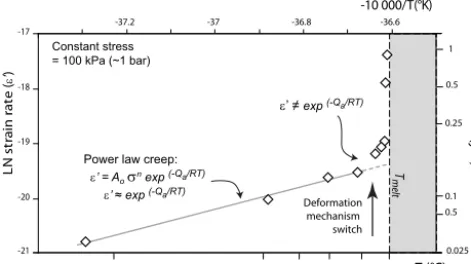
-21 -20 -19 -18 -17 1 0.5 0.1 0.5 0.25 0.025
-2 -1.5 -1 -0.5 0
-5
-37.2 -37 -36.8 -36.6
Constant stress = 100 kPa (~1 bar)
Power law creep: ε’ = Aoσn exp (-Qa/RT) ε’ ≈ exp (-Qa/RT)
ε’ ≠ exp (-Qa/RT)
L N s tr ai n r at e ( ε ’ ) T (°C) -10 000/T(°K) St ra in ra te (yr -1 ) T melt Deformation mechanism switch
Figure 3.Strain rate against temperature for experiments performed at 100 kPa, replotted after Morgan (1991). Thexaxis plots the re-ciprocal of temperature;yaxis plots the natural logarithm of strain rate. Points following the Arrhenius relation within the standard power law should appear on a straight line.
a straight line, the gradient of which equals(−Qa/R),
con-firming the Arrhenius relation in Eq. (5). However, at about −0.02◦C there is a sharp nick in the trend, with strain rates increasing by up to a factor 5 to 10 as the melting temper-ature is approached. Thus, at constant stress, ice above ca. −0.2◦C shows a sudden weakening, evidently not described by the Arrhenius relation of Eq. (5), suggesting that a stan-dard power law cannot be used to model temperate ice and potentially suggesting a switch in dominant deformation or accommodating mechanism (see also Barnes et al., 1971; Colbeck and Evans, 1973; Morgan, 1991).
Secondly, the value for the creep exponent nin for perate ice is highly uncertain. Experiments at constant tem-perature but varying stress (T ∼ −0.01◦C,σ=10–100 kPa)
by Colbeck and Evans (1973) suggestn=1.3; experiments of creep at the melting temperature past a sphere by Byers et al. (2012) also suggestn<1.5. By analysing bulk stress and strain rate using borehole tilt measurements in a 3-D bore-hole network in the temperate Worthington Glacier, Marshall et al. (2002) notedn∼1 at low stresses but a change ton∼4 at higher stresses (>1.8 kPa). De La Chapelle et al. (1999) noted a similar change fromn∼1.8 at low stresses ton∼3 at high stress (> 250 kPa) in experiments of pure ice in the pres-ence of a brine (i.e. not temperate ice sensu stricto). Analy-sis of bulk stress and strain rate of the temperate Glacier de Tsanfleuron, however, suggestn∼1 (Chandler et al., 2008). Note that ifn∼1, the stress–strain relation becomes a linear law rather than a power law and represents Newtonian vis-cous flow. There is further uncertainty as there appears to be a discrepancy between temperate ice behaviour seen in lab-oratory experiments and in temperate glaciers (Cuffey and Paterson, 2010).
It thus appears that deforming temperate ice behaves fun-damentally differently from deforming cold ice and cannot be reliably modelled with a standard power law. The sharp transition just below the melting temperature suggests that
this difference is largely related to the presence of water. Du-val (1977) noted in temperate ice experiments that a rise in water content up to ca. 0.8 % leads to a 5–8 times strain rate increase. Temperate ice in Alpine glaciers can contain 1–2 % water (Vallon et al., 1976), which has been observed in ex-periments to gather along grain triple junctions (Barnes and Tabor, 1966; Wilson et al., 1996), so that it is likely that a vein network along triple junctions exists (Nye and Frank, 1973; Mader, 1992). Partial melting of a deforming temperate layer is furthermore suggested by the formation of bubble-free ice, both in experiments (Barnes and Tabor, 1966) as well as in Alpine and surging Svalbard glaciers (Tison and Hubbard, 2000; Lovell et al., 2015). The dominant deformation mech-anism for temperate ice, however, is uncertain and it is pos-sible that different deformation mechanisms operate simul-taneously. Possible deformation mechanisms and their po-tential enhancement by the presence of water are suggested below.
Diffusion creep is enhanced by the presence of liquid along grain boundaries, since that liquid functions like a fast diffusion path (Pharr and Ashby, 1983; Raj, 1982; Goldsby and Kohlstedt, 2001).
Dislocation creep is also enhanced by liquid (Duval, 1977; De la Chapelle et al., 1995, 1999). Water along grain bound-aries decreases the surface area of grain-to-grain contacts and cause an increase in grain-to-grain contact stresses; this will enhance dislocation creep (De La Chapelle et al., 1999) but also other deformation mechanisms. Liquid may also sup-press strain hardening and enhance easy intracrystalline basal slip (Duval, 1977; De La Chapelle et al., 1999).
Dynamic recrystallisation and grain growth is rapid in deforming temperate ice (e.g. Duval et al., 1983; Wilson, 1986). Dynamic recrystallisation aids dislocation creep as it grows crystals with orientations favourable for easy basal slip and suppresses strain hardening (e.g. Duval et al., 1983). Dynamic recrystallisation results in a coarse grain size and should aid development of a crystal fabric.
Grain boundary sliding is commonly invoked to explain weakening in ductilely deforming materials (superplastic-ity). Superplasticity has been experimentally achieved in ice at very low temperatures (−30 to −80◦C) and very small (3–40 µm) grain sizes (Goldsby and Kohlstedt, 1997, 2001; Goldsby and Swainson, 2005), markedly different to the tem-perate ice under discussion here. Whether grain boundary sliding in ice leads to the formation or destruction of a crys-tallographic fabric appears debatable (Goldsby and Kohlst-edt, 2001, 2002; Duval and Montagnat, 2003; Goldsby and Swainson, 2005).
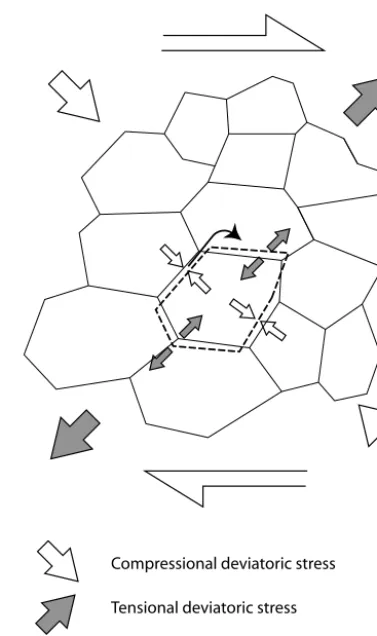
Ei-ther way, this leads to strain. For ice (in contrast to almost all other materials), it is important to emphasise that grain boundary melting involves a negative volume change upon melting (1V = −9 %), which makes grain boundary melt-ing under elevated stresses a thermodynamically favourable mechanism. The distance of heat transport to the stressed grain boundaries necessary to sustain grain boundary melt-ing is half the grain size (Fig. 4), some 3 orders of magni-tude smaller than the size of most bedrock obstacles. This mechanism only operates if ice and water coexist in thermal and chemical equilibrium and would thus not be observed in experiments with cold ice and where the liquid is a brine (cf. De La Chapelle, 1995, 1999). Grain boundary melting is supported by the formation of bubble-poor ice at the base of temperate glaciers: both Tison and Hubbard (2000) and Lovell et al. (2015) show that such ice is not formed by di-rect freeze-on (regelation ice) but by a metamorphic process involving partial melting. Grain boundary melting is loosely analogous to pressure solution (solution-precipitation creep) observed in salts and limestone, insofar that material changes from solid to liquid or vice versa along grain boundaries in different stress states (Pharr and Asby, 1983; McClay, 1977; Rutter, 1983), but differs in that grain boundary melting cre-ates its own liquid.
Which of these deformation mechanisms is dominant is difficult to establish. Tison and Hubbard (2000) documented large grain sizes (5–20 mm) and a well-developed crystallo-graphic fabric in deforming ice at the base of the temperate Glacier de Tsanfleuron, features not compatible with grain boundary sliding as a dominant deformation mechanism. Diffusion creep, grain boundary sliding and grain boundary melting all work on grain boundaries and are grain-size sen-sitive: they are favoured by a small grain size and the pres-ence of a liquid; these mechanisms normally result in n< 2 and thus could explain the n∼1 behaviour seen in some experiments and natural glaciers. However, all grain-size-sensitive mechanisms are at odds with the large grain sizes observed and can, on their own, not explain well-developed fabrics. Well-developed fabrics potentially attest to disloca-tion creep, but this is in turn at odds with the n∼1 be-haviour commonly observed. Altogether there is no clear ev-idence of a single dominant deformation mechanism, and all deformation mechanisms mentioned above may contribute. Considering the near-unique pressure-melting behaviour of H2O, grain boundary melting is worthy of further study. The
change in the stress dependency as observed in the Worthing-ton Glacier (Marshall et al., 2002) as well as in some exper-iments (De La Chapelle et al., 1999) suggests that the domi-nant deformation mechanism in temperate ice depends on the magnitude of stress. For the moment the rather non-generic term “melt-assisted creep” is used herein. A strong crystallo-graphic fabric and concentrations of dust or silt particles are known to significantly weaken cold ice in simple shear (e.g. Lile, 1978; Paterson, 1991, 1994; Dahl-Jensen and Gunde-strup, 1987; Azuma, 1994), but whether this leads to further
Compressional deviatoric stress
Tensional deviatoric stress
Movement of liquid along grain boundaries
Figure 4.Schematic illustration of grain boundary melting under simple shear. Melting occurs at grain contacts under high stress (compressional deviatoric stress); regelation may occur at grain contacts under low stress (tensional deviatoric stress). Liquid wa-ter moves along grain boundaries.
weakening of temperate ice is not known. There is still much unknown about creep in temperate ice; regardless of the ac-tual mechanism or the precise flow law, all experiments sug-gest that temperate ice is significantly weaker than, and be-haves very differently from, cold ice.
5 The pressure-melting component
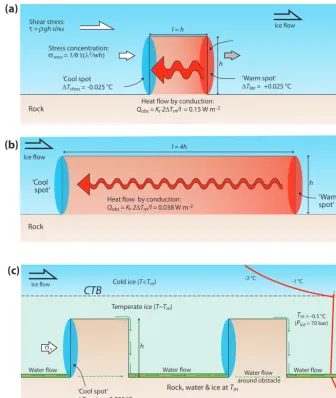
In the classic Weertman model, the stress concentration on the stoss side (Fig. 5a) that build up according to Eq. (3) causes a lowering of the melting temperature1Tm
accord-ing to
1Tm= −Cσstoss, (6)
where C is the pressure-melting constant (7.4× 10⁻⁸K Pa−1). As an example, with w=1 m, h=1 m andτ=124 kPa, similar to the parameters used by Weert-man (1957), this would result in a stoss-side normal stress
Ice flow
l = h
h
l = 4h
h
(a)
(b)
h
(c)
Shear stress: τ = ρgh sinα
Stress concentration: σstoss = 1/6 τ(λ2/wh)
Heat flow by conduction: Qobs = Kr 2∆Tm/l = 0.15W m–2 ‘Cool spot
∆Tstoss =-0.025 °C
‘Warm spot’ ∆Tlee = +0.025 °C
Heat flow by conduction: Qobs = Kr 2∆Tm/l = 0.038W m–2
Ice flow
Ice flow
σn
‘Cool spot’ ∆Tstoss- = - 0.025 °C
Tm = -0.5 °C (Pice = 70 bar) -1 °C -2 °C
Cold ice (T<Tm)
Temperate ice (T~Tm)
Rock, water & ice at Tm Water flow
Water flow Water flow
CTB
‘Coolspot’
‘Warm spot’
Water flow around obstacle Rock
Rock
Figure 5. (a)Basic Weertman sliding model, illustrating components of pressure melting. Thermal gradient through bedrock obstacle is indicated by red arrow.(b)Weertman sliding pressure melting with an elongate obstacle; all other parameters are the same.(c)Pressure melting, water and heat transport in a temperate basal layer with significant meltwater flow; a thermal equilibrium occurs everywhere by heat advection by flowing water except at the “cool spot” of the stoss side. CTB is the cold-temperate ice boundary. Schematic thermal gradient of Borehole D is indicated (after Lüthi et al., 2002). See Appendix A for calculations of values in the figure.
lowering of the melting point of1Tm= −0.025◦C.
Assum-ing the deviatoric stress on the lee side is equal but opposite, the melting temperature at the lee side is higher by an equal amount, so that 1Tm= +0.025◦C. Weertman (1957)
envisaged that water freezing on the lee side would release latent heat; this excess heat was regarded to betransported through the obstacle towards the stoss side where it caused further melting. The resultant heat flux through the obstacle
Qob is then controlled by the total temperature difference
between the lee and stoss side (2 1Tm=0.05◦C in this
example), the thermal conductivity of rockKrand the length lof the obstacle:
Qob=Kr21Tml−1. (7)
This heat flux was regarded to control the amount of thermal energy available at the stoss side for melting to proceed and hence as controlling the velocity by meltingVpm:
Vpm=QobHice−1ρice−1=Kr21Tml−1Hice−1ρice−1∝l−1, (8)
whereρice the density of ice. This model has a number of
problems. Firstly, if cavitation occurs it is unclear how heat can be transported to the stoss side (as pointed out by Lli-boutry, 1993). Secondly,Vpmis inversely proportional to the
aspect ratio). This result contradicts most observed geomor-phology (Stokes and Clark, 1999; Bradwell et al., 2008) and supports the notion that pressure melting is not dominant for large obstacles.
6 Stoss-side pressure melting in temperate ice
What are the rate-controlling factors for stoss-side pressure melting in a layer of temperate ice? In the conceptual model here (Fig. 5c), the temperate layer is thicker than the height of the obstacle. Water is continually produced by frictional heating, there is a net-melting environment with an excess of water and water pressure on the ice-bed contact will be high. Depending on the basal melt rate and the amount of water flowing along the ice–rock interface, heat advection by flowing water may well be more efficient than heat con-duction through rock or ice. In that case no significant ther-mal gradients through bedrock obstacles can build up and the entire basal system (temperate ice, water and top rock) is kept at thermal equilibrium at Tm. The only exception
is the stoss side of a bedrock obstacle, where the melting temperature is continually depressed as a result of the con-centrated deviatoric stress acting onto it (Fig. 5c). Thus, the problem of stoss-side pressure melting is reduced to a sin-gle “cool spot” at the stoss side, with a temperature1Tstoss
below the ambientTm(1Tstoss= −0.025◦C in the example,
with similar parameter values as Weertman, 1957). To sus-tain stoss-side pressure melting, heat needs to be transported only a short distance towards this cool spot: anywhere else is at Tm. Although total1T is half compared to the
Weert-man model (there being no “warm spot” at the lee side), the transport distance is much smaller. Most obstacles will be wider than high, in which case the critical transport distance is 0.5 h. As a consequence the heat flow towards the stoss side will be greater than in Weertman’s model, and it is in-dependent of the length of the obstacle. Cavitation may oc-cur, as this system is not dependent on regelation. The pro-cess can work without any regelation in an overall melting environment, which is compatible with the observation of continuous net basal melting at the base of ice sheets (e.g. Fahnestock et al., 2001). If regelation occurs on the lee side (because of lower stress) of one obstacle, any excess heat will be advected by flowing water to the stoss side of the next obstacle. In this process, the rate-controlling factors are the height of the obstacle (but not the width or the length) and the efficiency of the heat advection by flowing water. The process is notlimited by heat flow through the obsta-cle (cf. Weertman, 1957; Kamb, 1970), and the length of the obstacle becomes irrelevant. This type of stoss-side melt-ing will be faster than in Weertman’s model for all but the shortest obstacles, and certainly so for obstacles with l > h, which is the case for most observed bedrock bedforms in even the roughest of deglaciated terrains (Bradwell, 2013; Roberts and Long, 2005).
7 Effect of surface water input on temperate ice on a rough bed
Influx of surface meltwater represents addition of thermal en-ergy to the basal environment and can further aid stoss-side melting and hence basal motion. Consider the dramatic influx of surface meltwater by the sudden drainage of supraglacial meltwater lakes in West Greenland (e.g. Das et al., 2008). This water is relatively warm (ca. 1◦C; Tedesco et al., 2012) and such an influx thus represents a significant addition of thermal energy to the base. Sudden influx of warm meltwa-ter may have the following consequences:
a. An increase of basal water pressurePwresults in a drop
in effective pressurePe, lowering the friction on flat
surfaces. Frictional heating and drag on the flats will drop, as long as Pw remains high. However, because
there is less drag on the flat surfaces, the normal stress
σstoss onto the stoss side of obstacles increases (also
temporarily), enhancing stoss-side melting as well as creep.
b. The basal system is flushed with water that is well above the ambientTm. Given the very fast recorded flow of
large amounts of water (Das et al., 2008), it is assumed here that little heat is lost during englacial transport. Water entering the basal system at 1◦C is 1.5◦C above
Tm and 1.525◦C above the stoss-side melting point.
There is thus potentially a steeper thermal gradient be-tween the warm water and the cold spot at stoss side and more thermal energy is available. This may lead to ac-celerated stoss-side melting, which would continue until all the water has cooled toTm.
c. A more longer-term effect is that if warm water is added to the base and cannot drain away freely, the additional thermal energy will lead to a thickening of the temperate layer (upwards migration of the CTB), in essence cryo-hydrological warming of the basal system (cf. Phillips et al., 2010).
The rate-controlling factors of this enhanced stoss-side melt-ing are (i) the flux of surface meltwater, (ii) the temperature of this water, and (iii) the dissipation of the extra heat, for instance by further melting of ice above the flat surfaces.
2x pr essur
e melting r
ate ( T)
Decrease in ‘critical obstacle size’
Creep r
ate (
W)
10 x cr eep r
ate (
T) Pressur
e melting r
ate ( W
) KC
Co
V (m yr
–1)
10-5 10-4 10-3 10-2 10-1 1 10 h (m)
10-2
10-1
1 10
102
103
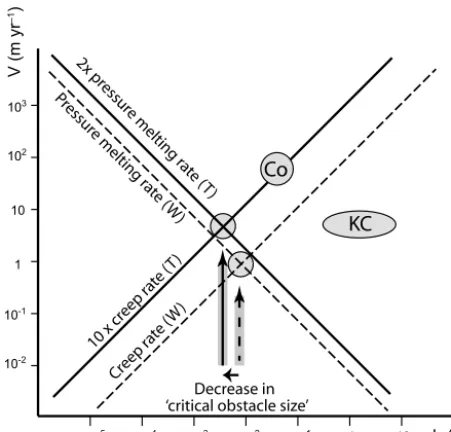
Figure 6. Sliding velocity due to pressure melting and enhanced creep (logarithmic scale) as a function of height of obstacle (Weert-man, 1957). Intersection represents the critical obstacle size.W is the velocities following Weertman;T is the velocities in temperate ice; KC and Co are velocity and critical obstacle size of estimates of Kamb and LaChapelle (1964) and Cohen et al. (2000) respectively.
and Bradwell, 2014). The sudden, short jump is probably due to true sliding as basal ice is pushed higher onto (but not over) sloping obstacles due to an increase ofPw. However,
the longer-term (days) increase in ice velocity may well be caused by accelerated stoss-side melting as described above. It is remarkable that the dramatic lake drainage events have a rather muted effect on ice velocity, strongly suggesting that the basal ice in West Greenland is “stuck” on the stoss sides of pronounced bedrock obstacles. The term “lubrica-tion” (e.g. Parizek and Alley, 2004; Shannon et al., 2013) is inappropriate to describe the latter process: it is enhanced pressure-melting regelation, rather than a lowering of fric-tion, that leads to the speed-up.
8 Critical obstacle size
Weertman (1957) introduced the notion of the “critical obsta-cle size”. Because pressure melting and enhanced creep have different dependencies on the obstacle size, melting and rege-lation should be the dominant mechanism for small obsta-cles, whereas enhanced creep should be dominant for larger obstacles. For his chosen parameters, Weertman arrived at a critical obstacle size of ∼1 cm (Fig. 6). Replacing the con-trolling mechanisms with those for temperate ice, but other-wise applying the same parameters, this would result in ap-proximately a 5–10 times increase in creep velocity and a doubling of the pressure-melting velocity, because the
con-trolling height is 0.5 h. This means that the critical obstacle size becomes even smaller, e.g. ca. 0.5 cm (Fig. 6). However, in subglacial observations and experiments Kamb and La Chapelle (1964) noted that melting/regelation was dominant at much larger obstacles and suggested a critical obstacle size of about 1 m. They suggested that whilst the qualitative idea of a critical obstacle size of Weertman (1957) was correct, the quantification was incorrect. In subglacial experiments under high vertical melt-rate conditions, however, Cohen et al. (2000) suggested critical obstacle size of ca. 5 cm. On the scale of typical bedrock obstacles such as roche moutonnées (l∼5–50 m,h∼1–10 m), enhanced creep will be dominant and, as discussed above, will in temperate ice be controlled by some form of melt-assisted creep. Pressure melting may not be important for bedrock obstacles on a rough bed but can be important for ice flow around cobble-sized debris.
9 Discussion
9.1 Summary of rate-controlling mechanisms
In summary, ice flow around a bedrock obstacle in temper-ate ice is accommodtemper-ated by stoss-side pressure melting or by enhanced creep, with creep being more important for larger obstacles. In temperate ice, the enhanced creep component of basal motion operates close to or at the melting tempera-ture. The rheology of this melt-assisted creep is poorly con-strained, but it does not behave according to standard power-law creep and is up to 1 magnitude faster than creep in cold ice, and it may involve a component of grain boundary melt-ing. The effects of strain softening and dust particles are un-certain; more laboratory experiments on the deformation of temperate ice may help to better understand creep in temper-ate ice.
If a temperate layer exists that is thicker than the height of bedrock obstacles, it is proposed here that stoss-side pressure melting is constrained by
– stress concentration on the stoss side, which depends on the surface area of the stoss side with respect to the spac-ing of obstacles as well as to the slope of the obstacles, something not considered here;
– height of the obstacle, which is critical to the transport distance of heat;
– frictional heating on the flat surfaces, which causes the production of excess meltwater;
– the efficiency and possible localisation of the local drainage network;
– input of surface meltwater.
Geothermal heat flow (~30–60 mW m–2)
1) Cold-based
2) At pressure
melting 3) Thick temperate layer + surface melt water4) Temperate layer
1) Frozen bed 2) Basal melting starts 3) Thick temperate layer 4) Transient phases of warm water
Frictional heat
(>100 mW m–2) Frictional + strain heat
(>100 mW m–2)
1) 2) 3) 4)
Frictional + strain heat + ‘hot’ water (>100 mW m–2)
- no sliding - Glen’s ductile flow (at low T)
- sliding limited by Weertman
- Glen’s ductile flow - sliding limited by water flow- thick layer with melt-assisted creep - sliding limited by surface melt water & water flow - thick layer with melt-assisted creep
Geothermal heat flow
Frictional heat
Tm 5 °C
10 °C
-15 °C -10 °C -5 °C
Solar / atmospheric heat
-20 °C
1) Cold-based 2) At pressure melting 3) Thick temperate layer
Tm Frictional heat
0
T(°C) Base
Top
K = 2.1
K ~3.0 - 3.5
Tm T
Base
Top 0
T Base
Top 0
Tm layer (exaggerated)
T Base
Top 0
Tm layer
(exaggerated)
Tm Tm Tm
Tm layer
CTB CTB
CTB
ice flow
Ice flow
Ice flow
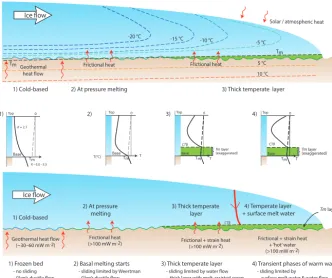
Figure 7.Hypothetical half ice sheet (e.g. Dahl-Jensen, 1989), with different thermal regimes, further explained in the text. CTB is the cold-temperate boundary;Kis thermal conductivity, in W m−1K−1;Tmis melting temperature. Numbers correspond to different thermal
regimes described in text.
9.2 Basal sliding regimes throughout an ice sheet The proposed model has implications for ice-sheet behaviour and the modelling thereof. Consider a hypothetical half ice sheet (Fig. 7), based on the thermomechanical model by Dahl-Jensen (1989) and with a passing resemblance to the Greenland Ice Sheet. Thermal gradients are strongly affected by horizontal motions as ice velocity exceeds the rate of heat conduction, so that a cold “tongue” occurs within the ice sheet (e.g. Dahl-Jensen, 1989; Iken et al., 1993). The bed is regarded as rough and hard. In such a model, three thermo-mechanical basal regimes can occur, with a potential fourth operating seasonally.
1. In the cold-based regime, the thermal gradient crosses
Tmwell into bedrock. All geothermal heat is conducted
upwards through the ice. No sliding occurs, and fric-tional heating is 0. All deformation is internal and can be described by standard power-law creep.
2. At some point the thermal gradient crosses Tm at the
base of the ice sheet, and the base is at the pressure-melting point. Sliding starts and frictional heating kicks in. In this regime, the friction coefficient will be highly variable as some patches will be frozen, with very high friction coefficient (Barnes et al., 1971; Budd et al., 1979; Zoet et al., 2013) but low sliding
veloci-ties, whereas other patches will be wet, with lower fric-tion coefficient but higher sliding velocities. Excess heat may still be conducted away by the overlying cold ice and water may well regelate onto lee sides and on over-lying ice, thus limiting the amount of water present. In this regime, basal sliding by some form of classic Weertman sliding is likely. Almost all creep still occurs in cold ice and can be described by a standard power law.
4. If large amounts of surface meltwater can drain to the base of the ice sheet, for instance by periodical drainage of supraglacial lakes, a different temporal thermome-chanical regime develops. Influx of surface meltwater adds thermal energy to the basal environment; this ther-mal energy is available in part to further accelerate stoss-side pressure melting.
9.3 Relevance for ice streaming and ice-sheet modelling The corollary of the processes described herein is that if a thick temperate layer is present, basal motion over a hard bed with bedrock humps provides less drag than ice modelled with cold ice properties. This finding is relevant to ice-sheet modelling. For instance, Peltier et al. (2000) argue that the Laurentide Ice Sheet cannot be adequately modelled using a standard power-law rheology; instead they suggest a differ-ent, weaker bulk rheological behaviour. This solution, how-ever, is at odds with findings that the bulk rheology of ice in boreholes can be adequately described as standard power-law creep. Instead, it may be more realistic to invoke fast, weak basal motion, even on hard beds, in ice-sheet models. How may this relate to ice-streaming mechanisms? A thick temperate layer has been observed in boreholes adjacent to the Jakobshavn Isbræ and inferred within its centre (Lüthi et al., 2002), whereas boreholes in non-ice streaming parts of the Greenland Ice Sheet show an absence of a temperate layer (Ryser et al., 2014). Ice streams are widespread and their locations appear to be controlled by a range of factors, of which topographic steering and the presence of soft, de-forming sediment bed are seen as the most important (e.g. Cuffey and Paterson, 2010; Winsborrow et al., 2010). There are, however, numerous palaeo-ice streams that neither por-tray strong topographic channelling nor have soft sediment (till) at their base (Bradwell et al., 2008; Bradwell, 2013; Eyles, 2012; Krabbendam et al., 2016).
A modern example of such an ice stream may be the NEGIS (Joughin et al., 2001; Fahnestock et al., 2001). While there is topographic steering near its outlet glaciers, topo-graphic steering is weak over much of its length (Joughin et al., 2001; Christianson et al., 2014). Seismic and radio-echo sounding have shown the base of the NEGIS to be rough (e.g. Christianson et al., 2014) and also suggest the possi-ble presence of water-rich till. However, the presence of soft, deformable till below the NEGIS is not proven and, if ex-istent, may not be the rate-controlling factor, as deforming till will not help in moving ice over bedrock humps. The bedrock geology of Greenland is dominated by Precambrian gneisses, and such rocks almost certainly underlie much of the inland track of the NEGIS. Deglaciated areas of similar Precambrian gneisses in Canada, Scotland, Scandinavia and West Greenland generally show a lack of till, extensively ex-posed bedrock and a rough landscape of rock knolls and rock basins (Roberts and Long, 2005; Krabbendam and Bradwell, 2014). On these grounds, widespread deformable till beneath
the NEGIS is unlikely. Using high-resolution radar profiles to reconstruct an isochron stratigraphy, Fahnestock et al. (2001) reported large areas of “missing” basal ice below the NEGIS and attributed this to very high, long-term basal melt rates (up to ca. 100 mm yr−1). These high basal melt rates were thought to be caused by anomalously high (10 times above normal values) geothermal heat flow. The geophysical evi-dence for such anomalously high geothermal flow, however, is localised and non-unique and does not cover the track of the NEGIS. More importantly, the contribution of frictional heating to high basal melting rates was not explicitly taken into account by Fahnestock et al. (2001). Instead, I suggest here that the NEGIS may possess a substantial basal layer of temperate ice, formed and maintained largely by frictional heating. Basal melting rates of 100 mm yr−1are possible in areas of high friction and/or high ice velocity (Fig. 1). In the inversion technique employed by Joughin et al. (2001), a weak basal temperate ice layer would potentially give a similarly low basal drag as a soft, deformable bed.
The occurrence of a temperate basal layer below cold ice is potentially an important factor controlling ice dynamics and ice streaming. However, the extent and thickness of such a layer is at present only constrained at a few widely dispersed boreholes. The occurrence of a basal temperate layer and es-timates of water content can be detected remotely by using radio-echo sounding at certain frequencies (Björnsson et al., 1996; Murray et al., 2000, 2007), and it would be interesting to see how thick and how widespread temperate basal layers are in modern-day ice sheets. The uncertainty of the rheo-logical behaviour and the exact form of the relevant flow law for temperate ice means that, unfortunately, ice bodies with significant amounts of temperate ice cannot be modelled re-liably at present, except by purely empirical constraints. Ar-guably, there is a need for more laboratory and natural ex-periments to better understand the mechanical behaviour of temperate ice.
Future challenges to improve constraints and parame-terisation of dynamic ice-sheet modelling include a better knowledge of the rheology of temperate ice, basal friction and frictional heating, basal roughness and distribution and thickness of the basal temperate layer.
10 Conclusions
Appendix A
To maintain a temperate layer below cold ice with a steep thermal gradient requires a heat flow through the cold-temperate boundary (CTB) of
QCTB=Kice(dT /dz) in [W m−2], (A1)
where Kice is the thermal conductivity of ice and dT /dz
the thermal gradient just above the CTB. In the case of borehole D near Jakobshavn Isbræ, the thermal gradient is 0.05◦C m−1 (Lüthi et al., 2002), requiring QCTB to be
2.1·0.05=0.105 W m−2, about twice the normal geothermal heat flow (see Fig. 2).
The transport of energy by water that passes through the temperate layerQLATand freezes above the CTB is given by
QLAT=FwHice in [W m−2], (A2)
whereFwis the mass flux of water across the CTB andHice
the heat of fusion of ice. A temperate layer will maintain its thickness ifQLAT=QCTBand will thicken ifQLAT>QCTB.
The required mass flux of water thus becomes
Fw=Kice(dT /dz) /Hice in [kg m−2s−1]. (A3)
In the example of Borehole D, the required mass flux
Fw=6.6×10⁻⁷kg m−2s−1. Expressed as a melt rate, using
Eq. (2),Mr=7.29×10⁻⁷m s−1or 23 mm yr−1.
The pressure-melting temperature is given by
1Tm= −C1P in [◦C]. (A4)
The overall pressure is
Pice=ρicegh. (A5)
Withhice=800 m, it follows thatPice=7.13×10³kPa, so
that1Tm= −0.52◦C.
Shear stress is given by
τ=ρghsinα. (A6)
With surface slopeα=1◦and ice thicknesshice=800 m, the
shear stressτ=124 kPa.
The concentration of horizontal normal stress acting onto a vertical stoss side is given by Weertman (1957); see Eq. (3). Using the same parameters as Weertman (1957):h=1 m,
w=1 m,λ=4 m and the overall shear stress from Eq. (A6),
τ=124 kPa, it follows thatσstoss=330 kPa.
The pressure-melting point at the stoss side is given by
1Tstoss= −Cσstossn in [
◦C]. (A7)
Taking the value of σstossn from Eq. (3) it follows that
1Tstoss= −0.024◦C. This is the pressure-melting point
de-pression below ambientTm, so that the Tstoss= −0.544◦C.
Heat flow Qob through an obstacle is given by Weertman
(1957); see Eq. (7). For an obstacle 1 m long, and taking the value of1Tstoss from Eq. (A7),Qob=0.15 W m−2. For an
Acknowledgements. Doug Macayeal, Martyn Drury, Roderick van der Wal, Steve Roberts and Phil Sargeant are thanked for encouraging and interesting discussions. Sam Roberson is thanked for comments on a previous version of the manuscript. Denis Cohen, Maurine Montagnat and an anonymous reviewer provided critical but very helpful reviews. Doug Benn and Olaf Eisen are thanked for their helpful short comments. This paper is published with the permission of the Executive Director of the British Geological Survey.
Edited by: O. Gagliardini
Reviewed by: M. Montagnat, D. Cohen, and one anonymous referee
References
Alley, R. B.: Flow-law hypotheses for ice-sheet modeling, J. Glaciol., 38, 245–256, doi:10.1029/2005JF000320, 1992. Alley, R. B., Blankenship, D. D., Bentley, C. R., and Rooney,
S: Till beneath ice stream B: 3. Till deformation: evi-dence and implications, J. Geophys. Res., 95, 8921–8929, doi:10.1029/JB092iB09p08921, 1987.
Aschwanden, A. and Blatter, H.: Meltwater production due to strain heating in Storglaciären, Sweden, J. Geophys. Res., 110, F04024, doi:10.1029/2005JF000328, 2005.
Azuma, N.: A flow law for anisotropic ice and its application to ice sheets, Earth Planet. Sci. Lett., 128, 601–614, doi:10.1016/0012-821X(94)90173-2, 1994.
Barnes, P. and Tabor, D.: Plastic flow and pressure melting in the de-formation of ice I, Nature, 210, 878–882, doi:10.1038/210878a0, 1966.
Barnes, P., Tabor, D., and Walker, J. C. F.: The friction and creep of polycrystalline ice, Proc. Roy. Soc. London A, 324, 127–155, doi:10.1098/rspa.1971.0132, 1971.
Bell, R. E., Tinto, K., Das, I., Wolovick, M., Chu, W., Creyts, T. T., Frearson, N., Abdi, A., and Paden, J. D.: Deformation, warming and softening of Greenland’s ice by refreezing meltwater, Nature Geosci., 7, 497–502, doi:10.1038/ngeo2179, 2014.
Björnsson, H., Gjessing, Y., Hamran, S. E., Hagen, J. O., Liestøl, O., Pálsson, F., and Erlingsson, B.: The thermal regime of sub-polar glaciers mapped by multi-frequency radio-echo sounding, J. Glaciol., 42, 23–32, doi:10.3198/1996JoG42-140-23-32, 1996. Blatter, H. and Hutter, K.: Polythermal conditions in Arctic glaciers, J. Glaciol., 37, 261–269, doi:10.3198/1991JoG37-126-261-269, 1990.
Boulton, G. S. : Processes and patterns of glacial erosion, in: Glacial Geomorphology, edited by: Coates, D. R., Binghampton: Univer-sity of New York, 41–87, 1974.
Bradwell, T.: Identifying palaeo-ice-stream tributaries on hard beds: Mapping glacial bedforms and erosion zones in NW Scotland, Geomorphology, 201, 397–414, doi:10.1016/j.geomorph.2007.02.040, 2013.
Bradwell, T., Stoker, M. S., and Krabbendam., M.: Megagrooves and streamlined bedrock in NW Scotland: the role of ice streams in landscape evolution, Geomorphology, 97, 135–156, doi:10.1016/j.geomorph.2007.02.040, 2008.
Budd, W. F., Keage, P. L., and Blundy, N. A.: Empirical studies of ice sliding, J. Glaciol., 23, 157–170, doi:10.3198/1979JoG23-89-157-170, 1979.
Byers, J., Cohen, D., and Iverson, N. R.: Subglacial clast/bed con-tact forces, J. Glaciol., 58, 89–98, doi:10.3189/2012JoG11J126, 2012.
Calov, R. and Hutter, K: The thermomechanical response of the Greenland ice sheet to various climate scenarios, Clim. Dynam., 12, 243–260, doi:10.1007/BF00219499, 1996.
Chandler, D., Hubbard, B., Hubbard, A., Murray, T., and Rippin, D.: Optimising ice flow law parameters using borehole deformation measurements and numerical modelling, Geophys. Res. Lett., 35, L12502, doi:10.1029/2008GL033801, 2008.
Christianson, K., Peters, L. E., Alley, R. B., Anandakrishnan, S., Ja-cobel, R. W., Riverman, K. L., Muto, A., and Keisling, B. A.: Di-latant till facilitates ice-stream flow in northeast Greenland, Earth Planet. Sci. Lett., 401, 57–69, doi:10.1016/j.epsl.2014.05.060, 2014.
Clarke, G. K., Nitsan, U., and Paterson, W. S. B.: Strain heating and creep instability in glaciers and ice sheets, Rev. Geophys., 15, 235–247, doi:10.1029/RG015i002p00235, 1977.
Cohen, D., Hooke, R. L., Iverson, N. R., and Kohler, J.: Sliding of ice past an obstacle at Engabreen, Norway, J. Glaciol., 46, 599– 610, doi:10.3189/172756500781832747, 2000.
Cohen, D., Iverson, N. R., Hooyer, T. S., Fischer, U. H., Jack-son, M., and Moore, P. L.: Debris-bed friction of hard-bedded glaciers, J. Geophys. Res.-Earth Surface, 110, F02007, doi:10.1029/2004JF000228, 2005.
Colbeck, S. C. and Evans, R. J.: A flow law for temperate glacier ice, J. Glaciol., 12, 71–86, doi:10.3198/1973JoG12-64-71-86, 1973.
Cuffey, K. M. and Paterson, W. S. B.: The physics of glaciers, Else-vier, Amsterdam, 2010.
Dahl-Jensen, D.: Steady thermomechanical flow along two-dimensional flow lines in large grounded ice sheets, J. Geophys. Res., 94, 10355–10362, doi:10.1029/JB094iB08p10355, 1989. Dahl-Jensen, D. and Gundestrup, N. S.: Constitutive properties of
ice at Dye 3, Greenland, in: The Physical Basis of Ice Sheet Mod-elling, edited by: Waddinton, E. D. and Walder, J., 170: IAHS Publications, 31–43, 1987.
Das, S. B., Joughin, I., Behn, M. D., Howat, I. M., King, M. A., Lizarralde, D., and Bhatia, M. P: Fracture propagation to the base of the Greenland ice sheet during supraglacial lake drainage, Sci-ence, 320, 778–781, doi:10.1126/science.1153360, 2008. De La Chapelle, S., Duval, P., and Baudelet, B.: Compressive
creep of polycrystalline ice containing a liquid phase, 33, Scripta metallurgica et materialia, 33, 447–450, doi:10.1016/0956-716X(95)00207-C, 1995.
De La Chapelle, S., Milsch, H., Castelnau, O., and Duval, P.: Com-pressive creep of ice containing a liquid intergranular phase: Rate-controlling processes in the dislocation creep regime, Geo-phys. Res. Lett., 26, 251–254, doi:10.1029/1998GL900289, 1999.
Duval, P.: The role of the water content on the creep rate of poly-crystalline ice, IAHS Publication, 118, 29–33, 1977.
Emerson, L. F. and Rempel, A. W.: Thresholds in the sliding resistance of simulated basal ice, The Cryosphere, 1, 11–19, doi:10.5194/tc-1-11-2007, 2007.
Eyles, N.: Rock drumlins and megaflutes of the Niagara Escarp-ment, Ontario, Canada: a hard bed landform assemblage cut by the Saginaw–Huron Ice Stream, Quaternary Sci. Rev., 55, 34–49, doi:10.1016/j.quascirev.2012.09.001, 2012.
Eyles, N. and Putkinen, N.: Glacially-megalineated limestone ter-rain of Anticosti Island, Gulf of St. Lawrence, Canada; onset zone of the Laurentian Channel Ice Stream, Quaternary Sci. Rev., 88, 125–134, doi:10.1016/j.quascirev.2014.01.015, 2014. Fahnestock, M., Abdalati, W., Joughin, I., Brozena, J., and
Gogi-neni, P.: High geothermal heat flow, basal melt, and the origin of rapid ice flow in central Greenland, Science, 297, 2338–2342, doi:10.1126/science.1065370, 2001.
Funk, M, Echelmeyer, K., and Iken, A: Mechanisms of fast flow in Jakobshavns Isbrae, West Greenland: Part II. Mod-eling of englacial temperatures, J. Glaciol., 40, 569–585, doi:10.3198/1994JoG40-136-569-585, 1994.
Glen, J. W.: The creep of polycrystalline ice, Proc. Roy. Soc. Lon-don A, 228, 519–538, doi:10.1098/rspa.1955.0066, 1955. Goldsby, D. L. and Kohlstedt, D. L.: Grain boundary
slid-ing in fine-grained ice I, Scripta Materialia, 37, 1399–1406, doi:10.1016/S1359-6462(97)00246-7, 1997.
Goldsby, D. L. and Kohlstedt, D. L.: Superplastic deformation of ice: Experimental observations, J. Geophys. Res., 106, 11017– 11030, doi:10.1029/2000JB900336, 2001.
Goldsby, D. L. and Kohlstedt, D. L.: Reply to comment by P. Duval and M. Montagnat on “Superplastic deformation of ice: Exper-imental observations”, J. Geophys. Res.-Solid Earth, 107, ECV 17-1–ECV 17-5, doi:10.1029/2001JB000946, 2002.
Goldsby, D. L. and Swainson, I.: Development of C-axis fabrics during superplastic flow of ice, Eos, Transactions, American Geophysical Union, 86, 2005.
Greve, R.: Application of a polythermal three-dimensional ice sheet model to the Greenland ice sheet: response to steady-state and transient climate scenarios, J. Climate, 10, 901–918, doi:10.1175/1520-0442(1997)010<0901:AOAPTD>2.0.CO;2, 1997.
Greve, R.: Relation of measured basal temperatures and the spatial distribution of the geothermal heat flux for the Greenland ice sheet, Ann. Glaciol., 42, 424–432, doi:10.3189/172756405781812510, 2005.
Gudmundsson, G. H. and Raymond, M.: On the limit to resolution and information on basal properties obtainable from surface data on ice streams, The Cryosphere, 2, 167–178, doi:10.5194/tc-2-167-2008, 2008.
Hallet, B: A theoretical model of glacial abrasion, J. Glaciol., 23, 39–50, doi:10.3198/1979JoG23-89-39-50, 1979.
Hindmarsh, R. C. A.: Deforming beds: viscous and plastic scales of deformation, Quaternary Sci. Rev., 16, 1039–1056, doi:10.1016/S0277-3791(97)00035-8, 1997.
Hoffman, M. J., Catania, G. A., Neumann, T. A., Andrews, L. C., and Rumrill, J. A.: Links between acceleration, melting, and supraglacial lake drainage of the western Greenland Ice Sheet, J. Geophys. Res., 116, F04035, doi:10.1029/2010JF001934, 2011. Hooke, R. L.: Flow law for polycrystalline ice in glaciers’ compar-ison of theoretical predictions, laboratory data, and field, Rev. Geophys., 19, 664–672, doi:10.1029/RG019i004p00664, 1981.
Iken, A., Echelmeyer, K., Harrions, W., and Funk, M.: Mechanisms of fast flow in Jakobshavns Isbrae, West Greenland: Part I. Mea-surements of temperature and water level in deep boreholes, J. Glaciol., 39, 15–25, doi:10.3198/1993JoG39-131-15-25, 1993. Iverson, N. R., Cohen, D., Hooyer, T. S., Fischer, U. H.,
Jack-son, M., Moore, P. L., Lappegard, G., and Kohler, J.: Ef-fects of basal debris on glacier flow, Science, 301, 81–84, doi:10.1126/science.1083086, 2003.
Joughin, I., Fahnestock, M., MacAyeal, D., Bamber, J. L., and Gogineni, P.: Observation and analysis of ice flow in the largest Greenland ice stream, J. Geophys. Res., 106, 34021–34034, doi:10.1029/2001JD900087, 2001.
Joughin, I., Smith, B. E., Howat, I. M., Scambos, T., and Moon, T.: Greenland flow variability from ice-sheet-wide velocity map-ping, J. Glaciol., 56, 415–430, 2010.
Kamb, B.: Sliding motion of glaciers: theory and observation, Rev. Geophys., 8, 673–728, doi:10.1029/RG008i004p00673, 1970. Kamb, B. and LaChapelle, E. : Direct observation of the mechanism
of glacier sliding over bedrock, J. Glaciol., 5, 159–172, 1964. King, E. C.: Flow dynamics of the Rutford Ice Stream ice-drainage
basin, West Antarctica, from radar stratigraphy Ann. Glaciol., 50, 42–48, doi:10.3189/172756409789097586, 2009.
Kleman, J., Stroeven, A. P., and Lundqvist, J.: Patterns of Quater-nary ice sheet erosion and deposition in Fennoscandia and a the-oretical framework for explanation, Geomorphology, 97, 73–90, doi:10.1016/j.geomorph.2007.02.049, 2008.
Krabbendam, M. and Bradwell, T.: Quaternary evolu-tion of glaciated gneiss terrains: pre-glacial weather-ing vs. glacial erosion, Quaternary Sci. Rev., 95, 20–42, doi:10.1016/j.quascirev.2014.03.013, 2014.
Krabbendam, M., Eyles, N., Putkinen, N., Bradwell, T., and Arbeleaz-Moreno, L.: Streamlined hard beds formed by palaeo-ice streams: A review, Sediment. Geol., 338, 24–50, doi:10.1016/j.sedgeo.2015.12.007, 2016.
Lile, R. C.: The effect of anisotropy on the creep of polycrystalline ice, J. Glaciol., 21, 475–483, doi:10.3198/1978JoG21-85-475-483, 1978.
Lliboutry, L.: Permeability, brine content and temperature of tem-perate ice, J. Glaciol., 10, 15–29, doi:10.3198/1971JoG10-58-15-29, 1971.
Lliboutry, L.: Internal melting and ice accretion at the bottom of temperate glaciers, J. Glaciol., 39, 50–64, doi:10.3198/1993JoG39-131-50-64, 1993.
Lovell, H., Fleming, E. J., Benn, D. I., Hubbard, B., Lukas, S., Rea, B. R., Noormets, R., and Flink, A. E.: Debris entrainment and landform genesis during tidewater glacier surges., J. Geophys. Res.-Earth Surf., 120, 1574–1595, doi:10.1002/2015JF003509, 2015.
Lüthi, M., Funk, M., Iken, A., Gogineni, S., and Truffer, M.: Mech-anisms of fast flow in Jakobshavn Isbrae, West Greenland: Part III. Measurements of ice deformation, temperature and cross-borehole conductivity in cross-boreholes to the bedrock, J. Glaciol., 48, 369–385, doi:10.3189/172756502781831322, 2002. Macayeal, D. R., Bindschadler, R. A., and Scambos, T. A. : Basal
friction of ice stream E, West Antarctica, J. Glaciol., 41, 247– 262, doi:10.3198/1995JoG41-138-247-262, 1995.