EVALUATION OF ESTROGENIC ACTIVITY OF ALCOHOLIC
EXTRACTS OF FRUITS OF SOLANUM XANTHOCARPUM USING
PERCENTAGE VAGINAL CORNIFICATION AND VAGINAL
OPENING AS PARAMETERS OF ASSESSMENT.
QUMRE ALAM*, VIJAYANARAYANA K., D.SATYANARAYANA.
Department of Pharmacology, Nitte Gulabi Shetty Memorial Institute of Pharmaceutical Sciences, Deralakatte, Paneer, Mangalore-574160.
Running Title: Estrogenic activity of Solanum xanthocarpum
*Correspondence: Mr. Qumre Alam.
E-mail : [email protected] Present address: Department of Pharmacology,
Al-Ameen College of Pharmacy,
Hosur road, near lalbagh main gate, Bangalore-560027.
Summary
The objective was to conduct a comparative study of estrogenic activity of alcoholic extract of Solanum xanthocarpum with diethylstilbestrol in bilaterally ovariectomized young albino rats using percentage vaginal cornification and vaginal opening as parameters of assessment.
Bilaterally overiectomized albino rats were divided into five groups (n=7) receiving differrent treatments, consisting of vehicle (distilled water), ethanolic extract of fruits of Solanum xanthocarpum at three different doses (viz., 100, 200, 400 mg/kg body weight) and standard drug diethylstilbestrol (DES) at a dose of 2 mg/kg body weight. All drugs were administered orally daily for 7 days. Estrogenic activity was assessed by taking percentage vaginal cornification and vaginal opening as parameters of assessment. The results proved the estrogenic activity of extracts for dose 200 & 400 mg/kg body weight by exhibiting the significant ( p<0.05 & p<0.01) result for various parameters like percentage vaginal cornification and vaginal opening. But the dose 100 mg/kg of Solanum xanthocarpum was proved statistically insignificant in above mentioned parameters. Solanum xanthocarpum showed moderate estrogenic activity in a dose dependent manner compared to diethylstilbestrol.
KEY WORDS:Solanum xanthocarpum, estrogenic activity, ovariectomized rats.
Phytoestrogens are nonsteroidal compounds with estrogenic activity occurring naturally in a variety of plants as coumestans, flavonoids and lignans1. They have attracted attention because they might be capable of preventing development of estrogen related cancers and also blunting the symptoms of menopause. Solanum xanthocarpum (Fam: Solanaceae) is a prickly diffusely bright green, perennial, 2-3 m high, it is woody at the base, with zig-zag stem, branches numerous, leaves 5-10 by 2.5-5.7 cm ovate, purple hairy on both sides with yellow sharp prickles. Berry 1-3 cm diameter yellow or white green veins found in different regions of the Indo-Pakistan subcontinent.2 Since the plant (Solanum xanthocarpum) contains phytosterols such as sitosterol, carpesterol and other sterols and phenolic substances and it extensively used in the treatment of sexual debility, facilitating conception, gonorrhoea3. It may possess estrogenic activity, but no scientific data is available on the endocrine effects of this plant. Hence the present study is undertaken to evaluate the possible estrogenic activity of alcoholic extract of fruits of Solanum xanthocarpum.
The introduction of cheap, plentiful, orally active phytoestrogens at a time when the natural estrogens are scarce will become a milestone in the development of effective endocrine therapy for menstrual disorders, control of fertility and postmenopausal osteoporosis. Bhavamisra specially mentions the plant as useful in facilitating conception2.
Formulations containing Solanum xanthocarpum are being promoted for use in conditions like irregular menses, menopause, breast cancer and infertility4. Thus the evaluation of the estrogenic activity of Solanum xanthocarpum was carried out to know whether its beneficial effect in various gynecological problems and breast cancer is due to its estrogenic activity.
Materials and Methods
Material: Fruits of Solanum xanthocarpum were collected from fields areas of Manjeshwar in the month of December and its identity was confirmed by Mrs Noelin J. Pinto, H.O.D. Dept of Botany, St Agnes College, Mangalore.
The collected fruits were cleaned from adhering soil and other materials, and then it was dried under shade for two weeks. The dried fruits were chopped and pulverized in an electric grinder. The powdered plant material was subjected to Soxhlet extraction with about 80%w/v ethyl alcohol. The extract obtained was concentrated over a hot water bath. Percentage yield of thus obtained crude extract was calculated. Accordingly alcoholic extract of Solanum xanthocarpum was prepared in sufficient quantity and stored in the refrigerator for further use.
Group 1 (Control): Received distilled water at a dose of 10 ml/kg.
Group 2 (Standard): Received aqueous suspension of diethylstilbestrol (NEMESTROL) at a dose of 2 mg/kg.
Group 3 (Test): Received alcoholic extract of Solanum xanthocarpum in distilled water at a dose of 100 mg/kg.
Group 4 (Test): Received alcoholic extract of Solanum xanthocarpum in distilled water at a dose of 200 mg/kg.
Group 5 (Test): Received alcoholic extract of Solanum xanthocarpum in distilled water at a dose of 400 mg/kg.
All drugs are administered orally daily for 7 days.
Vaginal opening and cornification was examined daily.
Vaginal cytology: This was done by vaginal smear method. Vaginal smear was taken by introducing a few drops of saline into the vagina(taking care not to touch the cervix) with the help of eye dropper. The saline was expelled into the vagina and withdrawn two or three times. The contents of the eye dropper was placed and spread on a glass slide, the smear was immediately fixed with 1%w/v aqueous methylene blue for 5-6 min, the excess of stain was removed by washing with distilled water and then the smear was counter stained with 2%w/v eosin for 2-3 min. Finally the excess of stain was washed off with distilled water and air-dried. The smear was examined under low power. Presence or absence of leukocytes, nucleated epithelial cells and cornified epithelial cells, and relative proportion of each cell type was used to quantify the percentage vaginal cornification.
Vaginal opening: The vaginal opening was observed and noted daily. Increase in vaginal opening is indicative of estrogenic activity.
Statistical Analysis: Paired student t test was used to analyze the difference in biochemical parameters between control group and solanum xanthocarpum alcoholic extract treated groups.One way analysis of variance (ANOVA) followed by Dunnet’s ‘t’ test was used to analyze the difference in percentage of vaginal cornification(%) and vaginal opening.
Results
Assessment of estrogenic activity of alcoholic extract of Solanum xanthocarpum was done by taking percentage vaginal cornification and vaginal opening as parameters.
A) Vaginal cytology (Table 1)
The vaginal smear of ovariectomized control did not show any vaginal cornification (Fig. 1), during the treatment period. Whereas, alcoholic extract of
VAGINAL CORNIFICATION (%) Grou p Treatment (route) Dose (mg/k g) Day 1 Day
2 Day 3 Day 4 Day 5 Day 6 Day 7
Day 8 1 Control, distilled water (p.o)
10 0 0 0 0 0.5±0
.28 0 0
0.5±0 .5 2 Standard, DES (p.o)
2 0 0
0 86.5± 0.28 88.5± 0.28 93± 0.40 97.5± 0.28 98.5± 0.81
3 100 0 0 0 2.5±
0.28 3.5± 0.28 4± 0.40 5. 5± 0.28 6.25± 2.52
4 200 0 0 0
52.25 ± 0.85 67± 0.40 76.5± 0.65 86.5± 0.64 97.1± 0.70 5 Solanum xanthocarpu m extract (p.o)
400 0 0 0 65±
0.28 74.5± 0.28 83± 0.40 94.5± 0.28 98.5± 0.28
Table 1: Effect of alcoholic extract of Solanum xanthocarpum on vaginal cornification in bilaterally ovariectomized albino rats.
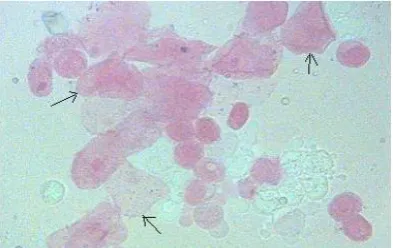
Fig.1: Photomicrograph (x100) of methylene blue and eosin stained vaginal smear of control rat, showing only leukocytes (i.e., in diestrous stage)
Fig.2: Photomicrograph (x100) of methylene blue and eosin stained vaginal smear of diethylstilbestrol (2 mg/kg, p.o) treated rat, showing only cornified epithelial cells (i.e., in
Fig.3: Photomicrograph (x100) of methylene blue and eosin stained vaginal smear of Solanum xanthocarpum extract (100 mg/kg, p.o) treated rat, showing only few cornified epithelial cells
(i.e., in between estrous and diestrous stage).
Fig.4: Photomicrograph (x100) of methylene blue and eosin stained vaginal smear of Solanum
xanthocarpum extract (200 mg/kg, p.o) treated rat, showing only cornified epithelial cells (i.e.,
in estrous stage)
Fig.5: Photomicrograph (x100) of methylene blue and eosin stained vaginal smear of Solanum
xanthocarpum extract (400 mg/kg, p.o) treated rat, showing only cornified epithelial cells (i.e., in
estrous stage).
B) Vaginal Opening(Table 2).
VAGINAL OPENING (%) Grou
p
Treatment (route)
Dose (mg/k
g) Day 1
Day 2
Day
3 Day 4 Day
5 Day 6 Day 7 Day
8
1
Control Distilled water
(p.o)
10
0 0 0 0 0 0 0 0
2 Standard, DES
(p.o) 2 0 0 0 60 100 90 80 70
3 100 0 0 0 5 5 8 9 5
4 200 0 0 0 55 70 75 80 85
5
Solanum xanthocarpum
extract (p.o)
400 0 0 5 50 70 76 79 84
Table 2: Effect of alcoholic extract of Solanum xanthocarpum on vaginal opening in bilaterally ovariectomized albino rats.
Control
Std
SX-100
SX-200
Discussion
Uterus and the female reproductive tract undergo innumerable physiologic and biochemical changes under the influence of ovarian hormones such as estrogen9. If female rats are ovariectomized, the resultant lack of estrogen causes atrophy of the uterus and the reproductive tract; administration of estrogenic substances to ovariectomized rats leads to vaginal cornification and vaginal opening and proliferative changes in uterine endometrium10.
Estrogenic compounds are known to cause the keratinization and cornification of the vaginal epithelium, causing the superficial cells to be shed into the lumen to form large squamous cells11.
Thus the dose dependent increase in percentage vaginal cornification shown by the alcoholic extract of solanum xanthocarpum can be attributed to its estrogenic activity.
Literature review conducted on Solanum xanthocarpum indicated the presence of flavonoids, phytosterols and phenolic compounds14,15. Flavonoids and phenolic compounds are known to possess estrogenic activity1,16. Thus the estrogenic activity shown by the extract of Solanum xanthocarpum can be attributed to the presence of flavonoids and phenolic compounds.
With a further study on the efficacy and safety aspect, the drug in future might be recommended for preventing the development of estrogen related cancers, blunting the symptoms of menopause, lowering the incidence of osteoporosis and providing a cardioprotective effect.
Acknowledgement
Authors are grateful to the principal of Nitte Gulabi Shetty Memorial Institute of Pharmaceutical Sciences, for his support throughout the study. This work was carried out with the financial support of Nitte Education Trust.
References
1. Murad F, Jeffrey AK. Estrogens and Progestins. In: Alfred GG, Theodore WR, Alan SN, Palmer T, editors. Goodman and Gilman’s The Pharmacological Basis of Therapeutics. Vol.2. Chapter.58, 8th ed. New York: Maxwell Macmillan Pergamon Publishing Corp.; 1991. p.1384.
2. Bharatiya Vidya Bhavan’s Swami Prakashananda Ayurveda Research Centre (SPARC); Selected Medicinal plants of India: A Monograph of Identity, Safety and Clinical Usage; Chemexcil 1992; (91):295-297.
3. Cassia R. Overka, Ping Yaoa, Shaonong Chena, Shixing Dengb, Ayano Imaia, Matthew Maina, Andreas Schinkovitza, Norman R. Farnswortha, Guido F. Paulia and Judy L. Bolton. High-Content Screening and Mechanism-Based Evaluation of Estrogenic Botanical Extracts. Combinatorial Chemistry & High Throughput Screening, 2008, 11, 283-293.
extract of Bupleurum marginatum. Ind. J. Pharmac. 1995; 27: 258-261.
6. Jonathan S, Dehadrai S, Prakash AO. Estrogenic activity in the ethanolic extract of Bupleurum marginatum. Ind. J. Pharmac. 1995; 27: 258-261. 7. Cassidy A. Dietary phytoestrogens–potential anti-cancer agents? British
Nutrition Foundation Bulletin 1999; 24:22-30.
8. Dayton SS, Novice SB, Muntwryler E. The estimation of glycogen with anthrone reagent. Arch Biochem 1980; 25: 191-5.
9. Prakash AO, Mathur R. Biochemical Changes in the rat uterine tissue following Embelia ribes extracts. Ind. J.Pharmac. 1979; 11(2): 127-34.
10.Williamson EM, Okpako DT, Evans FJ. Endocrine Activity: Antifertility and Sex Hormornes. In: Pharmacological Methods in Phytotherapy Research- Selection, Preparation and Pharmacological Evaluation of Plant Material.Vol.1. Chapter.11. New York: John Wiley & Sons; 1996. P.191-216. 11. Burn JH. Biological Standardization. Chapter.18. London: Oxford University
Press; 1952. p. 240-256.
12. Ruentiz PC. Female Sex Hormones, Contraceptives, and Fertility Drugs. In: Abraham DJ, editor. Burger’s Medicinal Chemistry and Drug Discovery. Vol. 3. Chapter.13. USA: John Wiley & Sons Inc.; 2003. p. 629-660.
13. Tripathi G. Effect of estradiol dipropionate on uterine and vaginal glycogen content of parkes mice. Ind. J. Physiol. Pharmac. 1983; 27(4): 317-22.
14. Mashelkar RA, Hajra PK, Kumar V, Babu CR, Bennet SSR. The Wealth of India. 2000; 1(Suppl): 258-259.
15. Krishna Kumar PP, Vaidya DSA. Selected Medicinal Plants of India. Bombay: CHEMEXCIL; 1992. P.119 –120.