3743
Energy Efficient Reliable Routing Protocol For
Heterogeneous Clustered Wireless Sensor
Network
Parvinder Singh, Rajeshwar Singh,
Abstract: : Nowadays, the wireless sensor networks (WSNs) have obtained much attention by research community for their ability to support a variety of applications. However, due to unpredictable behavior of sensor nodes, the cluster head-based data aggregation and routing issues pose significant challenges in WSNs. Recently, a handful of cluster head selection and routing techniques are presented for the improvement of network lifetime, energy efficiency and other important QOS-parameters. In addition, the energy-efficient techniques considered residual energy and distance parameter as path metric for the selection of next-hop for data communication. Although, these existing techniques aimed to improve the next-hop selection based on energy, such techniques lack efficient packet delivery in overloaded links. The purpose of our proposed technique is to design a Modified QoS-aware heterogeneously clustered routing protocol (MQHCR) which support delay-sensitive and QoS-applications. Our proposed MQHCR protocol conserve node energy, decrease delay, improve network lifetime and reduce routing link cost. In the first phase, the MQHCR efficiently elect cluster head (CH) based on energy and in the second phase, it selects the next hop based on various factors such as hop count, Round Trip Time (RTT) and residual energy. The results of the proposed routing technique demonstrate the improvement of MQHCR protocol as compared to other existing competing routing protocols.
Keywords: Wireless sensor networks, Heterogeneous networks, Quality of service, energy efficiency, Clustered Routing.
—————————— ——————————
1 INTRODUCTION
The modern era due to their ability to work in harsh environment without any required infrastructure. The nodes in WSNs are deployed randomly in adhoc manner which helps to gather sensing information from the outer world [1]. The nodes observe, process, aggregate and forward the sensed data to nearby nodes to finally accepted at sink node [2]. For efficient data transmission towards the base station, the entire network is divided into small clusters and this process is termed as clustering. After the formation of clusters, the node which satisfy certain conditions will be chosen as cluster head (CH) [3]. This cluster head node collects all the required data and further send it towards the sink node. The WSNs pose challenging constraints for communication protocols due to limited and non-replaceable resources [4]. In the traditional wireless networks, the routing protocols tend to improve network latency and data delivery. However, in WSNs, the main emphasis involves energy conservation and network overhead. The advantages of conventional routing technique include consistency, This disadvantage can only be overcome by developing energy efficient routing protocols which helps to improve network lifetime and network latency. Therefore, recently different researchers stress on development of robust and adaptive routing protocols for enhancement of energy efficiency and appropriate path discovery towards the destination nodes.The hierarchical-routing techniques are developed to improve network lifespan and energy efficiency. These techniques work on efficient load distribution among sensor nodes after incorporating sub-optimal paradigm and probabilistic methods [6]. However, due to the random behavior of communication links, the path discovery process in
these protocols are not optimized and required re-clustering in every communication round [7]. Furthermore, large number of path discovery packets are flooded through various relay nodes which consume network energy and incurs routing overhead [8]. Therefore, the routing protocol must select an optimum path for data dissemination and re-tuning [9]. This paper attempt to improve network lifetime by developing energy aware heterogeneously clustered protocol and finding an optimum path for efficient data delivery which further improve QoS [10]. The proposed protocol called as Modified QoS-aware heterogeneously clustered routing protocol (MQHCR) initially divided the whole network into clusters, elect cluster head based on energy, and provide routing solution based on residual energy, RTT and hop count factors. In addition, high network reliability is achieved through updated routing paths based on network measurements.
The main research findings of this work are summarized as follows:
(i) To explore a cluster formation and CH selection technique for densely deployed WSNs based on distance to BS and node residual energy.
(ii) To design an energy-aware, reliable and QoS improvement-based routing protocol (MQHCR) in clustered wireless sensor networks.
(iii) To compare the performance of proposed MQHCR protocol with other existed competing protocols in clustered WSNs.
This research paper is organized as follows. The numerous energy-efficient routing techniques related to WSN are briefly explained in Section 2. Energy consumption modelling, proposed MQHCR protocol architecture are presented in section 3. The simulation performance evaluation of proposed protocol and its comparison with existing techniques are presented in section 4. Finally, conclusion is discussed in section 5.
————————————————
Parvinder Singh, Research Scholar, ECE Department, IK Gujral Punjab Technical University, Jalandhar, Punjab, India. E-mail: [email protected]
2
RELATED
WORK
Due to the difference between the operation of normal wireless networks and the wireless sensor networks, the IP-based routing protocols are not suitable for WSNs. Thus, the routing protocols with distinct characteristics are proposed by various authors in WSN. The routing protocols in WSN falls in three main categories such as hierarchical, locations based and data-centric routing protocols. In hierarchical based routing schemes, network nodes are divided into different groups called as clusters and every cluster elect its own cluster head based on some parameters-based criteria. The CH is responsible for data aggregation and forwarding towards the base station (BS). The normal nodes perform sensing function and report to respective CHs [11]. Low Energy Adaptive Clustering Hierarchy (LEACH) is considered as the base of clustering-based routing in WSNs [12] and one of the most inspiring and popular hierarchal protocols. The LEACH operation is divided into two different phases, initial phase called as set-up phase and final phase called as steady-state phase. In set-up phase, the clusters are formed based on random distribution technique and in set-up phase, the sensor nodes send their data to CHs. However, the LEACH lacks its suitability for dense sensor networks and not suggest any packet relaying scheme. An energy-balanced clustering routing protocol (BPA-CRP) has been developed in [13]. In this technique, the network is allocated into different layers and clusters. The algorithm enables each cluster to perform more than one round without entering set-up phase. The BPA-CRP algorithm developed a new role for the node called as ―forwarder‖ which relay the data towards BS. A new energy efficient routing protocol (ENEFC) has been introduced in [14] which provide three different levels of routing: Cluster hierarchical routing, Multi-hop hierarchical routing and multi-level hierarchical routing. In every round when route breaks, this technique changed the level of routing between the BS and CH. In [15] a new energy-aware and neuro fuzzy cluster routing technique has been introduced. In this scheme, the authors aimed to enhance the performance of cluster based WSNs with the help of machine learning and neural network tools. In addition, four important are parameters that can influence the network performance. These parameters include the distance among sink and CH, the CH node residual energy, the among CH and sensor node and the degree of CH. Th proposed technique outperform in terms of network lifespan and efficient energy utilization. In [16], a new clustered routing protocol (CQRP) for distributed WSNs has been proposed. In this technique, the authors exploit issues like link failure and resilience in WSNs. The network achieved QoS requirement through efficient selection cluster heads. The proposed CQRP technique successfully increase the network efficiency with lower packet drop rate in mobile and stable conditions. However, the proposed technique does not provide significant improvement of energy efficiency. This technique helped to achieve better packet delivery rate despite mobility of CHs. A new sleep-based clustering technique for lower energy consumption has been introduced in [17]. This technique utilizes binary particle swarm optimization technique for grouping of base stations in one cluster which is having higher interference value. A sleep strategy has been introduced for base stations and orthogonal spectral sources
are assigned for smaller BS within the cluster. Although, the designed technique reduces energy consumption but fail to improve the other quality of service parameters. The authors in [18] proposed an energy-aware reliable protocol (RER) in MWSN. This technique utilizes hop -to-hop retransmission strategy to achieve better message reliability. A metric has been formulated based on separation among relay node and current node, separation among sink node and relay node and quality of link. The routing of packets through different paths follow new metric which exceed energy efficiency, reliability, network lifespan and packet delivery ratio. A new multipath QoS-oriented routing strategy has been introduced for multimedia wireless sensor networks [19]. This algorithm utilizes a multipath transmission model based on spline path planning with delay-energy balance which generates uniformly distributed paths. Furthermore, this work optimizes the workflow in multipath routing by creating a sub flow after considering energy consumption and throughput. This technique achieves minimum delay and energy consumption while improving throughput. In [20], the authors proposed a hybrid clustering strategy based on fitness function. This fitness function replaced the CH probability in the threshold function of LEACH protocol for better results. In addition, the newly designed fitness function proves its suitability in heterogeneous networks. A new TDMA schedule has been introduced which guarantee that each node performs data transmission once per frame. This concept helps to achieve uniform energy consumption and improve energy efficiency.
3.
MQHCR
PROTOCOL
This section will elaborate the network assumptions, energy modelling, the architecture of proposed MQHCR protocol and the phases of data transmission within the network.
3.1 Assumptions
A practical WSN is always designed based on certain assumptions, the various assumptions considered for this work are as follows.
i. All nodes are distributed randomly within the network field; the nodes remain immobile and recognized by unique IDs.
ii. All sensor nodes knew their location either through GPS system or location algorithm.
iii. The nodes possess different levels of energy; some percentage of nodes have higher energy than others. iv. The power of source nodes is adjustable according to
its distance from the destination.
v. All network nodes possess same type of constraints and capabilities in terms of data processing.
vi. The BS or sink nodes possess unlimited battery energy high radio range than normal nodes.
3.2 Energy modelling of MQHCR protocol
This section describes the radio model for MQHCR protocol. The presented model combined both multipath and free space [20]. The energy consumption model is revealed in figure 1. To transfer (bit) data packet at sampling rate r (bit/s) to distance d, the amount of energy consumed will be represented as follows:
3745
( ,d,r) = ( ) + =
𝐸
𝑡𝑥_𝑒𝑙𝑒𝑐∗
𝑥𝑟
+ 𝜀
𝑓𝑠∗
𝑥 𝑟∗ 𝑑
2
𝑓𝑜𝑟 𝑑 < 𝑑
𝑜𝐸
𝑡𝑥_𝑒𝑙𝑒𝑐∗
𝑥𝑟
+ 𝜀
𝑚𝑝∗
𝑥 𝑟∗ 𝑑
4
𝑓𝑜𝑟 𝑑 > 𝑑
𝑜
E
𝑅𝑥_𝑒𝑙𝑒𝑐(
𝑥
, d, r) =
E
𝑟𝑥_𝑒𝑙𝑒𝑐∗
𝑥𝑟
Where:
( , d, r): Energy consumed for transmission of a single packet.
( ): Electronics energy consumed for channel and source coding.
: Power consumed by a power amplifier. : represents the packet size.
r: represents the data rate (bits/sec.)
: Amount of energy consumed for a single bit in free space.
: Amount of energy consumed for a single bit in multipath propagation.
( , d, r): The percentage of consumed energy inside the receiver.
: Energy consumed for running of receiver circuit.
Fig.1. Radio energy model.
3.3 ARCHITECTURE OF MQHCR PROTOCOL
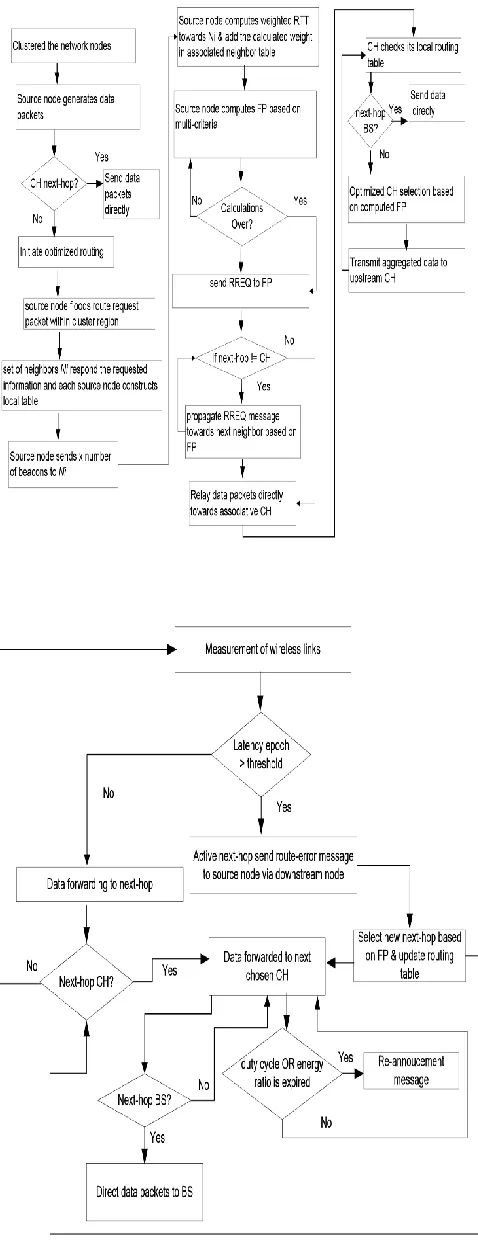
The architecture of MQHCR includes formation of clusters and routes as revealed in fig. 2.
i. In the initial step, the whole network is fragmented into different geographical clusters and a CH was elected based on remaining battery energy and the distance. The heterogeneous nature of nodes in terms of energy had significantly influence the network lifetime.
Fig. 2. MQHCR design.
ii. The route discovery phase calculates the most appropriate path in terms of energy, hop count and network traffic on a link.
iii. The MQHCR access the node status and link performance and accordingly transmit data on new selected path. All collective phases are responsible to achieve energy efficiency and QoS requirements. The workflow of MQHR in depicted in fig 4.
3.4 STEP 1: CLUSTER FORMATION
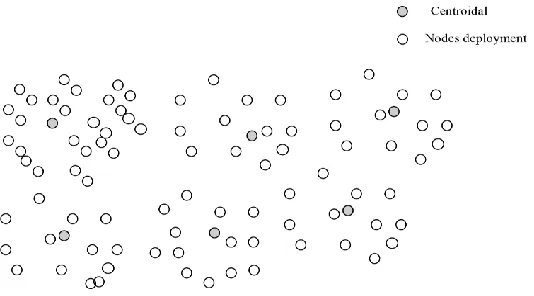
In the cluster origination phase of MQHCR, the BS initiate the location detection process by flooding the discovery messages towards the network sensor nodes. The next-hop nodes update their location information in their routing table based on discovery information and forwards to their neighbors. In this way all nodes update their routing table and select suitable node as neighbor based on minimum hop count. The nodes select next-hop and transmit their position co-ordinates. This process carried out till the BS assess the statistics of whole network.
Fig.3. View of Cluster formation.
energy-efficient groups with minimum overheads. The MQHCR then perform the cluster head selection process with least computational cost. The CH election process make use of residual energy and centrality facets. In addition, to increase the network lifetime, only those nodes can participate in the CH election process whose energy exceeds a threshold energy value as shown in Eq (3). The can be adjusted dynamically depending upon the ratio of node energy consumption in data transmission. Similarly, the centrality factor C (u) of a node has been incorporated in the proposed work. The centrality factor is defined as the reciprocal of sum of distance of the node from position y to its neighbors z for a given cluster as represented by Eq (4).
= (3)
C (u) = (4)
Where represents the initial node energy at the time of deployment.
3.5 STEP 2: ROUTE FORMATION
The route formation phase involves multiple node and link quality-based parameters to choose the next-hop in the route. These parameters include hop-count, weighted round trip time and residual energy of nodes. While making routing decision, the proposed MQHCR utilize fitness function to select the next-hop of sensor node i, which combined all the factors mentioned above and shown in Eq (5).
FF = + + (5)
Where represents the residual energy of node, represents the hop count value and
represents the weighted round trip time. The , , and are the associated weights which can be adjusted according to the priority. The node which is having maximum value of fitness function is selected as next hop. The energy factor in
Fig. 4. Workflow of MQHCR protocol.
3747 = (6)
Where, and represents the receiving and transmission time of beacon messages for a given node. The quality of channel and the transmission distance affect the RTT value. RTT represents the total round trip time by the data packets to arrive at receiver and the corresponding acknowledgement [21]. Therefore, the lowest value of indicates good quality channel which improves throughput. The RTT value changes with time, so, its weighted value can be computed below in Eq (7).
= (t) + (t+1) (7)
Where and are used as normalized factors whose value varies between 0 and 1. Fig 5 shows the selection of alternate path if a link in the present path exhibit high latency. So, the proposed protocol helps to avoid lossy wireless links and faulty nodes for better throughput performance.
Fig. 5. Low latency back-up path formation.
4 RESULTS
AND
DISCUSSION
This section evaluates the clustering and routing performance of proposed MQHCR protocol. For the best results in varying density sensor field, the different parameters are evaluated. The network area is a square field of 400m 400m. The nodes are heterogenous in nature whose initial battery energy varies between 3j to 7j. The simulations are performed in MATLB for validation. We perform simulation with 100 nodes having different energy levels. The simulation parameters are given in table 1. The MQHCR performance is compared with QHCR, CCWM, and PASCCC protocols.
4.1 NETWORK LIFETIME
Network lifetime is measured in the terms of dead nodes with increasing value of communication rounds. The death of nodes occurs due to the excessive use of set of nodes repeatedly. In the proposed protocol several factors are
considered to lengthen the life a node which includes higher initial energy nodes are selected as CH, base station nominates central nodes as CH and Round-trip time of a links. These factors improve the network lifetime compared to existing protocols. The performance of proposed protocol is shown in fig. 6.
Fig. 6. Network Lifetime
4.2 Network Stability time
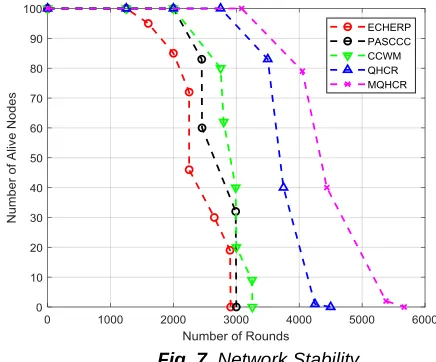
The time elapsed between the instant of deployment and the instant at which first node dies in the sensor network is called network stability period. Fig. 7 depicts the network stability period. The MQHCR has more stability than QHCR, CCWM and PASCCC protocols. The proposed protocol choose CH based on distance and choose optimum link for data transmission which help in improvement of network stability.
Fig. 7. Network Stability
4.3 Energy consumption, Throughput and End to end delay
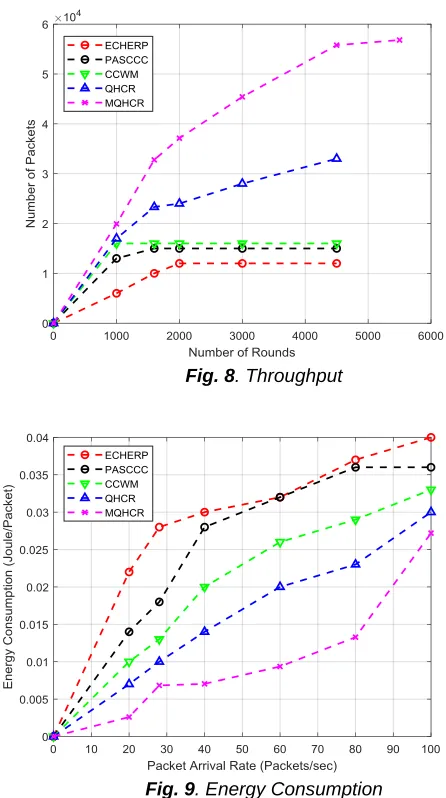
Fig. 8. Throughput
Fig. 9. Energy Consumption
The energy consumption, throughput and end to end delay are depicted in fig. 8, fig.9 and fig. 10 respectively. The proposed MQHR shows significant improvement in these three factors. The throughput and delay attributed to least hop-count factor, RTT and link reliability consideration in proposed methods. Whereas, the energy minimization is due to the residual energy factor in the fitness function.
Fig. 9. End to end delay
5. CONCLUSION
MQHCRprotocol solve the issues like in-efficient data routing and energy efficiency of WSN in different realistic scenarios. Majority of existing routing strategies create unbalanced clusters and consider only energy and distance-based parameters in routing decision. These protocols suffer from packet retransmissions and high transmission cost. Few protocols tried to improve the next-hop neighbor selection based on neighbor information but failed to address congestion problem on noisy wireless links. In the proposed MQHCR routing protocol, we consider link reliability, energy of node and hop count for new path selection. In addition, during data transmission phase, if any node suffers unavoidable congestion due to low quality on its link, it can request to source node to change of path. This process improves network throughput and decrease latency. Furthermore, the proposed protocol chooses multi-metric fitness function for next-hop selection. The next-hop positions are optimized based on node condition and packet transmission to congested links are eradicated. The experimental results conclude that the proposed protocol significantly increase network lifetime, energy efficiency, and throughput.
6 REFERENCES
[1] Abu Salem, A.O., Shudifat, N. ―Enhanced LEACH protocol for increasing a lifetime of WSNs‖. Pers Ubiquit Comput 23, 901–907, 2019
[2] Aghda, Seyed Ali Fatemi, and Mahdi Mirfakhraei. "An Improved Cluster Routing Protocol to Increase the
Lifetime of Wireless Sensor Network
(WSN)." Wireless Personal Communications Vol. 109, issue no. 3, pp. 2067-2075, 2019.
[3] Y. Zhang, X. Zhang, S. Ning, J. Gao and Y. Liu, "Energy-Efficient Multilevel Heterogeneous Routing Protocol for Wireless Sensor Networks," in IEEE Access, vol. 7, pp. 55873-55884, 2019.
[4] D. Wu, J. He, H. Wang, C. Wang, R. Wang, "A hierarchical packet forwarding mechanism for energy harvesting wireless sensor networks", IEEE Commun. Mag., vol. 53, no. 8, pp. 92-98, Aug. 2015.
[5] Dutt, Suniti, Sunil Agrawal, and Renu Vig. "Cluster-head restricted energy efficient protocol (CREEP) for routing in heterogeneous wireless sensor
networks." Wireless Personal
Communications vol.100, no. 4, pp. 1477-1497, 2018.
[6] Yao, Yanjun, Qing Cao, and Athanasios V. Vasilakos. "EDAL: An energy-efficient, delay-aware, and lifetime-balancing data collection protocol for heterogeneous wireless sensor networks." IEEE/ACM transactions on networking vol. 23, no. 3, pp. 810-823, 2014.
[7] C. Caione, D. Brunelli, L. Benini, "Distributed compressive sampling for lifetime optimization in dense wireless sensor networks", IEEE Trans. Ind. Inf., vol. 8, no. 1, pp. 30-40, 2012.
[8] Y. Liu, Q. Wu, T. Zhao, Y. Tie, F. Bai, and M. Jin, ―An
Improved Energy-Efficient Routing Protocol for Wireless Sensor Networks,‖ Sensors, vol. 19, no. 20, pp. 4579, 2019.
3749
Leon-Sanchez, A.-J. Saez-Castillo, and A. Triviño-Cabrera, ―A New Centralized Clustering Algorithm for Wireless Sensor Networks,‖ Sensors, vol. 19, no. 20, p. 4391, Oct. 2019.
[10] E. F. Ahmed Elsmany, M. A. Omar, T. Wan and A. A. Altahir, "EESRA: Energy Efficient Scalable Routing Algorithm for Wireless Sensor Networks," in IEEE Access, vol. 7, pp. 96974-96983, 2019.
[11] [11] M. Amjad, M. K. Afzal, T. Umer and B. Kim, "QoS-Aware and Heterogeneously Clustered Routing Protocol for Wireless Sensor Networks," in IEEE Access, vol. 5, pp. 10250-10262, 2017. [12] W. B. Heinzelman, A. P. Chandrakasan, and H.
Balakrishnan, ―An application-specific protocol architecture for wireless microsensor networks,‖ IEEE Transactions on Wireless Communications, vol. 1, no. 4, pp. 660–670, 2002.
[13] Khalid A. Darabkh, Mohammad Z. El-Yabroudi, Ali H. El-Mousa, ―BPA-CRP: A balanced power-aware clustering and routing protocol for wireless sensor networks‖, Ad Hoc Networks, Volume 82, Pages 155-171, 2019.
[14] Muthukumaran K, Chitra K, Selvakumar C, ―An energy efficient clustering scheme using multilevel routing for wireless sensor network‖, Computers & Electrical Engineering, Volume 69, Pages 642-652, 2018.
[15] K. Thangaramya, K. Kulothungan, R. Logambigai, M. Selvi, Sannasi Ganapathy, A. Kannan, ―Energy aware cluster and neuro-fuzzy based routing algorithm for wireless sensor networks in IoT‖, Computer Networks, Volume 151, Pages 211-223, 2019.
[16] N.V.S. Sree Rathna Lakshmi, S. Babu, N. Bhalaji, ―Analysis of clustered QoS routing protocol for distributed wireless sensor network‖, Computers & Electrical Engineering, Volume 64, Pages 173-181, 2017.
[17] Li, J., Wang, H., Wang, X. et al. Optimized sleep strategy based on clustering in dense heterogeneous networks. J Wireless Com Network , 290, 2018. [18] Ma, X.; Zhang, X.; Yang, R. Reliable Energy-Aware
Routing Protocol in Delay-Tolerant Mobile Sensor Networks. Wirel. Commun. Mob. Comput. 2019, 2019, 5746374.
[19] M. Shamim Hossain, Xinghui You, Wenjing Xiao, Jiayi Lu, Enmin Song, QoS-oriented multimedia transmission using multipath routing, Future Generation Computer Systems, Volume 99, Pages 226-234, 2019.
[20] Singh, Parvinder, and Rajeshwar Singh. "Energy-Efficient QoS-Aware Intelligent Hybrid Clustered
Routing Protocol for Wireless Sensor