Research Article
AN EXPLORATORY STUDY FOR ASSESSING TECHNOLOGY ACCEPTANCE AMONG AYUSH PHYSICIANS
Irfanahemad. A. S1, B.S.Nandakumar
1MD (Ayurveda),MPH (Hons) Research Scholar
Diseases Control, Rajiv Gandhi University o
2Associate Professor, Dept of Community Medicine.
Karnataka, India
Email:[email protected]
ABSTRACT
Introduction: AYUSH is the acroym of medical system that are beign practiced by India,such as Ayu
veda, Yoga and Naturopathy , Unani , Siddha
preserve the health of people, life prolongation and improvement of quality of life, disease prevention and treatment1. With the help of telemedicine it will be able to aid both the urban as well as
lation. Information systems have been identified as possible solution that can be used to alleviate di parity between rural and urban healthcare services and bridge the digital
ed that one of the barriers for successful implementation of health information system is the user a ceptance by health care personnel.Objectives
To assess users acceptance of telemedicine using UTAUT Use of Technology. Method: This is a cross
sample of 143 research participants during November to December 2017. AYUSH physicians were aware of the benefit of t
of the health care system. The barriers to the effective implementation of tele knowledge and lack of awareness regarding use and usage of the tele AYUSH physicians do acknowledge that tele
healthcare system. In general the acceptance of tele However in order to integrate it into standard work practic tele services is essential among AYUSH health care personnel
Keywords: Telemedicine, UTAUT model, User Perception, AYUSH physician.
MEDICAL JOURNAL
(ISSN: 2320 5091)
AN EXPLORATORY STUDY FOR ASSESSING TECHNOLOGY ACCEPTANCE AMONG AYUSH PHYSICIANS
, B.S.Nandakumar2
Research Scholar Rajiv Gandhi Institute of Public Healt Rajiv Gandhi University of Health Sciences, Bangalore, Karnataka, India Associate Professor, Dept of Community Medicine. M.S. Ramaiah Medical College,
AYUSH is the acroym of medical system that are beign practiced by India,such as Ayu veda, Yoga and Naturopathy , Unani , Siddha and Homeopathy. These system have
preserve the health of people, life prolongation and improvement of quality of life, disease prevention . With the help of telemedicine it will be able to aid both the urban as well as
Information systems have been identified as possible solution that can be used to alleviate di ty between rural and urban healthcare services and bridge the digital divide2. Literature has sugges
successful implementation of health information system is the user a
Objectives:1) To assess computer literacy of AYUSH physicians. To assess users acceptance of telemedicine using UTAUT# model. # Unified Theory of
This is a cross-sectional study, using mixed methods to obtain data from a sample of 143 research participants during November to December 2017.Results:
AYUSH physicians were aware of the benefit of tele-medicine to improve effectiveness and efficiency of the health care system. The barriers to the effective implementation of tele-medicine include lack of knowledge and lack of awareness regarding use and usage of the tele-medicine system.
USH physicians do acknowledge that tele-medicine can help to increase the effectiveness of the healthcare system. In general the acceptance of tele-medicine among healthcare personnel is positive. However in order to integrate it into standard work practices, specific training and capacity building for tele services is essential among AYUSH health care personnel
Telemedicine, UTAUT model, User Perception, AYUSH physician.
Impact Factor: 4.018
AN EXPLORATORY STUDY FOR ASSESSING TECHNOLOGY ACCEPTANCE
Rajiv Gandhi Institute of Public Health & Center for f Health Sciences, Bangalore, Karnataka, India
M.S. Ramaiah Medical College, Bangalore,
AYUSH is the acroym of medical system that are beign practiced by India,such as Ayur-have all the potential to preserve the health of people, life prolongation and improvement of quality of life, disease prevention . With the help of telemedicine it will be able to aid both the urban as well as rural
popu-Information systems have been identified as possible solution that can be used to alleviate dis-Literature has suggest-successful implementation of health information system is the user ac-To assess computer literacy of AYUSH physicians.2).
# Unified Theory of Acceptance and sectional study, using mixed methods to obtain data from a
Results: In general the medicine to improve effectiveness and efficiency medicine include lack of medicine system.Conclusion:
IAMJ: VOLUME 6, ISSUE 2, FEBRUARY, 2018 325
INTRODUCTION
World Health Organization adapts the defini-tion of telemedicine medicine as the delivery of Healthcare services where distance is a critical factor by Healthcare professionals using Infor-mation and Communication Technologies for the exchange of valid information for diagnosis treatment and prevention of disease and injuries research and evaluation and for continuing edu-cation of Healthcare providers on in the interest of advancing the help of individuals and their
communities3.
India is a geographically divided and diversified populated country. Therefore to provide equal and better medical care to every citizen of India is a major challenging task
Telemedicine is a modern, growing concept in both developed, and developing countries. In-formation and communication technology (ICT) is playing an important role to improve health care for both individuals and community levels4. AYUSH system has all the potential to preserve the health of people, life prolongation and im-provement of quality of life, disease prevention and treatment. With the help of telemedicine it will be able to aid both the urban as well as rural population. Health information systems have been identified as a possible solution that can be used to alleviate the disparity between rural and urban health care services. Information systems have been identified as possible solution that can be used to alleviate disparity between rural and urban healthcare services and bridge the digital divide. Literature has suggested that one of the barriers for successful implementation of health information system is the user acceptance by health care. The present study examined the computer literacy, perception and attitude of health care personnel using Unified theory of
acceptance and use of technology (UTAUT) model5.
Objectives
1. To assess computer literacy of AYUSH phy-sicians.
2. To assess users acceptance of telemedicine using UTAUT# model
# Unified Theory of Acceptance and Use Of Technology.5
Method
This study was conducted from November to December 2017, at Bijapur district as a Cross- Sectional Study. Requisite ethics clearances and administrative permissions and consent from participants were obtained. The major compo-nents of assessment included computer literacy and perception of AYUSH medical fraternity on technology in general and telemedicine in spe-cific. Data was collected using semi-structured questionnaire adopted from UTAUT5 model & qualitative data was collected through In-depth interview. The study population comprised of the AYUSH physicians willing to participate in the study. A Pre-tested semi-structured ques-tionnaire was used for obtaining information and In-Depth interview with Key informant was also conducted who completed questionnaires. The first part of questionnaire was regarding Demographic details; Second part had 9 ques-tions regarding Computer literacy; Third part which was developed using “UTAUT” model had 32 questions under 8 domains. Data gener-ated from the questionnaire were coded and ana-lyzed using Statistical Package for Social Sci-ence (SPSS) version 20. Data was analyzed in terms of frequency/ percentages and measures of central tendency-mean, median and variance
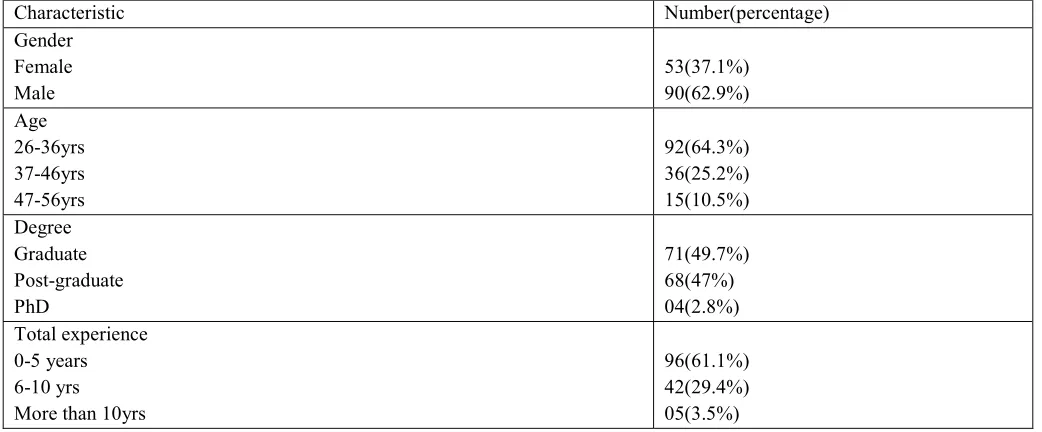
IAMJ: VOLUME 6, ISSUE 2, FEBRUARY, 2018 326 Table1: ShowingBase line characteristics of study participants
Characteristic Number(percentage)
Gender Female Male
53(37.1%) 90(62.9%) Age
26-36yrs 37-46yrs 47-56yrs
92(64.3%) 36(25.2%) 15(10.5%) Degree
Graduate Post-graduate PhD
71(49.7%) 68(47%) 04(2.8%) Total experience
0-5 years 6-10 yrs
More than 10yrs
96(61.1%) 42(29.4%) 05(3.5%)
Section: A
Study participants Profile:
Among the total Participants (N=143) 90(62.9%) were Male, 64.3% with the average age in between 26-26 years. 49.7% were
under-graduate, 47 %were Post-graduate and 3.5% were PhDs. around 61.1% were having a prac-tice Experience of 0-5 years.
Among 143 participants Ayurvedic doctors were 122, yoga 01 Unani 10 Homoepathy 10.
Table no 2: Computer literacy of the study participants
Question Number (Percentage)
Knew to type letters 133(93%)
Knew to draw graphs 126(88%)
Knew to make PPts 82(57%)
Had a formal training for Computer 06(4.2%)
Knew wha t is database 58(48%)
Knew what is statistical package 68(47%)
Using Smart phones 131(91.6%)
Section: B
Computer literacy of study Participants:
Around 93% knew to type letters in computers 88% to draw graphs only 57% were knowing to prepare PPts. and 4.2% had Formal training in Computer. 48% knew about Database and 47%
were aware of Statistical packages. Maximum number of study participants (91.6%) was using Smart Mobile phones.
Section: C
IAMJ: VOLUME 6, ISSUE 2, FEBRUARY, 2018 327 Figure no 1 Figure no 2
Figure no 3 Figure no 4
The unified theory of acceptance and use of technology (UTAUT) is a technology ac-ceptance model formulated by Venkatesh and others6. The UTAUT aims to explain user inten-tions to use an information system and subse-quent usage behavior. The theory holds that there are four key constructs: 1) performance expectancy, 2) effort expectancy, 3) social in-fluence, and 4) facilitating conditions. The first three are direct determinants of usage intention and behavior, and the fourth is a direct determi-nant of user behavior. Gender, age, experience, and voluntariness of use are posited to moderate the impact of the four key constructs on usage intention and behavior. The theory was devel-oped through a review and consolidation of the constructs of eight models that earlier research had employed to explain information systems usage behaviour (theory of reasoned
ac-tion, technology acceptance model, motivational model, theory of planned behavior, a combined theory of planned behavior/technology ac-ceptance model, model of personal comput-er use, diffusion of innovations theory, and social cognitive theory)
Performance expectancy
Performance expectancy represents the degree to which an individual believes that using sys-tem will assist them in attaining their goals in job performancy 7.
IAMJ: VOLUME 6, ISSUE 2, FEBRUARY, 2018 328
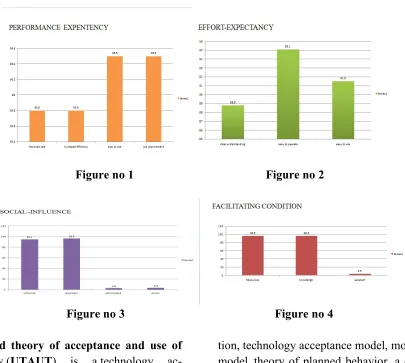
96.5% say it will increase their productivity in job.
AYUSH physician in rural areas found telemed-icine to be more useful than those working in district proper ie in urban areas.
Effort expectancy
Effort expectancy is defined as the degree of ease associated with the use of the system7. Among the participants (N=143) 93.6% consid-er computconsid-er training is must for use of TM, 95.7% consider TM can be learnt to operate, 91.5% consider it is easy to use & 88.8% have clear understanding about TM.
Social Influence
Social influence is defined as the extent to which an individual allows the opinions of oth-ers to influence their decision to use the sys-tem7.In this, a positive correlation was found for perceived knowledge of telemedicine.
Among the participants (N=143) 95.1.% and 96.5% consider people who influences them and are important consider that TM should be used by these people respectively.2.8% and 5.5% an-swered that they get support from administrative officer or doctor respectively.
Facilitating Condition
Facilitating Condition includes resource availa-bility such as technical assistance, knowledge of the system and compatibility with other system already in use 7.
Among the participants (N=143) 96.5% an-swered that they have physical, mental abilities and sufficient knowledge about TM.3.5% were of opinion that they will get support if required during use of TM.
In general the majority of AYUSH physician in the study believed that telemedicine would im-prove their productivity in workplace, useful during their daily activities. The advantages of telemedicine cited by AYUSH physician
in-cludes less time being spent, shorter waiting time, less travel by patients, reducing Out of Pocket expenditure.
On synthesis of the discussion notes from AYUSH doctors these following thing were noted, there is lack of adequate training about communication, hardware and software, they were concern about the legal issues .and net-work problem faced during usage, informed consent, privacy of patients. Incentive for refer-ring cases needs to be considered. Medico-legal issues need to be sorted out, telemedicine equipments are not accessible to doctors, feed-back from patients needs to be taken.
DISCUSSION
Telemedicine in India began comparatively later than most of countries. Despite the successful pilot phase in public sector, the system has been largely under-utilized and has failed to deliver promise in operational phase. This is one of the studies exploring to understand behavioral in-tention of healthcare personnel by employing unified theory of acceptance and use of technol-ogy (UTAUT) as the theoretical foundation. In the study done by Irfanahemad et.al 2018 it was found that the health care personnel in tertiary care pediatrics center found telemedicine to in-crease their productivity, quality and efficiency of work, same as that what we found in this study8. In the similar study “Awareness, attitude and readiness of clinical staff towards telemedi-cine “by Abbas Sheikh taheri et al. It was found that Clinical staff had little knowledge about telemedicine services 9, however they had a pos-itive perception. The same is the ours finding
IAMJ: VOLUME 6, ISSUE 2, FEBRUARY, 2018 329
help to increase the effectiveness of the healthcare system. The barriers to the effective implementation of tele-medicine include lack of knowledge and lack of awareness regarding use and usage of the tele-medicine system
However in order to integrate it into standard work practices, specific training and capacity building for tele-services is essential among AYUSH health care personnel.
CONCLUSION
The AYUSH physician found telemedicine to increase their productivity, quality and efficien-cy of work. Most of health care personnel found system easy to use. Maximum physician though not technically trained in computer can operate computer easily. Social influence and facilitat-ing conditions were also found to influence ac-ceptance of health care personnel of telemedi-cine. However in order to integrate it into stand-ard work practices, specific training and capaci-ty building for tele-services is essential among health care personnel. Most of respondents agreed about the role of telemedicine in improv-ing quality of health care. The need of proper awareness and training program is identified to make them aware about telemedicine and its application in patient care, education and re-search. Acceptance of new technology will not only support in health information management but will also take practices to a greater height.
LIMITATIONS
A significant limitation of this study was small sample size of healthcare personnel.
Acknowledgements
The authors acknowledge the support and encouragement of Dr Pallavi Sarji Utkarsh, HOD Rajiv Gandhi Institute of Public Health & Center for Diseases Control, Dr
Pruthvish S, HOD Dept of Community Medicine. M S Ramaiah Medical College Director Dept of HFW, Government of Kar-nataka. Dr Allen and Dr Ram-Mohan Reddy for their encouragement and guidance. Mr. Anil for helping in translating questionnaire in Kannada and last not the least I am thank-ful to all the AYUSH physician of Bijapur district those who took out time to partici-pate.
REFERENCES
1. Chaudhary A, Singh N. Contribution of world health
organization in the global acceptance of Ayurveda. Journal of Ayurveda and integrative medicine. 2011 Oct;2(4):179.
2. Travis P, Bennett S, Haines A, Pang T, Bhutta Z, Hyder AA, Pielemeier NR, Mills A, Evans T. Over-coming health-systems constraints to achieve the Millennium Development Goals. The Lancet. 2004 Sep 4;364(9437):900-6.
3. World Health Organization, Managment sciences for
Health, Udousoro NW, Pan American Health Organ-ization, Title O, Package W, et al. Impact of Infor-mation and Communication Technologies (ICT) on Health Care Robert Rudowski, Department of Medi-cal Informatics and Telemedicine, MediMedi-cal Universi-ty of Warsaw, Poland. Pac Health Dialog [Internet]. 2009;4(November):1–26
4. Walsham G. ICTs for the broader development of
India: An analysis of the literature. The Electronic Journal of Information Systems in Developing Coun-tries. 2010 May 1;41(1):1-20.
5. Venkatesh V, Thong JY, Chan FK, Hu PJ, Brown
SA. Extending the two‐stage information systems continuance model: Incorporating UTAUT predictors and the role of context. Information Systems Journal. 2011 Nov 1;21(6):527-55.
6. Holden RJ, Karsh BT. The technology acceptance
model: its past and its future in health care. Journal of biomedical informatics. 2010 Feb 1;43(1):159-72.
7. Venkatesh V, Morris MG, Davis GB, Davis FD. User
IAMJ: VOLUME 6, ISSUE 2, FEBRUARY, 2018 330
8. Irfanahemad AS, Nandakumar BS, Ugargol AP,
Radhika K. Factors associated with telemedicine use in a tertiary care pediatrics center - A cross-sectional study. 2018;1:31–4.
9. Technology HI, Sciences P, Technology HI,
Scienc-es P, Technology HI, SciencScienc-es P. AwarenScienc-ess, Atti-tude and Readiness of Clinical Staff Towards Tele-medicine : A Study in Mashhad, Iran. 2016;142–6.
Source of Support: Nil
Conflict Of Interest: None Declared
How to cite this URL: Irfan Ahemad. A. S &
B.S.Nandakumar: An Exploratory Study For Assessing Technology Acceptance Among Ayush Physicians. International Ayurvedic Medical Journal {online} 2018 {cited February, 2018} Available from: