provides abundances and other properties that quantitively constrain models of planet formation. The program Spectroscopy Made Easy (SME) determines stellar parameters by fitting observed spectra, though line lists must be selected wisely. For giant planets, it is now well established that stars with higher metallicity are more likely to have detected companions. Stellar metallicity does not seem to affect the formation and/or migration of detectable planets less massive than Neptune, especially when considering only the most massive planet in the system. In systems with at least one planet less than 10 times the mass of Earth, the mass of the most massive planet increases dramatically with host star metallicity. This may reflect metallicity dependent timescales for core formation, envelope accretion, and/or migration into the detection zone.
1. INTRODUCTION
Spectroscopic analysis of exoplanet hosts and the stellar sample from which they are drawn provides abundances and other properties that quantitatively constrain models of planet formation. For giant planets, it is now well established that stars with higher metallicity are more likely to have detected companions [1,7]. For sub-Neptune mass planets, initial results suggest that stellar metallicity has little or no affect on the likelihood of detecting companions. These observational results are generally interpreted as support for the core-accretion theory of planet formation. Metal-rich stars are assumed to have had metal-rich circumstellar disks. Planet cores form more quickly in a higher metallicity disk, allowing accretion of a gas giant envelope before the disk dissipates. Lower metallicity disks form planet cores more slowly, allowing the disk to dissipate before runaway gas accretion is possible.
In section2, I describe a tool for determining stellar properties, including abundances. I warn that the line list used in [9] does not provide a strong gravity constraint for warm stars or low gravity stars. In section3, I briefly review the empirical relationship between giant planet detectability and stellar iron abundance. I discuss possible interpretations, ruling out most except core-accretion. In section4, I review available data for sub-Neptune mass planets. I argue that low mass planets are rare around metal-rich hosts, perhaps because such planets easily grow to be gas giants.
2. SPECTROSCOPIC CHARACTERIZATION OF STELLAR HOSTS
The original paper describing SME is [10]. The current version is available for download from the SME web site1. Atomic and molecular line data formatted for SME may be obtained form the Vienna Atomic
ae-mail:
1http://www.stsci.edu/∼valenti/sme.html
EPJ Web of Conferences
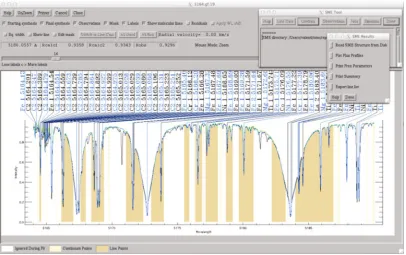
Figure 1. Screen grab of the Spectroscopy Made Easy (SME) user interface, here showing a fit to Mg I b triplet
region in the solar spectrum.
Line Database (VALD) [4,6]. SME can solve for empirical loggf and damping parameters, using an observed spectrum of a star (usually the Sun) as a constraint. Using empirical line data (available from the SME site) for wavelength ranges 5164-5190 (Mg b triplet) and 6000-6180 Å, [9] obtained spectroscopic parameters for 1040 cool stars in a large planet search survey. Mass, radius, gravity, and especially age in Table 9 of [9] were revised shortly after publication, when a software bug was fixed. The revised stellar parameters are available from the SME site.
Spectroscopy Made Easy (SME) [10] is IDL software and a compiled external library that fits an observed high-resolution stellar spectrum with a synthetic spectrum to determine stellar parameters. With sufficient observational constraints, SME can determine effective temperature (Teff), stellar surface gravity (logg), metallicity, abundances of iron ([Fe/H]) and other elements, projected rotation velocity (vsini), and other parameters. Figure 1shows a screen grab of the user interface. SME jobs can be created and submitted interactive via the user interface or in batch mode by calling IDL procedures. The results can be viewed interactively or processed by user-written IDL code.
Figure 2. SME spectrum fits from [9] for stars spanning a range of temperatures. Two wavelength intervals are shown. Shaded regions indicate damping wings of the Mg b triplet lines, which are gravity sensitive in cool dwarfs.
Figure 3. Distribution of [Fe/H] for all stars (red, left axis) in a radial velocity planet search sample and the subset
(blue, right axis) with known planets. The mean [Fe/H] is+0.02 for the full sample and+0.16 for known planet hosts.
gravity in stars warmer than 6200 K. This is particularly relevant to the stellar hosts of transiting planets, many of which are warmer than this limit.
3. HOST METALLICITY IMPACT ON GIANT PLANETS
Using SME results in [9], we determined [1] the distribution of iron abundance for 1040 stars in a Keck/Lick/AAT radial velocity planet search sample. Figure3compares the [Fe/H] distributions for all stars in the survey and for the subset known to host giant planets. Giant planet hosts tend to be more metal rich than the sample from which they were drawn.
EPJ Web of Conferences
Figure 4. Fraction of stars in the full sample that are known to host planets, as a function of [Fe/H] for two independent surveys (blue, red) and a model (green).
Figure 5. Dependence of [Fe/H] on semi-major axis for known planets withMsinigreater than 20 times the mass of Earth. The median semi-major axis for the sample isamed=0.84 AU. The mean value of stellar [Fe/H] is+0.11 for planets inside and outsideamed. 11% of the sample is outside the snow line. There is no observational evidence that [Fe/H] affects the stopping point of inward migration.
the results of an independent analysis [7] of a mostly disjoint CORALIE sample. Both studies found that the probability of detecting a giant planet increases rapidly with increasing stellar iron abundance. Quantitatively, doubling stellar iron abundance increases by a factor of four the likelihood of detecting a giant planet. These two studies obtained a similar result despite having very different stellar samples, spectrographs, radiative transfer codes, spectral lines, and analysis techniques (spectrum fitting versus equivalent widths). The dotted curve from [2] shows that a schematic core-accretion model is able to reproduce the observed dependence on [Fe/H].
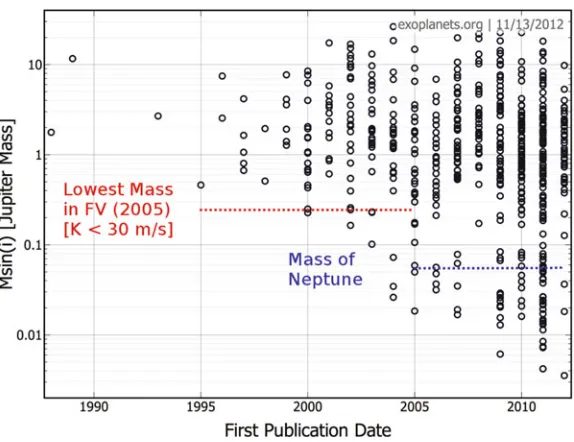
Figure 6. Projected planet mass as a function of first publication date, showing the steady improvement in mass
sensitivity. Discoveries since 2005 make it possible explore the abundance characteristics of stars that host planets less massive than Neptune.
been disproved by demonstrating that the abundance effect is similar for a wide range of convection zone masses (F versus K dwarfs, dwarfs versus giants). Giant planet hosts are not metal rich because detection is easier when spectral lines are deeper. Doppler signal is dominated by deep lines that depend only weakly on metallicity over the range covered by the planet search samples.
Giant planet formation by core-accretion occurs outside the snow line, where volatile exist and accrete in solid form. Hypothetically, known giant planet hosts might be metal rich because metal-rich disks facilitate inward migration to periods short enough to be detected by existing surveys. Figure5 show that host stars with close giant planets have the same mean iron abundance as host stars with distant giant planets. Metallicity does not seem to affect the stopping point of migration, but we cannot observationally rule out the hypothesis that a threshold metallicity is required to start migration. After disproving or limiting all of the preceding hypotheses, the remaining hypothesis is that giant planets are metal rich because metals shorten the timescale for giant planet formation by the core accretion process.
4. HOST METALLICITY IMPACT ON SUB-NEPTUNE PLANETS
Figure6shows that when studies [1] and [7] were published, only two known planets were less massive than Neptune. Seven years later there are dozens of known planets less massive than Neptune. This sample allows us to investigate whether stars with planets less massive than Neptune are metal rich, similar to stars with giant planets.
EPJ Web of Conferences
Figure 7. Iron abundance of stellar hosts as a function of projected planet mass for all known planets, including all
planets in multi-planet systems.
Figure 8. Iron abundance of stellar hosts as a function of projected planet mass for the most massive known planet
in each system.
to poor molecular line data. Nevertheless, the data suggest that stellar metallicity does not significantly affect the formation and/or migration of detectable sub-Neptune mass planets.
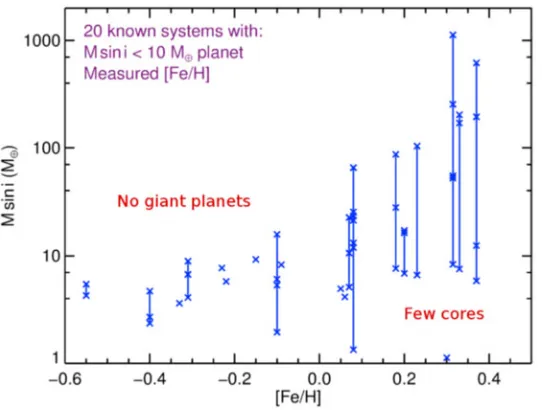
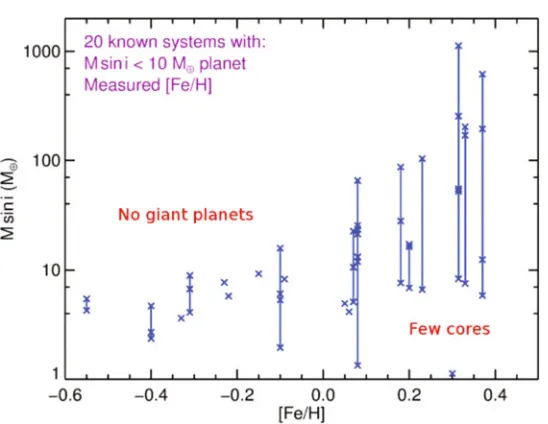
Figure 9. Projected planet mass as a function of iron abundance for all systems known to contain at least one planet
withmsiniless than 10 times the mass of Earth. All planets in such systems are shown. For planetary systems with a low mass planet, maximum planet mass increases with stellar metallicity.
region corresponds to a predicted “planet desert” in models [5] because cores in this mass range rapidly become gas giants. Figure 7shows that there are a number of observed planets in this region of the diagram, but there is a narrow gap around 30 times the mass of Earth.
Finally, we investigate how metallicity affects the conversion of low mass cores into giant (massive) planets. Figure 9plots all planets in systems with at least one planet less than 10 times the mass of Earth. Planets orbiting the same star are connected by vertical line segments. Systems with identical [Fe/H] are slightly offset horizontally to prevent overlap. The logarithmic plot show an upper envelope that increases with increasing metallicity. Metal-poor stars with cores do not form giant planets. In the context of core-accretion, the disk likely dissipated before runaway accretion could occur. Metal-rich stars tend to have relatively massive cores and multiple planets. The mass of the most massive planet increases dramatically with host star metallicity. Again in the context of core-accretion, metal-rich disks create cores quickly, allowing runaway accretion while the surface density of the disk is still high.
References
[1] Fischer, D. A., Valenti, J. A., ApJ, 622, 1102 (2005) [2] Ida, S., Lin. D. N. C., ApJ, 616, 567 (2004)
[3] Johns-Krull, C. M., McCullough, P. R., Burke, C. J., Valenti, J. A., et al., ApJ, 677, 657 (2008) [4] Kupka, F., Piskunov, N., Ryabchikova, T. A., Stempels, H. C., et al., A&AS, 138, 119 (1999) [5] Mordasini, C., Albert, Y., Benz, W., A&A, 501, 1139 (2009)
[6] Piskunov, N. E., Kupka, F., Ryabchikova, T. A., Weiss, W. W., et al., A&AS, 112, 525 (1995) [7] Santos, N. C., Israelian, G., Mayor, M., A&A 415, 1153 (2004)
[8] Sozzetti, A., Torres, G., Charbonneau, D., et al., ApJ, 664, 1190 (2007) [9] Valenti, J. A., Fischer, D. A., ApJS, 159, 141 (2005)
[10] Valenti, J. A., Piskunov, N., A&AS, 118, 595 (1996)
![Figure 2. SME spectrum fits from [9] for stars spanning a range of temperatures. Two wavelength intervals areshown](https://thumb-us.123doks.com/thumbv2/123dok_us/8759104.1436201/3.595.88.497.122.344/figure-spectrum-ts-spanning-temperatures-wavelength-intervals-areshown.webp)
![Figure 4. Fraction of stars in the full sample that are known to host planets, as a function of [Fe/H] for twoindependent surveys (blue, red) and a model (green).](https://thumb-us.123doks.com/thumbv2/123dok_us/8759104.1436201/4.595.160.435.309.513/figure-fraction-sample-planets-function-twoindependent-surveys-model.webp)