IJEDR1903015 International Journal of Engineering Development and Research (www.ijedr.org) 79
Earthquake Resistant Design-A comparative
analysis of various bracing system with RC-frame
1Javed Ul Islam, 2Mayank Mehandiratta, 3Rohit Yadav 1Research Scholar, 2Assistant Professor, 3Structural designer
1,2Arya College of Engineering & Research Centre 3Civil Shala
_____________________________________________________________________________________________________
Abstract— The current study specializes in the have a look at of the structural overall performance of metallic constructing with different bracing systems. The effectiveness of diverse varieties of bracing system has also been investigated. For this study at, a 10 storied frame structure has been analyzed and designed due to lateral loading. The structural performance of the RC frame building has been investigated the use of exclusive kinds of bracing system which includes X bracing, Inverted V-type bracing, K Bracing and single Diagonal bracing. A comparative analysis has been performed on lateral displacement, moments on beam between braced, story drift and un-braced structures at dissimilar floor stage. From the analysis it has been found that lateral displacement of bracing framed structure will be reduced as compare to RC-frame structure and also observed that X-Bracing system is more effective as compare to other bracing systems. X-Bracing frame structure is reduced by 35% displacement which is the largest one and as a consequence extensively contributes to extra structural stiffness. Finally, it can be stated that X-diagonally braced structure suggests higher structural overall performance amongst all the structures taken into consideration right here under comparable circumstances. Inclusion of bracing systems in the structure is more resilient in the event of the earthquake. At times it is also the cost effective solution for the earthquake resistant design of structures.
Keywords— Lateral load, Bracing, X-Bracing, Stiffness, Displacement, Staad pro V8i.
_____________________________________________________________________________________________________
I.INTRODUCTION
Bracing is one of the most extensively used lateral load resisting systems in multi-storied frame structure. Bracing is a highly efficient and economical method of resisting lateral force in a RC-frame Structure. Braced frame is a structural system, which is designed generally to withstand wind force and earthquake forces. Braced frames can be an effective system for seismic retrofit due to their high stiffness. Braced frames are nearly constantly composed of metallic steel or wood that helps distribute the load and increase the safety of structure. The beams and columns that carry vertical loads and the bracing system resist the lateral loads. Braced frames reduce lateral displacement, as well as the bending moment of frame structure. Steel bracing is economical, easy to stiff occupy less space and has flexibility to design for assembly the specified strength and stiffness. It allows acquiring a terrific boom of lateral stiffness with a minimal added weight, and so it's very effective for existing structure for which the very poor lateral stiffness is the primary problem. Wall Bracing is a construction technique used to improve structural performance of building.
A) Bracing in RCC frame Structure:-
A braced frame is a structural system designed primarily to oppose the wind and earthquake forces. In braced frames, members are designed to work in tension and compression, just like truss. The braced frames are almost always made up of steel members.
B) Type of Bracing According to Joint:- • Concentric Bracing System • Eccentric Bracing System
1) Concentric Bracing System :-
IJEDR1903015 International Journal of Engineering Development and Research (www.ijedr.org) 80 Fig.1.1 Concentric Bracing System
2) Eccentric Bracing System:-
Eccentric bracing consists of diagonal braces located in the plane of the frame where one or both ends of the brace do not join at the end points of other framing members. The system essentially combines the features of a moment frame and a concentrically braced frame, while minimising the disadvantages of each system. The eccentric connection to the frame means an eccentric brace transfers lateral forces via shear either to another brace or to a vertical column.
Fig.1.2 Eccentric Bracing System C) Various Structural Arrangements of Bracing:-
• X-Bracings • K-Bracings • V-Bracings
• Inverted V-Bracings • Diagonal Bracings
Fig.1.3 Different Types of Bracing System
II. LITERATURE REVIEW
Different types of bracings arrangements can be used as a structural member in different frame structures to resist lateral loads caused by wind, earthquake and other forces in high rise buildings. Steel bracings are generally provided outer sides of structure so that bracings can make building able to resist lateral loads.
IJEDR1903015 International Journal of Engineering Development and Research (www.ijedr.org) 81 Kumar et. al. (2017) studied on steel braced RC frame having different arrangements. He concluded that steel bracings are the most used and efficient elements for resisting the horizontal forces like seismic and wind. He chooses the seismic coefficient method to approximate the planning of braces in the building frame. In this paper he analyzed the seismic performance of the structure of a G+15 storey building having X bracing placed on different position of building.
Tanawade S. B., Kore P. N. and Swami P.S.(2016):- In this paper elastic seismic response of reinforced concrete frames with reinforced concrete bracing member in K or A at different level braced pattern with G+11 building with 5 bay structures is analyzed in both minor and major direction. This approach focuses on the planning of A-braces in a particular bay, level and its combination, which ultimately reduces lateral deflection so that the economy can eventually be achieved in comparison to the frame of the same moment.
A.B. Karnale et. al. (2015) analyzed different configurations of shear wall for 6 storey and 14storey frame. In this paper, researchers presented the results for different configurations of shear walls for 6 storey and 14 storey building using ETABs software. A contrast was done between the effects observed due to height of structure and it was found that shear wall is more effective in high rise buildings than in low rise buildings.
Mohd. Atif-In this paper they studied a G+15 building with shear walls and bracing members in four different earthquake zones by placing three types of bracing at different position.
Some important parameters like displacement, axial force, bending moments of columns and shear moment, torsion for beams are calculated. Results obtained and published in graphical and tabular forms. Linear static analysis method was used for analysis. The conclusion of this study was that shear walls are more efficient to control lateral deflection as compare to bracings. Lateral displacement of building were reduced by using X bracing.
MD.Samdhani Azad- This study pays attention on the seismic behaviour of structure with steel braced as well as with shear walls. Analysis has done in ETABS software to conclude the different type of behaviour. In their results they have shown comparison of Different models for maximum displacement and storeys drift. They concluded that model, having shear wall in the middle among all the model is the safest.
III. METHODOLOGY
A) Description of Model:-
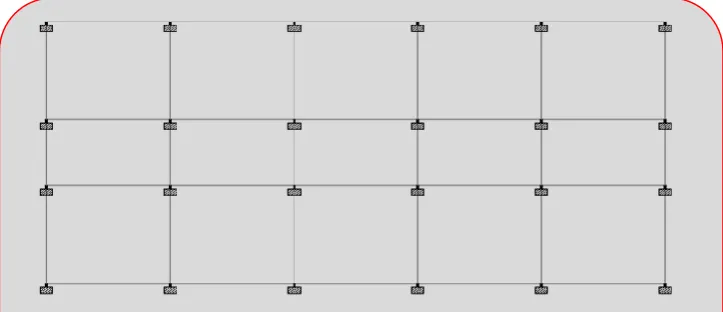
In this study a building having regular plan is considered for analysis as shown in fig. All stories including ground storeys having 3.5m floor to floor height is considered for the analysis. Area of plan of building is 480m2. Structures are having 5-bay in X-direction and each bay is having a length of 6m and in Z-direction number of ways are 3 with different length two bays are having length of 6m and middle bay is having a length of 4m.Three types of columns are considered in this study. Some columns are rectangular and some columns are square as per structure requirement. Two types of beams having different cross sections are used. Sizes of beams are 300X600 and 300X450. Slabs with a thickness of 200mm are used. A floor finishing of 50mm is provided. Supports of the structure are made fix at the bottom. Three types of walls are used – main wall, partition wall and parapet wall. The thickness of wall varies as main wall is having a thickness of 230mm, partition wall and parapet walls are half of the main wall thickness. Height of main wall and partition wall is same as the height of stories. Parapet wall is considered with a height of 1m. In this Study different types of bracings are used. Like as a X –Bracing , Inverted v Bracing K bracing and single Diagonal bracing. These bracings are having steel-I section ISMB-100. Building is located in two types of earthquake-zones. ZONE- III AND IN ZONE V. Soil condition are considered medium stiff and a damping ratio of 5% and importance factor is taken1.Dead loads and live loads are applied accordingly. Earthquake loads are applied as per IS 1893 (Part -1) 2002.
IJEDR1903015 International Journal of Engineering Development and Research (www.ijedr.org) 82 This structure is made of concrete grade M-30 with steel reinforcement of Fe-500. Bracings which are used in model are made of steel.
C) Models Considered for Analysis:-
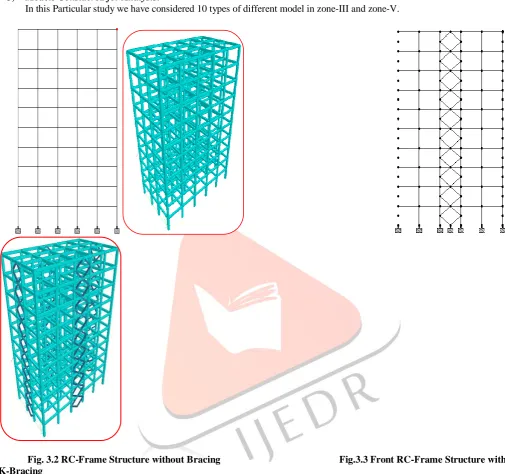
In this Particular study we have considered 10 types of different model in zone-III and zone-V.
Fig. 3.2 RC-Frame Structure without Bracing Fig.3.3 Front RC-Frame Structure with K-Bracing
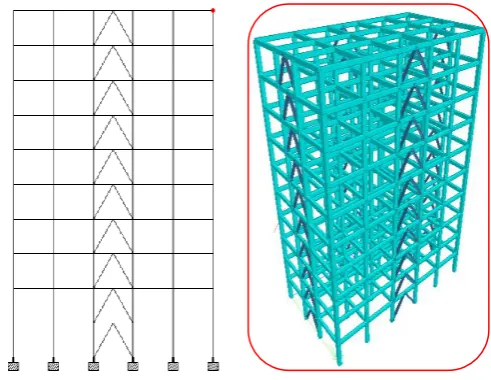
IJEDR1903015 International Journal of Engineering Development and Research (www.ijedr.org) 83 Fig. 3.3 RC-Frame Structure with X-Bracing Fig. 3.4 RC-Frame Structure with Diagonal Bracing
Fig. 3.5 RC-Frame Structure with V-Bracing D) Load Case Details:
1) Dead load:-Dead loads are calculated with the help of the unit weight of the materials assigned to the framing members. Indian code IS 875 (part I) -1987 is used for the design loads other than earthquake loads for building & structures. 2) Live load:-A live load of 4KN/m2 is applied on the structure.
3) Earthquake load:-The earthquake load based on the Indian Standard IS 1893 (Part 1): 2002, Criteria for Earthquake Resistant design of Structure, Part 1: General Provisions and Buildings (fifth revision) is used.
IV.RESULT & DISCUSSION
In this research analysis is done for different 10 models, of same heights, in different earthquake zones i.e. Zone 3 & Zone 5 and with different types of bracing arrangements. In this Study, the analysis and design of only 10 storey structures is done. Main focus of this study is to control the deflection using most suitable and economical bracing system in high rise buildings and make them safe against lateral forces as well as improves the bending moment. In addition to deflection criteria, center of attention is also given to earthquake resistant design of structure.
Table 4.1 Deflection Comparison in Various Bracing Systems with RC-frame (ZONE-3)
RC-Frame without Bracing
RC Frame with X-Bracing
RC Frame with V-Bracing
RC-Frame with K-Bracing
RC-Frame With Diagonal
bracing Lateral
Deflection in X direction
(mm)
127.00 81.67 82.13 84.30 91.00
Table 4.1 Deflection Comparison in Various Bracing Systems with RC-frame (ZONE-5)
RC-Frame without Bracing
RC Frame with X-Bracing
RC Frame with V-Bracing
RC-Frame with K-Bracing
RC-Frame With Diagonal
bracing Lateral
Deflection in X direction
(mm)
IJEDR1903015 International Journal of Engineering Development and Research (www.ijedr.org) 84 Graph 4.1 BM Comparison in different type of Bracing with RC-Frame in Lateral Direction (Zone-3)
Graph 4.2 BM Comparison in different type of Bracing with RC-Frame in Lateral Direction (Zone-5)
V.CONCLUSION
After analyzing and comparing we have observed that:
• Inclusion of Bracing systems in the structure is more resilient in the event of the earthquake • Deflection and bending moment in bracing system is very less as compare to RC-frame Structure.
• Among all types of bracing system, X-type Bracing system is most effective and economical Because it will more reduced 35.69% Deflection in Zone-3 and 35.29% deflection in Zone-5 as Compare to RC-frame Structure. • Among all types of bracing system, X-type bracing less amount of bending moment, it will more reduced 18.17%
B.M. in Zone-3 and 8.55% B.M in Zone-5 as compare to RC-frame Structure.
Among all models, braced structure has shown better resistance and stiffness than RC-frame structure. Finally, it has been observed that among all the structures considered, X-Bracing structure is the best suitable from the structural point of view.
0 50 100 150 200 250 300 350 400 450
M
ax
. B
.M
(K
N
-m)
Max. Bending Moment
Max. Bending Moment (SMRF) KN-m
880 900 920 940 960 980 1000 1020 1040
Ma
x.
B
.M (
KN
-m)
Max. Bending Moment
IJEDR1903015 International Journal of Engineering Development and Research (www.ijedr.org) 85 VI.ACKNOWLEDGMENT
I express my deep sense of gratitude and great regards to my guide, Mr. Mayank Mehandiratta (Assistant Professor ACERC), Jaipur for his valuable guidance and support. His profound experience and incomparable expertise combined with his kind supportive nature has been a substantial asset for us throughout our learning experience.
I would also like to thank Mr. Rohit Yadav (Structural Designer), for his valuable support in structural designing. I thank all our dear friends for their moral support and enthusiasm. I thank our parents for their blessings and prayers.
REFERENCES
[1] Kumar & et. al. "Analysis and Design of Shear Wall for an Earthquake Resistant Building using ETABS "International Journal for Innovative Research in Science & Technology, Volume 4 , Issue 5, October, (2017). [2] Tanawadeet.al. “analyzed elastic seismic response of reinforced concrete frames with reinforced concrete bracing
member” international journal of advance civil engineer ISSN 2250-323 volume-4, issue-3, (2016).
[3] IS 1893(PART 1): 2002, “criteria for Earthquake Resistant design of structure”, 5th revision, Bureau of Indian standard, New Delhi. (2002).
[4] IS 875-Part 1 2016: “Design Loads (other Than Earthquake) For Buildings and Structures” Bureau of Indian standard, New Delhi, (2016).
[5] IS 875-Part 2 2016: “Design Loads (other Than Earthquake) For Buildings and Structures” Bureau of Indian standard, New Delhi, (2015).
[6] IS 875-Part 5: “Design Loads (other Than Earthquake) For Buildings and Structures”, Special loads and Load combinations, New Delhi, (1997).
[7] Javed Ul Islam & et. al. “ Cost Comparison in RC-Frame, RC-Frame with Shear Wall and Bracing”, International Journal of Engineering Research & Technology (IJERT) RTCEC - 2018 Conference Proceedings, Special issue (2018).
[8] Khushboo Agarwal, Baldev Kumawat, & Javed Ul Islam, “Analyzing High Rise Building Frame with Different Bracings and Comparing Deflection” IEEE Journal , Conference Proceeding , May, (2019).