Optimization of Tung Oil Methyl Ester from
Transesterification Process and Fuel
Characterization as Diesel Substitute
Subhash L. Gadhave
Ph.D. Research scholar, Shri JJT University, Jhunjhunu, Rajasthan, India 333001.
Satishchandra .S.Ragit
Ph.D. Research Co-Guide, Shri JJT University, Jhunjhunu, Rajasthan, India 333001.
Abstract: Due to increased energy demand and concern about the environment friendly technology, renewable bio-fuels are better alternative to petro diesel. Biodiesel is alternative diesel fuel and also an eco-friendly prepared from renewable biological resources i.e. produced from vegetable oils and animal fats. The cost of biodiesel is the main difficulty to commercialization of the product. The common method to produce biodiesel fuel from vegetable oil is the transesterification process (methanolysis) with methanol in the existence of either alkaline or strong acid catalysts. For biodiesel production, transesterification reaction is quite sensitive to several parameters. The transesterification reaction differs on the basis of variables like the free fatty acid content and fatty acid composition of the oil. Some other variables such as ratio of alcohol to tung oil, reaction temperature, catalyst, mixing intensity, purity of reactants. The present work aimed at the standardization of transesterification process parameters for the production of methyl ester of filtered tung oil and fuel characterization for engine performance. In this paper investigate the chemical composition of tung oils, fuel properties of tung oils and biodiesel, transesterification process, the furthermost important variables that effect the transesterification reaction, environmental attention and economic possibility of biodiesel.
Keywords: Transesterification. Tung oil, acid catalysts, fuel properties.
I. INTRODUCTION
India has 1.27 billion people is the second largest populous country of the world. The population of India will be increased by 45 516 persons daily in 2016.In India about 75% energy generation is from fossils fuel, with coal having 40% of India’s total energy consumption and remaining by crude oil and natural gas with 24% and 6% respectively India is mostly reliant on fossil fuels imports to assure its energy demands[3]. Due to increased energy demand and unavailability of petroleum diesel gave attention of researcher to work on alternative fuel [1]. Many renewable sources of energy have successfully been tried and used by different nations to limit the use of fossil fuels. This renewable source of energy includes solar energy, wind energy, geothermal energy, tidal energy, ocean thermal energy, hydropower and others. Using renewable energy is to make India self- dependent to some extent, but still lags far behind to make a significant change in the import of crude oil which is the need of present day [3]. Biodiesel produced from various vegetables oils depending upon their agricultural policies, local crop availability and feedstock price [6].
The focus of biodiesel production is typically on edible oil such as soybean, rapeseed and palm. Recently, waste oil and fats like used frying oil, greases and tallow were proposed and used as biodiesel resources [3]. The basic constitutes of vegetable oil is triglyceride, which is an ester composed of three fatty acids and one glycerol. Because the fatty acids of vegetable oils vary in carbon chain length and the number of double bonds, biodiesel has different properties depending on the fatty acids composition of the feedstock [7]. The alkali process for biodiesel production can achieve high purity and yield of biodiesel in a short time.
As the demand of biodiesel increases, the interest in nonedible oil such as Jatropha, castor, Neem, Sesame, Jojoba and Tung oil has grown. Out of these nonedible oils, tung oil is pressed from the nuts of the tung tree (Vernicia fordii), and the nut has an oil content of 30 to 40%. Tung oil is used as a protective coating or drying agent [13-14]. Because of tung oil has a high acid value (AV), the esterification using solid acid catalyst, KOH, employed to produce biodiesel more efficiently. The fuel properties of tung oil methyl ester (TOME) produced from preheated tung oil by alkali catalyst were analysed.
II. EXPERIMENTAL METHODS
Tung oil used in present study was supplied by Riddhi Chemicals, Near Malad shopping centre, Malad (W), Mumbai. All chemical (Methanol, KOH catalyst and silica gel) were procured during experimentation from D. Haridas & Company, Near Zambare Palace, Maharshinagar, Pune.All chemicals are brought locally and other reagents were analytical grade and large number of sample bottles were purchased from Sahil gift shop, Katarj to put different biodiesel sample and its blends during experimentation.
B. Transesterification Process for Tung oil
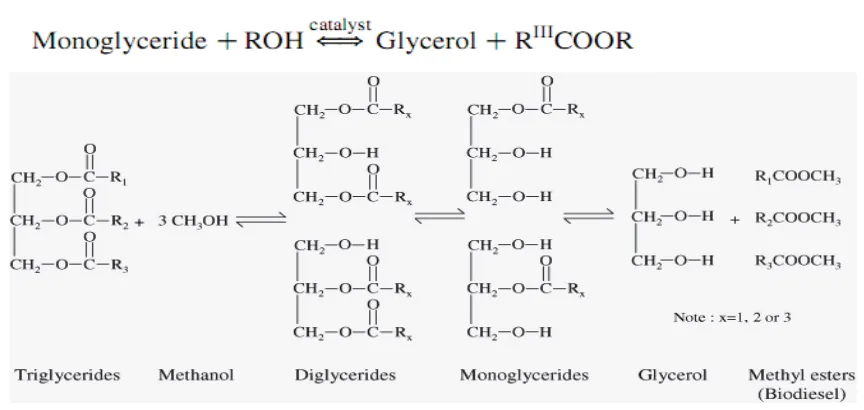
Transesterification is defined as the chemically reacting triglycerides such as one of the vegetable oil with an alcohol in the presence of an alkaline or acidic catalyst to produce glycerol and fatty acids ester. In this process the ester is made when vegetable oil combines with a simple alcohol in the existence of a catalyst. The overall transesterification reaction is given by three consecutive and reversible equations:
Fig. 2 Transesterification reaction of Tung oil biodiesel
There are four steps in the preparation of an ester are namely: i. Heating oil at desired temperature
ii. Stirring and heating of alcohol-oil mixture with an alkaline or acidic catalyst iii. Separation of glycerol and washing of ester with water.
iv. Evaporating traces of water from ester recovered.
For the pre-treatment of tung oil, the mixture of oil, methanol and KOH was mixed by a magnetic stirrer at 60°C for 30 min. After the reaction carried out, the acid value of the sample were determined. Tung oil is mixed with methanol and potassium hydroxide at 60°C for 30 min. After washing with distilled water and centrifuging at 15,000 rpm for 20 min, biodiesel properties were analysed.
3. Properties of Tung Oil as fuel
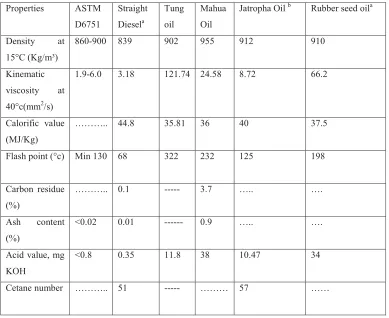
Fuel properties of tung oils has been studied and compared with those of diesel and according to the specification provided by ASTM standards. The fuel properties of tung oils as listed in Table 1 indicate that the kinematics viscosity of tung oils varies in the range of 4.6-5 cSt at 40°C. The calorific value of optimized tung oil was 9100 kcal/kg which is lower than diesel fuel. The flash point and fire point of tung seed biodiesel were observed to be higher than of diesel fuel.
Table 1 Comparison of Physio-Chemical Properties of Raw Tung oil with diesel and vegetable oil
Properties ASTM D6751
Straight Diesela
Tung oil
Mahua Oil
Jatropha Oil b Rubber seed oila
Density at 15°C (Kg/m³)
860-900 839 902 955 912 910
Kinematic viscosity at 40°c(mm2/s)
1.9-6.0 3.18 121.74 24.58 8.72 66.2
Calorific value (MJ/Kg)
……….. 44.8 35.81 36 40 37.5
Flash point (°c) Min 130 68 322 232 125 198
Carbon residue (%)
……….. 0.1 --- 3.7 ….. ….
Ash content (%)
<0.02 0.01 --- 0.9 ….. ….
Acid value, mg KOH
<0.8 0.35 11.8 38 10.47 34
Cetane number ……….. 51 --- ……… 57 ……
aSinha et al(2008),bDeng.X et al(2010),cRamadhas et al(2005)
The transesterification reaction was carried out in a 1000cc inverted glass funnel as a separator which separates fatty acid methyl esters and glycerol. The Transesterified Tung biodiesel along with glycerol is shown in the Fig 2.
III. CHARACTERISTICS OF TUNG OIL METHYL ESTER (TOME)
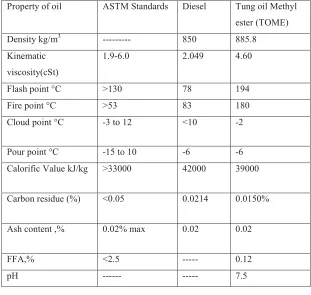
The physical and chemical properties (Density, Lower calorific value and Cetane number) of Tung Oil Methyl Ester (TOME) were calculated. The Properties of the tung oil methyl ester were tabulated in (Table 2) as follows:
1.Density
Density influences the efficiency of the fuel atomization for airless combustion system. It has some influence on the break-up of fuel injected into the cylinder. In this, additional fuel is injected by mass as the fuel density increases. The density of tung oil methyl ester is 885.8 kg/m3 which meet the ASTM Standards.
2.Kinematic viscosity
It is defined as the resistance of liquid to flow and is the most essential fuel features. This factor affects the operation of fuel injection, blending formation and combustion process. The high viscosity affects with the injection process and leads to insufficient atomization. The kinematic viscosity of tung oil methyl ester is 4.60 cSt which meets ASTM Standards.
It is the minimum temperature of the fuel at which the fuel gives flash when it comes to contact with testing flame. It is a vital parameter from the safety point of view such as safe for transport, handling, storage purpose and safety of any fuels. This is higher than petrol diesel which has flash point of 194°C. A fuel with high flash point may cause carbon deposits in the combustion chamber.
4.Lower calorific value
It is a measure of the energy produced when the fuel is burnt completely which also determines the suitability of Methyl ester as an alternative to diesel fuel. The calorific value of Tung oil Methyl ester is normally lower than diesel due to oxygen content of Methyl ester.
Table 2: Comparison of Physio-Chemical Properties of Tung Oil Methyl Ester with other biodiesel
Property of oil ASTM Standards Diesel Tung oil Methyl ester (TOME)
Density kg/m3 --- 850 885.8
Kinematic viscosity(cSt)
1.9-6.0 2.049 4.60
Flash point °C >130 78 194
Fire point °C >53 83 180
Cloud point °C -3 to 12 <10 -2
Pour point °C -15 to 10 -6 -6
Calorific Value kJ/kg >33000 42000 39000
Carbon residue (%) <0.05 0.0214 0.0150%
Ash content ,% 0.02% max 0.02 0.02
FFA,% <2.5 --- 0.12
pH --- --- 7.5
IV.CONCLUSION
x This study investigate that biodiesel could be produced successfully from the tung oil by alkali-catalyzed transesterification.
x The production of biodiesel from tung oil offers a triple-facet solution: economic, environmental.
x In considering the range of tests performed in this project, the specifications used to identify acceptable biodiesels do not need any additions.
x The viscosity of tung oil reduces substantially after transesterification and is comparable to petro-diesel and the physical and chemical properties of biodiesel produced conform to EN/ASTM standards.
x We can conclude that using water as a washing agent does not affect the reaction productivity at the same time it increases purity of the product.
x The unique variables that affect the biodiesel production are the catalyst concentration and the molar ratio alcohol/oil.
x According with the above, optimizing the characteristics of tung oil methyl ester as a diesel substitute without any modification in the compression ignition engine.
REFERENCES
[2] GuoqingGuan, Katsuki Kusakabe, Nozomi Sakurai, Kimiko Moriyama. (2009) Transesterification of vegetable oil to biodiesel fuel using acid catalysts in the presence of dimethyl ether. Fuel, 88: 81-86.
[3] Sharma Y.C., Singh B. (2009) Development of biodiesel: Current scenario. Renewable and Sustainable Energy Reviews, 13:1646-1651.
[4] Ghadge, S.V., & Raheman, H.(2006) Bioresource Technology, 97,379-384. [5] Ma F., Hanna MA. (1999) Biodiesel production: a review Biores.Technol, 70: 1-15.
[6] Hariram V and Mohan Kumar G. Identification and characterization of FAME’s in Algal oil methyl ester using FT IR,NMR, and GC/MS. International Journal of Emerging trends in Engineering and Development 2012: Issue 2 Vol 5 :653-662.
[7] Jefferson S de Oliveiraa, Polyanna M Leitea, LinFROQ%GH6RX]DD9LQÕFLXV00HOORD(LG&6LOYDE-RHO&5XELPD6LPRQL03 Meneghettib, Paulo A.Z Suareza. Characteristics and composition of Jatropha gossypiifolia and Jatropha curcas L. oils and application for biodiesel production. Biomass and Bioenergy 2009 :33: 449 – 453.
[8] Conceicao, M.M, Candeia, R.A,Silva,F.C, Bezerra,A.F.Fernande,V.J. & Souza, A.G. (2007) Renewable & sustainable Energy Reviews,
11,964-975.
[9] Srivastava, A. & Prasad, R.(2000). European Journal of Lipid Science and Technology, 106,382-389. [10] Gui-zhuan XU “Study on Immobilized Lipase Catalyzed Transesterification Reaction of Tung Oil” March 2009
[11] Gopal BV, Sridevi V , Sarma AJN and Rao PV, “Processing and Characterization of Cotton Seed Methyl Ester” Austin Chem Eng - Volume 2 Issue 2 -Dec. (2015)
[12] Sharma Y.C. and Singh B., Development of Biodiesel from Karanja, a tree found in rural India, Fuel, Doi:10.1016/j.fuel.2007.08.001, (2007)
[13] S.S. Ragit, S.K. Mohapatra, K. Kundu, Prashant Gill, “Optimization of neem methyl ester from transesterification process and fuel characterization as a diesel substitute” published in the Journal of Biomass and Bioenergy, 35 (2011) 1138-1144.
[14] Ellis N., Guan F., Chen T., Poon C., Monitoring biodiesel production (transesterification) using in situ viscometer, Chem Eng. J. doi:10.1016/j.cej.2007.06.034 (2007).