Analysis of Bio-inspired Scalable Routing Protocol
for Cognitive Radio Sensor Networks
1
Amit N. Thakare; 2 Dr. Latesh Bhagat (Malik); 3 Achamma Thomas
1
Research Scholar, Department of Computer Science and Engineering, G. H. Raisoni College of Engineering, Nagpur, 440016,India
2
Associate Professor & Head, Department of Computer Science and Engineering, Government College of Engineering, Nagpur, 441108, India
3
HOD, Department of Computer Science and Engineering, G. H. Raisoni College of Engineering, Nagpur, 440016, India
Abstract:Wireless sensor network (WSN) is an autonomous system of number of sensor nodes deployed in the region and connected by the wireless links. The sensor nodes are battery powered node with some limited energy to utilize in network for various applications. The nodes are changing the position frequently and forward the packets from source to the destination. The routing is the main issue in wireless sensor networks. Thus there is need of designing the routing protocol for WSN. The next generation of wireless sensor network is the improvement in the hybridization techniques. The MAC and network layer is to be improved for the next generation wireless technology. The new idea behind the routing techniques is by sending the packets whenever the communication required with available spectrum holes. The next generation WSN is the CRSN (Cognitive radio sensor network) with cognitive capabilities. It is a possibly new routing philosophy that provides a scalable so lution to relatively large network in CRSN. An inspired from swarm colony optimization as artificial intelligence techniques likely to be ACO (Ant colony optimization) method used to find the shortest route with reliable routing in CRSN. In this paper an attempt has been made to compare the performance of routing methods for CRSN using biologically inspired methods. As per finding the differences in the protocol provides better solution for routing techniques with high density network. The performance differentials are analyzed using varying number of packets and pause time. The simulation is carried out using ns2 simulation tool. The results illustrate the importance of implementing the routing protocols in CRSN environment for large network.
Keywords: Routing; scalability; ant colony optimization; cognitive radio sensor network; performance analysis.
1. Introduction
ireless sensor networks are emerging trends in the communication technology. Wireless sensor networks consists of large number of sensor nodes deployed in the specific region as an autonomous system with on-board system with wireless transceivers, a small processor and battery with specific allocation they are capable to communicate with each other.
The nodes are deployed over large dense network. They must interact with environment to sense the physical variable such as temperature. They communicate, route and forward packets for various application and reach to the base station as sink node. As per large network to route the packets it is difficult for sensor node because of non-rechargeable or infeasible battery of sensor nodes. WSN should be scalable and energy-efficient, reliable and adaptive to any failure and self-organized fulfill the entire requirements for good communication network.
BS
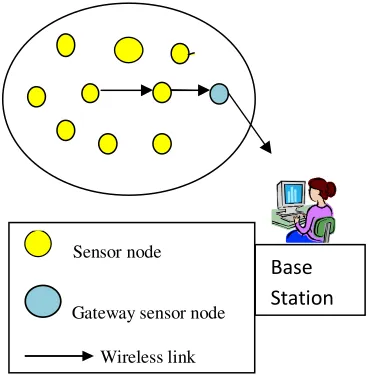
Fig. 1: Architecture of wireless sensor network
W
Sensor node
Gateway sensor node
Wireless link
Base
The hundred and thousands of sensor nodes are working and routing techniques having the job of identifying and discovering the number of routes to route the packets with given region. The some parameters affects in the performance of network such as delay in the network, node exhaust because of energy level of battery, routing overhead, packet delivery and much more. The main requirement of routing protocol is to optimize the network performance. The ad hoc network is the base line of the sensor network as infrastructure less and improvement in the network such as MANETS, WSN, and CRSN and so on. The based on these networks the requirement are not much differ for successful communication.
Routing in WSN or CRSN are the challenging job because of limited level of hardware and other resource available. The designing the routing protocols with some consideration such as minimum routing overhead, adaptive should be sustain more in the network. The sensor nodes operate on the different environment and therefore the routing may be done in centralized or distributed network. The designing approach of the routing protocol that the sensor nodes should be self-organized, adaptive to any failure and scalable and able to remain alive for long time.
The swarm intelligence (SI) is the artificial intelligence techniques that are behavior of social insects which solves the different complex problems in the society of research. The inspiration from the collective behavior to these insects’ societies brings the solution for self-organization techniques, solves the fault-tolerance issues like choosing alternative path and collective behavior solves the problem of large network. The inspiration from these insects society for the research to solves the complex problem. There are many techniques of SI based such as ACO (Ant Colony Optimization), PSO (Particle swarm optimization), BCO (Bee Colony Optimization), solves the problem. The analogy between these bio-inspired methods and real routing problems motivate to design the routing protocol for solving different issues.
We consider the analogy of bio-inspired method as AntHocNet routing protocol for designing the routing protocol. The routing protocol is designed and analyzed for next generation sensor network as cognitive radio sensor network with its capabilities as spectrum sensing and spectrum decision utilize the available vacant bands as secondary users with multi-hops probabilistic approach.
The rest of the sections are organized as follows, section II describes the literature review, section III explains the Issues and challenges and proposed methods, section IV
performance evaluation and discussion and section V concluded the paper.
2. Literature Review
I. F. Akylidiz et al. [1] done the survey of sensor networks. The authors are surveyed on each layer of protocol stack. The author also provides the design factors of wireless sensor networks. The goals such as creation of network infrastructure and efficiently shared the resources. Same as in network layer there is need of development of new protocol for fault-tolerance and scalability for wireless sensor networks. Low-Energy Adaptive clustering hierarchy (LEACH) routing protocol proposed by Heinzelman et al. [2]. In conventional routing protocols the first hierarchical routing protocol in wireless sensor networks. In setup phase the cluster formation is exists and in steady phase the data transmission to the base station. The two tier hierarchical methods are proposed by the author. Where in second tier the cluster head formation and how many times in each rounds. Muruganthan et al. [3] proposed the centralized low energy adaptive clustering routing protocol as (LEACH –C). Lindsey et al. [4] proposed the power efficient gathering in sensor information systems routing protocols, which is the improvement in the LEACH protocol. It requires the formation of a chain that is achieved in two steps those are construction phase and gathering data. E. Egea-Lopez et al. [5] proposed and state that increasing growth of WSN research and challenges issues related to performance. L. Alazzawi et al. [6] proposed the simulation of scalability issue for wireless sensor network routing protocols.
Ant-Hoc protocol for mobile ad hoc network as a new routing protocol compared with the existing protocol with AntNet and AODV and DSDV routing protocol. The simulation results shows that the Ant-Hoc routing protocol is best in all aspect of performance analysis based on QoS, routing load and connectivity. Mohammad Saleem et al. [11] proposed the Bee-inspired power aware routing protocol for wireless ad hoc sensor network. They consider the BEE colony optimization for their research work and find the research gaps to develop the protocol for reliable, power aware, scalable routing protocol with considering the different behavioral techniques of BEEs. They specially develop the protocol for routing overhead and route optimality based on packet delivery ratio and other parameters.
3. Design Issues and Proposed method
Wireless sensor network has different challenges and issues to overcome the constraints of WSN’s and solve the design application issues. The challenges and design issues in WSN are limited energy consumptions, fault tolerance, scalability, productive cost, data aggregation, load balancing, congestion, security, self-organization. In this paper, we consider following issues to develop the algorithm for robustness in self-organizing, adaptive in fault-tolerance, and scalability issues.
Self-organization: A WSN is expected to remain operational for an extended period of time. Here the new node added in this network, may be the other nodes fail because of failures or exhaust their batteries becomes un-operational. A routing protocol must resilient to such dynamic & generally unpredictable variations sustain long term availability of network services.
Fault-tolerance: One of the sensor nodes may fail, the algorithm can reorganize itself so that it continues to function without any disruption. The nodes are in working condition. The routing protocols are adaptive to topological changes.
Scalability: Sensor node deployment in WSNs is application dependent and affects the performance of the routing protocol. The large number of nodes is deployed in the region having short communication range and high failure rates. The routing protocols have effectively acceptable for those challenges.
3.1 Biological Inspired Method
A. Bio-inspired Methods
Swarm optimization methods are useful to design our next generation routing protocol. swarm prompted the design of
very efficient optimization and algorithms. The state of art many algorithms is based on ACO (Ant Colony Optimizations) and BCO (Bee Colony Optimizations) techniques useful to solve combinatorial optimization & NP-hard problems. We consider the ACO techniques to improve the efficient communication techniques.
1) Ant Colony Optimization
Researchers are find out the bio-inspired methods such as biological ants in the real world are able to utilize swarm Intelligence as artificial intelligence to find the solutions for different problems. Ant Colony Optimization (ACO) has been developed to mimic the behavior of real ants to provide heuristic solutions for optimization problems. The ACO is proposed by Macro Dorigo in 1992 in [12] his Ph.D. dissertation. While searching the food the ants while its journey they deposited a chemical are called pheromones. Pheromones attract other ants and follow the a path to the food source that other ants can follow. The other ants walk along the path, more pheromone is laid & path will increase & required time is less. There is another possibility of pheromone evaporation for that purpose reduces the change for other ants to consider the path Michael Brand et al.[13]. This characteristic of ants is adapted on ant colony optimization algorithms to solve real problems. ACO meta-heuristics approached models the real ants. In ACO a number of artificial ants build solutions to optimization problems. The path optimization between nest & food is achieved by ant colonies by exploiting the pheromone quantity dropped by ants. The analogy between the ACO characteristics and requirements are with the WSN and CRSN network. In WSN the path is chosen and data are transmitted through the labels on head of data packets, whereas in ACO the path is chosen based on pheromone left by ants in the path. Whereas there is forward ants and backward ants handling the responsibilities of forwarding information to exploring paths and collect the information from source to destination and backward ants to updating the information passing by nodes Kashif Saleem et al., [14].
2) ACO based Algorithms
Mishra et al [16] The fault tolerant routing protocols using greedy ACO chooses a single path. The several algorithms were designed for the optimized routing process in wireless sensor network.
3.2 Research Method
In the proposed work we try to design the method for scalability issues. The wireless sensor networks works on sensors with limited battery power. The energy level of each sensor goes down with utilization of nodes in active condition. Those nodes are remaining ideal it store the maximum energy based on the method applied on the individual node with designed protocol. The state-of-the-art of the network to designed the routing protocol which route the packets with some conditions of saving energy, time, space that affect on sustainability of network lifetime of sensor nodes in the network. Though we consider the sensing task likely to be provide the spectrum availability for different frequency bands either 914MHz or 2.4GHz[22]. Those bands are unused causes the spectrum holes. The spectrum holes are utilized by the other waiting secondary user when primary user are not in active mode. Such sharing of spectrum are play important role for fully utilization of frequency spectrum bands. The same analogy play the role in swam intelligence, they try to utilize the available space and carry forward the work continuously with dropping pheromone trail so that other worker ants used the same route for finding the food source and came back to their nest, the concepts are used for the communication network.
Thus the concentration applied on the combination of cognitive technology and wireless sensor network causes the next generation communication network called as cognitive radio sensor network.
In previous paper we try to design the self-organized network and fault-tolerance network that are based on the same techniques. The scalability issues are also the important issues for sustainability of the network when the sensor nodes are increased in number. The sensor nodes are deployed in the specific unattended fashion for sensing the data and the data which sense forward to the base station. The neighbor discovery algorithm plays role for advertisement of neighboring nodes so that with finding the interested and shortest path nodes to forward the data to the base station. The node density is large in the network that scale the network, to occupy the all sensor nodes in CRSN, the nodes are forming the cluster with neighbor discovery, those nodes are nearer it forms the cluster and cluster nodes are forming the cluster head(CH) based on certain threshold energy level of nodes. The cluster nodes are find the multiple channels, select it and communicate with other cluster head nodes. They aggregate all the data and forward to the base station. The base station as sink node are static and also the multiple sink nodes are considered to forward the data packets to the sink node for proper balance network and to reduce less energy consumption. These concepts solve the scalability issue for CRSN or WSN network.
Source
node Channel Base station
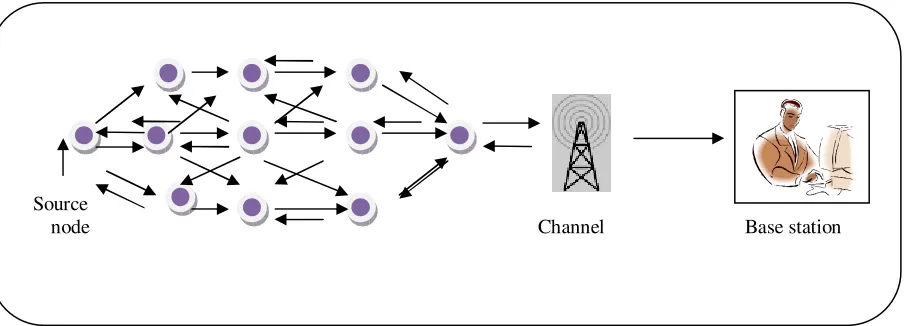
Fig. 2. Neighbor Discovery
The neighbor discovery algorithm creates nodes adjacency matrix with multi-hops probabilistic approach
probabilistically transfer with multi-hops fashion reach to the base station through different channel. Thus there are Markov chain model plays the role for probabilistic approach.
Markov Chain is a class of characterizing stochastically the process by Markov property. The meaning is the next process takes depends on the current state and not on the previous state. To prove this for discrete time as given as follows and stated by [17]. Here P is the probability of selecting the behavior of next-hope sensor node and Xt is the condition probability.
]
|
1
[
]
,...,
|
1
[
X
tx
X
0x
0X
tP
X
tx
X
tx
tP
+
=
=
=
+
=
=
(1)
This process called as a Markov Chain model. This way multiple nodes transfer the data with Markov model. ______________________________________________ Neighbor Discovery with multipath construction ______________________________________________ I/p: n number of nodes are deployed in region randomly.
O/p: Optimum path selection with multi-hops construction
Sink nodes advertise the hello message periodically For each path (i, j) do
Perform the spectrum sensing; End for
finding the number of hops to its neighbor node (Nd, ID, List of Nd);
Compute the probability of choosing multi-hop{ 0,1} Probability of choosing path {0,1} through channel; Like ants choose the path randomly
either channel is busy or idle; If [channel is busy (ON)] Primary user (active) is used; else if [channel is Idle(OFF)] Secondary user (active) is used;
Ants used available space (shortest route)
Depends on channel sensing neighbor discovery works, For selection of channel the next hop neighbor node with handoff for PU to SU(Channel list, radio frequency,
transmission range) Ants find the optimum neighbor with avoiding obstacles.
End for End if End
_____________________________________________
____________________________________________ Clustering Approach
______________________________________________ I/O: N numbers of nodes are deployed in region with multi-hops fashion
O/P: forming cluster & CH with channel selection reach with optimum path to the sink node.
After sensor nodes spectrum sensing and spectrum sharing
for
N number of nodes are after deployment for cluster. If (nodes nearer to each other)then
Forming cluster Else
Move to other nearer neighbor nodes End if
End for For
After nearer neighbor form cluster with cognitive capabilities
CH selection procedure starts to reduce energy level If (node > threshold energy level)then
Forming cluster Head(CH) Else remain in cluster End if
End for
CH finds the available channel (channel allocation) If(channel = busy)then
Select channel else Other channel End if
Destination node forward the packets to the base station with optimum path selection.
______________________________________________
666
Fig. 3. Clustering Approach of CRSN
4. Result and Discussion
In this paper we have considered for QoS (Quality of Services) analyzed with the three parameters, the average end-to-end delay, average throughput, and packet delivery fraction. The performance parameters average throughput is obtained as the ratio of total number of bits received by a layer of destination node and total number of simulated time slots (sending time of the first packet minus receiving time of last packet by destination node).
Average Throughput =
St
Rt
N
−
, where the N = Total
number of packets received by destination node, Rt and St are the receiving time of last packet and sending time of the first packet.
Average End-to-End Delay = The ratio of total number of receiving packet by destination node and receiving time of ith packet by destination minus sending timeof ith packet of source.
Packet Delivery Factorial = The ratio of receiving the number of packets by destination node and sending the number of packets by source node.
Energy Evaluation
The total energy is used by the individual sensor nodes in the network. The transmission and receiver energy cost for
k number of bits for the distance of d meters are Et x(k, d), Er x(k) respectively as mention in equations of (1) and (2)
Et x(k, d) = Eelec. × k + Eamp. × k × dγ (1)
Er x(k) = Eelec. × k (2)
The Eelec. is the energy cost for transmitting and receiving multiple signal. Eamp is the energy amplifier consumed energy for reliable transmission as on [5].
Now,
Eamp. = εfs (3)
Where εfs is the energy cost of amplifier to transmit one bit at an open space for one hop same as for multiple-hops is εmp
Where the εmp given as follows.
Consider the pass loss components γ = {2, 4}. Now the distance d0 is the distance between the transmitter and receiver. The distance is given as
(4)
The Et x(k, d) =
(5)
The sensor node is in sleep mode are denoted as Esleep
Esleep = Elow ×t (6)
The Elow is energy consumption of any node during sleep mode of one second, where as the t is total time spend in t second.
So, the total energy spend is
Etotal = Et x (k, d) + Erx (k) + Esleep(t) (7)
4.1 Simulation parameters
we consider the 100 number of sensor nodes with uniform random distribution, with the variation in parameters as packet size (100, 200, 300, 400, 500) with an initial energy
of each node is 100 Joule, data transmission rate is 2 kbps, radio transmission rate 200 m, bandwidth of each channel 2 Mbps, sensing time 0.025 sec., operating time 0.6 sec, hand-off time 0.001 sec., with transport protocol TCP Reno, Number of TCP connection is 13, CBR of 256 kbps, routing protocol is analyzed with AODV and DSR routing protocol with cognitive capability. Number of channels is 11 in number, MAC as cognitive MAC and the simulation runs with 150 seconds in time. Here we select minimum interface channels with false alarm probability zero. The following are the output of four parameters, Average End-to-End Delay, Average Throughput, Packet delivery fraction, energy remains among the four parameter analysis to solve the scalability issue.
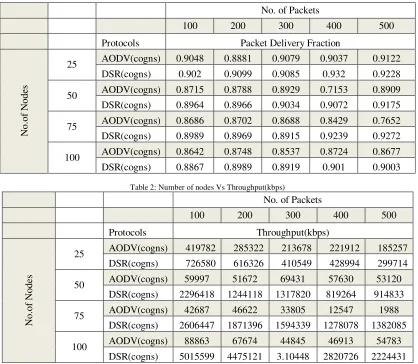
Table 1: Number of nodes Vs Packet Deivery Fraction
No. of Packets
100 200 300 400 500
Protocols Packet Delivery Fraction
N
o.
of
N
ode
s
25 AODV(cogns) 0.9048 0.8881 0.9079 0.9037 0.9122 DSR(cogns) 0.902 0.9099 0.9085 0.932 0.9228
50 AODV(cogns) 0.8715 0.8788 0.8929 0.7153 0.8909 DSR(cogns) 0.8964 0.8966 0.9034 0.9072 0.9175
75 AODV(cogns) 0.8686 0.8702 0.8688 0.8429 0.7652 DSR(cogns) 0.8989 0.8969 0.8915 0.9239 0.9272
100 AODV(cogns) 0.8642 0.8748 0.8537 0.8724 0.8677 DSR(cogns) 0.8867 0.8989 0.8919 0.901 0.9003
Table 2: Number of nodes Vs Throughput(kbps)
No. of Packets
100 200 300 400 500
Protocols Throughput(kbps)
N
o.
of
N
ode
s
25 AODV(cogns) 419782 285322 213678 221912 185257 DSR(cogns) 726580 616326 410549 428994 299714
50 AODV(cogns) 59997 51672 69431 57630 53120
DSR(cogns) 2296418 1244118 1317820 819264 914833
75 AODV(cogns) 42687 46622 33805 12547 1988
DSR(cogns) 2606447 1871396 1594339 1278078 1382085
100 AODV(cogns) 88863 67674 44845 46913 54783
Table 3: Number of nodes Vs End to End Delay(ms)
No. of Packets
100 200 300 400 500
Protocols End To End Delay(ms)
N
o.
of
N
ode
s
25 AODV(cogns) 21.59 23.65 26.92 29.49 31.48
DSR(cogns) 21.64 24.89 27.29 40.93 32.16
50 AODV(cogns) 30 34.73 33.91 36 54.15
DSR(cogns) 23.56 27.37 28.65 34.71 52.15
75 AODV(cogns) 45.9 28.97 45.71 35.14 48
DSR(cogns) 21.83 26.96 28.73 44.89 44.3
100 AODV(cogns) 38.68 37.42 41.28 55.96 49.88
DSR(cogns) 21.29 32.68 29.85 34.48 36.05
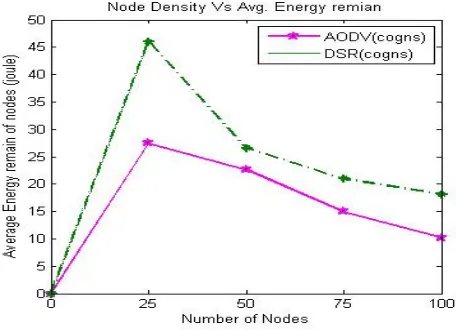
The above table 1, table 2, table 3 shows that the analysis of two different protocols with cognitive capabilites. The In table 1 it observes that the averagly the DSR with cogns has high packet delivery fraction, high Throughput and low delay as compare to AODV with cogns. The primary user when in no use that spectrum holes are fulfill by the secondary user applying various algorithm. The consideration of two different protocols with cognitive capabilities shows various results proved by the above experimental simulation results with energy level also high of DSR(cogns) tha n AODV(cogns).It gradually increases when the nodes are increases from 25 to 100 number of nodes as shown in figure 4.
Fig. 4.Number of nodes vs Average Energy of nodes
5. Conclusion
In this paper the objective is to improve the scalability issue. To improve the scalability we consider the 25 to 100
sensor nodes for our experiment as node density. As observed that the increasing number of nodes may cause the reducing the performance of individual nodes in the network. The cognitive radio sensor networks which are the increasing network for the next generation wireless network also perform better in packet delivery ratio, throughput, and end2end delay with proper energy consumption of individual nodes, as per total energy by above equation. Here we consider the two routing protocol AODV and DSR with cognitive capabilities as AODV (cogns) and DSR (cogns) and observed that the DSR(cogns) perform better as compare to AODV(cogns) in parameter such as Throughput. They solve the complex NP-hard combinatorial optimization problem based on different application. The hands-off techniques from primary user to secondary user with available spectrum holes in the network occupied the secondary user for some duration of time and changing the route from primary user to secondary with efficiently. It solves and optimized different issues and challenges, which is the need of today era and solves the telecommunication problems.
Aknowledgment
The aknowledge to guide Dr. Latesh G. Bhagat(Malik) and aknowledge to other researcher for their research contribution, also the research centre the G. H. Raisoni College of Engineering, Nagpur.
References
[2] W. Heinzelman, et al., “An application specific protocol architecture for wireless microsensor networks”, in press: IEEE Transaction on Wireless Networking”.
[3] S.Muruganatha, D. Ma, eta l., “A Centralized Energy-Efficient Routing Protocol for wireless Sensor Networks”, IEEE Commun. Mag., 2005, Vol. 43, Issue3, pp. 8-13.
[4] S. Lindsey and C. Raghavendra , “PEGASIS: Power-Efficient Gathering in Sensor Information Systems,” IEEE Aerospace Conf. proc., 2002, Vol. 3, 9-16, pp. 1125-30 .
[5] E. Egea-Lopez, J.Vales-Alonso et al, “Simulation scalability issues in wireless sensor networks. IEEE Communication Magazine, pages 64-73, July 2006. [6] L. Alazzawi, A. Elkateeb, “Performance Evaluation of the
WSN Routing Protocols Scalability,” Journal of Computer Systems.
[7] A. Abbasi, M. Younis, A survey on clustering algorithms for wireless sensor networks, Journal of Computer Communications, Special Issues on Network Coverage and Routing Schemes for Wireless Sensor Networks, In Press.
[8] M. Paone, A. Cucinotta, et al., “A bio-inspired distributed routing protocol for wireless sensor networks: performance evalution,” in Proc. IEEE. Inst. Conf. Distrib. Comput. Syst., 2010, pp. 247-255.
[9] Oey, C. H.; Christian, et al., “Energy-and cognitive-radio-aware routing in cognitive radio sensor networks. Int. J. Distr. Sen. Netw. 2012, 1-11.
[10] Essam H. Hussein, et al., “Ant-Hoc: A swarm intelligence-based routing protocol for Adhoc networks,” IRACST-International Journal of Computer networks and Wireless Communications (IJCNWC), ISSN: 2250-3501, Vol. 6, No 1, Jan-Feb 2016.
[11] Mohammad Saleem et al, “BeeSensor: A bee-inspired power aware routing protocol for wireless sensor networks. In:Applications of evolutionary computing. LNCS. Vol. 4448/2007. pp. 81-90.
[12] Darigo, M.(1992), “Optimization, learning and natural algorithms”, Ph.D. dissertation.
[13] Brand, M., Masuda, M., Wehner, N., & Yu, X. H.(2010) , “Ant colony optimization algorithm for robot path planning”, International Conference on Computer Design and Applications (ICCDA 2010), vol. 3 , pp. 436–440. [14] Kashif Saleem., et al.(2009), “Ant based self-organized
routing protocol for wireless sensor networks”, IJCNIS
1(2).
[15] Kwang Mong Sim et al., “Ant Colony optimization . for Routing and Load-balancing: Survey and New
Direction”, IEEE Transaction on systems, Man, and Cybernetics-PartA: Systems and humans, Vol. 33, No. 5, September 2003.
[16] R. Misra, and C. mandal, “Minimum Connected Dominating Set Using a Collaborative Cover Heuristic for Ad Hoc Sensor networks,” IEEE Transaction on Parallel and Distributed Systems, Vol. 21, pp. 292-302, 2010.
[17] Yang, W. Markov Chains and Ant Colony Optimization, in Proceeding Yang 2013, Markov, CA.
[18] VINT Project, “The network simulator-NS-2, “http://www.isi.edu/nsnam/ns.
[19] A. N. Thakare and L. G. Malik, ”A Review of Routing Protocols in Wireless Sensor Networks Using Biologically Inspired Methods,” 6th International Conference on Emerging Trends in Engineering and Technology (ICETET), IEEExplore, pp. 103-104, Dec. 2013.
[20] Thakare A.N., Malik L.G.(2014) Design Approach of Self-Organized Routing Protocol in Wireless Sensor Networks Using Biologically Inspired Methods. In: Maringanti R., Tiwari M. Arora A. (eds) Proceedings of Ninth International Conference on Wireless Communication and Sensor Networks. Lecture Notes in Electrical Engineering, Vol. 299, Springer, New Delhi. [21] Thakare, A.N., Bhagat, L.and Thomas, A. (2017) ‘A
self-organised routing algorithm for cognitiveradio-based wireless sensor networks using biologically-inspired method’,Int. J. Artificial Intelligence and Soft Computing, Vol. 6, No. 2, pp.148–169.
[22] A. O. Bicen, O. B. Akan, “Reliability and Congestion Control in Cognitive Radio Sensor Networks,” to appear in Ad Hoc Networks Journal (Elsevier), 2011.
Amit N. Thakare: He is pursuing the PhD.(Computer Science &
Engineering)from G. H. Raisoni College of Engineering, Nagpur, M.Tech (Computer Science & Engineering)in 2008 from MGMs College of Engineering,Shree Ramanand Teerth Marathwada University, Nanded, B.E.(Computer Technology) in 2002, from Manoharbhai Patel Institute of Engineering & Technology, Rashtrasant Tukadoji Maharaj Nagpur University, Nagpur (Maharashtra), India, He is life member of ISTE, Member of CSI and IEI,Paper presented and Published more than 15 papers.
Dr. Latesh G. Bhagat(Malik): She has completed Ph.D.
(Computer Science & Engineering) from Visveyaraya National Institute of Technology in 2010, M.Tech. (Computer Science & Engineering) from Banasthali Vidyapith, Rajasthan, India and B.E. (Computer Engineering) from University of Rajasthan, India . She is gold medalist in B.E. and M.Tech. She is currently working as Associate Professor & Head of Department in Department of Computer Science & Engineering at Government College of Engineering, Nagpur, MS, India. She has teaching experience of 19 years. Mrs. Latesh Bhagat (Malik) is life member of ISTE, CSI, ACM and presented 46 papers in international journal and 57 papers in international conference. She is recipient of 2 RPS and 1 MODROBs by AICTE. She guided 31 PG projects and 8 Ph.D. students are registered under RTM Nagpur University.
Mrs. Achamma Thomas: received M.Tech(Computer Science &