Detection of Rain Fall and Wind Direction using Wireless
Mobile Multi Node Energy Efficient Sensor Network
1
P. Jagannadha Rao,
2P.Bhavya Manjeera,
3V. Sridevi,
4R. Sridevi V. UshaRani
1
College of engineering, Department of Chemical Engineering, Andhra University,Visakhapatnam.
2
Asst. Engineer (Chemical-Production), Trimex Sands Pvt. Ltd., Srikakulam.
3
Sanketika Vidyaparishad Engineering College, Visakhapatnam
4
Dr. LankapalliBullayya College of Engineering for women, Visakhapatnam
ABSTRACT
Accurate measurements of rainfall are important in meteorology, hydrology (e.g. flood warning), agriculture, environmentalpolicy and weather forecasting.Because of the global warming the expected monsoons are making delay in giving artefact of rain to humankind. The global warming also cause un-expecting flood in many villages and cities. The climate always habituated in changing its behaviour in terms of its direction and intensity suddenly, which cause a large damage to humankind directly and indirectly. Sometimes farmers fail to protect their products safely from calamities. Although the satellite systems are working in this direction to make people alert, but it is highly essential to monitor the nearest area weather, to take immediate action. In this paper the detection techniques of rainfall and wind direction within small regions are presented. And in this paper few sensor model operations are discussed to meet the requirements. Also it is very important to look in designing the electronic system consists of the interfacing peripherals, to optimize its operation in terms of its power consumption. In this paper it is also discussed some techniques used to minimize the power consumption.
Keywords
Rainfall, diaphragm, wind velocity, direction, sensor nodes, clock scheme, energy efficient
1.
Introduction
The satellite systems are playing vital role in monitoring weather system on earth and giving their valuable measurements to scientist to take correct decisions. But this is
some time difficult to monitor these satellite results through televisions and other media at different locations. Sometimes farmers, industrialists, and other mankind eagerly wait for weather effect of their next village, town, city or an area in the city. If we can estimate the weather condition such as rainfall, wind direction, and pressure in the next village, people can alert to finish their priority jobs immediately, before it enters in to their village. If small sensor systems are arranged in the nearest place or next village from which it is required to measure the weather readings, those sensor readings can be transmitted to individual mobile phones through sensor network [13]. For this technology people need to register their mobile numbers into the electronic system to receive the alert messages of the weather. Basically satellite readings are also use full in estimating weather report, but these reports are calculated on wide range of area. And the estimations sometimes go deviated from the expected values due to global warming, local industries, or due to local environmental disasters.
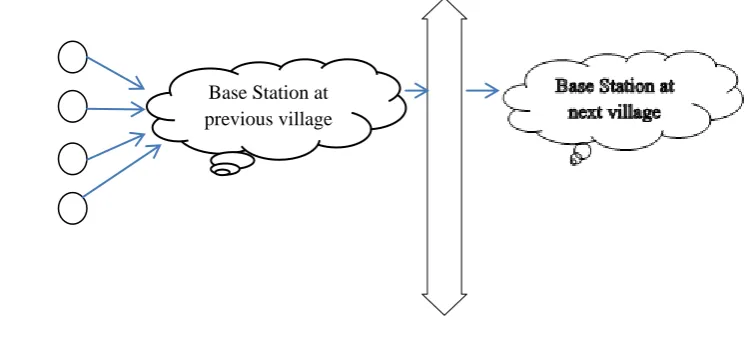
So along with these satellite readings it is also highly essential to monitor the nearest area weather readings automatically. The weather readings of the nearest area are automatically transmitted to mobile phones through sensor network. The sensor network play vital role in measuring the environment conditions in the previous village and sending to next village as shown in figure 1. Based on these results the base station readers will be more vigilant in doing their current jobs. Accurate measurements and accurate predictions can be made in this system.
Figure 1: Physical analysis of the present measurement system
Base Station at
previous village
N
E
T
W
O
R
k
The sensor nodes can store data, make decisions about what data to transmit on and even make decisions about when and what to sense. Sensor networks can be used to monitor the environment, objects in that environment, and the interactions between objects and
their effect on surrounding environment. The sensor networks include environmental sensing, and theireffects, equipment maintenance and their interfacing with respective sensor element [13].
Wireless network technology and miniaturization now make it possible to realistically and accurately monitor the environment. These systems can provide new data for environmental science, such as climate models, as well as vital hazard warnings such as flood alerts. This capability particularly benefits research in remote or dangerous locations, where many fundamental processes have rarely been studied due to inaccessibility.
It is also need to be considered to save power. It is a major problem facing in many electronic digital systems in minimizing the power consumption. If it able to control the power consumption the system able to run for long time with small power supply. In the present paper the power consumption is achieved by controlling the clock timings. By minimizing unnecessary arriving of the clock pulses the system power consumption can be reduced to minimum level. It further increases the performance of the system.
2.
Hardware
In the present work sensor network is designed in view that in future the size of the sensor network may increase to large extent. In that case the system nodes may not be sufficient to support future system requirements. Keeping this in mind the system is designed in such a way the ports can and nodes can be expandable to meet future requirements [12]. Before designing and installing any system, it is necessary to understand its physical environment and deployment in detail. The system must be able to withstand specific conditions such as temperature, pressure, or vibration [1].In addition, the collection and interpretation of data can dramatically affect the design of communications and security mechanisms. Sensor networks are designed to interface array of sensors with signalling conditioning. Every sensor node in figure 2 is equipped with a transducer, small processing unit, transceiver, and power source. The readings from various sensing nodes are collected and converted to 4-20mA standard signals to transmit it for long distances and to minimize data losses. Further all these sensing node signals are passed to junction box of which contain a 16-terminal port stand. That means at a time 1sixteen sensing signals can be received form multi sensor node. Further the signals are multiples into Data Acquisition system (DAQ). The Data Acquisition system containssignal conditioner for attenuation andDigital Signal Processingunit processor as shown in figure 2. The signal processor will convert the attenuated signal into processor understandable signal and transmittable signal.
Sometimes the final digital system may not be fully justified in receiving full strength signal from ADC (Analog to Digital Converter). In some cases the system is fully busy with complex algorithms due to its complexity. While the complexity is high the system cannot grant port to receiving channel. In such type of situations there is chance of losing information due to improper synchronization. So here a
pipeline is used to overcome from data losing and to match the synchronization between system and external peripheral. For achieving accurate information a new clock scheme [6] is implemented in the present design. Accurate readings can be obtained by checking the data pulses at each stage and triggering next stages by checking previous data pulse stages. More over less relative error can be obtained by checking data waves at each stage of the new clock scheme pipeline. Power consumption can be minimized with the new clock scheme. In achieving new clock scheme clock constraints and limitations are considered to minimize the clock skew in pipeline[10].
Self-configured techniques are followed to enable power down configuration [2]. In self-configured mode the sensor node will be dependent on one another. In power down configuration the sensor network system will be in idle mode, when the weather is in normal condition. This will save the power consumption in the system. Some of the main factors need to consider in self-configuring network design are, moving intelligence closer to the point of measurement control. Convergence of transducers, computation and communication towards common goal such that make cost effective to maintain distributed systems.
Data Acquisition is the process by which physical phenomena from the real world are transformed into electrical signals that are measured and converted into a digital format for processing, analysis, and storage by a computer.Industrial PC I/O interface products have become increasingly reliable, accurate and affordable. Because of this, PC-based data acquisition and control systems are widely used in industrial and laboratory applications like monitoring, control, data acquisition and automated testing. Data acquisition systems are usually capable of directly handling low-voltage inputs i.e. from a few millivolts up to a few volts.
Data acquisition and control hardware generally performs one or more of the following functions: analog input, analog output, digital input, digital output and counter/timer functions
Analog Inputs (A/D) Digital Inputs and Outputs:
Analog to digital (A/D) conversion changes analog voltage or Digital input/output functions are useful in applications such as current levels into digital information. The conversion is contact closure and switch status monitoring, industrial On/Off necessary to enable the computer to process or store the signals.
Analog Outputs (D/A):
The opposite of analog to digital conversion is digital to analog (D/A) conversion. This operation converts digital information into analog voltage or current. D/A devices allow the computer to control real-world events. Analog output signals may directly control process equipment. The process can give feedback in the form of analog input signals. This is referred to as a closed loop control system with PID control. Analog outputs can also be used to generate waveforms. In this case, the device behaves as a function generator.
Figure 2: Block diagram of Signal Conditioning
The problem of estimating spatial coordinates is known as localization.Localization is an important building block for sensornetworks and is itself a sensor network. It is developed for automatic self-configurationthrough adaptive localized algorithms.A localized algorithm is a distributed computation inwhich sensor nodes achieve a desired global objective, [5] while constraining their communication to sensors within some neighbourhood.Assume that neighbouring reference points are synchronizing, so that their signal transmissions do not overlap in time. Furthermore,
in any time interval T, each of the reference points would have transmitted exactly one signal. Each mobile node listens for a fixed time period t and collects all the beacon signals that it receives from various reference points. We characterize the information per reference point Ri by a connectivity metric (CMi), defined as[11],
( , )
100
( , )
recv i
sent
N
i t
CM
X
N
i t
( , )
sent
N
i t
= Number of beacons that have been sent by Ri in time t( , )
recv
N
i t
= Number of beacons sent by Ri that have been received in time tR = Transmission range of the reference point t = t Receiver sampling or data collection timess
Unlike the Internet, wireless sensor networks are organizedaround the naming of data, not nodes [5].Nodes are neither unique nor reliable; applications expressa need for a particular data element or type of databy naming it directly. By eliminating indirection, e.g.the mapping from a name to a node address to a route,a sensor network can eliminate the maintenance overheadassociated with constructing and maintaining thesemappings and directory services[7].Because sensor data are intrinsically associated withthe physical context of the phenomena being sensed,spatial coordinates are often a naturalway to name data.Spatial coordinates are also employed by collaborativesignal processing algorithms (e.g. beamforming) thatcombine data from multiple sensor nodes
for such tasksas target tracking. Furthermore, geographic assistancein ad hoc routing promises significant reductions in energy consumption [8][ 9].
3.
Data Assimilation
A sensor networking system contains various computing systems which contains large number of sensor nodes that are tightly held or communicate to measure a specific physical environment. Sensor nodes communicate with one another over wireless low-bandwidth links and have limited processing capacity. Sensor nodes work together and integrated to collect information about their surrounding environment, this may include things like temperature, light intensity, humidity, rainfall, wind speed or GPS location.
Attenuation due to the rainfall intensity along the path is calculated by, [3]
1
br
A dBkm
aR
--- (1)Where
A
r is the rain induced attenuation, R is rain rate inmm/hr and the coefficients a and b are generally functions of frequency, polarization and drop size distribution (DSD). It has long been known that the relationship in (1) could serve as a basis for measurements of path-integrated and area-integrated rainfall. The major problem identified in context of rainfall monitoring, Evaluate the confidence intervals of the obtained estimates by making use of available information [4] (such as the link density, frequency band, instrument noise, and environmental uncertainties).
It is quite difficult to measure the rain intensity and wind direction in the same region. But finding the wind direction is more important in predicting the rainfall in a particular area. The diaphragms are placed to find the wind pressure. The Diaphragms are placed in different directions to find the wind movement in different angles. Identifying pressure ranges in different angles realises the low pressure directions.The displacements of the diaphragms are proportional to wind velocity. When the velocity of the air increases the diaphragms senses the direction of the air in that particular direction.The displacements are converted into electrical signal using LVDT. LVDTs are best transducers in perceive
Sensor
Multi
Sensing
Node
Junction
Box
DSP
Pipeline
Application
Algorithm
New
Clock
Scheme
Data
Storage
User
Interface
Communication
Networ
k I
nt
er
fa
ce
Po
rt
Sensor
Sensor
Multi-Channel
ADC
New
Clock
Scheme
the rain stream direction. So the LVDT directions are very important in deciding wind directions and predicting rain fall. At the same time the rain gauge readings confirm the rain fall in the particular location. So in the next village based on the wind directions and velocity, villagers can predict rain fall.
4.
Simulations
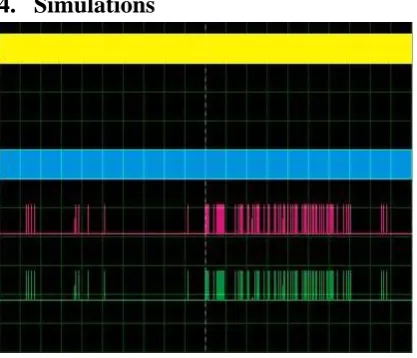
Figure 3: Data simulations through pipeline after DAQ
The first wave in yellow colour represents the global clock and the second wave with blue colour represents the new clock present at pipeline. The third wave is the data arrived at Data Acquisition System (DAQ) input and the fourth wave is the output at pipeline observed in digital CRO designed in graphics tools with the help of object oriented language advanced java. In the present method it is observed that very less data loss is observed when compared to old clock schemes. In old schemes input data takes more time to propagate to output terminal. But in the new method less propagation delay is observed and accurate results are obtained which as discussed earlier [6]. The measurement deviations are very minute which can be negligible.
5.
Conclusion
Accurate measurements and accurate predictions can be made in this system.The percentage of relative errorcomparatively very small over wide range of frequency ranges. The propagation delay between Digital processor and final network port interface control is reduced. The architecture bridges an intelligent connection between environment and present sensor network. In future we are concentrating on further accurate process with lesser hardware with less power consumption. This can be achieved by reducing spatial complexity of the program and hardware design. Intelligent self-configured networking is maintained and controlled by localization algorithms. The system is designed to compatible with few mobile adapters only. With fewer modifications in interfacing port stand the system can made prepare to exchange data with any type of mobile adapter. High level language such as java is used to minimize time complexity and spatial complexity. Direct function calling is possible with
high level languages in DAQ. It speed up the response at DAQ input and output ports.
References
[1] Kirk Martinez et al., “Environmental Sensor Networks”, Published by the ieee computer society, aug 2004, doi: 0018-9162/04, pp50-56.
[2] N.S. Kumar et al., “Intelligent Network: Design of intelligent multinode Sensor networking”, IJCSE, vol2 no3, 2010, 468-472.
[3] D. Atlas and C. Ulbrich, “Path- and area-integrated rainfall measurement by microwave attenuation in the 1-3 cm band,” J. Appl. Meteorol., vol. 16, pp. 1322-1331, 1977. [4] Hagit Messer et al., “Environmental Sensor Networks
Using Existing Wireless Communication Systems forRainfall and Wind Velocity Measurements”, IEEE Instrumentation & Measurement Magazine, april 2012, 32-38.
[5] Deborah Estrin, Ramesh Govindan, John Heidemann, and Satish Kumar. Next century challenges: Scalable coordination in sensor networks. In Proceedings of the Fifth Annual ACM/IEEE International Conference on Mobile Computing and Networking (MobiCom 99), pages 263–270, Seattle,WA, USA, August ” 15–20” 1999. ACM.
[6] N. Suresh kumar, et al., “A New Method to Enhance Performance of Digital Frequency Measurementand Minimize the Clock Skew”, IEEE Sensor journal, vol11,No10,oct 2011, 2421-2425.
[7] NirupamaBulusu et al., “Scalable Coordination forWireless Sensor Networks: Self-Configuring Localization Systems”, Proc. of the 6th International Symposiumon Communication Theory and Applications(ISCTA’01),Ambleside, UK, July 2001.1. [8] Brad Karp and H.T. Kung.Gpsr: Greedy perimeter
stateless routing for wireless networks. In Proceedings of the Sixth Annual ACM/IEEE International Conference on Mobile Computing and Networking (MobiCom 2000), pages 243– 254, N.Y., August 2000. ACM. [9] YaXu, John Heidemann, and Deborah Estrin.
Geography-informed energy conservation for ad hoc routing.In Proceedings of the Seventh Annual ACM/IEEE International Conference on Mobile Computing and Networking, Rome, Italy, July 2001.ACM.To appear. [10] N.S. Kumar et al., “Effect of Interrupt Logic on Delay
Balancing Circuit”, International Journal of Computer Applications (0975 – 8887), Volume 27– No.4, August 2011.
[11] NirupamaBulusu et al., “GPS-less Low Cost Outdoor Localization For Very Small Devices”, This research is supported by the SCOWR project throughNSFgrantANI- 9979457.
[12] Salem Hadim et al., “Middleware: Middleware Challenges and Approaches for Wireless Sensor Networks”, IEEE Distributed systems online 1541-4922 © 2006 Published by the IEEE Computer Society Vol. 7, No. 3; March 2006.
Biography
P.J.Rao (P.JagannadhaRao) has passed out B.Tech (Chemical Engineering) and M.Sc. ( Mineral Process Engineering) during the years 1982 and 1984 respectively. He is pocessing 22 years of Industrial , consultancy and 6 years of Academic experience in various Industries of repute and Department of Chemical Engineering, Andhra University. He has the hands on exrerience in the fields of Production, Process, Environmental Management and Industrial Safety. He had been associated with industies include Petrochemical, metallurgical, Pharma, Chemical, Agro processing, Tanneries, cement, sugar,beach sand processing, fertiliser, sugar, steel tec. Presently he is working as Associate Professor in the dept. of Chemical Engineering. He had been awarded Ph.D in Chemical Engineering during the year 2011.
P.BhavyaManjeera has passed out B.Tech(Chemical Engineering) during the year 2009 from A.U.College of Engineering, Andhra University with first class. She is persuingM.Tech in Chemical Engineering under the scheme
of locally employed while working as Assistant Engineer (Chemical) in Trimex Sands Pvt. Limited, Vastavalasa, SrikakulamDist since August 2009 to till date. She is reporting The Director and Unit head in the matter pertaing to Project Management, Process calculationd, Production R & D Activities on Pigmentation of TiO2, Recoveries of Heavy Minerals, Environmental and Safety aspects. Presently she is engaged in M.Tech project work scheduled to submit during August 2012 for obtaining M.Tech degree in Chemical Engineering.