Error Concealment by Tracking and Velocity Estimation of
Macro-Block in Video Communication at the Decoder of H.264/AVC
Md. Abu Marjan1, Nahid Binte Sadia2, Md. Dulal Haque3, Md. Palash Uddin4, Masud Ibn Afjal5 and Md. Rashedul Islam6
1, 2, 3
Telecommunication & Electronics Engineering, 4, 6 Computer Science & Information Technology, 5 Computer Engineering, Hajee Mohammad Danesh Science and Technology University (HSTU), Dinajpur-5200, Bangladesh
1
[email protected], [email protected], [email protected], [email protected], 5
[email protected], [email protected]
ABSTRACT
Nowadays it is an important concern passing large amount of data over the wireless or wired media using comparatively low bandwidth. Video is one of them. To reduce data size of video, many compression techniques is used like H.261, H.263, H.26L, H.264/AVC, MPEG-2 and MPEG-4 etc. When compressed data pass throw comparatively low bandwidth media or for the characteristics of media there may be some data loss in the transmission line. This loss affects the original video and it occur some error. In this paper introduce a new technique for error concealment by post processing using an artificial intelligence at the receiver of H.264/AVC decoder. The artificial intelligence of the decoder based on image/video characteristics and human visual system properties, previous video frame of current error affected frame and frame rate, velocity of the macroblock and the physical relationship of the parameter, position and velocity of an object and time. In this methodology; at normal situation the system learn about two parameter which is the velocity and the rate of change of intensity of macroblock .When error occur, this technique gives an optimum solution for error concealment of error affected frame in the video communication. For live video streaming this methodology gives better performance for smooth object moving videos like video conference, video lecture, stage performance etc and it also give better performance for all downloaded video.
Keywords: Video Error Concealment, Artificial Intelligence, Velocity of Macroblock, Estimation Macroblock Position, Video Compression, Video Communication.
1. INTRODUCTION
In today's world science has brought us in such a higher place, where improved communication system has made our life so much easier and comfortable. Video communication is the latest blessing of science that brought the whole world in front of our eye. For well Video communication efficient coding is one of the demanding aspects of information and communication
concealment and other Error concealment by post processing. Forward error concealment is a technique that can minimized both quantization and transmission error. In this technique some mathematical or logical operation performed and some time add some extra data to the original data at the sender after sending the video data to the transmission line. In the video communica-tion Forward error correccommunica-tion (FEC) is a common technique to recover the error by adding extra data. Packet size control (PSC) method in the company of optimal packet-level FEC may enhance the efficiency of FEC [9]. Adaptive Cross-Layer FEC technique is also shows better performance in reducing error rate using feedback to calculate the redundancy rate [10]. Another technique of FEC is forward-looking forward error correction mechanism recover the lost packet from its FEC block and the previous FEC block from the recovered packet; this is a recursive process to recover the first FEC block [11]. Another of error concealment is Error concealment by post processing; in this technique error recovery is performed at the decoder or receiver and error concealment is independent from the sender. One of the common mechanisms of Error concealment by post processing is Motion-Compensated Temporal Prediction. Joining with layered coding that includes all the motion information in the base layer makes this method very effective [12]. Maximally smooth recovery technique makes utilization of the smoothness property of most video and image signals through a controlled energy minimization way. In still images to recover damaged blocks block-transform-based coders are used by making utilization of the spatial smoothness only [13]. There is also a technique of second-order smoothness criteria to reduce the blurring artifacts [14]. In this paper introduce a novel mechanism of error concealment which based on error concealment by post processing.
2. PROPOSED ALGORITHM
Proposed methodology is designed as a post processing technique for error concealment of compressed video data which effected by error in the transmission line. This technique is based on image/video characteristics and human visual system properties. For error concealment we construct an artificial intelligence which gives an optimum solution for the affected current frame using previous and current data. This solution of this artificial intelligence maintains a threshold level; indicate the minimum level below which human understands the effect of the error. This artificial intell-igence based on the characteristics of image/video, previous video frame, current frame and frame rate of video, velocity of the macro-bock and the physical
relationship of the parameter position and velocity of an object and time. The main concern of this paper is to design an artificial intelligence in the decoder for error concealment. According to video characteristics, video is a flow of images. This image is called frame. In video transmission Frame rate is very important which refers to the number of frame per second.
There is different types of error may occur in the transmission line like lose of motion vector, lose of macroblock data or both, other identification data is it P or I frame etc. This kind of lose may recover by the proposed technique. This technique may an extra feature of H.264/AVC. Now I want to discuses about this technique.
For better understanding discuses this technique in two parts:
Learning
Error concealment
2.1 Learning
We know the decoding technique of the h.264/avc, learning of proposed technique perform parallel at the decoding time without disturbing decoding system. In this proposed system learn about two parameters, one is velocity of macroblock and other rate of change of color intensity that macroblock with the corresponding frame number.
Learning velocity of moving macroblock using previous frame and frame rate:
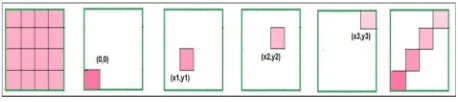
The velocity of moving macroblock is calculated by the distance it travelled with respect to the time. Figure 1 show that the frame sequence and the point of the macroblock.
Fig. 1.Concept of frame sequence and macroblock.
Figure 2 Shows Euclidean distance formula is used to calculate the distance between the sequences of frames. By using the values of distance with respect to frame rate, the initial velocity of the macroblock is defined. The defined velocity is of 2-dimension. Angle of the initial velocity is related to the angel of distance which define as
V=d/t
Where V is the initial velocity t is the time of passing one frame in the video, this value obtains from frame rate of a video and d is the distance of two position of macroblock.
is the angle of the distance as well as velocity. It also learns about the rate of change of color of macroblocks. When error is occurred in a frame the artificial intellige-nce perform the following operation.
Fig. 2. Distance estimation by Euclidean distance formula
Learning Rate of change of intensity of macroblock using previous frame and frame rate:
Intensity is an important parameter for the video communication. For better performance we use this parameter. Figure 3 shows the conceptual shape of intensity chance of macroblock of frame sequence. Rate of change of intensity of macroblock determine for each macroblock at the time of decoding with the help of previous frame and the frame rate. Following the given equation rate of change of intensity is determined.
Fig. 3. Intensity chance of macroblock
Intensity change [i] =intensity of frame [N] ~ intensity of frame [N+1]
Rate of intensity change [i] = Intensity change[i]/frame rate
As mention earlier that the learning process performer parallel at the time of video decoding and store into a primary memory for the farther use; when error occurred in the received video sequence
2.2 Error concealment
Track the position of affected macroblock
When error occurred in a frame as soon as this perform an operation to estimate the accurate position of the macoblock in the current frame for error concealment. As discus earlier about learning step of the artificial
intelligent using this data it perform an operation to find the kertatian point in the two dimensional plan using the relationship of velocity, distance and time. It also calculates angle of the velocity to find accurate position of all affected macroblocks of error affected frame. Figure 4 shows the relationship between velocity, dista-nce and time and the tracking the position of affected macroblock. Where r is the distance or motion vector of the macroblock V initial velocity of the macroblock and t is the time of passing one frame in the video, this value obtain from frame rate of a video.
Fig. 4. Tracking the position of affected macroblock
As the same procedure the artificial intelligence calculate the position of the affected macroblock with respect to other previous frame. From all calculated solution the system gives an optimum position of the affected macroblock. Also determine the parent marcoblock of affected child macroblock.
Recover the affected macroblock
Fig. 5. Recover the macroblock
After recover the affected macroblock, the system put this recovered macroblock into the optimum calculated position. This process as shown in the Figure 6.
Fig. 6. Error Concealment
3. BLOCK DIAGRAM OF PROPOSED
METHODOLOGY WITH H.264/AVC
This diagram is an integrated form of H.264/AVC and our proposed methodology It is known that the video communication must need to compressed to send over the channel; that why we use the compression technology H.264/AVC. Here the indication block indicate our contribution including parallel learning and the concealment part which discuses earlier.
Fig. 7. Block diagram
4. RESULT AND PERFORMANCE
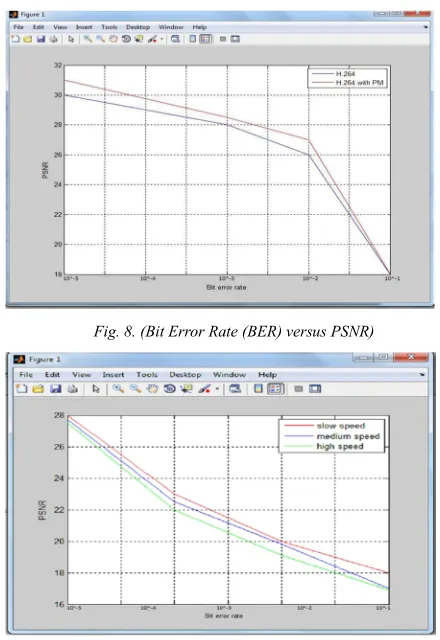
To evaluate the performance of the proposed method-ology we use the MATLAB simulation software. We use the base code of video compression technique h.264 [15] [16]. Figure 8 shows MATLAB simulation of Bit
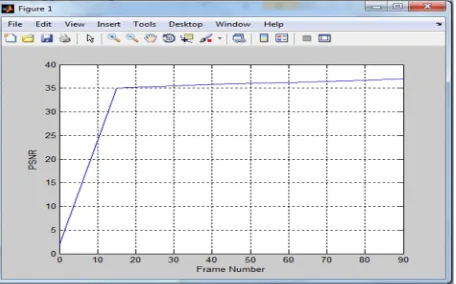
Error Rate (BER) versus PSNR of monochrome video of pure h.264 coding and h.264 with proposed technology, for both cases PSNR decrease with respect to increase of BER but the proposed technology shows better result than pure h.264. Figure 9 shows that Farme number per second versus PSNR of proposed methodology. It indicates that when frame number increase 1 to 15 per second PSNR increase rapidly. and when frame number above 15 per second PSNR increase slowly .Over all we can say that increasing of frame number per second increase PSNR of the video signal when we decode the video with proposed methodology. Figure 10 shows the simulation of proposed methodology when the input video object have different velocity there is slow or smooth moving video shows better performance than the medium or fast speed video object. The rapid variation of the velocity of object in the video give poor performance but the smooth variation of the velocity of object in the video gives better performance. Note that most of the videos have smooth variation of object velocity. Now we conclude that for live video streaming this methodology gives better performance for smooth object moving videos like video conference, video lecture, stage performance etc and it also give better performance for all downloaded video.
Fig. 8. (Bit Error Rate (BER) versus PSNR)
Fig. 10. Bit Error Rate (BER) versus PSNR
5. FUTURE WORK
In this paper a conceptual view of error concealment and performance analysis of proposed methodology of only using the backward prediction has shown. In future we will work with bi-directional prediction of video coding and we will develop an algorithm of upgrading the video quality with the help of proposed methodology.
6. CONCLUSIONS
This proposed technology is a new scheme of error concealment. In this paper we show the conceptual view of a technology and the performance analysis. In this technology object motion and the characteristic of image and video is used for error concealment. We thing that this technology is also used for improve the quality of the video in the video communication. The performance of this methodology will be poor when a new object comes certainly in the frame and the velocity of this object is rough for the live streaming video. It can overcome by using bidirectional prediction.
REFERENCES
[1] Md. Abu Marjan1, Md. Palash Uddin2, Masud Ibn Afjal3 and Md. Dulal Haque4 "Developing an Efficient Algorithm for the Representation and Compression of Large Bengali Text" IFOST-2014,21-23 October [2] Thomas Wiegand, Gary J. Sullivan, Gisle Bjøntegaard,
and Ajay Luthra" Overview of the H.264/AVC Video
Coding Standard" IEEE TRANSACTIONS ON
CIRCUITS AND SYSTEMS FOR VIDEO
TECHNOLOGY, VOL. 13, NO. 7, JULY 2003
[3] N. Ohta,Packet Video: Modeling and Signal Processing. Nor-wood, MA: Artech House, 1994
[4] S. Lin and D. J. Costello,Error Control Coding: Fundamentals and Applications Englewood Cliffs, NJ:Prentice- Hall,1983
[5] K. N. Ngan and R. Stelle, “Enhancement of PCM and DPCM images corrupted by transmission errors,” IEEE Trans. Com-mun., vol. COM-30, pp. 257–265, Jan. 1982. [6] K. M. Rose and A. Heiman, “Enhancement of one-
dimensional variable-length DPC Mimages corrupted by transmission er-rors,”IEEE Trans. Commun., vol. 37, pp. 373–379, Apr. 1989.
[7] O. R. Mitchell and A. J. Tabatabai, “Channel error recovery for transform image coding,”IEEE Trans. Commun., vol. COM-29, pp. 1754–1762, Dec. 1981 [8] W.-M. Lam and A. Reibman, “An error concealment
algorithm for images subject to channel errors,” IEEE Trans. Image Processing, vol. 4, May 1995, pp. 533–54 [9] Chi-Huang Shih "Enhancing Packet-level Forward Error
Correction for Streaming Video in Wireless Networks " IJCSI International Journal of Computer Science Issues, Vol. 9, Issue 5, No 2, September 2012 ISSN (Online): 1694-0814.
[10]K .SreenivasaRao, K.Sri Rama Krishna "Performance Analysis Of Adaptive Cross Layer FEC Mechanism For
Video Transmission Over Wireless Networks"
International Journal of Engineering Trends and Technology (IJETT) – Volume 4 Issue 10 - Oct 2013. [11]Ming-Fong Tsai, Ce-Kuen Shieh,Tzu-Chi Huang, and
Der-Jiunn Deng "Forward-Looking Forward Error Correction Mechanism for Video Streaming over Wireless Networks" IEEE SYSTEMS JOURNAL VOL. 5, NO. 4, DECEMBER 2011
[12]M. Ghanbari, “Cell-loss concealment in ATM video codes,”IEEE Trans. Circuits Syst. Video Technol., vol. 3, pp. 238–247, June 1993.
[13]Y. Wang, Q.-F. Zhu, and L. Shaw, “Maximally smooth image recovery in transform coding,”IEEE Trans. Commun., vol. 41,pp. 1544–1551, Oct. 1993.
[14]W. Kwok and H. Sun, “Multi-directional interpolation for spatial error concealment,” IEEE Trans. Consumer Electron., vol. 39, pp. 455–460, Aug. 1993
[15]A A Muhit, M R Pickering, M R Frater and J F Arnold, “Video Coding using Elastic Motion Model and Larger Blocks,” IEEE Trans. Circ. And Syst. for Video Technology, vol. 20, no. 5, pp. 661-672, 2010.
[16]A A Muhit, M R Pickering, M R Frater and J F Arnold, “Video Coding using Geometry Partitioning and an Elastic Motion Model,” accepted for publication in
Journal of Visual Communication and Image