RP-HPLC METHOD DEVELOPMENT AND VALIDATION FOR THE SIMULTANEOUS ESTIMATION
OF SOFOSBUVIR AND VELPATASVIR IN BULK AND PHARMACEUTICAL DOSAGE
*Padmavathi.Sakinala, Sravanthi.Gali, Sai srilakshmi .G, Naga varalakshmi.T, Vani .T
Department of Pharmaceutical Analysis, Nirmala College of Pharmacy, Atmakur, Mangalagiri, Guntur DistA R T I C L E I N F O
INTRODUCTION
The quality of a drug plays an important role in ensuring the safety and efficacy of the drugs. Quality assurance and control of pharmaceutical and chemical formulations is essential for ensuring the availability of safe and effective drug formulations to consumers. Hence Analysis of pure drug substances and their pharmaceutical dosage forms occupies a pivotal role in assessing the suitability to use in patients. The quality of the analytical data depends on the quality of the methods employed in generation of the data (1). Hence, development of rugged and robust analytical methods is very important for statutory certification of drugs and their formulations with the regulatory authorities.
The wide variety of challenges is encountered while developing the methods for different drugs depending on its nature and properties. This along with the importance of achieving the selectivity, speed, cost, simplicity, sensitivity, reproducibility and accuracy of results gives an opportunity for researchers to come out with solution to address the challenges in getting the new methods of analysis to be adopted by the pharmaceutical industry and chemical laboratories. Different physico-chemical methods (1) are used to study the physical phenomenon that occurs as a result of chemical reactions.
International Journal of Current Advanced Research
ISSN: O: 2319-6475, ISSN: P: 2319-6505,
Available Online at www.journalijcar.org
Volume 7; Issue 6(J); June 2018; Page No.
DOI: http://dx.doi.org/10.24327/ijcar.2018
Copyright©2018 Padmavathi.Sakinala et al. This is an open access article distributed under the Creative Commons Attribution License, which permits unrestricted use, distribution, and reproduction in any medium, provided the original work is properly cited.
Article History:
Received 8th March, 2018 Received in revised form 11th April, 2018 Accepted 26th May, 2018 Published online 28th June, 2018
Key words:
Sofosbuvir, Velpatasvir, RP-HPLC
*Corresponding author: Padmavathi.Sakinala
Department of Pharmaceutical Analysis, Nirmala College of Pharmacy, Atmakur, Mangalagiri, Guntur Dist
HPLC METHOD DEVELOPMENT AND VALIDATION FOR THE SIMULTANEOUS ESTIMATION
OF SOFOSBUVIR AND VELPATASVIR IN BULK AND PHARMACEUTICAL DOSAGE
Padmavathi.Sakinala, Sravanthi.Gali, Sai srilakshmi .G, Naga varalakshmi.T, Vani .T
Department of Pharmaceutical Analysis, Nirmala College of Pharmacy, Atmakur, Mangalagiri, Guntur DistA B S T R A C T
A simple, Accurate, precise method was developed for the simultaneous estimation of the Sofosbuvir and Velpatasvir in Tablet dosage form. Chromatogram was run through BDS 250 x 4.6 mm, 5. Mobile phase containing Buffer 0.1%OPA: Acetonitrile taken in the ratio 55:45 was pumped through column at a flow rate of 1 ml/min. Buffer used in this method was 0.1% OPA buffer. Temperature was maintained at 30°C. Optimized wavelength selected was 240.0 nm. Retention time of Sofosbuvir and Velpatasvir were found to 2.251 min and 2.633. %RSD of the Sofosbuvir and Velpatasvir were and found to be 0.4 and 0.4 respectively. %Recovery was obtained as 99.11% and 98.81% for Sofosbuvir and Velpatasvir respectively. LOD, LOQ values obtained from regression equations of Sofosbuvir and Velpatasvir were 0.16, 0.48 and 1.15, 3.47 respectively. Regression equation of Sofosbuvir is y = 1907.x+10654, y = 4963x+9760 of Velpatasvir. Retention times were decreased and run time was decreased, so the method developed was simple and economical that can be adopted in regular Quality control test in Industries.
The quality of a drug plays an important role in ensuring the safety and efficacy of the drugs. Quality assurance and control of pharmaceutical and chemical formulations is essential for the availability of safe and effective drug formulations to consumers. Hence Analysis of pure drug substances and their pharmaceutical dosage forms occupies a pivotal role in assessing the suitability to use in patients. The depends on the quality of the methods employed in generation of the data (1). Hence, development of rugged and robust analytical methods is very important for statutory certification of drugs and their
e variety of challenges is encountered while developing the methods for different drugs depending on its nature and properties. This along with the importance of achieving the selectivity, speed, cost, simplicity, sensitivity, of results gives an opportunity for researchers to come out with solution to address the challenges in getting the new methods of analysis to be adopted by the pharmaceutical industry and chemical laboratories. Different ed to study the physical phenomenon that occurs as a result of chemical reactions.
Among the physico-chemical methods, the most important are optical (refractometry, polarimetry, emission and fluorescence methods of analysis), photometry (photocolorimetry and spectrophotometry covering UV
nepheloturbidimetry) and chrom
thin layer, gas liquid and high performance liquid chromatography) methods. Methods such as nuclear magnetic resonance (NMR) and para magnetic resonance (PMR) are becoming more and more popular. The combination of mass spectroscopy (MS) with gas chromatography is one of the most powerful tools available. The chemical methods include the gravimetric and volumetric procedures which are based on complex formation; acid-base, precipitation and redox reactions. Titrations in non-aqueou
have also been used in pharmaceutical analysis. The number of new drugs is constantly growing. This requires new methods for controlling their quality. Modern pharmaceutical analysis must need the following requirements.
1. The analysis should take a minimal time.
2. The accuracy of the analysis should meet the demands of Pharmacopoeia.
3. The analysis should be economical.
The selected method should be precise and select The quality and safety of a drug is generally assured by monitoring controlling the assay and impurities effectively. While assay determines the potency of the drug and impurities will determine the safety aspect of the drug. Assay of pharmaceutical products plays an important role in efficacy of the drug in patients.
International Journal of Current Advanced Research
6505, Impact Factor: 6.614
www.journalijcar.org
; Page No. 13750-13756
//dx.doi.org/10.24327/ijcar.2018.13756.2469
This is an open access article distributed under the Creative Commons Attribution License, which permits unrestricted use, distribution, and reproduction in any medium, provided the original work is properly cited.
Padmavathi.Sakinala
Department of Pharmaceutical Analysis, Nirmala College of Pharmacy, Atmakur, Mangalagiri, Guntur Dist-522503
HPLC METHOD DEVELOPMENT AND VALIDATION FOR THE SIMULTANEOUS ESTIMATION
OF SOFOSBUVIR AND VELPATASVIR IN BULK AND PHARMACEUTICAL DOSAGE FORM
Padmavathi.Sakinala, Sravanthi.Gali, Sai srilakshmi .G, Naga varalakshmi.T, Vani .T
Department of Pharmaceutical Analysis, Nirmala College of Pharmacy, Atmakur, Mangalagiri, Guntur Dist-522503A simple, Accurate, precise method was developed for the simultaneous estimation of the Sofosbuvir and Velpatasvir in Tablet dosage form. Chromatogram was run through Std Mobile phase containing Buffer 0.1%OPA: Acetonitrile taken in he ratio 55:45 was pumped through column at a flow rate of 1 ml/min. Buffer used in this method was 0.1% OPA buffer. Temperature was maintained at 30°C. Optimized wavelength selected was 240.0 nm. Retention time of Sofosbuvir and Velpatasvir were 2.251 min and 2.633. %RSD of the Sofosbuvir and Velpatasvir were and found to be 0.4 and 0.4 respectively. %Recovery was obtained as 99.11% and 98.81% for Sofosbuvir and Velpatasvir respectively. LOD, LOQ values obtained from regression , 0.48 and 1.15, 3.47 respectively. Regression equation of Sofosbuvir is y = 1907.x+10654, y = 4963x+9760 of Velpatasvir. Retention times were decreased and run time was decreased, so the method developed was ical that can be adopted in regular Quality control test in Industries.
chemical methods, the most important are optical (refractometry, polarimetry, emission and fluorescence methods of analysis), photometry (photocolorimetry and spectrophotometry covering UV-Visible, IR Spectroscopy and nepheloturbidimetry) and chromatographic (column, paper, thin layer, gas liquid and high performance liquid chromatography) methods. Methods such as nuclear magnetic resonance (NMR) and para magnetic resonance (PMR) are becoming more and more popular. The combination of mass py (MS) with gas chromatography is one of the most powerful tools available. The chemical methods include the gravimetric and volumetric procedures which are based on base, precipitation and redox aqueous media and complexometry have also been used in pharmaceutical analysis. The number of new drugs is constantly growing. This requires new methods for controlling their quality. Modern pharmaceutical analysis must need the following requirements.
ysis should take a minimal time.
The accuracy of the analysis should meet the demands of Pharmacopoeia.
The analysis should be economical.
The selected method should be precise and select The quality and safety of a drug is generally assured by monitoring and controlling the assay and impurities effectively. While assay determines the potency of the drug and impurities will determine the safety aspect of the drug. Assay of pharmaceutical products plays an important role in efficacy of
Research Article
International Journal of Current Advanced Research Vol 7, Issue 6(J), pp 13750-13756, June 2018
MATERIALS AND METHODS
Materials
Sofosbuvir and Velpatasvir pure drugs (API), Combination Sofosbuvir and Velpatasvir tablets (epclusa), Distilled water, Acetonitrile, Phosphate buffer, Methanol, Potassium dihydrogen ortho phosphate buffer, Ortho-phosphoric acid. All the above chemicals and solvents are from Rankem
Instruments
Electronics Balance-Denver
pH meter -BVK enterprises, India
Ultrasonicator-BVK enterprises
WATERS HPLC 2695 SYSTEM equipped with quaternary pumps, Photo Diode Array detector and Auto sampler integrated with Empower 2 Software.
UV-VIS spectrophotometer PG Instruments T60 with special bandwidth of 2 mm and 10mm and matched quartz cells integrated with UV win 6 Software was used for measuring absorbances of Sofosbuvir and Velpatasvir solutions.
Methods
Diluent: Based up on the solubility of the drugs, diluent was
selected, Acetonitrile and Water taken in the ratio of 50:50
Preparation of Standard stock solutions:Accurately weighed
200 mg of Sofosbuvir, 50 mg of Velpatasvir and transferred to 50ml volumetric flasks and 3/4 th of diluents was added to these flask and sonicated for 10 minutes. Flask were made up with diluents and labeled as Standard stock solution. (4000µg/ml of Sofosbuvir and 1000µg/ml Velpatasvir)
Preparation of Standard working solutions (100% solution):
1ml from each stock solution was pipetted out and taken into a 10ml volumetric flask and made up with diluent. (400µg/ml of Sofosbuvir and 100µg/ml of Velpatasvir)
Preparation of Sample stock solutions: 5 tablets were
weighed and the average weight of each tablet was calculated, then the weight equivalent to 1 tablet was transferred into a 100ml volumetric flask, 50ml of diluents was added and sonicated for 25 min, further the volume was made up with diluent and filtered by HPLC filters (4000µg/ml of Sofosbuvir and 1000µg/ml of Velpatasvir)
Preparation of Sample working solutions (100% solution):
1ml of filtered sample stock solution was transferred to 10ml volumetric flask and made up with diluent. (400µg/ml of Sofosbuvir and 100µg/ml of Velpatasvir)
Preparation of buffer
0.1%OPA Buffer: 1ml of ortho phosphoric acid was diluted to
1000ml with HPLC grade water.
Validation
System suitability parameters
The system suitability parameters were determined by preparing standard solutions of Sofosbuvir (400ppm) and Velpatasvir (100ppm) and the solutions were injected six times and the parameters like peak tailing, resolution and USP plate count were determined.
The % RSD for the area of six standard injections results should not be more than 2%.
Specificity: Checking of the interference in the optimized
method. We should not find interfering peaks in blank and placebo at retention times of these drugs in this method. So this method was said to be specific.
Precision
Preparation of Standard stock solutions:Accurately weighed
200 mg of Sofosbuvir, 50 mg of Velpatasvir and transferred to 50ml volumetric flasks and 3/4 th of diluents was added to these flask and sonicated for 10 minutes. Flask were made up with diluents and labeled as Standard stock solution. (4000µg/ml of Sofosbuvir and 1000µg/ml Velpatasvir)
Preparation of Standard working solutions (100% solution):
1ml from each stock solution was pipetted out and taken into a 10ml volumetric flask and made up with diluent. (400µg/ml of Sofosbuvir and 100µg/ml of Velpatasvir)
Linearity
25% Standard solution:0.25ml each from two standard stock
solutions was pipetted out and made up to 10ml. (100µg/ml of Sofosbuvir and 25µg/ml of Velpatasvir)
50% Standard solution: 0.5ml each from two standard stock
solutions was pipetted out and made up to 10ml. (200µg/ml of Sofosbuvir and 50µg/ml of Velpatasvir)
75% Standard solution:0.75ml each from two standard stock
solutions was pipetted out and made up to 10ml. (300µg/ml of Sofosbuvir and 75µg/ml of Velpatasvir)
100% Standard solution:1.0ml each from two standard stock
solutions was pipetted out and made up to 10ml. (400µg/ml of Sofosbuvir and 100µg/ml of Velpatasvir)
125% Standard solution: 1.25ml each from two standard
stock solutions was pipetted out and made up to 10ml. (500µg/ml of Sofosbuvir and 125µg/ml of Velpatasvir)
150% Standard solution: 1.5ml each from two standard stock
solutions was pipettede out and made up to 10ml (600µg/ml of Sofosbuvir and 150µg/ml of Velpatasvir)
Accuracy
Preparation of Standard stock solutions:Accurately weighed
200 mg of Sofosbuvir, 50 mg of Velpatasvir and transferred to 50ml volumetric flasks and 3/4th of diluents was added to these flask and sonicated for 10 minutes. Flask were made up with diluents and labeled as Standard stock solution. (4000µg/ml of Sofosbuvir and 1000µg/ml Velpatasvir)
Preparation of 50% Spiked Solution: 0.5ml of sample stock
solution was taken into a 10ml volumetric flask, to that 1.0ml from each standard stock solution was pipetted out, and made up to the mark with diluent.
Preparation of 100% Spiked Solution:1.0ml of sample stock
solution was taken into a 10ml volumetric flask, to that 1.0ml from each standard stock solution was pipetted out, and made up to the mark with diluent.
Preparation of 150% Spiked Solution:1.5ml of sample stock
solution was taken into a 10ml volumetric flask, to that 1.0ml from each standard stock solution was pipetted out, and made up to the mark with diluent.
Acceptance Criteria
Rp-Hplc Method Development And Validation for the Simultaneous Estimation of Sofosbuvir and Velpatasvir in Bulk And Pharmaceutical Dosage Form
Robustness: Small deliberate changes in method like Flow
rate, mobile phase ratio, and temperature are made
were no recognized change in the result and are within range as per ICH Guide lines.
Robustness conditions like Flow minus (0.9ml/min), Flow plus (1.1ml/min), mobile phase minus, mobile phase plus, temperature minus (25°C) and temperature plus
maintained and samples were injected in duplicate manner. System suitability parameters were not much affected and all the parameters were passed. % RSD was within the limit.
LOD sample Preparation: 0.25ml each from two standard
stock solutions was pipetted out and transferred to two separate 10ml volumetric flasks and made up with diluents. From the above solutions 0.1ml each of Sofosbuvir, Velpatasvir, solutions respectively were transferred to 10ml volumetric flasks and made up with the same d
LOQ sample Preparation: 0.25ml each from two standard
stock solutions was pipetted out and transferred to two separate 10ml volumetric flask and made up with diluent. From the above solutions 0.3ml each of Sofosbuvir, Velpatasvir, solutions respectively were transferred to 10ml volumetric flasks and made up with the same diluent.
Degradation studies
Oxidation
To 1 ml of stock solution of Sofosbuvir and Velpatasvir
20% hydrogen peroxide (H2O2) was added separately. The solutions were kept for 30 min at 600c. For HPLC study, the resultant solution was diluted to obtain 400
solution and 10 µl were injected into the system and the chromatograms were recorded to assess the stability of sample.
Acid Degradation Studies
To 1 ml of stock s solution Sofosbuvir and Velpatasvir, 1ml of 2N Hydrochloric acid was added and refluxed for
The resultant solution was diluted to obtain 400
solution and 10 µl solutions were injected into the system and the chromatograms were recorded to assess the stability of sample.
Alkali Degradation Studies
To 1 ml of stock solution Sofosbuvir and Velpatasvir
sodium hydroxide was added and refluxed for 30mins at 60 The resultant solution was diluted to obtain 400
solution and 10 µl were injected into the system and the chromatograms were recorded to assess the stability of sample.
Dry Heat Degradation Studies
The standard drug solution w a s placed in oven 1 h to study dry heat degradation. For
resultant solution was diluted to 400µg/ml& 100µg/ml solution and10µl were injected into the
chromatograms were recorded to assess th sample.
Photo Stability studies
The photochemical stability of the drug was also studied by exposing the 4000µg/ml Sofosbuvir
Velpatasvirµg/ml solution to UV Light by keeping the beaker in UV Chamber for 1days or 200 Watt hours/m
stability chamber. For HPLC study, the resultant solution was
lidation for the Simultaneous Estimation of Sofosbuvir and Velpatasvir in Bulk And
changes in method like Flow rate, mobile phase ratio, and temperature are made but there were no recognized change in the result and are within range
Robustness conditions like Flow minus (0.9ml/min), Flow plus (1.1ml/min), mobile phase minus, mobile phase plus, temperature minus (25°C) and temperature plus (35°C) was maintained and samples were injected in duplicate manner. System suitability parameters were not much affected and all
RSD was within the limit.
0.25ml each from two standard was pipetted out and transferred to two separate 10ml volumetric flasks and made up with diluents. From the above solutions 0.1ml each of Sofosbuvir, Velpatasvir, solutions respectively were transferred to 10ml volumetric flasks and made up with the same diluents
0.25ml each from two standard out and transferred to two separate 10ml volumetric flask and made up with diluent. From the above solutions 0.3ml each of Sofosbuvir, Velpatasvir, solutions tively were transferred to 10ml volumetric flasks and made
Sofosbuvir and Velpatasvir, 1 ml of 20% hydrogen peroxide (H2O2) was added separately. The c. For HPLC study, the resultant solution was diluted to obtain 400µg/ml&100µg/ml solution and 10 µl were injected into the system and the chromatograms were recorded to assess the stability of sample.
ml of stock s solution Sofosbuvir and Velpatasvir, 1ml of 2N Hydrochloric acid was added and refluxed for 30mins at 600c. The resultant solution was diluted to obtain 400µg/ml&100µg/ml solution and 10 µl solutions were injected into the system and the
matograms were recorded to assess the stability of sample.
Sofosbuvir and Velpatasvir, 1 ml of 2N sodium hydroxide was added and refluxed for 30mins at 600c. obtain 400µg/ml& 100µg/ml solution and 10 µl were injected into the system and the chromatograms were recorded to assess the stability of sample.
oven at 105°C for HPLC study, the µg/ml& 100µg/ml e system and the the stability of the
The photochemical stability of the drug was also studied by 4000µg/ml Sofosbuvir &1000µg/ml solution to UV Light by keeping the beaker in UV Chamber for 1days or 200 Watt hours/m2 in photo e resultant solution was
diluted to obtain 400µg/ml & 100µg/ml
were injected into the system and the chromatograms were recorded to assess the stability of sample.
Neutral Degradation Studies
Stress testing under neutral condition the drug in water for 1h r s HPLC study, the resultant solutio 100µg/ml solution and 10 µl w the chromatograms were recorde the sample.
Assay of Sofosbuvir and Velpatasvir
Natco PharmaLimited,bearing the label claim Sofosbuvir 400mg, Velpatasvir 100mg. Assay was performed with above formulation. Average % Assay for Sofosbuvir and Velpatasvir obtained was 99.64
RESULTS & DISCUSSIONS
Optimization of Chromatographic Conditions
To develop and establish a suitable RP
simultaneous estimation of Sofosbuvir and Velpatasvir, bulk and Tablet dosage forms, different preliminary tests were performed and different chromatographic conditions were tested and optimized chromatographic conditions were developed.
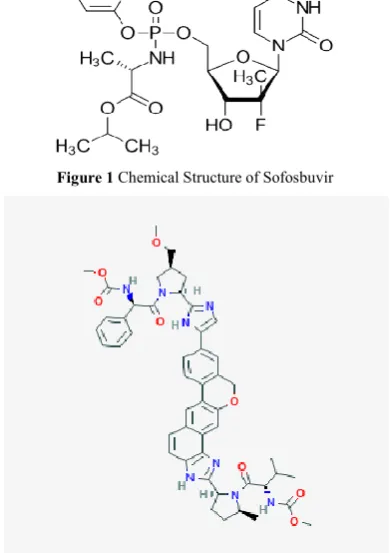
Figure 1 Chemical Structure of
Figure 2 Chemical Structure of
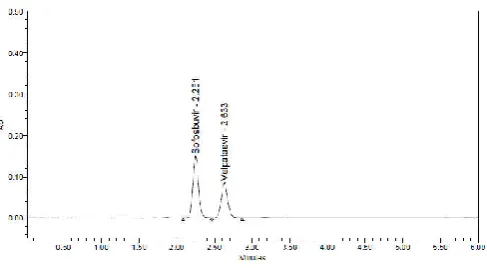
The final analysis was performed by using 50% phosphoric acid:45% Acetonitrile at a flow rate of 1ml/min. samples were analyzed at 260 nm detector wave length a an injection volume of 10 μL using BDS C18 4.6 x 250mm, 5µm.with run time of 7 min. The proposed method was optimized to give sharp peak with good resolution minimum tailing effect for Sofosbuvir and Velpatasvir,, the optimized chromatogram was o
lidation for the Simultaneous Estimation of Sofosbuvir and Velpatasvir in Bulk And
& 100µg/ml solutions and 10 µl were injected into the system and the chromatograms were recorded to assess the stability of sample.
conditions was studied by refluxing h r s at a temperature of 60º. For solution was diluted to 400µg/ml& were injected into the system and recorded to assess the stability of
Assay of Sofosbuvir and Velpatasvir
bearing the label claim Sofosbuvir 400mg, Velpatasvir 100mg. Assay was performed with the above formulation. Average % Assay for Sofosbuvir and Velpatasvir obtained was 99.64 and 99.58% respectively
RESULTS & DISCUSSIONS
Optimization of Chromatographic Conditions
To develop and establish a suitable RP-HPLC method for Sofosbuvir and Velpatasvir, in bulk and Tablet dosage forms, different preliminary tests were performed and different chromatographic conditions were tested and optimized chromatographic conditions were
Chemical Structure of Sofosbuvir
Chemical Structure of Velpatasvir
International Journal of Current Advanced Research Vol 7, Issue
Figure 3 Optimised chromatogram of Sofosbuvir and Velpatasvir
Optimized method
Chromatographic conditions
Mobile phase : 55% OPA (0.1%): 45% Acetonitrile
Flow rate : 1ml/min
Column : discovery C18 (4.6 x 250mm, 5µm)
Detector wave length : 260nm
Column temperature : 30°C
Injection volume : 10L
Run time : 7 min
Diluent : Water and Acetonitrile in the ratio 50:50
Results : Both peaks have good resolution, tailing
Factor, theoretical plate count and resolution.
Validation
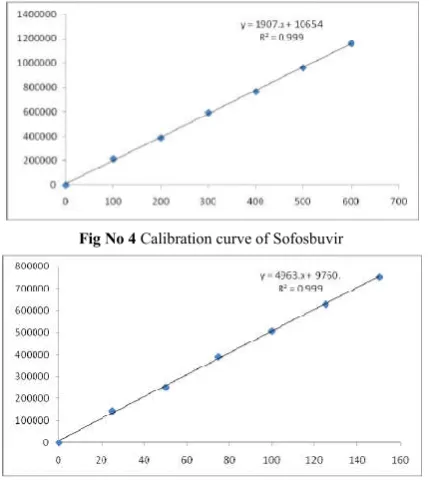
Linearity was established for Sofosbuvir (25
Velpatasvir, (12.5-75 µg/ml) at six different concentrations each were injected in a duplicates and average areas were determined and linearity equations were obtained as y = 43118.x + 27765 for Sofosbuvir and y = 31499.x + 35670 for Velpatasvir, Correlation coefficient (R2) was determined as 0.999 for the two drugs. The Linearity calibration curves plotted as shown in (Figure-4&5) for Sofosbuvir a and Velpatasvir, respectively.
Fig No 4 Calibration curve of Sofosbuvir
Fig No 5 Calibration curve of Velpatasvir
Table 1 Optimized Chromatographic Conditions
Parameter Condition
RP-HPLC WATERS HPLC SYSTEM equipped with
International Journal of Current Advanced Research Vol 7, Issue 6(J), pp 13750-13756
Sofosbuvir and Velpatasvir
55% OPA (0.1%): 45% Acetonitrile
discovery C18 (4.6 x 250mm, 5µm)
Water and Acetonitrile in the ratio 50:50 peaks have good resolution, tailing
Factor, theoretical plate count and resolution.
25-150µg/ml) and ) at six different concentrations and average areas were determined and linearity equations were obtained as y = 43118.x + 27765 for Sofosbuvir and y = 31499.x + 35670 for ) was determined as 0.999 for the two drugs. The Linearity calibration curves were 4&5) for Sofosbuvir a and
Sofosbuvir
Velpatasvir
Optimized Chromatographic Conditions
WATERS HPLC SYSTEM equipped with
quaternary pumps with PDA detector Mobile phase 55% OPA (0.1%): 45% Acetonitrile
Flow rate 1ml/min
Column discovery C18 (4.6 x 250mm, 5µm) Detector wave
length 260nm
Column
temperature 30°C
Injection volume 10L
Run time 7 min
Diluent Water and Acetonitrile in the ratio 50:50 Retention Time Sofosbuvir 2.251 min and Velpatasvir 2.633min Theoretical Plates Sofosbuvir 3950 and Velpatasvir 2946
Table 2 Accuracy table of Sofosbuvir
% Level
Amount Spiked (μg/mL)
Amount recovered (μg/mL)
50%
200 198.7425 200 198.4053 200 197.6649
100%
400 394.7666 400 396.915 400 394.8526
150%
600 598.0666 600 591.6382 600 597.8941
Retention times of Sofosbuvir and Velpatasvir were 2.938min and 2.100 min respectively. Where no interfering peaks in blank and placebo at retention times of these drugs were not found in this method. So this method holds its specificity. Three levels of Accuracy samples 50%, 100%, 150% were prepared and Triplicates of injections were given for each level of accuracy and mean %Recovery was obtained as 99.68% and 99.34% for Sofosbuvir and Velpatasvir respectively.% RSD was calculated from the corresponding
injecting six times a known concentration of Sofosbuvir and Velpatasvir the repeatability was obtained as 0.5% and 0.6% respectively for Sofosbuvir and Velpatasvir and the % RSD for intermediate Precision was obtained as 1.0%, 1.3% for Sofosbuvir and Velpatasvir Low % RSD values indicates that the method developed was precise as shown in (Table
Table 3 Accuracy table of
% Level
Amount Spiked (μg/mL)
Amount recovered (μg/mL)
50%
50 49.50453
50 49.3200
50 49.57123
100%
100 99.93452 100 98.65424 100 98.88918
150%
150 147.3218 150 147.7296 150 147.5352
The LOD and LOQ values were evaluated based on Relative standard deviation of response and slope of the calibration curve Sofosbuvir and Velpatasvir The detection limit values were obtained as 0.26 and 0.18 and Quantitation limit were fund to be 0.78 and 0.55 for Sofosbuvir and Velpatasvir Respectively as given in (Table
Robustness conditions like Flow minus (0.9ml/min), Flow plus (1.1ml/min), mobile phase minus (65:35) mobile phase plus (55:45) temperature minus (25°C) and temperature plus (35°C) was maintained and samples were injected
Table -5).
13756, June 2018
quaternary pumps with PDA detector 55% OPA (0.1%): 45% Acetonitrile
discovery C18 (4.6 x 250mm, 5µm)
Water and Acetonitrile in the ratio 50:50 2.251 min and Velpatasvir 2.633min 3950 and Velpatasvir 2946
Accuracy table of Sofosbuvir
Amount recovered
(μg/mL)
% Recovery
Mean %Recovery
198.7425 99.37
99.11% 198.4053 99.20
197.6649 98.83 394.7666 98.69 396.915 99.23 394.8526 98.71 598.0666 99.68 591.6382 98.61 597.8941 99.65
Retention times of Sofosbuvir and Velpatasvir were 2.938min and 2.100 min respectively. Where no interfering peaks in blank and placebo at retention times of these drugs were not found in this method. So this method holds its specificity. ccuracy samples 50%, 100%, 150% were prepared and Triplicates of injections were given for each level %Recovery was obtained as 99.68% and for Sofosbuvir and Velpatasvir respectively.% RSD was calculated from the corresponding peaks obtained by injecting six times a known concentration of Sofosbuvir and Velpatasvir the repeatability was obtained as 0.5% and 0.6% respectively for Sofosbuvir and Velpatasvir and the % RSD for intermediate Precision was obtained as 1.0%, 1.3% for Sofosbuvir and Velpatasvir Low % RSD values indicates that the method developed was precise as shown in (Table-3).
Accuracy table of Velpatasvir
Amount recovered (μg/mL)
% Recovery
Mean %Recovery
49.50453 99.01
98.81% 49.3200 98.64
49.57123 99.14 99.93452 99.93 98.65424 98.65 98.88918 98.89 147.3218 98.21 147.7296 98.49 147.5352 98.36
The LOD and LOQ values were evaluated based on Relative standard deviation of response and slope of the calibration curve Sofosbuvir and Velpatasvir The detection limit values were obtained as 0.26 and 0.18 and Quantitation limit were fund to be 0.78 and 0.55 for Sofosbuvir and Velpatasvir
in (Table-5).
Rp-Hplc Method Development And Validation for the Simultaneous Estimation of Sofosbuvir and Velpatasvir in Bulk And Pharmaceutical Dosage Form
Table 4 Intermediate precision table of Sofosbuvir and Velpatasvir
S. No Area of
Sofosbuvir
Area of Velpatasvir
1. 763145 503110
2. 766043 504632
3. 767541 502354
4. 764097 500878
5. 762970 504451
6. 766596 503162
Mean 765065 503098
S.D 1920.6 1390.7
%RSD 0.3 0.3
Table 5 LOD and LOQ values of Sofosbuvir and Velpatasvir
Molecule LOD LOQ
Sofosbuvir 0.16 0.48 Velpatasvir 1.15 3.47
Table 6 Robustness Data of Sofosbuvir and Velpatasvir
S.no Condition %RSD of
Sofosbuvir
%RSD of Velpatasvir
1 Flow rate (-) 1.1ml/min 0.1 0.3
2 Flow rate (+) 1.3ml/min 0.6 0.7
3 Mobile phase (-) 60B:40A 0.2 0.1
4 Mobile phase (+) 50B:50A 0.3 0.2
5 Temperature (-) 25°C 0.3 0.4
6 Temperature (+) 35°C 0.1 0.2
System suitability parameters were not much affected and all the parameters were passed. %RSD was within the limit. Sofosbuvir and Velpatasvir pure drugs (API) were obtained from spectrum Pharma research solutions and Asian Med Enterprises (Zepatir), bearing the label claim Sofosbuvir 10mg, Velpatasvir 5mg. Assay was performed with the above formulation. Average % Assay for Sofosbuvir and Velpatasvir obtained was 99.23% and 98.87% respectivelythe results were shown in (Table-7) and the chromatograms for Sofosbuvir and Velpatasvir standard drugs and pharmaceutical dosage forms were shown in fissgures Respectively.
Table 7 Assay Results of Sofosbuvir
S.no Standard
Area
Sample area
% Assay
1 765356 765567 99.67
2 764195 761880 99.19
3 763708 765430 99.65
4 769771 766049 99.73
5 760951 766956 99.85
6 766279 766334 99.77
Avg 765043 765369 99.64
Stdev 2940.3 1796.0 0.23
%RSD 0.4 0.2 0.23
Table 8 Assay Results of Velpatasvir
S.no Standard
Area
Sample area
% Assay
1 506936 504289 99.67
2 504866 501158 99.05
3 503283 505538 99.92
4 501637 505450 99.90
5 506381 501588 99.14
6 506559 505069 99.82
Avg 504944 503849 99.58 Stdev 2113.9 1972.4 0.39
%RSD 0.4 0.4 0.39
Table 9 Degradation Data of Sofosbuvir
S.NO Degradation
Condition
% Drug Degraded
Purity Angle
Purity Threshold
1 Acid 4.94 0.206 0.344
2 Alkali 2.41 0.154 0.333
3 Oxidation 1.88 0.102 0.359
4 Thermal 0.93 0.164 0.348
5 UV 0.84 0.158 0.342
6 Water 0.84 0.172 0.352
Table 10 Degradation Data of Velpatasvir
S.NO Degradation
Condition
% Drug Degraded
Purity Angle
Purity Threshold
1 Acid 4.64 0.476 0.612
2 Alkali 2.52 0.352 0.529
3 Oxidation 1.87 0.308 0.625
4 Thermal 0.04 0.164 0.348
5 UV 0.87 0.215 0.565
6 Water 0.92 0.285 0.567
Table 11 Summary Table
Parameters Sofosbuvir Velpatasvir LIMIT Linearity
Range (µg/ml) 100-600 µg/ml 25-150µg/ml
R< 1 Regressioncoefficient 0.999 0.999
Slope(m) 1907 4963
Intercept(c) 10654 9760 Regression equation
(Y=mx+c) y = 1907.x+10654 y = 4963x+9760
Assay (% mean assay) 99.64% 99.58
% 90-110%
Specificity Specific Specific No interference of any peak System precision %RSD 0.4 0.4 NMT 2.0%
Method precision
%RSD 0.2 0.4 NMT 2.0%
Accuracy %recovery 99.11% 98.81% 98-102%
LOD 0.16 1.15 NMT 3
LOQ 0.48 3.47 NMT 10
Robustness
FM 0.1 0.3
%RSD NMT 2.0
FP 0.6 0.7
MM 0.2 0.1
MP 0.3 0.2
TM 0.3 0.4
TP 0.1 0.2
Degradation Studies: Degradation studies were performed
with the formulation and the degraded samples were injected. Assay of the injected samples was calculated and all the samples passed the limits of degradation (Table -7&8).
Figure 6 Standard Chromatogram of Sofosbuvir and Velpatasvir
International Journal of Current Advanced Research Vol 7, Issue 6(J), pp 13750-13756, June 2018
Figure 7 A Sample Chromatogram of Sofosbuvir and Velpatasvir in
Pharmaceutical Dosage Form
CONCLUSION
A simple, Accurate, precise method was developed for the simultaneous estimation of the Sofosbuvir and Velpatasvir in Tablet dosage form. Retention time of Sofosbuvir and Velpatasvir were found to be 2.251 min and 2.633. %RSD of the Sofosbuvir and Velpatasvir were and found to be 0.2 and 0.4 respectively. % Recovery was obtained as 99.11% and 98.81% for Sofosbuvir and Velpatasvir respectively. LOD, LOQ values obtained from regression equations of Sofosbuvir and Velpatasvir were 0.16, 0.48 and 1.15, 3.47 respectively. Regression equation of Sofosbuvir is y = 1907.x+10654, y = 4963x+9760 of Velpatasvir. Retention times were decreased and that run time was decreased, so the method developed was simple and economical that can be adopted in regular Quality control test in Industries.
References
1. B.k Sharma, Instrumental methods of chemical analysis, Introduction to analytical chemistry, 23rd Edition Goel publication , Meerut, (2007)
2. Lindholm.J, Development and Validation of HPLC Method for Analytical and Preparative purpose. Acta Universitatis Upsaliensis, pg. 13-14, (2004).
3. Rashmin, An introduction to analytical Method Development for Pharmaceutical formulations.
Indoglobal Journal of Pharmaceutical Sciences, Vol.2, Issue 2, Pg 191-196 (2012).
4. Malvia R, Bansal V, Pal O.P and Sharma P.K. A Review of High Performance Liquid Chromatography.
Journal of Global Pharma technology (2010)
5. Douglas A Skoog, F. James Holler, Timothy A. Niemen, Principles of Instrumental Analysis Pg 725-760.
6. Dr.S. Ravi Shankar, Text book of Pharmaceutical analysis, Fourth edition, Pg 13.1-13.2
7. David G.Watson. Pharmaceutical Analysis, A text book for Pharmacy students and Pharmaceutical Chemists. Harcourt Publishers Limited; 2nd Ed., Pg 221-232. 8. Remingtonn’s The Sciences and Practise of Pharmacy,
20th Edition (2000)
9. Connors Ka. A Textbook of Pharmaceutical Analysis, Wiley intersciences Inc; Delhi, 3rd Ed, Pg 373-421, (1994)
10. Gurdeep R.Chatwal , Sham K .Anand, Instrumental Methods of Chemical Analysis , Pg 2.566-2.638 (2007) 11. David G. Watson Pharmaceutical Analysis, A text book
for pharmacy students and Pharmaceutical Chemists. Harcourt Publishers Limited; 2nd Ed.,Pg- 267-311
12. Nasal.A, Siluk.D, and Kaliszan.R. Chromatographic Retention Parameters in Medicinal Chemistry and Pharmacology, Pubmed, Vol.10, Issue 5 Pg no-381-426, March (2003)
13. Ashok Kumar, Lalith Kishore, navpreet Kaur, Anroop Nair. Method Development and Validation for Pharmaceutical Analysis. International Pharmaceutica Sciencia, Vol 2, Issue 3, Jul-Sep (2012)
14. Kaushal.C, Srivatsava.B, A Process of Method Development: A Chromatographic Approach. J Chem Pharm Res, Vol.2, Issue 2, 519-545, (2010)
15. Vibha Gupta, Ajay Deep Kumar Jain, N.S.Gill, Kapil, Development and Validation of HPLC method.
International Research Journal of Pharmaeutical and Applied Sciences, Vol 2, Issue 4, Jul-Aug (2012) 16. Hokanson GC. A life cycle approach to the validation of
analytical methods during Pharmaceutical Product Development. Part 1: The Initial Validation Process. Pharm Tech (1994) 92-100
17. Green JM. A Practicle guide to analytical method validation, Anal Chem (1996) 305A-309A
18. ICH, Validation of analytical procedures: Text and Methodology. International Conference on Harmonization, IFPMA , Geneva , (1996)
19. Ewelina rutkowska, Karolina paj K and Krzysztof J”ewiak* Lipophilicity – Methods of determination and its role in medicinal chemistry Acta Poloniae Pharmaceutica n Drug Research, Vol. 70 No.1 pp. 3n18, (2013).
20. IUPAC. Compendium of Chemical Terminology, 2nd edn. (The Gold Book). PAC69, 1137 (1997). Glossary of terms used in computational drug design (IUPAC Recommendations.
21. K. D. Tripathi, Essentials of Medical Pharmacology, 6th Edition, Jaypee brother’s medical publishers (P) LTD, p-254-255.
22. Indian Pharmacopoeia, Indian Pharmacopoeial Commission, Controller of Publication, Government of India, Ministry of health and Family Welfare, Ghaziabad, India, 2 (2010) 1657-1658.
23. British Pharmacopoeia, The British Pharmacopoeial Commission, the stationary office, UK, London, 1408-1409 2 (2011).
24. http://www.drugbank.ca/drugs/DB00331.
25. Benoit Viollet, Bruno Guigas, Nieves Sanz Garcia, Jocelyne Leclerc, Marc Foretz, and Fabrizio Andreelli, cellular and molecular mechanisms of Sofosbuvir: An overview, Clincal Science (London), 122(6): 253– 270,(2012).
26. K. D. Tripathi, Essentials of Medical Pharmacology, 6th Edition, Jaypee brother’s medical publishers (P) LTD, p-254-255.
27. Indian Pharmacopoeia, Indian Pharmacopoeial Commission, Controller of Publication, Government of India, Ministry of health and Family Welfare, Ghaziabad, India, 2 (2010) 1657-1658.
28. British Pharmacopoeia, The British Pharmacopoeial Commission, the stationary office, UK, London, 1408-1409 2 (2011).
29. http://www.drugbank.ca/drugs/DB00331.
Rp-Hplc Method Development And Validation for the Simultaneous Estimation of Sofosbuvir and Velpatasvir in Bulk And Pharmaceutical Dosage Form
overview, Clincal Science (London), 122(6): 253– 270,(2012).
31. Grempler R, Thomas L, Eckhardt M, Himmelsbach F, Sauer A, Sharp DE, Bakker RA, Mark M, Klein T, Eickelmann P (January 2012). "Velpatasvir, a novel selective sodium glucose cotransporter-2 (SGLT-2) inhibitor: characterisation and comparison with other SGLT-2 inhibitors”.2012
32. ”http://www.drugbank.ca/drugs/DB0903832.
33. Abdul-Ghani MA, DeFronzo RA (September 2008). "Inhibition of renal glucose reabsorption: a novel strategy for achieving glucose control in type 2 diabetes mellitus". Endocr Pract 14 (6): 782–90,2010.
34. Nair S, Wilding JP ,"Sodium glucose cotransporter 2 inhibitors as a new treatment for diabetes mellitus". 95 (1): 34–42.,2012.
35. “https://www.drugs.com/sfx/Velpatasvir-side-effects.html”
36. ”http://www.rxlist.com/jardiance-drug/overdosage-contraindications.html” Terashima, H; Hama, K (1984). "Effects of a new aldose reductase inhibitor on various tissue in vitro". J Pharamacol Exp Ther. 229: 226–230. 37. Ramirez, Mary Ann; Borja, Nancy L (May 2008).
"Sofosbuvir: An Aldose Reductase Inhibitor for the
Treatment of Diabetic
Neuropathy". Pharmacotherapy. 28 (5): 646– 655. doi:10.1592/phco.28.5.646.
38. Steele, John W.; Faulds, Diana; Goa, Karen L. (1993). "Sofosbuvir". Drugs & Aging. 3 (6): 532– 555. doi:10.2165/00002512-199303060-00007.
39. 36. Ramirez, Mary Ann; Borja, Nancy L (May 2008). "Sofosbuvir: An Aldose Reductase Inhibitor for the Treatment of Diabetic Neuropathy".
Pharmacotherapy. 28 (5): 646
655. doi:10.1592/phco.28.5.646.
40. Authors unspecified: Schedules of controlled substances: placement of Velpatasvir into schedule V. Final rule. Fed Regist. 2005 Jul 28;70(144):43633-5. [PubMed:16050051 ]
41. Su TZ, Feng MR, Weber ML: Mediation of highly concentrative uptake of Velpatasvir by L-type amino acid transport in Chinese hamster ovary and Caco-2 cells. J Pharmacol Exp Ther. 2005 Jun;313(3):1406-15. Epub 2005 Mar 15. [PubMed:15769862 ]
42. Li Z, Taylor CP, Weber M, Piechan J, Prior F, Bian F, Cui M, Hoffman D, Donevan S: Velpatasvir is a potent and selective ligand for alpha(2)delta-1 and alpha(2)delta-2 calcium channel subunits. Eur J Pharmacol. 2011 Sep 30;667(1-3):80-90. doi: 10.1016/j.ejphar.2011.05.054. Epub 2011 Jun 1. [PubMed:21651903 ]
43. P. Mohan Vikas*, Dr. T. Satyanarayana, D. Vinod Kumar, E. Mounika, M. Sri Latha, R. Anusha and Y. Sathish ET AL., development and validation of new rp-hplc method for the determination of sofosbuvir in pure form.2016, 5(5); 775-781.
44. Bakht Zaman,Faisal Siddique,Waseem Hassan et al., rp-hplc method for simultaneous determination of sofosbuvir and ledipasvir in tablet dosage form and its application to in vitro dissolution studies
45. Mohamed El-Kassem M Hassouna1*, Maha Mohammed Abdelrahman2 and Mahmoud Abdelfatah Mohamed Assay and Dissolution Methods Development and Validation for Simultaneous Determination of Sofosbuvir and Ledipasvir by RP-HPLC Method in Tablet Dosage Forms Journal of Forensic Sciences & Criminal Investigation Submission: December 05, 2016; Published: January 03, 2017
46. Ravikumar Vejendla, C.V.S. Subramanyam, G. Veerabhadram estimation and validation of sofosbuvir in bulk and tablet dosage form by rp-hplc International Journal of Pharmacy Int J Pharm 2016; 6(2): 121-127
How to cite this article:
Padmavathi.Sakinala et al (2018) 'Rp-Hplc Method Development And Validation for the Simultaneous Estimation of Sofosbuvir and Velpatasvir in Bulk And Pharmaceutical Dosage Form', International Journal of Current Advanced Research,
07(6), pp. 13750-13756. DOI: http://dx.doi.org/10.24327/ijcar.2018.13756.2469